Netflix Update No. 46: “Walk Don’t Run”
February 18, 2011

Jim Hutton, Cary Grant, and Samantha Eggar in a scene from "Walk Don't Run"
We watched the 1969 film “Walk Don’t Run,” which was notable for being Cary Grant’s last movie. He retired, so the story goes, because he realized that he could no longer pull off the leading man image and didn’t think his fans would accept him in supporting roles. So he was “retired” for 20 years, as far as the movies were concerned.

CARY GRANT
In “Walk Don’t Run,” Grant plays a prominent British businessman, Sir William Rutland, who visits Tokyo during the 1964 Olympic Games, arrives two days ahead of schedule and can’t find a hotel room. He spots a notice posted by someone wanting to share an apartment and goes to the address. The “someone” is Christine Easton (Samantha Eggar), a nervous young lady who is engaged to a supercilious employee of the British Embassy. She isn’t interested in sharing her apartment with a strange man, but Rutland ignores her protests, confuses her with the kind of fast talk that Grant was so good at, and moves in. Christine tries to make the arrangement as hard as possible on Rutland by imposing an impossibly tight schedule for use of the bathroom, but Rutland – though totally unable to keep up with the timetable – isn’t that easily dissuaded.

JIM HUTTON
During a business call in Tokyo, Rutland meets brash American Steve Davis, who is a member of an American Olympic team — though he won’t say which one — and who also is without a place to stay until the Olympic quarters open. Davis is played by the ill-starred Jim Hutton. Rutland and Davis are at odds at first, but Rutland ends up subletting half of his room to Davis — without asking Christine, of course. She objects when she finds out, but she is no match for the two of them. Rutland, who is happily married and old enough to be Christine’s father, doesn’t like Christine’s fiancée and thinks Davis would be a better match for her. Therein lies the story, although there’s a subplot in which Davis is accused of being a spy.
This is a good-natured film, and the three principal actors do it justice. Grant was about 62 when he made this movie, and he hadn’t lost any of his appeal or energy.

SAMANTHA EGGAR
The movie was shot on location in Japan, and that adds to its interest. Tokyo is a busy place, and the outdoor shots were done in the middle of the daily bustle.
This movie is based on a highly-regarded 1943 film, “The More the Merrier,” which I haven’t yet seen. That stars Charles Colburn, Joel Macrae, and Jean Arthur. It tells the same general story, but it takes place in Washington, D.C., and makes fun of the housing shortage there during World War II. Colburn plays the businessman, and he was widely praised for his performance. He and Grant were very different personalities, but I can picture Colburn playing the role.
Netflix Update No. 45: “Last Chance Harvey”
February 16, 2011


DUSTIN HOFFMAN
We watched the 2008 film “Last Chance Harvey” which stars Dustin Hoffman and Emma Thompson. Apparently this film attracted some attention when it was released, but I must have been out of town, because I don’t remember hearing about it. Hoffman and Thompson both got Golden Globe “best” nominations, so somebody was paying attention.
This movie got mixed reviews, but I’ll cast my lot with the yea-sayers.
Hoffman plays Harvey Shine, a song writer and musician who wanted to be a jazz pianist but settled for writing commercial jingles. Now that that industry depends far more on digital sound than on the black-and-whites, he’s having a hard time keeping up, so much so that his job is in jeopardy — hence the title of the film.

LIANE BALABAN
Meanwhile, Harvey is due to fly to London to attend the wedding of his daughter, Susan (Liane Balaban), who is tighter with her mom and stepfather than with Harvey, her dad. In fact, Harvey feels very much in the way at the dinner on the eve of the ceremony.
Meanwhile, the film follows the life of Londoner Kate Walker (Thompson), a lonely woman who works as a survey taker at Heathrow Airport. Despite a friend’s clumsy attempts to find her a match, Kate seems almost willingly trapped in a drab existence punctuated by constant phone calls from her aged and equally lonely mother.

EMMA THOMPSON
OK, it’s obvious early on that Kate and Harvey are going to cross paths, but these characters are so well drawn by the actors, and their situations are so familiar, that it’s hard not to get interested in them. I read that Hoffman and Thompson had had a positive experience working together in a previous film and that Hoffman agreed to this role on the condition that he and Thompson ad lib some of their dialog. The relationship between them seems natural, so that strategy paid off.
Some viewers might be distracted by the age difference between Hoffman and Thompson — which is emphasized in a certain way by the difference in their heights — but there is no suggestion that their interest in each other is primarily sexual, or sexual at all, and the things that do attract them to each other make perfect sense. I, for one, am not cynical enough to dismiss the way Harvey’s personality is rejuvenated under the influence of a timid, self-conscious, but witty and intelligent woman. If one starts with the premise that Joel Hopkins’ script starts with — that both of their lives were at a dead end — the idea that they could form a relationship is both plausible and redemptive.

Hoffman and Thompson
“Luckiest man on the face of the earth”
February 8, 2011

LOU GEHRIG
There’s a hilarious string of comments on the MSNBC web site stemming from a story about Lou Gehrig’s medical records. It’s entertaining to read these strings, because the readers who engage in them get upset and abusive – in this case, two of them sunk to assailing each other’s grammar – and then they get off on tangents and eventually go spinning off into space.
In this case, the brief story that started the row was about Phyllis Kahn, a member of the Minnesota State Legislature, who has introduced a bill that would open medical records after a person has been dead for 50 years, unless a will or a legal action by a descendant precludes it.
Kahn was inspired by a story that broke several months ago about a scientific study that speculated that the root cause of Gehrig’s death was concussions he suffered while playing baseball. Gehrig’s ailment, of course, was diagnosed as Amyotrophic Lateral Sclerosis, which affects the nerve cells in the brain and spinal cord.

LOU GEHRIG
A study published last summer in the Journal of Neuropathology & Experimental Neurology made a connection between brain trauma and a form of ALS. Gehrig played first base, a position not usually associated with concussions, but he was hit in the head by pitches during his career, and he might have suffered head traumas in when he was the runner in a close play. He famously played for 14 years without missing a game, which means he played hurt many many times. In fact, although he is lionized for setting a record for consecutive games that stood until Cal Ripken Jr. surpassed it, Gehrig was criticized in some quarters in his own time by folks who regarded his streak as a foolish stunt and worried that he would damage his health.
Researchers want to look at Gehrig’s medical records, which are housed at the Mayo Clinic, and Kahn thinks they should be allowed to do so – and that, in the absence of instructions to the contrary, the records of any person dead for 50 years should be accessible. Gehrig has no descendants

PHYLLIS KAHN
As a Lou Gehrig fan, my emotions are screaming, “Leave the big guy alone!” As a former journalist, my interest in free flow of information is muttering that such records should become available at some point — though I don’t know what that point should be. Considering the level of concern about concussion injuries in football, research in this area could be valuable, and Gehrig might have provided an almost unparalleled opportunity to examine the impact of repeated injuries. His doctors might even have considered a link between his grueling career and the illness that killed him. The Mayo Clinic and a bioethics professor at the University of Minnesota are opposing this bill, probably concerned more about the opening of a flood gate than about Gehrig’s privacy in particular.
Incidentally, Phyllis Kahn, a Democrat-Farm-Labor legislator, once pleaded guilty to a misdemeanor for stealing campaign brochures distributed on behalf of a Republican candidate and replacing them with material for one of Kahn’s DFL compatriots. But that’s a story for another post.
Books: “The Mind’s Eye”
February 7, 2011

OLIVER SACKS
At a party we attended in Manhattan about a dozen years ago, I spied a man who had backed himself into a large potted plant — something like a rubber tree — as though he didn’t want to be seen. After staring at him for a minute or so because he seemed familiar, I said to Pat, “My God, that’s Oliver Sacks.” Ignoring what seemed to be a clear signal that he was going for invisibility, we approached him, and had a pleasant little conversation.
It struck me at the time that he seemed as shy as Robin Williams had made him appear in the movie “Awakenings.” We noticed that the first time we saw the movie, because the character was, in that respect, so different from the outlandish figures Williams most often plays. I didn’t know at the time that the movie had been preceded by a documentary — also “Awakenings” — that Dr. Sacks himself narrated.

ROBIN WILLIAMS
Some time after we saw the Robin Williams movie, I stumbled on the documentary on television, and I was struck by how much Williams had approximated Sacks’ personality, including the apparent shyness.
Now, in Dr. Sacks’ most recent book, “The Mind’s Eye,” I read at least one explanation for his reticence. Sacks writes in that book that he suffers — if that’s the right word — from prosopagnosia, which means he cannot distinguish one human face from another. In fact, he can’t recognize his own face in a mirror. One of his brothers has the same condition, which can be genetic, but can also be acquired through a trauma such as stroke. In an expansive discussion of the condition, Dr. Sacks writes, for example, that he visited his psychiatrist, left the office, and bumped into the psychiatrist again in the lobby, minutes later, and didn’t recognize him. Sacks wrote that this condition can contribute to shyness. Voila.

SUSAN BARRY
Like many of Dr. Sacks’ previous books, this one contains a series of case studies with a lot of historical context. And although the subject matter is human disabilities, the book is in many instances uplifting, because Dr. Sacks also writes about how men and women, because of their own persistence and because of the brain’s ability to compensate for traumatic events, have managed to live fruitful lives despite the loss of some basic function — such as the ability to read or to identify common objects or to navigate even familiar spaces.
One of the cases concerns Susan Barry, who was born with crossed eyes that were surgically corrected when she was a young girl. The surgery straightened the eyes from a cosmetic point of view, but Barry was still left with monocular vision, because the brain uses crossed eyes individually, switching back and forth between them.

OLIVER SACKS
Barry, who teaches neurobiology, was in college before she realized she didn’t see things in stereo, as it were. And she was in her forties before other vision problems put her in contact with an optometrist who helped her, through therapy and continuing eye exercises, to do what had previously been thought impossible, achieving stereoscopic vision without further surgical intervention, after living nearly fifty years without it. She has described her experience in her own book, “Fixing My Gaze.” Dr. Sacks himself, who has been fascinated with stereoscopy since he was a child, reports in “The Mind’s Eye” that he himself is coping with monocular vision after recently losing the sight of his right eye due to cancer.
There are several equally remarkable stories in Dr. Sacks’ book, including a pianist who lost her ability to read music or text, a novelist (Howard Engel) who lost his ability to read, and an artists’ agent who lost her ability to speak. In each case, the “patient” – with the help of a flexible brain – learned to live with or in spite of these conditions.
The study of the brain is, in a way, only beginning, thanks to imaging technology that for the first time allows researchers to unobtrusively observe brain activity in living human beings. Sacks’ book hints at where that study may take us, and the prospects are exciting.
An NPR report on Susan Barry’s experience is at THIS LINK.
Egypt and Israel: An odd couple at risk?
February 3, 2011

Anwar el-Sadat, Jimmy Carter, and Menachem Begin at the signing of the Camp David Peace Treaty in 1979.
When I list the countries I have visited, I don’t include Egypt. In a certain sense, though, I have been to what is now Egypt, and under unique circumstances. My visit, which was unplanned, occurred while I was on a tour of Israel with a group of American journalists. The trip was planned well in advance, so it was a coincidence that I was in Tel Aviv on March 26, 1979, the day the Camp David peace treaty was concluded between Israel and Egypt.

ANWAR el-SADAT
The itinerary for our trip included a stop at Yamit, a town the Israelis had built in the Sinai Peninsula, which had been seized from Egypt during the Six-Day War in 1967. One of the provisions of the treaty was that Israel would return the Sinai to Egypt, and Egypt would leave it demilitarized. Another result of that treaty – seemly lost in the clamor surrounding the popular uprising in Egypt – was U.S. political and military support for Egypt. On the day we were supposed to go to Yamit, our guides told us the trip was cancelled because the residents of the town – who objected to the treaty, and especially to the withdrawal of settlers from the Sinai – had blockaded the highway. We were surprised that we had to explain this, but we told the guides that if the settlers were blockading the highway, that was where we wanted to be.
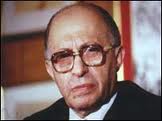
MENACHEM BEGIN
So the bus took us as far as we could go, and we got out and talked to the angry settlers, who had piled furniture and tires and other obstructions across the highway. We talked to the settlers about their determination to stay in Yamit; when we returned to the bus, the driver told us he knew how to get to the town without using that highway. That turned out to be true, although the bus got stuck in the desert sand at one point, and we all had to get out and push. Yamit was virtually deserted, and it was an odd experience to walk through that town with virtually no human life in sight. We did encounter one elderly, gregarious man who identified himself as the “unofficial mayor” and explained the layout of the town and his own disappointment about Israel’s decision. Yamit was still in Israeli hands on that day. It was evacuated in April 1982, and some of the settlers had to be routed from their homes and carried away by the Israeli Defense Forces. The town, which was a beautiful little settlement of about 2,500 people, was demolished before the peninsula was ceded to Egypt.

JIMMY CARTER
The Camp David Treaty was brokered by President Jimmy Carter and signed by Egyptian President Anwar al-Sadat and Israeli Prime Minister Menachem Begin. Sadat and Begin both were excoriated in some quarters, and the treaty certainly was a factor in the murder of Sadat in 1981. Egypt was also suspended from the Arab League for a while.
Whatever else one may think of the treaty, it has prevented hostilities between Israel and Egypt for more than 30 years, during most of which Hosni Mubarek has been president of Egypt. The future of that treaty – and the likelihood of renewed belligerence between the two countries – is one of the many things at stake in the uprising against Mubarek’s regime.

- Anwar el-Sadat with Ronald Reagan in 1981

When the treaty was signed in Washington, D.C., the ritual was televised live on an oversized screen in a public square in Tel Aviv. There were lights and music and dancing, but the joy seemed largely orchestrated. When my colleagues and I wandered just a few blocks from that square, the city was quiet. A couple of us stopped in a bar operated by a Yemeni woman named Chanita Madmoni. We sat next to two old Israelis – one Greek, the other Rumanian. We told them they didn’t seem excited about the “shalom.” They’d rather have peace than war, they said, but they weren’t convinced it would last. Judging by their ages, I’d venture that it lasted longer than they did.
“Please listen to our new options”
February 1, 2011
 My niece visited our house the other day and, as she was leaving, she paused to jot down our land line phone number, which she had lost. I told her the number and added, “Anyway, we’re in the book.” But I immediately recalled that Verizon and AT&T, among others, have been moving toward discontinuing phone books. Although phone books are a nuisance to have around the house, and although I can’t remember the last time I used a phone book instead of the Internet to look up a number, I’ll be sorry to see them go. I’m an avid phone book reader when I’m away from home. I study such things as how many people are listed with my surname and how many with my wife’s surname. There are seldom more than one or two – often none. Whenever I find one it’s like spotting cobalt sea glass. I also thumb through to see which name generates the longest list in that locale – Smith? Patel? – and which names catch my attention because they’re familiar or odd.

Icelandic phone book
Reading the phone book in Iceland, incidentally, is an offbeat experience, because most people in Iceland don’t have family names as such. Folks are listed in the phone book by their first names, patronyms, addresses, occupations, and then telephone numbers. The patronym consists of a person’s father’s first name and a suffix that indicates whether it’s a son or daughter. So the Icelandic singer would be listed as Björk Guðmundsdóttir, because she is the daughter (dottir) of Guðmundur Gunnarsson, who is the son of Gunnar. If you look closely at the page to the left, you can see listings for several people who share Björk’s name.

CHARLES LAUGHTON
It was often said of the actor Charles Laughton that he could make an audience weep simply by reading the phone book aloud. That was meant as a compliment to Laughton, but I think I’d be reduced to tears if I had to listen to any actor read the phone book. I, on the other hand, will miss those out-of-town opportunities to read the listings to myself and provide occasional commentary to anyone without the sense to leave the room.
Meanwhile, my first thought after I told my niece that we’re “in the book” was that the expression “in the book” might disappear from our language if the trend to eliminate “the book” continues.
 Although I know it’s an inevitable process – idioms coming and going – I always regret the loss of such expressions. I’m old enough, though, that “in the book” could last as long as I do. After all, the rotary dial started disappearing from telephones in the 1960s and has been virtually non-existent for several decades. And yet, many people still speak of “dialing” a number when, in fact, they’re entering the number with a keypad.
Come to think of it, I’m so old that I’m older than rotary dials.

“We start and end with the family” — Anthony Brandt
January 31, 2011

STEPHANIE ZIMBALIST
Since I was a kid, I have been fascinated by instances in which multiple members of a family have worked in the same or similar fields. For example, the other day I heard an interview on WNYC radio with Louis Rozzo, a fish dealer who was making an argument for taking the trouble to buy fresh anchovies and sardines and other fish that are typically packed in oil and canned. The conversation was interesting enough, but a detail that resonated with me was that Rozzo is the fourth generation owner of F. Rozzo and Sons. I would have liked to hear more about that.
In a similar way, I like reading about people like the Delahanty brothers – five of them played major league baseball – or the Harrisons, who included a signer of the Declaration of Independence, a Virginia legislator and attorney general, two presidents of the United States, and two members of Congress. The five Marx Brothers have always interested me less for their comedy than for their family history, which started with their maternal uncle, Al (Schoenberg) Shean, who was a famous vaudevillian.

STEPHANIE ZIMBALIST
This topic has been on my mind because I had an opportunity recently to talk with actress Stephanie Zimbalist, who is soon to appear in a production of Frank Gilroy’s play “The Subject Was Roses” at the George Street Playhouse in New Brunswick. On her own, Stephanie Zimbalist has built a substantial resume of performances on television and on the stage. However, her family’s background in the performing arts goes back at least as far as her great-grandfather Aron Zimbalist, who was an orchestral conductor in Russia in the 19th century. Her grandparents were both outstanding classical performers whom I have admired since I was very young. Her grandfather was Efrem Zimbalist, a concert violinist whose name can be mentioned in the same sentence with Jascha Heifitz and Fritz Kreisler. Efrem Zimbalist was married to Alma Gluck (nee Reba Feinsohn), who was one of the most popular female vocalists of the early 20th century. My family had 78 rpm recordings by both of these artists — along with others — and, long before I understood their significance, I listened to them over and over again on our wind-up Victrola.
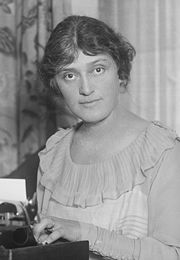
ALMA GLUCK
Alma Gluck, who was born in Romania, was a soprano who was on the roster at the Metropolitan Opera Company. She also had a substantial concert career and was one of the first serious artists to make phonograph records, and that greatly contributed to her fame. She made more than 170 recordings for Victor between 1911 and 1924, choosing songs from a wide variety of genres. She and her husband made at least 32 recordings together, and he had a long list of recordings of his own. Zimbalist was also a composer and the director of the Curtis Institute of Music in Philadelphia.
Efrem Zimbalist and Alma Gluck were the parents of Efrem Zimbalist Jr. – Stephanie’s father – who is a popular film and television actor whose starring roles included the TV series 77 Sunset Strip and The FBI.

Stephanie Zimbalist justifably has a great deal of pride in this heritage. I found that she enjoys talking about Alma Gluck – who died before Stephanie was born – and is well schooled in her grandmother’s career. Stephanie told me — only half joking, I suppose — that she didn’t pursue a singing career because she didn’t want to weather comparisons with her grandmother. Still, Stephanie Zimbalist has a trained voice and has given some performances. Speaking about her grandmother, she told me, “Daddy said she would have loved me, but I don’t know. She was tough task master on him. She wanted him to be a doctor or an engineer, and he wanted to be a dancer or a gymnast.” But the musical gene apparently didn’t skip a generation with the actor, Stephanie said. “He says he knows very little about music, but he knows an awful lot. He studied orchestration at Curtis, and he’s written a lot of things; he’s written many many pieces of music.”

ALMA GLUCK and EFREM ZIMBALIST
Stephanie Zimbalist’s mother, the former Stephanie Spaulding, died in 2007. Stephanie cares for her mom’s pet, an elegant long-hair dachshund named Scampi, who participated in our interview. I asked Stephanie what would be next in her career after her run at George Street, and she said, “Nothing. I don’t have a career. I just have bumps in the road. That’s probably why I’m doing good work these days, if I am doing good work. Nothing’s an agenda. I don’t do anything to see where it will take me. I just do it for the work. On my plate in my life right now is this sweet little thing” — a reference to Scampi, who was on Stephanie’s lap. “And then, my Dad is 92, God bless him, and doing very well, but I spend quite a bit of time with him, just to be there.”

A publicity shot for “77 Sunset Strip”: Roger Smith, left, as private detective Jeff Spencer; Efrem Zimbalist Jr., right, as Spencer’s colleague, “Stu” Miller; and Edd Burns as their protege, Gerald “Kookie” Kookson — the inspiration for the 1959 pop song “Kookie, Kookie, Lend Me Your Comb.”
Netflix Update No. 44: “Caramel”
January 27, 2011

NADINE LABAKI
When we visited Lebanon toward the end of the Clinton administration, the country was still occupied by the Syrian army. The occupation was a nuisance, because we frequently came across checkpoints where the cousin who was driving us around had to explain himself — or ourselves — to these interlopers. To bog things down a little more, the Lebanese army had its own checkpoints. Besides being an obstruction, the presence of the Syrians served as a constant reminder of the tense atmosphere that has too often prevailed in the country.
My maternal grandparents were born in Lebanon, and our principal reason for going there was to visit members of my grandmother’s family. Thanks to my cousin’s generosity with his time, we also saw a good deal of the antiquity and natural beauty Lebanon has to offer. Coming from a country that hadn’t had a war on its soil in well over a century, we couldn’t help being struck by the contrast between the competing armies with their automatic weapons and the Lebanese people going about their everyday lives.

NADINE LABAKI
That came to mind when we watched “Caramel,” a film made in Beirut, co-written and directed by Nadine Labaki, who also plays the central character, Layale. The story is about six women, three of whom work in a beauty salon, which is the axis around which the action revolves. The title, incidentally, refers to a sweet concoction used in the salon for hair removal; it actually figures in the plot in two instances.
The characters in the story are Layale, who is in a self-destructive relationship with a married man; Nisrine (Yasmine al Masri), who is about to be married to a man who doesn’t know of her previous sexual experiences; Rima (Joanna Moukarzel), who is attracted to other women – including Siham (Fateh Safa), a stunning customer at the salon; Jamale (Giselle Aouad), a frequent client at the salon, an aspiring actress who is having trouble coping with age; and Rose (Sihame Haddad), an elderly seamstress who cares for an unbalanced older sister, Lili, (Aziza Semaan), and is conflicted when she gets what apparently is her only chance at romance.
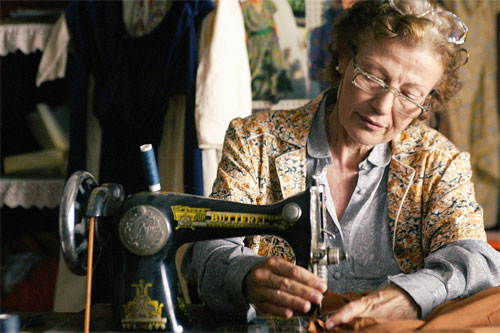
SIHAME HADDAD
Labake — whose eyes, by the way, are hypnotic — tells the stories of these women with a loving, delicate, sometimes even dreamy touch. The blend of drama and comedy is just right. The performances, without exception, are credible and affecting. All of the characters, including the distracted Lili, are endearing and sympathetic.
The choice of settings adds to the quality of this film, because Labake keeps the camera’s eye on the story, and doesn’t go exploring the city for its attractive waterfront or its war-scarred ruins, or its slums. In fact, there are no allusions to the recent history of Beirut; this story is about the interior lives of these women.

YASRINE AL MASRI
An interesting cultural aspect of this story is that Nisrine is the only Muslim in the circle of friends; the other women are Christians. Nisrine’s family is very traditional — and, presumably, so is her fiancée, which is why — with the support and encouragement of her friends, she takes a drastic step to deceive her groom about her virginity.
The dialog in this film is in Arabic, and we watched it with English subtitles. It’s fun to listen to the actual dialog, because — as we noted when we visited there — the Lebanese mix French and English into their Arabic. This movie was well received when it appeared in 2007, and the attention was well deserved.

A policeman questions Lili, who collects paper -- including parking tickets -- in the streets of Beirut.
The Life of Riley: A matter of perspective
January 14, 2011

Sign at a tavern in Portland, Ore.
One of the classes I taught last semester included a section on idiomatic expressions. A topic like that always calls attention to the difference in the ages of the students and the instructor. We came across many expressions that a person my age uses casually but that many or all of the students didn’t recognize. None of them, for instance, knew the expression “hocus pocus,” which refers to the things magicians do and say to create the illusion that they have paranormal resources.
Another example arose when, instead of instructing, I was telling the students about Marcello, the new cat at our house. We had met Marcello on the sidewalk outside a gift shop in North East, Md., and the chance acquaintance evolved into a permanent arrangement. Now, I told my students, Marcello is living “the life of Riley.”

Opening title of the television series "The Life of Riley"
As the words left my lips, I could read in the faces of the students that they didn’t know what that meant. My experience has been that students are a tolerant lot, and that they wouldn’t think of embarrassing the instructor by pointing that he had said something they couldn’t comprehend. They would have been content to go on living without knowing what that expression meant. So I asked them: “Do you know that expression?” They didn’t, and even though none of them asked, even then, what it meant, I told them.
That set me to wondering where that expression originated, but I didn’t have time until now to look it up. Apparently there is no definitive answer. One theory traces the phrase to a song written in 1898 by vaudevillian Pat Rooney Sr. In that song, a hotel owner named Riley looks forward the day when he strikes it rich. The phrase itself is not in the lyric of that song.
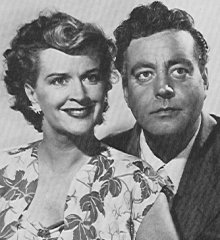
Rosemary DeCamp and Jackie Gleason
The expression does appear in a song called “My Name is Kelly,” which was written by Howard Pease in 1919. “Faith, and my name is Kelly, Michael Kelly / But I’m livin’ the life of Reilly just the same.” The fact that Pease used the phrase that way suggests that it was well known by that time. The author of a British web site, The Phrase Finder, writes that the first known instance of “the life of Riley” appearing in print in the United States occurred in 1911 in the Hartford Courant in a story about the demise of a notorious wild cow, something — I must confess — I have never heard of before: “The famous wild cow of Cromwell is no more. After ‘living the life of Riley’ for over a year, successfully evading the pitchforks and the bullets of the farmers, whose fields she ravaged in all four seasons.”
Of course, I associate the expression with the television comedy series that starred William Bendix as Chester A. Riley; Marjorie Reynolds as his wife, Peg; the gorgeous Lugene Sanders as their daughter, Babs, and Wesley Morgan as their son, Junior.

Lugene Sanders
Although the expression implies that a man is living a life of ease, Chester Riley worked steadily in the wing assembly division of Cunningham Aircraft in Los Angeles. He was the stereotypical bumbling father who was always in some kind of scrape. He didn’t have many happy endings, and his closing line on most episodes became one of the most popular catch phrases of the era: “What a revoltin’ development this is!”
A radio show with the same title that appeared for a few months in 1941 was not related to the later series. Film star William Bendix appeared on radio as Chester Riley from 1945 to 1951. One of the developers of that series was Gummo Marx. Bendix was making a film version of “Riley” when the show moved to television in 1949, so Jackie Gleason was cast as Riley and Rosemary De Camp as Peg. A contributing writer for that series was Groucho Marx, who had once been considered for the title role on radio. The series won an Emmy, but it ended after one short season because of a contract dispute.

Bill Bendix on the cover of a Dell comic based on the series.
The show was introduced on television again in 1953 with Bendix and Marjorie Reynolds leading the cast, and it was a hit, running for six seasons. A 2009 BBC series with the same title is not related in anyway to the American shows.
While I was looking around for information about this show, I came across two modern-day uses of the expression “Life of Riley,” both with more serious and somewhat ironic applications. One is a foundation headquartered in Sarasota, Fla., that raises funds to promote awareness of and seek a cure for pediatric brain tumors. The organization is named for Riley Saba, a 7-year-old girl who died because of such a tumor. You can visit the foundation’s web site by clicking HERE.
Another site, this one located in Great Britain, was inspired by a boy whose first name is Riley. The youngster has a form of cerebral palsy, and a group of his family’s friends formed an organization to raise funds for charities that assist kids with that or similar conditions. Riley came by his first name because his dad was attracted to the song “The Life of Riley” by the Lightning Seeds. The song was written by Ian Broudie whose own son, Riley, now plays guitar with the group. You can learn more about the charity group by clicking HERE.
Netflix Update No. 43: “Love in the Afternoon”
January 10, 2011
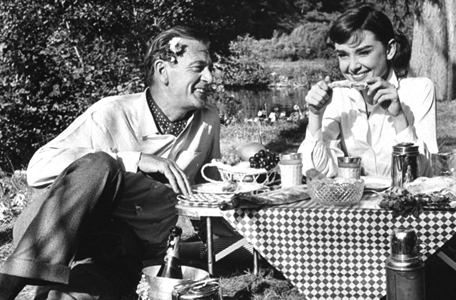
Gary Cooper and Audrey Hepburn in "Love in the Afternoon"
“Love in the Afternoon,” a 1957 movie directed and co-written by Billy Wilder, is entertaining in several ways, but it is also seriously flawed. The principal flaw was in the casting, no matter how good the names Gary Cooper, Audrey Hepburn, and Maurice Chevalier, may sound when listed in the same credits.

Audrey Hepburn
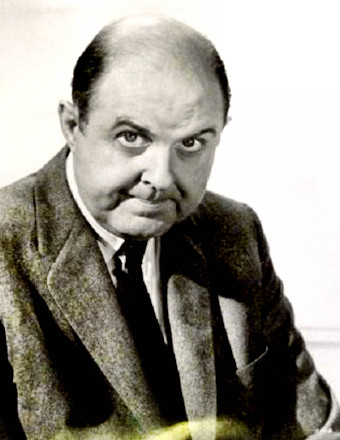
The film, which is said to have been Wilder’s paean to director Ernst Lubitsch, is a subtle, witty, lightly slapstick romantic comedy concerning a Parisian private detective, his cellist daughter, and an international playboy with whom they both become involved. Detective Claude Chavasse (Chevalier) is engaged by Monsieur X, a cuckolded husband played by John McGiver — later the accommodating jewelry salesman in “Breakfast at Tiffany’s” — who wants to know who his wife has been seeing. Chavasse determines that the guilty party is millionaire Frank Flannagan (Cooper) a globe-hopping businessman with at least a girl in every port. Chavasse’s daughter, Ariane (Hepburn), who studies cello at a Paris conservatory, is fascinated by her father’s profession and questions him incessantly about his clients and, in the face of his reticence, snoops in his files. After she overhears Chavasse’s client declare that he will go to the Hotel Ritz and shoot Flannagan, she feels compelled to warn the target — whose photos in the files have beguiled her.
John McGiver
Ariane, after getting no satisfaction from the police, goes to the hotel herself and makes her way into Flannagan’s room just in time to allow the paramour to escape so that the husband discovers Flannagan with Ariane instead. This encounter, of course, is the beginning of a series of meetings between Flannagan and Ariane, but she refuses to give him any information about her identity, and he takes to calling her “thin girl.” As is his habit, Flannagan eventually leaves Paris for other resorts, and it appears that the “affair” — to all appearances a chaste one — is over. But about a year later, he is back in Paris and the two accidentally meet at an opera house and the liaison, such as it is, continues, with Ariane filling Flannagan with fibs about the many men in her life — many of them based on things she has read in her father’s case files. Flannagan doesn’t know whether to believe these stories or not; that, plus the lack of any information about the girl, increasingly agitates him.

Maurice Chevalier and Audrey Hepburn
This being a movie, Flannagan and Monsieur X happen to meet in a Turkish bath and Monsieur X — still clueless about his wife’s dalliance — discerns the broad outlines of what is troubling Flannagan and recommends that he engage Chavasse to find out the truth about the “thin girl.” Flannagan does so, and Chavasse quickly figures out that the girl Flannagan is talking about is Ariane. Since Chavasse, through his investigations, is intimately acquainted with Flannagan’s track record with women — kiss them and run — he reveals the truth to Flannagan and urges the tycoon to leave Ariane in peace. Flannagan sets out to do that, but at the last moment, as his train is already beginning to roll out of the Paris station, he lifts the tearful Ariane on board and the two ride off in each other’s arms.
There are a couple of leaps in logic in this plot. One is that Chavasse had reported that Monsieur X’s wife was having an affair with Flannagan, but Ariane’s intervention made it appear that Chavasse had been wrong. That raises the question of why Monsieur X would recommend Chavasse as an outstanding detective. Another is that at the end of the film, after Chavasse has tried so hard to convince Flannagan to leave Ariane alone, the old man stands on the train platform with a satisfied smile on his face as his daughter rides off with the playboy.

Billy Wilder
Hepburn, Chevalier, and McGiver are delightful in this film. The big flaw — which was pointed out by critics at the time — was that Gary Cooper, who was 55, was much too old to be a credible partner for Hepburn, who was 28. Cary Grant, 53 at the time, had turned down the role because of the age difference. To complicate matters, Cooper — a friend of Wilder’s — was not in good health. He looked older than he was, and he looked drawn and tired, and that was exacerbated by the fact that the film was in black and white.
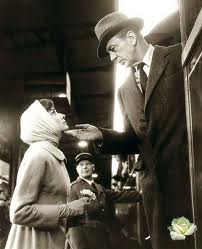
Audrey Hepburn and Gary Cooper in the closing scene.
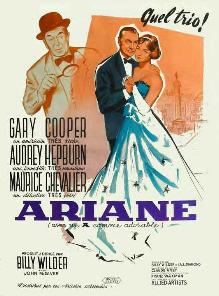
An interesting sidelight is that this film had two endings — one for American theaters and one for European. In the European version, which was released under the title “Ariane,” the audience was left to use its imagination about what took place between Flannagan and Ariane after the train left the station and closing titles started rolling.
In the American version, however, because extramarital sex was at least publicly frowned upon in the mid-1950s, the film closed with a voice-over in which Chevalier explains that Flannagan and Ariane got married and were “serving a life sentence in Manhattan.” The film was a failure in the U.S., but it was a hit in Europe.
 CharlesPaolino's Blog
