Books: “Franklin and Eleanor”
January 7, 2011

Franklin and Eleanor Roosevelt in 1941
“I hate it,” Charlie Brown once said, “when there are two sides to a story.” Actually, Charlie, there are at least two sides to every story, and none more certainly than the story of Franklin and Eleanor Roosevelt, probably the most complicated First Couple in American history. The sorting out of their relationship still goes on 65 years after FDR’s death, most recently in Hazel Rowley’s book “Franklin and Eleanor: An Extraordinary Marriage.”
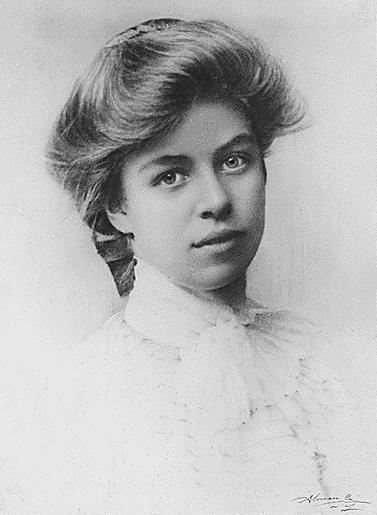
ELEANOR ROOSEVELT in1898
This is not the story of how the insatiable FDR cheated on his wife, leaving the pair in a marriage maintained only for the sake of appearances and finances. It’s a lot more complicated and — in Rowley’s view — a lot more important than that. It is well established by now that in 1918 Eleanor discovered love letters written by her secretary, Lucy Mercer, to FDR, and that the incident had a permanent impact on the marriage. It is also known that FDR promised never to see Lucy Mercer again and that he broke that promise — in fact, that Lucy was among those who were with him in Warm Springs, Ga., in 1945, when he suffered the cerebral stroke that resulted in his death. It is also known that Franklin Roosevelt was an incurable flirt, and that he highly valued his relationships with women who were both charming in their own right and — this was essential — who were charmed by him. Rowley explains that this tendency often irritated Eleanor, but that she came to understand and accept the importance of certain women in her husband’s life.
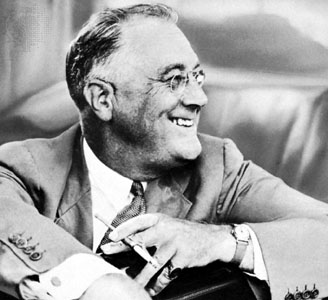
FRANKLIN ROOSEVELT
But the author explains that there was much more to the story than that. Physical intimacy disappeared from the Roosevelts’ marriage, but Rowley writes that Eleanor, who had six children in relatively rapid succession, thought of her sexual relations as a necessary but unwelcome burden. But Eleanor, like most human beings, had needs of her own with respect to affection and intimacy. She fulfilled these needs in more than one way, with both women and men, though how intimate these relationships were is largely a matter of conjecture. Rowley recounts that Franklin encouraged his wife’s friendship with a lesbian couple to the point of helping the three of them build a house and a workshop on property he owned near his mother’s home in Hyde Park, N.Y.
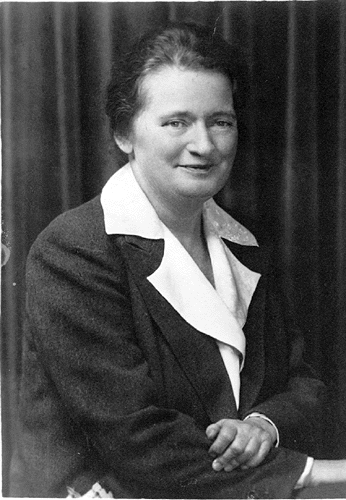
LORENA HICKOK
Eleanor also had an intense tie to Lorena Hickok, a pioneering Associated Press reporter who became so close to the Roosevelts that she herself decided she could no longer report on them objectively. By the time FDR was elected president for the first time, in 1932, Rowley writes, “Everyone in the political press corps knew that Lorena Hickok was a lesbian. By now most of the reporters had figured out that she was passionately in love with Eleanor and that her feelings appeared to be reciprocated.”
Whatever relationships Franklin and Eleanor forged outside their marriage, Rowley maintains, the two of them continued to love and support each other, and they formed a partnership whose vigor helped carry the nation through the Great Depression and the Second World War. At times they seemed to constitute a single person, as Eleanor traveled to places at home and abroad that were beyond her paralyzed husband’s capacity. Although Eleanor’s activism occasionally embarrassed the politically sensitive Franklin, they shared many of the same ideals of social justice.

LOUIS HOWE and FDR
In the process of describing the marriage of these two gigantic historical figures, Rowley draws portraits of many of the interesting characters in the Roosevelt clan and entourage — a crowd that FDR liked to think of as a big, happy family. Not the least of the players was Louis Howe, a disheveled ex-journalist who was one of FDR’s closest advisers for most of his political career, the tireless battery behind the campaigns that made Roosevelt governor of New York and president of the United States. Some of the people around Roosevelt — including his patrician mother, Sara — disapproved of this little man with cigarette ashes on his rumpled clothing, but Eleanor wasn’t one of them, and Rowley describes how it was Howe who repeatedly encouraged Eleanor to make herself heard on the issues that were important to her — a visionary attitude in that male-dominated era.
Netflix Update No. 42: “Sixty Six”
January 2, 2011

PAUL WEILAND
Many months ago, I heard film director Paul Weiland interviewed on National Public Radio, describing what sounded like an interesting film that had been inspired by the catastrophes that befell Weiland’s bar mitzvah. The title of the film was “Sixty Six,” and I immediately put it on my Netflix queue, but it was flagged as unavailable until very recently. It was worth the wait.
The 2006 British film concerns Bernie Rubens (Gregg Sulkin), a nebish of a kid — Weiland’s alter ego — who is a misfit even within his own family. As Bernie sees it, the year 1966 will give him the opportunity to improve his image. He is preparing to become bar mitzvah, and besides believing the rhetoric about becoming a “man,” he envisions a reception that will be so grand as to eclipse the expansive party that was thrown for his abusive older brother Alvie (played by Ben Newton.)

GREGG SULKIN
Bernie’s inability to fit in either at home or out among his peers seems to escape the notice of his pretty mother, Esther (Helena Bonham Carter), and his eccentric father, Manny (Eddie Marsan). Manny co-owns a successful grocery store with his brother Jimmy(Peter Serafinowicz). When a new supermarket opens next to their store, Manny refuses to entertain an offer to buy the Ruben store, and this is indicative of a rigidity that affects everything he does and his personal relationships.
As Bernie continues with his grandiose plans for his bar mitzvah party, the family’s financial fortunes continue to decline until the boy has to swallow the reality that his reception is going to be modest event indeed. As though that weren’t disappointment enough, he is terrified that Britain’s soccer team will qualify for the World Cup Final, which is scheduled to be played in London on the same date.

EDDIE MARSAN
The conventional wisdom is that Britain’s footballers are unlikely to survive the competition long enough to play for the championship, but the conventional wisdom is wrong and Brits everywhere are transfixed as their team faces Germany on the day on which Bernie had imagined himself as the axis on which the whole universe would be turning.
In one British review I read, the critic wrote that this film was reminiscent of Neil Simon at his best. I think that’s an apt comparison. Although there is a great deal of comedy in “Sixty Six,” the truth in the story, which Weiland wrote, is sometimes almost painful to watch — and I find that in some of Simon’s work. And yet, also as in Simon’s best work, the truth includes self discovery and redemption, and not only for Bernie.
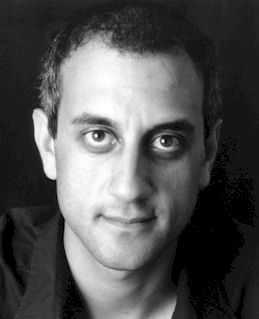
RICHARD KATZ
This movie has a talented ensemble. Marsan’s performance in what for the most part is a very quiet role is at times disturbing as he portrays the humorless Manny’s odd behavior — driving dangerously below the speed limit, checking the car door a half dozen times to make sure it’s locked, hoarding his money in the attic and, most important, closing his mind to the painful period his younger son is living through. Gregg Sulkin is both funny and moving as the heartbroken and increasingly frantic Bernie, and Richard Katz is warm and humorous as the blind rabbi who prepares Bernie and other boys for bar mitzvah.
There were some comments when this film was released that it depended on stereotypes of Jewish people, although opinions seemed to vary as to whether those stereotypes were offensive. We didn’t detect any intent to ridicule or offend Jewish people, but it’s something to be aware of.
Set ‘er up, Joe!
December 31, 2010

Vodka and cranberry
We asked the bartender at a hotel in Warsaw for vodka and cranberry juice, but he claimed never to have heard of such a thing. When we described it to him, he offered to substitute blackberry brandy for the cranberry juice, and that turned out to be satisfactory – enough so, that we ordered it every day we were there.
I think about cocktails at this time of year, because I have associated them with New Year’s Eve since I was a child. It seems to me that images associated with the occasion — in newspaper ads, for instance — invariably have martini glasses along with the confetti and streamers. Before I started going out to New Year’s Eve parties and confronted reality, I thought of them as the epitome of sophistication, and cocktails were intrinsic to the concept. I guess I don’t think of myself as being sophisticated, because the only mixed drinks I like are vodka and cranberry and gin and tonic, and I haven’t had a gin and tonic in about a decade.

Horse's Neck
Coincidentally, I read today that Franklin Roosevelt loved to mix drinks for his friends and visitors. According to the author of the book that will be the subject of a post sometime next week, FDR especially liked to flourish the shaker. His own favorite cocktail was the Horse’s Neck, which in his case meant whiskey and ginger ale. The drink gets its name from the twisted lemon rind submerged in the glass.
When I was a kid, I liked the names of individual drinks my parents and their friends mentioned — Black Russian, Manhattan, Brandy Alexander, Tom and Jerry, Tom Collins. Those names were right out of Esquire, and I’d rather not say how I knew that when I was a kid. One of those names was Presbyterian, and I understood years later when my father-in-law, strictly a social drinker, got hot under the collar at a wedding we attended, because the young bartender didn’t know what a Presbyterian was — namely bourbon, club soda, and ginger ale.

Harvey Wallbanger
That young guy aside, I always thought of the bartender as the archetype of cool. I still occasionally think that I’d like to be a bartender if it was in just the right kind of establishment — high brow, cool, “the ladies who lunch” kind of place. That may be why I wandered into a hotel bar in Manhattan one early afternoon many years ago while I waited for the actress Jane Russell to keep an appointment with me. Dim lights, highly polished dark wood, barkeeps with black vests, and garters on their sleeves. At the time, I had taken a few turns with Harvey Wallbanger while pretending to keep up with some of my harder-drinking friends, so I sat alone at the bar and ordered one. I think I imagined myself in a movie, circa 1948. The bartender allowed as how Mr. W. hadn’t caught on yet in Gotham and, when I had fought my way to the bottom, he asked if the drink had been satisfactory. I had no idea, but the script made me say that it was a bit too heavy on the Galliano. I think I wished at that moment that I was a smoker, because exhaling a long stream before answering would have added so much to that scene. My host was accommodating nevertheless, and he served up another on the grounds that the customer must be satisfied. My appointment was long in coming, and Roberto got the proportions right on the third try. When Jane Russell came down from her room in a cloud of apologies, I wouldn’t have made her feel guilty for the world, and I gallantly agreed when she asked if we could find a place with strong black coffee.

Sheet music cover for "Friend Highball" lyrics and music by William J. McKenna, 1915.
Books: “The Great Fire of Rome”
December 27, 2010

CHRISTOPHER COLUMBUS
When I was a kid, I was led to believe by adults, who I assume meant well, that his contemporaries discouraged Christopher Columbus from undertaking his first voyage to “the Indies” on the grounds that he and his ships would drop off the edge of a flat earth. I didn’t imagine this. I have asked at least a dozen folks of my vintage — which grows increasingly rare, by the way — and they have recalled being told the same thing, even by teachers. I was well into middle age when I learned that the Europeans Columbus was likely to have encountered knew that the Earth was a sphere, and that the argument current at the time had to do with the planet’s size, not its shape. I now know that the idea of a spherical Earth, dates from the sixth century BC, although it wasn’t until much later that there was practical proof of what had been generally accepted as the fact. Columbus was one who helped to demonstrate it. The Admiral of the Ocean Sea, it turns out, wasn’t wrong about the globe; he was simply wrong about its dimensions.

NERO
It wasn’t until more recently — the past few weeks, in fact — that I learned the truth about the Roman emperor Nero, namely that he couldn’t have fiddled while Rome burned, because the violin didn’t appear in Europe until hundreds of years after his death. That came up in a new biography of Nero written by Stephen Dando-Collins, who also casts doubt on the widely accepted ideas that Nero ordered the burning of Rome in 64 AD and that he initiated the Roman persecution of Christians in order to deflect blame for the fire from himself. (The writer points out that there were so few Christians in Rome during Nero’s reign that it’s even likely that the emperor knew nothing about them.)
Nero was 16 years old when he succeeded his uncle Claudius, becoming the fifth Roman emperor and the last who shared a bloodline with Julius Caesar. Among his interests were singing and chariot racing, and he wasn’t content just to be a spectator of either. Dando-Collins explains that Nero repeatedly entered amateur singing contests, which were all the rage at the time, much to the enjoyment of the hoi polloi and much to the dismay of the Roman nobility.
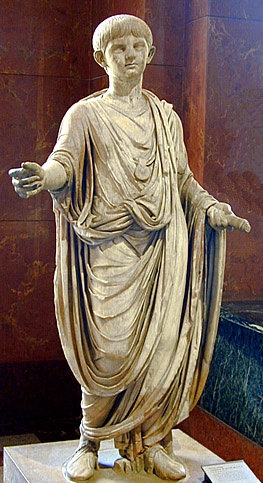
Nero: The boy emperor
Besides sponsoring and reveling in races, he also took the reins at times, once narrowly missing death when he was thrown from the chariot. He first entered a singing competition in Neapolis, what is now Naples. On the occasion of the fire in Rome, he was in his birthplace, Antium — present day Anzio — to participate in another contest. The fire evidently started in the food concessions under the stands of the Circus Maximus, which was the largest wooden structure of any kind and the largest sports arena ever built. The capacity was about 300,000 spectators.
Rumors that Nero was responsible for the fire and that he had ordered his agents to impede the firefighting — such as it was — began while the city was still in flames. The rumors were the results of a complex of jealousies and intrigues that were common to life in the corridors of Roman power. They were encouraged, ironically, by Nero’s seemingly efficient response to the fire, which some said he caused so he could remake the city in his own image. He did build an enormous new residence for himself, but he also rebuilt the devastated part of the city with broader streets and a better water supply and — of all things — building codes to prevent some of the shoddy construction that had contributed to the losses in the fire.

AGRIPPINA
Nero did a great deal to assist those whose homes and belongings were wiped out in the fire, but he was no angel. He irritated powerful people with what they considered his coarse behavior — including his bi-sexual adventures — and with his choices for appointments, favoring freedmen to blue bloods. He led the kind of uneasy life that went with being emperor of Rome, and his insecurities — some of them well founded — resulted in the suicides and executions of many a noble figure, not the least of whom were his mother, Agrippina the Younger, and his stepbrother. Dando-Collins describes in some detail the political dynamics and the bloody outcomes that both solidified Nero’s power and eventually led to his own downfall a few years after the fire, when he was only 30 years old.
Many of us, who have no reason to be students of ancient Roman history, carry around a cartoonish notion of Nero as a crazy tyrant. But while Dando-Collins doesn’t try to disguise the extreme measures the emperor would take to keep himself on the throne — and his head on his shoulders — the writer does present Nero in context. He points out that contemporary accounts of Nero’s life were written in most cases by men who disliked him, that his manner of dealing with political enemies and criminals was not out of line with the practices of the time — in fact, was more lenient — and that he was remarkably patient with people who ridiculed him. The author also regards Nero as a “visionary” with respect to public works and points out that the empire was prosperous under his administration — at least until he started collecting and spending money to rebuild the ruined capital.
As much as we’d like to know the whole truth about people like Nero, they make history more interesting in their own way by flitting in and out of the shadows.
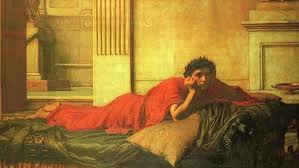
Nero agonizes over the death of his mother, whose constant interference caused the emperor to order her execution. Painting by John William Waterhouse
“Bide the end!”
December 24, 2010

CHARLES DICKENS
When I was in the sixth grade, our teacher, Mrs. Minor Merchant, assigned two other students and me to write a short play based on Charles Dickens’ novella, “A Christmas Carol.” I had never read the story before then, but I have read it every Christmas season since, as I am in the midst of reading it now. In the meantime, I became a fan of Dickens in general, and have read all of his novels and many of his other works — some of them over and over again. Of course, I have also watched adaptations of his work for the screen and the stage. Most of Dickens’ work is too expansive to be recreated in another medium except in sharply truncated form. That’s to be understood, but I have noticed that among the elements of his storytelling that usually fall by the wayside is the intensity of the anger with which he wrote — and that is in no case more than true than in the case of “A Christmas Carol.”
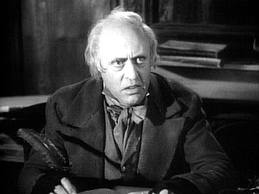
Alastair Sim in the title role of the 1951 film "Scrooge"
This tale, published in 1843, reputedly changed the way Christmas was observed in Great Britain and the United States. Apparently Christmas had become an impersonal, institutional event. Dickens believed it should be centered more on the family and the home and should inspire feelings of affection and generosity. The themes in “A Christmas Carol” touched folks in exactly that way and permanently altered the way they marked the day. Dickens was not religious in the conventional sense; in fact, he famously rejected organized religion in general and religious dogma in particular and repeatedly lampooned the clergy and their preaching. Still, he held Jesus in high regard and subscribed to what he construed to be Jesus’ central message: Love one another.
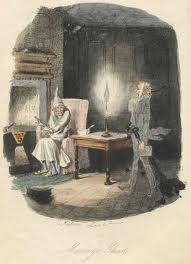
Ebenezer Scrooge is confronted by the ghost of his business partner, Jacob Marley.
Dickens had experienced a powerful dose of inhumanity as he grew up in impoverished and humiliating circumstances, and he went out of his way as an adult to witness the suffering of those whom the industrial revolution had left without hope of a decent, dignified life. His reaction to what he saw is often obscured in the popular images of the characters Dickens created. When Dickens was 12, his father was sent to debtor’s prison — an event memorialized by the experience of Wilkins Macawber in “David Copperfield.” Dickens had to work 10-hour days under atrocious conditions pasting labels on bottles of boot blacking — and that was also recreated by the boy Copperfield in the novel. The fact that not only Dickens but many other children were treated so badly infuriated Dickens. He wrote about such abuse in “Oliver Twist,” but the anger with which he wrote is hardly evident in such echoes as the musical “Oliver!” And as charming as “A Christmas Carol” can be, it is darkened again and again by Dickens’ flaring temper. This indignation drives these stories, but it often gets left behind when the text is reinterpreted for the stage or the screen.
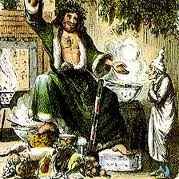
Scrooge meets the Spirit of Christmas Present
Dickens bristled, for example, over his perception that those who were well off were not only insensitive to the poor, but dismissive of them. He put the words in the mouth of Scrooge, and the adaptations generally preserve them: “If they would rather die, they had better do it, and decrease the surplus population.” But less familiar is Dickens’ outburst through the Spirit of Christmas Present, who – as they discussed the crippled Tiny Tim –- the son of Scrooge’s impoverished and misused clerk — hurled Scrooge’s words back in his face but went on: “Will you decide what men shall live, what men shall die? It may be , that in the sight of Heaven, you are more worthless and less fit to live than millions like this poor man’s child. Oh God! To hear the Insect on the leaf pronouncing on the too much life among his hungry brothers in the dust!”

Alastair Sim as Scrooge and Francis De Wolff as the Spirit of Christmas Present
There is another exchange between Scrooge and the same Spirit that was inspired by the views of a member of Parliament, Sir Andrew Agnew, who several times introduced measures that would have forbidden virtually all activity in London on Sundays. The restrictions were skewed in such a way that they would have heavily affected the poor but would have had little impact on the rich. Among the provisions would have been a ban on popular recreation and the closure of bakers’ shops. These enterprises were already prohibited from baking bread on Sundays and on Christmas Day, but many poor families, who had only meager facilities at home for heating food, took their victuals to a baker so as to enjoy a hot meal once a week and on the holiday. As Scrooge and the Spirit are watching simple citizens bustling around the city shops on Christmas day, Scrooge remarks, “I wonder you, of all the beings in the many worlds around us, should desire to cramp these people’s opportunities for innocent enjoyment.”
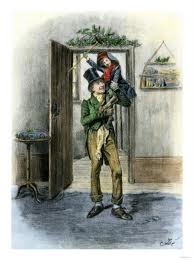
Bob Cratchit and Tiny Tim
When the Spirit expresses surprise on being blamed, Scrooge presses on: “You would deprive them of their means of dining every seventh day, often the only day they can be said to dine at all? Wouldn’t you?” The Spirit denies any part in such a thing, and Scrooge makes one retort too many: “Forgive me if I am wrong. It has been done in your name, or at least in that of your family.” Here, again, the text provides a furious outburst on the subject of hypocrisy, as the Spirit speaks on Dickens’ behalf: “There are some upon this Earth of yours who lay claim to know us, and who do their deeds of passion, ill-will, hatred, envy, bigotry, and selfishness in our name, who as strange to us and all our kith and kin, as if they had never lived. Remember that, and charge their doings on themselves, not on us.”

The Spirit exposes Scrooge to Ignorance and Want
Perhaps one of the best-known scenes in this Christmas story occurs when Scrooge notices something like a foot emerging from the same Spirit’s robe. When Scrooge asks about it, the Spirit opens the robe to reveal two “yellow, meagre, ragged, scowling, wolfish children.” “Are they yours?” Scrooge asks. The Spirit’s answer is always abbreviated in the retelling, but it is worth reading in full, especially considering how they might still apply: “They are Man’s. And they cling to me, appealing from their fathers. This boy is Ignorance. This girl is Want. Beware them both, and all of their degree, but most of all beware this boy, for on his brow I see that written which is Doom, unless the writing be erased. Deny it! Slander those who tell it ye! Admit it for your factious purposes, and make it worse. And bide the end!”
“Have they no refuge or resource?” Scrooge asks.
“Are there no prisons?” the Spirit replies. “Are there no workhouses?”
Netflix Update No. 41: “Bread and Tulips”
December 21, 2010

LICIA MAGLIETTA
We watched “Bread and Tulips” – “Pane e Tulipane” – an Italian romantic comedy from 2000.
This is a quirky, entertaining film with absurd English subtitles. My knowledge of Italian is just enough past the rudimentary level that I could follow much of what the actors were saying, and I could also see that the subtitles in many cases were only rough approximations of the actual dialogue. And a person who didn’t know Italian at all would notice that some of the translations were so literal as to be comical. Despite that distraction, however, we found this film to be well worth the while.
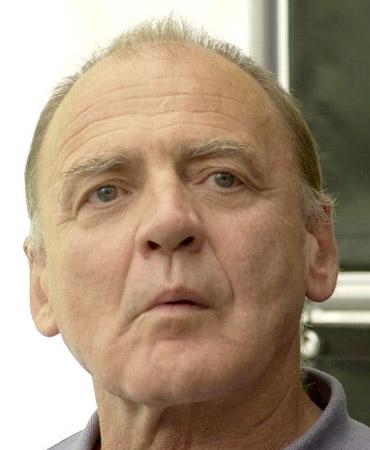
BRUNO GANZ
The story concerns Rosalba Barletta (played by Licia Maglietta), who is left behind at a rest stop during a vacation with her family. When she telephones her overbearing, unfaithful husband Mimmo (played by Antonio Catania), he barks at her to stay where she is and expresses no regret for the mistake or concern for her wellbeing. Already discontented with her life, Rosalba decides to ignore his instruction and sets off on her own by hitchhiking. She ends up in – where else? – Venice, where she secures room and board in the apartment of Fernando Girasole, a suicidal Icelandic man (played by Bruno Ganz) who works as maitre d’ in a small restaurant.

LICIA MAGLIETTA
. Rosalba supports herself in this spontaneous adventure by working for a local florist named Fermo (played by Felice Andreasi) – an anarchist in the best Italian tradition. Rosalba, who has developed a sweet and mutual romantic interest in Fernando, keeps in touch with her family but does not hurry home. Mimmo runs out of patience with her and hires Cosantino Caponangeli (played by Giuseppe Battiston) to travel to Venice and find her. Cosantino does find Rosalba, but that enterprise doesn’t turn out at all the way Mimmo intended.

GIUSEPPE BATTISTON
Although we found this film engaging over all, we were confused by dream sequences involving Rosalba. Under Silvio Soldini’s direction, the transition from reality to dream is not immediately clear. We would like to have understood better Fernando’s secretive relationship with a young woman and her son. The nature of their connection – not what most people might assume at first – is only superficially explained. There are also several instances in which scenes fade to black in a way that gives the film the feel of a television movie with the commercials edited out.

On the other hand, the director keeps the film visually interesting by avoiding any saccharine image of Venice and presenting instead a glimpse at the city’s life that tourists don’t experience. Licia Maglietta and Bruno Ganz are irresistible if unconventional romantic figures, and the contrast between their thoughtful personalities and the cartoonish Mimmo and Cosantino makes for a pleasant menage.
“Bread and Tulips” was well received when it first appeared. The attention was deserved.

Rosalba gives Cosantino the slip in a scene from "Bread and Tulips"
Books: “Growing Up Laughing”
December 5, 2010
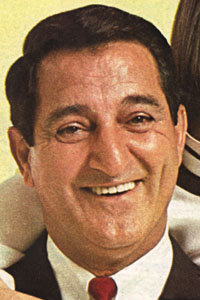
DANNY THOMAS
Danny Thomas used to do a monologue about a man who got a flat tire and then discovered that he had no jack in his car. He had no choice but to walk to a gas station that was miles away, and the routine consisted of this guy muttering to himself as he trudges along the road. Already annoyed, he makes himself angrier by imagining how the garage owner will try to take advantage of him. He is so furious by the time he reaches the station that he verbally attacks the unwitting mechanic, telling him what he can do with his jack. Some people could tell that story in a few sentences; Thomas could make it last ten minutes. That was the genius of the saloon comic whose talent and know-how made him a television mogul.
Thomas was a popular guy in our house, not only because he was funny but because he had Lebanese parents. My mother’s parents were from Lebanon, and when Thomas became a national figure, he was the only one who shared that heritage. The Lebanese were once regarded in our country as exotic, so much so that my mother told me that her parents instructed her to say she was French if anyone should ask. Danny Thomas with his broad popularity and his frequent acknowledgement of his background provided a chance to wave the flag.
 The story has been told often enough about how Thomas, when it appeared that he might never succeed as an entertainer, promised St. Jude that if his fortunes changed he would build a shrine to the saint. Even St. Jude might have forgiven someone for dismissing a vow made in desperation, but Thomas stuck to his word and, in the process, made himself one of the heroes of 20th century America.
When Thomas first launched a campaign to raise money for his project, the backbone of the drive then as now was the Arab-American community, including several of my mother’s Lebanese cousins. My parents attended fundraising events, including one at which Thomas and his wife, Rose Marie, appeared.

MARLO THOMAS
I figured that tenuous connection was better than nothing when I had an opportunity last year to share a meal with Marlo Thomas, one of Danny Thomas’s three children. I needn’t have bothered. She is a gracious and open woman who doesn’t require pandering. She and her siblings are also their father’s successors as heroes, making an extraordinary commitment to generating support for the hospital he founded. Although it has been operating since 1962, the mission of St. Jude Children’s Research Hospital – to treat children with catastrophic pediatric diseases regardless of their families’ ability to pay – seems more like a dream than a reality The hospital has operating costs in the neighborhood of $1.5 million a day. Someone who joined us at dinner asked Marlo about covering that nut. “How do you do it?” he said. And she answered: “We do it.” I have often thought about that answer; it reveals a combination of determination and confidence that I have encountered in leaders of other charitable enterprises.
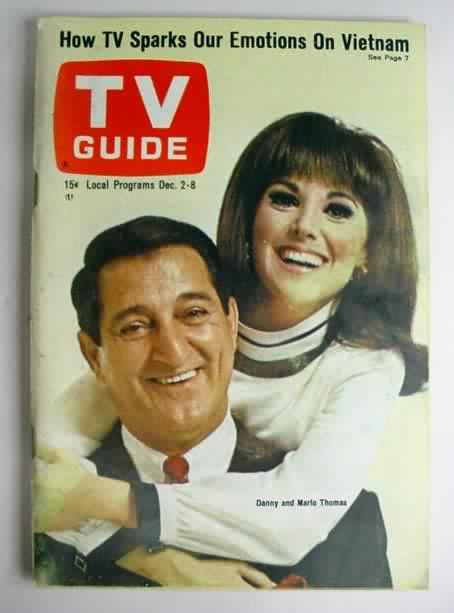 Marlo Thomas, on her own, has had a remarkable career. She is a talented dramatic and comic actress, and her TV series “That Girl” was a benchmark in prime time representation of independent women. Her project “Free to be You and Me” — a record album, a TV special, and a book — broke new ground in eliminating the image of the helpless or subservient female that infected traditional children’s literature and entertainment.
She has recently published her sixth book, “Growing Up Laughing.” This book alternately recounts her childhood and adolesence in the Thomas household — which was frequently extended to include the likes of Sid Caesar, Milton Berle, and Jan Murray — and her conversations with contemporary comics about the origins of their own funny bones. Jerry Seinfeld, Kathy Griffith, Whoopi Goldberg, Don Rickles, Chris Rock, and Robin Williams are among them. The observations of these modern performers supplement the wisdom that Marlo Thomas gleaned from her exposure to the wits of her dad’s generation. The book is entertaining and full of insights about both the inspiration and the discipline of comedians.
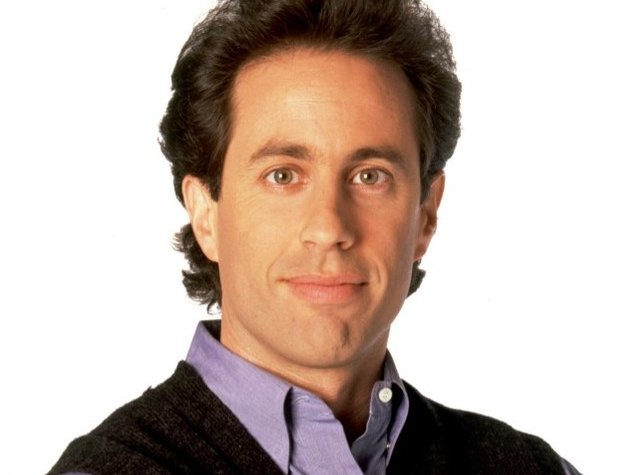
JERRY SEINFELD
I particularly liked Jerry Seinfeld’s explanation of his remark that comedy doesn’t belong on the arts pages, but on the sports pages:
One of the things that drew me to comedy was that it’s a simple world. It doesn’t require the interpretation of any critic to tell you whether something is good or not good. If the audience is laughing, the guy’s good. If they’re not laughing, he’s not good. Period. And that’s the analogy to sports: You can talk all you want about how two teams played in a game. But we all know who won at the end. There’s no debate. It doesn’t require any perception. … Standup comedy doesn’t require value judgments. If you get laughs, you work; if you don’t get laughs, you don’t work. It’s all about the score.
Number 12
December 1, 2010
 While I wasn’t paying attention, Gil McDougald slipped away. The news got away from me over the weekend, and I did not hear until this afternoon that the former Yankee infielder had died on Sunday.
I saw Gil play many times in the 1950s, when my father used to take me to Yankee Stadium as often as three times a week. We looked at ballplayers differently then. We admired players like Gil, of course. How could we not have admired a guy who played second, short, and third at a championship level? But, aside from their prowess on the field, we didn’t think of them as being remote from our place in the world. They were celebrities, but not in the way that term is understood today.
 McDougald had a business on the side; I think it was called Yankee Maintenance Service. One of his clients was the bank around the corner from our house, and we’d often see the blue Volkswagen bus parked outside while the crew was cleaning the place. Once in a while, Gil would stop by to make sure his customer was satisfied with the service. It wasn’t the sort of thing Alex Rodriguez does with his time.
 The news stories about Gil’s death have reported that he played on a bunch of championship teams with Mickey Mantle, Whitey Ford, and Yogi Berra. But he also played with Hank Bauer, Bill Skowron, and Andy Carey — just guys playing ball, like Gil.
I went to see Gil at his place of business long after he had retired from baseball. He told me that at the end of his ten-year career with the Yankees, Gene Autry offered to double his annual salary if he would play two more years with the fledgling Angels in California. Autry wanted names on the roster. Gil — a family man par excellence — said he wouldn’t disrupt his household for that price.
Gil McDougald was an All-Star at three infield positions. The only other man who can make that claim is Pete Rose. When Casey Stengel said, after the Yankees had beaten the Braves in the 1958 World Series, “I couldn’t have done it without the players,” he was talking about Gil as much as about anyone else. And when I remember those hazy afternoons in the Stadium that greed has torn down, the guy out there gunning one over to Joe Collins, that’ll always be Gil.

The Polo Grounds in 1951: Gil McDougald becomes the first rookie to hit a grand slam in a World Series.
Books: “Here’s Looking at Euclid”
November 24, 2010
 Overall, I don’t think my father was disappointed in me. He didn’t set himself up for disappointment, because he didn’t pressure me to pursue any particular career. When I said I wanted to be a priest, that was all right with him. When I became a newspaper journalist instead, that was all right, too. He was both a practicing Catholic and a newspaper reader, so he was in a good position for success.
There was, however, one thing that he might have found frustrating about the younger of his sons — Tony’s brother, as it were — and that was my inability to learn how to add several columns of figures without carrying numbers.

NACD photo
At slow moments in my family’s grocery store — where adding columns of figures was a frequent chore — Dad would try to show me how to add three or four columns at once, rather than starting with the right-hand column (the pennies column) and carrying the excess to the top of the column to the left. “Put down the two, and carry the four” — that was how I had learned arithmetic. I couldn’t understand the alternate method Dad tried to teach me, which annoyed me, because he could add columns of figures with his technique nearly twice as fast as I could do it with mine.
Many years later, the dawn broke in my clouded mind while I was reading a book on math. There, for Pete’s sake, was Dad’s method — explained just as I remembered Dad explaining it — but somehow I finally understood it and have used it ever since.
 Like many people, I suppose, I regarded math at best as a necessary evil in elementary and high school. I didn’t go near the subject in college or graduate school. When I was in my 30s, however, I inexplicably chose to read a book on math written by Bertrand Russell, and was surprised to find that the subject was attractive. As I result, I have read many books about math, the most recent one being “Here’s Looking at Euclid” by the British journalist Alex Bellos.
In fewer than 300 pages, Bellos covers a remarkably wide range of topics. He explains the origins of mathematical concepts that we take for granted — the sixty-minute hour and sixty-second minute, for example — and how mathematical understanding has evolved since some Sumerian in the fourth millennium B.C. first pressed a stylus into a clay tablet. He writes about pi and infinity and probability (including its role in gambling), and the bell curve.

MUNDURUKU MEN
Bellos begins his book with an account of the Munduruku people of Brazil, who have a number system that goes only from one to five. Moreover, the Munduruku use only the numbers one and two to count precisely, using three, four and five more as estimates. In fact, Bellos explains, the Munduruku are baffled by others’ compulsion to enumerate people or objects and either cannot or will not answer if asked how many children they have. They know who their children are; that’s enough for them. It’s healthy, I think, to be reminded from time to time that everyone doesn’t look at the world through the lens we use.

Ventura College
What I particularly like reading about is the mystery and elegance that many people find in numbers. One example is the “golden proportion” or “golden ratio,” to which Bellos devotes a chapter. The definition of this term, known to mathematicians as phi, might be off-putting at first. Here it is as Bellos explains it: “The golden mean is the number that describes the ratio when a line is cut in two sections in such a way that the proportion of the entire line to the larger section is equal to the proportion of the larger section to the smaller section.” That number begins as 1.61803 and, like pi, goes on forever. It appears in many familiar geometric figures, including the five-pointed star. The 16th century mathematician Luca Pacioli, Bellos reports, “concluded that the number was a message from God, a source of secret knowledge about the inner beauty of things.” That notion may seem remote until Bellos explains how a retired dentist discovered that the golden proportion was the key to designing dentures that give an individual patient a proper smile – now a widely accepted principle in dentistry.
I’m sorry now that I once thought of math only as a nuisance, but books like this one have helped me make up for a misspent youth.
I’m obsessed
November 6, 2010

KATE SMITH
The popular song “Wrap Your Troubles in Dreams” was written in 1931, and its lyricists, Ted Koehler and Billy Moll, provided a hopeful message that sounded all the more melancholy because of the reality of the times – economic depression. My favorite recording of that song was made by Kate Smith. I like the way she sings two lines — both of them in this verse:
Your castles may tumble / that’s fate, after all / Life’s really funny that way / No use to grumble / Smile as they fall / Weren’t you king for a day?
Kate Smith had a wonderful, musical laugh, which I loved to hear on her radio and television shows. And she laughs that laugh on the word “funny” in that verse without breaking the tempo of the line. I can’t hear her sing that line too often, and I’ve had the recording for about 40 years. Then, at the end of the verse, she does a little glide on the word “day,” starting on the note and then smoothly sliding down the scale. Again, I’m obsessed with that line. I play the song just to hear her treatment of that one word – “day.”
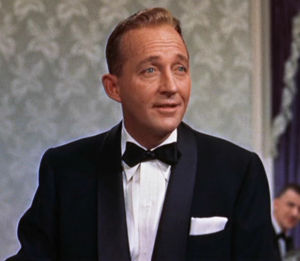
BING CROSBY
In a similar vein, for many years, whenever I learned that a TV station was going to broadcast the movie “High Society,” I would watch it so that I could hear Bing Crosby and Frank Sinatra perform the duet “Well, Did You Evah,” sometimes referred to as “What a Swell Party This Is.” I even figured out about how far into the movie that song occurs, because I didn’t want to watch the whole film, which is a flawed remake of “The Philadelphia Story.”
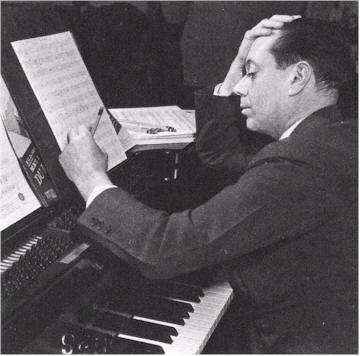
COLE PORTER
The movie has a book by John Patrick and songs by Cole Porter. In “Well, Did You Evah” Crosby and Sinatra simultaneously sing Porter’s lyrics and exchange spoken barbs. At one point, Crosby sings, “Have you heard / about dear Blanche? / Got run down by an avalanche.” Sinatra says, “Nooooo,” and Crosby answers “Don’t you worry. She’s a game girl, you know. Got up and finished fourth.” Sinatra: “This kid’s got guts.” Crosby: “Havin’ a nice time? Grab a line.” At which point, Sinatra resumes singing. Crosby was Mister Smooth, and the way he delivers the line, “Don’t you worry. She’s a game girl, you know . . . ” has captivated me since the first time I heard it about 50 years ago. Fortunately, I now have bookmarked that song from YouTube and I can listen to Crosby say that line as often as I like, which is often, because I’m obsessed.
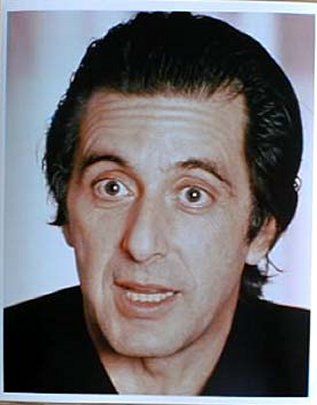
AL PACINO
I don’t experience this kind of fixation only with music. It also occurs with the spoken word — for example, with Al Pacino’s speech in the climax of the movie “Scent of a Woman.” I read a review of that movie in which the critic remarked that Pacino’s dramatic choices were confined to whether to speak loud or louder. It’s fair to say that Pacino often gobbles the scenery, but the most effective line in that speech is one for which he lowers his voice and uses the words like sharp instruments. It is the last sentence of this passage: “As I came in here, I heard those words, ‘cradle of leadership.’ Well, when the bow breaks, the cradle will fall. And it has fallen here; it has fallen. Makers of men; creators of leaders; be careful what kind of leaders you’re producin’ here.” When Pacino says those last words – “Be careful what kind of leaders you’re producin’ here” – he makes them prophetic, ominous. I bookmarked the video of that scene, too – it’s at THIS LINK — and I never tire of hearing him say it. I’m obsessed.

SETH RUDETSKY
I recently learned that this behavior doesn’t constitute a private disorder of mine – and that there is a name for it: deconstruction. The dawn broke when I was at the George Street Playhouse in New Brunswick talking to Seth Rudetsky, who is so versatile that he defies definition. It’s something like comedian-actor-radio host-raconteur-musician-composer. I was talking to him because he is going to appear in the George Street production of the musical play “[title of show].”
Rudetsky hosts a web site which includes a series of videos he calls “Deconstruction.” In these, he plays clips from Broadway musicals — a subject he knows inside-out — and analyzes, in his supercharged manner, the techniques with which a singer such as Florence Henderson, Laurie Beechman, or Kristin Chenoweth handles a song – or a line, or a word, or a syllable. “I’m obsessed!” he often says when he has played a phrase over and over again, mouthing the words along with the singer.
I’m glad to finally know that I’m in good company. Rudetsky’s site is at THIS LINK.
 CharlesPaolino's Blog