“Batter, batter, batter!”
April 13, 2011

ED REULBACH
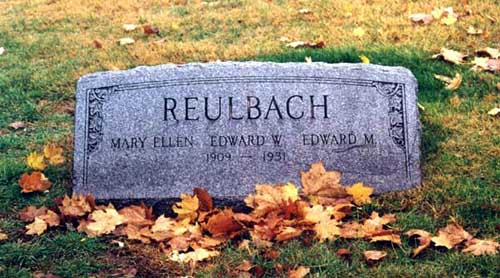
I was surprised the other day when I stumbled across the information that Ed Reulbach is buried in a Catholic cemetery in Montclair, New Jersey. I have always associated Reulbach with the Chicago Cubs, and I have never associated him with New Jersey.
Reulbach’s name is not well known today, except by people like me who live in the past. He was well known in his own time, however; he was one of the most dominant pitchers of his era. Actually, in some respects he has had relatively few equals in the whole history of the game, but he pitched in the dead-ball era and he isn’t on the minds of the play-by-play announcers whose memories don’t go back much farther than the 1960s.
I’m in the midst of reading The House that Ruth Built, a new book about the 1923 baseball season in New York. (A review will follow soon.) The author refers to a pitcher who threw both ends of a double header, and that’s what got me thinking about Reulbach. Modern pitchers are such fragile creatures that the idea of one of them throwing a double header is absurd. A modern pitcher rarely throws more than five or six innings at a time.
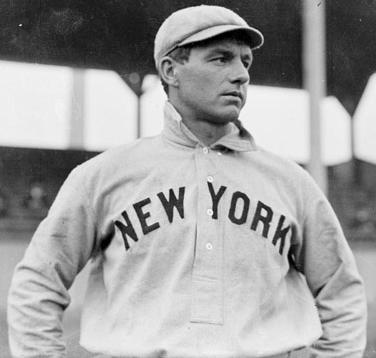
JOE McGINNITY
This wasn’t always the case. It wasn’t long ago that a starting pitcher was expected to throw a complete game. Whether he did or not depended on his performance on the mound, not the number of pitches he threw. Even then, pitching double headers was unheard of after 1926, when Dutch Levsen, pitching for the Indians, became the last to do it.
The most spectacular performance in this regard was turned in by “Iron Man” Joe McGinnity of the New York Giants, who pitched three double headers in the month of August, 1903, and won all six games without relief. McGinnity won 31 games that year. Perhaps more significantly — in view of the modern practice of counting pitches — he won 35 games in 1904, , 21 in 1905, and 27 in 1906.
Altogether, there were 45 instances of a pitcher throwing a double-header. Grover Cleveland Alexander did it a couple of times. Also in this elite group was Fred Toney, who won a double bill for Cincinnati in 1917. What’s even more remarkable is that in that same season, Toney and Hippo Vaughan of the Chicago Cubs joined in the only game in history in which both pitchers pitched no-hitters for nine innings. Vaughan lost it in the 10th.
Reulbach’s performance stands out, because on September 26, 1908, he pitched two games for the Cubs against Brooklyn, and they were both shutouts. He’s the only pitcher in the history of the game to pull that off. To emphasize his point, he allowed a total of eight hits in the two games.
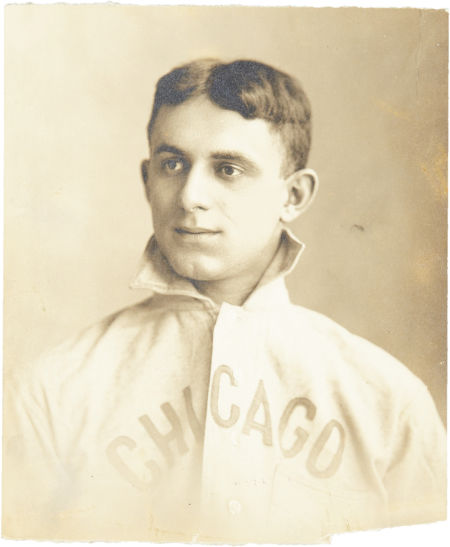
For the record, Reulbach pitched nine more seasons after the year of his double shutouts and he finished with a .632 won-loss percentage and an ERA of 2.28.

The stone on the Ruelbach family grave makes no mention of the pitcher's career. His lifetime ERA has been bettered only 10 times, and he was the first pitcher to throw a one-hitter in World Series play.
“They can go to hell” — Mohamad al-Fayed
April 11, 2011

Bronze statue of Marcus Aurelius
In the Capitoline Museum in Rome there is a bronze statue of the Roman Emperor Marcus Aurelius Antoninus. This is the only complete bronze statue of a Roman emperor that still exists. It was erected while the old stoic was in office – 176 AD. The reason that there are no other bronze statues from that era is that it was routine in the fourth and fifth centuries to melt them down so that the metal could be used for other statues or for coins. Sic semper gloria, as the saying goes. Statues of the emperors were destroyed also because Christians — apparently with no regard for the historical curiosity of future generations — regarded them as offensive remnants of paganism. In fact, it is said that the statue of Marcus Aurelius survived because it was erroneously thought to be an effigy of the sort-of Christian emperor Constantine.
It has not been unusual for statues of great, or at least dominant, figures to be desecrated by unappreciative come-latelies. Just the other day, some Syrians who are impatient with the fact that they lack basic political and economic rights did insulting things to an image of their former president, Hafez al-Assad, affectionately known as the “butcher of Hama” because of an unpleasant incident in which he caused the deaths of from 17,000 to 40,000 people.

Abraham and Tad Lincoln in Richmond
There was some unpleasantness of a different sort about 8 years ago concerning a statue erected in Richmond representing Abraham Lincoln and his son Tad. The statue reflects on Lincoln’s visit to the ruined city in April 1865 at the end of the Civil War. There were bitter protests by people who objected to the statue, apparently still not able to concede Lincoln’s conciliatory attitude toward the southerners whose treason brought on the war in the first place.
Meanwhile, there has been some statuary-related turmoil in England. The trouble isn’t about figures of Neville Chamberlain or Guy Fawkes or Edward VIII. No, the man at the center of the maelstrom is Michael Jackson. There are two new statues of Jackson in place in the UK, and both of them are getting the raspberry from some of Jackson’s fans.

Statue of Michael Jackson in East London
One scuffle is about a statue of Jackson dangling his baby son out of a hotel window. The life-sized image — which the artist calls “Madonna and Child” — recalls the incident in which Jackson held his son Prince Michael II out of a window in Berlin in 2002 while hundreds of fans were gathered below.
The sculpture is by a Swedish-born artist named Maria von Kohler; it’s displayed in the window of a music studio in East London. Jackson’s fans — who apparently haven’t been lured away by any of Simon Cowles’ instant sensations — find the sculpture revolting. They see it as an part of a persistent campaign of slander against Jackson, who set the bar for slander rather high. Viv Broughton, chief executive of the music studio, has a different view. He called the sculpture a “thought-provoking statement about fame and fan worship.”

Statue of Michael Jackson at Craven Cottage Stadium in London
The other skirmish has been prompted by a statue of Jackson erected outside Craven Cottage Stadium in London. The stadium is the home of the Fulham Football Club, a soccer team. Mohamed al-Fayed — whose son Dodi died in the auto accident that killed Princess Diana — owns the football club. The elder Fayed was a friend of Jackson.
Art critics have had a field day with the statue and some of Jackson’s disciples have criticized it, too.
Fayed responded to the criticism with a certain delicacy: “If some stupid fans don’t understand and appreciate such a gift, they can go to hell.”
I’ve often thought, when I pass the statue of Vice President Garret Hobart in front of City Hall in Paterson, how melancholy he must be as hundreds of people pass him each day without a glimmer of recognition. On the other hand, he has nobody attacking him except the pigeons.
Books: “The Rise and Fall of the Bible”
April 8, 2011

THEA BOWMAN
The literary scholar and Catholic nun Thea Bowman recalled in the video “Almost Home” that the old folks she knew when she was growing up in Mississippi were steeped in Holy Writ. “I was reared around a lot of old people,” she said. “They knew Scripture. I knew people who could not read or write, but they could quote you a Scripture with the chapter and verse. They would use Scripture when they were tired and a Scripture when they were frustrated, a Scripture to challenge us . . . a Scripture to threaten you, a Scripture to reward you or to praise you or to teach you; I grew up in that kind of world.’’
But these folks, Bowman said in the album “Songs of My People,” didn’t concern themselves with whether or not Jonah and the big fish that swallowed him were real. What these folks were interested in was the truth that was communicated by that story — a truth that had to do with life today — namely, the imperative of accepting the will of God.
For my money, that was an enlightened point of view, a sensible way of approaching the Bible. Everyone doesn’t agree. There are Christians who believe that the Bible means what it says — period.
 If there are two contradictory accounts of the creation of human beings, two differing accounts of the death of Judas, four accounts of Easter morning at the empty tomb, and three accounts of the conversion of St. Paul — well, this is the infallible word of God, so they say.
This is one of the issues that is explored in The Rise and Fall of the Bible (Houghton Mifflin Harcourt), an engaging little book by Timothy Beal, who is a professor of religion at Case Western Reserve University in Cleveland. Beal writes a great deal in this book about the Bible-publishing business, which he thinks is on the wane — likely to decline if not disappear in the digital revolution. Even at that, he argues, although there are lots of Bibles being published and sold — in a dizzying variety of formats — the number of people who are actually reading the sacred texts is another matter.
 In fact, Beal maintains, some versions of the Bible — loaded with sidebars and commentaries and graphics that tend to push the Chapters and Verses into the background — are not calculated to get people directly engaged with Moses and Isaiah and Mark and Matthew and the rest of that crowd. In many cases, he thinks, the design is to get the reader to accept a particular interpretation of the Biblical content and to overlook — or remain unaware of — the ambiguities and contradictions that are in the very nature of the Bible. These are Beal’s own words:
The icon of the Bible as God’s textbook for the world is as bankrupt as the idea that it stands for, of religious faith as absolute black-and-white certainty. Just as the cultural icon of the flag often becomes a substitute for patriotism, and just as the cultural icon of the four-wheel-drive truck often becomes a substitute for manly independence and self-confidence, so the cultural icon of the Bible often becomes a substitute for a vital life of faith, which calls not for obedient adherence to clear answers but thoughtful engagement with ultimate questions. The Bible itself invites that kind of engagement.
 Beal maintains that the iconic view of the Bible as the single source of religious truth ignores the history of the Bible, which did not exist as a single entity until hundreds of years into the Christian era — and still appears in more than one configuration. Beal predicts that Bible reading — like most other reading — will eventually become a digital experience, and he welcomes that prospect. He sees a healthy similarity between the generations of transmission of the traditions and texts that eventually became the Bible — a process that involved, and still involves, constant re-reading and re-translating and re-interpreting — and the generations to come in which the Scriptures will be subject to the kind of discourse that is already going on in other fields of study on, of all things, the Internet.
Beal points out that Jesus of Nazareth didn’t take the Hebrew Scriptures to have one literal meaning, but engaged in interpretation of a kind that still goes on among Jewish scholars — a process I have listened to with fascination at no less revered a venue than the Western Wall. The author doesn’t see religious faith as a science of certainties but as a struggle that has its intermittent moments of enlightenment and elation and doubt and discouragement. His viewpoint reminded me of an observation made by Albino Luciani — Pope John Paul I — that even the angels ascending to heaven on Jacob’s ladder were taking only one step at a time.
 This is Beal’s conclusion:
In kindred spirit, what if we were to think of the Word of God not as bound between two covers of a book but as that endless noise of interpretation, an inconclusive process that we are invited to join? What if that cacophonous hymn, rising up across time and space from digital networks, living rooms, lunchrooms, churches, and bus stops is the living Word of God? An endless, inarticulate din of talking, arguing, reading, and rereading in the library of questions. The Word as we don’t know it. The Word as we live it. Word without end.
Six sliders and an order of fries
March 30, 2011

- Green Brook, NJ

I haven’t read Dante Alghieri’s “Inferno” since college, so I don’t remember if he imagined a circle of hell reserved for folks who introduce their grandchildren to White Castle. If so, I hope he was wrong, but it’s too late now. We’ve already done it.

 Well, the grandsons and their parents were coming to our house for a sleepover recently, and our daughter suggested that we take the boys to White Castle — which was a thinly veiled way of saying that we should take her to White Castle — something I suspect her husband doesn’t approve of. I don’t think the boys were hooked, based on that one visit, but they’re only little guys, so there’s plenty of time. It isn’t that Pat and I spend a lot of time at White Castle, but we get the hankering now and again, and we go with no apologies. Two or three times, we have made reservations — yes, reservations are required — for the Valentine’s Day dinner at the White Castle in South Plainfield. There are red table clothes and flowers, a waiter at your table, and a menu to order from — the same food, of course, or why would we be there?
 I mentioned that Pat and I don’t spend a lot of time at White Castle. No, we have salad and a green vegetable with every dinner, we eat a lot of garlic and olive oil, we don’t overdo the red meat , and we would eat fish if either one of us could swallow it. But life is full of hazards and temptations. I started a new job in January, and my drive home takes me right past the White Castle in Green Brook. “You know,” Pat said to me, ” you could stop on your way home.”
“Clang, clang, clang went the trolley”
March 17, 2011
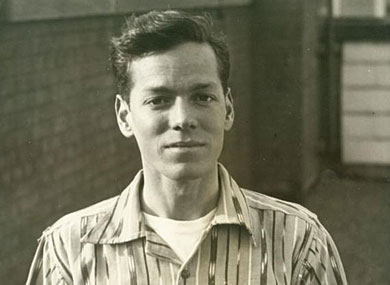
HUGH MARTIN
In the midst of the tragedies playing out in Japan and Libya and Bahrain, song writer Hugh Martin — an important figure in American musical history — slipped away last Thursday at the age of 96.
Martin wrote a lot of fine music for the Broadway stage and for films, but he etched his name in brass when he composed “Have Yourself a Merry Little Christmas,” “The Trolley Song,” and “The Boy Next Door” — all classics and all written for Judy Garland in the film “Meet Me in St Louis.”
The first of those songs set Martin apart in special way, because it is relatively rare for a writer to produce a song that becomes a Christmas standard. That one became not only a standard but one of the most recorded and most popular Christmas songs of all time.
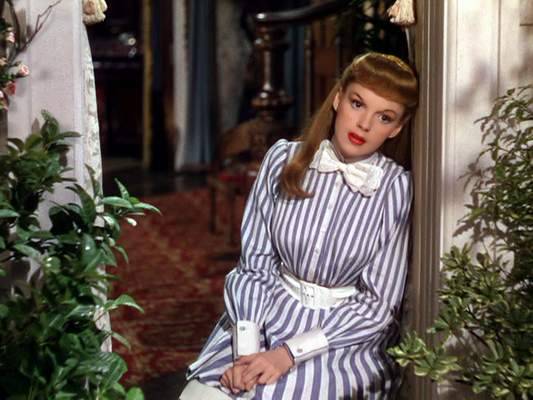
JUDY GARLAND
The song has an interesting history which is available in Martin’s own words at THIS LINK. This is the short version. Martin’s perennial songwriting partner, Ralph Blane, asked about a tune he had overheard Martin fooling around with, but Martin said he had given up on it. Blane had liked the melody and asked Martin to try it again. Martin wound up writing “Have Yourself a Merry Little Christmas.” Judy Garland’s character sang this song to her little sister (Margaret O’Brien) who was distraught because their father was moving the family from its homestead in Missouri to New York City.
In that context, the combination of Martin’s melancholy melody and his lyrics was heart-wrenching. So much so, that Judy Garland and others objected that it was too sad. Martin at first refused to change it, but actor Tom Drake talked him into it.

HUGH MARTIN
For instance, the song originally began: Have yourself a merry little Christmas. It may be your last / Next year we may all be living in the past. Martin changed that to Have yourself a merry little Christmas. Let your heart be light / Next year all our troubles will be out of sight.
That was in 1944. In 1957, at the request of Frank Sinatra, Martin changed the song again. The original lyric read, But at least we all will be together, if the Fates allow / From now on we’ll have to muddle through somehow. Sinatra found that a little downbeat for a Christmas album he was recording, and Martin accommodated him with, Hang a shining star upon the highest bough,” which is the way it is usually performed now.
No matter, in all of its versions it’s a wonderful song from a wonderful talent.

Margaret O'Brien and Judy Garland in "Meet Me in St. Louis"
Talking baseball
March 10, 2011

PETER SCOLARI
But to put that story in context, Scolari told me that his father — attorney Art Scolari — had played baseball at East Side High School in Paterson (this would have been long before Joe Clark got there) and then was an All-American shortstop at Drew University. Paterson? I was born in Paterson. My dad, who was about 13 years older than Art Scolari, went to Central High School where he ran track — particularly relays — and later managed a semi-pro baseball team that played all around the Paterson area.

PETER SCOLARI / New York Daily News
I haven’t told Peter Scolari this yet, but after our conversation, my web browser stumbled on a story in a 1939 issue of the old Daily Record of Red Bank, N.J., reporting that a teenager named Lawrence Mahoney, who was from Lincroft, had successfully defended his state horseshoe pitching championship for the fifth time in a row. It was no snap, according to the story: breathing down Mahoney’s neck was 15-year-old Art Scolari of Paterson. Mahoney was 9-0 in the tournament; Scolari was 8-1.
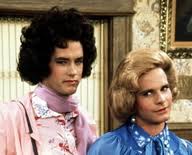
Tom Hanks and Peter Scolari in their "Bosom Buddies" regalia
I could have talked about baseball all night — it’s one of my many excuses to talk too much — but I was at the George Street Playhouse in New Brunswick to talk to Peter Scolari about his current project, a production of Ken Ludwig’s new play, “Fox on the Fairway.” This play, with a golf theme, had its world premiere last year in Washington, D.C. It’s a farce, and that’s a word that sends up the skyrockets, because farce done badly — or even done “all right” — is a painful experience for an audience. I’ve been there. Scolari, who knows a lot more about it than I do, made that point: “I don’t like to see a farce in which folks do an okay job. I’ll watch ‘The Sunshine Boys’ or ‘The Odd Couple’ and have a great time if everybody does a ‘good’ job. If I go to a farce and everybody does a ‘good’ job, I think, ‘Why did you do this?’ ”
I’ve read Ludwig’s play, but reading farce is like reading a recipe. It lays out the parts and the moves, but it can’t even hint at the reality. I have also read at least one negative review of the Washington production, but the fact that a farce doesn’t work with one company doesn’t mean it won’t work with another. Ludwig, after all, is the author of “Lend Me a Tenor” and “Crazy for You,” both of which won him Tony awards. And Scolari knows a thing or three about playing comedy in general and farce in particular.
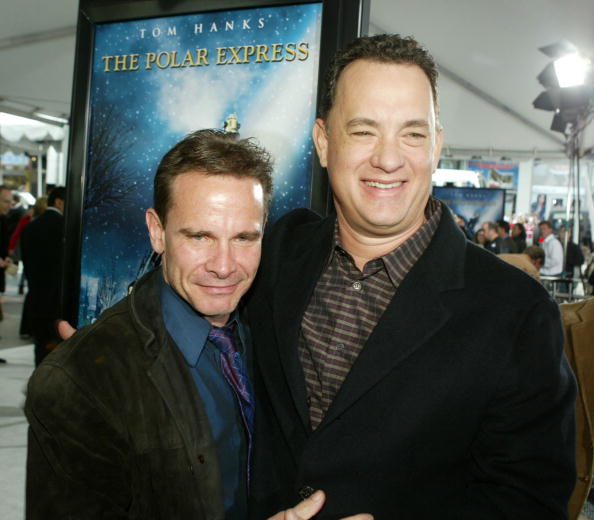
Peter Scolari and Tom Hanks in 2004 at the premiere of "Polar Express" in which they both appeared
Scolari first drew national attention in 1980 when he co-starred with Tom Hanks in “Bosom Buddies,” a TV sit-com about two young men who dress in drag so they can live in a women-only hotel where the rent is dirt cheap and about what they can afford. The show, which lasted a couple of seasons, was indirectly inspired by the Billy Wilder movie “Some Like it Hot.” Since then, Scolari has put together a long resume of television and stage appearances, mostly in comedies, including 142 episodes of Bob Newhart’s second hit series, “Newhart.”
Talking to Scolari, who is witty, thoughtful, and articulate, was an entertainment in itself. If I weren’t aware that I was keeping him from his train after he had spent a full day of rehearsal, I would have prompted him to talk for another hour, just so I could listen. If I had had unlimited time and he had had unlimited patience, I would have steered him back around to baseball, because no sport lends itself to talk as well as baseball does, and my guess is that Scolari appreciates that as much as I do. I asked him which New York team he roots for now that he is living on the East Coast again after his sojourn in California. He could have simply said that he roots for the Yankees, but this wasn’t a guy answering questions. This was a guy talking baseball:

Thurman Munson, Yankees catcher, captain, All-Star, and MVP, was killed in a plane crash in 1979. He was 32.
“I follow the Yankees. I make no apologies about it, but they’re not the Yankees. For me the Yankees who owned my heart ended with the captain, with Thurman Munson. I never got over that, to be honest with you, as a fan. So you come back, and they’re your team, and they’re in the Bronx, and that’s really important — but it’s not quite the same.”
Netflix Update No. 47: “City Island”
March 7, 2011
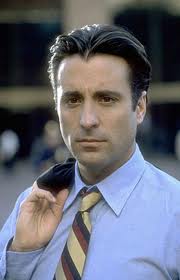
ANDY GARCIA
We watched the 2009 movie, “City Island,” starring Andy Garcia and Julianna Margulies with an Alan Akin-esque supporting role for Alan Arkin.
This is an edgy and often humorous story, written and directed by Raymond DeFelitta, about a dysfunctional family living on an island in The Bronx. Vince Rizzo (Garcia) is a corrections officer who doesn’t like to be called a “prison guard” and who really wants to be an actor. He steals off to Manhattan to attend an acting class led by the grizzled but insightful Michael Malakov (Arkin). Vince assumes that his wife, Joyce (Margulies) would ridicule his ambition, so he explains his weekly absences by saying he is playing poker. She thinks he’s having an affair.
The Rizzos have a son and a daughter together. Vince Jr. (Ezra Miller) secretly has a feeding fetish, and Vivian – played by Garcia’s daughter, Dominik (sic) – is a college student who secretly has lost her scholarship and is stripping to earn tuition money.
Vivian reluctantly comes home on a break at about the same time that Vince realizes that a new prison inmate is his son, Tony (Steven Strait), the product of a liaison Vince had while he was still in his late teens. In keeping with the family practice, Vince has not told Joyce about this.

JULIANNA MARGULIES
Not one to complicate matters by thinking them through, Vince tells Tony only that Tony’s dissolute mother was a “friend,” and he arranges to have Tony released in his custody. He takes Tony home, giving Joyce only the explanation he had given Tony, and the result is even more dissent in the Rizzo household.
Meanwhile, Vince has developed a close, but not romantic, relationship with Molly (Emily Mortimer), a fellow student in Malakov’s class. Molly – who has secrets of her own – pushes Vince to have more confidence in his prospects as an actor. He inadvertently jars her into reconsidering some of the lies she has been living.
The quirky characters, odd-ball story, and strong performances by all the actors make this movie unpredictable and compelling. The environment adds to the interest. The film was shot on location at City Island which looks as if it’s a piece of New England that wandered away and couldn’t find its way back. The characteristics of the place – at least as Vince describes them in the movie – provide a credible context for his self-image and his behavior.

ALAN ARKIN
It’s almost always a treat to find Alan Arkin in a movie. He is in his element in this one, playing a crusty drama teacher who is up to here with actors who want to emulate Marlon Brando. Malakov is especially impatient with students who inexplicably pause instead of speaking their dialogue – a Brando trade mark. Presumably, Malakov wouldn’t have had much time for William Shatner. Vince, as it happens, is a Brando devotee.
This movie makes a point about the consequences of deceit among people whose relationship implies intimacy. It may be an obvious point, but the empirical evidence is that it can’t be made too often.
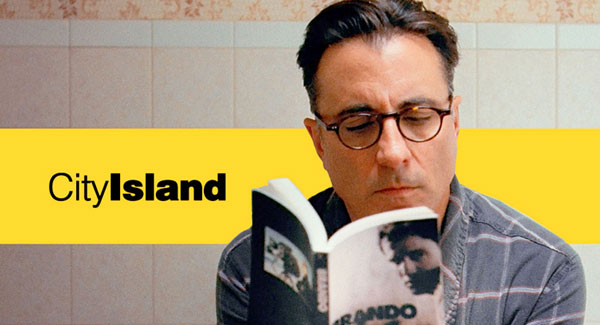
Vince Rizzo studies up on Marlon Brando in "City Island"

AMELIA EARHART
Somewhere in this home office there is a 78 rpm recording of Jack Kaufman singing “Lucky Lindy” and “Lindbergh, the Eagle of the USA.” The record was part of the hype that followed Charles A. Lindbergh’s solo flight from New York to Paris in 1927. If a female aviator were going to be cast as Lindbergh’s counterpart, there was only one thing about Amelia Earhart that qualified her: She vaguely resembled the pilot. Where flying acumen was concerned, there were numerous women whose experience, skills, and breadth of knowledge far exceeded Earhart’s. As it turned out, that didn’t matter. Earhart had “the look” — or, at least, enough people thought so to make her marketable as “Lady Lindy,” and so, she became the legend and the other women are forgotten by all but students of aviation history. Some things never change.
I read about that in “Amelia Earhart: The Turbulent Life of an American Icon,” by Kathleen C. Winters.

Amelia Earhart and George Putnam
Winters, who died last August, was an aviation historian, biographer of Anne Morrow Lindbergh, and a licensed pilot. In short, she knew a lot about flying and her knowledge gives this book important context. I think it was because of her respect for flying that she took an unfiltered look at Earhart and presented her in what for many readers, including me, is a new light. Not that Winters went after Earhart; on the contrary, she seems to have recognized Earhart’s basic decency and approved of Earhart’s sense of adventure and her independence, her part in the campaign to promote commercial air travel, and especially her insistence and practical demonstrations that women were capable of undertakings once thought the sole province of men.
But Winters shows in some detail that Earhart was undisciplined, sometimes even careless, and that she wouldn’t take responsibility for her mistakes. But although there could have been no Amelia Earhart legend without Amelia Earhart’s cooperation, the magician who created the phantom heroine was Earhart’s husband, George Putnam.

1928 advertisement
Putnam, an opportunistic book publisher at the time, played a critical role in booking Earhart as the first woman to fly across the Atlantic Ocean — a year after Lindbergh’s solo flight. Earhart flew, all right, but she never took the controls, because she was incapable of handling the sea plane that made the flight and because she hadn’t learned to fly by instruments alone — something that could, and did, become necessary over the ocean. A two-man male crew handled the flight and Earhart was “baggage,” as she herself said. But Putnam created so much publicity — much of it exaggerated or just plain false — that Earhart became permanently larger than life, certainly larger than reality. Putnam, who eventually left his wife and married Earhart, also managed the rest of her career, encouraging her in a series of risky and often pointless performances and booking her in never-ending schedule of public appearances that financed the couple’s flamboyant lifestyle.
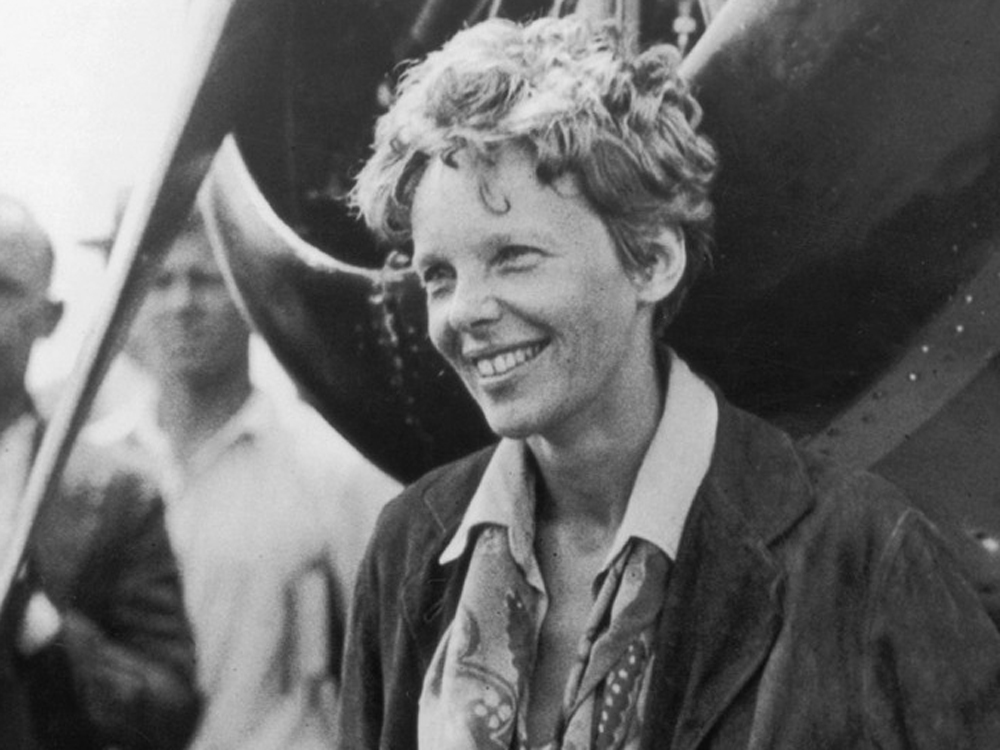
Amelia Earhart after her own solo transatlantic flight in 1932 - 1700 miles shorter than Lindy's.
It’s symbolic of Putnam’s whole approach to Earhart’s career that he signed her, over her objections, to appear in a print ad for Lucky Strike cigarettes, although Earhart did not smoke. The ad didn’t say she smoked, but the implication was clear. What Putnam didn’t anticipate was a strong negative push-back from a public — particularly a female public — that didn’t approve of women smoking.
Earhart was charming, and she did set some speed and distance records, but her indelible place in the public consciousness was based on Putnam’s manufactured image — and on her disappearance in 1937 while she and navigator Fred Noonan were over the Pacific Ocean during an attempt to fly around the world along the equator — a feat that would have had virtually no significance in aviation by that time. Winters points out that Earhart still had limited understanding of radio operation and that neither she nor Noonan knew Morse code. A naval vessel — in a typically improper use of public resources to support Earhart’s private escapades — was trying to monitor Earhart’s approach to tiny Howland Island where a landing strip had been constructed for her at public expense. The crew couldn’t keep contact with the flyer, and all indications are that she and Noonan couldn’t spot the minuscule island or wandered off course and wound up in the ocean. Bone fragments discovered late last year on a Pacific island are being examined for any connection to Earhart. Winters notes a melancholy detail: An experienced flyer encouraged Earhart to have the rudders and wing strips of her Lockheed painted red so that it would be easier to spot if it went down. Earhart liked the plane’s paint job fine just as it was.

Hilary Swank and Richard Gere as Amelia Earhart and George Putnam in the 2009 film "Amelia"
O, Pioneers!
February 25, 2011
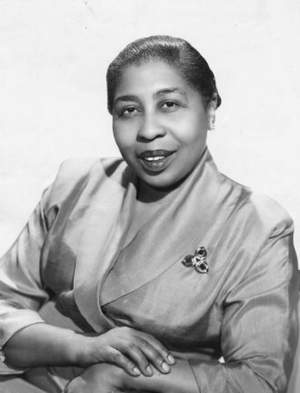
Amanda Randolph
PBS has been running a series of documentaries under the title “Pioneers of Television.” We have watched three of them — on westerns, detective shows, and sitcoms — and found them informative and entertaining. Being the quarrelsome type, however, I question the use of the term “pioneers” — at least with respect to sitcoms, which were the topic of Monday night’s broadcast.
The program included segments on Jackie Gleason – specifically on the one full season of “The Honeymooners,” Lucille Ball, Andy Griffith, Danny Thomas, and Dick Van Dyke and Mary Tyler Moore. I can’t argue with the stature of those performers nor with the contributions all of them made to the development of TV comedy. But while there were some general references to the fact that situation comedies originated on radio, I don’t understand how a documentary about sitcoms can ignore Gertrude Berg.

Gertrude Berg
I had a similar complaint — and wrote about it here — when the US Postal Service released a series of stamps honoring “pioneers” of television and didn’t include Gertrude Berg. I won’t repeat that post here, but Berg started her show — most widely known as “The Goldbergs” — on radio in 1929 and moved it to television in 1949. She owned, produced, and wrote the show, and she played the main character. Although it was a comedy, the show had very serious overtones, and it was the first show of its kind to introduce general audiences to the family lives of American Jews. That’s not a pioneer?
While I was watching that program Monday night, I spotted an actress named Amanda Randolph in a still from the Danny Thomas show. She played Louise, the wisecracking maid to the “Williams” family. By that time, Amanda Randolph had been an entertainer for more than 30 years — as a piano player and then as an actress in radio and movies. She was the first black actor to star in a regularly scheduled television show — “The Laytons” — which ran for a couple of months on the old Dumont network in 1948. She later had a recurring role as Ramona Smith – the mother of Sapphire Stevens – on the television version of “Amos ‘n’ Andy” — the first TV show with an all-black cast, and the last one for many years. That’s not a pioneer?

Lillian Randolph
Amanda Randolph was the older sister of Lillian Randolph, another groundbreaking black actor and singer. She started working in radio in the mid 1930s and became a mainstay in that medium and in television and films. She had a recurring role in the radio, television, and movie versions of the popular comedy “The Great Gildersleeve,” and she played Madame Queen — girlfriend of Andy Brown — in the radio and TV versions of “Amos ‘n’ Andy.”
Lillian Randolph may be best remembered now for the role of Annie in “It’s a Wonderful Life.”
Somebody at PBS doesn’t remember, but I do.
Amelia Earhart: Is it you at last?
February 22, 2011
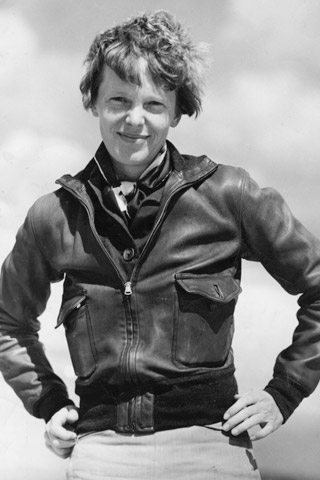 I see by the papers, as it were, that a scientist in British Columbia is going to try to identify bone fragments believed to be those of Amelia Earhart by using DNA technology. Earhart went missing in July of 1937 and was presumably killed along with navigator Fred Noonan during their attempt to fly around the world along the equator. Their bodies were never found, but bone fragments that were found on a Pacific island late last year are being examined at the University of Oklahoma to determine if they are the remains of Earhart. A story published today by The Canadian Press reported that a forensic archeologist at Fraser University in Vancouver is going to try to recover Earhart’s DNA from envelopes that contained letters written by Earhart. The letters were opened at the ends, so the flaps are intact. The premise of the study is that Earhart probably licked those flaps in order to seal the envelopes and that DNA from her saliva may still be present.
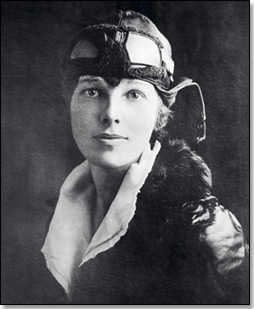 This news breaks while I’m in the midst of reading a recent biography of Earhart by Kathleen C. Winters. I’ll probably post a review here in a few days.
From a practical point of view, it may not matter very much whether those bones are Earhart’s or not. As there always are in such cases, there are folks who want to believe that the explanation for her disappearance is more complicated than that her plane went down, but there is no evidence to support them. On the other hand, anyone with a sense of history hates stories with missing conclusions. So a definitive finding that those bones belonged to Amelia Earhart would serve two purposes – putting unfounded theories to rest and putting the period to an historical epoch.
 CharlesPaolino's Blog