Books: “The Man who Broke Into Auschwitz”
August 26, 2011

DENIS AVEY/BBC photo
The title of the book is misleading. Denis Avey, a British soldier during World War II, didn’t break into Auschwitz. He was a POW there, so he was already within the walls, as it were. He and the other inmates had been put to work building an enormous industrial plant in which a German company planned to manufacture synthetic rubber and methanol. From the first, Avey was deeply disturbed by the condition of the Jewish prisoners – the “stripeys” he called them because of their pajama-like uniforms. He was so distressed in fact, that he became obsessed with the need to see for himself the section of the Auschwitz complex where the Jewish inmates lived. If he survived the prison himself, Avey wanted to be a witness.

AVEY with Prime Minister GORDON BROWN/BBC
So compelling was this need in Avey’s mind that on two occasions he swapped clothing with a Jewish inmate and shuffled off with the other Jewish prisoners at the end of the work day. What he found was at least as bad as he had imagined.
That part of Avey’s story is recounted in “The Man who Broke into Auschwitz,” which he co-wrote with Rob Broomby, a BBC reporter who worked very hard to help Avey reconstruct the experience 60 years after the fact.
Before he was sent to Auschwitz, Avey had seen plenty of combat in North Africa. He was part of the force that first drove the Italian army out of Egypt and across Libya and then went on the defensive when Erwin Rommel brought his Afrika Korps into the fray and reversed the tide of battle for a time.

ERWIN ROMMEL
Avey, who explains that he went to war in the first place for adventure, not for King and country, was a brash sort whose chutzpah both got him into scrapes and enabled him to survive on both the battlefield and in prison. Once he was captured, he escaped several times including one final time during a forced march eastward in the dead of winter when the Nazis abandoned Auschwitz in order to elude the advancing allies.
On one occasion, Avey watched while an SS officer repeatedly beat a Jewish inmate until the young man died. Avey was already frustrated by both the fact that the Nazis were deliberately working the Jews to death and by the knowledge that he couldn’t do anything about it. When that young man died, Avey shouted a crude German insult at the officer, who responded by cold cocking Avey with the butt of a hand gun. The injury cost Avey his sight and eventually the eye itself.
But the worst injury he suffered was psychological. When he finally returned home, his own family – including his father, who had also enlisted – didn’t want to discuss the war at all, and others wanted to hear only about derring-do on the battlefield. No one was interested in, or capable of confronting, the truth about the concentration camp.
 Avey himself stopped talking about it for decades, and he suffered nightmares and other signs of post traumatic stress disorder – a problem that was not recognized and therefore not treated at the time.
There is much more to this story, including the unexpected outcome of a small favor Avey was able to do for one Jewish inmate, but that’s best read in the pages of Avey’s book. It was largely because of Broomby’s work that Avey was eventually able to talk openly, and write, about what he experienced. The two men have performed an important service, because it is critical that knowledge of what the Nazis did be kept alive in the public consciousness.
That’s true both because of the crimes committed by the Third Reich and its collaborators but also because such atrocities have been committed again and again since then – the difference being only one of scale.

From the mound to the altar
August 25, 2011

WARREN SPAHN
Since it was our 47th wedding anniversary, Pat and I went to dinner Monday night at that great Italian place in Clinton. We ate on the patio. In the opposite corner was a family of four — parents and a teenager of each gender. Before we got there, some guy who was riding a bike along the sidewalk recognized the family and stopped to talk. In fact, he parked the bike and sat down on the brick wall and made himself comfortable. The father in the family act, pretty much ignoring everyone else at the table, spend the time shooting baseball trivia questions at the visitor. I found this a little off-putting, both because he was talking loud enough for us to hear and because of the quality of the questions. What left-handed pitcher won the most games lifetime? Puh-leez! Give me something I can work with, will ya? (By the way, that was Warren Spahn with 363, which is also the greatest number of wins by any pitcher who spent his entire career in the live-ball era.)
Now, me? I would have asked him about Allen Travers, capisce? I was thinking about Travers the other night when the announcers on the Yankee broadcast were obsessing over the fact that Phil Hughes had thrown 106 pitches in a game for the first time this season.
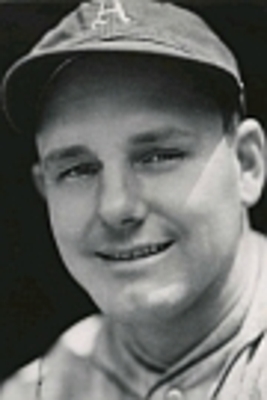
EDDIE ROMMEL
Besides making me worry that Hughes might have to spend the rest of his life with a prosthetic arm, that conversation got me to thinking about all the great performances that would never have taken place if the pitch count had been a part of baseball from the beginning.
I was thinking, for example, about Eddie Rommel — later an American League umpire — who spent 12 years pitching for the Philadelphia Athletics and supposedly invented the knuckle ball as we now know it. In 1932, Rommel came in in relief against the Indians in the second inning, behind 3-2. He pitched 17 innings, gave up 29 hits and 15 runs, and won the game 18-17. The 29 hits allowed is still the single-game record.
Travers was a different matter. He was a student at St. Joseph’s College in Philadelphia in 1912 when Ty Cobb of the Detroit Tigers went into the stands at Hilltop Park in New York to pummel a New York Highlanders fan who had been verbally abusing him during a game. It turned out that the fan had lost one hand and several fingers from the other hand in an industrial accident. Ban Johnson, president of the American League, suspended Cobb indefinitely. When the Tigers were supposed to play the Athletics in Philly a couple of days later the team announced that they wouldn’t take the field until Cobb was re-instated.

Fr ALOYSIUS TRAVERS
The League told the Tigers they faced a $5,000 fine and would forfeit every game until there were players. To avoid the penalties, the Tigers enlisted Allen Travers — non-playing manager of the St. Joseph baseball squad — to round up a team off the streets and sandlots of Philadelphia. The nine guys were signed by the Cardinals. Travers was on the mound, and no one counted his pitches. He pitched eight innings and gave up 24 runs, which is still the major league record. The Athletics won the game, 24-2.
Travers later became a Jesuit and taught in college and high school in New York and Philadelphia. The 24 runs allowed wasn’t his only record. He was also the only major league player to become a Catholic priest.
But who’s counting?
You can read a fuller account of Father Travers’ experience by clicking HERE.
“We never repent of having eaten too little” — Thomas Jefferson
August 17, 2011

Gov. CHRIS CHRISTIE
I caught a few minutes of Ann Coulter’s appearance on one of the Sunday talk shows this week, and found that by not tuning in earlier I had missed hearing her reasons for promoting Chris Christie as a Republican presidential candidate.
Apparently, it wasn’t a half-hearted endorsement; I heard her refer to the governor as “my first love.”
Coulter is not the first person to make this case. Christie is a controversial figure in terms of his public policy and his style, but he seems to be developing a following around the country.
Still this kind of talk has an unfamiliar ring to us in New Jersey because, except for Bill Bradley’s failed attempt to win the Democratic nomination in 2000, making presidents has not been our thing in recent decades.
Even the two we contributed in the distant past had imperfect credentials. Woodrow Wilson wasn’t born in New Jersey, and Grover Cleveland – who was born here and is buried here – spent most of his life someplace else.
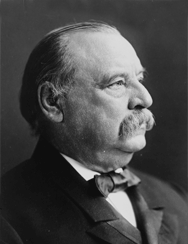
GROVER CLEVELAND
Christie hasn’t lent much credibility to the idea that he would be a willing candidate, but if he should run, one thing that has come up already and surely would get a lot of attention in the news coverage – and late-night commentaries – would be his girth.
Christie himself has often acknowledged that his weight is a result of his eating habits and that it is unhealthy.
In the world we live in, it is also a potential liability from the aesthetic point of view.
There already have been stories speculating as to whether a man of Christie’s size can be elected president – kind of a diss on the intelligence of the body politic.
In fact, that question has already been answered twice by the elections of William Howard Taft and Grover Cleveland.
Taft, the largest president so far, was six feet tall and weighed more than 330 pounds when he was elected president in 1908. After Taft had left the presidency, he lost about 80 pounds, which lowered his blood pressure and improved his ability to sleep.
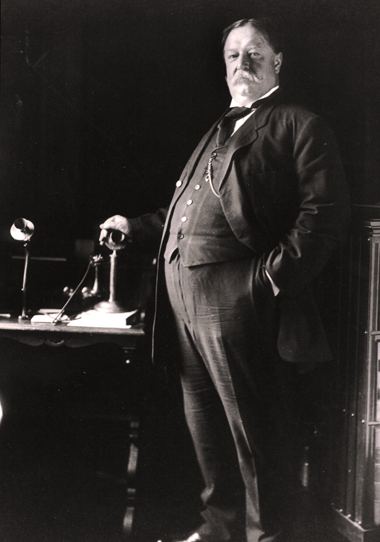
WILLIAM HOWARD TAFT
Cleveland – whose weight isn’t mentioned as frequently as Taft’s – was five-feet-eleven and weighed between 235 and 280 pounds. His weight is noticeable in photographs from his presidential years, but it apparently didn’t trouble the citizens who gave him the majority of the popular vote three times in a row – the only president besides Franklin Roosevelt to achieve that. (In 1888, Benjamin Harrison won the majority of the electoral votes.)
The criticism directed at political candidates in the 19th and early 20th centuries could be as cruel, in its own way, as the attacks that are leveled today. Cartoonists gleefully exploited the proportions of both Cleveland and Taft, and no one’s physical appearance attracted more public ridicule than that of Abraham Lincoln.
But the pervasive and relentless nature of media in our age add a lot of destructive power to negative messages.
Some voters might be legitimately concerned about the life-threatening nature of Christie’s weight, but the web of electronic communications has given people the idea that they can – and should – say virtually anything that comes into their heads. The comments posted on web sites suggest that many writers think it’s a virtue to be as coarse and demeaning as they can.
I noticed, for instance, that folks who frequent a Facebook page for graduates of my high school alma mater, say some pretty awful things about former teachers and classmates – undaunted by the fact that most of their targets are still living and could easily read these messages.
For his own well-being – particularly if he takes on the rigors of a presidential campaign and a term or two in the White House – Christie ought to do something about his weight.
Besides prolonging his life, it would spare him and his family the meanness that has become the lingua franca of smart alecs in the digital age.

Woodrow Wilson with his predecessor, William Howard Taft, shortly before Wilson was inaugurated as the 28th president. In 1921, the 29th president, Warren G. Harding, appointed a slimmer Taft chief justice of the United States. Taft is the only person to have held both offices.
Books: “What a Wonderful World”
August 13, 2011
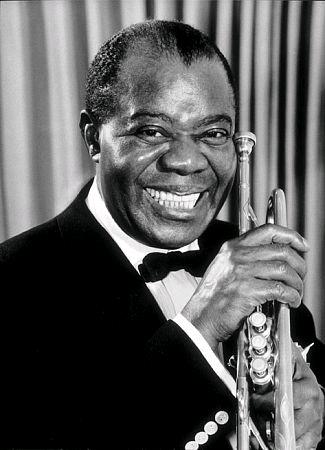
LOUIS ARMSTRONG
Sometime in the early 1960s, I went with a couple of my cousins to hear Louis Armstrong and his band play at Seton Hall University. I can’t remember how I decided to attend that show; there was not a single Armstrong recording among my LPs – which were dominated by operatic arias and country-and-western songs. I knew Armstrong from his television appearances, and I do recall finding him irresistible: not the trumpeter — I didn’t know from trumpets — the whole package. Whenever Armstrong’s image appeared on the black-and-white screen, I would pay attention. He was unique, and he was entertaining.
I was not aware until I read Ricky Riccardi’s recent book, What a Wonderful World, that the quality that attracted me to Louis Armstrong was the very thing that some folks found irritating, disappointing, even traitorous. Jazz purists objected to Armstrong’s departure from his musical roots in his native New Orleans, and many black Americans objected to his on-stage persona, in which they saw the perpetuation of the minstrel end man – a clown whose vocation was amusing white audiences. This was complicated by the fact that although Armstrong was at the height of his international fame in the heyday of the American civil rights movement, he played no visible part in the campaign — this, despite the fact that he and his band had often felt the sting of prejudice.
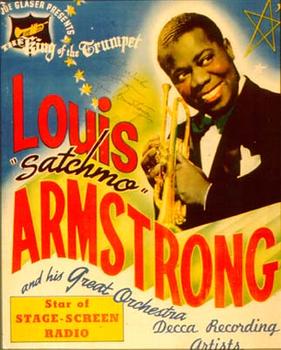
In fact, Armstrong refused for decades to appear in New Orleans as long as local laws prohibited mixed-race bands — perhaps an ironic position for him to take, given the fact that one of the raps on him was that he was willing to play before segregated audiences. His explanation was that he played where his manager booked him, and that he played for whoever wanted to hear him — and they were legion. Armstrong maintained that he contributed as much as anyone else to the progress of black Americans, because he paved the way for others to be received by white audiences.
His bookings are an interesting topic in Riccardi’s book. Armstrong’s manager during the last several decades of his career was Joe Glaser, a Chicago tough guy with a criminal background. There was some kind of bond between the two men — so much so that their arrangement was based on a handshake so that Glaser’s financial obligations to Armstrong were not spelled out. Glaser certainly got rich on the relationship, and Armstrong insisted that he had everything he wanted in life, including his daily regimen of marijuana and an herbal laxative that he treated as kind of a sacrament.
 Riccardi describes in some detail the schedule kept by Armstrong and his band, the All Stars. It’s exhausting just to read about it. It was not unusual for the musicians to perform forty one-nighters in a row without a break — and this went on for decades. Outsiders thought Glaser was taking advantage of Armstrong, wringing out every dime he could before the man dropped dead. Armstrong denied this; Riccardi doesn’t seem to accept it, but even in the material the author provides in this book — such as a letter in which Armstrong complains to Glaser about being treated “like a baby” — there’s a strong insinuation that the critics were right. Armstrong himself insisted that he was doing what he wanted to do, but he also complained from time to time about exhaustion, and he lost more than one player from the All Stars because the grind was just too much.
 Riccardi, who is a student of music and an authority on Armstrong, defends Armstrong’s repertoire; the subtitle of the book is The Magic of Louis Armstrong’s Later Years. Among the criticisms of Armstrong was that he played almost the same song set night after night, to which Armstrong replied that he played what the paying audience expected him to play. As for the indictment of Armstrong’ s wide grin and rolling eyes, it never occurred to me that those mannerisms were supposed to be a stereotype of a black man — if it had occurred to me, I would have been offended and would not have been at that show at Seton Hall. To me, Armstrong was just being himself. Still, his position on race, as Riccardi presents it in this book, was ambiguous at most. At times he would lose his temper and rant about the way black Americans were treated, but he was also capable of making a statement in which he adopted a shaky rationale based on a distinction between “lazy” black people and industrious ones like him. In the event, Armstrong had almost no black audience when he was recording his enormous pop hits, “Hello, Dolly” and “What a Wonderful World” and whether that was due to his play list or to his attitude toward his race remains a matter of conjecture.
You can watch and listen to Armstrong sing and play “Mack the Knife” by clicking HERE.
Books: “The Abacus and the Cross”
July 29, 2011
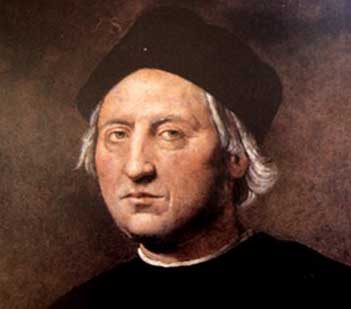
CHRISTOPHER COLUMBUS
In a post last December, I mentioned in passing the widely held fiction that when Christopher Columbus set off on his first voyage, many if not most Europeans thought he would sail his ship off the edge of a flat earth and into oblivion. I was taught this in elementary school, and I have spoken to many people my age who remember being taught the same thing. More recently, I questioned my college students about this, and many of them said they had the same impression about Columbus.
The fact is that it was common knowledge among Columbus’ contemporaries in Europe that the world was round — a point that Nancy Marie Brown makes in her book, The Abacus and the Cross.
This book is not about Columbus; it’s about Gerbert of Aurillac, a French monk who lived in the 10th century. Gerbert had a thirst for knowledge and he became thoroughly schooled in the humanities and in the sciences.

GERBERT of AURILLAC
His scholarship carried him to Spain, where he came in contact with a thriving Arab Muslim culture which had preserved enormous amounts of philosophical and scientific knowledge that had been lost to Europe. Gerbert seems to have had both the curiosity and the capacity of a Leonardo or Michelangelo, and he devoured as much learning as he could. He was engrossed in both mathematics and in music, for example, and in the relationship between the two disciplines. He scrutinized the properties of organ pipes, and he eventually designed a built a prototypical organ that was not driven by water — the common technique of his time — but by forced air.
He didn’t only strive to satisfy his own curiosity. He was an influential teacher whose students included royalty. In the process of carrying out this vocation he introduced Europe to the place system of arithmetic — vertical rows for the ones, tens, hundreds, and so forth — which was much more efficient than the clumsy Roman system and which the western world has been using ever since. In this connection, he also carried back from Spain numerals that had originated in India and that had been adapted by the Muslims — the forerunners of the so-called Arabic numbers we use today. As the title of the book suggests, he learned in Spain to use an abacus board to calculate, and he later designed his own versions and taught others how to use them.
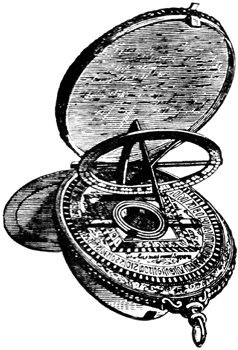
AN ASTROLABE
Also among Gerbert’s interests was astronomy. He learned all about astrolabes, overlaid disks that were used to trace the positions of the sun and the moon and the stars and the planets — and tell time — and about celestial globes, which were three dimensional representations of the apparent paths of the heavenly bodies. He made his own models of these instruments, too, sometimes taking as much as a year to finish one.
As Brown points out, it is clear not only that Gerber, in the 10th century, knew that the world was round, but that Pythagoras determined that around 530 BC, and Erastosthenes figured out how to calculate the circumference of the globe by 240 BC. Some flat-earthers persisted, but by the time of Columbus the point was moot in western Europe. Columbus knew the world was round; his mistake was in underestimating the circumference.
Being a churchman in that era, and one who enjoyed consorting with powerful people, Gerbert inevitably got drawn into the constant political turmoil in Europe, and his fortunes rose and fell along with those of his patrons.
He almost ended on a high note when he was elected Pope Sylvester II in 999 AD.
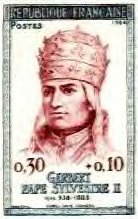
SYLVESTER on FRENCH STAMP
Even that didn’t turn out so well, because he had to flee Rome for a while along with his patron of the moment, the Holy Roman Emperor Otto III. Sylvester died in 1003.
During his lifetime and for a long time after his death he was the subject of rumors that he consorted with the devil or engaged in sorcery. Ironically, this was because of his pursuit of knowledge in astronomy and mathematics, which in some ignorant minds were associated with the occult.
Four with fries. Yes, I said four!
July 27, 2011
 There’s a place in New Brunswick that serves up a hot dog known as the “crackler.” A strip of bacon is wrapped around the dog like an armature, and the dog and bacon are deep fried. I used to frequent that place — Tido ‘n His Junkyard Dogs — before the Gannett Co. discovered that I was of no further use and I had to find work in another neighborhood. I thought to myself at first that it might be easier to forego the cracker and simply put a loaded revolver to my head, but my watering palate got the best of me, and indulged myself from time to time. I suppose one could make the argument that I was putting my family’s future at risk by abusing my arteries in that manner, but I was, after all, accepted “for better or for worse,” and if this was as bad as “worse” got, perhaps it wasn’t a bad bargain for anyone concerned.
I have often wondered, standing in a checkout line while some bloke at the front asks the clerk for an eight-dollar pack of cigarettes from the vault, whether I would still lay down that much money if I had been a smoker. I have never been a smoker, so I have never had to confront that dilemma, but it seems as if New York Times columnist Mark Bittman would like to come at me from a different direction.
Bittman wrote this week that the federal government should heavily tax unhealthy foods so as to discourage people like me from becoming a drain on the health care system.
 This is the approach that has already been taken with cigarettes, which the feds and the states have gleefully taxed and taxed again, boasting that they’re only looking out for people who can’t look out for themselves, whereas what they’re really doing is compensating for their own inability to control government spending by making scapegoats of people engaged in an unpopular but legal activity. The last I heard, beer wasn’t a healthy drink. Why don’t governments tax the hell out of that? I think you know why.
Bittman isn’t in government, and I don’t suspect him of such a cynical motive — although he does mention the potential for billions in tax revenues from consumers of donuts and Pepsi. I think he means well, and in a way that’s almost worse. Government can do whatever it wants in the way of public education — things such as Mayor Bloomberg’s calorie-posting requirement — but slapping what amounts to a financial penalty on people exercising their freedom to eat what they choose, which is perfectly legal, is too much government in private life.
You can read Mark Bittman’s column by clicking HERE.
“Oh, bother!”
July 22, 2011

JIM CUMMINGS
I was shocked when a colleague told me the other day that she had never read the Winnie-the-Pooh books, and I suppose I should have hidden my surprise better than I did. That’s a conceit of mine – that everyone’s life experiences should be the same as my own. Then again, we’re talking about Winnie-the-Pooh, for heaven’s sake.
This conversation was occasioned by the fact that Pat and I went on Sunday to see the new Disney movie, Winnie-the-Pooh, with our daughter and our two grandsons. The film is well done with hand-drawn images and a story line that are true to the spirit of both A.A.Milne, who wrote the books, and Ernest Shepard, who illustrated them.
Milne and Shepard, of course, provided text and pictures, but they did not provide the voices of the characters. That was left to the Disney studio, where some genius cast Sterling Holloway in the title role of Winnie-the-Pooh and the Honey Tree in 1966. Holloway played the part in two more Disney short features, and his high-pitched, plaintive voice became the voice of Pooh for a couple of generations of kids and adults who, by the mercy of God, have not fully grown up.

STERLING HOLLOWAY
Holloway retired in the 1970s, and the Disney casting office had another epiphany, choosing voice actor Jim Cummings – who can be heard in about a hundred films – to speak for Pooh, as it were. It was a tough assignment for an actor who, I’m sure, wanted to do his work without a ghost looking over his shoulder but also wanted to keep the character authentic in the minds of the audience. No problem. Cummings’ performance is distinctive, but it has the ring of a bear, and a hungry one at that, of very little brain.
Cummings knows something about following a tough act. He also took over the role of Tigger in the Pooh films after the retirement of Paul Winchell, who entertained audiences in the 50s and 60s with a ventriloquist act that featured the mannequin Jerry Mahoney, and who was also the first person to design and build an artificial heart.
I can’t say I missed Holloway while we were watching Winnie-the-Pooh, but I miss him in general. I first became aware of him when he appeared in the recurring role of eccentric but gentle Waldo Binney, a neighbor of the title family on the series The Life of Riley, which starred William Bendix as Chester A. Riley.

HOLLOWAY and ALTER EGO
Holloway was unique, sui generis, in the quirkiness of his appearance, his demeanor, and his voice, so it was always a pleasure to run across him in movies or TV shows – the latter including The Amazing Adventures of Superman. He appeared in about 150 screen and TV properties over all. In the 1970s, he also did voiceover commercials for Purina Puppy Chow dog food, and sang what was then a familiar jingle: “Puppy Chow / for a full year / till he’s fully grown.”
As often happens with performers who have long careers, two of Holloway’s landmark achievements are largely forgotten – namely the fact that he introduced two songs that became a permanent part of the American musical repertoire. This occurred when he was appearing on Broadway in the 1920s and the songs were “(I’ll take) Manhattan” and “Mountain Greenery,” both composed by Richard Rodgers and Lorenz Hart.
Holloway, who never married because – he said – he liked his life the way it was, died in 1992 at the age of 87.
Click on THIS LINK to see and hear Sterling Holloway singing “A Perfect Day,” a song written in 1909 by Carrie Jacobs Bond. Holloway’s touching rendition occurred in the 1940 film “Remember the Night.”

George Reeves and Sterling Holloway in an episode of the TV series "The Amazing Adventures of Superman."
Books: “Stan Musial: An American Life”
July 15, 2011
 It might be significant that I couldn’t think of any way to begin this post about Stan Musial — any way but this, that is. The thesis of Stan Musial: An American Life is that, because Musial played his whole career with the St. Louis Cardinals, he has been perennially undervalued vis-a-vis his contemporaries who played in cities like Boston and New York. I grew up during his career, and it’s true that, living in the New York area — especially after the National League teams both slunk out of town — Musial was not the topic of everyday conversation.
He was, as New York Times columnist George Vecsey suggests in this book, just kind of there, and the next thing we knew he had accumulated more than 3,600 hits and had established himself as one of the best hitters of his era.
Musial came from Donora, Pa., which was a gritty industrial town where his dad worked in a steel mill whose management wasn’t concerned about the employees’ health. Vecsey draws a detailed picture of life in that town, and that may be the most worthwhile part of this book. Young Stan was a good athlete, but he got into the Cardinals’ organization as a pitcher — something he wasn’t suited for.
 In 1941, he had a storybook season. He started out in the spring in the Cards’ baseball camp in Hollywood, Fla., where he was supposed to pitch batting practice, and by the end of the summer he had been converted into a hard-hitting outfielder and was called up by the parent team for the last week of a pennant race.
He played for the Cardinals until he retired in 1963, amassing one of the great personal records in the game plus a reputation for reliability, and for dignity on the field, and for a cheeful and hospitable approach to life. He was well liked in and out of the game.
While it is true, as Vecsey writes, that Musial’s extraordinary career has been overshadowed in the popular mind by the careers of contemporaries like Joe DiMaggio in New York and Ted Williams in Boston, his numbers are indelibly preserved in the record book where they put the accomplishments of other players in perspective, for better or for worse. Derek Jeter, for instance, has achieved what only 28 out of about 17,000 major league players have achieved, and yet he can’t escape the ink that says that Musial’s mark in total hits is out of reach.
But Vecsey, writing about “an American life,” does a little too much fawning over Musial and not enough exploring of aspects of the ballplayer that Vecsey himself brings up. He dwells on Jackie Robinson’s revolutionary appearance with the Brooklyn Dodgers in 1947 and he intimates that Musial was at most a passive participant in the breaking of the color line, but he does not deeply plumb Musial’s attitude on race.
 Vecsey reports that Musial was spared military service during the heat of World War II on the grounds that he was a parent and the sole support of his mother and father – who, incidently, had several other children; that he declined to join an army unit when a baseball colleague urged him to do so, and that, when his number was up, as it were, he served at the tail end of the war by playing baseball in Hawaii and then by flying a stateside desk. The author writes, too, that Musial was not an activist when his fellow players rebelled against the reserve-clause system that for a long time made players the property of their owners, the Fourteenth Amendment notwithstanding. In a broader way, Vecsey writes that Musial was a peacelover, meaning that he liked to avoid conflict. We are left to infer that Musial was happy in statu quo so long as things were going well for him — which they were for several decades.
Vecsey does at least let a voice other than his own — that of former Cardinals star Curt Flood — speak to the question of who Stan Musial really is. Flood unsuccessfully sued major league baseball after refusing to agree to a trade in 1969; his suit was the opening shot in a movement that ultimately changed labor relations in baseball.
In his autobiography, Flood wrote that he and other players respected Musial as a player and as a person; they thought of him as a man who would not consciously do harm. But, Flood continued, “He was just unfathomably naïve. After twenty years of baseball, his critical faculties were those of a schoolboy. After twenty years, he was still wagging his tail for the front office – not because he felt it politic to do so but because he believed every word he spoke.”
Netflix Update No. 49: “Sabah”
July 10, 2011

ARSINEE KHANJIAN
The 2005 Canadian film Sabah has a lot to recommend it, but nothing more potent that Arsinee Khanjian, the actress in the title role.
The film concerns a family of Syrian Muslims living in Toronto. Sabah is an unmarried 40-year-old woman who is responsible for looking after her stylish but perhaps a little hypochondriac widowed mother. Unlike most of her family, Sabah wears drab traditional Muslim clothing — something that seems to symbolize the oppression she has been subjected to by her brother Majid (Jeff Seymour) since their father died. Majid wants Sabah at their mother’s side, and he monitors Sabah’s movements and finances as though he were her father.
In an unusual act of rebellion, Sabah — who loved to swim when she was a child — begins to surreptitiously visit an indoor pool in the city, despite her brother’s instruction that a Muslim woman is not seen in a bathing suit in public. At the pool, Sabah meets a secular Christian man, Stephen — played by Shawn Doyle — who is very courteous to her but also is clearly fascinated with the timid woman from their first encounter.

SHAWN DOYLE
The poolside meetings evolve into a sweet romance, but Sabah’s insistence on keeping the relationship a secret from her family tries Stephen’s patience. Meanwhile, Majid’s young niece defies him by refusing to accept his choice of a husband for her, as Majid wrestles with a broader family problem that he has been keeping from his mother and siblings.
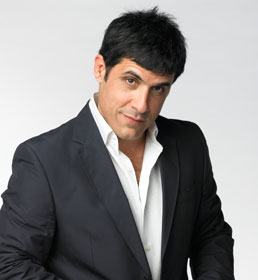
JEFF SEYMOUR
This movie — sort of an Abie’s Irish Rose for the 21st century — infuses the familiar challenge of intermarriage with a well-written script and thoughtful direction, both by Ruba Nadda, a Canadian of Arab ancestry. Our only reservation about the book was that the resolution of the family’s complicated problems was a bit too sudden — especially given the earlier intransigence of Majid.
The characters are all well played, and Doyle in particular deserves credit for the nuances and subtleties he brings to the person of Stephen. But Arsinee Khanjian, who was 45 when she made this film, is irresistible in the part of Sabah. The initial vulnerability, the glimpses of fire beneath a stoic exterior, and the thrill of her growing awareness of a wider world than she has ever known make Sabah an unusually attractive figure.
This film was well received when it was introduced, and those of us who are catching up to it late can see why.
Netflix Update No. 48: “Broken English”
June 10, 2011

PARKER POSEY
In the 2007 film “Broken English,” Parker Posey plays the kind of character who makes you wish you could climb into the screen and either hug her or slap her. She is Nora Wilder, and if the name seems a little distingué, Nora isn’t. She has a nice little management job in a nice little Manhattan hotel, but she doesn’t have a successful love life. Other thirtiesh women do — or seem to, at least — but when Nora does start dating a man these days, the outcome is never good, what with the other girlfriend and the ex who can’t let go and like that. The situation isn’t made any better by Nora’s mother, Vivien — very well played by Gena Rowlands — a sweetheart for all other purposes who has a clumsy way of reminding Nora of her desperate condition.
Nora does meet one man who doesn’t seem to be dragging around the barnacles that weigh down her usual beaux – a thoughtful Parisian named Julien, played by Melvil Paupaud. Considering her experiences up to this point and the sharp contrast presented by this liaison, her tentative approach to this man is both understandable and frustrating.

MELVIL PAUPAUD
Julien returns to Paris, and the action of the movie follows him there, and from that point, you’re on your own.
This movie, which was written and directed by Zoe Cassavetes, got a lot of attention at the Sundance Film Festival, and with good reason. The story is effectively filmed in realistic surroundings in New York and Paris; there’s nothing obvious here. The writer does lean a little heavily on coincidence at one point, but so did Dickens. Cassavetes achieves just the right balance between the oppressive nature of Nora’s dilemma and the comic situations that arise from it.
What with the actors, the characters, the story and the cinematography, this is worth a couple of hours on the couch.
 CharlesPaolino's Blog