Netflix Update No. 55: “Lovely, Still”
November 14, 2011
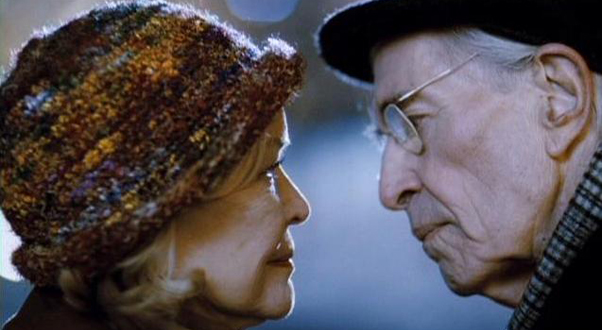
ELLEN BURSTYN and MARTIN LANDAU
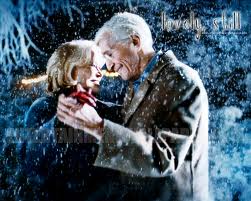
After we watched Lovely, Still, a 2008 film starring Ellen Burstyn and Martin Landau, I poked around on the Web and found the widest possible range of opinons — from a contemptible piece of trash to a work of genius. Put me down as confused, which I guess is somewhere between the extremes. This movie, directed and written, in part, by Nicholas Facker, concerns elderly Robert Malone (Landau), who appears as a solitary man who lives alone and works at a nearby supermarket — near enough that he has been walking to work since he crashed his car into his garage door.

MARTIN LANDAU
During his lunch breaks at the market, Robert passes the time making pencil drawings that reveal a high level of skill that seems out of place in a man whose life is so drab and pointless. While he is drawing one day, he is approached by Mary (we are not told her last name), played by Burstyn. She introduces her self and tells him that she admires his drawing. When Robert returns home that evening, he finds the front door of his house ajar. Unaware that he didn’t close the door when he left for work, he cautiously enters the house to search for an intruder, and he finds one — Mary, who lives across the street with her daughter, Alex, played by Elizabeth Banks. As Mary tries to explain that she had seen the open door and wanted to make sure he was all right, the startled Robert screams at her to get out of his house.

ELIZABETH BANKS
When Robert calms down, however, he apologizes and the interchanges that follow end up with Robert accepting Mary’s invitation to take her to dinner the following night. Although Alex is wary of this, for reasons she does not state, Mary pursues the relationship which evolves into a romance, the first romance, Robert tells her, he has ever had. Meanwhile, Robert seeks and receives advice on courtship from his boss, Mike (Adam Scott), who seems to be more than reasonably solicitous of this confused old man, even going shopping with Robert to pick out Christmas presents for Mary. This movie is swathed in Christmas lights and sentimental music, and early on we became uneasy about the fairy tale. Eventually, Mary’s behavior and demeanor signal that something is seriously amiss — that there’s something she isn’t telling us. Sure enough, in the last few scenes, we learn that nothing in the film, including the relationships among the major characters, is what it seemed to be, and that the truth is as harshly real as the setup for it was cozily unreal. To complicate matters, we didn’t fully understand what had really happened and we couldn’t make heads or tails of the conclusion. As I poked around on the Web, I found that we were not alone. We speculated about what the writers might have been trying to convey, but we could find reasons to dismiss every theory we concocted.

ADAM SCOTT
That’s too bad, because in our view this film has a lot to recommend it: the musical choices, the photography, and particularly the exemplary performances by all four major players. The story, in spite of its obscure ending, also effectively calls attention to the loneliness of people whom we encounter in everyday life and to the possible consequences of old age.
So we liked it as far as we could, but we’re confused. Perhaps someone else will watch Lovely, Still and open our eyes.
Books: “Clarence Darrow: Attorney for the Damned”
November 11, 2011

Richard Loeb (left) and Nathan Leopold
I was surprised to find in some recent conversations that acquaintances my age don’t remember the “Free Nathan Leopold” movement. I was in my teens when it reached its climax, and I remember reading about it in newspapers and hearing about it on broadcast news. I probably was more attuned to it, because I read a paperback book about Leopold and his friend Richard Loeb, who in 1924 had murdered a 14-year-old boy just to show that they could do it. It was characterized for many years as “The Crime of the Century.” Leopold and Loeb were very rich and very bright young men, not yet 20, and they had gotten caught up in the philosophy of Friedrich Nietzsche. They decided that they fit the mold of Nietzsche’s “superman” and that they were above the law — an idea that the State of Illinois didn’t share.
This is one of the cases John A. Farrell writes about to support the title of his excellent book, Clarence Darrow: Attorney for the Damned. It was one of the two cases for which Darrow is best remembered — the other being the Scopes trial, which involved the teaching of evolution in a Tennessee school — but, as Farrell describes in detail, there was much more to Darrow himself and his tumultuous legal career.

Clarence Darrow
Darrow was a complicated man, a mass of contradictions. He was also one of the great celebrities of his era, attracting enormous crowds to courtrooms and to the streets outside with his eloquence and logic and with his theatrical, sometimes outrageous style of questioning witnesses and addressing juries.
Darrow defended John Thomas Scopes, who was tried in 1925 in the evolution case. That trial was a charade, because Scopes was a willing dupe who agreed to face the charge in order to get the subject before the courts.
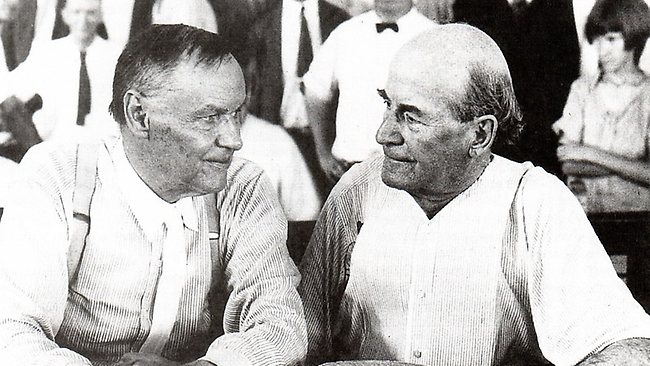
Clarence Darrow and William Jennings Bryan
The case set up an historic confrontation between the agnostic, libertarian Darrow and the three-time Democratic presidential candidate, William Jennings Bryan, who won the case in the sense that Scopes was convicted but who squirmed as Darrow’s questions showed Bryan’s ignorance of both history and the Bible.
The subtitle of the book refers to Darrow’s penchant for taking on clients whose fate seemed sealed – and frequently bringing in an unexpected result.

Dr. Ossian Sweet
At times he stood for underdogs – such as Dr. Ossian Sweet, his brother Henry, and nine other black men charged with murder after a bystander was shot to death while the Sweets and their friends defended the doctor’s Detroit home from a violent white mob.
It was 1925 and the jury was white — hardly the circumstances a lawyer would hope for — but Darrow, who had been hired by the NAACP – got a hung jury in the first trial and acquittal when Henry Sweet was retried alone.

Clarence Darrow
As he often did, Darrow moved the focus of the proceedings off the immediate charge before the court and drew attention to a broader principle: “There is nothing but prejudice in this case,” he told the jury. “If it was reversed, and eleven white men had shot and killed a black while protecting their home and their lives against a mob of blacks, nobody would have dreamed of having them indicted . . . . .
“That’s all there is to this case,” he said. “Take the hatred away and you have nothing.’’
The same Darrow who stood up for that black family was just as willing to defend people of privilege, such as Leopold and Loeb, and just as skillful in doing it. Inasmuch as Leopold and Loeb admitted the murder, those following the case expected them to enter a plea of guilty by reason of insanity. But Darrow entered a plea of guilty and said he would rely on the mercy of the court. In a performance that no judge would allow today, he concluded the penalty trial with an eight-hour argument in which he presented “these boys” as “immature and diseased children . . . wandering around in the dark.’’ Speaking, as he always did, without notes, Darrow cited the lack of precedent in Chicago for hanging defendants under the age of 21, and for hanging defendants who had pleaded guilty.
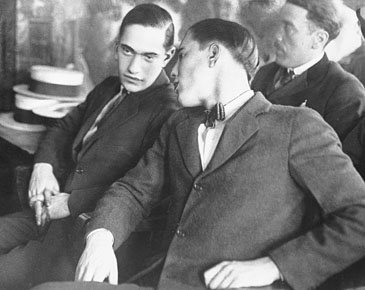
Leopold and Loeb
Darrow dismissed the death penalty itself as “one long slaughter house,” and he brought tears to the eyes of onlookers, including the defendants, when he spoke of their mothers and the mother of the slain Bobby Franks: “The mother who looks into the blue eyes of her little babe cannot help wonder what will be the end of this child, whether it will be crowned with the greatest promises which her mind can imagine, or whether he may meet death from the gallows.’’
Leopold and Loeb were sentenced to life in prison for the murder plus 99 years for kidnapping. Loeb was killed by another inmate, but Leopold led an exemplary and productive life in prison, which eventually inspired public pressure on his behalf. He was paroled in 1958 and moved to Puerto Rico, where he was a model citizen.
Farrell devotes a lot of attention to Darrow’s work on behalf of labor during an epoch in which workers were resorting to violence in order to free themselves from exploitation – whether in the mines of Pennsylvania or in the headquarters of the Los Angeles Times, which was liquidated by explosives in 1910.
Farrell also writes of the brooding, disheveled, boozy attorney’s insatiable thirst for women, his literary ambitions, and his wildly vacillating economic fortunes. As Farrell illustrates and explains, Darrow at times seemed to be an idealist who would take on a lost cause for no pay and at other times seemed to be an opportunist, interested only in money and his own aggrandizement.The jury, as it were, is still out on those questions, but Farrell does make one thing clear: Whatever else Darrow was, he is one of the most memorable characters of his time.
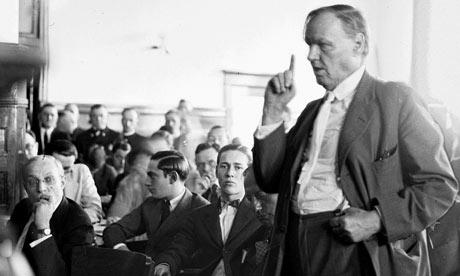
Clarence Darrow in the courtroom during the trial of Richard Loeb and Nathan Leopold, seen to Darrow's right in this picture.
Books: “Sleeping with the Enemy”
November 10, 2011
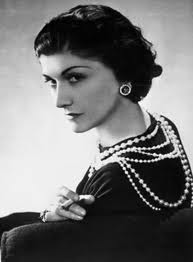 I don’t know if this is true, but I have read in several places that the government of France reports that Chanel No. 5 perfume sells at the rate of one vial every 30 seconds. By my calculation, that means 2,880 vials a day. Sephora gets $85 for 1.7 ounces and $115 for 3.4 ounces, so we’re talking about something like $100 million a year. Besides being such a hot commodity, this perfume is a monument to the woman who introduced it in 1921, the fashion designer Gabrielle “Coco” Chanel.
Chanel — the designer, not the perfume — is the subject of Sleeping with the Enemy: Coco Chanel’s Secret War, written by Hal Vaughan, who portrays her as a virulent anti-Semite who not only accommodated herself to the Nazi invasion of France but actually became a Nazi undercover agent.
When Chanel was 12, her mother had died and her father had left. She spent six years in the custody of Cistercian nuns and then stepped out into the world where she quickly progressed from cabaret singer and courtesan to fashion powerhouse. Her impact on style was enormous; her trade marks were jersey sportswear and the “little black dress” that made a lasting statement about the realtionship between simplicity and elegance.

When Germany invaded France in 1940, Chanel moved to the Ritz and accepted the occupation as the new normal. In fact, she took an influential German officer as one of her many lovers – and she continued to make millions. But Vaughn maintains that documents from that period show that Chanel did more than accept the reality of the Nazi presence, that she actually became an agent of the Abwehr intelligence agency and undertook secret missions in Berlin and Madrid. The book includes a copy of a document that seems to show that Chanel was designated Agent F-7124.
Significantly, Chanel, who was comfortable living in opulence in Paris while her countrymen suffered under the Nazi regime moved to neutral Switzerland for a while after the Third Reich collapsed. Vaughan points out that that move may have saved her from the fate of French collaborators who were publicly shamed, imprisoned or executed. Chanel was briefly arrested by the Free French, but she emerged from the war largely unscathed.
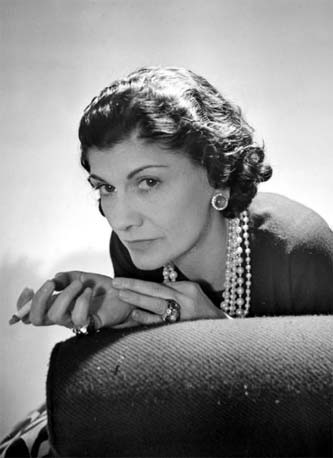
She returned to Paris in 1955 and resumed her career, getting a better reception in the United States than in France.
Vaughn portrays Chanel as anti-Semitic and speculates, without demonstrating it, that her antipathy toward Jews might have been instilled by her contact with the Catholic Church. He also reports in detail that after the initial success of the iconic perfume, Chanel transferred control of it to a Jewish family, the Wertheimers, in a deal that guaranteed her an annual return. Although she later tried unsuccessfully to get the franchise away from the family, and did negotiate a more favorable arrangement for herself, the Wertheimers still are the purveyors of Chanel No. 5.
Chanel was apolitical, and she actually fled Paris for a while in the uncertain aftermath of the invasion. There is nothing in Vaughn’s account to suggest that she was interested in the Nazis’ ambitions. Instead, it’s clear that her top priority was to continue her lavish, drug-ridden life. She also had a personal interest in staying on speaking terms with the Germans, because her nephew was a prisoner of war. She did everything she could until she got him released; in fact, Vaughan maintains that she was enticed to work for the Abwher in the first place because she thought her contacts could help her nephew.
Chanel had many liaisons with rich and powerful men, some of whom helped finance her career, but she never married, explaining that she “never wanted to weigh more heavily on a man than a bird.” An interesting aspect of the story as Vaughn tells it is that, despite her relationship with the Germans, she had many close friends in Great Britain, including Winston Churchill.
Touch ’em all, Mr. Freese!
October 28, 2011

Gene and George Freese
All the excitement about David Freese and his World Series heroics has got me thinking about George and Gene Freese, who were also major league baseball players, though no relatives of David, as far as I can tell. Gene and George were brothers, but they were not the Deans, the DiMaggios, or the Alous. I remember them because they played in the 1950s and 1960s, when I was still reasonably alert, and because I have the kind of mind that retains things such as the names of obscure baseball players.
George Freese appeared in only 61 major league games — “only” being a relative term inasmuch as most of us don’t appear in any — but he hung around the game longer than that as a coach, minor league manager, and scout. I might have remembered him anyway just because he was Gene Freese’s brother, but George has a distinction of his own: he is one of I guess a couple of hundred players who have hit inside-the-park grand slam home runs. I have never seen one, but I recall reading about George Freese’s 1955 homer in Baseball Digest. The writer described an inside-the-park grand slam as the most exciting play in baseball, and while I don’t go in much for hyperbole, I can understand why he would say that. It must seem to the fans as if the earth has stopped turning its axis while they hold their collective breath and watch that ball and the batter racing for the plate.
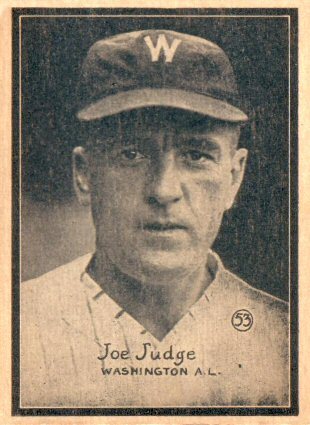 For many years after George Freese ran his home run home, I thought of his feat as unusual. Certainly, in decades of watching baseball, I had never seen anything like it. But I have learned since that there have been far more such homers than I would have imagined. Even Yankee pitcher Mel Stottlemyre hit one — in 1965. Some players have hit more than one, and some players have hit more than one in one season — for example, third baseman Joe Judge, who did it twice in 1925.
Many of the inside-the-park grand slams were hit during the dead-ball era, and the first one was hit by Harry Stovey of the Worcester Ruby Legs in 1881. Stovey did it again in 1886. It was appropriate in a way that he was the first to turn this trick, because he was the pre-eminent home run hitter of his day and the first player to hit 100 home runs in his career.

HARRY STOVEY
Netflix Update No. 54: “Sunflower”
October 22, 2011
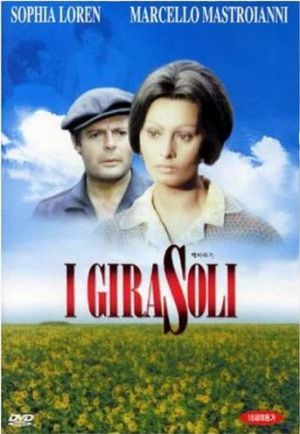 Having dabbled with Marcello Mastroianni in Macaroni and Marriage Italian Style, we went to the well once more in the form Sunflower, a film we had never heard of. The results were mixed.
This film, made in 1970, was the last directed by Vittorio De Sica, and —significantly — it was the first western film shot, in part, in the Soviet Union. Mastroianni, who was 46 when this movie was made, plays Antonio, a happy-go-lucky Neapolitan who is drafted into the Italian army during World War II. He is not a willing conscript, and his valor isn’t helped by the fact that he is in the middle of passionate fling with Giovanna, played by 36-year-old Sophia Loren. His attempt, with Giovanna’s connivance, to avoid military service results in a court-martial and his deployment to the Russian front — which was a brutal fate thanks to both the Red Army and the merciless winters.
When the war ends, Antonio doesn’t return, but Giovanna is convinced that he is still alive. After failing to get any satisfaction from public authorities, she travels to Russia to look for him. It’s not a spoiler to say she finds him, inasmuch as Mastroianni is the co-star. Some may find the circumstances and outcome predictable; some may not.
 Watching this film, which has Italian dialogue and English subtitles, is an uneven experience. Mastroianni and Loren are an irresistible combination, and they play their parts well, but the story itself is at times melodramatic and implausible. In what seems to have been an overreaching attempt to project the character’s moods, Loren is made to look at times as if she’s 30 and at other times as if she’s 50.
The photography in both Italy and Russia is eye-catching, and there is a very effective scene in which Giovanna visits a Russian hillside that is dotted with hundreds of wooden crosses marking the graves of Italian soldiers. The film also has a wonderful score by Henry Mancini that was nominated for an Oscar.

Netflix Update No. 53: “Marriage Italian Style”
October 10, 2011
 When we recommended to a neighbor that she watch the Marcello Mastroianni-Jack Lemmon film “Macaroni,” she countered by referring us to the 1964 movie “Marriage Italian Style,” in which Mastroianni stars with Sophia Loren. I had seen it about 40 years ago, but didn’t remember anything about it.
Filmed in Italian in Naples, this is the story of an amoral businessman who meets a teen-aged prostitute in a brothel during an Allied bombing raid, and then makes her his mistress when they meet again several years later. Domenico Soriano (Mastroianni) is in the baking business, and he puts Filumina Maturano (Loren) in charge of one of his stores while he keeps her — outside his home — in a very comfortable style. Filumena is not satisfied with this arrangement and she pressures “Dummi,” as she calls him, both to publicly acknowledge her and to make her a part of his household. Step-by-step she gains concessions that include a room in his house and recognition as the “lady” of the premises, but she does not get the final prize, marriage, until she employs a subterfuge that blows up in her face.
 Domenico’s passion for Filumena degrades into disgust, and he takes up a relationship with a young cashier at one of his shops.
Meanwhile, Filumena has a secret of her own — actually, three — namely a trio of sons she has borne as a result of her career, one of them by the unwitting Domenico.
 This film, directed by Vittorio De Sica and filmed in the earthy Neapolitan environment, is a combination of farce, tawdry melodrama, and implausible plot, that can’t be taken seriously. Considering the lengths De Sica went to in order to exploit Loren’s legendary physique – as opposed to the weight of her acting – the Oscar she won as “best actress in a foreign film” seems farcical in itself.
Having said that, I can report that the movie, taken for what it is, is funny and entertaining. The surroundings, whether indoor or out, are engaging, and Mastroianni himself is hard to completely dislike in any role. In this case, except for the ludicrous conclusion, he is worth watching as the rake trying to avoid the consequences of a misspent adulthood.
Netflix Update 52: “Macaroni”
September 28, 2011

Marcello Mastroianni in a tight spot in "Macaroni"
“Macaroni” — a 1985 film starring Jack Lemmon and Marcello Mastroianni — is an offbeat story set in always-interesting Naples. Lemmon plays Robert Traven, a careworn airline official who visits Naples for a business meeting after being absent since he served there with the U.S. military during World War II. Traven has no sooner flopped, exhausted, in his hotel room when he is disturbed by a visit from Antonio Jasoniello, who claims that not only were he and Traven acquainted during the war but that Traven had a romance with Jasoniello’s sister. Traven rudely denies ever having known Jasoniello or the sister, even when Jasoniello produces a snapshot of the Yankee soldier and the bella ragazza.
 After chasing Jasoniello away, Traven has second thoughts and seeks the man out, purportedly to apologize and to return the snapshot. He finds Jasoniello working in the refrigerated archives of the Bank of Naples, and what he may have intended to be a perfunctory visit turns into an increasingly complicated relationship with the whole Jasoniello clan — including Jasoniello’s son, a would-be rock musician who is a little reckless about how he tries to jump start his career.
Traven is puzzled by the fact that he is recognized and called by name by a succession of strangers in Jasoniello’s neighborhood. Jasoniello shrugs this off, but Traven eventually learns that his celebrity status was deliberately concocted and maintained for four decades by Jasoniello himself. Therein lies a touching and hilarious story.
“Macaroni” (I can’t account for that title) has a talented and almost entirely Italian cast. Mastroianni himself, of course, was the quintessential Italian film actor, though the combination of his heavy accent and the less-than-ideal sound quality on this DVD made him at times difficult to understand. Pairing him with Lemmon was a wise decision, and the movie is entertaining and uplifting.
Netflix Update No. 51: “The Angel Levine”
September 21, 2011
 The Angel Levine is one of the oddest movies we’ve watched, and from what I’ve read on the Internet it strikes people in many different ways. Some abhor and ridicule it and some like it and watch it repeatedly. A cast that includes Harry Belafonte, who produced this 1970 film, Zero Mostel, Ida Kaminska, and Milo O’Shea seems a promise of success, but the reality is more complicated.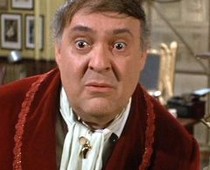
ZERO MOSTEL
Although the pessimistic Mishkin is not easily convinced of Levine’s purported state of existence, the pair slowly develop a relationship in which Mishkin becomes as interested in Levine’s welfare as Levine is interested in his.
The acting in this film — including that of Milo O’Shea in the unlikely role of the irascable Jewish doctor who attends to Fanny — is what one would expect of such reputable performers. The film is a showcase for Belafonte’s magnetism and Mostel’s mastery of the wobegone persona. Some scenes, however, are ponderous, including a long inaudible passage — which we witness from outside a drug store — in which Levine carries out a plot to get Fanny’s prescription without paying for it and a scene in which the Mishkins carry on a conversation in Yiddish, without subtitles.
The film is far from perfect, and yet it is provocative — especially in the way it portrays the dilemma of the Mishkins, who at life’s end are without the means to live in comfort and security.
Netflix Update No. 50: “Hey Hey It’s Esther Blueburger”
September 5, 2011

DANIELLE CANTANZARITI
In our quest to keep up with the career of Keisha Castle-Hughes, we came across a 2008 Australian film, “Hey Hey It’s Esther Blueburger.”
This is a rather blunt story — written and directed by Cathy Randall — about a 13-year-old girl, the title character, who attends a private school, where the snobbish and often brutal cliques ridicule and shun her, while she also navigates a home life made difficult by a rigid mother (Essie Davis) and thoughtless father (Russell Dykstra). Esther falls in with Sunni — Castle-Hughes — an older and more worldly wise student at a public school. The relationship introduces Esther to a gritty world she has been unaware of, and it teaches her a hard lesson about the hazards of trying to fit in by distorting one’s own identity.

DANIELLE CANTANZARITI
Esther is played by Danielle Cantanzariti, who got the part when she turned up for a cattle call audition for extras. The film-makers had screened about 3,000 candidates over a period of four months. The girl is excellent in the role. The character is quirky and smart, and Cantanzariti really goes to town on that. The story has both drama and humor, and this child is skilled at both. Some of the exchanges between her and her brother Jacob (Christian Byers) — who has his own share of complexes — are hilarious.
Castle-Hughes gives a smooth performance as Sunni, whose self-assured demeanor masks the tension in her life with an amiable but unfocused single mother, Mary– nicely played by Toni Collette. The delicate balance in Sunni’s own life is revealed when she loses control in her attempt to re-make Esther, and the younger girl goes too far in order to preserve her standing with her peers. Castle-Hughes played an 12-year-old Maori girl in “Whale Rider” and Mary, the mother of Jesus, in “The Nativity Story.”
The film has a soundtrack that is well tuned to Randall’s themes, including music related to the Blueberger family’s Jewish faith, which figures prominently in the story in a couple of ways.
“Hey Hey It’s Esther Blueburger” cost a lot to make and didn’t return much for the investors. It deserved better.

KEISHA CASTLE-HUGHES and TONI COLLETTE
Books: “Wonder Girl”
August 31, 2011
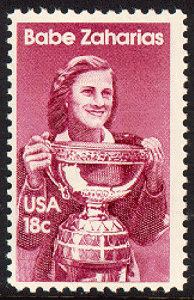 If ever an athlete embodied the phrase sic transit gloria mundi, it was Babe Didrikson Zaharias. There are a couple of generations of adults among whom she is virtually unknown, and yet she was such a combination of natural ability, hard work, and results, that she has no peer.
I’m not an expert on this subject. I had only the vaguest idea of who Babe Didrikson was until I read Don Van Natta’s excellent book, Wonder Girl. But thanks to Van Natta’s scholarship, his journalistic discipline, and his entertaining and literate writing style, I now know plenty about Babe – and I’m glad I learned, even at this late stage of my life.
Babe Didrikson died of cancer in 1956, when I was 16 years old. In those days, I followed baseball and boxing, so I had only the slimmest knowledge that she was a prominent golfer. What I learned from Van Natta’s book is that Babe Didrikson would have excelled at almost any sport she chose and that she made a considerable mark in both track-and-field and in basketball before she turned her whole attention to golf.
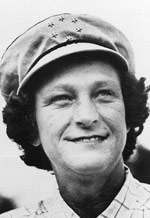 I’ll mention only one particular performance, because every time I think about it I am impressed all over again. Babe, who gave up on education before she finished high school, took a job with a Dallas-based insurance company, but not because she was interested in actuarial tables. Some companies in those pre-television days sponsored amateur sports teams that competed with each other around the country and acted as living advertisements for their employers. Babe’s principal job at the insurance company was playing basketball and track, both of which she did at a championship level. She was so extraordinary, in fact, that in 1933 her boss and coach sent her to the American Athletic Union’s national championship meet in Illinois.

DON VAN NATA JR.
I mean that literally. He didn’t send the rest of the team — only Babe. And competing against squads from around the U.S., she entered eight of the ten events and won the gold medal in broad jump, baseball throw, shot put, javelin, and the 80-meter hurdles and tied for first in the high jump. She collected a total of 30 points; the second-place team scored 22. In that meet, Babe qualified for the 1932 Olympic Games in Los Angeles, where she won two gold medals and a silver and set two world records and an Olympic record.
I had to tell that story. But Van Natta’s book isn’t engrossing only because it reports on that and Babe’s many other achievements. This book tells the story of an American life. Babe’s parents were faithful and hard-working natives of Norway who settled in Texas. They had a large family, and they lived from hand to mouth. Babe loved this family and she remained loyal to her parents and siblings and other connections, always including their financial well being in her reasons for driving herself so hard.
Babe was a tomboy, and when she grew older she was perceived as mannish. This plus the fact that she remained single for so long led busybodies, including prominent sports writers, to speculate about her sexual orientation. She also was the target of verbal abuse from sports writers and others who believed, as Joe Williams wrote in the New York World Telegram, that “it would be much better if she and her ilk stayed at home, got themselves prettied up and waited for the phone to ring.” The rough-and-tumble Babe broke through the barrier of snobbery that surrounded amateur golf at that time; she was a founding member of the LPGA.
She put an end to much but not all of that talk when she married popular pro wrestling villain George Zaharias in 1938. The marriage lasted a lifetime, but it was tumultuous. Zaharias was a compulsive promoter, and he insisted that Babe keep up an exhausting schedule of competition and personal appearances, even when she would rather have taken a break.
 An important factor in the story of Babe Didrikson’s life was her complicated personality, which was at the same time endearing and obnoxious. She was a bold braggart, constantly tooting her own horn. Van Natta reports that Babe would walk into the clubhouse before a golf match and announce herself by saying, “Babe’s here! Who’s gonna finish second?” And when she wasn’t bragging and even lying about her prowess, she was needling and annoying her opponents, deliberately trying to throw them off their game. But it is part of the genius of Van Natta that while he tells a great deal about this aspect of Babe Didrikson, he tells it in the wider context of her life, so that her braggadocio does not define her in the reader’s mind.
Babe Didrikson was diagnosed with rectal cancer and underwent a permanent colostomy. There would still be enough greatness in her to resume her golf career and win tournaments. But the cancer prompted her to rise to the occasion in another way. She became a tireless campaigner for funds to support cancer treatment and education, and she made a point of visiting cancer patients, especially children, to encourage them to go on with their lives.
Babe Didrikson: a life worth remembering.
 CharlesPaolino's Blog