Netflix Update No. 60: “A New Life”
December 19, 2011

ALAN ALDA
I don’t think I’ve ever disliked Alan Alda in a role, his role in the 1988 film “A New Life” is no exception. But this film has the added advantage of having been written and directed by Alda, so it is shot through with his wit and his sense of timing.
In truth, “A New Life” is a piece of fluff, but the combination of Alda and his art with a cast that includes Hal Linden, Ann-Margret, and Veronica Hamel give the fluff enough substance to keep it interesting.
Alda plays Steve Giardino (who makes up these names?), a Wall Street trader whose gearshift is perpetually in overdrive. Among the things he neglects are his wife, Jackie, played by Ann-Margret. Jackie finally has enough — or, more accurately, not enough — and she and Steve split. Both are disoriented in the single state, and Steve is further confused by his stock-market colleague Mel Arons (Hal Linden), a profligate who tries to prod Steve into a similar way of life. Jackie eventually takes up with a much younger and overly attentive sculptor, Doc (John Shea), who is a waiter in real life. Steve settles in, or so it seems, with a medical doctor, Kay Hutton (Veronica Hamel). The truth in this movie is that stable relationships are not easy to come by, and both Steve and Jackie will have more work to do.

HAL LINDEN
This is a delightful ensemble, as the names of the actors promise. Linden is especially entertaining as a kind of Mephistopheles figure to the confused and somewhat naive Steve. “What are you making such a big deal about happiness for?” he asks Steve. “Look at me. I trade all day against guys who would cut my heart out of an eighth. I drink too much, I eat rich food, I make love to women half my age. You think I’m happy?”
(He grins) “That’s the advantage of being shallow.”
Fans of such Alda-esque dialogue will find it throughout this film.
Look for Alda’s daughter, Beatrice, in the limited role of Steve’s adult daughter, Judy.

Ann-Margret and Alan Alda on the set of "A New Life"
Books: “1493”
December 17, 2011

aka CHRISTOPHER COLUMBUS
One of my chores at Paolino’s Market when I was a kid was to open up fifty-pound bags of potatoes and divide the spuds into ten- and five-pound bags. “Packing potatoes,” as we called it, was a frequent part of the routine in our store, and that was appropriate in its way, because what could be more routine than a potato — one of the most plain, most simple, and least consequential of vegetables.
Or so I thought until I read 1493 by Charles C. Mann, author of 1491.
In this substantial and exhaustively researched volume, Mann describes the impact of the voyages of Christopher Columbus, whom he calls Cristóbal Colón, the name the explorer answered to in Spain. Overall, Mann explains, the impact of those voyages was to globalize life on earth, sending folks traveling to hemispheres they had perhaps only dreamed about and distributing other forms of life, ranging from mosquitoes to horses, from tobacco plants to rubber trees, to spots where they had never existed before — a phenomenon known as the Columbian Exchange. Simultaneously, languages and cultural traditions and man-made products were scattered across the planet. So were doleful phenomena such as malaria and potato blight.

The process that Columbus launched, and personally participated on his first trips across the Atlantic Ocean and back, is so complex and far-reaching, as Mann describes it, that I can’t adequately summarize it here. But the potato is a good example of the upheaval Columbus touched off.
Little did I know last June, when I was watching my cousins hoeing potatoes in their massive garden in Il Valle di Sessa Cilento, that potatoes, which were first domesticated in the Andes, weren’t exported to Europe in quantity until the second half of the 16th century, when some species of them were being cultivated in the Canary Islands and shipped off to the mainland.
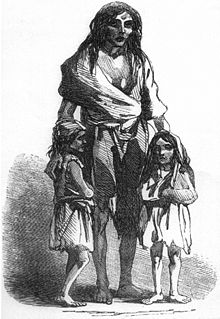
Irish mother and her children during the potato famine in 1849
The consequences of this, Mann writes, were enormous for a continent that was accustomed to frequent food shortages. In fact:
“Many scholars believe that the introduction of S. tuberosum to Europe was a key moment in history. This is because their widespread consumption largely coincided with the end of famine in northern Europe. (Maize, another American crop, played a similar but smaller role in southern Europe.) More than that, the celebrated historian William H. McNeill has argued, S. tuberosum led to empire: ‘[P]otatoes, by feeding rapidly growing populations, permitted a handful of European nations to assert dominion over most of the world between 1750 and 1950.’ Hunger’s end helped create the political stability that allowed European nations to take advantage of American silver. The potato fueled the rise of the West.”
There is much, much more just to the potato story, including the fact that a blight that also originated in the Andes migrated first to North America and then to Europe in the mid 19th century, causing almost incomprehensible hunger and illness, especially but not solely in Ireland.
Mann discusses the potato itself and its geographical history in minute detail, and he does the same with a broad range of subjects including slavery, the mixing of races in the “new world,” and the impact of world economies — most notably that of China — of the Spanish trade of silver from South America. His discussions frequently extend down to the present day, and this book in general is a valuable aid in understanding how the world evolved from the 15th century to the 21st.
Netflix Update No. 59: “The Yellow Handkerchief”
December 16, 2011

WILLIAM HURT
“The biggest disease today,” Mother Teresa is supposed to have said, “is not leprosy or tuberculosis, but rather the feeling of being unwanted.” Mother Teresa may have been referring primarily to the kind of people she ministered to, people who are poor and disfranchised, but the problems she identified can affect people of all kinds. Three people who are suffering from the “disease” of feeling cut off from any human community are the princpal characters in The Yellow Handkerchief , a 2008 film loosely based on a story by Pete Hamill.
These folks are Brett Hanson (William Hurt), who has just been released after a six-year term in prison; Martine (Kristen Stewart), a 15-year-old girl who has wandered away from her inattentive, single father and her friendless life; and Gordy (Eddie Redmayne), a Native American teenager who is on an aimless odyssey. Martine hitches a ride with Gordy after being rejected by a boy who had taken advantage of her, and Brett, who meets the pair chance, joins them on the first leg of his trip back to New Orleans to find his former wife, May (Maria Bello). May, a beautiful but solitary woman bound to the waterways of New Orleans, had married Brett after overcoming what might have been more sensible instincts, and he divorced her as a way of freeing her after the incident that landed him in prison.

EDDIE REDMAYNE
This was an odd trio in that Gordy was attracted to Martine, who regarded him as eccentric and immature, and Brett — although he was protective of the teenagers — considered them only as a means to an end, namely returning to New Orleans to find out if May would accept him after the callous way he had left her. As they continue to travel together, however, the three gain more and more insight into each other’s psyches and problems and find that in their isolation and their desire to be “a part of something” they are more alike than they had imagined.
This film was shot against the background of post-Katrina Louisiana. Besides being visually interesting, the grim landscapes and the devastation provide metaphors for loneliness on the one hand and a longing for rebirth on the other.
In spite of Hurt’s persona, this is a true ensemble piece in which he, Stewart, Redmayne, and Bello give credible and sympathetic performances.

WILLIAM HURT and KRISTEN STEWART
Books: “Pearl Harbor Christmas”
December 15, 2011

I grew up among the remnants of war. I was born in September 1942 when the United States had been engaging Nazi Germany and Japan for less than a year. By the time I was old enough to be aware of my surroundings, there still were handwritten letters from the front, brass uniform buttons, photos of soldiers, sailors, and marines, patriotic records, and newspaper clippings reporting on the service of relatives and friends, including cousin Mike Aun, who was awarded the Bronze Star twice, the Silver Star, and the Purple Heart with three oak-leaf clusters.

FRANKLIN D. ROOSEVELT
I also recall that for a long time after 1945, my parents and other adults would frame their conversations in terms of what had occurred before, during, and after “the war.” They needn’t say which war.
So although I don’t remember the war itself, I feel that it was a part of my life, and I eagerly learn as much about it as I can. My most recent opportunity came in the form of Pearl Harbor Christmas, a new book by Stanley Weintraub.
In this compact book, Weintraub describes events at home and abroad from December 22, 1941, to January 1, 1942 — devoting a chapter to each day. The dominant personalities by far are Franklin Roosevelt and Winston Churchill. Churchill was staying at the White House after crossing the submarine-infested Atlantic in winter seas. He couldn’t wait to get to Washington, because Pearl Harbor had accomplished what he could not, forcing the United States into a war that Britain probably could not survive otherwise. But, although the newborn American belligerence was directed mostly at Japan, Churchill wanted to make sure, and did, that the U.S. would go to war first against Nazi Germany.

WINSTON CHURCHILL
Churchill addressed a joint session of Congress, spoke at the Christmas tree-lighting ceremony on the White House lawn — the only time he and Roosevelt spoke from the same platform — and dashed up to Ottawa to speak before the Canadian Parliament. What with his blustering, his cigar-smoking, and his drinking, he was quite the counterpoint to patrician, dignified Roosevelt. Actually, he came across more like Lyndon Johnson: Weintraub describes an incident on December 26 when Churchill was dictating to a male secretary notes for the address to Congress. Churchill was in his bath when he started dictating. He got out, wrapped a towel around himself, walked to an adjoining bedroom, dropped the towel, and continued dictating, stark naked. Suddenly, the secretary recalled, “President Roosevelt [in his wheelchair] entered the bedroom and saw the British Prime Minister completely naked walking around the room dictating to me. WSC never being lost for words said, ‘You see, Mr. President, I have nothing to conceal from you.”’
While Roosevelt and Churchill and others were in Washington working issues of joint command, Adolf Hitler was in Berlin or Bavaria trying to chew the great deal he had bitten off.

ADOLF HITLER
Hitler’s troops were in trouble on the Russian front, and even those closer to home were suffering from a lack of adequate supplies. Hitler actually had Joseph Goebbels run a clothing drive to help keep his soldiers warm. In a radio address, Goebbels told the German people that they “would not deserve a moment’s peace if a single German soldier was exposed to the harshness of winter without articles of warm clothing.”
Meanwhile, the situation in the Pacific continued to deteriorate as the Japanese took advantage of their momentum and munched away at the region. Churchill had not yet publicly acknowledged the reality, Weintraub writes, and continued to waste resources trying to defend ground that was already as good as lost.
Even more closely involved in such a charade was U.S. Army Gen. Douglas MacArthur, who had to abandon his headquarters and retreat with his wife and son to a tunnel in Corregidor while he continued to send out dispatches about tank battles, with nonexistent tanks, putting up a fight that wasn’t occurring.
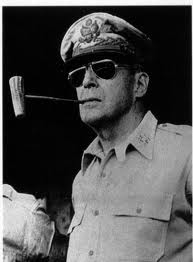
DOUGLAS MACARTHUR
Weintraub explains that there was a certain ambivalence about the war in the United States at first; it still seemed far away.
Still, the government took the impending conflict seriously enough to pack up the founding documents — the Declaration of Independence, the Constitution, and the Bill of Rights — and ship them off under heavy security to repose in Fort Knox for the duration.
The holidays went on as usual. Despite security concerns, Roosevelt insisted that the national tree be on the White House lawn, not in Lafayette Park where the Secret Service wanted it. There were presents, too, including eight thousand cigars sent to Churchill from various sources.
The new year was marked by a couple of oddities – Churchill making a rare visit to a church, attending a service with Roosevelt in Alexandria, Va., and the beleaguered Hitler publicly invoking “the Lord” in hoping that 1942 would bring positive results for the German people.
Throughout the United States, however, the prospects of what would come in the next three and half years did not weigh heavily on the celebratory spirit, and that, Weintraub writes, included the biggest celebration of all:
“ ‘If there was uneasiness over the possibility of Axis bombs falling into Times Square,’ the Times reported, ‘you could not read it in the celebrants’ faces.’ Despite Pearl Harbor and the reality of world war, it had not yet reached very far into the American psyche.’’
Netflix Update No. 58: “Happy Accidents”
December 10, 2011

Vincent Donofrio and Marisa Tomei in "Happy Accidents"
I’ve been reading some articles about time travel; it’s a good way to make your head spin without the aid of alcohol.
The subject came up because we watched “Happy Accidents,” with Marisa Tomei and Vincent Donofrio. In this film, released in 2000, Tomei plays Ruby Weaver, a woman chronically unlucky in her relationships with men. She thinks her luck has changed when she becomes involved with Sam Deed (Donofrio), until he tells her that he is a traveler from the future – specifically from the year 2470.

VINCENT DONOFRIO
Sam claims that he saw Ruby’s picture when he was living in Dubuque, and that he traveled through time, to Brooklyn, in search of her – though he doesn’t say why. As any person would, Ruby initially thinks Sam is either joking or deranged, but Sam won’t budge off his story. Ruby is particularly disturbed by a notebook in which Sam has repeatedly sketched the face of a woman — he claims it’s Ruby’s face — and written the words Chrystie Delancey — he claims she’s his “contact,” another time traveler who was assigned to give him his orientation when he arrived in the past — that is, the present.
This tale grows quite intense; in fact, I was surprised to see it listed on IMDb as a comedy, because there’s nothing funny about it. It keeps us guessing whether we’re watching a fantasy in which Sam is telling the truth, or a tragedy in which Sam is either playing mind games with Ruby or is insane.
Underlying the story itself is the paradox that the notion of time travel to the past always poses — the question of causality. Namely, if time travel to the past were possible, would the time travelers, either by their mere presence or by their overt actions, change the course of events, change the future.
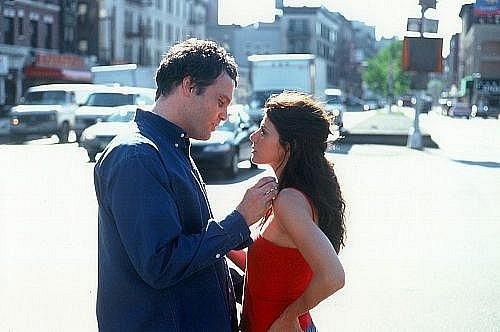
Donofrio and Tomei
I don’t think this movie did very well at the box office, but it’s a worthwhile property. The story is compelling, Tomei and Donofrio are both magnetic, and there are strong supporting performances by Tovah Feldshuh as Ruby’s mother, Holland Taylor as Ruby’s therapist — a pivotal role, and Nadia Dajani as Ruby’s best friend.
Several years ago, I read a book entitled The Physics of the Impossible by theoretical physicist Michio Kaku. In that book, Kaku explored some ideas that have been presented over the years in science fiction literature, films, and TV shows, and organized them according to how plausible they were. As I recall, he concluded that under the known laws of physics, time travel into the past was impossible and time travel into the future was possible, but not likely to become reality for many many years. If you’d like to see a somewhat comprehensible explanation of Albert Einstein’s view of time travel, click HERE.
“It’s nobody’s business but the Turks” — Jimmy Kennedy
December 6, 2011
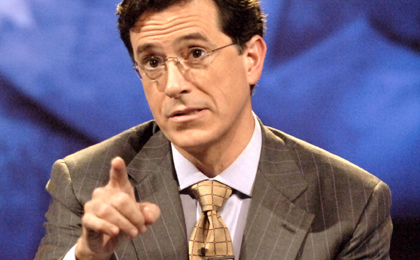
STEPHEN COLBERT
Stephen Colbert, in his recent irreverent commentary on the new English translation of the ritual of the Roman Catholic mass, said something to this effect: “For the record, consubstantial is now Istanbul.” For the benefit of the uninitiated, consubstantial is a technical term in the Nicene Creed that expresses something we Catholics and many other Christians believe about the nature of God. In the translation in use from around 1970 until Nov. 27, the Latin phrase consubstantialem Patri was rendered “of one substance with the Father,” but in the new rendition it reads, “consubstantial with the Father.”
Anyway, that was the occasion for Colbert to make that play on words.

JIMMY KENNEDY
That had the unintended result of reviving in my brain the memory of a song written in 1953, with lyrics by Jimmy Kennedy and music by Nat Simon, namely “Istanbul (Not Constantinople”). I don’t know how historically accurate Kennedy was trying to be, but the song in general refers to the fact that in 1930, the government of the relatively new Republic of Turkey declared Istanbul to be the one and only name of a city that had had many names — sometimes more than one at the same time — over its very long history. Istanbul was not a new name in 1930. Far from it, the name was known in some form since at least the tenth century.
Things like that used to interest song writers, and Kennedy turned out a lyric that, in part, went like this:
Istanbul was Constantinople
Now it’s Istanbul, not Constantinople
Been a long time gone, Constantinople
Now it’s Turkish delight on a moonlit night
Every gal in Constantinople
Lives in Istanbul, not Constantinople
So if you’ve a date in Constantinople
She’ll be waiting in Istanbul
Even old New York was once New Amsterdam
Why they changed it I can’t say
People just liked it better that way
So take me back to Constantinople
No, you can’t go back to Constantinople
Been a long time gone, Constantinople
Why did Constantinople get the works?
That’s nobody’s business but the Turks.
The ‘fifties being what they were, that was a big hit for the Four Lads.It was played on the radio again and again, and it was bored into my subconscious mind, where it rested happily until Colbert summoned it from the tomb.Kennedy, incidentally, was a very talented guy who wrote several standards, including “South of the Border,” “The Isle of Capri,” and “Red Sails in the Sunset.” Nat Simon and Charles Tobias teamed up in 1946 to write “The Old Lamp-Lighter.”
But Kennedy’s best-known work may be the lyrics he wrote in 1939 for “My Prayer,” which had been composed in 1926 by violinist Georges Boulanger. Glenn Miller and the Ink Spots had big hits with that song, but its most popular interation was the 1956 recording by The Platters.
“Istanbul (Not Constantinople)” has been recorded by many performers, including Bing Crosby and Ella Fitzgerald, Caterina Valente, Bette Midler, and They Might Be Giants.
You can hear the Four Lads’ version by clicking HERE.

Netflix Update No. 57: “Tortilla Soup”
December 4, 2011

HECTOR ELIZONDO
I have to begin by saying that I was predisposed to like Tortilla Soup because I am predisposed to like Hector Elizondo, who is the focal point of this film. Tortilla Soup, a 2001 remake of the 1994 Taiwanese movie Eat Drink Man Woman, concerns Martin Naranjo (Elizondo), a semi-retired Mexican-American gourmet chef who is the widowed father of three beautiful young women. His daughters still live at home and — at the beginning of the story, at least — gingerly try to accommodate his fixed ideas what their lives, and family life, should be.
The oldest daughter, Leticia (Elizabeth Peña) is loveless and unhappily employed as a high school chemistry teacher. She has broken with her father only to the extent that she has left the Roman Catholic Church in favor of evangelical Christianity. The second daughter, Carmen (Jacqueline Obradors), would have liked to follow in her father’s culinary footsteps, but she caved into his pressure to become a businesswoman. The youngest girl, Maribel (Tamara Mello), disdains the degree of her sisters’ conformity and is potentially the most rebellious.
In a parallel story story line, Yolanda (Constance Marie), a divorced friend of the family, introduces her mother, Hortensia (Raquel Welch), into the Naranjo household. The flamboyant Hortensia quickly decides that she will marry Martin and mistakenly believes that he shares her ambition.

ELIZABETH PEÑA
As Martin strives to keep his family together with a constant stream of elaborate meals, each of his daughters starts to drift away – Letitia into the arms of an athletic coach at the high school, Carmen to a lucrative job in Barcelona, and Maribel to the side of a young man who is more of an alternative to her father than he is a lover.
Although the situation is hackneyed and the denouement is predictable, this is a charming movie. That’s attributable to the attractive and talented cast, the intimate nature of both the story and the manner in which it is told, and the lively and evocative musical background.
Elizondo, whose stodginess is altogether benign, is irresistible, and the actresses who portray his daughters establish a credible combination of affection and tension among themselves and between them and their father.
I don’t recommend watching this film on an empty stomach, because the enormous amount of food that cascades across the screen as one meal follows another is mouth-watering.
Books: “American Emperor”
November 29, 2011

ALEXANDER HAMILTON
I grew up with Alexander Hamilton. It’s not that I was his contemporary; it’s that I was born in Paterson, New Jersey, and grew up on its streets. I heard over and over again that Hamilton had founded the city. Like a lot of things children are taught, that wasn’t true. What was true was that Hamilton accurately envisioned an industrial city growing up around the Great Falls of the Passaic River. Paterson became the silk-weaving center of the world and was also the source of steam locomotives and Colt revolvers.
Aside from the fact that he was born on Nevis – a rare distinction – the only other thing I associated Hamilton with was the duel in which Aaron Burr, who was then the vice president of the United States, shot Hamilton to death. That happened in Weehawkin in 1804.
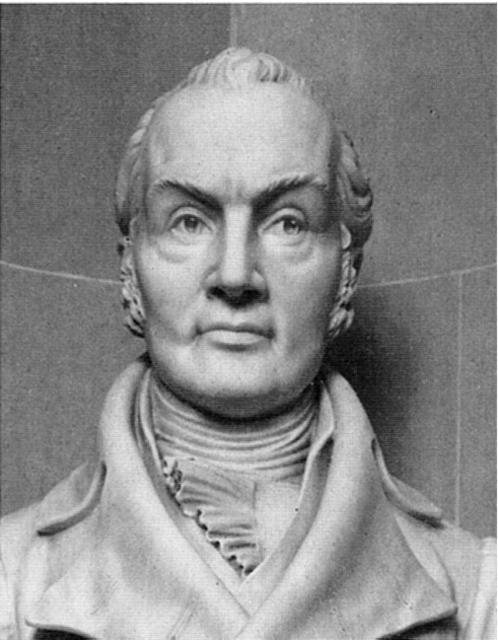
I never thought much about Burr at all until I read David O. Stewart’s book, American Emperor: Aaron Burr’s Challenge to Jefferson’s America. Come to find out that Burr was a rip-snorting renegade who wanted to invade Spanish territories in North America, merge them with states he hoped would secede from the Union, and set himself up as ruler of the new nation.

AARON BURR
Burr, who was born in Newark, came from a distinguished family. He himself had an impressive military and political career which reached its zenith, in a sense, when he was elected the third vice president in the old electoral system. After a contentious series of ballots, Thomas Jefferson and Burr were tied for the presidency. Although Burr was willing to serve as vice president – which was the consolation prize under that system – Jefferson, once he was in office, gave Burr the cold shoulder, marginalizing him to the point that the once influential man was a supernumerary.
Meanwhile, Stewart explains, although Burr and Hamilton had been on good social terms, Hamilton conducted a political campaign against Burr in the public press, ridiculing him in the acidic fashion that was common in those days. Burr – whatever other faults he may have had – wouldn’t wouldn’t play that game, and he did not answer Hamilton until he read a published account of remarks Hamilton had made at a dinner. Burr and Hamilton exchanged a series of letters over the incident, with Hamilton ultimately refusing Burr’s demand that he apologize for that and other slights. Burr challenged him to a duel, and Hamilton accepted. Dueling was illegal in New York and New Jersey; the two men and their parties crossed the Hudson from Manhattan to a spot on the bluff in Weehawkin that was inaccessible from above. Hamilton was mortally wounded.
AARON BURR
Burr was indicted for murder in both states, which meant that he had to live on the road – an odd situation for the vice president of the United States. By this time, he was already concocting a vague plan to put together a realm for himself carved out of Spanish holdings – including parts of Mexico and Texas – and what were then western states that Burr imagined might be interested in leaving the union. He actually negotiated directly with Great Britain over this idea.
Meanwhile, Burr enlisted as one of his principal co-conspirators Gen. James Wilkinson who, on the one hand, was the highest ranking officer in the U.S. military and, on the other hand, was a paid spy for Spain. Burr enlisted numerous other people, including Andrew Jackson, although he seems to have given different information to different people, including in some cases the fantastic claim that the Jefferson administration was aware of and sympathetic to his plan.
Burr went so far as to assemble the crude makings of a private army, and set off by river transport to carry out a plot that still wasn’t clear to anyone except, perhaps, Aaron Burr. The numbers of supporters he had hoped for did not materialize, and some of those who did were arrested. Burr himself was taken into custody and sent to Richmond to be tried for treason.

JAMES WILKINSON
He was not convicted of treason, however. Stewart, who is an attorney, explains the fascinating intricacies of the trial and the verdict. The short version is that treason consists of conducting an armed attack on the United States, and Burr hadn’t done that.
Burr facing further charges in Ohio and was still under both murder indictments. Although he was broke, he traveled to Europe and stayed for four years. Even then, he tried to get first the British government and then Napoleon to support him in a campaign against Spain in the Americas.
When the indictments had been dropped, Burr returned to New York and in 1831 resumed the practice of law.
This account portrays the United States and its surroundings as tumultuous and unstable. Stewart points out, in fact, that even Jefferson accepted the idea that some of the states still might opt out of the republic and go off on their own.
Stewart also provides details of a contrasting and touching aspect of Burr’s life – his affectionate but ill-fated relationship with his daughter. The portrait Stewart paints of Burr is that of a charismatic, adventurous, and impetuous rascal, a man of courtly manners and an incorrigible womanizer — in short, far more interesting a character than I had ever imagined.

Murder most foul
November 24, 2011

GREG HALMAN
When I first heard the other day that Greg Halman had been stabbed to death I was, of course, shocked, but not just because of the murder itself. Murder usually takes us by surprise, whether the victim was someone we knew, someone we only knew about, or someone we never heard of. It’s in the nature of the crime that it seems to come, as it were, out of left field.
In this case, my shock was doubled because the victim was a major league baseball player. It’s a hangover from my growing-up years when I thought those guys were special. I came to learn, as we all do, that they’re subject to all the weaknesses and vulnerabilities of our kind. I know that intellectually, but emotionally I’m the type who still thinks Santa Claus will show himself some day and sit in judgment over the sheep and the goats.
The fact is, though, that baseball players may be more susceptible to homicide than the general population is. Something like 17,000 men have played in the major leagues and I know of ten who have been murdered. What’s that – one in about 1700? The murder rate in the United States last year – ostensibly an all-time low – was nearly one in 10,000.

LUKE EASTER
The ones I know about are Frank Bell, Frank McManus, Ed Morris, Lymon Bostock, Tony Solaita, Gus Polidor, Ivan Calderon, Dernell Stenton, and Luke Easter.
The one that most sticks in my mind is Easter, because he was one of my first “favorite” players. He came into the major leagues in 1949 when I was seven years old. He was about six-foot-four and weighed 240 pounds. I got most of my baseball on the radio then, and for a while I thought his name was Lou Keester. I didn’t know it then, but because he was black he didn’t get to play in the bigs until he was 34 – although he was inconsistent when reporting his age and place of birth. He is a prime example of the damage that racism did to major league baseball. He appeared in only six seasons in the majors and played in more than 100 games in only four. He was a good first baseman and a slugger in semi-pro ball — which was a big deal in his day — and in the Negro Leagues. He hit a total of 86 home runs in 1950, ’51, and ’52; he played only 396 games in those three seasons, and he was 37 years old in 1952. He and Mickey Mantle were the only players to hit a ball over the right-field scoreboard in Cleveland’s Municipal Stadium. Easter’s traveled 477 feet.
After his major league stint, Easter played in the minors until he was 48 and coached for a while. Wherever he went, he added to his reputation as a genuinely nice man who liked to help other players. When he and baseball were done with each other, he went to work for the Aircraft Workers Alliance and became the chief union steward at a company in Euclid, Ohio. In 1979, he was delivering payroll money to a bank when he was accosted by armed robbers who shot him to death when he wouldn’t turn over the money.
When a fan remarked that he had witnessed one of Easter’s longest home runs, Easter said: “If it came down, it wasn’t mine.”
Netflix Update No. 56: “Then She Found Me”
November 17, 2011
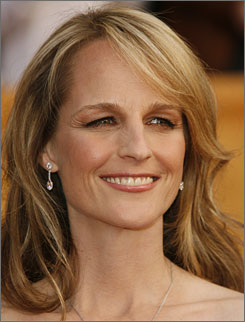
HELEN HUNT
A lot of ills come from being in the wrong place at the wrong time, and Helen Hunt provides an example in the 2007 film “And Then She Found Me,” based on Elinor Lipman’s 1990 novel.
The film was produced, directed, and written in part by Helen Hunt, who also plays the “me” in the title. Perhaps she was having trouble concentrating.
The premise of this dour property that is passed off as a “romantic comedy” is that 39-year-old April Epner’s adoptive mother has died — shortly after denying April’s charge that mom had favored her biological son. This comes on the heels of the collapse of April’s marriage to Ben Green (Broderick), who abruptly gives her the “I just can’t do this anymore” routine. Ben hasn’t cooled off too much to have a last barnyard fling with April on the kitchen floor, and that provides the delicate nuance of an awkward pregnancy — hers, not his.
April doggedly goes on with her career as a Brooklyn schoolteacher, which puts her in contact with Frank (Firth), the conveniently divorced father of one of her pupils. Frank, a sandy-haired teddy bear, has the earthy charm of the British Isles about him, and the romantic sheen of an unemployed and, one presumes, unappreciated writer. He isn’t too charming or romantic to resent the fact that Ben, thanks in part to the pregnancy, still has one foot in his relationship with April.

- HELEN HUNT and BETTE MIDLER
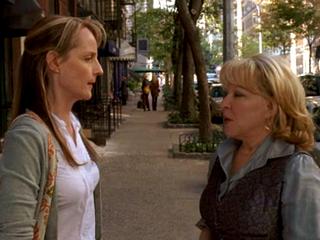
As though April’s life weren’t interesting enough, a messenger comes to a school with a letter in which a woman who does not identify herself at first claims to be April’s biological mother. The woman turns out to be daytime television talk-show host Bernice Graves (Midler). April is skeptical about Bernice’s claim, infuriated by her badly contrived lies, and put off by her overbearing attempts to play mother.
 If the resolution of this tangled tale seems satisfactory, it may be only because the resolution means the film is over. It’s kind of like a cricket match in that regard.
Clearly we’re supposed to find humor somewhere in this story, but there is none. There certainly is none coming from Hunt, who can be described only as grim.
Incidentally, in the scenes in which April and a shifting cast of companions visit the gynecologist, the doctor is portrayed by Salman Rushdie. I read somewhere that Hunt recruited him because she wanted to make sure all the major faiths were represented in a scene in which there is prayer. I’m not sure which faith he represents.
Hunt didn’t take the hint when she was turned down by the studios before making this film herself on a shoestring budget. Broderick, Firth, and Midler agreed to work for scale, which seems appropriate. If they had accepted their usual salaries for this film, their names should be on the placards in Zuccotti Park.
 CharlesPaolino's Blog