Netflix Update No. 63: “Father’s Little Dividend”
March 12, 2012
 Spencer Tracy got away with playing the same character a lot of the time, and with good reason: It worked. A case in point is his role in the 1951 comedy Father’s Little Dividend, which was a sequel to Father of the Bride.
Tracy plays Stanley Banks, a suburbanite who looks forward to forging a new kind of life with his wife, Ellie (Joan Bennett), now that their three children are grown. He’s especially thinking about travel — Europe, maybe, or the beach at Waikiki. This dream is disrupted by the announcement that the Banks’ daughter, Kay Dunstan (Elizabeth Taylor), is pregnant.
 Ellie is delighted with this news, but Stanley is worried, depressed, and angry. He correctly suspects that first the pregnancy and then the baby will absorb Ellie’s attention to the exclusion of all other things. He also dislikes the prospects of being a grandfather, because he doesn’t like confronting his age.
The pregnancy, as pregnancies will, proceeds with or without Stanley’s endorsement. Meanwhile Ellie becomes increasingly irritated by Kay’s in-laws, who seem determined to take control of every aspect of the baby’s life, including its name and the decor of its nursery.

JOAN BENNETT
To complicate matters further, Kay leaves her husband whom she suspects of having an affair, and Ellie is distraught over the obstetrician’s theories, apparently revolutionary in 1951, about a mother being totally awake during childbirth and bonding immediately with her infant.
This film, which was shot in 22 days, was directed by Vincente Minelli. It’s typical of the style of the times, including the overdressed actors. (I was old enough in 1951 that I can testify that men did not wear suits to do everything but sleep and have sex.) It’s also thoroughly entertaining in the way of the comedies of that period, no little thanks to the irresistible Spencer Tracy. For anyone who has seen neither film, it might be fun to watch Father of the Bride first, but it’s not necessary in order to appreciate the sequel.
 An image that is perhaps too typical of the time is the black maid, in this case Delilah, played by Marietta Canty. She appeared in more than 40 films — including Rebel without a Cause, The Spoilers, and Father of the Bride — mostly in this kind of role and often without receiving credit. Like her colleagues, she braved the criticism often directed at black actors who accepted such parts and conducted herself with skill and dignity. She retired from show business in the late 1950s. She was a political and social activist for the next three decades. She was also a nurse and a justice of the peace. Her home in Hartford, Connecticut, is on the National Registry of Historic Sites.

Books: “The Nazi Séance”
February 27, 2012

One of the most bizarre characters among the opportunists, lackeys, and hangers-on who orbited around Adolf Hitler and the Nazi party was Erik Jan Hanussen — a mentalist who is the subject of Arthur J. Magda’s book The Nazi Séance.
Hanussen, who worked his way up from rinky-dink vaudevillian to international celebrity, lived on the edge. Driven almost entirely by his appetite for fame and fortune, he dazzled some people and irritated others, and while he was being applauded for his feats on stage he was also being hounded by skeptics and enemies.
His act consisted of such effects as finding people in an audience whose names had been written on slips of paper and sealed in envelopes, finding hidden articles, telling strangers details about their lives, and occasionally foretelling the future.
 Hanussen also conducted private consultations and séances for which he charged substantial sums.
He had many critics, but the most serious challenge to his credibility may have been a criminal case of fraud brought against him in Czechoslovakia. Although he probably had defrauded the people involved, he beat the charges after the judge, who seems to have been sympathetic anyway, allowed Hanussen to conduct a daring demonstration of his skills in the courtroom.
He also became a target of the communists who in the late ’20s and early ’30s were struggling with the Nazis for political control of Germany and who had no patience with such things as magic and spiritualism.
Some of the Nazis, on the other hand, including some high-ranking ones, were caught up in a post-World War I wave of interest in other-worldly things.
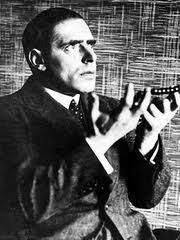
Hanussen, Magida writes, had no interest in politics or government, but he cast his lot with the Nazis to the extent that he used his charisma and manipulative skills to make some influential friends, not the least of whom was Count Wolf-Heinrich von Helldorf, head of the Nazi storm troopers in Berlin. Hanussen, who lived lavishly, entertained Helldorf in style and, while the Nazis were still trying to consolidate their power, the mentalist repeatedly lent money to Helldorf, holding onto the IOUs. Hanussen, who owned a newspaper in Berlin, used it to vigorously promote Adolf Hitler and his party.
Hanussen’s success was to a large extent a result of his hubris, and the primary example of that was the fact that he was not a Danish aristocrat, as he claimed, but an Austrian Jew named Hermann Steinschneider.
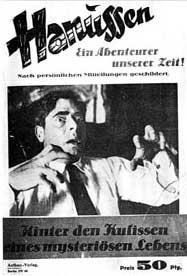
How he kept this from the Nazis for as long as he did is unclear, particularly since he continued to observe some Jewish rituals. In fact, one of his three wives converted to Judaism when she married him.
Eventually he was outed, first by a German communist newspaper and then by a Nazi publication. Even after this happened, he continued to behave with an extraordinary recklessness. He went too far, though, in February 1933, when he conducted a séance attended by some Nazi elite and tried to goad a hypnotized young actress into talking about a large fire. The following day, the Reichstag, seat of the German government, was torched. The circumstances surrounding that fire are still in dispute, but the Nazis blamed the communists. Magida writes that Hanussen, from his apartment, inexplicably telephoned the editor of a communist newspaper — a man he was otherwise unlikely to talk to — to inform him of the fire and warn him of the possible consequences.
In addition, Hanussen tried to use Helldorf’s IOUs to strong-arm the Nazis into letting him in on a lucrative business deal from which he had been shut out. The Nazis hadn’t been in power very long before three men took Hanussen for a ride. His body, with three shots in it, was found much later in the forest where he had been killed.
Unlike most of the Nazis’ millions of victims, Hanussen asked for it. Ironically, the success he enjoyed before he was eliminated was in part a result of an attitude that he shared with Hitler, who took advantage of the desperation and aimlessness of the German people after the combined blows of defeat in World War I and deprivation during the Great Depression. The following remarks are Hanussen’s, but they might have come from either man:
“”Their sadness comes from the fact that they don’t have a teacher, a father, a boss, a friend who impresses them enough that they can trust him. Why do these people come to me? Because I am stronger than they are, more audacious, more energetic. Because I have the stronger will. Because they are children and I am a man.”
Books: “A Slave in the White House”
February 21, 2012

PAUL JENNINGS
Folks confer a couple of lofty titles on James Madison, but “hypocrite” isn’t usually one of them. But Elizabeth Dowling Taylor isn’t bashful about using that term in her book A Slave in the White House: Paul Jennings and the Madisons.
The subject of the book was born into slavery on Montpelier, Madison’s farm in Virginia, and remained in bondage until he was 46 years of age. Within the stifling confines of slavery, Jennings rose to the highest possible place, serving for many years — including the White House years — as Madison’s “body servant.” That meant that he attended to Madison’s personal needs — shaving him, for instance — and traveled with him pretty much everywhere. He also was often the first person a visitor encountered, and he supervised the other household staff in preparing dinners and receptions. Taylor surmises that Jennings, who was literate, paid a lot of attention to the conversations that took place when political and social leaders visited the Madisons.

JAMES MADISON
One of the influential people Jennings became familiar with was Daniel Webster of Massachusetts, who served as a U.S. senator and as secretary of state. Madison had agreed, under pressure from a family member, to provide in his will that his slaves would be freed after specified periods. Madison — whose titles included “Father of the Bill of Rights” — reneged on that commitment and left about 100 slaves to his wife, with the provision that they would not be sold and that they would be freed at some point. When Dolley Madison began selling slaves in order to allay her financial problems, Jennings approached Webster, who had in the past assisted slaves. Webster arranged through a third party for Jennings to buy his freedom; Jennings worked for Webster for several years, and eventually, Webster took on the loan himself.

DANIEL WEBSTER
Jennings was the father of five; he married three times and was widowed twice. When he had satisfied his debt to Webster, he took a job in the Interior Department and worked there until a few years before his death in 1874. During the balance of his working life, he was a bookbinder.
Jennings also seems to have been something of an activist. The evidence Taylor had at her disposal suggested to her that even while he himself was a slave, he forged documents for others trying to get to free states and that after he had achieved his own freedom he was a player in the largest known attempt by slaves to escape to the North — 77 men, women, and children who tried to slip out of Washington via the Potomac River and Chesapeake Bay.
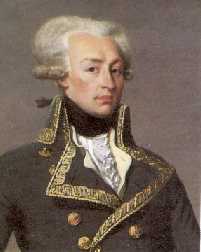
MARQUIS de LAFAYETTE
The most dramatic incident that occurred during Jennings’ years as a slave probably was the invasion of Washington by British troops in 1814. By Taylor’s account, Jennings was one of the servants at the White House with Dolley Madison when the alarm came that the house had to be evacuated, and he evidently was among the small group that removed the life-sized Gilbert Stuart portrait of George Washington that now hangs in the East Room. The painting almost certainly would have been destroyed when the British ransacked and burned the mansion.
Taylor’s account of Jennings’ life provides a lot of insight into slavery in Virginia, which was a complex system governed by both necessity and tradition. Her book also explores the contradictory position in which Madison and his close friend, Thomas Jefferson, found themselves. Both men publicly acknowledged that human slavery was essentially evil and that it should be eliminated, but both men kept scores of slaves to labor on their behalf. They were openly berated for this by abolitionists in the United States and by visitors from abroad. The Marquis de Lafayette, for example, visited the United States in 1824 and told Madison and Jefferson that he was nonplussed to find that almost a half century after he had fought for human liberty in the colonies, two of the principal figures of the Revolution were still keeping human beings in bondage.

THOMAS JEFFERSON
Madison gave what turned out to be only lip service to emancipation, insisting that while it was desirable, it was also more important to preserve the federal union. Madison also argued that any plan to emancipate slaves had to include a plan to remove them from the United States — probably to west Africa, where none of them had ever lived. His reasoning was that black and white Americans could not live together in peace, and he based that conclusion on his opinion that black people were a depraved race, lazy, profligate, and likely to resort to violence — an idea that apparently was not diluted by his long and close exposure to Paul Jennings, who was none of those things.
Books: “Masters of Mystery: The Strange Friendship of Arthur Conan Doyle & Harry Houdini”
February 13, 2012
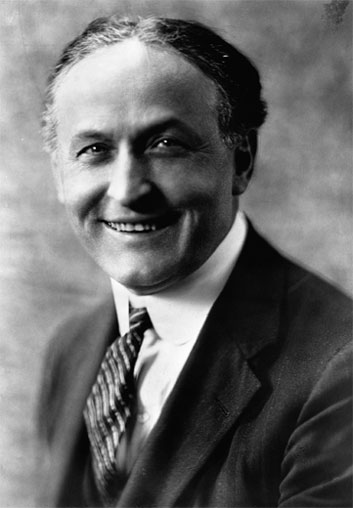
HARRY HOUDINI
While I was a grad student at Penn State, a family magic act appeared at Waring Hall. The show must have been either cheap or free, because we were living on $77 a month, and we went. With us was Michael Moran, an actor, who was visiting us that week. After each trick, Michael explained how it was done. All but one – the one in which the father in this family act crumpled up a piece of paper into a ball, placed it on a tennis racket, held the racket out at a right angle to his body, bouncing that wad of paper until it turned into an egg. He took the egg off the racket and broke it into a glass bowl. Michael couldn’t explain that one.
Intellectually, I knew that the magician had pulled a switch, but somewhere in my being I wanted to believe that he had changed that ball of paper into an egg.
This was nothing new. When I was a kid, I religiously (sic) watched Joseph Dunninger’s TV show. Dunninger was a mentalist who performed astounding feats and and made a standing offer of a $1,000 reward — a lot of money then — for anyone who could show that his subjects were in kahoots with him. Still, he ended every show by saying something like the following: “And remember, a child of ten could do the things I do, after thirty years of practice.” I found that disclaimer disappointing; I would rather he had said nothing and left us guessing — and left me able to believe that he could read minds.

JOSEPH DUNNINGER
I imagine that same neurotic desire in audiences contributed a lot to the success of Harry Houdini, and also the success of spiritualists and mediums who claim they can summon the spirits of the dead. Those folks are the subject of Christopher Sandford’s book, Masters of Mystery: The Strange Friendship of Arthur Conan Doyle and Harry Houdini.
The title is a little misleading in that Houdini and Sir Arthur Conan Doyle, author of the Sherlock Holmes stories among other things, were never really “friends.” It was more that they were interested in each other, almost obsessed with each other. What they were interested in was their contrary opinions about contacting the dead. Doyle got immersed in that subject because of his own bereavements, and he was convinced not only that intelligence could exist apart from the body but that the dead could communicate with the living, notably through mediums, and that he himself had experienced it. He seriously believed that a new religion should be established based on that premise. Houdini, on the other hand — who had bereavement issues of his own — didn’t discount the possibility of life after death or even the concept of communicating with the dead, but he made a second profession out of investigating mediums and concluded that all of them, including Conan Doyle’s wife, were frauds.

ARTHUR CONAN DOYLE
The two men did correspond and then meet, and they exchanged visits with their families, but there was never any prospect that one would convert the other. Such friendship as there was came to an end when Conan Doyle’s wife, Jean, conducted a seance in which she purported to contact Houdini’s deceased mother, repeating the mother’s messages to her son through “automatic writing,” meaning that Jean’s hand involuntarily scribbled down what Cecilia Weiss was saying. Conan Doyle was convinced; Houdini was not, inasmuch as Jean wrote in English, a language Mrs. Weiss had never spoken, and called her son by the wrong first name. Houdini was polite about it at the time, but he later denounced the seance as a fake.
Although Conan Doyle was subjected to some criticism, he conducted a vigorous campaign to promote the ideas of spiritualism, drawing big crowds wherever he went. Houdini, on the other hand, took a lot of trouble to expose individual mediums as phonies, driving some of them out of the business. Sandford alludes several times to the obvious irony that Conan Doyle, who had invented the relentlessly logical Holmes, could accept as legitimate supposedly spiritual events for which there was no support or which were debunked by calmer minds. As for Houdini, it’s impossible to know how much of his crusade was based on his professed outrage over the manipulation of people who were desperate to contact their lost loved ones and how much was driven by the showman’s instinct that had made him an international celebrity.
Netflix Update No. 62: “The Last Time I Saw Paris”
January 29, 2012
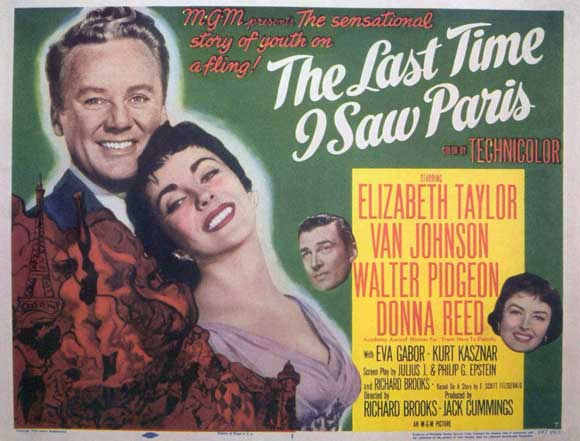 A couple of things Van Johnson told me about himself have stuck in my mind for more than 30 years. One was that he had a lifelong ambition to ride an elephant during the opening of a Ringling Brothers & Barnum and Bailey Circus performance. The other was that he was disappointed that living in a Manhattan apartment meant that children would never come to his door on Halloween.

VAN JOHNSON
I’ve been thinking about those things today because last night we watched Van Johnson in the 1954 film The Last Time I Saw Paris. He co-starred with Elizabeth Taylor. Others in the cast were Walter Pidgeon, Donna Reed, Eva Gabor, George Dolenz, and Sandy Descher.
This film, which was loosely based on F. Scott Fitzgerald’s short story “Babylon Revisited,” is a long flashback to Paris at the end of World War II in Europe. Johnson plays Charlie Wills, a soldier and aspiring novelist who works as a reporter for the military newspaper Stars and Stripes. At the beginning of the tale, he has returned to Paris from the United States, and he reminisces about the bitter circumstances under which he had left the City of Light: During the celebratory bedlam in Paris when the war ended, Charlie winds up at a party at the home of James Elwirth (Pidgeon), an impecunious American chancer who believes in living high even if one can’t afford it. Charlie is invited to the home by Elwirth’s quite proper daughter Marion (Reed), but is quickly infatuated with Marion’s ne’er-do-well sibling, Helen (Taylor).
Charlie and Helen marry and have a daughter, Vicki, played by Descher. Marion — who is broken-hearted over losing Charlie to the sister of whom she disapproves, settles on a rebound match with a thoughtful Frenchman, Claude Matine (Dolenz).

ELIZABETH TAYLOR
The marriage of Charlie and Helen goes well, even while they’re living from hand to mouth, but Charlie is gradually losing confidence in himself as one publisher after another rejects his novels. Then their world is permanently altered as oil is discovered on Texas land, thought to be barren, that Elwirth jokingly gave the couple as a wedding gift. While Helen struggles to maintain stability in the family, Charlie sinks further and further into a morass of depression and decadence.
When this movie was released, some critics savaged it. It is true that the story is implausible and that some of the acting is either arch or wooden. Eva Gabor, as socialite Lorraine Quarl, who plays a supporting role in Charlie’s decline, gives exactly the kind of performance one expected of the Gabors. Descher, who was only nine years old, is gag-me cute in the role of Vicki –and she inexplicably never ages as the years roll by.

SANDY DESCHER
Van Johnson’s light comedy is entertaining, but his drunk scenes are simply unbelievable. I once heard from a stage veteran that an actor who can’t play a convincing drunk is no actor at all. That might be too harsh a judgment on Johnson, but this film suggests that faux inebriation was not his strong suit.

WALTER PIDGEON
Elizabeth Taylor and Donna Reed did passably well as the sisters, although a scene in which Taylor’s character is mortally ill is so unconvincing as to be ludicrous. Walter Pidgeon, on the other hand, is delightful as the irresponsible but charismatic Ellswirth and Dolenz plays Claude as the most realistic figure in the film.
I don’t know if this is true, but I have read that the producers didn’t use the title of Fitzgerald’s story because they were afraid movie-goers would think the film had a biblical theme. I wondered about the title they did use, particularly because its lyrics express sentiments exactly opposite of those in this film. The song “The Last Time I Saw Paris” is heard in the background throughout the movie. It turns out that song was written in 1940 by Jerome Kern and Oscar Hammerstein, and it was sung by Ann Sothern in the 1941 film Lady be Good. It won the Oscar for best song. The song was composed in the aftermath of the German occupation of France. There were six versions of the song on the hit charts by the end of 1940, and Kate Smith bought the exclusive right to sing it on the radio for six months.
 As is often the case with movies, the shortcomings of The Last Time I Saw Paris do not add up to a failure. The film is nicely photographed — much of it in Paris, it captures the mood and mores of the early ‘fifties, and it is entertaining. It’s also an inoffensive opportunity to spend a couple of hours indulging oneself in the kind of escapism provided by “golden-age” stars such as Van Johnson and Elizabeth Taylor.
You can hear the title song, presented in the mood in which it was written, by clicking HERE. The performance is by Anne Shelton, a fine British vocalist who devoted a lot of time and energy to entertaining troops via radio and in person.
Books: “William Henry Harrison”
January 27, 2012
 United States presidents and baseball players have at least this in common: They can alter the record books just by showing up.
A case in point is William Henry Harrison, the ninth president and the subject of a book by the same name — one of the Times Books series of short biographies of the presidents. The author is New York Times columnist Gail Collins.
Harrison was in office hardly a month, but he still made his marks. He was the first presidential candidate to personally campaign for the office. He was the last president born before the Declaration of Independence. He gave the longest inaugural address. He was the first president to be photographed while in office. He was the first president to die in office. He was the first president to die in office of natural causes. He served the shortest term — 31 days. He was part of one of two sets of three presidents who served in the same year — 1841 and 1881. He was the only president whose grandson was president.
 As Gail Collins recounts with a lot of good humor, the campaign of 1840, in which the Whig Harrison defeated the incumbent Democrat Martin Van Buren, was a first of its kind, too, in the sense that it was the first really populist election in the United States, the first one that wasn’t dominated by a political and economic elite.
Harrison had unsuccessfully challenged Van Buren in 1836 when the fractious Whigs ran two candidates — basically a northern and a southern. But in 1840, the party got behind Harrison and he far out paced Van Buren in electoral votes, although the popular vote was much closer. More than 80 percent of the eligible voters participated — a statistic that must be filtered through the fact that women and a great many men did not have the franchise in those days.
As Collins describes it, the Whig campaign was like a three-ring circus, with literally thousands of stump speakers going from town to town, parades, rallies, and dinners with plenty of alcohol.

MARTIN VAN BUREN
The campaign was further distinguished by the Whigs’ successful effort to sell the public a candidate whom they could appreciate — a kind of frontiersman, one of the common folks, whose idea of a good time was flopping down in his log cabin and swilling hard cider.
In actual fact, Harrison was born on a Virginia plantation, was well educated and very mannerly, drank only in moderation and disapproved of drunkenness, and lived in a 16-room farmhouse in Ohio.
The 21st century voter may not be surprised to hear that the facts didn’t matter. The public bought the lie, which was encouraged with all kinds of “log cabin” events, images, songs, and verses, and other Whig politicians were happy to let some of the backwoods shading rub off on them.

TECUMSEH
This was also the campaign of “Tippecanoe and Tyler Too” — the “Tyler” being a reference to vice-presidential candidate John Tyler. Harrison had served in the army before retiring to his farm, and he was involved in several fights with the Indians and British in the struggle over the Northwest Territories. In one of those battles, near the juncture of the Tippecanoe and Wabash rivers in the Indiana Territory, Harrison, who was governor of the territory, routed a settlement being built by the brothers and Shawnee leaders Tecumseh and Tenskwatawa (“the Prophet). Harrison had far more men, and he took far more casualties, and the battle wasn’t really decisive in the long run. He had a couple of much greater successes under his military belt. But, hey, “Tippecanoe and Tyler too” rhymes, and the alliteration was irresistible.

It is well known that Harrison was inaugurated on a bitter winter day, and that he foolishly appeared at the outdoor event — including his two-hour speech — without a hat or coat. Gail Collins explains further that the amiable president-elect arrived in Washington already exhausted from both celebratory events and sieges by office-seekers, and that the pressure didn’t let up in the capital.
The author writes that Harrison was 67 years old when he campaigned for the office, and that the Democrats dismissed him as a feeble old man — not a far-fetched idea in 1840, when a man of that age frequently was in his dotage. Collins says Harrison’s recklessness might have been his attempt to refute the Democrats’ claims. In any case, shortly after the inauguration, he came down with what was probably pneumonia. He died on April 4, 1841.
Books: “A Soldier’s Sketchbook”
January 13, 2012

KATE SMITH
During World War II, the popular radio star Kate Smith used to end her daily broadcasts by saying, “And remember … if you don’t write, you’re wrong!” Kate Smith, who was a major supporter of the war effort in general and of American troops in particular, was prodding those at home to send letters to soldiers and sailors. I don’t know whether Kate Smith introduced that expression, and that inspired a songwriter, or the other way around. I do know that a writer named Olive Kriser wrote a song by that title in 1943, and it, too, urged families and friends to write to the troops.
For me, that phrase has always evoked what I imagine was a melancholy aspect of the war years: young men and women suddenly separated from their families, friends, neighbors, familiar surroundings, everyday routines, and hurled into the maelstrom, wondering about the folks, about ever seeing them again, longing for a mundane conversation around the kitchen table, a cheese sandwich made by Mom. And yearning, yearning, for a word from home.
That was the real-life experience of tens of thousands of young people, including Joseph Farris of Danbury, Connecticut, who was drafted, trained, and shipped off to the fighting fields of France and Germany shortly after leaving high school.
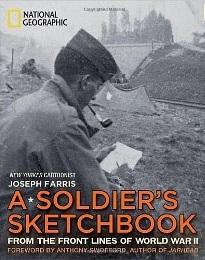
 Farris, who has become a very successful cartoonist and illustrator, has recreated his experience in A Soldier’s Sketchbook, an elegant volume published by National Geographic. Farris got lots of letters, but in this book, he reproduces many of the letters that he wrote to his parents and two brothers during the three years, beginning in May 1943, that he spent in the United States Army. The book also contains facsimiles of some of those letters and of other documents, photographs of Farris and some of his colleagues, and watercolors and drawings that he did while he was in service.
Farris provides a narrative in which he demonstrates how he pulled his punches in his letters home, both because military censorship sharply restricted what combatants could write about and because he didn’t want to worry his family. The folks wouldn’t know until it was well over that Farris — who wound up heading a heavy machine-gun platoon — came under heavy fire, watched his fellows soldiers being blown away, shivered in the cold and wet of the foxhole, and confronted the fact that any hour could the last in his brief life.
 By the time Farris got into combat, Italy had surrendered, Athens had been liberated, France had been invaded, and the German siege of Leningrad had been broken. The jig was up for the Third Reich. So although he experienced the worst of the war, he also had some less lethal duty, moving through towns in France and Germany and temporarily occupying houses that were far more comfortable than a hole in the ground.
A touching aspect of this book is the writer’s lack of self pity and his consistent concern for the well being of his parents and brothers. While he was still in harm’s way, he wrote to his younger brother George, “Dad, Mom, & I are exceedingly grateful, kid, that you are around to help out. Mom & Dad depend a helluva lot on you, so don’t let them down. You may work a little harder than many other fellows your age but in the long run it’s going to pay. You don’t know how thankful I am for the training I got in the store” — a reference to his family’s Danbury Confectionery — “not only the business experience but the systematic method necessary. You’re fortunate in having the swellest folks possible. If I can treat my future children half as good as Mom & Dad have treated us I’ll feel that (I) have done my job well.”
Throughout his military service, Farris thought about his plans for a career in art, and often asked his family to send him supplies. His work has appeared in the New Yorker and in other major publications. You can see many of his cartoons and illustrations by clicking HERE.
For another interesting aspect of World War II, click HERE to read about the Women’s Land Army. The site includes many letters written home by Genevieve Wolfe, who was one of a group of 40 young women from West Virginia who traveled to a camp in Ohio to provide labor needed on farms in the northern part of the state.
Books: “Eva Braun: Life with Hitler”
December 29, 2011
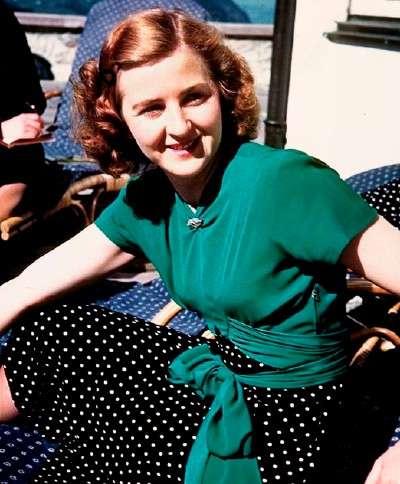 Chelsea, an aspiring actress, tells Cosmo Kramer during an episode of the TV series Seinfeld that her manager is “trying to put together a miniseries for me on Eva Braun. I mean think about it, is that a great idea? We know nothing about Eva Braun, only that she was Hitler’s girlfriend. . . . What was it like having sex with Adolf Hitler? What do you wear in a bunker? What did her parents think of Hitler as a potential son-in-law? I mean it could just go on and on….”
It could and it will, because while it isn’t true that we know nothing about Eva Braun, it is true that we know relatively little, considering that she was the consort of one of the most recognizable and most reviled men in human history.
Heike B. Görtemaker, tries to bring some clarity to this subject in Eva Braun: Life with Hitler, which was originally published in German. The very things that have made Braun an obscure figure up to now were obstacles to the author’s work, beginning with the fact that Hitler wanted to be perceived as a solitary messiah whose life and energy were devoted to lifting Germany and its people from the ignominious consequences of World War I.
 In order to maintain his image, Hitler kept the very existence of Eva Braun a secret from the German people, and he kept her at least at arm’s length and often much farther when they were in the company of his inner circle. Hitler married Braun on the day before they both committed suicide in a bunker in April 1945 while the Red Army was literally striding through the Reichstag grounds about 25 feet above their heads. He once said that he had never married because he needed the political support of German women and that he would lose some of his appeal if he had a wife. “It’s the same with a movie actor,” Hitler said. “When he marries he loses a certain something from the women who adore him. Then he is no longer their idol as he was before.”
When I read that in Görtemaker’s book, I wondered what “certain something” Hitler had that would attract any woman, never mind millions of them. Evidently the author wonders about that, too. When she writes that Braun’s life was shaped by Hitler’s power, his world view, and his “charismatic attraction,” she adds parenthetically, “however difficult it may be to explain what that consisted in.”
 Görtemaker is convinced that neither Braun nor the other women around Hitler — principally the wives of men like Albert Speer and Joseph Goebbels — were simply adornments who were expected to be seen but not heard. On the other hand, the author finds it impossible to say definitively how much Braun and the others knew about German policy, and particularly about the Holocaust. They had to know of the persecution of Jews in Europe; it was no secret. But discussion of the extermination program in Hitler’s presence was forbidden when he was in his “family circle,” as it were, meaning the crowd that frequented Berghof, Hitler’s frequent refuge in Bavaria.
 Hitler met Braun in 1929 when he was 40 and she was 17 and working as an assistant to Dietrich Hoffmann who became the privileged official photographer of the Nazi party and the Third Reich. Görtemaker speculates that the couple were not intimate until 1933 when Braun had become an adult . At first they saw each other only intermittently, and this apparently weighed on Braun and was the cause of two suicide attempts. After the second incident, Hitler arranged for Braun to have her own home in Munich and to have regular access to Berghof, where her assertion of her prerogatives irritated some of Hitler’s coterie.
Whatever attracted Braun to Hitler in the first place, long before it was clear that he would lead the German nation, her commitment to him was complete. Görtemaker writes that the level of her loyalty was the object of admiration to at least some of Hitler’s associates and it may have been the one thing that most endeared her to him. There’s no evidence that she pressured him to marry her or that she complained about being kept out of the public eye. And, in the most dramatic possible demonstration of her constancy, however misguided, she went to Berlin against Hitler’s wishes with the clear intention of dying with him while many others, including Speer and Hoffmann, were already concocting lies about being “outsiders” in Hitler’s camp. The normal confidentiality of the culture in which Hitler lived, coupled with the loss and destruction of written records and the unreliability of later testimony by turncoats trying to save their own hides and reputation may mean that we’ll never know more about Eva Braun than Görtemaker has been able to tell us in this book. That’s unfortunate, not because Braun was so different from others who supported Hitler, but because she was so like them. She was in all respects an ordinary person who came under the still elusive spell of a bumbling, absurd little man who terrorized the world for more than a decade
“You’ll go down in history!”
December 24, 2011
 There’s a radio station in these parts that started the week after Thanksgiving to play nothing but Christmas music. And that has been pretty much restricted to non-religious Christmas music, which sharply limits the available tracks, even with generic winter tunes like “Let it Snow” thrown in.

JOHNNY MARKS
We usually stick to the public radio classical music station, but once in while, when that station delves into music we find grating, we have switched to the commercial station, but the steady diet of what seems like a dozen songs can be nauseating. Earlier today, within less than 30 minutes, that station played yet again “Rudolph, the Red-Nosed Reindeer” by Gene Autry, “Rockin’ Around the Christmas Tree” by Brenda Lee, and “Have a Holly Jolly Christmas” by Burl Ives. It occurred to me as I reached for the remote that all of those songs were the work of Johnny Marks. That’s no small thing when one considers that relatively few pop Christmas songs have become standards.
“Rudolph, the Red-Nosed Reindeer” was actually a collaboration with Marks’s brother-in-law, Robert May, a Phi Beta Kappa graduate of Dartmouth, who worked as a copywriter for Montgomery Ward.

ROBERT MAY
For many years, the retail chain had been giving away Christmas coloring books to children who visited Santa Claus at Montgomery Ward stores, but in the 1930s, turned to creating its own book, which featured the tale of Rudolph, written in verse by Robert May. By 1946, more than six million copies of the book had been distributed. To its credit, Montgomery Ward, which originally owned the copyright to Rudolph because it had been written by an employee as an assignment, turned the rights over to May in 1947. Marks turned May’s poem into lyrics and set it to music. Although other singers turned down the chance, Gene Autry recorded the song for the Christmas season of 1949 and the disc sold more than 2.5 million copies the first year and has sold tens of millions since.
 Incidentally, May’s achievement was remarkable in its own right in that he managed to add a character to the ages-old Santa Claus legend.
Marks, who attended Colgate and Columbia universities, also wrote “I Heard the Bells on Christmas Day,” a musical adaptation of a poem by Henry Wadsworth Longfellow. The song was recorded by several major artists, including Harry Belafonte, Bing Crosby, and Kate Smith.
From what I’ve read, although “Rudolph” made Marks a rich man, he wasn’t crazy about being remembered only for that and a few other Christmas songs. As it happens, Marks also collaborated with Carmen Lombardo and D.L. Hill to write one of my favorite songs, “Address Unknown.” It was a big hit for the Ink Spots. You can hear their recording by clicking HERE.
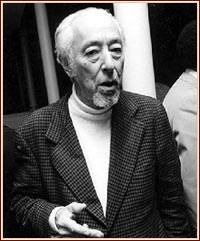
JOHNNY MARKS
I don’t want to leave Johnny Marks without mentioning that he served with the U.S. Army during World War II — specifically, as a captain in the 26th Special Service Company — and he was awarded the Bronze Star and four battle stars.
Serving under General George Patton during the invasion of Normandy, Marks won the Bronze Star for leading 20 men in an attack on a castle and capturing the 100 Germans inside. 
Neflix Update No. 61: “Alice”
December 20, 2011
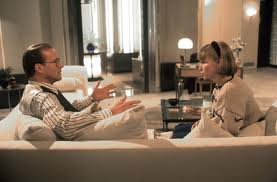
WILLIAM HURT and MIA FARROW in "Alice"
I don’t know if it’s possible to not be in love with Mia Farrow, but watching the 1990 Woody Allen film Alice is not the way to avoid it.

MIA FARROW
In this wonderful fantasy, written and directed by Allen, Farrow plays Alice Tate, the wife of wealthy businessman Doug Tate (William Hurt). Alice lives in a world in which her biggest concern is how to fit all the pampering she receives into her busy schedule. She and Doug have children, and Alice seems genuinely attached to them, but the kids spend most of their time with a nanny while Mom is with the personal trainer or the hair dresser or with her equally spoiled and gossipy lady friends.
Her routine is disrupted at her childrens’ private school when she meets and is attracted to Joe (Joe Mantegna), the divorced father of one of the other children. Shy and at least nominally Catholic, Alice suppresses her interest in Joe at least for a while. Right around this time, her usual hypochondria becomes focused on a chronic pain in her back, which drives her to consult an herbalist in a crummy building in Chinatown.
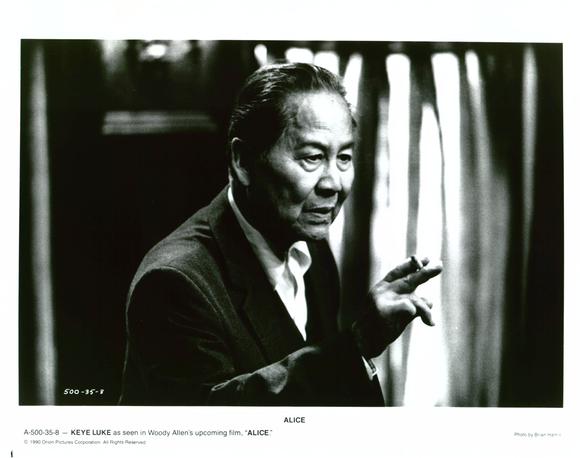
KEYE LUKE
Dr. Yang, played in a marvelous performance by Keye Luke — his last role — understands immediately that there is nothing wrong with Alice’s back. He hypnotizes her and then introduces her to a series of herbs that have extraordinary effects on her, and eventually on Joe, including invisibility. Alice and Joe learn a great deal about themselves and about their spouses (ex-spouse, in Joe’s case). The result is a total change in both of their lives, although not in the way that might seem obvious.
Yang, who barks at any sign of self-indulgence in Alice and consistently refers to himself in the third person, is a unique and hilarious character.
As usual with Woody Allen, every character in this film is perfectly cast, including a brief turn by Bernadette Peters as a mystical “muse” who addresses Alice’s ambition to be a writer; Gwen Verdon as Alice’s memory of her mother; Blythe Danner as Alice’s somewhat estranged sister; and Alec Baldwin as the ghost of Alice’s first lover. Even the tiny role of an interior decorator is enhanced by Allen’s choice of Julie Kavner.
GWEN VERDON
As for Farrow, she is simply irresistible.
The film is outstanding for its photography and for the writing, which got Allen an Oscar nomination.
Alice was loosely based on Juliet of the Spirits, a 1965 Italian movie directed by Federico Fellini, the first feature-length film he shot in color.
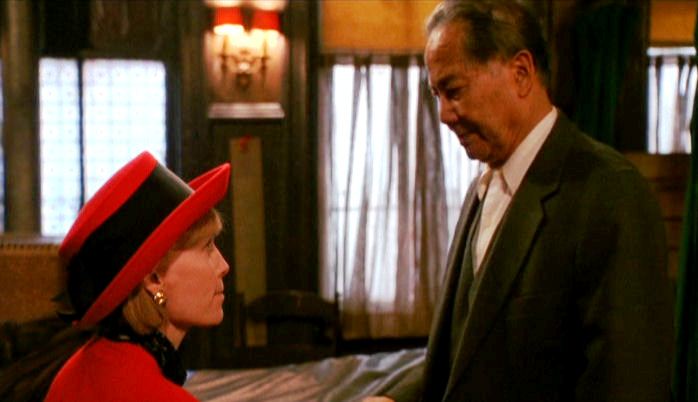
MIA FARROW and KEYE LUKE in "Alice"
 CharlesPaolino's Blog