Netflix Update No. 30: “A Kid for Two Farthings”
April 24, 2010
 We watched a 1955 Carol Reed movie, “A Kid for Two Farthings,” which is clumsy in some respects, but quirky enough to hold our interest.
The story takes place in a crowded mercantile neighborhood in London’s East End, where a young boy named Joe and his mother room with an aged Jewish tailor named Kandinsky. Joe’s father has been in South Africa for two years on a vaguely described quest to make his fortune. Whether he’s ever coming back is an open question, and the uncertainty is a source of anxiety for the boy and his mother.

DIANA DORS
Kandinsky has an assistant in the shop, a muscle-bound young man named Sam, who has been engaged for four years to a bleached blonde named Sonia, but hasn’t been able to afford a ring.
Sam hopes to win an international bodybuilding title so that he can afford to buy the ring, marry Sonia, and set up housekeeping, but a wrestling promoter, Blackie Isaacs, keeps pressuring him to take on a few rigged matches with the promise that he’ll earn enough quickly to carry out his plans. Under pressure from Sonia, Sam finally agrees to a rigged match with a has been that will lead to a bigger bout with a giant named Python Macklin.
Macklin ridicules Sam and bad blood develops between two, adding to the implications of their scheduled match.
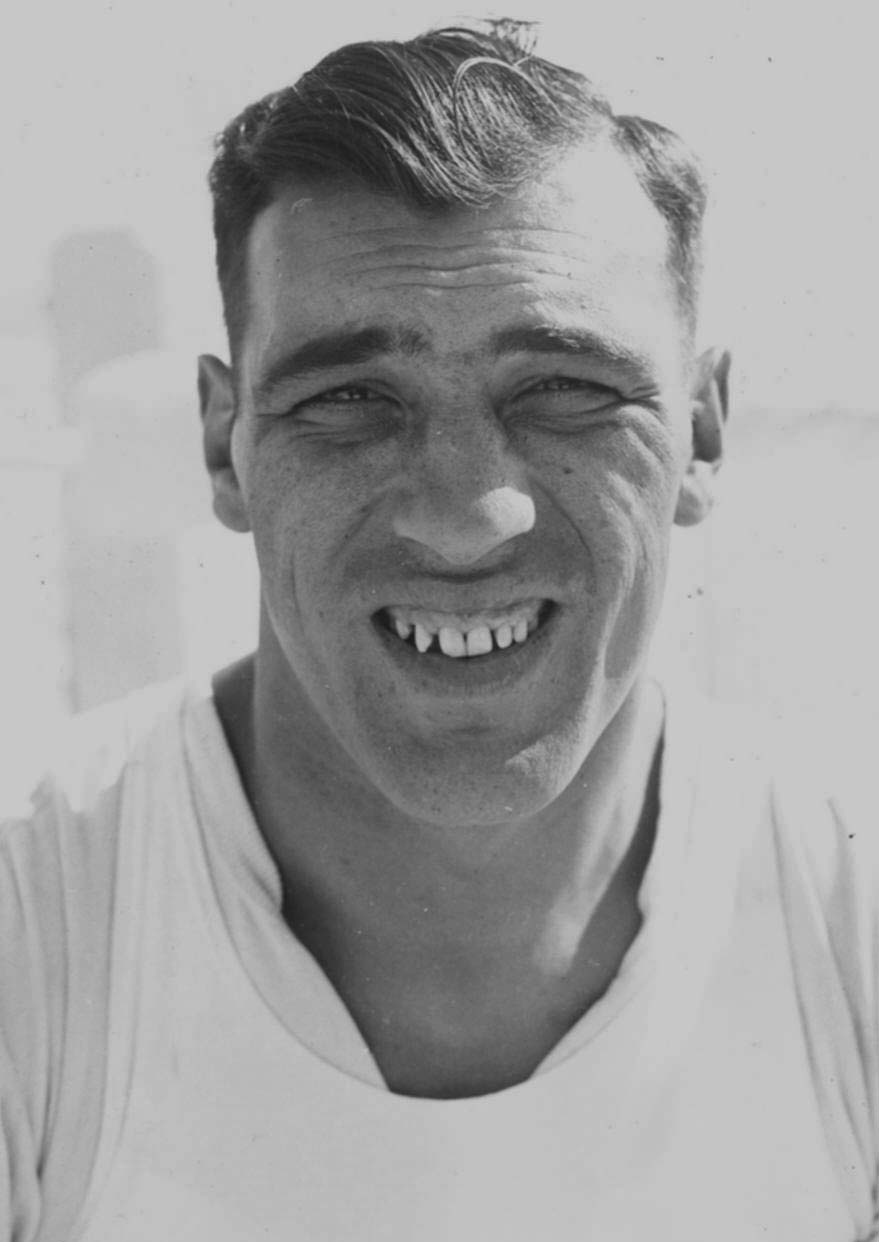
PRIMO CARNERA
Joe, the little boy, spends a lot of time listening to Kandinsky’s philosophy and learns from the old man about the magical properties of unicorns — specifically that they are capable of making dreams come true. The boy has a lot of dreams — his father’s return from South Africa, a ring for Sonia, and a steam presser for Kandinsky, who is still using an ancient iron. When Joe’s pet chick dies, Kandinsky gives the boy money to buy a dog, but Joe comes back with a sickly goat that has a single horn growing from its forehead. The arrival of this “unicorn” — real or imagined — drives the rest of the story.
This film is a visual treat because much of it takes place in the teeming market place, Kandinsky’s rusty old shop, and a seedy wrestling arena.
DAVID KOSSOFF
Celia Johnson as Joe’s mother, Joanna; David Kossoff as Kandinsky; and Lou Jacobi as Blackie Isaacs give especially good performances. Some commentators have speculated that Kandinsky is a metaphor for the lives of Jews in Europe after the Holocaust and the Second World War, and there is a rabbi in Old World clothing, praying and listening to an old Gramophone, who appears several times in the marketplace – including in the final scene of the movie.
In way that is unique to his own personality, Primo Carnera — the colossal former world heavyweight boxing champion — is very effective as the evil Macklin. On the other hand, Diana Dors as Sonia and Joe Robinson as Sam display as much acting acumen as two blocks of mahogany.
All in all, this is a sentimental, brooding, haunting film — far from perfect, but worth the time.
“… till it’s over”
April 19, 2010
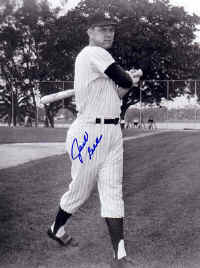
JACK REED
The 20-inning game the Mets won on Saturday got me to thinking about a 22-inning game between the Yankees and the Tigers in June 1962. I was watching that game at home, but I left, drove about 10 miles to visit a friend for several hours, and then drove home and found my brother watching the Yankees and the Tigers. That was long before VCRs and the YES Network’s “encores,” and I was dumbfounded when Tony told me it was the same game I had been watching before I left. It ended exactly seven hours after it had started. The Yankees won, 9-7.
As if the game wasn’t enough of a curiosity in itself, the way it ended was one of those delightful surprises that baseball is so good at providing. For a few years back then, the Yankees carried on their roster an outfielder named Jack Reed, whose job was to play center field in the very late innings so that Mickey Mantle, near the end of his career, could rest his battered and diseased legs.

CLETIS BOYER
Nothing more was expected of Reed, and usually nothing more was forthcoming. But the young man from Silver City, Mississippi, picked the top of the 22nd inning in that game to hit the only home run of his career, providing the Yankees with the runs they needed to win. Reed, incidentally, may not have spent much time in major league baseball, but he is one of a handful of players who can boast of appearing in both the World Series and a college bowl game – three games with the Yankees in the 1961 fall classic, and the 1953 Sugar Bowl with Ole Miss.
Yankee third baseman Cletis Boyer had hit a three-run homer in the first inning off Tigers starter Frank Lary, who was usually hard on the Yankees.

ROCKY COLAVITO
And while Rocky Colavito probably would have said that he’d rather the Tigers had won, even if he had gone hitless — ballplayers always say things like that — he had one of the biggest days of his career, collecting seven hits in ten times at bat. Meanwhile, the Tigers pitchers held the Yankees scoreless for 19 consecutive innings in that game — two shutouts, end to end.
Another note: Yogi Berra, who was 37 years old, caught the complete game.
“Near a volcano one still falls in love.” Amos Oz
April 17, 2010

School children in Heimaey. The island has about 4500 inhabitants.
The news of a volcanic eruption in Iceland and the lingering aftermath has had me thinking of our visit a few years ago to Heimaey, one of the Westman Island group off the southern coast of Iceland — the only one that is inhabited.
We took the ferry out to Heimaey, a trip of about four nautical miles, spent the night in a very nice little hotel, and then wandered all over the island and took a cruise around its outskirts.
The centerpiece of Heimaey is Eldfell, a volcano that erupted in January 1973, an event that continued until the following July. Besides the initial output of volcanic ash — an estimated 1.6 million cubic feet were blown onto the town — there was substantial flow of lava that threatened to close the island’s harbor.

A cluster of typical Icelandic buildings on Heimaey with Eldfell in the distance.
Overnight the whole population of Heimaey was evacuated, largely thanks to the fleet of fishing boats that was in the harbor at that time of year. If the lava had continued to flow unabated, it would have closed the narrow channel into the harbor which would have been disastrous to the fishing industry that supports the island’s economy. However, the islanders prevented that by pumping sea water onto the lava, redirecting the flow of the molten rock and causing much of it to solidify.
There was enormous damage to the town. Also, because of the lava flow, the length of the island grew from about 6 miles to about 8 miles. Ultimately, the residents returned and the town was restored. Video of the 1973 eruption is a THIS LINK.

A mural on an exterior wall of a building in Heimaey depicts the principal occupations of the residents.

A panorama of Heimaey, the largest island in the Vestmannaeyjar archipelago, first settled in the ninth century AD.
Hear the voice of Edwin Booth. No, really.
April 12, 2010

EDWIN BOOTH
I had an opportunity this week to talk to William Henline, a young playwright who is about to introduce a drama about Edwin Booth, the most prominent American actor of the mid and late 19th century and the brother of John Wilkes Booth. The focal point of the play is Edwin Booth’s effort to come to terms with what his brother had done. The dynamics are not the obvious. Edwin and Wilkes Booth lived at politically opposite poles. Wilkes was a Confederate sympathizer and operative who despised Abraham Lincoln, as many people did at the time. Edwin supported the Union, and Henline’s research shows that the only two times Edwin Booth is known to have voted, he voted for Lincoln. The brothers’ political differences ran so deep that they were incapable of discussing the subject.

JOHN WILKES BOOTH
Still, Henline discerns that there was a fraternal love that underlay this fissure between the brothers and that survived even Edwin’s revulsion and humiliation over the murder of Lincoln. Edwin, it seems, was constitutionally incapable of rationalizing or excusing Wilkes Booth’s crime, but was equally incapable of casting off his sibling — even if he did once say that he didn’t want Wilkes Booth’s name mentioned in his presence.
Edwin Booth’s rooms at the Players Club in New York have been preserved as they were on the day he died in 1893. Near his bed is a portrait of John Wilkes Booth.
Henline also called my attention to the fact that there is a recording available of Edwin Booth reciting part of a speech from William Shakespeare’s “Othello.” The quality is as poor as one might expect from such an early recording, but if you listen to it at THIS LINK, you can follow the text on the screen and understand most of the speech. Considering who Edwin Booth was and when he spoke these words, it’s a stirring experience to sit at a laptop in 2010 and hear his voice.
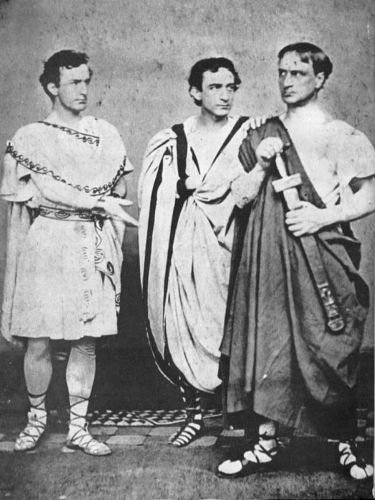
John Wilkes Booth, left, as Marc Antony; Junius Brutus Booth Jr. as Cassius; and Edwin Booth, right, as Brutus, in a production of “Julius Caesar” in New York in 1864. It was the brothers’ only joint appearance on stage.

MAURA TIERNEY
I learned something about myself yesterday: I’m not hip. I thought otherwise, but yesterday I saw The Wooster Group’s musical play — at least, I think that’s what it was — at the Baryshnikov Arts Center in New York, and I realized that I am a Pod.
This play, which has been around in one form or another since 1983, is called “North Atlantic.” That’s because it is set on an American aircraft carrier, during the cold war, off the coast of the Netherlands. It’s 90 minutes long. The creators have opted for no intermission. No doubt they had in mind to maintain the continuity of the piece at which, in a certain sense, they succeeded. The piece certainly continued — so much so that 90 minutes seemed like a geologic epoch. Another benefit of eschewing a break, perhaps unintended, is that the audience stayed to the end. I know four people who would have opted for an earlier dinner at Park and Orchard.

FRANCES McDORMAND
Far from disliking experimental theater, I have always appreciated it. But then, I have always understood it. In 1969, for example, I saw Omar Shapli’s play, “Rules for the Running of Trains on the Erie Railroad to go into Effect on Jan. 1, 1882 – Section 10,” and I understood that the frenetic activity and the references to the Haymarket Riot and the reportage of Nelly Bly was painting a portrait of American life, and the hypocrisy that affected it, at the turn of the 20th century.
By contrast, at the Baryshnikov yesterday, I had no idea what was going on, and I’d wager that most of those in the theater who pretended that they did understand were embarrassed to admit the truth. The program was an unbroken stream of scrambling about, incongruous argument, unprovoked yelling, and filthy sexual repartee. The actors frequently and by design talked over each other so that any chance, however remote, that a clip of dialog here or there would make sense was conclusively thwarted. It may be apocryphal, but I heard a rumor that the playwright, James Strahs, appeared backstage in a fury after the show because he thought he had heard a coherent sentence.

A scene from "North Atlantic"
This play, which has been revised and revived several times over the decades, is offered as a spoof of programs such as, say, “South Pacific,” that portray life in the military. If I hadn’t learned better, I’d have thought that it was a sophomoric attempt at best. The constant stream of graphic references to penises and vaginae and variations of intercourse sounded more like a spoof of the conversations in the locker room at Passaic Valley High School, say around 1958. It turns out, though — as it frequently does in my life — that I was on the outside looking in. The critic in the Los Angeles Times, commenting on the West Coast run of this revival, said so in so many words: “The piece navigates in a zone that will be a delight to devoted fans and avant-garde hipsters but will probably leave ordinary theatergoers dog-paddling to safety.”
All this time, I thought I was an avant-garde hipster, whereas I was actually the duffer flapping around at the shallow end of the pool.
I have only myself to blame for this rather expensive faux pas. I talked my companions into seeing this play because Maura Tierney was in the cast. My wife and I had seen her two previous appearances on New York stages, and I didn’t think we needed any more evidence than her magnetic presence in those plays and my general conviction that she is a fine actress. It wasn’t discouraging at all to also note that Oscar winner and Tony nominee Frances McDormand is in the ensemble.
I’m going to see Boyd Gaines in A.J. Gurney’s play “Sylvia” later this week. It’s about a man who brings home a stray dog he finds in a park. I think I’ll understand it.

Some of the players in "North Atlantic"
“She’s making history, working for victory” — Evans and Loeb
March 28, 2010

"Rosie the Riveter"poster from World War II era
Like many people, I guess, I frequently brood over the questions I should have asked when I was a kid. One category that came to mind today is related to my father’s work in an aircraft assembly plant during World War II. All I know is that Dad was not drafted into military service, but was assigned to work at the Curtiss-Wright Corp., I presume in Caldwell. He was 29 years old when my brother was born in 1941, and his age might have had something to do with his exemption. He told me that he worked in my family’s grocery store during the day and at Curtiss-Wright at night, but how long he worked at the plaht and what he did, I didn’t ask. Along about 1976, it became too late. I can’t blame it on the ignorance of youth, either; by the time Dad died, I was in my 30s, and I still hadn’t asked.
Fortunately, most people are smarter than I am, including some filmmakers who are tracking down women who worked in the defense industry during the war — the fabled labor force that shared the sobriquet “Rosie the Riveter.”

Women at work in a defense plant during World War II
I saw a note on the web site of the Detroit Free Press indicating that the filmmakers plan to visit Michigan next month looking for women in that state who had supported the war effort by building aircraft and manufacturing munitions and other matériel. This is a project of New York University’s Tamiment Labor Archives; it’s explained in some detail at THIS LINK.
Several years ago, a project in Morris County, here in New Jersey, conducted several lengthy interviews with women who had been part of the Rosie brigade. The interviews, and photos of those women, are available at THIS LINK.
The term “Rosie the Riveter” was first used in 1942 in a song by that name written by Redd Evans and John Jacob Loeb. In poking around on this subject, I also learned that the women who did this indispensable work have been commemorated in the Rosie the Riveter Charter High School in Long Beach, Calif., a school that gives girls an opportunity to learn non-traditional trades.

A student at Rosie the Riveter Charter High School learns to operate a power saw.
“Free speech is life itself.” — Salman Rushdie
March 26, 2010

ANN COULTER
So Ann Coulter spoke at the University of Calgary last night, and Canada is still intact. There is no way to know whether Coulter’s remarks at the University of Ottawa – which she did not deliver because she was, in effect, driven away by a crowd of protesters – would have differed from the remarks she gave at Calgary, where she was treated almost politely.
The episode at Ottawa was interesting in its own way because the protesters presumably were to the left of Coulter on the political spectrum but were behaving a lot like people in the States have behaved recently — people who, one would assume, are in Coulter’s vicinity on the philosophical scale. So folks of all stripes are capable of intolerance.
This incident and others like it also expose the fact that many of us are almost infantile in our understanding of the very institutions we pretend to uphold.

NOAM CHOMSKY
In particular, people like those who hounded Coulter at Ottawa don’t grasp, or don’t want to accept, the radical principle that by whatever criterion we mitigate the rights of one person, we put our own rights in jeopardy. Such people also don’t grasp that they have to be willing to be offended if they want to live in a free society. It’s what the ancients called “a hard saying,” and far more of us subscribe to it rhetorically than like it when it’s put into practice. “If we don’t believe in freedom of expression for people we despise, we don’t believe in it at all,” as Noam Chomsky put it.
There’s a guy who occasionally sets up shop outside the post office down the street to spread his vitriol about Barack Obama — which I don’t agree with, and Nancy Pelosi — which is negotiable. I hear neighbors complaining about that guy, but to me he is just a part of the big portrait of America. I don’t like Ann Coulter, but I feel much more secure in my own life to the extent that she is allowed to say what’s on her mind.
Netflix Update No. 29: “Speak”
March 20, 2010

KRISTEN STEWART
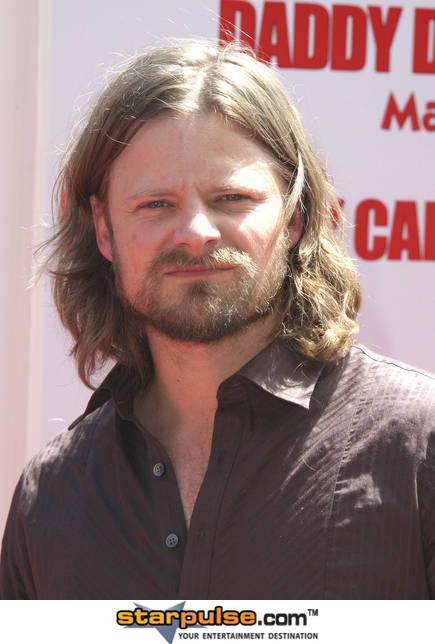
We watched “Speak,” a 2004 television movie based on a well-received novel by Laurie Halse Anderson, who specializes in books for teens and young adults. “Speak” focuses on Melinda Sordino — played by Kristen Stewart — who is entering high school at a pivotal time in her young life. She has been the victim of a sexual assault, and she has not been able to confide in anyone — a frequent dilemma for women and girls who have been abused. The assault on Melinda has indirectly estranged her from her former clique so that she enters the new school environment as a solitary and lonely figure. Her parents — played by Elizabeth Perkins and D.B. Sweeney — are not completely inattentive to Melinda, but they are preoccupied with their own problems and clueless about hers. In the event, as she is increasingly isolated, Melinda becomes less and less willing to engage anyone in conversation. The only people with whom she has any satisfactory relationships are a rebellious art teacher — played by Steve Zahn — who alternately goads and encourages Melinda to express her self through images of trees, and her lab partner — played by Michael Angarano — who seems immune to the social dynamics of the high school.
STEVE ZAHN
This is a well written and well told story. It’s all about Melinda, and therefore all about Kristen Stewart. And Kristen Stewart is up to the challenge. She is this movie, and the other players, perhaps with some help from director and screenplay writer Jessica Sharzer, give Stewart space. The actress has been busy since she made this movie at the age of 13, and it’s reasonable to expect that she’ll stay that way.
Melinda is presented as an observer of her own life, and her narration is laced through the story. Stewart’s understated delivery of the quick-witted teenager’s sardonic remarks adds palpable substance to the film. “It’s time for a mental health day,” Melinda explains. “So conjugate this: I cut class. You cut class. He/she/it cuts class.”
The Lifetime Channel will broadcast this film at 9 p.m. on Tuesday, March 23.
The bigger they are . . . .
March 16, 2010

HUMPHREY BOGART
Once again the other morning, instead of getting up I clicked on the TV and turned to Turner Classic Movies. Never a good idea. We ended up watching “The Harder They Fall,” a 1956 movie starring Humphrey Bogart, Rod Steiger, and Virginia Mayo. It was Bogart’s last film; he died the following year.
“The Harder They Fall” was ostensibly based on the life of Primo Carnera, and if it was, it wasn’t meant as a compliment to the Italian boxer. The film concerns an Argentine giant who is brought to the United States by an unscrupulous promoter (Steiger) whose angle is to build up the unwitting and incapable kid through a series of fixed bouts and then bet against him when he fights for the heavyweight title. As far as I know there is no proof, but there is a persistent story Carnera was used in just that way.

Jersey Joe Walcott
The cast of “The Harder They Fall” included Jersey Joe Walcott, who won the world heavyweight title in 1951, when he was 37 years old. Walcott — who served as sheriff of Camden County and chairman of the N.J. State Athletic Commission — played a trainer in “The Harder They Fall,” and seemed comfortable in the part.
MAX BAER
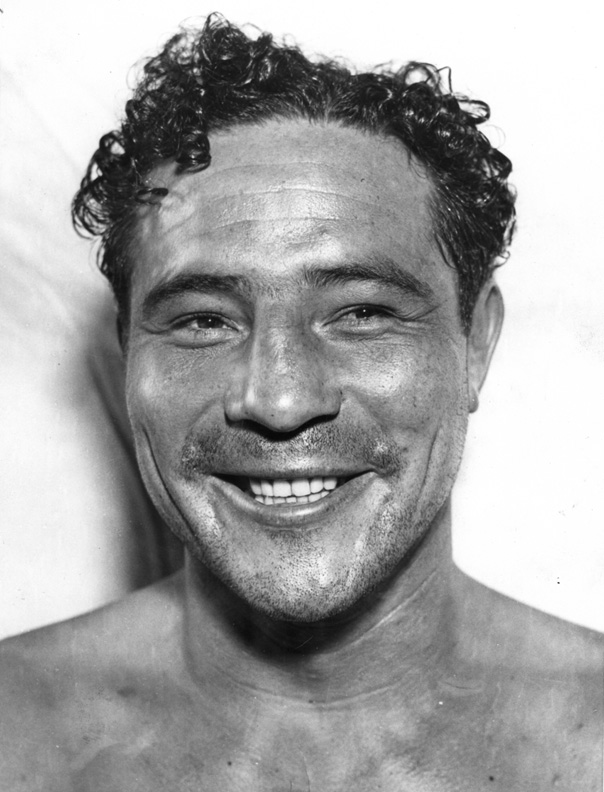
Also in this cast was Max Baer, who played the heavyweight champion who beat the Argentine kid and put an end to his career. This appears to have been a none-to-subtle reference to the fact that Baer took the title from the 275-pound Carnera in 1934. There is also an episode in this film in which the boxer played by Baer gives his opponent such a beating that the man suffers brain damage and dies. That, too, happened in Baer’s career: In 1930, a fighter named Frankie Campbell — brother of Dodger star Dolph Camilli — died after a bout with Max Baer in San Francisco.

BUDDY BAER
Max Baer — father and namesake of the actor-director-producer who played Jethro in “The Beverly Hillbillies” — appeared in a couple of dozen movies and television productions. His brother, Buddy Baer — who was just as hard a puncher — had a record of 52 wins and 7 losses with 46 knockouts. He never won a title, but he had the distinction of once knocking Joe Louis out of the ring — in a fight that Louis ended up winning on a disqualification call. Baer claimed Louis had hit him and knocked him down after the bell ended the seventh round, and he refused to answer the bell for the eighth. Buddy Baer, too, appeared in numerous movies and television shows after he gave up boxing.
ROCKY GRAZIANO
There were other personable guys who dabbled in entertainment after they were through in the ring, including Rocky Graziano and “Slapsie” Maxie Rosenbloom.
Graziano was a New York street brawler and thief who did time on Riker’s Island and spent lots of time in other sorts of incarceration and under the protection of the Catholic Church. He went AWOL from the Army after punching an officer, and he was suspended from boxing for failing to report an attempted bribe and again for running out on a bout. He was a very good boxer and immortalized himself in the annals of the sport for his three bloody fights with Tony Zale in 1946, 1947, and 1948. The second of those fights made Graziano middleweight champion of the world.

MAXIE ROSENBLOOM
After his fighting career, Graziano — who, like a lot of guys with his background, was a charismatic figure — became a popular entertainer, especially on television comedies and variety shows.
Rosenbloom won the world light heavyweight title in 1932 and held it until 1934. On the one hand, his method of moving around the ring made it hard for opponents to land decisive blows, but that quality also meant that his fights often went the distance, and he took a lot of shots to the head. This eventually affected his physical health. Still, he capitalized on the image of a goofy pug and became a familiar figure on television. Although he wasn’t a serious actor, he played a significant role in Rod Serling’s “Requiem for a Heavyweight,” the iconic boxing story that starred Jack Palance and Ed and Keenan Wynn and included in its cast Max Baer.

PRIMO CARNERA
In an interesting parallel, Primo Carnera, who was even more unlikely an actor than Rosenbloom, also hit one high note in a limited screen career. Carnera was a giant. When he defended his heavyweight title against Paolino Uzcudun, the two fighters weighed a total of 488 3/4 pounds — the most weight ever in a title match. And when he defended the title against Tommy Laughran, the average weight of the two fighters was 227 pounds, but Laughran weighed only 184. It was the biggest disparity ever in a title bout.
Carnera used his size and generally menacing appearance to his advantage in the 1955 film “A Kid for Two Farthings,” and he won critical approval for his portrayal of villainous wrestler Python Macklin.

Rocky Graziano knocks Tony Zale through the ropes in their 1947 fight.

FRANK MORGAN
To hear Josh Olson tell it, he’s courting all kinds of trouble by writing a script for a proposed follow-up to MGM’s classic film, “The Wizard of Oz.” According to the Los Angeles Times interview with Olson, who wrote the 2005 film “A History of Violence” — don’t tell me he’s not versatile — he expects some pushback from purist fans of the original. Actually, what he said was the following: “You want to write something that takes people back to the fondness they had for the original. I’m aware of the fact that there are a couple million people who will come to your house and burn it down if you don’t get it right” — which would, after all, be one more chapter in the history of violence.

JUDY GARLAND and TOTO
However, the script Olson submitted to Warner Brothers is not intended as a re-make of the Judy Garland film, which is why I used the term “follow-up” earlier. The proposed new film, to be called simply “Oz,” would deal with a granddaughter of Dorothy Gale who visits the Other Side. This really would be in keeping with the history of the story introduced in 1900 in the form of a children’s book (“The Wonderful Wizard of Oz”) by L. Frank Baum. The book and a play adapted from it a couple of years later were very successful, and Baum — apparently nobody’s fool — wrote a total of 14 Oz books. Those books, plus 19 written by Ruth Plumly Thompson, two written by Frank Kramer, one written by Rachel Cosgrove, and a final one written in 1963 by Eloise Jarvis McGraw and Lauren Lynn McGraw, are considered the “canon” of Oz literature. Obviously, in the aggregate they wander far from the premises of the original story.

The title page from the original "Oz" book.
Literary critics with a lot of time on their hands have tried over the years to read political messages and other serious subtexts into Baum’s work, but Baum himself insisted that he had intended only to write stories for the entertainment of children. Oz, in other words, was not like Wonderland.
Olson’s premonition of an angry mob — tongue in cheek, of course — put me to mind of the furious gang that gathered outside the Binney & Smith plant in Easton, Pa., about a decade ago to protest the retirement of certain colors in the Crayola spectrum.
Change can be a buster.
The LA Times blog is at THIS LINK.

Dorothy meets the Cowardly Lion in W.W. Denslow's illustration of "The Wonderful Wizard of Oz."
 CharlesPaolino's Blog