Netflix update No. 70: “The Answer Man.”
July 31, 2012
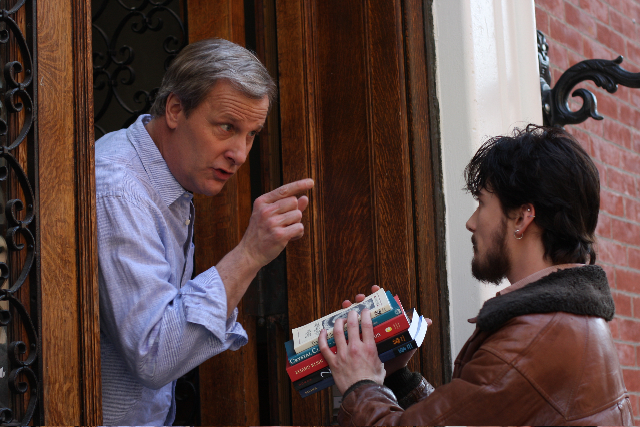
JEFF DANIELS and LOU TAYLOR PUCCI
When I saw a film named The Answer Man in the Netflix catalog, I thought it might be about Albert C. Mitchell, who had a radio show by that name that was still running when I was a kid. In that show, Mitchell offered to answer any question that was called or mailed in by a listener. The show was contrived to give the impression that Mitchell could answer these questions off the top of his head, but that wasn’t the case. Steve Allen famously did a parody of this show in which he played the “Question Man.” He would be given an answer, and he would provide the question. One answer, for example, was “the cow jumped over the moon.” The question was, “What happened when lightning hit the milking machine?”

LAUREN GRAHAM and JEFF DANIELS
Anyway, the movie isn’t about that. Instead, it’s about a writer named Arlen Faber (Jeff Daniels) whose one success was a book called Me and God, in which he revealed that he had had a personal encounter with the Creator of all that is . The book took the form of a series questions and the Almighty’s answers. This one success was the only one Faber needed. The original book and a wide variety of spin-offs — including a cook book — written by other people made him a wildly popular celebrity.

MAX ANTISELL
But Faber wasn’t interested in fame. In fact, in the 20 years after the book appeared, he hasn’t made a public appearance or consented to an interview, despite the pleas of his publisher. He spends most of his time in his Philadelphia apartment and, on the rare occasion that he speaks directly to another human being, his behavior ranges from disagreeable to obnoxious.
His routine is upset, however, when his life intersects with those of two disconnected strangers: Elizabeth (Lauren Graham), a single mother who has just opened a chiropractic office, and Kris Lucas (Lou Taylor Pucci), a young man whose bout with alcoholism has put at risk the book store he runs with his assistant Dahlia (Kat Dennings).

LAUREN GRAHAM and OLIVIA THIRLBY
Faber comes in contact with Lauren because he needs treatments for his bad back. Lauren and her receptionist, Anne (Olivia Thirlby), don’t know what to make of the volatile and manipulative Faber, but Faber is attracted to Laurenr — the first such attraction for him in decades — and he develops an uncharacteristically benign relationship with her young son, Alex (Max Antisell). Faber wants to get rid of some of the books that he has accumulated in his apartment, and he tries to sell them to Kris, who has no cash to buy them with. The impending loss of his store is not the worst of Kris’s problems, though. His effort to stay sober isn’t helped by the fact that he lives with an endearing but alcoholic father. In a desperate attempt to keep from slipping under the waves, Kris blackmails Faber into an arrangement in which Kris will take a few of Faber’s excess books off his hands each time Faber, drawing on his supposed supernatural source of wisdom, answer one of Kris’s questions .

JEFF DANIELS and MAX ANTISELL
There is, of course, a reason why Faber has hidden from public view for two decades, and that back story eventually comes out into the daylight.
This film, which was made in 2008, got mediocre reviews, but we found it engaging. I did object to some unnecessary physical humor, but the premise is unusual, the main characters are interesting, and the actors are effective in those roles. Although this is described as a romantic comedy, Pucci’s performance as a young man in the grip of addiction is particularly disturbing.
Don’t believe the critics.

A touch of class
July 17, 2012
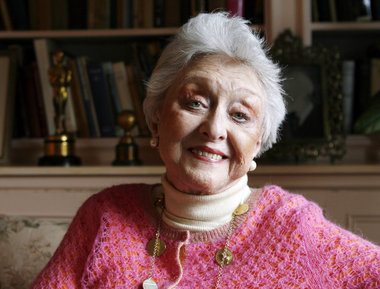 This is the kind of person Celeste Holm was.
In the 1970s I wrote about her somewhere that her favorite stage role was Anna in “The King and I,” a role she took over in 1951 at the request of Richard Rodgers after the original Anna, Gertrude Lawrence, died during the run of the show. Celeste saw that and called me. “I wonder if you’d do me a favor,” she said. “Would you send that article to Richard Rodgers. I want him to know how I feel about that role.” I asked her why she didn’t send it to him herself, and she said that she didn’t think it would be “appropriate” for her to send someone an article about herself. “Well,” I said, “don’t you think Richard Rodgers is going to think it’s peculiar that someone he never heard of sends him a newspaper clipping from out of nowhere.” “Oh,” she said with a laugh that she once told me was only slightly removed from wisdom, “you’re a writer. You’ll think of something to tell him.”
 So I complied — Celeste was just regal enough that a person didn’t seriously consider not complying — and Richard Rodgers was delighted, as he told me by return mail.
The fact that she managed that transaction so carefully was part of the elegance that enveloped her — a kind of sophistication that I associated with women like Arlene Francis and Kitty Carlisle Hart. But Celeste was anything but distant. A lot has been published since her death this week about her many civic and charitable works. And while that involved titled roles with public and private organizations, it always involved Celeste’s heart.
 I saw that first hand on one occasion when I foolishly volunteered to produce a sort of cultural concert of music and drama to benefit an organization that provided services to mentally handicapped citizens. I recruited a bunch of professional performers, but I had no idea what I was doing. The program was what vaudeville used to call an olio — a bunch of unrelated parts, but in this case it was supposed to look like a coherent whole. To achieve that, I had written a script that tied the sundry parts together, and I asked Celeste if she would be the narrator. She, being Celeste, agreed, and I took the script up to her apartment on Central Park and together we tweaked it to fit her particular style of speaking.
 As the day of the performance approached, however, I was convinced that the disparate pieces of the concert were going to unravel into an incoherent melange — with about 900 paying customers in the audience. As I anticipated a complete run-through of the various acts on the afternoon before the performance, I called Celeste. She and her husband, actor Wesley Addy, not only came to the run-through but took command of it, checking sound and lighting, talking up the performers so as to assure a smooth transition from act to narration to act to narration.
That night, when the lights went up and Celeste stepped up to a lectern, she looked down at the seats directly in front of her and saw a group of mentally handicapped people whom we had invited to the event. Celeste hadn’t anticipated these guests. Her eyes filled with tears. Instead of beginning the narration, she walked to the edge of the stage: “Thank you!” she told those folks. “Thank you so much for coming!”
Books: “The Longest Fight”
July 16, 2012

JOE GANS
Prize fighting was part of my growing up.
My parents associated with some people who were connected to the boxing game: a promoter, a ring announcer, a cut man. At times, Mom and Dad would attend fights; I remember Mom coming home after one of those occasions with flecks of blood on her pink suit. Apparently they were at ringside.
In those days, the 1950s, we could watch fights on broadcast television, and we saw Carmine Basilio, Ezzard Charles, Jersey Joe Walcott, Sugar Ray Robinson, and Archie Moore.
Then, as now, I was a little schizophrenic when it came to boxing. I liked watching fighters like the ones I named, but I didn’t approve of boxing and thought it should be banned. I thought, and think now, that an enterprise in which the object is to knock your opponent senseless has no place in a civilized society.

WILLIAM GILDEA
Boxing was, in fact, illegal in most of the United States in the period discussed in William Gildea’s book, The Longest Fight. Where it was legal, one of the most prominent practitioners of “the sweet science” was Joe Gans, Gildea’s subject, the lightweight champion of the world and the first African-American to hold a world boxing title.
Gans held the lightweight title from 1902 to 1908 and he won the welterweight title as well in 1906. A native of Baltimore, he was strikingly handsome, well spoken, witty, courteous, and charming. Those qualities plus his nearly matchless skill in the ring attracted a large following, including white folks in numbers that were unusual for a black athlete in the days when Jim Crow was in such full vigor that racial epithets and garish cartoon figures of black Americans were commonplace in daily newspapers.

A postcard promoting the first Gans-Nelson fight.
Gildea recounts that Gans put up with plenty of abuse during his career, but he had learned the wisdom of restraint, and he practiced it in and out of the ring. When a white opponent spat in Gans’s face while the referee was going through the ritual of instructions, Gans bided his time until the fight began. His demeanor in everyday life was disarming, and he won over many people who otherwise would have included him in their overall prejudices about black people.
Gildea reports that people such as promoters and managers took advantage of Gans, because they knew a black athlete had no recourse and often was risking his life just by climbing into the ring with a white boxer.

”BATTLING” NELSON
In what was arguably the biggest fight of Gans’s career — the “long fight” referred to in the title of this book — the manager of Oscar “Battling” Nelson insisted that Gans submit to three weigh-ins on the day of the contest, and under unheard of conditions. Gans just stood for it. No one, he knew, wins at the weigh-in.
That fight took place in September 1906 under a broiling sun in the Nevada desert town of Goldfield. Gans defended his lightweight title against Nelson, whom Jack London called “the abysmal brute” for both his free-swinging style and his penchant for dirty tactics like groin punches and head-butting. Nelson was also an unapologetic racist who made no bones about his revulsion for Gans and black people in general. It was a fight to the finish, and the finish didn’t come until the referee disqualified Nelson for a low blow in the 42nd round, after two hours and 48 minutes of combat.
By that time, Gans had beat the tar out of Nelson whose face, Gildea writes, was almost unrecognizable, but if Nelson had one positive attribute it was that he could take punishment, so he was still standing when the referee made Gans the winner.

Gans during one of the three weigh-ins before the fight in Goldfield.
Gildea describes the “fight to a finish” in episodes running through the book, interrupting the account from time to time to relate other aspects of Gans’s career and private life, including the two dives he acknowledged, his warm relationship with his mother, his romantic ties, his establishment of a Baltimore hotel and saloon that was a drawing card for a stylish crowd, both black and white, and his early death.
Gildea, whose carefully crafted narrative makes this book especially enticing, clearly explains the quality that made Gans a perennial winner. He blocked his opponents’ punches, moved as little as possible, threw a punch only when he saw an opening. And when he did punch, the blow was short and direct — in fact, Gildea writes, Gans introduced the technique of reaching out to touch his opponent and freezing the distance in his mind.
Gans is largely forgotten today, but as Gildea demonstrates, he was an important figure in the history of boxing and, more significantly, in the history of black citizens in the United States. Like the black men and women who were the first to venture into other fields, Gans took a barrage of slings and arrows for the team, and he did it with style.
Books: “The Mark Inside”
July 14, 2012

J. FRANK NORFLEET
I was a neophyte reporter in Perth Amboy when I first heard the term “flim flam.” I came across it on a police report during my daily visit to headquarters, and I was to see it many times during the two and a half years I covered the city. This term can be used to mean more than one thing, but in the parlance of Perth Amboy police in the mid ’60s, it meant a scam that was run on the sidewalk outside a bank. In those days, before there were banks every thousand feet, Perth Amboy was a banking center and therefore a favorite haunt of a certain kind of con artist.
In Perth Amboy, flim flam meant that an older person who had just emerged from one of the banks on Smith Street would be approached by an amiable stranger who appeared to be both excited and confused. The stranger had found a bank envelope stuffed with cash and with no identification. While the stranger explained this to the unwitting target, a third party would “observe” the scene and approach the pair to ask what was up. Eventually, the ring leader would offer to split the money with the dupe — something that wouldn’t make sense if the easy mark wasn’t drunk with the smell of found money. There was a catch: the sucker would have to put up a significant among of money to show “good faith.” Usually, the victim would go back into the bank and withdraw that money, agree to meet the pair later to split up the dough, and you know the rest.
 This gag followed the same pattern every time. The first few times I read flim flam reports, I asked anyone who would listen how a person could fall for such a scheme. Cops who knew more about human nature than I did told me it was about greed, but it was also about trust. That’s the “con” in “con man” — a guy gets away with a stunt like that because he wins the confidence of his prey.
That phenomenon — the ability to con — is the subject of Amy Reading’s sassy, informative, and sometimes provocative book, The Mark Inside. In this book, Reading, who holds a Yale doctorate in American Studies, traces the origins and development of the con game in America, finding its roots in the humbug of showmen such as Phineas T. Barnum and following its evolution into the modern age — an age, she writes, in which the con is no longer the sole province of showmen and criminals but a vital tool in the commerce of everyday life.

AMY READING
Radical changes in American life, Reading deduces, led to this vastly increased reliance on the con. These changes included systems of rapid transportation — notably the railroad, the rise of cities, and finally the emergence of a “managerial class,” very different from the classes that once lived and traded only with what their own hands had produced, a class whose lingua franca was trust, the ability to get others to like them. Some critics have argued that Reading exaggerates the pervasive influence of this development, but the anecdotal evidence of the daily news — and even our own behavior, if we’re honest about it — seems to support her. What is our first concern in any transaction if not that the other party likes and trusts us, whether or not the trust is well placed?
As Reading is describing this aspect of American history, she is also telling the story of J. Frank Norfleet, a successful Texas rancher who in 1919 went to Dallas to conduct a legitimate transaction designed to improve his land holdings. When he arrived in the city, he almost immediately became the target of a gang of swindlers overseen by Joseph Furey, a gang that prowled cities like Dallas on the lookout for people exactly like Norfleet.
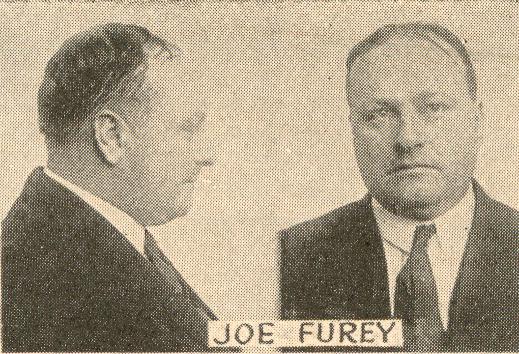
JOSEPH FUREY
Through an ostensibly chance encounter not unlike those on the streets of Perth Amboy, the gang drew Norfleet into a web that eventually involved phony securities investments and wound up costing him what today would be well over a million dollars. The Furey gang had this swindle down to an art form; every person involved knew his part well. What they didn’t count on was the personality of Frank Norfleet. Unlike con-game victims who usually slunk way in shame and fear, Norfleet put his personal affairs aside and went after the six characters who had done him wrong. He spent a fortune, took big chances, chased down leads from state to state, coped with corrupt cops and politicians, and benefited from dumb luck. Eventually, he succeeded utterly, and all six of the gangsters were prosecuted.

LOU BLONGER
When Norfleet traced the last of the six to Denver, he became the target of yet another con game, this one engineered by an organization run by Lou Blonger, who for 25 years was the crime kingpin in the city. Blonger himself ended up being toppled, thanks to the amateur detective, J. Frank Norfleet.
Norfleet, by Reading’s account, quickly warmed to his role as a relentless and fearless sleuth, and he loved to tell the story, even if he exaggerated at times. Reading’s own detective work sorts through fiction and fact, and the fact turns out to be compelling and even astounding on its own terms. After Norfleet had disposed of his quarry, he wrote an autobiography, appeared on vaudeville stages, delivered lectures, and started to produce a silent movie about himself. He became, Reading writes, a con man in his own right, selling J. Frank Norfleet to whoever would buy.
Neflix Update No. 69:”Lou”
July 11, 2012

LILLY BELL TINDLEY
On that list of “films I’m going to see someday,” put down Lou, an Australian production from 2010.
This movie, shot entirely in New South Wales, takes up a well worn topic — the relationship between a child and an elderly relative — but does it with a sensitive and touching twist. The story, written and directed by Belinda Chayko, focuses on a rural family that consists of a young mother and her three daughters, living in difficult straits since the husband-father walked off about ten months before. The mother, Rhia (Emily Barclay), is under enormous pressure because of unpaid bills, her inability to properly parent her children, and her need for a male figure in her life.
Rhia’s oldest daughter, 11-year-old Lou (Lilly Bell Tindley) is particularly troubled by the family’s circumstances which have poisoned her relationship with her mother. In a desperate attempt to increase the family’s income, Rhia agrees through a social service agency to take care of her husband’s father, Doyle (John Hurt), who is exhibiting symptoms of dementia. Since Rhia works, this arrangement means that Doyle is often left in the custody of Lou, who already resents his presence in the house. Over time, though, the girl develops first an interest in Doyle, a former merchant seaman who loves to talk about his adventures in the Pacific, and then an affection for the old man.

JOHN HURT and LILY BELL TINDLEY
The time Doyle spends with the three girls — including an unauthorized trip to the beach — lifts his spirits but further alienates Lou from her disapproving mother. Doyle often fixes his imagination on his former wife, who left him many years before, and he begins to believe that she has returned to him in the person of Lou — an idea that Lou at first discourages but then, out of compassion for Doyle, permits to continue.
This is a slow-paced story in a bucolic setting but the sustained tension in the family’s life and the dangerous potential in Lou’s alliance with Lou makes the movie compelling.
This movie was the debut Lilly Bell Tindley, who was 11 at the time, and that makes her performance all the more remarkable. Chayko liked to put the camera right in Tindley’s beautiful and expressive face, and Tindley made the most of it. We should be hearing more from this young lady.
The well-traveled John Hurt is a heart-breaking but endearing figure as Doyle, and Barclay is wholly convincing as the confused and beleaguered mother.

EMILY BARCLAY
Netflix Update No. 68: “Kiss Me Goodbye”
July 10, 2012
 By coincidence, we watched Barbara Walters’ absurd “documentary” about heaven two days after watching the 1982 comedy Kiss Me Goodbye. The Walters program didn’t refer to that film, but it did include clips from Ghost and other entertainment properties that alluded in some way to life after death.
In Kiss Me Goodbye, the person who has managed to live on after his physical death is a Broadway musical star and choreographer named Jolly (James Caan) who expired after he fell down a staircase during a party in his Manhattan home. As the film opens, Jolly’s widow, Kay (Sally Field), is about to move back into the house after having abandoned it for several years. Kay is engaged to Rupert (Jeff Bridges), a moderately conservative man, and she wants to begin the marriage in the stylish digs.
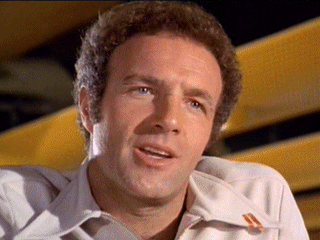
JAMES CAAN
Her plans are disrupted when she discovers that Jolly’s ghost inhabits the place and claims that he wants to reestablish their relationship. Kate’s erratic behavior worries and confuses Rupert and the others in her circle, and eventually she worries them even more by telling them about her encounters with Jolly.
Rupert, who is already jealous of the attention Kate gets from Jolly’s former colleagues, is upset by her ghost stories, but not enough to leave her. Instead, he pretends that he, too, can see Jolly and suggests that the three of them take a trip in the country together. The result, of course, is chaos.
The key to the story is found in Jolly’s real reason for manifesting himself to Kate — and the reason is not what he claims and not what may seem obvious.

SALLY FIELD
This is light fare, something on the order of milkweed spores. A story that barely stands on its own isn’t helped by some excessively broad comedy, including a particularly annoying bit of slapstick about exorcising a spirit from a dog. I read in what I admit is not an authoritative source that James Caan disliked this movie, took the part for the money, and considered the time he spent making the film one of the worst periods of his life — probably an exaggeration unless he’s had an especially charmed existence. Still, his soave, self-assured character provides by far the most fun in the film.
Sally Field was nominated for a Golden Globe as best actress in a comedy, which makes sense, I suppose, because she was, as usual, playing herself, something she should be good at after so much practice.
Kiss Me Goodbye is a remake of Dona Flors e Seus Dois Maridos, a 1976 Brazilian film which, in turn, was based on a 1966 novel, by the same name, written by Jorge Amado.
Kiss Me Goodbye was the last theatrical movie made by the distinguished actress Claire Trevor, who appears as Kay’s meddling mother, Charlotte.
Books: “The Divorce of Henry VIII”
July 4, 2012

HENRY VII
The story of Henry VIII and his marriage to Anne Boleyn is widely known in its broad essentials. But such a thing as the divorce and remarriage of a king of England is not simply done — particularly when the nuptial rearrangement is frowned upon by the pope and the Holy Roman Emperor.
Henry’s decision to put aside his first wife, Catherine of Aragon, in favor of Anne Boleyn came at the dawn of the Renaissance when the political life of Europe could not have been more complicated. It was that complexity rather than any such goal on Henry’s part that protracted and inflamed the matter to the point that it resulted in a permanent breach between the English crown and the papacy and, of course, the founding of what we know as the Church of England.
In her history, “The Divorce of Henry VIII,” Catherine Fletcher puts Henry’s case in the context of Europe in the mid 16th century in terms of both the shifting relationships among kingdoms and other political entities and in terms of the swarm of diplomatic agents who scurried around the continent eavesdropping, spying, stealing, bribing, kidnapping, crossing and double crossing, and often living the high life that went along with representing a monarch.

Catherine of Aragon
In fact, the author tells the story largely in terms of these last, these “diplomats,” with particular attention to Gregorio Casali, a native of Rome who represented Henry at the papal court when the divorce issue began to brew. Fletcher, who seems to have done a lot of detective work to trace the activities of this relatively obscure character, explains that it was not unusual in Europe in that era for men to hire themselves out as ambassadors for countries other than their native land. In fact, she writes, it wasn’t unusual for men to hire themselves out as ambassadors to more than one crowned head at a time. This kind of activity was an industry in itself — a family business for the Casali clan that included Gregorio and several siblings who pursued the same career.
Because of the slow pace of communications, envoys working at a distance from their patrons were often given wide latitude in the conduct of their offices; particularly while Cardinal Wolsey was Henry’s chancellor, Gregorio often acted on his own when the circumstances seemed to demand it. On the other hand, in the days before electronic cash transfers, people in Gregorio’s line of work frequently had to shell out their own cash to keep up appearances or even to keep eating and hope that the payments due would be forthcoming. And these diplomats, as it were, had their work cut out for them, what with the constant warfare in Europe and the resulting ebb and flow of military and political power. Gregorio’s course in representing Henry before the pope wasn’t made any easier by the fact that Catherine of Aragon was the emperor’s niece. When the issue of a divorce first arose, the pope and the emperor were seriously at odds, which theoretically weighed in Henry’s favor in the Vatican, but while the matter dragged on, Clement and the emperor made peace. And that complication was superimposed on many other considerations involving the major powers in Europe and the many states, including the papal ones, that made up what is now Italy.

POPE CLEMENT VII
The question Henry raised was tricky. He had married Catherine in the first place with a papal dispensation because she was the widow of his brother. But in his frustration over Catherine’s failure to provide a male heir, and in his infatuation with Anne Boleyn, Henry now decided that the marriage to Catherine was null because it conflicted with a principle stated in the Book of Leviticus, and he wanted the pope to say so. Clement had to deal with both the philosophical and moral issues raised by that request and balance his decision against what effect it would have on his position in the grand scheme of European politics. For most of the six years that Henry’s campaign went on, Clement stalled.
As Henry became more and more impatient and less and less concerned about the authority of the pope, Gregorio’s position became increasingly tenuous. But that seemed to be an almost inevitable experience for those who wanted to play in the high stakes games Fletcher describes in this book.
Netflix No. 67: “Arranged”
June 30, 2012

ZOE LISTER JONES and FRANCIS BENHAMOU
My mother once told me that she refused a marriage that had been arranged by her father and uncle. I gave her credit for her chutzpah, because I knew how stern and single-minded those Lebanese gentlemen were. Of course, given the possible consequences for me, I was also grateful for her decision.
Mom took that stand sometime in the 1930s. I don’t know if arranged marriages were more common then, but they are still practiced now, even in the United States, and they are increasingly an anomaly in an era in which couples as often as not dispense with marriage itself.
The practice of this tradition in the 21st century — specifically among observant Muslims and Orthodox Jews — is the subject of Arranged, a 2007 movie based loosely on the personal experience of executive producer Yuta Silverman.

MARCIA JEAN KURTZ
The story concerns Rochel Meshenberg (Zoe Lister Jones) and Nasira Khaldi (Francis Benhamou) who begin their teaching careers the same fall at a school in Brooklyn. Rochel wears the conservative clothing expected of an Orthodox Jewish woman and Nasira wears Muslim garb. These outward signs of their religious identities lead their students to openly express the expectation that the teachers hate each other. The students’ open expression of this assumption, and the teachers’ means of addressing it prompt the school principal, Mrs. Jacoby (Marcia Jean Kurtz), to make some very inappropriate observations about the way the teachers dress and in general how they adhere to the religious traditions of their families.

MIMI LIEBER
While the young women are dealing with issues in their new careers, their families are busy trying to arrange marriages in keeping with centuries-old practices. Nasira takes this in her stride, but Rochel’s rejection of a series of unappealing prospects creates tension in her family, and especially between her and her mother, Sheli (Mimi Lieber), who is determined to settle Rochel’s future and protect the family’s image in the Jewish community.
These circumstances have the effect of creating a bond between Rochel and Nasira — a bond their parents don’t appreciate. As a function of this friendship, the mischievous Nasira decides to directly intervene in the selection of a spouse for Rochel.
This low-key film, which was shot in about two weeks, is laced with attractive characters and talented actors. From my perspective as neither Jewish nor Muslim, it seems to be respectful of the traditions of both peoples even while it comes down on the side of cultural openness and personal freedom.

Netflix Update No. 66: “How About You?”
June 29, 2012

JOAN O’HARA and HAYLEY ATWELL
Every so often, acting trumps story. That’s the case with “How About You?”, a 2007 Irish film based on a short story by Maeve Binchy.
I can’t speak for the short story, but the film is predictable. Thirty-something Kate Harris (Orla Bradley) runs a residence that is occupied by older people, including four who are particularly nasty. Kate’s sister, Ellie (Hayley Atwell), appears unexpectedly to ask Kate to help her finance a trip around the world Ellie is planning with her boyfriend. Kate clearly doesn’t approve of Ellie’s lifestyle but grudgingly gives her a job cleaning the house and attending to the needs of the residents. Ellie develops an interest in sweet, fragile Alice Peterson (Joan O’Hara), and tries to take the edge off Alice’s loneliness — with a little smoke as part of the remedy.

IMELDA STAUNTON and BRENDA FRICKER
But Ellie has no patience with the sour quartet that includes the widowed former judge Donald Vanston (Joss Ackland); the spinster Nightingale sisters, Heather (Brenda Fricker) and Hazel (Imelda Staunton); and former singer-actress Georgia Platts (Vanessa Redgrave).
As Christmas approaches, most of the residents leave for the holiday, but not these four. Meanwhile, Kate receives word that her mother has suffered a stroke. Kate wants to be with her mother and leaves the reluctant Ellie to manage the house and look after the unholy quartet.

VANESSA REDGRAVE
Kate warns Ellie that the house is constantly being inspected by a local health official who could drop in at any time. With Kate gone, Ellie makes an effort to maintain control, but the unreasonable demands of the residents wear out her limited patience.
In her climactic conflict with the group, Ellie confronts them with the unvarnished truth about the way they are living. They take her remarks to heart, and gradually they reveal the events in their past lives that brought them to this house and turned them into such bitter human beings.

HAYLEY ATWELL and ORLA BRADY
I won’t describe how the story turns out, but suffice it to say that not many viewers would be surprised.
In spite of the see-it-coming-a-mile-away resolution, the film is worthwhile because all of the characters are interesting and all of the actors are talented. The most complex figures are the Nightingale sisters, one of whom is a skillful artist and the other a pool shark. We learn only enough about their dark family background to be tantalized, but we never hear the details and we never witness the denouement.
The title of the film is a reference to the song by Burton Lane and Ralph Freed that Mickey Rooney and Judy Garland introduced in the 1941 film Babes on Broadway. The song is heard several times during this movie, including a barroom rendition by Vanessa Redgrave.
And, what’s more, we’d do it again.
June 16, 2012

A phone rang in the newsroom at around 8:30 am, and the caller had a problem. He was a shift worker who got off a half hour before and had been in the nearby tavern long enough to get into, first, an argument and, second, a wager.
This was happening in Perth Amboy, long before the advent of the Internet or, for that matter, desk-top computers. The reporter taking the call was surrounded by mechanical Royal typewriters. But none of this context was of interest to the caller. He needed an answer, and he needed it soon. The question: “Is a giraffe’s tail as long as its neck?” There was money riding on the answer and, one suspected, paper money.
The reporter didn’t promise to resolve the question, but he did promise to call back one way or the other.

The home of the Perth Amboy Evening News, later The News Tribune, from 1923 until 1969. The present owner has preserved the name above the doors.
The reporter riffled through the meager reference materials in the newsroom but did not find the answer. With an air of futility, he called the nearby Staten Island Zoo, and located a person who provided information that may or may not have settled the wager. The giraffe’s neck is about six feet long. Its tail is about three feet long, but the tuft of hair at the end could double the length. The reporter called the pay phone at the tavern, repeated the data and hung up, praying that there were no weapons on the premises.
I recalled this incident the other day when I heard on National Public Radio that a listener had complained about a report on All Things Considered about a round of layoffs at a group of newspapers in the South. The listener wanted to know why the NPR news staff thought the layoffs of journalists was any more tragic than the layoff of anyone else. I didn’t hear the broadcast the listener was referring to, so I don’t know if the NPR staff exhibited some disproportionate sympathy for people of their kind, but the exchange reminded me of something I don’t hear much about in the reporting and commentary on the decline of newspapers in the United States.

A patch from The News Tribune, which was located in Woodbridge from 1970 to the mid 1990s. The patch is for sale on eBay.
The giraffe incident was a lighthearted example of the role local newspapers have played in their communities, a role that usually dealt with far more serious issues than animal anatomy.
The local newspaper was the last resort for many folks who were trying to settle wagers, finish their homework, or save their homes, their families, or their lives. There is no way to calculate the number of questions that were answered or problems that were solved by personnel at the newspapers that employed me for more than 40 years. Occasionally these matters resulted in stories; sometimes they were very big stories. But in countless instances, the news staff acted as exactly what it was, a surrogate for the public, and might spend hours or days or weeks wrestling with an issue that never generated a word in print. “You are the voice of those who have no voice,” one of my publishers once told me, and we all took that seriously.
 The news staff, cumulatively, had skills, knowledge, and contacts that many people did not have. And in the days when newspapers had significant circulation and influence on public opinion, the voice of a journalist on the other end of the phone was, for many, especially those in public authority, vox Dei.

The Home News Tribune, successor to The News Tribune of Woodbridge and the Daily Home News of New Brunswick.
But for those who called, whether readers or not, we constituted the only place to turn.
A friend once told me about a young woman, an immigrant, who was working in New York City as a translator. Her grandmother had come from the Old Country to visit her, and never went back. The grandmother’s visa had long since expired when she started to show signs of dementia. Because of the grandmother’s immigration status, the granddaughter was afraid to seek help but at the same time was afraid to leave her grandmother alone during the day. What, my friend wanted to know, did I intend to do about it? These folks had no connection to the newspaper; they lived in another part of the state. I called whom I needed to call and soon had a promise that the elderly woman’s immigration status would be normalized so that she could get the care she needed.
That’s one example. The women and men I worked with for four decades could contribute dozens, scores, of stories of that kind. I don’t know what will replace that resource, that safety valve —that friend who won’t turn away—in the life of a community.
 CharlesPaolino's Blog