“. . . or the highway.”
October 9, 2013
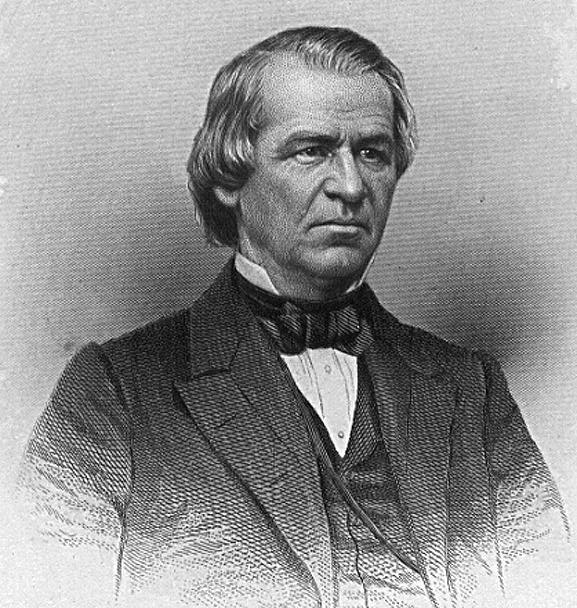
The standoff between President Obama and the Republican majority in the House calls to my mind the struggle between President Andrew Johnson and the Republican majority after the Civil War and the murder of Abraham Lincoln. Johnson was a fine man in many respects, but if ever there was a wrong man at the wrong time in the presidency it was he. Johnson, who was from Tennessee, was the only U.S. senator who remained in his seat when his state seceded from the Union. He was elected vice president in 1864 on a fusion ticket with Lincoln and was vaulted into the presidency by Lincoln’s death. The Republicans were the progressive party at the time and the Democrats were not only conservative but identified with the slave-holding South. Johnson himself owned a few household slaves, although one of his daughters remarked that it was difficult sometimes to tell who was slave and who was master. Millions of words have been written about this, but suffice it to say that Johnson and the Republicans disagreed about how the former Confederates states and the former slaves should be treated by the federal government. As that dispute was boiling over, Congress passed a routine bill to fund the Army but attached an unrelated rider — which came to be known as the Tenure of Office Act — which provided that once the president had appointed a federal official with the consent of the Senate, he could not remove the official from office without the consent of the Senate.

Johnson believed that the Tenure of Office Act was an unconstitutional incursion on the powers of the president, but he wasn’t prepared to squelch it by vetoing the army appropriations bill. So he signed it, but afterward he deliberately violated it by removing from office Edwin M. Stanton, the secretary of war, who had served in the Lincoln administration in that role and as attorney-general. Because of vague wording in the law, it’s an open question whether Johnson had violated it at all. However, Stanton refused to leave, which led to a chain of events, including Stanton barricading himself in his office, that descended to the level of comic opera. Johnson’s presumed violation of the Tenure of Office Act was the centerpiece of the impeachment proceedings the Republicans brought against him. Johnson was acquitted and completed his term, but the balance of power between the executive and Congress had been disrupted. Congress repealed the Tenure of Office Act in 1887, and the U.S. Supreme Court, ruling on a similar law in 1926, said in an opinion written by Chief Justice and former President William Howard Taft, that the Tenure of Office act had been invalid.

WILLIAM HOWARD TAFT
Netflix Update No. 82: “Never Too Late”
October 8, 2013

OLYMPIA DUKAKIS
Now that I’m 71 and nearly a senior citizen myself, I find that I’m drawn to these movies about seniors who show that they are by no means through. A case in point is Never Too Late, a 1996 Canadian comedy with a cast that includes Olympia Dukakis, Cloris Leachman, Jean Lapointe, Jan Rubes, Cory Haim, and Matt Craven. The story line is that Woody (Lapointe) is a resident of a rest home and part of a card-playing quartet with three outsiders: Rose (Dukakis), an actress; Olive (Leachman), a radio host; and Joseph (Rubes), a cranky and tight-fisted Slav.
Woody has an acrimonious relationship with Carl (Craven), the owner/manager of the home, who has Woody’s power of attorney and uses it to keep Woody from getting access to his cash. When Carl prevents Woody from chipping in to pay for the burial of a friend, Rose, Olive, and Joseph begin to suspect that something is amiss in the management of the home. With the help of Joseph’s grandson, Max (Haim), they launch an investigation that at times skirts the law of the land in an effort to figure out how Carl is handling the residents’ assets. While one might jump to an accurate conclusion about how their probe turns out, one might not anticipate the plot twist at the end.
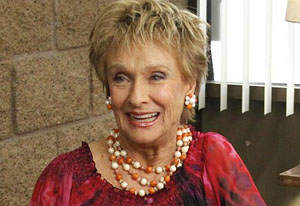
CLORIS LEACHMAN
Although this is a comedy, it looks squarely at some grim implications of old age. On the other hand, the movie includes a touching romantic relationship between Rose and Joseph — something not often portrayed by an industry that usually associates sexuality only with youth. The story line is not impossible, but some aspects of it are improbable, at least as they are portrayed in this film. There are also two scenes that seem to be cut in mid sentence. Nonetheless, it’s an entertaining little farce, and the actors all turn in sound performances. American audiences are familiar with Olympia Dukakis and Cloris Leachman, but maybe not so much with Rubes and Lapointe, two fascinating characters.

JAN RUBES
Rubes, who died in 2009, started his professional career as an operatic basso in his native Czechoslovakia and sang with the Canadian Opera Company before he switched to film and television acting. He appeared in at least 39 films, including the 1985 thriller Witness, in which he portrayed the Amish patriarch Eli Lapp. Rubes also appeared in 15 TV movies and 15 series. Lapointe, a native of Canada, is known mostly, in his entertainment career, as a singer and comedian. He was also a member of the Canadian Senate, representing Quebec from 2001 to 2010.

JEAN LAPOINTE
Netflix Update No. 81: “Sally of the Sawdust”
October 1, 2013
 Watching silent movies always gives me a melancholy feeling. I think the sensation comes from a wistful and naive attraction to the era in which those films were made — an era that was gone long before I was born. The mood comes over me almost regardless of the film I’m watching, whether it is drama or comedy.
And so it was with a mixed response that I watched D.W. Griffith’s 1925 comedy Sally of the Sawdust, in which the leading players were W.C. Fields, Carol Dempster, and Alfred Lunt. This film, which is based on Poppy, a 1923 stage musical, is lighter fare than usually comes to mind when Griffith’s name is mentioned, but it has dark undertones as well.
Fields plays “Professor” Eustace McGargle, a circus juggler and con man who befriends a single mother and her daughter, Sally (Dempster). After the mother dies, McGargle briefly considers returning Sally to her grandparents in the fictional New York suburb of Green Meadows, but he has a genuine affection for the child and decides to keep her with him.

As Sally grows, McGargle also uses her as a dancing warm-up to his own act. When their fortunes are at a low ebb, the pair wind up in Green Meadow where they work at a charity carnival while McGargle prepares to finally restore the girl to her family, who have have benefitted financially from a real estate boom in the area. Although the handsome son (Lunt) of a local tycoon falls in love with Sally, his father is repelled by the idea of such a match and does what he can to prevent it by having McGargle and Sally arrested on the basis of the professor’s three-card monte operation. There are parallel frenetic scenes as Sally attempts to escape from custody and McGargle purloins a tin lizzy and leads a gang of bootleggers on a wild chase as he attempts to reach town and his distressed ward. To make a long story short, they all live happily ever after.

CAROL DEMPSTER
One impression I couldn’t shake is that this film, which appeared toward the end of Griffith’s career, was longer than it had to be. The story is thin and obvious, and the twin sequences of Sally’s escape and McGargle’s chase, go on too long by about a third.
Still, it was interesting to watch Fields, who in his later career made so much of verbal comedy, perform for an hour and a half in silence. Also, McGargle foreshadows other roles Fields would play but, except for Wilkins Macawber in David Copperfield, his characters didn’t face situations quite as grave as the one McGargle wrestled with. Fields would get to reprise this role in Poppy, a 1936 sound version of the same story.
I found Carol Dempster to be very appealing as Sally. She was one of Griffith’s discoveries and appeared in many of his films, and she was also for a time his lover. While I was watching Sally in the Sawdust, my wife came into the room and remarked that Dempster was kind of forlorn-looking. That struck me, too, and I read that Dempster attracted critical remarks on that account at the time she was making these movies. But I found that slightly hangdog quality both suitable and, in its own way, attractive. Evidently, at least some film critics now feel the same way.
A significant factor in my enjoyment of this film was the score that was written and performed, on a digital piano, by Donald Sosin.
I’m going to watch this film again and use the pause button several times. As with most silent films that were shot on locations, I often found myself transfixed by the background, by the storefronts and the signs and the cars and the structures that were serving their purpose on a long-ago day when Griffith’s camera happened to capture them.

“Of castles on the Rhine, candlelight and wine . . .”
September 27, 2013

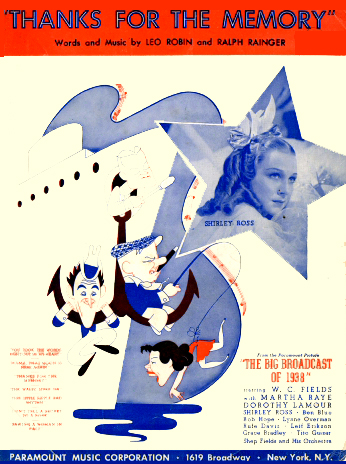
SHIRLEY ROSS and BOB HOPE sing “Thanks for the Memory” in “The Big Broadcast of 1938.”
Jack Benny occasionally played his theme song on the violin, but to my knowledge, he never sang it on the air, if at all. That makes Benny and “Love in Bloom,” the topics of my last post, unusual among performers and their signature songs. Perhaps the best example of the more typical approach is Bob Hope and “Thanks for the Memory.”
Hope’s theme, as it happens, was written by the same artists who wrote “Love in Bloom.” Ralph Rainger composed the music, and Leo Robin provided the lyrics.
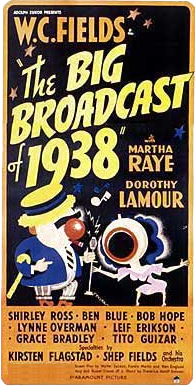
Rainger and Robin wrote the song for The Big Broadcast of 1938, the last in a series of such musical films from Paramount. This plot for this one involved a trans-Atlantic race by two ocean liners. The ensemble included W.C. Fields, Hope and Ross, Martha Raye, Dorothy Lamour, Ben Blue, and Kirsten Flagstad.
Ross and Hope play a couple who are near the point of divorce. In “Thanks for the Memory,” they reminisce about the high and low points of their relationship — a relationship, incidentally, which survives after all. The song won an Academy Award.
Ross and Hope got to team up the following year and sing another song that became an American classic: “Two Sleepy People” by Frank Loesser and Hoagy Carmichael. That duet was in a film titled “Thanks for the Memory.”
Hope adopted “Thanks for the Memory” as his theme, and sang it at the end of his live and televised performances for the rest of his career, changing the lyrics to fit the situation. It was an interesting choice for a comedian, because its original meaning was melancholy, and even when Hope’s writers put humorous lines in it, the sad undercurrent was always there. That was particularly true when Hope sang “Thanks for the Memory” at the end of the many shows he performed for American troops.
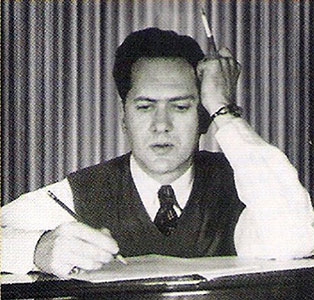
RALPH RAINGER
Ralph Rainger wrote scores for at least 40 movies. He would have written for many more, but he was killed in an air collision in 1942 when he was only 41 years old. The DC-3 he was traveling on collided with a U.S. Army Air Corps bomber over Palm Springs.
You can see and hear Bob Hope and Shirley Ross singing “Thanks for the Memory” in The Big Broadcast of 1938″ by clicking HERE.
“Oh, no, it isn’t the trees . . . .”
September 23, 2013

The young JACK BENNY (Benjamin Kubelsky) with his violin.
I was about to watch an episode of the Jack Benny Program recently when I became absorbed in the opening theme. The theme is associated not just with the television series but with Jack Benny himself. The song, “Love in Bloom,” was not written by amateurs. The music was by Ralph Rainger and the lyrics by Leo Robin. Ralph Rainger, a member of the Songwriters Hall of Fame, wrote a lot of music for movies between 1930 and 1942. One of his compositions, “Thanks for the Memory,” written for The Big Broadcast of 1938, won an Academy Award. (I’ll have more to say about that song in a later post.) Leo Robin, who wrote the lyrics to “Love in Bloom,” is also a member of the Hall of Fame. His work included “Thanks for the Memory,” “Beyond the Blue Horizon,” “Prisoner of Love,” and “Blue Hawaii.”
“Love in Bloom” was introduced in 1934 in the film She Loves Me Not. It was sung in a duet by Bing Crosby and Kitty Carlisle.

LEO ROBIN
Crosby, that same year, was the first to record the song, which was nominated for an Academy Award.
Kitty Carlisle — an elegant woman whom, incidentally, I once visited at her Manhattan apartment — liked the song enough that she considered adopting it as her own theme. She scuttled that idea, however, when Benny made the song his signature, frequently playing it, and deliberately butchering it, on his violin.
The song has qualities that don’t come across in most of Benny’s renditions. You can see for yourself as Crosby and Kitty Carlisle sing it in the film. Click HERE.
You can also see a hiliarious routine in which Benny and Liberace play the song on the keyboard and violin on a 1969 episode of Liberace’s TV show. Here Benny lets himself show, for a while at least, that he was more competent on the violin than he cared to admit. Click HERE.
Brothers, all
September 11, 2013

JOHN MONGOMERY WARD
When I held forth here recently on the subject of soprano Geraldine Farrar and her baseball-playing father, Sidney, I mentioned that Sid had bolted from the National League in 1890 to play in the maverick Players’ League. That put Sid in the middle of a significant but largely forgotten epoch in the history of the national game.
The Players League was the offspring of the Brotherhood of Professional Base-Ball Players, which was in effect the first union organized by professional athletes. The brains behind the Brotherhood was John Montgomery Ward, who was an outstanding player for five teams over 16 years. He was best known as a pitcher, although he also played shortstop and second base. In 1880, he pitched the second perfect game in the National League, for the Providence Grays (there wouldn’t be another one for 84 years) and in 1882 he pitched the longest complete-game shutout in history, beating the Detroit Wolverines 1-0 in 18 innings. He also accumulated 2,104 base hits. He is the only player ever to win more than 100 games as a pitcher (164-103) and get more than 2,000 hits.

Ward’s plaque in the National Baseball Hall of Fame doesn’t mention the Brotherhood or the Players’ League
Ward graduated from Columbia Law School in 1885 and became the leader of an effort by players to negotiate improvements in the conditions of their employment, including an increase in salaries and an end to the “reserve clause” which provided that players who were under contract to one team were prohibited from negotiating with other teams when the contract expired. Ward organized the Brotherhood in ’85 but when it became clear after several years of negotiation that the owners were intractable, he launched the Players League.
About half of the players who had been National Leaguers in 1889 bolted to play in Ward’s league which offered profit sharing and did not have a reserve clause or a cap on player salaries. Sid Farrar, who had played for the Philadelphia Quakers in the NL bolted to play for the Philadelphia Athletics in the Players League. In fact, the Players League attracted most of the talent from the National League, but when revenues didn’t live up to expectations, the owners of the maverick teams surreptitiously agreed to sell their teams to the NL franchises, and the Players League folded after one season.
Major League Baseball ruled in 1968 that the Players League, short-lived though it was, had been a major league. So, among other things, the Buffalo Bisons’ record stands: they recorded the greatest opening-day winning margin by beating the Cleveland Infants 23-2.
Incidentally, the reserve clause remained in effect in Major League Baseball until 1975.
Daddy’s little girl
September 4, 2013

GERALDINE FARRAR
My wife, Pat, who is reading Adriana Trigiani’s novel The Shoemaker’s Wife, has mentioned two characters in the story who are familiar to me: Enrico Caruso and Geraldine Farrar. We like to say, even though it can’t be demonstrated, that Caruso was the nonpareil of tenors, and Farrar, his contemporary, was a popular soprano and film actress. She was a member of the Metropolitan Opera Company for 17 years, singing 29 roles in some 500 performances, frequently appearing with Caruso. She had a particular following among young women, and they were known at the time as “Gerryflappers.” I was young when I became a fan of hers, too, but that was nearly 30 years after she had retired as a singer. A kid of eclectic tastes, when I came home from the record store on most Friday nights, I could be carrying doo-wop, country-and-western, American standards, or opera. I bought many discs with cuts by Caruso, Farrar, or the two of them together.
A biographical detail about Farrar that particularly appeals to me is the fact that her father, Sidney, was a major league baseball player from 1883 to 1890. A first baseman, he played most of his career for the Philadelphia National League franchise. In his last season, he bolted to the maverick Players League, still playing in Philadelphia. He appeared in 943 games and, in the dead-ball era, had 905 hits and a .253 batting average.
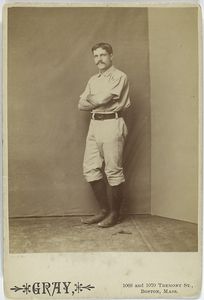
SIDNEY FARRAR
When Sid Farrar was through playing baseball, he opened a men’s clothing shop in Melrose, Massachusetts, in partnership with Frank G. Selee, a Hall of Fame major league manager. Farrar and his wife, Etta, were singers in their own right. Farrar was a baritone, and it was said of him that if he was speaking in what, for him, was a conversational tone of voice on one side of a street, he could be clearly heard from the other side.
When Geraldine went to Europe to study voice, her parents went with her and remained on the Other Side until Geraldine had made a name for herself in Berlin, Munich, Salsburg, Paris, and Stockholm and returned to the United States in 1906.
In later life, when he had been widowed, Sid Farrar was a familiar figure at Geraldine’s concerts, and she said that he was often surrounded by other old ballplayers who may have looked a little out of place in the classical concert hall. It dawned on her, she said, that those old guys weren’t there to see her; they were there to see her dad.
One of my favorite Caruso-Farrar recordings is their 1912 rendition of “O Soave Fanciulla” from La Boheme. Click HERE to hear it.
A man named “Birmingham”
August 30, 2013

MANTAN MORELAND
My recent post about Eddie “Rochester” Anderson got me to thinking about another black actor of that generation — Mantan Moreland, who sometimes used the name “Birmingham” Brown. Moreland was born in Louisiana in 1902 and as a child repeatedly left home to look for work in circuses and other road shows. He eventually got into vaudeville, working the tanktown circuit, but also appearing on Broadway and touring Europe.
Like many actors with similar resumes, Moreland developed a lot of skills while he was doing that work, and he eventually put them to use on the screen, appearing in at least 130 movies and television shows, but mostly movies. He worked in so-called race movies (movies made by black producers for black audiences), in shoestring productions, and in major features, and he created his most indelible impression in the role of “Birmingham” Brown, chauffeur to the film detective, Charlie Chan, who ostensibly was Chinese, though he was played by Caucasian actors. The character of “Birmingham” Brown, like most of the characters Moreland played, perpetuated stereotypes about black people. Specifically, the bug-eyed Birmingham was afraid of everything and often tried to dissuade Chan from wading into dangerous situations. His entreaty — “Mistuh Chan! Mistuh Chan!” — became familiar to millions of moviegoers in the 1940s and to a later generation of television viewers when the Charlie Chan films resurfaced on the small screen. Of course, the portrayal of Chan himself was problematic in its own way.

Monogram Studios, which made the 15 Charlie Chan films in which Moreland appeared, thought enough of his comic abilities to give him second billing.
The major properties Moreland appeared in included A Haunting We will Go, with Stan Laurel and Oliver Hardy; Cabin in the Sky, and See Here, Private Hargrove.
White filmmakers and white audiences were content for decades to take advantage of the willingness of black actors to play subservient or demeaning roles, but when the nation became uncomfortable with, or at least self-conscious about, that kind of comedy, many black performers had a hard time getting any work at all.
Mantan Moreland himself, along with many of his black peers, was conflicted about the image they presented while they were trying to establish themselves as entertainers and, not incidentally, make a living. Moreland, in hindsight, judged the epoch harshly, telling an interviewer in 1959 that he would “never play another stereotype, regardless of what Hollywood offers.”
“The Negro, as a race,” Morehead said, “has come too far in the last few years for me to dash his hopes, dreams, and accomplishments against a celluloid wall, by making pictures that show him to be a slow-thinking, stupid dolt. … Millions of people may have thought that my acting was comical, but I know now that it wasn’t always so funny to my own people.” After that, he did appear in a few movies and in television series including Adam-12, The Bill Cosby Show, and Love American Style.
When Moreland was touring in vaudeville, he often worked with a comic named Ben Carter, and the two developed a routine known as “incomplete sentence” in which they carried on a rapid conversation in which neither could finish a sentence. It required a firm command of the material and impeccable timing. Moreland and Carter brought the routine to the movie screen by way of the Charlie Chan films. You can see clips of the routine if you click HERE.

Mantan Moreland in the 1944 film “Pinup Girl.”
Netflix Update No. 80: “The Jack Benny Show”
August 22, 2013

EDDIE ANDERSON and JACK BENNY
My lack of interest in current television is at the point where I have a very limited diet. I’m not going to make an argument for the “golden age,” because I don’t think it’s valid. There have been many excellent shows since the 1950s. Still — and I’m willing to call this a matter of taste — I am attracted to early programming, and especially to situation comedies such as Make Room for Daddy, Burns and Allen, and the proto-sitcom, The Goldbergs.
Thank heaven, then, for services like Netflix, which makes many of these shows available, including The Jack Benny Show. Benny is a favorite of mine, not only because he was such a unique character and was so skillful in portraying his fictional persona — the miser who wouldn’t admit to being older than 39 — but because of his place in American show business history.

A poster advertises a broadcast of Jack Benny’s radio show on a station in Seattle. LSMFT, for the benefit of the younger crowd, stood for “Lucky Strike Means Fine Tobacco.”
The production values of television shows in the 1950s do not compare favorably with what we have become used to sixty years later, but the era got its “golden age” reputation because of the cadre of writers and performers who had migrated to television on a path that led from vaudeville, burlesque, and the legitimate theater by way of radio. Jack Benny and many of his contemporaries had worked very hard to develop their sense of what audiences at the time thought was funny or dramatic, and to develop the timing and delivery that would work in the new medium. They learned their lessons well; Jack Benny’s slow burn is still funny, even when you can see it coming from a mile away.
An interesting aspect of Benny’s show was his relationship with Eddie “Rochester” Anderson, a gravel-voiced black actor who was part of the Benny stock company which included, among others, announcer Don Wilson and Irish crooner Dennis Day.
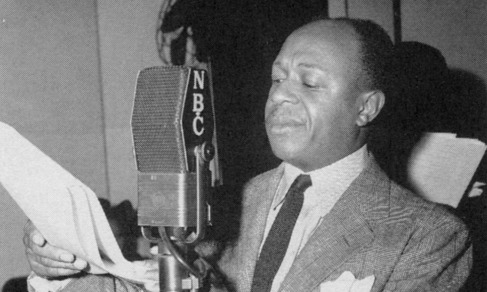
EDDIE ANDERSON
Anderson who, like Benny, got his start in vaudeville, started working with Benny in radio in 1937, first in a few bit parts and then playing Benny’s valet. He played that role on radio and television until 1965. He was the first black performer to have a regular role on radio, but that meant that he was faced with what became a classic conundrum for black artists — the question of whether to play a subservient character or not work in movies, radio, or TV. It was a difficult question for the actors as well as for the black Americans who were being treated as second-class citizens if as citizens at all.
Given the racial climate at the time, The Jack Benny Show took an unusual approach by presenting Rochester as a quick-witted and sarcastic character who was always a little smarter than his boss. The approach was unusual also because this plot element juxtaposed two deadpan figures and the combination was hilarious and was sustained for nearly thirty years. At first, in radio, there was often a racial aspect to the humor surrounding Rochester, but after World War II, Benny — who took an unambiguous public stand in favor of racial harmony — insisted that all racial content be eliminated from his scripts.
Eddie Anderson was one of the most popular and highest-paid actors of his time. He appeared in many movies, including Green Pastures and Gone With the Wind. He handled his money wisely and was both wealthy and generous. Among other enterprises, he owned a company that manufactured parachutes for the American military during World War II.
You can see Jack Benny and Eddie Anderson in a typically funny scene by clicking here.
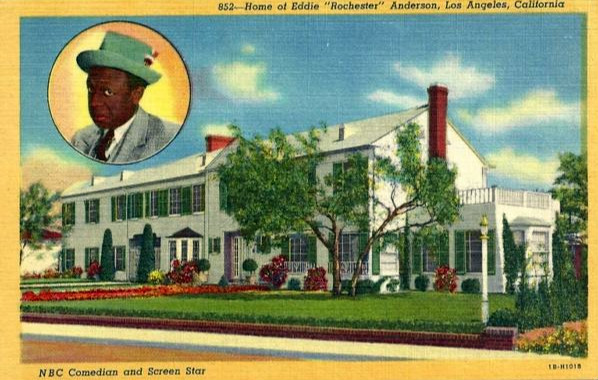
Eddie Anderson’s home on a street named after him in the West Adams district of Los Angeles.
Netflix Update No. 79: “Marvin’s Room”
July 30, 2013

DIANE KEATON and MERYL STREEP
If blood is, indeed, thicker than water, does the same chemistry apply to bone marrow? That question is at the heart of the matter in “Marvin’s Room,” a 1996 film produced by Robert De Niro and starring Diane Keaton, Meryl Streep, Leonardo Di Caprio, Gwen Verdon, and Hume Cronyn.
The story, which is based on a play by Scott McPherson, concerns the uneasy reunion of a badly fractured family. The Marvin of the title (Cronyn) has been bed-ridden at his Florida home for 17 years after suffering a stroke. Unable to walk or to speak coherently, Marvin is cared for by his daughter Bessie (Keaton), who also looks after her aunt Ruth (Verdon), who is in the early stages of dementia.
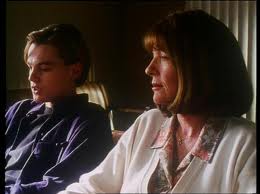
LEONARDO Di CAPRIO and DIANE KEATON
Bessie is diagnosed with leukemia and needs a marrow transplant. She turns for help to her sister Lee (Streep) although they haven’t communicated since Lee moved to Ohio 20 years ago. Lee has two sons who are potential donors, Hank (DiCaprio) and Charlie (Hal Scardino). Lee and Hank have a poisonous relationship which recently reached new depths when he was confined to a mental health facility after deliberately setting fire to their house.
Despite the mutual hard feelings between the sisters, Lee takes her sons to Florida to be tested for compatibility, although Hank is coy about whether he would agree to donate marrow even if he were a match. The atmosphere is uncomfortable and not made any better when Lee considers the possibility that she could inherit this responsibility if Bessie should die.

GWEN VERDON, HAL SCARDINO, DIANE KEATON, LEONARDO Di CAPRIO
There is an unexpected chemistry between Bessie and Hank, however, and the story turns on that, though not in a simplistic way.
This film was very well received when it first appeared, and with good reason. Although the premise has all the potential for a sob story, it is written and directed (by Jerry Zaks) into a tense and moving drama. The unusual array of stars (which includes De Niro as Bessie’s doctor) delivers on its promise, too.
 CharlesPaolino's Blog