Amazon Update No. 2: “For the First Time”
July 18, 2014

JOHANNA von KOCZIAN and MARIO LANZA
When I was about ten years old, my mother took me to see the MGM movie The Great Caruso, in which Mario Lanza played the title role, the tenor Enrico Caruso. Despite my age, I became absorbed in both singers. At first I nagged my mother to buy vinyl for me, but eventually I was old enough to do it on my own. All that vinyl is down in the living room right now, along with hundreds of other 33 rpm disks that include doo-wop, rock ‘n’ roll, country and western, swing, easy listening, opera, and classics.
At any rate, we recently tried to find The Great Caruso on Amazon and Netflix and came up empty, so we settled for Lanza’s last film, the 1959 romantic comedy For the First Time. This film was popular in its time, it got some good reviews, and it was a financial success. This was strictly entertainment, not to be taken seriously, largely an excuse for Lanza to sing — which was a good thing, because opportunities to hear him were much more limited in those pre-iPod, pre-internet days than they would be today. He sings operatic arias and in operatic ensembles, and he sings Italian folk music and popular songs. It’s all good except, from my point of view, “Pineapple Picker,” a song that had no business being in the same room with Mario Lanza.

MARIO LANZA and ZSA ZSA GABOR
Lanza plays Tony Conti, a world-renowned if unreliable tenor. In the flamboyance he exhibits at the beginning of the story, Conti resembles Lanza. After an embarrassing episode in which Conti’s drinking and tardiness cause a Vienna concert to be cancelled with the audience already in the seats, Conti’s agent spirits him off to Capri to lay low until the bad publicity runs its course. There, Conti meets a young German woman, Christa, played by an irresistible actress named Johanna von Koczian, and they are mutually smitten. Johanna, of course, is deaf. (Get it? He’s a famous tenor; she can’t hear him sing.) At the point in the movie at which Tony and Christa meet, I said to my wife, Pat, “In the last scene, she’ll be sitting in an opera house listening to him hit those high notes.” Meeting Christa jolts Conti to the point that he stops drinking and womanizing and becomes responsible about his career. He is practically broke as a result of his shenanigans up to this point, but he takes on a series of performances in various cities of Europe and plans to visit — you guessed it! — the best ear specialist at each stop. No doubt, you can figure out how such a plot turned out in 1959.
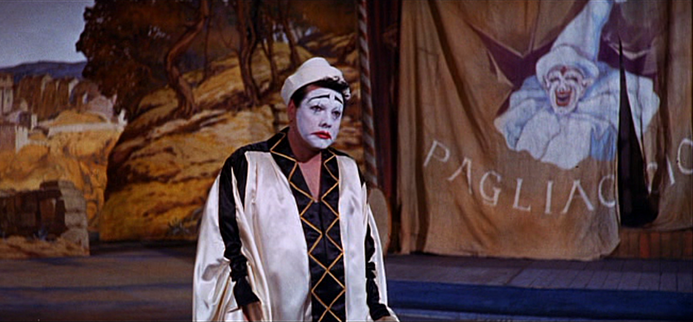
MARIO LANZA sings “Vesti la Giubba” in a scene from “For the First Time”
Mario Lanza, who was 38, died a few months after this film was released. He looked well and vigorous in the film, his voice — dubbed, of course — was full of the power and earthy passion that had made it famous and he projected the boyish charm that endeared him to the public. This was the sort of movie theme — a romance on the Continent – in which audiences of that era would expect to encounter Zsa Zsa Gabor, and they weren’t disappointed. Zsa Zsa played a countess who had a sporadic affair with Tony, as she did with lots of other prominent men. She was 42 and at the height of her beauty when this film was made and her performance had none of the grating personality she adopted for late-night television shows when her looks would no longer carry her. Kurt Kasznar is comical as Tony’s beleaguered manager and protector, and I particularly liked Hans Söhnker’s sympathetic and believable performance as Christa’s uncle.
Due in large part to his personal habits, Lanza’s career was much shorter than it should have been, but he left behind a wonderful legacy of recorded music. Although he appeared in complete operas only a few times, he played an important cultural role by being one of the first singers to make operatic music popular among a mass audience. Prominent tenors even now often acknowledge their debt to him.
The film closes with Conti, as Rhadames, singing in the ensemble that closes Giuseppe Verdi’s Aida. You can see that scene by clicking HERE.
Doing nicely on her own
June 21, 2014
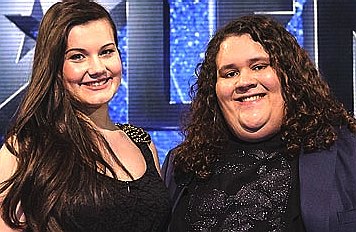
CHARLOTTE and JONATHAN
I ordered two CDs from abroad in the past few weeks. One, a collection of Hebrew songs sung by Dudu Fisher, came from Jerusalem; the other, the first solo album by Charlotte Jaconelli, came from Britain. Despite the best of intentions, I haven’t listened to the Dudu Fisher album yet, but I listened to Charlotte Jaconelli’s album with in a couple of hours of receiving it, and I was not disappointed.
Charlotte Jaconelli was half of an act, with Jonathan Antoine, that caused a sensation when they appeared on Britain’s Got Talent in 2012. They were 16 and 17 years old, respectively, and they were an unlikely looking pair, she already cutting a glamorous figure and he very overweight and very casually dressed, with dark wavy hair falling down to his shoulders. There was the usual eye-rolling from Simon Cowell, and the air of resignation as he walked the teens through their bios. But when Jonathan and Charlotte cut loose — he with a startling operatic tenor and she with a pure pop soprano — the house was on its feet.

When the uproar had subsided, the judges were unanimous in their praise, but Cowell, in that delicate way that he has, suggested to Charlotte that she might hold Jonathan back in his career, and told Jonathan that perhaps he should “dump her.” “Well, We came here as a duo,” Jonathan said, “and we’re going to stay here as a duo.” Inexplicably, Jonathan and Charlotte finished the season in second place, behind a dog act, but Cowell signed them to a recording contract and they turned out two albums together. But then they split up because, Charlotte has said, they had different ambitions with respect to the kind of music they want to perform and record. Jonathan’s first solo album is due out in the fall, and Charlotte’s, aptly named Solitaire, was released recently.

From Charlotte Jaconelli’s Facebook page
There are eleven songs on the CD — an odd number, by the way — and they seem to have been chosen so that on this first solo album, Charlotte can demonstrate her range. She performs pop, Broadway, and classical works, and her pure, silvery voice is equally at ease in all of them. One might detect a little bit of caution in this first solo venture; but, on the other hand, Charlotte also did not give in to any temptation to show off, something she has the vocal power to do. There are two duets (“I Know Him So Well” with Kerry Ellis and “All I Ask of You” with Daniel Koek) that demonstrate again that Charlotte’s voice holds its own with a male counterpart.
I was particularly happy to find that the carefully chosen playlist includes “I Dreamt I Dwelt in Marble Halls” from the 1843 opera “The Bohemian Girl.” This is a well-traveled song that has been recorded by performers as diverse as Enya and Sinéad O’Connor. Rosina Lawrence dubbed it for Julie Bishop in the 1936 film version of the opera, starring Stan Laurel and Oliver Hardy. The song has been lampooned at times, but Charlotte Jaconelli’s sensitive performance makes it clear why the tune still has legs after 170 years.
We’re going to be hearing a lot from Charlotte Jaconelli. For now, you can click HERE to see and hear her sing “Pie Jesu,” one of the songs on the Solitaire album.
—
We saw a major production of South Pacific the other night — at least the fifth time we’ve seen it on the stage — and so we heard the Seabees sing once again: “We got mangoes and bananas we can pick right off the tree.” No doubt that was true in that part of the world in the 1940s, but the news lately suggests that bananas may not be nearly that available, if they are available at all.
Aggressive diseases that are immune to pesticides and other control measures are threatening to seriously deplete the world’s banana crop, which provides a staple in the diets of an estimated 420 million people and is an important food source to hundreds of millions of others. The worst menace seems to be a soil fungus known as Panama Disease, which has devastated crops in Southeast Asia and has also been identified in Mozambique and Jordan. Authorities say there is a risk that the fungus will spread to Latin America, where the Cavendish variety of banana most familiar in the United States is grown.

As serious as this situation is, I can’t hear about it without thinking of the novelty song, “Yes, We Have No Bananas,” which was written by Frank Silver and Irving Cohn in 1922 for the Broadway revue “Make it Snappy.” Eddie Cantor sang it in that show. Nonsense songs were very popular then and down through the 1950s, and Billy Jones’s recording of this tune was the number-one song in the nation for five weeks in 1923. The origin of the title and first line of the song is uncertain, but the lyrics as a whole may have been inspired by a similar banana blight that originated in Suriname and by the 1920s reached the Caribbean and Central America.As the illustration on the sheet music suggests, this song was part of a genre of entertainment that depended on making fun of immigrants. The lyric tells of a Greek man who owns a fruit store and answers any question in the same fashion: “Yes, we have no bananas.”
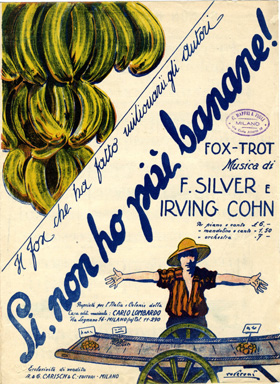
Italian translation of the Silver-Cohn tune.
I was curious about a reference in the lyric to “sparrow grass,” a term I had never heard before. I learned that “sparrow grass” is a corruption, perhaps a derisive one, of “asparagus.” The Oxford English Dictionary includes a statement written in 1791 by natural historian John Walker, presumably writing about the usage in Britain: “Sparrow-grass is so general that asparagus has an air of stiffness and pedantry.”
You can hear Billy Jones’s 1923 recording, in which his put-on accent sounds more Italian than Greek, by clicking HERE.
These are the lyrics:
There’s a fruit store on our street
It’s run by a Greek.
And he keeps good things to eat
But you should hear him speak!
When you ask him anything, he never answers “no”.
He just “yes”es you to death,
And as he takes your dough, he tells you…
“Yes! We have no bananas
We have no bananas today!!
We have string beans and onions, cabBAges and scallions
And all kinds of fruit and say
We have an old fashioned toMAHto
A Long Island poTAHto, but
Yes! We have no bananas
We have no bananas today!”
Business got so good for him that he wrote home today,
“Send me Pete and Nick and Jim; I need help right away.”
When he got them in the store, there was fun, you bet.
Someone asked for “sparrow grass”
and then the whole quartet
All answered:
“Yes, we have no bananas
We have-a no bananas today.
Just try those coconuts
Those wall-nuts and doughnuts
There ain’t many nuts like they.
We’ll sell you two kinds of red herring,
Dark brown, and ball-bearing.
But yes, we have no bananas
We have no bananas today.”

Billy Jones and Ernest Hare gained fame as radio personalities, billing themselves as “The Happiness Boys.”
Don’t argue with Ralph: The legacy of Redding and Reeves
January 10, 2014
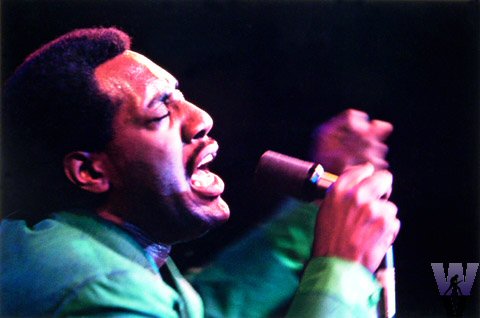
OTIS REDDING
A former newspaper colleague of mine was recalling on Facebook the other day that on the occasion of Kurt Cobain’s suicide an editor approached and asked, in effect, “Is that a big story for your generation?” I know the feeling. In 1967, when I was 25 and Otis Redding was 26, Redding was killed in a plane crash and I had to convince my managing editor that that was front-page news.
The Facebook conversation reminded me of an incident that occurred about 20 years later when my wife and I and another couple were visiting Nevis, a tiny island in the Leeward group in the Caribbean. Shortly after we arrived, a Nevitian fellow we knew only as Ralph was driving us to the house we would be occupying that week. Ralph took us by surprise by asking this question: “Who were the two greatest American singers?” Considering the size of the field, and the fact that we didn’t know the consequences of answering wrong, we kept our counsel. So Ralph answered his own question: “Otis Redding and Jim Reeves.” Discretion being the better part of whaddyacallit, we feebly agreed with that assessment, but Ralph seemed to detect a lack of passion. His voice ticked up a bit in both pitch and volume: “Don’t tell anyone here that Otis Redding and Jim Reeves weren’t the greatest singers!” Having already made mental notes about the ubiquitous machetes on the island, we promised to do no such thing.

I have always enjoyed the fact that one of the songs most identified with Redding, “Try a Little Tenderness,” originated in such an unlikely milieu.That song, a favorite of mine, was written in 1932 by Jimmy Campbell, Reg Connelly, and Harry M. Woods and it was recorded many times, including by such as Jimmy Durante, Frank Sinatra, Mel Tormé, and Frankie Laine, but also by Etta James, Tina Turner, and Three Dog Night. When Otis Redding wanted to record it in his own style in 1966, the publishers were reticent, but that turned out to be the best known and most enduring version. To see and hear Redding singing “Try a Little Tenderness” the day before he died click HERE. To hear a far more conventional rendition by Frank Sinatra, click HERE.
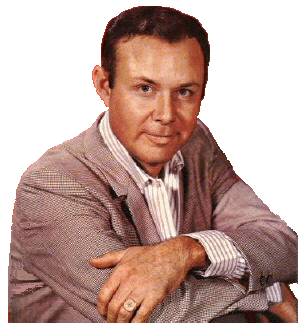
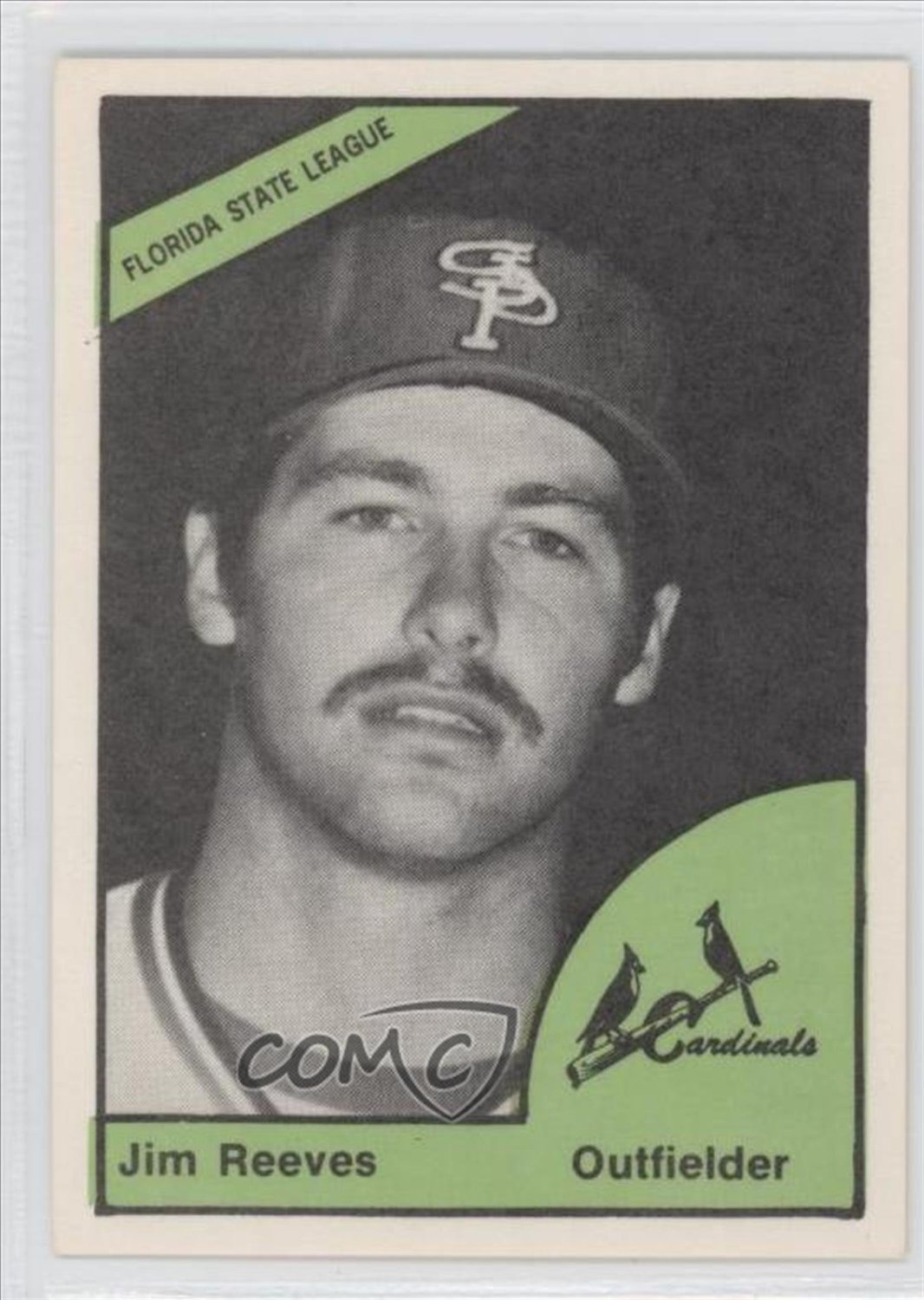
JIM REEVES
While Ralph’s question in itself took us by surprise, we were even more baffled by the reference to Jim Reeves, who I wouldn’t have expected to hold iconic status in the western Caribbean. Moreover, Reeves had died, also in a plane crash, even earlier than Redding — on July 31, 1964. I had painful memories of that, because I had been a big fan of Jim Reeves, Webb Pierce, Faron Young, Kitty Wells, and that whole crowd. I still have lots of their vinyl and a turntable to play it on.
I don’t know how well known it is, but Reeves was very athletic and had his eye on professional baseball. He played for three years in the St. Louis Cardinals’ farm system before an injury to his sciatic nerve ended his career.
He could hardly have done better in baseball than he did in music; he was an international star. Once he adopted the easygoing Nashville sound, he became one of my favorites. His hits included “Bimbo,” “Welcome to My World,” “Blue Christmas,” and “Make the World Go Away.” I was always stuck on “I Love You Because,” and you can see and hear him singing it at a 1964 concert in Oslo by clicking HERE.
Ishkabibble: “I should worry?”
November 22, 2013

KAY KYSER and MERWYN BOGUE
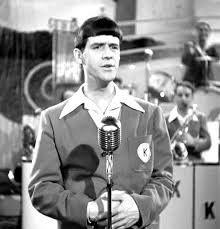
From time to time, I hear myself calling Marcello the Cat by another name — Ishkabibble. Usually it’s an unconscious substitution, but I caught myself at it the other day and had a vague recollection that I first heard that name from my mother and that she told me that it was the name of a character on a radio show. Since I can’t ask Mom about it any more and time is running out for me, I looked it up and found out that, indeed, there was a radio personality, Merwyn Bogue, who went by that nickname.
Bogue was headed for a career in law but his comic bent and his skill with the cornet led him into the entertainment business. He was associated for many years with Kay Kyser’s orchestra — even while he served in the Army during World War II — and he appeared on Kyser’s radio and television show, Kay Kyser’s Kollege of Musical Knowledge.
 Bogue’s stage routine was laced with horn playing and nonsensical babble, but he was sharp enough in real life that he managed Kyser’s band from 1931 to 1951. He also appeared in ten movies between 1939 and 1950.
When the market for his brand of entertainment dried up, Bogue made a living in real estate.
According to Bogue his stage name was taken from the title of a song — “Ische ka bibble” — ostensibly a Yiddish expression meaning “I should worry?” I have read in several sources, however, that the title is gibberish, not Yiddish. The song Bogue referred to was written in 1913 with music by George W. Meyer and words by Sam Lewis. This song apparently made the term almost immediately popular as a nonsense expression. Some folks who dabble in language think Ishkabibble could be derived from one of several actual Yiddish expressions, such as “Nish gefidlt,” meaning “It doesn’t matter to me.” There’s a three-minute video about Merwyn Bogue’s life at THIS LINK.
“better than a palace with a gilded dome. . . .”
November 21, 2013

My mind has been wandering for a couple of weeks, but yesterday I caught myself humming “Just a Love Nest,” and that nudged me back to the topic of performers’ theme songs. “Just a Love Nest” was one of the best known of that category — the theme for George Burns and Gracie Allen on their radio and television shows. The song, with music by Otto Harbach and words by Louis Hirsch, was written in 1920 for the musical Mary, which was produced by George M. Cohan. The chorus, which provided the melody line adopted by Burns and Allen, was appropriate both for their domestic comedy and for their personal lives, which constituted one long love story:
 Just a love nest
Cozy with charm,
Like a dove nest
Down on a farm.
A veranda with some sort of clinging vine,
Then a kitchen where some rambler roses twine.
Then a small room,
Tea set of blue;
Best of all, room—
Dream room for two.
Better than a palace with a gilded dome,
Is a love nest
You can call home.

LOUIS HIRSCH
“Love Nest” was Hirsch’s most successful song, but he was a prolific composer as well as an accomplished pianist. Between 1910 and 1924 he wrote scores for twenty-four musical shows, including four editions of the Ziegfeld Follies. He often contributed to the story line of the shows he worked on. He was one of the nine founders of the American Association of Composers, Authors, and Publishers (ASCAP), and he was a director of the organization for seven years.
No doubt we would have heard a lot more from Hirsch, but he died of pneumonia in 1924 at the age of 36. Treatment pneumonia was in its infancy at that time, and the disease was still a leading cause of death in the United States.

OTTO HARBACH
Otto Harbach, on the other hand, lived to be 89, and he wrote the lyrics of an impressive list of hit songs, including “Smoke Gets in Your Eyes,” “Indian Love Call,” “Cuddle Up a Little Closer, Lovey Mine,” “I Won’t Dance (Don’t Ask Me),” “One Alone,” and “Yesterdays.” Among the shows he worked on were No, No, Nanette, Rose-Marie, The Desert Song, and Roberta.
Harbach was also a founding member of ASCAP and served the organization in various capacities, including as president.
There is a recording of “Just a Love Nest” made in 1920 by a popular tenor named John Steel. You can hear it at THIS LINK.


During the movie Same Time, Next Year, which was the topic of my last post, Alan Alda’s character sits down at a piano a few times, and one of the songs he plays is “If I Knew You Were Coming, I’d Have Baked a Cake.” I don’t think I’ve heard anyone perform that song in decades, but I do remember when it was a big hit. That was in 1950, and in that era, novelty songs, as they were called, often made it to the charts and sometimes in a big way.
The one Alda played was written by a committee: Al Hoffman, Bob Merrill, and Clem Watts (a pseudonym for bandleader Al Trace). Like many popular songs, it was an expansion of an expression, the title, that already existed in popular culture. The lyric went, in part:
If I knew you were comin’ I’d’ve baked a cake
baked a cake, baked a cake
If I knew you were comin’ I’d’ve baked a cake
Howd-ya do, howd-ya do, howd-ya do
Had you dropped me a letter, I’d a-hired a band
Grandest band in the land
Had you dropped me a letter, I’d a-hired a band
And spread the welcome mat for you
Oh, I don’t know where you came from
’cause I don’t know where you’ve been
But it really doesn’t matter
Grab a chair and fill your platter
And dig, dig, dig right in.

The first and iconic recording of this song was made by Eileen Barton. The tune arrived on the Billboard magazine chart in March 1950 and stayed for 16 weeks, peaking at No. 1. A recording made that same year by Georgia Gibbs was on the Billboard chart for six weeks. The best-known performance of the song, with good reason, was by Ernie in an encounter with the Cookie Monster in 1969 during the first season of Sesame Street. You can see that scene by clicking HERE.
Another of Al Hoffman’s collaborations, this one with Jerry Livingston and Milton Drake, was the nonsense song “Mairzy Doats,” which the trio composed in 1943. The song has been recorded, and has charted, many times. The Merry Macs, a popular harmony group, took it to Number 1 in March 1944. According to Drake, the inspiration for the song was an English verse he heard his young daughter singing: “Cowzy tweet and sowzy tweet and liddle sharksy doisters.” (Cows eat wheat and sows eat wheat and little sharks eat oysters.)
You can hear the Merry Macs’ hit recording by clicking HERE. This song was a particularly good fit for the wack-a-doodle bandleader Spike Jones, and you can hear his recording by clicking HERE.
“. . . only one place for me”
October 10, 2013

MILTON BERLE
As I continue my recent reminiscences about the theme songs of entertainers, I’m struck by the contrast between the outrageous comic persona of Milton Berle and the sentimental character of his signature tune, “Near You.” Berle, largely forgotten by later generations, was the first major television star and one of the most popular figures in the United States. He started performing in silent movies when he was a child and later was a success in musical theater, vaudeville, and radio. After he brought his slapstick routines and outlandish costumes to television in 1949, he dominated the medium for several years and is generally credited with doubling the sales of TV sets.

FRANCIS CRAIG
The song Berle chose as his closing theme had music by Francis Craig and lyrics by Kermit Goell. Craig, who had his own dance band, also wrote the hit song “Beg Your Pardon” and a tune called “Dynamite” which is the fight song of his alma mater, Vanderbilt University. The lyricist, Kermit Goell, had an interesting background including a degree in agriculture from Cornell and experience excavating historic sites in Turkey with his sister, Theresa, who was an archaeologist. Goell was also an Army Air Force veteran of World War II.

“Huggin’ and Chalkin'”, which Goell wrote with Clancy Hayes, was recorded by Kay Kyser, Hoagy Carmichael and Johnny Mercer, and his “One Finger Melody” was a hit for Frank Sinatra.
The lyric of “Near You,” which was published in 1947, begins like this: There’s just one place for me, near you / It’s like heaven to be near you . . . .” As I recall, Berle would appear on stage at the end of his show and sing, “There’s just one place for me, near you / Only one place for me, and that’s near you ….” and then say his good-night while the music continued.
Craig’s own recording of “Near You,” spent 21 weeks on the Billboard Best Sellers chart, hitting number one. The record was number one on the “Most Played By Jockeys” chart for 17 consecutive weeks, which was the record for both a song and for an artist on any chart. The Black-Eyed Peas broke the record for an artist in 2009, but with two songs — “Boom Boom Pow” and “I Gotta Feeling.”
“Near Me” has been recorded by Andy Williams, Roger Williams, Nat King Cole, and Jerry Lee Lewis, among others. You can hear the Andrews Sisters’ recording by clicking HERE.
“Of castles on the Rhine, candlelight and wine . . .”
September 27, 2013

SHIRLEY ROSS and BOB HOPE sing “Thanks for the Memory” in “The Big Broadcast of 1938.”
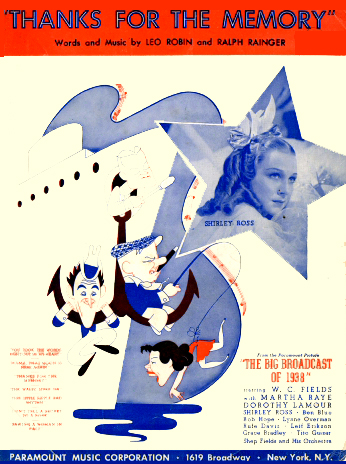
Jack Benny occasionally played his theme song on the violin, but to my knowledge, he never sang it on the air, if at all. That makes Benny and “Love in Bloom,” the topics of my last post, unusual among performers and their signature songs. Perhaps the best example of the more typical approach is Bob Hope and “Thanks for the Memory.”
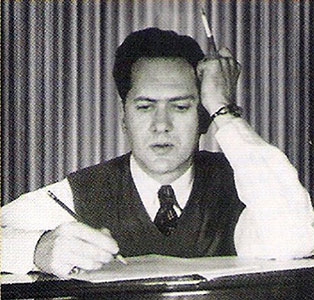
Hope’s theme, as it happens, was written by the same artists who wrote “Love in Bloom.” Ralph Rainger composed the music, and Leo Robin provided the lyrics.
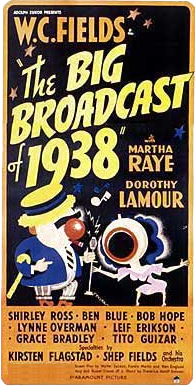
Rainger and Robin wrote the song for The Big Broadcast of 1938, the last in a series of such musical films from Paramount. This plot for this one involved a trans-Atlantic race by two ocean liners. The ensemble included W.C. Fields, Hope and Ross, Martha Raye, Dorothy Lamour, Ben Blue, and Kirsten Flagstad.
Ross and Hope play a couple who are near the point of divorce. In “Thanks for the Memory,” they reminisce about the high and low points of their relationship — a relationship, incidentally, which survives after all. The song won an Academy Award.
Ross and Hope got to team up the following year and sing another song that became an American classic: “Two Sleepy People” by Frank Loesser and Hoagy Carmichael. That duet was in a film titled “Thanks for the Memory.”
Hope adopted “Thanks for the Memory” as his theme, and sang it at the end of his live and televised performances for the rest of his career, changing the lyrics to fit the situation. It was an interesting choice for a comedian, because its original meaning was melancholy, and even when Hope’s writers put humorous lines in it, the sad undercurrent was always there. That was particularly true when Hope sang “Thanks for the Memory” at the end of the many shows he performed for American troops.
RALPH RAINGER
Ralph Rainger wrote scores for at least 40 movies. He would have written for many more, but he was killed in an air collision in 1942 when he was only 41 years old. The DC-3 he was traveling on collided with a U.S. Army Air Corps bomber over Palm Springs.
You can see and hear Bob Hope and Shirley Ross singing “Thanks for the Memory” in The Big Broadcast of 1938″ by clicking HERE.
“Oh, no, it isn’t the trees . . . .”
September 23, 2013

The young JACK BENNY (Benjamin Kubelsky) with his violin.
I was about to watch an episode of the Jack Benny Program recently when I became absorbed in the opening theme. The theme is associated not just with the television series but with Jack Benny himself. The song, “Love in Bloom,” was not written by amateurs. The music was by Ralph Rainger and the lyrics by Leo Robin. Ralph Rainger, a member of the Songwriters Hall of Fame, wrote a lot of music for movies between 1930 and 1942. One of his compositions, “Thanks for the Memory,” written for The Big Broadcast of 1938, won an Academy Award. (I’ll have more to say about that song in a later post.) Leo Robin, who wrote the lyrics to “Love in Bloom,” is also a member of the Hall of Fame. His work included “Thanks for the Memory,” “Beyond the Blue Horizon,” “Prisoner of Love,” and “Blue Hawaii.”
“Love in Bloom” was introduced in 1934 in the film She Loves Me Not. It was sung in a duet by Bing Crosby and Kitty Carlisle.

LEO ROBIN
Crosby, that same year, was the first to record the song, which was nominated for an Academy Award.
Kitty Carlisle — an elegant woman whom, incidentally, I once visited at her Manhattan apartment — liked the song enough that she considered adopting it as her own theme. She scuttled that idea, however, when Benny made the song his signature, frequently playing it, and deliberately butchering it, on his violin.
The song has qualities that don’t come across in most of Benny’s renditions. You can see for yourself as Crosby and Kitty Carlisle sing it in the film. Click HERE.
You can also see a hiliarious routine in which Benny and Liberace play the song on the keyboard and violin on a 1969 episode of Liberace’s TV show. Here Benny lets himself show, for a while at least, that he was more competent on the violin than he cared to admit. Click HERE.
 CharlesPaolino's Blog