Amazon Update No. 2: “For the First Time”
July 18, 2014

JOHANNA von KOCZIAN and MARIO LANZA
When I was about ten years old, my mother took me to see the MGM movie The Great Caruso, in which Mario Lanza played the title role, the tenor Enrico Caruso. Despite my age, I became absorbed in both singers. At first I nagged my mother to buy vinyl for me, but eventually I was old enough to do it on my own. All that vinyl is down in the living room right now, along with hundreds of other 33 rpm disks that include doo-wop, rock ‘n’ roll, country and western, swing, easy listening, opera, and classics.
At any rate, we recently tried to find The Great Caruso on Amazon and Netflix and came up empty, so we settled for Lanza’s last film, the 1959 romantic comedy For the First Time. This film was popular in its time, it got some good reviews, and it was a financial success. This was strictly entertainment, not to be taken seriously, largely an excuse for Lanza to sing — which was a good thing, because opportunities to hear him were much more limited in those pre-iPod, pre-internet days than they would be today. He sings operatic arias and in operatic ensembles, and he sings Italian folk music and popular songs. It’s all good except, from my point of view, “Pineapple Picker,” a song that had no business being in the same room with Mario Lanza.

MARIO LANZA and ZSA ZSA GABOR
Lanza plays Tony Conti, a world-renowned if unreliable tenor. In the flamboyance he exhibits at the beginning of the story, Conti resembles Lanza. After an embarrassing episode in which Conti’s drinking and tardiness cause a Vienna concert to be cancelled with the audience already in the seats, Conti’s agent spirits him off to Capri to lay low until the bad publicity runs its course. There, Conti meets a young German woman, Christa, played by an irresistible actress named Johanna von Koczian, and they are mutually smitten. Johanna, of course, is deaf. (Get it? He’s a famous tenor; she can’t hear him sing.) At the point in the movie at which Tony and Christa meet, I said to my wife, Pat, “In the last scene, she’ll be sitting in an opera house listening to him hit those high notes.” Meeting Christa jolts Conti to the point that he stops drinking and womanizing and becomes responsible about his career. He is practically broke as a result of his shenanigans up to this point, but he takes on a series of performances in various cities of Europe and plans to visit — you guessed it! — the best ear specialist at each stop. No doubt, you can figure out how such a plot turned out in 1959.
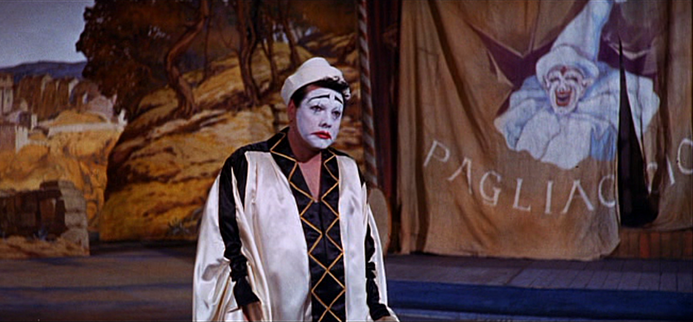
MARIO LANZA sings “Vesti la Giubba” in a scene from “For the First Time”
Mario Lanza, who was 38, died a few months after this film was released. He looked well and vigorous in the film, his voice — dubbed, of course — was full of the power and earthy passion that had made it famous and he projected the boyish charm that endeared him to the public. This was the sort of movie theme — a romance on the Continent – in which audiences of that era would expect to encounter Zsa Zsa Gabor, and they weren’t disappointed. Zsa Zsa played a countess who had a sporadic affair with Tony, as she did with lots of other prominent men. She was 42 and at the height of her beauty when this film was made and her performance had none of the grating personality she adopted for late-night television shows when her looks would no longer carry her. Kurt Kasznar is comical as Tony’s beleaguered manager and protector, and I particularly liked Hans Söhnker’s sympathetic and believable performance as Christa’s uncle.
Due in large part to his personal habits, Lanza’s career was much shorter than it should have been, but he left behind a wonderful legacy of recorded music. Although he appeared in complete operas only a few times, he played an important cultural role by being one of the first singers to make operatic music popular among a mass audience. Prominent tenors even now often acknowledge their debt to him.
The film closes with Conti, as Rhadames, singing in the ensemble that closes Giuseppe Verdi’s Aida. You can see that scene by clicking HERE.
Netflix Update No. 93: “Papadopoulos & Sons”
July 11, 2014

STEPHEN DILLANE
I suppose one way to demonstrate film artistry is to tell a predictable and somewhat saccharine story in such a way that it pleases both the audience and the critics. That’s what Marcus Markou did with the 2013 movie Papadopolos & Son which he produced, wrote, directed, and distributed. The title character in this piece is Harry Papadopoulos, who emigrated with his family from Greece to Britain and made a fortune mass producing Greek food products. Harry lives in a mansion with his three children and an outspoken but indispensable housekeeper, Mrs. Parrington, referred to almost exclusively as “Mrs. P.” The older son, James, likes horticulture and resists his father’s nudges toward a business degree. The younger son, Theo, is a prodigy — a kind of European Brick Heck — with an almost frightening understanding of the stock market. The third child is 18-year-old Katie, a benign but spoiled fashionista. This family’s life is marred by the fact that the wife and mother of the clan has died by the time we meet them.

JAMES DILLANE
Although his food business is highly profitable, Harry has a dream — an enormous commercial complex bearing his name. Inasmuch as he is not Rameses II, he has to leverage his holdings to raise the money for this monument. Timing is everything, and Harry’s was bad. He is in debt up to his spanakopita when the world economy collapses and the bank calls in its markers. Harry can’t pay, and he loses virtually everything. His only recourse, as he sees it, is to consult his brother Spiros, from whom he has been estranged for many years because of Spiros’ profligate lifestyle. Spiros has no resources, but he wants to help. He suggests that He and Harry re-open what was once the family business — a fish-and-chips restaurant that was doing well until Harry moved on and Spiros spun out of control. Harry is not interested in this plan, but Harry also has no other options. The family still owns the London building in which the shuttered restaurant has been mouldering away, and so Spiros and Harry and the kids move in there and start fixing up the place even while Harry tries to find investors who will help him go back to being a baklava magnate.

GEORGES CORRAFACE
A complicating factor is a kebab shop, run by Turks, directly across the street from the fish-and-chips emporium. The owner resents the Greeks for returning to the neighborhood and, to add insult to injury, putting kebabs on the menu. Meanwhile, the kebab merchant’s son has eyes for Katie, and she reciprocates with eyes of her own.

THOMAS UNDERHILL
Although the veteran moviegoer might be able to write the rest of this plot, the movie is more than the surface story line as Markou focuses on what motivates Harry and exposes darker aspects of the family’s history. Although the issue of Greek-Turkish tension is introduced in the ‘hood, as it were, Markou’s interest here is in what family ties mean when the chips (no pun intended) are down. The film is well photographed — I especially liked the way Markou studies Harry’s facial expressions — and the performances are, without exception, spot on. The cast includes Stephen Dillane as Harry; Georges Corraface as Spiros; James Dillane as Harry’s elder son, Frank; Georgia Groome as Katie; Selina Cadell as Mrs. P; and Thomas Underhill as Harry’s younger son, the stock wizard Theo.
This film was initially due for very limited theatrical exposure in England but word got out and public demand resulted in wider release. The movie has also been a success in terms of critical comment. My only complaint is that there are some moments, particularly at the beginning of the film, when the dialogue is hard to understand.

Frank …. Need I say more?
July 1, 2014

FRANK SINATRA
While I was rummaging around in the dusty archives of this blog, I came across a post I wrote in May 2009 concerning a plan by Martin Scorsese to oversee a film about the life of Frank Sinatra. The particular thing that had caught my attention was a report by Hollywood blogger Nikki Finke to the effect that, while Scorsese had Leonardo DiCaprio in mind for the title role, Universal Studios preferred Johnny Depp. I’m not an authority on these matters, but it doesn’t seem to me that either of those actors quite matches the description of Sinatra offered by Debbie Reynolds in a film they made together: “kind of cute, in a beat-up broken-down sort of way.”
I had forgotten about that post, and coming across it made me wonder what had happened to Scorsese’s project. From what little I’ve been able to find out with no more effort than a couple of Google searches, Scorsese typically has several projects in the works at any one time, and the Sinatra movie is among those still turtling along. The most recent report I could find was posted in December 2013 on a site called The Playlist, and all the post added was Scorsese’s confirmation that “that project’s still going strong.” I understand that construction on the Cathedral of St. Peter in Cologne was begun in 1248 and completed in 1880, so I suppose everything is relative, as I was telling Professor Einstein just the other day.

MARTIN SCORSESE
I also read an August 2013 report by Mike Fleming Jr. on deadline.com to the effect that Universal had assigned Billy Ray (The Hunger Games, Captain Phillips) to write the screenplay and that the several prospective producers would include Sinatra’s daughter Tina, Peter Guber, and Cathy Schulman. “It was Guber and Schulman who brought in the project to the studio,” Fleming wrote, “after they secured life and music rights from Frank Sinatra Enterprises, which is a joint venture of the estate of Ol’ Blue Eyes and the Warner Music Group.”
In a certain sense, I’m not interested in any of this. I have an aversion to movie or television biographies of folks who were my contemporaries and whose personalities were as strong and pervasive as Sinatra’s. Whether it were DiCaprio, Depp, or Danny DeVito, I wouldn’t be able to accept the actor as Sinatra. I had that experience when Brad Garrett played the title role in Gleason, a 2002 CBS movie biography of Jackie Gleason. Garrett did a creditable job in the part, I suppose, but he simply wasn’t Gleason, and I couldn’t get past that. Ask me to buy Howard Silva as Benjamin Franklin and I’m good, but not with someone who was a constant presence in my own lifetime.
This is exacerbated, too, by the fact that I live in New Jersey, where by common consent we maintain the fiction that Sinatra was our guy, accept no substitutes. Oh, sure enough, he was from Hoboken and did his first singing in that neck of the woods — a figurative term even then — but he was much more of a Mr. Hollywood and Mr. Vegas and even Mr. Manhattan than he was a Mr. Hudson County. Perhaps he took Jimmy Durante’s remark too seriously: “I went to Hoboken to forget, and then I had to go to Hackensack to forget Hoboken.” That was before Hoboken was the high-rent district it is today.

LOUIS LA RUSSO II
The issue of Sinatra’s connection to New Jersey came up in 1975 when I interviewed a playwright named Louis La Russo II who had written a gutsy play entitled Lamppost Reunion that initially ran for 77 performances at the Little Theater in New York. The play was set in the sort of fictional Lamppost Bar where the owner and a few of his friends reminisce about the days when they sang in a group with a character named Fred Santora (get it?) who is about to make an appearance at Madison Square Garden. After nearly forty years, I don’t remember the details very well, but I know that at least a couple of guys were proud of their background with Santora, but one of them was nursing some undefined resentment. Of course, while they’re discussing all this, Santoro walks into the bar, and the past becomes the present and at least one ugly secret comes out of the dark. In that first production, Danny Aiello played “Biggie,” owner of the Lamppost Bar, and Gabriel Dell, who was a well-known comic actor back then, played Santoro. I believe that play is still produced now and then.
When I interviewed Louis La Russo, he told me that Sinatra’s “people” had let him know that they weren’t crazy about the resemblance between his character and Mr. Vegas, etc. I think La Russo was more amused than anything else.
 Although I never met Sinatra — what with him being All It and me being just this guy in Jersey —I did, through a process somewhat related to the “degrees of separation” phenomenon, socialize with his father, Anthony Martin Sinatra, known variously as Tony and Marty. Because of a mutual friend, I had dinner with the elder Sinatra on several occasions in the early 1960s at the Clam Broth House, a Hoboken landmark that was condemned in 2004. I was in his company for several hours before I realized who his son was, because Marty, who ostensibly had been a paid fireman in Hoboken — in Hudson County, it’s best to use the qualifier when talking about folks who hold public-sector jobs — was an unassuming guy who was content with his own persona.
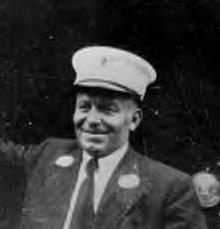
ANTHONY MARTIN SINATRA
Eventually, he did tell me about his boxing career and about a mutual acquaintance, Jackie Farrell, who, Marty said, had put the arm on the owner of a local gin mill to give Frank and his companions their first paid job. Jackie, an amiable and helpful guy, weighed about ninety pounds and usually wore a brown suit. I knew him when he constituted the public relations department for the New York Yankees when the team was still being run like a mom-and-pop grocery.
Among Sinatra’s musical moments on film, my favorite is his duet with Bing Crosby in High Society (1956). It starts at about 4:18 at THIS SITE.
Netflix Update No. 92: “I Love You, I Love You Not”
June 17, 2014

CLAIRE DANES and JEANNE MOREAU
The potential was there; in fact, it was almost too obvious. An introverted Jewish girl attending a posh private school in Manhattan is the target of anti-Semitic harassment. Her parents seem to think of her as an inconvenience, but she can turn for solace and encouragement to her grandmother — a survivor of the Nazi death camp at Auschwitz.
These are the main ingredients in I Love You, I I Love You Not, a 1996 film based on a play by Wendy Kesselman, but the result is confusing and at times even incomprehensible.
The cast is promising enough. Jeanne Moreau plays the grandmother, referred to only as “Nana”; Claire Danes plays Daisy, the troubled girl known for her silence, and, in flashbacks and dream sequences, the younger Nana; and Jude Law plays Ethan, the charismatic, lacrosse-captain, straight-A student whom Daisy secretly yearns for and, in fact, stalks.

CLAIRE DANES and JUDE LAW
The movie begins as a Holocaust survivor is making an audio-visual presentation to a class that includes Daisy and Ethan and others who exhibit varying degrees of appreciation for or indifference to what they are hearing and seeing. Daisy is the most affected by far. It shortly becomes clear that she is a misfit at the school. The anti-Semitism that presumably contributes to this condition is clearly presented in only one incident. Another factor in her isolation, one that is openly discussed, is the fact that she is bookish to a fault, a characteristic that her grandmother nourishes even if she doesn’t encourage it. We never meet Daisy’s parents, but we can infer that there is no love lost between them and their daughter. We infer from the dialogue only that they like their freedom as gadabouts and want Daisy as out-of-the-way as possible. Whenever she talks to them on the telephone, they accuse her of adopting a “tone”(she doesn’t), and they accuse Nana of the same thing on one occasion. Although we would expect Daisy’s solitude to raise some issues of intimacy, her obsession with Ethan, whom she barely knows, seems out of character for such a cerebral young woman, and so does her willingness to share this obsession with a few girlfriends, in childish terms.

Daisy’s stalking is clumsy enough that Ethan becomes fully aware of it, and eventually they are face to face, and then in a relationship. When Daisy is unwilling to let their passion progress beyond heavy kissing and caressing, Ethan — who is under pressure from his friends to drop her for one of the other girls who “want your jock” — breaks up with her. This leads to a crisis in which Daisy rages at Nana and flees Nana’s home and survives only because of Nana’s intervention, naturally, and Daisy continues to nurse a hope that she can recapture Ethan’s attention. Nana’s role in all of this is problematic. Daisy is so fixated on Nana’s wartime experience that she once uses a marker to write on her own arm the number the Nazi’s tattooed on Nana’s. And she insists that Nana repeat a macabre sort of bedtime story which represents the loss of Nana’s two siblings in the death camp. Why Daisy deals with Nana’s history in this fashion is not made clear. Ethan’s motivations are familiar enough, but Nana’s and Daisy’s are not, and inasmuch as their relationship constitutes the raison d’être for this film, that’s a problem.
Netflix Update No. 91: “Carolina”
June 9, 2014
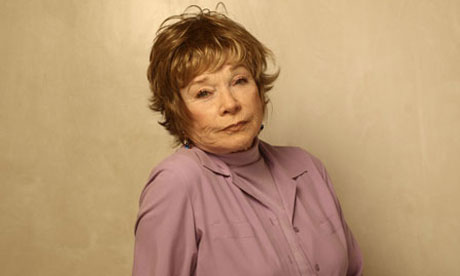
SHIRLEY MACLAINE
I suppose when we search for movie based on the fact that Shirley MacLaine is in the cast, we should be prepared for almost anything. And I suppose that’s what we got when we found the 2003 film Carolina in which MacLaine stars with Julia Stiles and Alessandro Nivola. This was a $15-million property, but Miramax never released it to theaters. After sitting on the movie for two years the distributor abruptly released it directly to DVD in 2005.

JULIA STILES
The story, written by Katherine Fugate, uses a well-exercised premise in which a character who seems to live within the strike zone has close ties to her family who are well outside the foul lines if not beyond the left-field wall. Stiles plays Carolina Mirabeau — so called because her gadabout dad, Ted (Randy Quaid) always named his kids after the states in which he happened to launch their conception. Carolina has a job handling the contestants on a TV dating-game show. She also has an inexplicably poor track record in her own dating game, despite being smart, witty, and gorgeous. A relationship with a rich Briton named Heath Pierson (Edward Atterton) seems more promising than most of Carolina’s liaisons, and it is a critical ingredient in this film, and not only because Pierson, an unlikely contestant on the garish dating show, inadvertently costs Carolina her job. The only intimacy Carolina seems to enjoy consistently is of the platonic sort, involving her charismatic neighbor, Albert Morris, played by Nivola. Morris earns his living by writing romantic novels under a female pseudonym.

RANDY QUAID
Carolina, and ultimately her sisters, Georgia and Maine, were raised by Millicent Mirabeau, Ted’s mother and their grandmother. Millicent is the kind of role a screenwriter would create for vintage ’03 MacLaine if there were only an hour to spare. Millicent lives on the outskirts of the city, figuratively and literally, consorts with whatever odd sorts she takes a shine to and says and does whatever she damn well pleases. You know: Shirley MacLaine. Carolina loves Millicent and often spends time with her, and Millicent has her own ideas about how Carolina should live and particularly whom Carolina should marry. At Millicent’s demand, an outdoor Thanksgiving dinner takes place at her house for her family and a colorful cast of extras, including the only mildly colorful Albert. When Carolina insists that the venue be moved to her apartment one year, there are both predictable and revealing results. This movie is worthwhile for the characters and the performances, but the story is implausible in many regards, the juxtaposition of the uber and under strata of LA society doesn’t seem to have a clear purpose, and the conclusion relies on a turn of events that I would characterize as the easy way out — for the writer if not for the character involved.
Amazon update no. 1: “Judith”
May 11, 2014

SOPHIA LOREN
We hooked up our new Amazon Fire TV gizmo and got a little giddy with the voice-recognition remote. One of the names we blurted into the device was “Sophia Loren” and that led us to watch Judith a 1965 example of a wasted opportunity.The cast also included Jack Hawkins and Peter Finch.
This project had possibilities. The story is set in Palestine shortly before the British pulled out of what was to become the State of Israel. A ragtag military organization called the Haganah — forerunner of the Jewish Defense Force — is anticipating more than the usual hostility from surrounding Arabs and is particularly concerned about a former German tank commander, Gustav Schiller, who is providing the Arabs with tactical training. In order to find the elusive Schiller, the Haganah leadership recruits the Nazi’s former wife, Judith, a Jew who has her own reasons for wanting to track him down.
At the beginning of the film we watch as Judith is smuggled into a sea port in a large wooden crate along with another woman and a piece of heavy machinery. When the crate is opened we already see the flaw in this movie: one of the women is dead — not a surprising outcome, considering the mode of transport — but Judith is tastefully disheveled but not so much so that she isn’t ravishing in eye makeup and lipstick as befitted a mid-1960s sex goddess.

PETER FINCH and SOPHIA LOREN
Judith is hustled off to the kibbutz where an Haganah unit is housed under the supervision of Aaron Stein, played by Finch. The back story is that Schiller and Judith had a son together, but that Schiller ultimately abandoned his wife and took their child. Judith wound up in the Dachau concentration camp and was forced to have sex with German officers.
Judith doesn’t know where Schiller is, but the Haganah leaders figure that she could identify him if they did locate him. Aaron nudges the impatient Judith into approaching the local British Army commander, a Major Lawton (Jack Hawkins) into letting her see the military file on Schiller. Lawton, who is an upright chap, is nevertheless no match for Judith’s charms, and he hands over the file, which indicates that Schiller’s last known address was Damascus.Stein and another Haganah member take Judith to Damascus where they find Schiller. Judith double-crosses Haganah by shooting Schiller, but somehow the men smuggle the wounded man back to Palestine.While the kibbutz is being attached by Arab forces, Schiller tells Judith about the plan of attack, but he is killed by Arab bombs before telling her where their son has gone.

JACK HAWKINS and SOPHIA LOREN
There probably was enough to go on here to make a decent movie. Finch and Hawkins turned in good performances, and the gritty location shots created a credible image of the environment in which such events would have taken place in 1948. But the film is often reduced to absurdity because of the seemingly irresistible opportunity to exploit Sophia Loren’s physical charms.
“Lord, what fools these mortals be!”
April 7, 2014

“Chuck and Andy, Chuck and Andy, Chuck and Andy ….”
Mickey Rooney fiddled with his makeup kit and muttered those words again and again as though we weren’t in the room.
That was in 1973. My colleague, Andy Kudrick, and I had entered Rooney’s dressing room a few moments before and had introduced ourselves. The ritual seemed to send Rooney into a meditative trance in which we had provided the mantra: “Chuck and Andy, Chuck and Andy, Chuck and Andy ….”
When the actor again became conscious of our presence, he said, “Sit down, but don’t ask me about Judy Garland. I don’t talk about those days. I don’t live in the past. I look forward to the future!”
Judy Garland hadn’t been on our minds, so we were comfortable with this ground rule.

Apparently, Mickey Rooney himself was not comfortable with it. We were there to talk to him about a stage production of William Shakespeare’s play A Midsummer Night’s Dream in which he was cast as Bottom. Rooney, who died yesterday, had played Puck in the 1935 film version of that play.
But before we could begin the conversation, he launched into a rambling invective against unspecified demons who, in his view, had used Judy Garland for their own profit and advancement and ultimately had destroyed her. I had read about her life, so I had some idea what he was referring to. “I loved her,” he said when he had exhausted the topic, at least for then: “I really loved her.”
Andy and I were unsettled by this outburst, because we felt as if it were an intimate moment that we had no business witnessing and because, in the seconds that followed, we didn’t know if we should remain silent, speak, or quietly leave the room.
But Rooney recovered from his reverie without so much as a “Chuck and Andy,” broke into a grin, and engaged us in a lively conversation about Bottom, Puck, and things besides.

“Miss Golightly, I protest!”
I was relieved. Although entertainment personalities were part of the raw material of my profession, I had approached this particular encounter fully conscious of what an iconic figure Rooney was. He was also a personal favorite, and that was because of his enormous range as an actor, something that helps to account for a career that lasted 88 years. He became a star through what now appear to be overblown characters in both musical comedies and dramas, but over time he showed that he had a capacity for subtlety, too, as witness his performances in the feature film Requiem for a Heavyweight (1962) and the television movie Bill (1982).
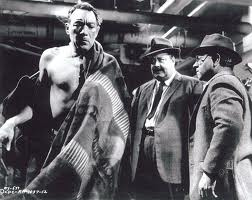
Anthony Quinn, Jackie Gleason, and Mickey Rooney in “Requiem for a Heavyweight”
It is, indeed, a gift
March 5, 2014

W.C. Fields
Ordinarily, I wouldn’t have been eavesdropping on Jim Beckerman’s telephone conversation. We were colleagues in newspaper journalism; we worked in a newsroom and we were accustomed to shutting out the phone chatter going on all around us. But every once in a while, a phrase or a clause would penetrate the shield. If a person within earshot were to say, “Was it a homicide?”, for example, we would notice that.
Something like that happened one day when I was standing near Jim’s desk, but he didn’t get my attention by mentioning a homicide or a fire or an FBI raid on yet another mayor’s office in New Jersey. I don’t recall now exactly what he said. It could have been, “Never mind Norman’s skates!” or “I didn’t know oranges were bad for the heart,” or “Mr. Abernathy here has to get his commission.” I don’t know exactly what it was, but I do know that it was a line from the 1939 movie It’s A Gift.

“I wouldn’t ride across the country with that man for a million dollars!”
In this film, W.C. Fields plays Harold Bissonette (pronounced, his nagging wife, Amelia, insists, “Biss-uh-NAY). Harold is a grocer in the fictional town of Wappingers Falls, New Jersey, but when he unexpectedly inherits some money he sells his corner store and buys an orange ranch in California. His wife, brilliantly played by Kathleen Howard, and his daughter, Mildred, are outraged. Only his hyperactive son, Norman, is enthusiastic about the move. Moreover, Mildred’s boyfriend, John Durston, who sold the orange grove to Harold, knows that the property is worthless but can’t convince Harold of that. After an eventful trip across country, Harold finds that John Durston was correct — at least to the extent that the land won’t support an orange grove — but Harold also learns from a nearby farmer, Mr. Abernathy, that developers need the place to complete a racetrack project. “You’re an old fool,” Amelia tells Harold after learning that the family is going to be rich, “but I can’t help loving you.”
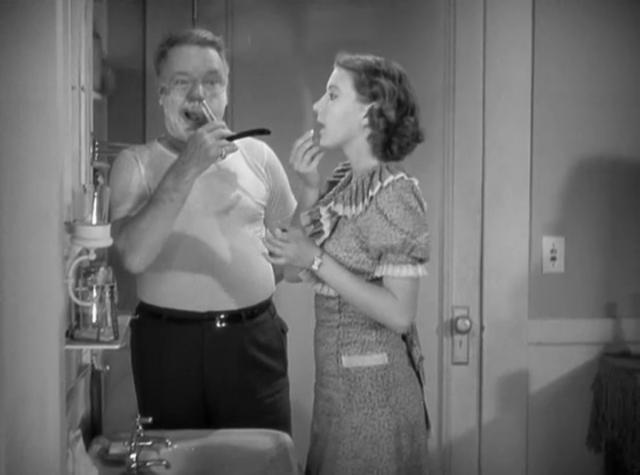
“If you want me to cut my throat, keep that up. … Evidently do.”
It’s a Gift is regarded by many film critics as one of the funniest movies ever made. We didn’t know that when we became addicted to it at our house. We just knew that we thought it was funny enough to watch again and again, and eventually we began to recite the dialogue. I don’t mean that we repeated certain lines, such as “Yes, Mrs. Casterini, I would love some oatmeal” from Moonstruck or “I’m givin’ you pearls here, son,” from Scent of a Woman. No, I mean that we recited whole speeches, such as Amelia’s rant to her beleaguered husband:
“I don’t know how you expect anybody to get any sleep, hopping in and out of bed all night, tinkering around the house, waiting up for telephone calls. You have absolutely no consideration for anybody but yourself. I have to get UP in the morning, get breakfast for YOU and the children. I have no MAID, you know. Probably never shall have.”

“The public is buying them up like hotcakes!”
And we recited scenes, sometimes to the consternation or confusion of others who were waiting for a table at a restaurant or riding on the same ferry in the North Atlantic. One such was a conversation between the Bissonettes’ upstairs neighbor, Mrs. Dunk (Josephine Whittell), and her daughter, Abby (Diana Lewis), who has been dispatched to buy something to settle the stomach of Baby Dunk. Harold, escaping from Amelia’s nagging, is trying to sleep on the back porch of his second-floor apartment. Mrs. Dunk is on the porch above him, and Abby is already in the back yard:
Mrs. Dunk: Don’t forget the ipecac!
Abby: I thought you said syrup of squill.
Mrs. Dunk: I can’t hear you, talk louder!
Abby: I thought you said syrup of squill.
Mrs. Dunk: All right, syrup of squill. I don’t care.
Abby: I don’t care either. I’ll get ipecac if you want me to.
Mrs. Dunk: Well, ipecac or syrup of squill. I don’t care which.
Abby: I don’t care either. You tell me what to get and I’ll get it.
Mrs. Dunk: Get whichever one you want. I don’t care. Whatever they have handy. It’s just the same to me.
Abby: It’s just the same to me, too. I hate ’em both. Oh, where will I go? To Jones’s?
Mrs. Dunk: Use your own judgment.
Abby: No, you tell me where to go.
Harold (muttering): I’d like tell both of you where to go.
Enter Amelia, who overhears this dialogue and comes out onto the porch:
Amelia: Who were those women you were talking to?
Harold: Mrs. Dunk upstairs.
Amelia: Seems to me you’re getting pretty familiar with Mrs. Dunk — upstairs!
Harold: They were talking to me, I wasn’t talking to them.
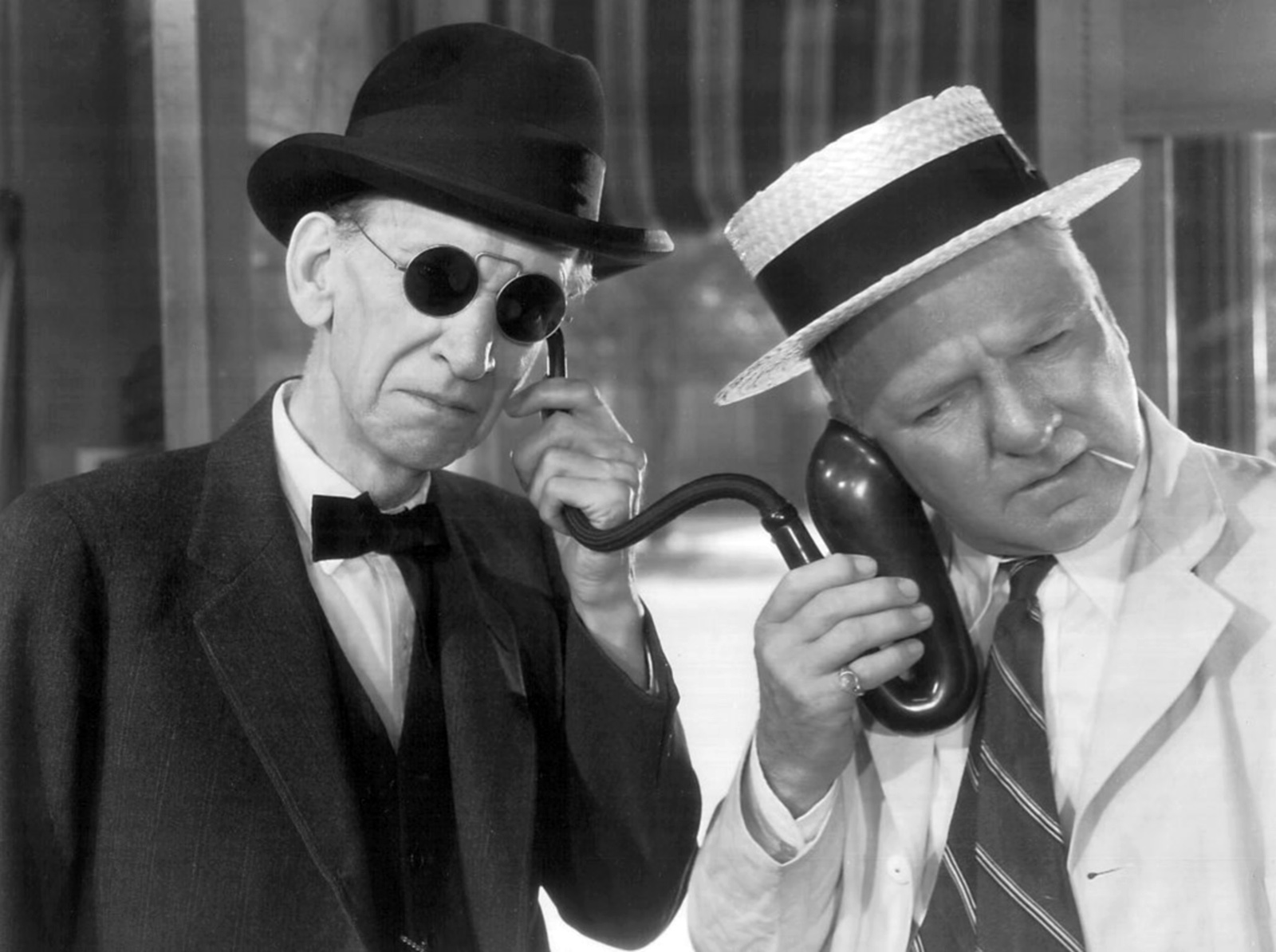
“Just a little glassware.”
It wasn’t until I overheard Jim’s end of a telephone conversation that I realized that my family and I weren’t the only ones who at will could perform large chunks of dialogue from It’s a Gift. Recently I have seen several strings on Facebook in which one user posted a line from the film and a stream of “friends” immediately started chiming in with others.
Why is this true? One reason may be that this script wasn’t turned out by a team of college-educated writers who were handed a premise and ordered to be funny within the limitations of the budget. This was the combined work of Fields himself, who had been seasoned by years on the stage, J.P. McEvoy, a veteran magazine writer, and Jack Cunningham, who had been writing screenplays since 1917. McEvoy, by the way, created the newspaper comic strip Dixie Dugan, which ran from 1929 to 1966.
It’s probably because of the combined experience of these men that there is scarcely a line or exchange in It’s a Gift that isn’t funny. The script is hard to match on that account, and the fact that it was assigned to a brilliantly wackadoodle cast of characters completes the package.
One of the most famous scenes from this movie involves a salesman who is pitching annuity policies. This character was played by T. Roy Barnes (pictured above in the gray fedora), who died at the age of 56 less than three years after It’s a Gift was released but achieved film immortality with his search for a potential client, Carl LaFong. The salesman’s conversation with Harold takes place during the “porch scene,” and you can see that whole sequence at THIS LINK.
Netflix Update No. 90: “And Your Name is Jonah”
March 2, 2014

JEFFREY BRAVIN
I had a phone conversation with Sally Struthers a few years ago when she was touring with a production of Annie.The fact that she was touring with that show was a reflection of an experience that she and may other actors have had: she appeared in a hit television series and never quite matched that in her later career. It’s no disgrace; it has happened to many others through no fault of theirs. It’s just the nature of the television industry.
Sally Struthers certainly isn’t absent from television because she isn’t a good actress.We were reminded of that the other night when we watched a 1979 Hallmark movie, And Your Name is Jonah, in which she plays a woman whose deaf son has been misdiagnosed as mentally handicapped.When the mistake is discovered the boy is released from the institution he has been living in. But his dad, although he tries, cannot understand the boy’s needs, and the marriage is strained to the breaking point.
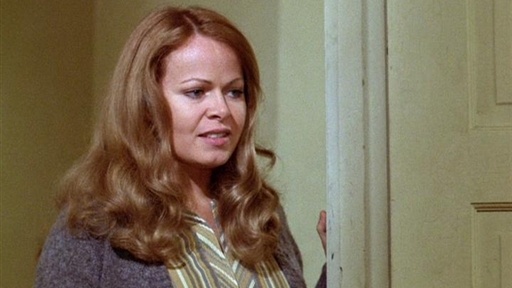
SALLY STRUTHERS
Sally Struthers gave a strong performance as a loving mother who will not be diverted from her mission to help her son live as a member of the community. Jonah was played with great effect by nine-year-old Jeffrey Bravin, who was the fourth generation of his family to be born deaf. He is now an administrator at the American School for the Deaf in West Hartford, Connecticut. He and his wife have two children who, I believe, are hearing. Titos Vandis is a sympathetic figure as Jonah’s grandfather, who sells produce in an open-air market.
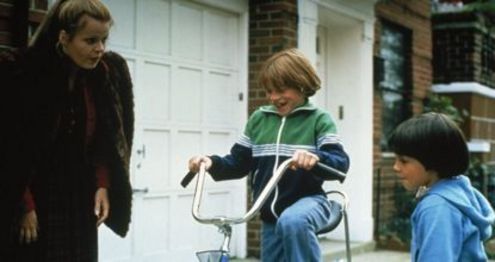
This movie touches on sensitive issues related to deafness, including the question of whether deaf people should rely on sign language or learn to lip read and speak. I was ignorant of that issue until I read Seeing Voices: A Journey into the World of the Deaf, which was published in 1989 by the neurologist Dr. Oliver Sacks. This movie also treats the overarching theme of the need and right of deaf people to be treated not as pitiable victims but as the whole human beings they are.
Netflix Update No. 89: “The Happy Poet”
January 3, 2014

It’s all about Bill, an unpublished poet, whose dream is to sell vegetarian lunches in a park in Austin, Texas. He buys a hot dog cart — on monthly payments — and starts whipping up the hummus and babba gannounj. He calls his business Happy Poet, but whether he is happy or not is a matter of conjecture since the central joke of this deft little 2010 comedy is the poker face on Paul Gordon, who wrote and directed the film and plays the title role.
Bill has no business sense and his enterprise gets off to a slow start, but he gets help and moral support of sorts from two underemployed hangers-on and a young woman who not only likes the vegetarian fare but takes a shine to Bill himself.
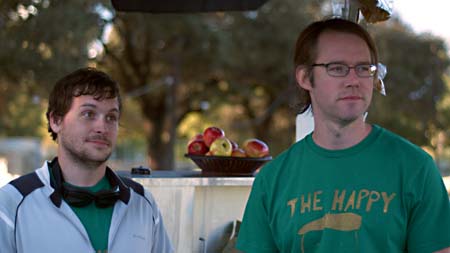
JONNY MARS and PAUL GORDON
The most helpful, seemingly, is Donny (played by Jonny Mars), a charismatic hustler who has a motorcycle and an idea: he will print and distribute flyers promoting the Happy Poet all over downtown Austin and then deliver lunch orders called in to Bill’s cell phone. This might be a workable if limited business model — if it weren’t for Donny’s sideline.
Curtis, played by Chris Doubek, shows up around four and helps Bill close up — even consuming some unsold victuals, giving what turns out to be a misleading impression of indolence. And Agnes, played by Liz Fisher, is a willing customer, because she eats healthy, who finds Bill more intriguing in a way that most people can’t perceive.

PAUL GORDON and CHRIS DOUBEK
Bill’s foray into the culinary trade would have ended in failure but for an unexpected reversal of fortune. Sad to say, the resolution is giddily contrived and out of character in this film. It appears to be a clumsy attempt to create a contrasting background for Gordon’s poker face, which remains unmoved by events until everything goes black. But the movie was a game effort by Gordon, and it got some positive attention when it made the rounds of festivals. The casting and the performances and the effective use of the Austin locations add up to an engaging experience.
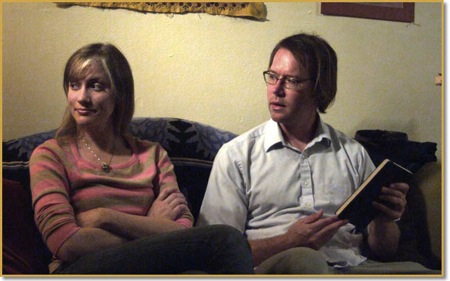
LIZ FISHER and PAUL GORDON
 CharlesPaolino's Blog