“… the consent of the governed.”
July 3, 2010
 Once in a while we hear of an Independence Day ceremony in which someone reads the text of the Declaration of Independence. I have never attended such an event, but I can imagine that the presentation could be effective. The language in the document has always enthralled me. I have read it so often and pored over various passages while I was simultaneously reading about the history of that period, that I know the declaration as well as I do the prayers we say at Mass.

- THOMAS JEFFERSON

I frequently use portions of the text — most of which was written by Thomas Jefferson — as examples for my English students. There are excellent illustrations, for example, of the use of parallel structure: He has plundered our seas, ravaged our coasts, burnt our towns, and destroyed the lives of our people.
Unfortunately, many of my students don’t seem to know what part the Declaration of Independence played in American history, as though the title didn’t make it clear enough. I don’t mean to ridicule the students, but I have learned in their essays that many can’t distinguish between the Declaration and the Constitution. They don’t understand that the nation as we know it was not formed until a couple of decades after the Continental Congress published the Declaration.
 I don’t know how well the public at large knows that history, but I do wonder at least once a year about how deeply citizens appreciate the philosophy of the Declaration, and especially its observation that in order to secure people’s natural rights “governments are instituted among men, deriving their just powers from the consent of the governed.” Jefferson was arguing, of course, that the British Parliament was not operating under that principle, that Parliament was making decisions without the consent of the governed. The underlying principle didn’t apply only to that situation, however.
 The idea codified in the Declaration was, indeed, that government should act in accordance with the will of the majority of citizens, but that also presumed that more than a few citizens would participate in the process, at least by exercising the right to vote. As it is, some parts of the population had to struggle long and hard to gain full citizenship, including the franchise. The turnout at most elections in this country suggests that the ballot is not as valuable to many of us as it is to those who have been denied it.
So you’ll have a hot dog, and you’ll think about it. The text of the Declaration of Independence is available HERE.

John Trumbull's 19th century painting of the presentation of the Declaration of Independence to the Continental Congress
Books: “Lincoln and McClellan”
June 27, 2010
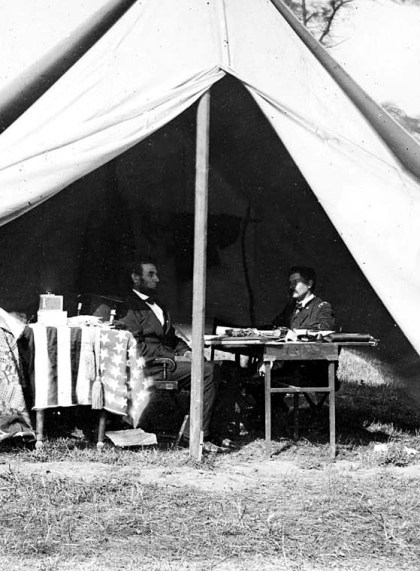
- Abraham Lincoln meets with Maj. Gen. George McClellan in October 1862, following the Battle of Antietam

The recent decision by President Obama to remove Gen. Stanley McChrystal from his command in Afghanistan in favor of Gen. David Petraeus prompted a lot of people to reflect on the analogous event involving President Truman and Gen. Douglas McArthur. My mind reached back further, however, because I happened to be reading Lincoln and McClellan, a recent book by John C. Waugh about another president and general whose relationship came to grief.

GEORGE McCLELLAN
Maj. Gen. George B. McClellan is remembered today mostly for his reticence on the battlefield and for the effect that had on Abraham Lincoln. Lincoln finally removed the general from command of the Army of the Potomac after the carnage at Antietam. It’s hard to say that there was a winner or loser in that awful battle, but Lincoln’s frustration was that McClellan let Robert E. Lee and his army slip away without pursuit — this after McClellan had repeatedly resisted Lincoln’s urgings to attack or pursue the enemy.
In a way, McClellan, like so many of his contemporaries, was one more victim of the Civil War. He was a charismatic and erudite man who was well trained at West Point — but not as a fighter. McClellan had served in the Mexican War and had left the army for a lucrative executive position with a railroad, but he returned to arms when secession made war inevitable.
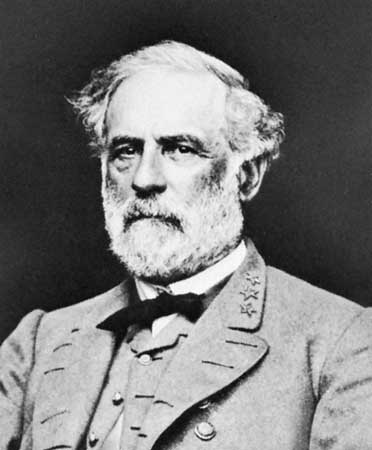
ROBERT E. LEE
Lincoln called on McClellan after the disaster of First Bull Run, and McClellan used his considerable skill to, in effect, create the Army of the Potomac and mold it into a formidable fighting force. His personal qualities endeared him to the troops, and that sentiment spilled over to the Northern public. McClellan was lionized as a new Napoleon. He believed his own publicity, but he fell short of its promise. Among his errors were that he was never quite satisfied with the readiness of his army and that he wildly overestimated the size of his enemy with the result that he ended up being embarrassed by much smaller forces than his own.
Although McClellan ran for president in 1864 and in later life served as governor of New Jersey and campaigned for Democratic presidential candidates Winfield Scott and Grover Cleveland, he hated politics and despised politicians.

ABRAHAM LINCOLN
He resented any interference in military affairs by civilian authorities, and that put him on a collision course with Lincoln who, for better or for worse, had his own ideas about strategy and let the general know about them. There were bitter exchanges between McClellan and both Lincoln and Secretary of War Edwin Stanton, who was something of a troublemaker in his own right.
This condition was complicated by the fact that McClellan came from an elite Philadelphia family and regarded people with humbler pedigrees as his social and intellectual inferiors — and that included, one might say especially, Abraham Lincoln. In letters to his wife, Ellen Marcy McClellan, the general dismissed Lincoln as “an idiot” and “a gorilla.” This was consistent with a pattern in McClellan’s life in which he usually regarded his superiors as incompetent.

GEORGE McCLELLAN circa 1880
Like many or maybe most northerners, McClellan was not concerned about the institution of slavery or about the slaves themselves, and he insisted that they were not a factor in the war. He maintained that the war should be conducted with the least possible impact of southern institutions and property – and he pointedly included slavery and slaves in that philosophy. As as result, he was scandalized when Lincoln issued the Emancipation Proclamation, and the fact that Lincoln insisted that the proclamation was a war measure didn’t mitigate McClellan’s disgust.
McClellan has often been brushed off as an almost comical figure who dithered while Lincoln fumed, but passing easy judgment on the men and women who lived through and participated in the war and the events surrounding it is a disservice to them. That’s why I appreciate books like this one, in which John Waugh presents a balanced view of the life and career of a complicated man caught up in a complicated epoch.
Books: “Franklin Pierce”
June 13, 2010

FRANKLIN PIERCE
When I was a kid, a bubble gum company came out with a line of president cards which I guess were intended as the nerd’s alternative to baseball cards. I was into baseball – including the cards – but I was also into history. Also, my Dad owned a grocery store, so I had easy access to whatever the gum companies were peddling.
I recall sitting across from my father at the kitchen table. He held the president cards, arranged in chronological order, and I would try to list them from memory. I can still hear him saying one night when I got stuck somewhere in the latter 19th century: “C’mon! What street does your Aunt Ida live on?” The answer was Garfield Place, as in James A.
It occurred to me at that young age – it was during Dwight Eisenhower’s first administration – that Franklin Pierce had the best-looking face on those cards.

FRANKLIN PIERCE
Pierce is the subject of a new little biography – part of a Time Books series on the presidents. This one is written by Michael F. Holt, a history professor at the University of Virginia and an expert on the political life of the country in the years leading up to the Civil War. Sure enough, Holt points out that Pierce was not only handsome, but charming and warm hearted as well. Unfortunately, those qualities carried a lot more weight in the internal politics of Democratic New Hampshire than they did when spread out over a nation that was on the verge of committing suicide over the issue of expanding slavery into the western territories.
In fact, Pierce was nominated for the presidency in 1852 not so much because his party thought he was the Man of the Hour but because the party couldn’t muster a winning vote for any of the three leading candidates – one of whom was not Pierce. He was the original Dark Horse, as far as the presidency of the United States was concerned.

FRANKLIN PIERCE
Pierce actually showed some skill in managing the foreign affairs of the country, and he directed the Gadsden Purchase, which was the last major territorial acquisition in what is now the contiguous 48 states. But the crisis of the moment had to do with whether the institution of slavery was going to migrate west along with settlers – an argument that many thought had been closed with the Compromise of 1820. Pierce’s attitude on this issue was complex. First of all, he was a strict constructionist, meaning that he didn’t believe the federal government had any right to interfere in the internal affairs of states, including slavery. Pierce was not pro-slavery per se, but he believed that as long as slavery was protected by the Constitution, the federal government had no right to intrude.

JEFFERSON DAVIS
Pierce was also fiercely determined to hold the Union together, and that inspired his loathing of the abolition movement. He considered abolitionists fanatics whose shenanigans were threatening the solidarity of the nation. And so, Pierce was a New Englander who consistently supported the Southern slave-holding oligarchy.
Another error in Pierce’s thinking, Holt explains, was an attempt to unify the Democratic party – which was suffering regional and philosophical tensions – by doling out federal patronage jobs to men who represented the whole spectrum of opinion. Among other things, he appointed his friend Jefferson Davis – soon to be president of the Confederacy – as Secretary of War, a move that did not endear Pierce to northern interests that despised and feared the southern plantation establishment. Rather than unifying the party, this policy succeeded in irritating just about everybody but those who got lucrative or influential positions.

JANE PIERCE
Pierce made enough mistakes that he was denied re-nomination by his own party. He was gracious in defeat, Holt reports, but he had to have been sorely disappointed. Among those who probably was not disappointed at all was the president’s wife, Jane Appleton Pierce, who had no patience with politics or life in the capital. In fact, when a rider caught up with the Pierces’ carriage to report that Pierce had been nominated for president, Jane fainted dead away. The poor woman was shy and fragile, and she and her husband endured a series of tragedies that unfortunately were not uncommon in the mid 19th century. They had three sons. Two died at very young ages and the third was killed when a railroad car in which the parents and child were riding left the track and overturned. Holt mentions that although Pierce did not approve of Abraham Lincoln’s policies, he wrote Lincoln a heartfelt note of sympathy when one of Lincoln’s sons died in the White House.

NATHANIEL HAWTHORNE
Pierce was a heavy drinker – a problem drinker, actually – during much of his life, including the years after Jane died in 1863.
An interesting aspect of Pierce’s life was his compassion for other people – the most prominent of whom may have been Nathaniel Hawthorne, whom Pierce met while a student at Bowdoin College. The men were so close that when Hawthorne sensed that he was dying he asked to spend some of his last days with Pierce. Although Hawthorne could travel only with difficulty, Pierce accommodated him and set off with him on a trip that was to be Hawthorne’s last. Pierce found the writer dead in a room at a hotel where the two men had stopped on their journey. Pierce, who was well off, included Hawthorne’s children in his own will.
Pierce is consistently ranked as one of the least effective, or “worst,” of American presidents. But life isn’t lived on historians’ templates; it is lived between the ground and the sky in specific times and places and under specific and complex conditions. Calling a man one of the “worst” in any realm might have as much to do with what we expect of him at a comfortable distance than it has to do with the choices and challenges that confronted that man in his own circumstances. When Abraham Lincoln had been murdered, an angry crowd approached Pierce’s home demanding to know why he wasn’t displaying a flag. Pierce pointed out that his father, Benjamin, had fought in the Revolution, his brothers in the War of 1812, and he himself in the Mexican War: “If the period during which I have served our state and country in various situations, commencing more than thirty-five years ago, have left the question of my devotion to the flag, the Constitution, and the Union in doubt, it is too late now to remove it.”
Books: “FDR’S Funeral Train”
May 29, 2010
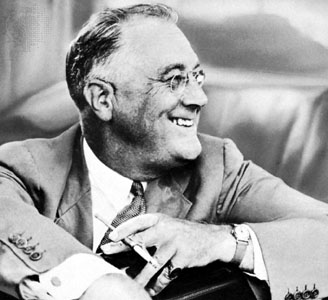
FRANKLIN ROOSEVELT
When I was growing up, I couldn’t wait for Andy the Mailman to bring the monthly magazines my mother subscribed to — especially Better Homes & Gardens, Woman’s Day, Good Housekeeping, Family Circle, and McCall’s.
Mostly, I liked the one-panel cartoons, and I looked forward to reading the humor column on the last page of BH&G, which appeared under the byline of Burton Hillis, which I learned only a couple of years ago was a pen name for Bill Vaughan.

ELEANOR ROOSEVELT
My favorite feature, though, appeared in McCall’s. It was Eleanor Roosevelt’s Q&A column, “If You Ask Me.” She started writing that column in 1949 and continued until she died in 1961. I don’t know how old I was when I started reading it. I was only seven years old in 1949, so it might not have been then, but I must have been pretty young, because I can still recall my mother asking me why a boy my age wanted to read that column. I don’t know what answer I gave, but I remember being fascinated with Eleanor Roosevelt long before I fully understood who she was.
As I grew older, of course, I came to appreciate her character and the many contributions she made to American life.
My mind is on Mrs. Roosevelt just now because I recently reviewed Robert Klara’s interesting book, “FDR’s Funeral Train,” which is a chronicle of the transport of Franklin Roosevelt’s body from Warm Springs, Ga., where he died in April 1945, first to Washington, D.C., for a service in the East Room of the White House and then to Hyde Park, N.Y., for a funeral and burial at the Roosevelt home.
Klara provides a lot of details about the logistics of this enterprise — everything from the preparation of the president’s body and the selection of a 700-pound copper casket to the history and features of the engines and cars that made up the trains.
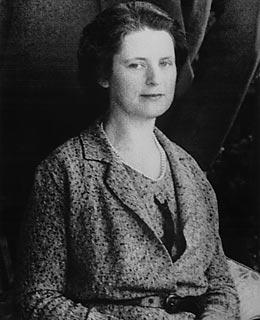
LUCY MERCER RUTHERFERD
Woven into this account, however, are the human stories — including the culmination of Franklin Roosevelt’s long liaison with Lucy Mercer Rutherferd. Mrs. Rutherferd had been Eleanor Roosevelt’s social secretary when FDR — with the presidency far in the future — began his affair with her. Eleanor Roosevelt discovered this relationship in 1918 and ultimately agreed to an arrangement in which she and FDR would remain married but would live separately, as it were, and he would not see Mrs. Rutherferd. The second part of that bargain didn’t last very long, and he continued to see Mrs. Rutherferd literally until the day he died. In fact, she was present when Roosevelt suffered the cerebral hemorrhage that caused his death.
Taken by surprise by her husband’s death, Eleanor Roosevelt traveled to Warm Springs and was, to all outward appearances, the picture of composure and dignity as she planned and participated in the rituals that led to the grave.
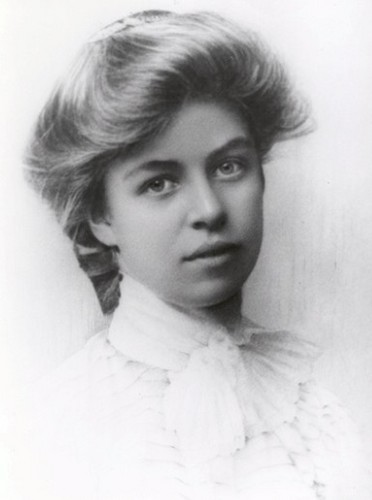
ELEANOR ROOSEVELT
During this sad trip, however, Mrs. Roosevelt not only confirmed what she had suspected — that FDR had continued to see Mrs. Rutherferd and that Lucy had been at Warm Springs when he died — but also that the visits between the two had been arranged with the connivance of various members of the president’s official and personal household — including the Roosevelts’ daughter, Anna.
Klara also relates in this book how the death of FDR affected Harry Truman, who had not been a member of FDR’s inner circle and had not been informed of important matters of state, including the fact that scientists in New Mexico were at that moment developing what they believed would be the most destructive bomb ever produced.

HARRY TRUMAN
However unprepared Truman may have been for his new role, Klara describes him as a man who kept his wits about him and did what had to be done. Roosevelt died in Georgia on a Thursday afternoon, and he was buried in upstate New York on the following Sunday. Truman planned to address a joint session of Congress on Monday, and he spent his time on the train from Washington to Hyde Park and back again working on that speech with his advisers. It was, Klara reports, a hit with Congress and with the public, as Truman promised to pursue Roosevelt’s policies, including FDR’s demand for unconditional surrender by both Germany and Japan. In a few months, Truman, who hadn’t been trusted with the secret of the bomb, would make the lonely decision to use it against Japan in order to put an end to hostilities in the Pacific.
Klara includes some detailed descriptions of the awkward political atmosphere on the trains as one administration was passing out of existence and another was taking control. The author also discusses the controversial security risk taken by organizers and participants in the Hyde Park funeral, as virtually the whole government traveled together on the train while the country was at war. The risk wasn’t far fetched; Klara notes that among the passengers — despite the high level of security — was a government operative who was a spy for the KGB.

A woman weeps over the death of Franklin Roosevelt. The president's widow said she never realized until she watched the crowds along the funeral train's route the dimensions of the public's devotion to FDR. / Life magazine photo
 On April 19, I wrote about a 22-inning baseball game in 1962 in which the Yankees beat the Tigers, 9-7, thanks to the only home run of Jack Reed’s career. I mentioned in that post that Tigers outfielder Rocky Colavito went seven-for-ten in that game. That attracted a response from Gloria, who is a member of a group that is campaigning for the Veterans Committee to elect Colavito to the National Baseball Hall of Fame this year.
It’s well known by now that the Hall of Fame is not the Hall of Justice. I have commented here, for example, on the fact that Pete Rose — an obnoxious SOB, but one of the best hitters of all time — is ineligible because he gambled on baseball, but Adrian “Cap” Anson stares smugly from his plaque despite his critical role in keeping two or three generations of black players out of the major leagues. So if Rocky Colavito hasn’t been elected, there is no reason to be surprised.
I have a good perspective on this question, because I saw Colavito play at Yankee Stadium many times. I was fortunate enough to have a father who was devoted to both baseball and the Yankees, and at one point in the 1950s and 1960s, we attended an average of three games a week when the Yankees were home. We saw Colavito through most of his career.

BOBBY LOWE
Colavito’s stats as a hitter and as a fielder speak for themselves. They are readily available on the Internet, so I won’t recite them all here. I will mention that in 116 years, only 15 men have hit four home runs in one game; Colavito was one of them. That in itself doesn’t qualify him for the Hall of Fame, but in the context of the career he had at the plate, it can’t be ignored. The feat was first accomplished by Bobby Lowe of the Boston Beaneaters in 1894. Lowe was playing in the dead-ball era, but he was also playing in Boston’s Congress Street Park, which had a short left-field line. All four of his homers were hit to left. The only other player in the 19th century to hit four home runs in one game was Ed Delahanty of the Phillies, who did it in 1896. Records are incomplete, but it is known that at least two of Delahanty’s homers that day were inside the park.
 Another thing that distinguishes Colavito’s share of this record is that he is one of only six men in major league history to hit four home runs in consecutive at-bats in a single game. The others were Lowe, Lou Gehrig, Mike Schmidt, Mike Cameron, and Carlos Delgado. As rare an accomplishment as that is, it was typical of Colavito in the sense that he always brought excitement to the game; he put derrières in the seats, as it were, and it’s hard to calculate the value of that. It’s unusual for the fans at a baseball stadium to jump to their feet because of an outfielder’s throw, but Colavito’s arm was a high-caliber gun, and I was often among those who bolted out of our seats when he uncorked one toward the infield.
Rocky Colavito belongs in the Hall of Fame. If you want to read more about Colavito or sign a petition to the Veterans Committee, you can do both at THIS SITE.

Rocky Colavito, right, with pitching great Herb Score in 2006, when they and five others were inducted into the Cleveland Indians Hall of Fame.
Em cee squared
May 17, 2010

A blackboard with formulas written by Albert Einstein, preserved in the Museum of the History of Science at the University of Oxford.
 Several decades ago, I began to make a point of reading several books each year on subjects about which I knew little or nothing — including subjects that I found repulsive. Among those subjects have been mathematics and physics, both of which bedeviled me when I had to study them in high school and college. As I have mentioned here before, at least with respect to mathematics, I have derived a great deal of satisfaction from pondering these subjects when examinations and grades are not at issue, and I have found that those who claim that there is beauty and wonder in these fields are telling the truth
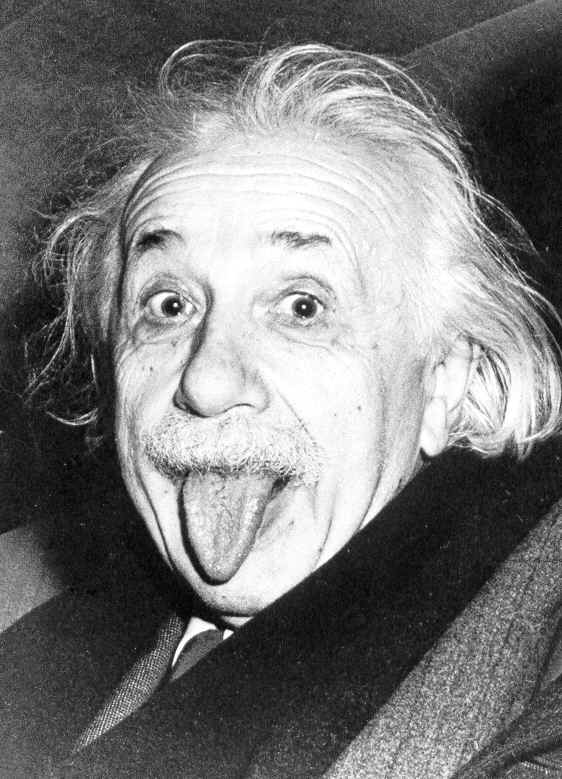
 That background explains why I grabbed the opportunity to review a popular biography entitled “Einstein: The Life of a Genius” by Walter Isaacson. This is a coffee table book that contains a limited amount of text in proportion to the number pages and illustrates its points with many photographs and also with facsimiles of several letters and documents. Among these are Einstein’s letter to Franklin D. Roosevelt in which the scientist advised the president to call together a group of experts to study the possibility of developing an atom bomb — something Nazi Germany was known to be doing at the time. As it happened, Einstein — a pacifist whose work in physics helped pave the way to such weapons — was considered too great a security risk to work on the project himself, what with him being a native of Germany, a socialist, and a Jew.
 Isaacson records that one of Einstein’s early physics instructors described him as “an extremely clever boy,” but added, “You have one great fault: You’ll never let yourself be told anything.” It wasn’t meant as compliment, but still, this tendency as much as anything else led to Einstein’s achievements in theoretical physics. Einstein — like Isaac Newton before him — would not accept anything as settled just because it was handed on to him by authoritative sources. He wondered and questioned and “experimented” with physical phenomena such as light and motion by forming images in his mind, and he changed the world.
Einstein is a curiosity in a way, because he was one of the most widely known celebrities of his time and his name is part of our language more than 50 years after his death, and yet most of us have little or no idea what he was up to. That doesn’t matter. He deserves his place in our culture if for no other reason than his persistence in questioning even his own conclusions.
“How long ya’ gonna be gone?” — Ruby and Kalmar
May 14, 2010

Sheet music to "So Long, Oolong"
When Patricia T. O’Conner, author of popular books on English usage, visited the Leonard Lopate show on WNYC this week, the segment was introduced by a vocal of the song “Three Little Words,” which made me think of Harry Ruby. Ruby and his longtime colleague, Bert Kalmar, wrote that song in 1930 for what would now be considered an offensive movie.
The film was “Check and Double Check” — the only movie made by Freeman Gosden and Charles Correll in their blackface roles as Amos Jones and Andrew H. Brown — characters they made famous with their long-running radio series, “Amos ‘n’ Andy.” The song didn’t get small-time treatment in the film; it was performed by Bing Crosby and the Duke Ellington Orchestra.
The song also lent its name to the title of the 1950 film biography of Ruby and Kalman.

HARRY RUBY
Harry Ruby first came to my attention when I was a kid, and he made a guest appearance on the Danny Thomas television show, “Make Room for Daddy.” Ruby sang another song he had written with Kalman, one that — some might say mercifully — is not as well known as “Three Little Words.” The 1920 tune was “So Long, Oolong. How Long Ya’ Gonna be Gone,” which had racist overtones, as did so many Tin Pan Alley songs written in that era.
The song is about a Japanese girl named Ming Toy, whose boyfriend left for what was supposed to be a short spell but turned into a long spell. Hence the chorus: So long, Oolong, how long ya’ gonna be gone?”
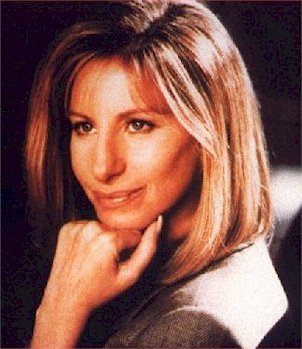
BARBRA STREISAND
Ruby and Kalman were prolific, and some of their work was much more sophisticated than the Oolong affair. For example, they wrote “My Honey’s Lovin’ Arms,” which got a signature performance many years later in “The Barbra Streisand Album.” The pair also wrote “Who’s Sorry Now?” “Nevertheless (I’m in Love with You),” “A Kiss to Build a Dream On,” and the Betty Boop theme, “I Wanna be Loved by You,” among others.
As talented and productive as Ruby was as a songwriter, though, what I like best about him is that he always wanted to be a baseball player. He tried, unsuccessfully to make it into the pros, and he never missed a chance in later life to get close to the game. His devotion to the sport is the source of one of the great baseball anecdotes.

LOU GEHRIG
Ruby seized an opportunity to appear in “Elmer the Great,” a sports movie starring the comedian Joe E. Brown, who was also a devotee of baseball. The movie was shot at the old Wrigley Field, a minor league park in Los Angeles. One of the scenes called for an player, to be portrayed by Ruby, to drop a ball hit to him in the outfield. Ruby walked off the set, insisting that he wouldn’t drop a ball on purpose for any amount of money. Later, when Brown and Ruby happened to be in the company of Lou Gehrig, Brown told that story, figuring that Ruby would be embarrassed. Gehrig, with a straight face, said it was the greatest baseball story he had ever heard
Hear the voice of Edwin Booth. No, really.
April 12, 2010

EDWIN BOOTH
I had an opportunity this week to talk to William Henline, a young playwright who is about to introduce a drama about Edwin Booth, the most prominent American actor of the mid and late 19th century and the brother of John Wilkes Booth. The focal point of the play is Edwin Booth’s effort to come to terms with what his brother had done. The dynamics are not the obvious. Edwin and Wilkes Booth lived at politically opposite poles. Wilkes was a Confederate sympathizer and operative who despised Abraham Lincoln, as many people did at the time. Edwin supported the Union, and Henline’s research shows that the only two times Edwin Booth is known to have voted, he voted for Lincoln. The brothers’ political differences ran so deep that they were incapable of discussing the subject.

JOHN WILKES BOOTH
Still, Henline discerns that there was a fraternal love that underlay this fissure between the brothers and that survived even Edwin’s revulsion and humiliation over the murder of Lincoln. Edwin, it seems, was constitutionally incapable of rationalizing or excusing Wilkes Booth’s crime, but was equally incapable of casting off his sibling — even if he did once say that he didn’t want Wilkes Booth’s name mentioned in his presence.
Edwin Booth’s rooms at the Players Club in New York have been preserved as they were on the day he died in 1893. Near his bed is a portrait of John Wilkes Booth.
Henline also called my attention to the fact that there is a recording available of Edwin Booth reciting part of a speech from William Shakespeare’s “Othello.” The quality is as poor as one might expect from such an early recording, but if you listen to it at THIS LINK, you can follow the text on the screen and understand most of the speech. Considering who Edwin Booth was and when he spoke these words, it’s a stirring experience to sit at a laptop in 2010 and hear his voice.
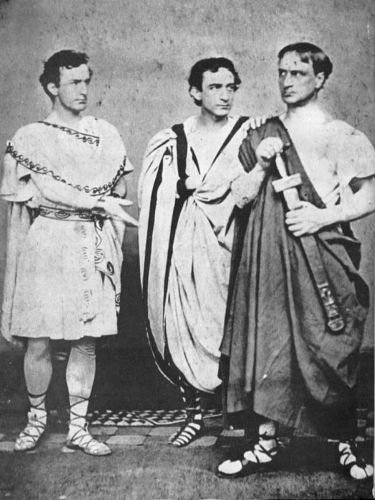
John Wilkes Booth, left, as Marc Antony; Junius Brutus Booth Jr. as Cassius; and Edwin Booth, right, as Brutus, in a production of “Julius Caesar” in New York in 1864. It was the brothers’ only joint appearance on stage.
“She’s making history, working for victory” — Evans and Loeb
March 28, 2010
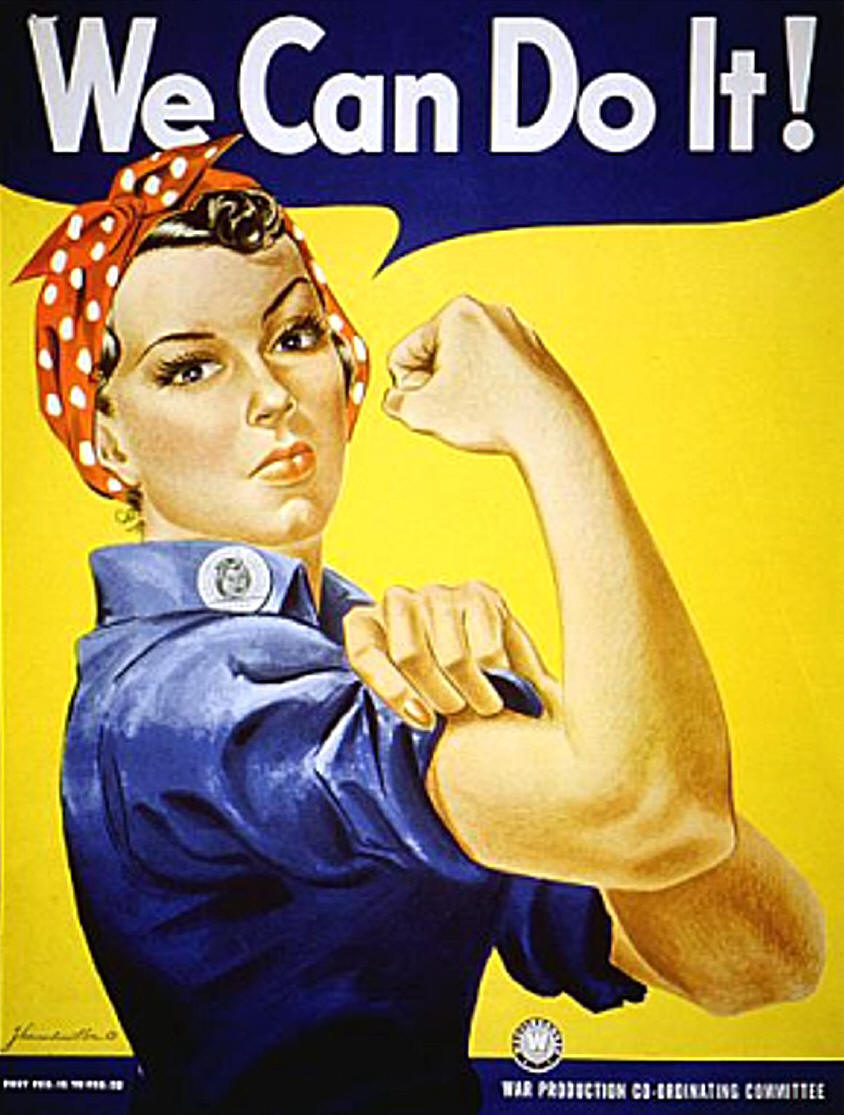
"Rosie the Riveter"poster from World War II era
Like many people, I guess, I frequently brood over the questions I should have asked when I was a kid. One category that came to mind today is related to my father’s work in an aircraft assembly plant during World War II. All I know is that Dad was not drafted into military service, but was assigned to work at the Curtiss-Wright Corp., I presume in Caldwell. He was 29 years old when my brother was born in 1941, and his age might have had something to do with his exemption. He told me that he worked in my family’s grocery store during the day and at Curtiss-Wright at night, but how long he worked at the plaht and what he did, I didn’t ask. Along about 1976, it became too late. I can’t blame it on the ignorance of youth, either; by the time Dad died, I was in my 30s, and I still hadn’t asked.
Fortunately, most people are smarter than I am, including some filmmakers who are tracking down women who worked in the defense industry during the war — the fabled labor force that shared the sobriquet “Rosie the Riveter.”
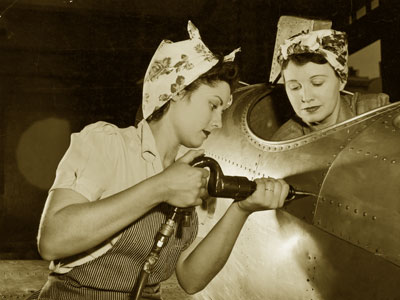
Women at work in a defense plant during World War II
I saw a note on the web site of the Detroit Free Press indicating that the filmmakers plan to visit Michigan next month looking for women in that state who had supported the war effort by building aircraft and manufacturing munitions and other matériel. This is a project of New York University’s Tamiment Labor Archives; it’s explained in some detail at THIS LINK.
Several years ago, a project in Morris County, here in New Jersey, conducted several lengthy interviews with women who had been part of the Rosie brigade. The interviews, and photos of those women, are available at THIS LINK.
The term “Rosie the Riveter” was first used in 1942 in a song by that name written by Redd Evans and John Jacob Loeb. In poking around on this subject, I also learned that the women who did this indispensable work have been commemorated in the Rosie the Riveter Charter High School in Long Beach, Calif., a school that gives girls an opportunity to learn non-traditional trades.
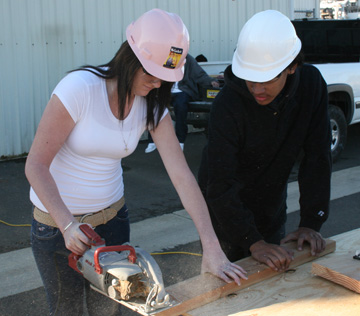
A student at Rosie the Riveter Charter High School learns to operate a power saw.
“. . . and shall forever be revered by his fellow countrymen.” — George Washington, establishing the Badge of Military Merit”
March 6, 2010
 Richard Owen died on June 6, 1944. Yes, what the date implies is true: He died during the Allied invasion of Normandy. Sgt. Owen was a paratrooper with the Army’s 101st Airborne, 506th PIR-E Company — the “Band of Brothers.” His plane was hit during the early hours of the operation; it crashed during a landing attempt and burned for three days.
Sgt. Owen was posthumously awarded the Purple Heart, one of the most precious possessions for an American or his or her family. I was born a little less than two years before Sgt. Owen died. As I was growing up, remnants of the war were still evident in our house. My Dad was 30 years old when the war began, and I guess that’s why he was assigned to civil defense and aircraft construction on the Home Front. But there were letters and uniform buttons on shelves and in drawers that evoked the recent service of our cousins, Mike Aun in Europe and his brother Fred in the Pacific, and our dear friend Jack Mawhinney, also in Europe.

The Silver Star
Among the keepsakes from the recent war were clippings from the Paterson Evening News, and there I read that Mike Aun, who by then had married and moved to Lexington, S.C., had been awarded the Bronze Star, the Silver Star, and the Purple Heart with three Oak Leaf Clusters. I asked my Mom, to whom Mike was like a brother, what those awards meant. She explained as best she could to an ignorant child, but I was much older before I understood the implications of “meretorious service” and “gallantry in action.” I already understood, though, what she meant when she said that Mike had been hurt four times while he was “overseas,” as my Mom always expressed it. I loved Mike for a lot of reasons, but I idolized him for that Purple Heart. No doubt because I was introduced to the award in such a personal way, I have always paused over references to men and women who have earned the Purple Heart, and so I was particularly attracted to the story of Sgt. Owen, whose award certificate turned up at a Salvation Army center in a box of donated household tchotchke.
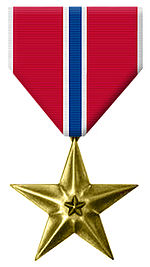
The Bronze Star
Personnel at the Salvation Army, Capt. Ron Heimbrock and Darlene Pelkey, were aware of the importance of that certificate, and they were upset to think of it as discarded along with things of no value. They launched a search that eventually involved many other folks, and the combined effort led to members of Sgt. Owen’s family who honor his memory. One of them has custody of the medal itself, and she treasures it.
The fact that people who had no direct connection to Sgt. Owen thought enough of what that certificate represented is a comment on their own sensitivity. It is also a fitting salute, across the decades, to one of the many who never should be forgotten.
You can read the Washington Post story about Sgt. Owen himself and about the discovery of the certificate and the search for Sgt. Owen’s family by clicking HERE.
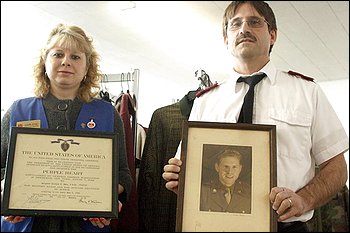
Darlene Pelkey and Salvation Army Capt. Ron Heimbrock with the Purple Heart Citation and a photo of Sgt. Richard Owen / Daily Courier-Observer photo by Bob Beckstead
 CharlesPaolino's Blog