Netflix Update No. 91: “Carolina”
June 9, 2014
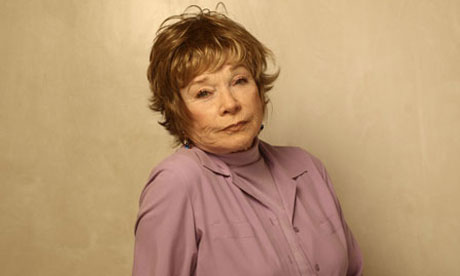
SHIRLEY MACLAINE
I suppose when we search for movie based on the fact that Shirley MacLaine is in the cast, we should be prepared for almost anything. And I suppose that’s what we got when we found the 2003 film Carolina in which MacLaine stars with Julia Stiles and Alessandro Nivola. This was a $15-million property, but Miramax never released it to theaters. After sitting on the movie for two years the distributor abruptly released it directly to DVD in 2005.

JULIA STILES
The story, written by Katherine Fugate, uses a well-exercised premise in which a character who seems to live within the strike zone has close ties to her family who are well outside the foul lines if not beyond the left-field wall. Stiles plays Carolina Mirabeau — so called because her gadabout dad, Ted (Randy Quaid) always named his kids after the states in which he happened to launch their conception. Carolina has a job handling the contestants on a TV dating-game show. She also has an inexplicably poor track record in her own dating game, despite being smart, witty, and gorgeous. A relationship with a rich Briton named Heath Pierson (Edward Atterton) seems more promising than most of Carolina’s liaisons, and it is a critical ingredient in this film, and not only because Pierson, an unlikely contestant on the garish dating show, inadvertently costs Carolina her job. The only intimacy Carolina seems to enjoy consistently is of the platonic sort, involving her charismatic neighbor, Albert Morris, played by Nivola. Morris earns his living by writing romantic novels under a female pseudonym.

RANDY QUAID
Carolina, and ultimately her sisters, Georgia and Maine, were raised by Millicent Mirabeau, Ted’s mother and their grandmother. Millicent is the kind of role a screenwriter would create for vintage ’03 MacLaine if there were only an hour to spare. Millicent lives on the outskirts of the city, figuratively and literally, consorts with whatever odd sorts she takes a shine to and says and does whatever she damn well pleases. You know: Shirley MacLaine. Carolina loves Millicent and often spends time with her, and Millicent has her own ideas about how Carolina should live and particularly whom Carolina should marry. At Millicent’s demand, an outdoor Thanksgiving dinner takes place at her house for her family and a colorful cast of extras, including the only mildly colorful Albert. When Carolina insists that the venue be moved to her apartment one year, there are both predictable and revealing results. This movie is worthwhile for the characters and the performances, but the story is implausible in many regards, the juxtaposition of the uber and under strata of LA society doesn’t seem to have a clear purpose, and the conclusion relies on a turn of events that I would characterize as the easy way out — for the writer if not for the character involved.
Amazon update no. 1: “Judith”
May 11, 2014

SOPHIA LOREN
We hooked up our new Amazon Fire TV gizmo and got a little giddy with the voice-recognition remote. One of the names we blurted into the device was “Sophia Loren” and that led us to watch Judith a 1965 example of a wasted opportunity.The cast also included Jack Hawkins and Peter Finch.
This project had possibilities. The story is set in Palestine shortly before the British pulled out of what was to become the State of Israel. A ragtag military organization called the Haganah — forerunner of the Jewish Defense Force — is anticipating more than the usual hostility from surrounding Arabs and is particularly concerned about a former German tank commander, Gustav Schiller, who is providing the Arabs with tactical training. In order to find the elusive Schiller, the Haganah leadership recruits the Nazi’s former wife, Judith, a Jew who has her own reasons for wanting to track him down.
At the beginning of the film we watch as Judith is smuggled into a sea port in a large wooden crate along with another woman and a piece of heavy machinery. When the crate is opened we already see the flaw in this movie: one of the women is dead — not a surprising outcome, considering the mode of transport — but Judith is tastefully disheveled but not so much so that she isn’t ravishing in eye makeup and lipstick as befitted a mid-1960s sex goddess.

PETER FINCH and SOPHIA LOREN
Judith is hustled off to the kibbutz where an Haganah unit is housed under the supervision of Aaron Stein, played by Finch. The back story is that Schiller and Judith had a son together, but that Schiller ultimately abandoned his wife and took their child. Judith wound up in the Dachau concentration camp and was forced to have sex with German officers.
Judith doesn’t know where Schiller is, but the Haganah leaders figure that she could identify him if they did locate him. Aaron nudges the impatient Judith into approaching the local British Army commander, a Major Lawton (Jack Hawkins) into letting her see the military file on Schiller. Lawton, who is an upright chap, is nevertheless no match for Judith’s charms, and he hands over the file, which indicates that Schiller’s last known address was Damascus.Stein and another Haganah member take Judith to Damascus where they find Schiller. Judith double-crosses Haganah by shooting Schiller, but somehow the men smuggle the wounded man back to Palestine.While the kibbutz is being attached by Arab forces, Schiller tells Judith about the plan of attack, but he is killed by Arab bombs before telling her where their son has gone.

JACK HAWKINS and SOPHIA LOREN
There probably was enough to go on here to make a decent movie. Finch and Hawkins turned in good performances, and the gritty location shots created a credible image of the environment in which such events would have taken place in 1948. But the film is often reduced to absurdity because of the seemingly irresistible opportunity to exploit Sophia Loren’s physical charms.
It is, indeed, a gift
March 5, 2014

W.C. Fields
Ordinarily, I wouldn’t have been eavesdropping on Jim Beckerman’s telephone conversation. We were colleagues in newspaper journalism; we worked in a newsroom and we were accustomed to shutting out the phone chatter going on all around us. But every once in a while, a phrase or a clause would penetrate the shield. If a person within earshot were to say, “Was it a homicide?”, for example, we would notice that.
Something like that happened one day when I was standing near Jim’s desk, but he didn’t get my attention by mentioning a homicide or a fire or an FBI raid on yet another mayor’s office in New Jersey. I don’t recall now exactly what he said. It could have been, “Never mind Norman’s skates!” or “I didn’t know oranges were bad for the heart,” or “Mr. Abernathy here has to get his commission.” I don’t know exactly what it was, but I do know that it was a line from the 1939 movie It’s A Gift.

“I wouldn’t ride across the country with that man for a million dollars!”
In this film, W.C. Fields plays Harold Bissonette (pronounced, his nagging wife, Amelia, insists, “Biss-uh-NAY). Harold is a grocer in the fictional town of Wappingers Falls, New Jersey, but when he unexpectedly inherits some money he sells his corner store and buys an orange ranch in California. His wife, brilliantly played by Kathleen Howard, and his daughter, Mildred, are outraged. Only his hyperactive son, Norman, is enthusiastic about the move. Moreover, Mildred’s boyfriend, John Durston, who sold the orange grove to Harold, knows that the property is worthless but can’t convince Harold of that. After an eventful trip across country, Harold finds that John Durston was correct — at least to the extent that the land won’t support an orange grove — but Harold also learns from a nearby farmer, Mr. Abernathy, that developers need the place to complete a racetrack project. “You’re an old fool,” Amelia tells Harold after learning that the family is going to be rich, “but I can’t help loving you.”
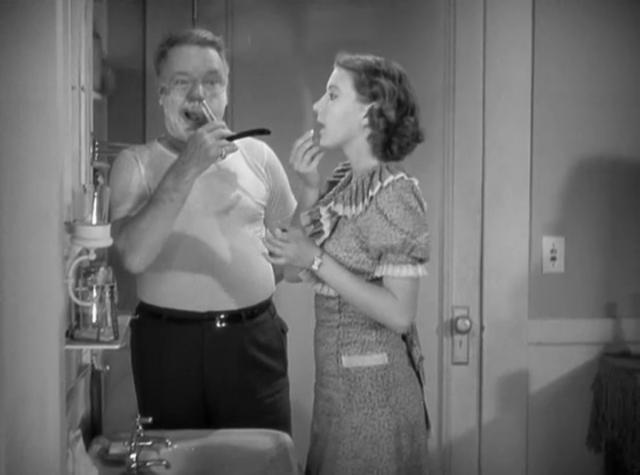
“If you want me to cut my throat, keep that up. … Evidently do.”
It’s a Gift is regarded by many film critics as one of the funniest movies ever made. We didn’t know that when we became addicted to it at our house. We just knew that we thought it was funny enough to watch again and again, and eventually we began to recite the dialogue. I don’t mean that we repeated certain lines, such as “Yes, Mrs. Casterini, I would love some oatmeal” from Moonstruck or “I’m givin’ you pearls here, son,” from Scent of a Woman. No, I mean that we recited whole speeches, such as Amelia’s rant to her beleaguered husband:
“I don’t know how you expect anybody to get any sleep, hopping in and out of bed all night, tinkering around the house, waiting up for telephone calls. You have absolutely no consideration for anybody but yourself. I have to get UP in the morning, get breakfast for YOU and the children. I have no MAID, you know. Probably never shall have.”

“The public is buying them up like hotcakes!”
And we recited scenes, sometimes to the consternation or confusion of others who were waiting for a table at a restaurant or riding on the same ferry in the North Atlantic. One such was a conversation between the Bissonettes’ upstairs neighbor, Mrs. Dunk (Josephine Whittell), and her daughter, Abby (Diana Lewis), who has been dispatched to buy something to settle the stomach of Baby Dunk. Harold, escaping from Amelia’s nagging, is trying to sleep on the back porch of his second-floor apartment. Mrs. Dunk is on the porch above him, and Abby is already in the back yard:
Mrs. Dunk: Don’t forget the ipecac!
Abby: I thought you said syrup of squill.
Mrs. Dunk: I can’t hear you, talk louder!
Abby: I thought you said syrup of squill.
Mrs. Dunk: All right, syrup of squill. I don’t care.
Abby: I don’t care either. I’ll get ipecac if you want me to.
Mrs. Dunk: Well, ipecac or syrup of squill. I don’t care which.
Abby: I don’t care either. You tell me what to get and I’ll get it.
Mrs. Dunk: Get whichever one you want. I don’t care. Whatever they have handy. It’s just the same to me.
Abby: It’s just the same to me, too. I hate ’em both. Oh, where will I go? To Jones’s?
Mrs. Dunk: Use your own judgment.
Abby: No, you tell me where to go.
Harold (muttering): I’d like tell both of you where to go.
Enter Amelia, who overhears this dialogue and comes out onto the porch:
Amelia: Who were those women you were talking to?
Harold: Mrs. Dunk upstairs.
Amelia: Seems to me you’re getting pretty familiar with Mrs. Dunk — upstairs!
Harold: They were talking to me, I wasn’t talking to them.
“Just a little glassware.”
It wasn’t until I overheard Jim’s end of a telephone conversation that I realized that my family and I weren’t the only ones who at will could perform large chunks of dialogue from It’s a Gift. Recently I have seen several strings on Facebook in which one user posted a line from the film and a stream of “friends” immediately started chiming in with others.
Why is this true? One reason may be that this script wasn’t turned out by a team of college-educated writers who were handed a premise and ordered to be funny within the limitations of the budget. This was the combined work of Fields himself, who had been seasoned by years on the stage, J.P. McEvoy, a veteran magazine writer, and Jack Cunningham, who had been writing screenplays since 1917. McEvoy, by the way, created the newspaper comic strip Dixie Dugan, which ran from 1929 to 1966.
It’s probably because of the combined experience of these men that there is scarcely a line or exchange in It’s a Gift that isn’t funny. The script is hard to match on that account, and the fact that it was assigned to a brilliantly wackadoodle cast of characters completes the package.
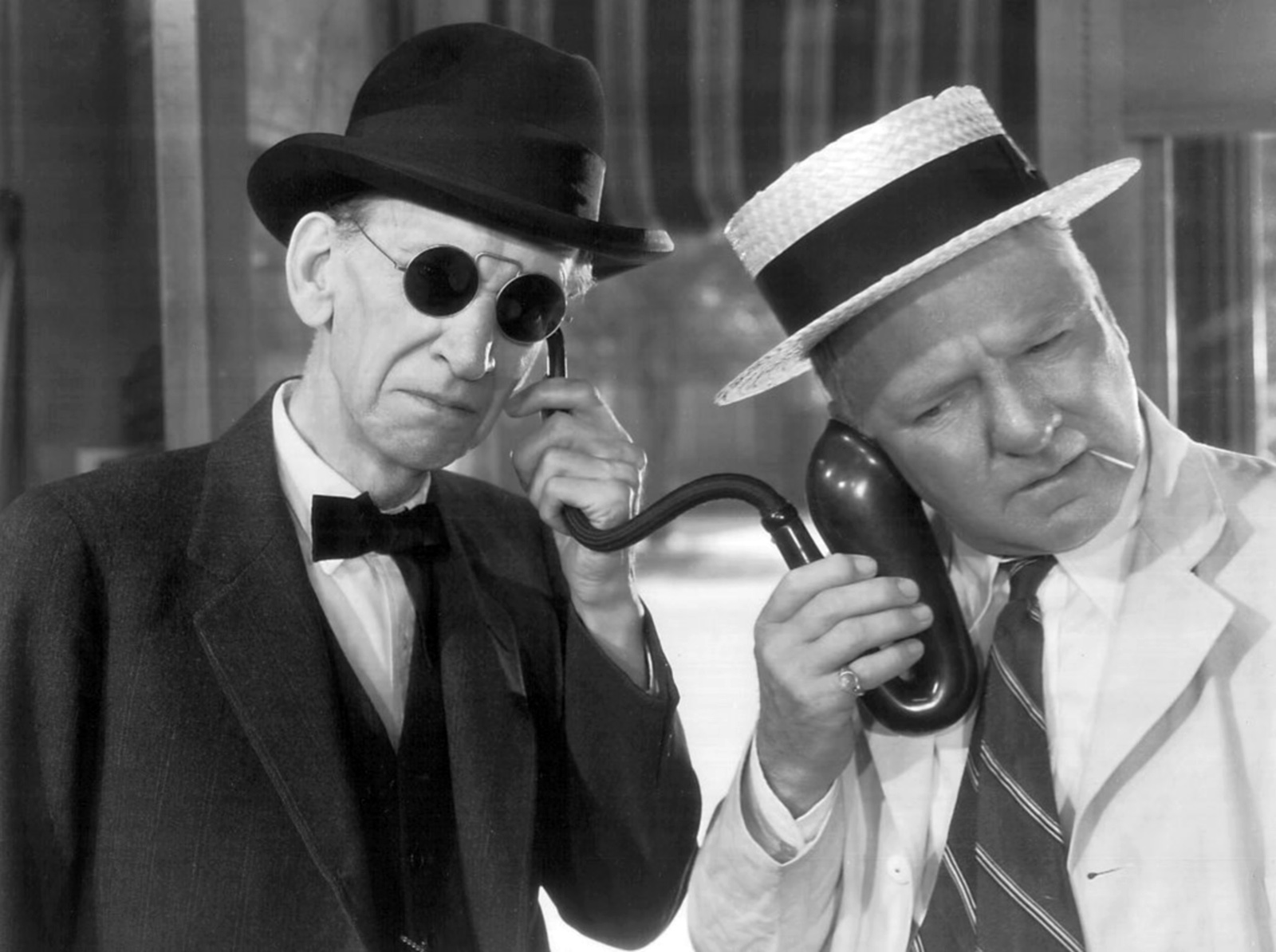
One of the most famous scenes from this movie involves a salesman who is pitching annuity policies. This character was played by T. Roy Barnes (pictured above in the gray fedora), who died at the age of 56 less than three years after It’s a Gift was released but achieved film immortality with his search for a potential client, Carl LaFong. The salesman’s conversation with Harold takes place during the “porch scene,” and you can see that whole sequence at THIS LINK.
Netflix Update No. 90: “And Your Name is Jonah”
March 2, 2014

JEFFREY BRAVIN
I had a phone conversation with Sally Struthers a few years ago when she was touring with a production of Annie.The fact that she was touring with that show was a reflection of an experience that she and may other actors have had: she appeared in a hit television series and never quite matched that in her later career. It’s no disgrace; it has happened to many others through no fault of theirs. It’s just the nature of the television industry.
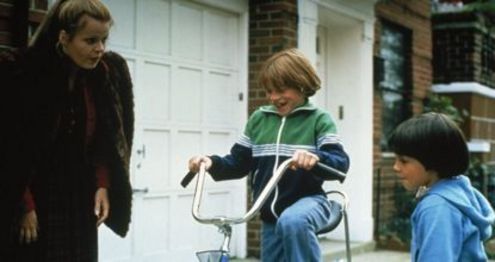
Sally Struthers certainly isn’t absent from television because she isn’t a good actress.We were reminded of that the other night when we watched a 1979 Hallmark movie, And Your Name is Jonah, in which she plays a woman whose deaf son has been misdiagnosed as mentally handicapped.When the mistake is discovered the boy is released from the institution he has been living in. But his dad, although he tries, cannot understand the boy’s needs, and the marriage is strained to the breaking point.
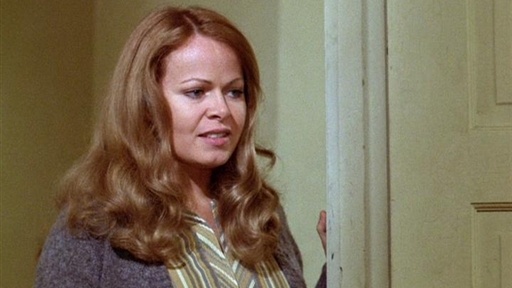
SALLY STRUTHERS
Sally Struthers gave a strong performance as a loving mother who will not be diverted from her mission to help her son live as a member of the community. Jonah was played with great effect by nine-year-old Jeffrey Bravin, who was the fourth generation of his family to be born deaf. He is now an administrator at the American School for the Deaf in West Hartford, Connecticut. He and his wife have two children who, I believe, are hearing. Titos Vandis is a sympathetic figure as Jonah’s grandfather, who sells produce in an open-air market.
This movie touches on sensitive issues related to deafness, including the question of whether deaf people should rely on sign language or learn to lip read and speak. I was ignorant of that issue until I read Seeing Voices: A Journey into the World of the Deaf, which was published in 1989 by the neurologist Dr. Oliver Sacks. This movie also treats the overarching theme of the need and right of deaf people to be treated not as pitiable victims but as the whole human beings they are.
Netflix Update No. 89: “The Happy Poet”
January 3, 2014

It’s all about Bill, an unpublished poet, whose dream is to sell vegetarian lunches in a park in Austin, Texas. He buys a hot dog cart — on monthly payments — and starts whipping up the hummus and babba gannounj. He calls his business Happy Poet, but whether he is happy or not is a matter of conjecture since the central joke of this deft little 2010 comedy is the poker face on Paul Gordon, who wrote and directed the film and plays the title role.
Bill has no business sense and his enterprise gets off to a slow start, but he gets help and moral support of sorts from two underemployed hangers-on and a young woman who not only likes the vegetarian fare but takes a shine to Bill himself.
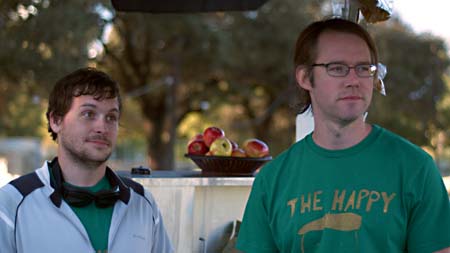
JONNY MARS and PAUL GORDON
The most helpful, seemingly, is Donny (played by Jonny Mars), a charismatic hustler who has a motorcycle and an idea: he will print and distribute flyers promoting the Happy Poet all over downtown Austin and then deliver lunch orders called in to Bill’s cell phone. This might be a workable if limited business model — if it weren’t for Donny’s sideline.
Curtis, played by Chris Doubek, shows up around four and helps Bill close up — even consuming some unsold victuals, giving what turns out to be a misleading impression of indolence. And Agnes, played by Liz Fisher, is a willing customer, because she eats healthy, who finds Bill more intriguing in a way that most people can’t perceive.

PAUL GORDON and CHRIS DOUBEK
Bill’s foray into the culinary trade would have ended in failure but for an unexpected reversal of fortune. Sad to say, the resolution is giddily contrived and out of character in this film. It appears to be a clumsy attempt to create a contrasting background for Gordon’s poker face, which remains unmoved by events until everything goes black. But the movie was a game effort by Gordon, and it got some positive attention when it made the rounds of festivals. The casting and the performances and the effective use of the Austin locations add up to an engaging experience.
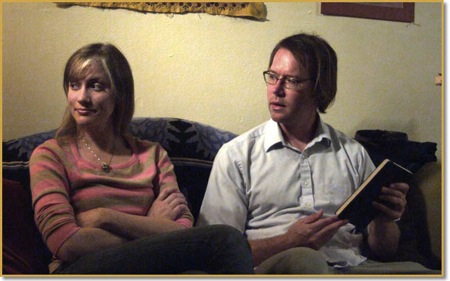
LIZ FISHER and PAUL GORDON
Netflix Update No. 88: “Cookie’s Fortune.”
December 29, 2013

PATRICIA NEAL
The dysfunctional family is a tried-and-true topic for a novel or a movie, and it was put to good use in the 1999 film Cookie’s Fortune.
The movie was written by Anne Rapp and filmed on location in Holly Springs, Mississippi; the ensemble cast includes Glenn Close, Charles S. Dutton, Julianne Moore, Liv Tyler, Patricia Neal, Chris O’Donnell, Ned Beatty, and Lyle Lovett.
As Easter approaches in a small southern town, widow Jewel-Mae “Cookie” Orcutt (Patricia Neal), who has never reconciled herself to the death of her husband, Buck, has decided that her own death will reunite her with him. She uses one of her revolvers as the instrument for this transition. Her body is discovered by her daughters Camille Dixon (Glenn Close) and Cora Duvall (Julianne Moore). Camille, a half-mad playwright, cares only that news of the suicide will disgrace the family so she forces the dotty but lovable Cora to help her in a clumsy attempt to make the death look like murder.

GLENN CLOSE and JULIANNE MOORE
This scheme has an unintended consequence when the police come to suspect and arrest a black man, Willis Richland (Charles S. Dutton), who lives on Cookie’s property, does odd jobs around the place, and is her closest friend in town. Camille, who has a tenuous grip on sanity, knows better, of course, but her fear of scandal and her desire to become the grande dame of Cookie’s house keep her lips sealed. Among those who find it unlikely that Willis killed Cookie is Cora’s funky prodigal daughter, Emma (Liv Tyler), who has just returned to town after going AWOL. Unlike her mother and aunt, Emma shared a mutual affection with Cookie, and she is confident of Willis’s integrity — and that’s without knowing that Willis has deeper ties to the family than anyone but Cookie was aware of.
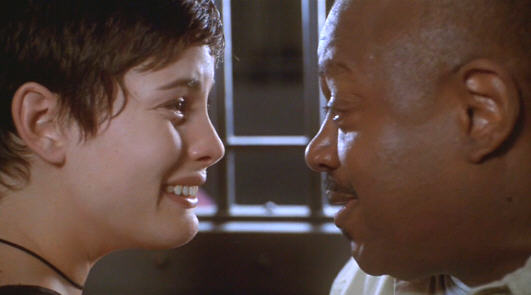
LIV TYLER and CHARLES S. DUTTON
This is an oddball, engaging story, and the outstanding cast lives up to expectations. I, for one, couldn’t get enough of Liv Tyler. This film is billed as a comedy, and it has plenty of comic moments. Still, portrayals of madness always give me a little chill, and Glenn Close — particularly in the last few moments — inspires a full-blown shudder.
Jane Russell: There’s more to the story
December 7, 2013

JANE RUSSELL
We saw the movie Philomena last night, and I was intrigued by the reference to Jane Russell. I think it’s well known by now that the movie deals with the practice of some convents and other institutions in Europe to force single young women to surrender their children for adoption and to require a large donation from American couples to take those children to the United States. The movie has to do with a particular instance in which a woman named Philomena Lee, whose child was taken from her in that manner, attempts decades later to find out what became of the boy.
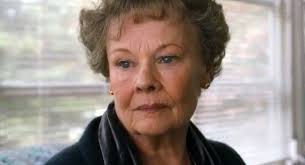
Dame JUDI DENCH
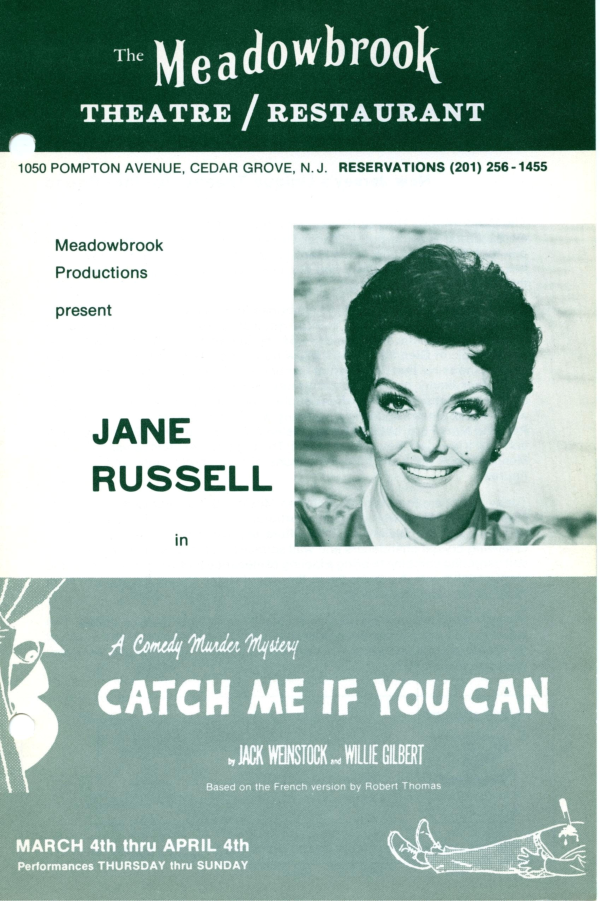
In the more or less true account, Dame Judi Dench plays Philomena, who — in the company of a freelance writer — visits the convent where she was left by her father after becoming pregnant at the age of 18. The reporter notices among the photographs hanging in the reception room at the convent an autographed, provocative photo of Jane Russell. He asks a nun about the photo, and the clear implication is that Jane Russell was among the wealthy Americans who “bought” a child at this convent. That caught my interest because I met Jane Russell in 1971 when she was appearing here in New Jersey in a production of Catch Me If You Can. In fact, I had coffee with her in Manhattan and one of the topics of our conversation was adoption.

JANE RUSSELL
Jane Russell told me that during her first marriage, which was to Hall of Fame quarterback Bob Waterfield, she visited orphanages and similar institutions in five countries in Europe and was frustrated to find that it was nearly impossible for an American couple to adopt the children who were languishing there. She eventually did adopt three children, but her experience in Europe also inspired her in 1952 to found the World Adoption International Fund which eventually facilitated tens of thousands of adoptions. She became an advocate for adoptive parents and children, testifying before Congress in 1953 in favor of the Federal Orphan Adoption Bill which allowed American parents to adopt children fathered by American troops overseas. And in 1980 she lobbied for the Adoption Assistance and Child Welfare Act which provides financial assistance based on the particular circumstances of foster and adoptive parents and adoptive children.
From what I have read so far, I deduce that Jane Russell did not adopt a child from the convent that is the focus of Philomena. I did read an account of an interview in which she told a reporter that after having failed to adopt a child in England, she was going to try her luck in Ireland. Whether any of her eventual adoptions amounted to “buying” babies, I cannot tell. I do notice that news stories that refer to her as one of the wealthy Americans alluded to in Philomena do not go on to report her work on behalf of adoptive parents and children.
Netflix Update No. 87: “Heartburn”
November 30, 2013
——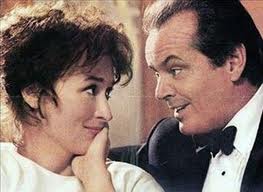
Having just watched an Angelica Huston movie, we felt that logic dictated that we watch a Jack Nicholson movie; the first one we were willing to subject ourselves to was Heartburn, a 1986 film directed by Mike Nichols and based on Nora Ephron’s fictionalized account of her ill-fated marriage to Washington Post reporter Carl Bernstein. Nicholson plays a D.C. journalist named Mark Forman and Meryl Streep plays a food writer named Rachel Samstat. These two meet at party, do the “why don’t we go somewhere else” routine, stretch “somewhere else” to mean Forman’s bed, and get married. Even if you didn’t know Ephron’s story, you’d know in the first few minutes of this film where the relationship is headed.

Mark seems to be an enthusiastic husband and, as nature takes its course, a doting father. The only stress on the marriage at first is the incompetence of the contractor the couple hired to renovate the wreck of a house they bought in D.C. But behind the scenes Mark is having friendly doings with an awkwardly tall Washington hostess, and this comes to light when Rachel is almost ready to give birth to their second child. Rachel reacts to the revelation by rushing back to her father’s home in New York, but she succumbs to Mark’s entreaty that she return to him. That turns out to be a bad decision. The messy outcome involves a key lime pie.

I don’t know how literally this story reflects what went on between Ephron and Bernstein (he had an affair with the wife of the British ambassador to the United States) but it doesn’t make clear what either of these characters really wants out of life. Rachel’s decision to marry Mark — after mutual acquaintances urge her not to, and after she holds up the ceremony for hours while she has a panic attack — is hard to absorb, and Mark’s passionate insistence on remaining in a marriage that clearly cramps his style is no more understandable. One conclusion I came to: It is possible to grow tired of Meryl Streep and Jack Nicholson within 108 minutes. It is.
By the way, Heartburn marked the film debut of Kevin Spacey, who plays an armed robber who relieves Rachel of her wedding ring. The cast also includes Maureen Stapleton, Richard Masur, Miloš Forman, and Stockard Channing.

KEVIN SPACEY
Netflix Update No. 86: “Agnes Browne”
November 30, 2013

ANJELICA HUSTON
I never thought of Tom Jones as a deus ex machina, but in the movies all things are possible. To wit, Agnes Browne, which was co-produced and directed by Angelica Huston, who, apparently to prove that she is no shrinking violet, also played the title role. This movie, filmed in Dublin and released in 1999, was based on the novel The Mammy by Brendan O’Carroll, who appears several times in the film as a derelict townsman.
At the beginning of the film, set in 1967, we learn that Agnes Browne’s husband has been killed in a motor vehicle accident, leaving her with seven children to raise. This is quite a challenge inasmuch as, unless she can collect on her husband’s union pension, her only means of support will be selling fruits and vegetables in an open-air market. She doesn’t even have enough to cover the costs of her husband’s funeral and burial, so she borrows money from neighborhood loan shark Mr. Billy, played by Ray Winstone. When, after a few months, a stroke of luck enables Agnes to pay off the balance of the loan and avoid the usurious interest, Mr. Billy is irritated and he finds a way to get even by strong-arming one of Agnes’s young sons.

ARNO CHEVRIER
On the block where the open-air market is located, a French baker named Pierre, played by Arno Chervrier, has opened a shop, and although he is very courteous, he doesn’t hide the fact that he has eyes for Agnes. Agnes is too preoccupied to respond at first, but eventually she agrees to what turns out to be a very elegant date. But Agnes gets most of her personal support during this period from her fellow street merchant Marion Monks (Marion O’Dwyer) who is full of joie de vivre and sexual insights. Marion is so solicitous of her friend that she manages to buy tickets to a Tom Jones concert that she knows Agnes yearns to attend. Tragedy will eventually deprive Agnes of Marion’s friendship, and it’s a loss that Agnes can scarcely afford.
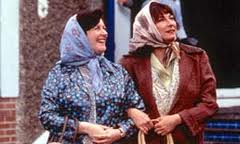
MARION O’DWYER and ANGELICA HUSTON
Because of the debt incurred by one of her sons, Agnes finds herself hours away from losing her furniture to Mr. Billy, although a viewer would hardly believe that such a blow will actually fall on this heroine.
This movie held our interest until the last few minutes despite the fact that we found the dialogue hard to follow in places because of the strong Irish accents and the tendency of some of the actors to mutter. We were absorbed mostly in the characters themselves and in the environment; the story line wasn’t very durable. It was difficult to follow Agnes’s reactions and motivations, beginning with her matter-of-fact response to her husband’s sudden death. But the real weak spot in this movie is the denouement, the resolution of the Mr. Billy crisis, which primarily involves the children, draws in Tom Jones — in person —under improbable circumstances, and is just childish in general.
This movie wasn’t received well in the United States, but it seems to have done much better in Europe.
Netflix Update No. 83: “Same Time, Next Year”
October 14, 2013

Although its premise and denouement seem cynical to me, I found Same Time, Next Year (1978) to be an engaging and entertaining film, and an especially apt showcase for the talents of Ellen Burstyn and Allen Alda. The romantic comedy is so apropos for Burstyn, in fact, that she starred on Broadway with Charles Grodin in the stage version in 1975 and won the Tony and Drama Desk awards for her performance.
The principal characters in this story are Doris and George, two married people who meet by chance in 1951 at an inn in California, wind up in bed together, and decide to repeat the encounter on the same weekend every year — and they do so for 26 years. Doris, who lives in the San Francisco area, is at the inn because she is supposed to attend a religious retreat nearby; George, who is from New Jersey, is an accountant in town to see a client. In the play by Bernard Slade, Doris and George are the only two characters; in the film, there are other actors, but their roles are only incidental. It’s not an easy thing for two actors to carry a film by themselves, but Burstyn and Alda succeed utterly.

At each meeting, they express and act on their passion for each other, but they also discuss their lives at home, what’s best and worst about their spouses, what’s going on with their children, of whom there are a total of six. Unlike the folks who usually turn up in this kind movie situation, neither Doris nor George claims to be in a failed marriage; in fact, both seem to genuinely like their partners. As the meetings go on — separated in this film by black-and-white images of the historical and cultural events that shaped life in those decades — Doris and George both evolve in their appearance, their mode of dress, and their outlook, and these changes don’t always blend harmoniously. But still they go on meeting, until tragic changes in George’s life force a decision — an “up or down vote,” to use the parlance of the Beltway — by both of them. As I suggested at the beginning of this post, I am repelled by the way this story line glibly accepts the deceit that was necessary for this relationship to continue. Still, I can’t help but applaud the skill with which both actors kept the story compelling and made the transitions in these characters believable.

 CharlesPaolino's Blog