“We lepers ….” — Fr. Damien du Veuster
October 8, 2009

DAMIEN DU VEUSTER
The following is a story I submitted to the English edition of L’Osservatore Romano concerning one of the heroes of the 19th century.
A Belgian man who spent his adult life in the South Pacific and is memorialized in the U.S. Capitol will be declared a saint on Oct. 11.
He is Damien de Veuster, a sometimes controversial 19th century figure, who sacrificed his life to minister to lepers on the Hawaiian island of Molokai.
In addition to Father Damien, Pope Benedict XVI will canonize Archbishop Zygmunt Szcesny Felinski, founder of Russian Catholicism; Father Francisco Coll y Guitart, founder of the Congregation of the Dominican Sisters of the Annunciation of the Blessed Virgin Mary; Rafael Arnáiz Barón, a contemplative Trappist monk from Spain; and Jean Jugan, a French woman who founded the Little Sisters of the Poor.
Father Damien was born Jozef de Veuster in the Flemish village of Tremelo on Jan. 3, 1840, one of seven children of a corn merchant.
Still a teenager, Josef , following the example of his brother Auguste, joined the novitiate of the Congregation of the Sacred Hearts of Jesus and Mary in Leuven. In 1860, he became a brother, taking the name Damien.

FATHER DAMIEN
He aspired to be a missionary, and his opportunity came unexpectedly. Auguste – who had taken the religious name Pamphile – was prevented by illness from traveling to Hawaii, and Damien went in his place.
He was ordained a priest in Honolulu in 1864 and was assigned to the Catholic parish in North Kohala.
Hawaii was then beset by infections, including influenza and syphilis, introduced by travelers and seamen. The most problematic ailment, first reported in 1840, was Hansen’s Disease – leprosy – both because it was highly contagious until a treatment was developed in the 1930s, and because most people contracting it in the 19th century were assured a progressive, disfiguring degeneration of their skin, eyes, and limbs.
To prevent the disease from spreading, Hawaiian authorities in 1866 consigned lepers to an inaccessible colony at Kalaupapa on the island of Molokai. The place was bordered on three sides by the Pacific Ocean and was isolated from the rest of the island by 1600-foot cliffs.
Whatever resources the government provided for the lepers were insufficient. Once they were out of sight and no longer a hazard or an offense to the general population, the residents of the colony declined into a dysfunctional community marked by poverty, alcohol abuse, violence, and sexual license.

FATHER DAMIEN
There the matter restedwhen, in 1873, Father Damien, after overhearing a conversation about the lepers, asked Louis Maigret, the first apostolic vicar in what was then the Sandwich Islands, for permission to go to Molokai.
Bishop Maigret not only granted permission, but he accompanied Father Damien to Kalauapa where – knowing what was at stake – he introduced the priest to the community of 816 souls as “one who will be a father to you and who loves you so much that he does not hesitate to become one of you, to live and die with you.’’
Nor did Father Damien have any illusions about what his decision meant. Not long after arriving in Kalaupapa, he wrote to his brother and colleague: “I make myself a leper with the lepers to gain all to Jesus Christ.”
His ministry, however, was not confined to liturgy, sacraments, and religious instruction.
He restored civility – forcefully when necessary – built and repaired housing for the lepers – lending his own carpentry skills to the labor of colonists still able to work, improved agriculture, organized schools, treated the sick with his own hands, built coffins and dug graves.

THE YOUNG PRIEST
At first he found conditions almost overwhelming.
“Many a time,” he wrote, “in fulfilling my priestly duties at the lepers’ homes, I have been obliged, not only to close my nostrils, but to remain outside to breathe fresh air. To counteract the bad smell, I got myself accustomed to the use of tobacco.’’
In time, however, he put delicacy and caution aside and ministered directly to people bearing the most grotesque badges of the cruel disease.
He was criticized at times for being demanding and headstrong, particularly when he was soliciting assistance for his lepers.
Joseph Dutton, a American Civil War veteran from Stowe, Vermont, verified this characterization – with an explanation.
Dutton – who joined Damien in 1886 and remained at the colony for more than 40 years, described the priest as “vehement and excitable in regard to matters that did not seem to him right, and he sometimes said and did things that he afterwards regretted … but he had a true desire to do right, to bring about what he thought best. ….”
After a decade of this work, in December 1884, Father Damien realized that he had contracted leprosy.
“Its marks,’’ he wrote to his bishop, “are seen on my left cheek and ear, and my eyebrows begin to fall. I shall soon be completely disfigured. I have no doubt whatever of the nature of my illness, but. I am calm and resigned and very happy in the midst of my people. The good God knows what is best for my sanctification. I daily repeat from my heart, Thy will be done.”
Still, he labored on, often with help that in his later years included Father Louis Conrardy, a Belgian priest, who attended to the colony’s pastoral needs; Mother Marianne Cope, superior of the Franciscan Sisters of Syracuse, who organized a hospital, and James Sinnett, a nurse from Chicago who would eventually have Father Damien as one of his patients.
Father Damien, 49, died on April 15, 1889, and was buried beneath the pandanus tree that had provided his only shelter when he arrived in the colony.

MOTHER MARIANNE COPE
Mother Marianne carried on Father Damien’s work, remaining in Kalaupapa, without ever contracting leprosy, until her death in 1918 at the age of 80. She was beatified by Pope Benedict XVI in 2005.
In 1935, Father Damien’s remains were transferred to Belgium on a U.S. Navy ship. King Leopold III joined about 100,000 people in receiving the body at Antwerp.
Father Damien, widely known during his lifetime, has been memorialized in many places, including a bronze statue, donated by the State of Hawaii, in the national statuary collection in the U.S. Capitol building; a statue at the Hawaiian state capitol in Honolulu, and several clinics devoted to the treatment of HIV/AIDS patients.
And yet, a month after Damien died, Charles M. Hyde, a Presbyterian minister in Honolulu, wrote a private letter, published without his permission, challenging the positive image of Damien, who had received substantial financial support from Protestant groups. Hyde – who once had publicly praised Damien – now dismissed him as “a coarse, dirty man, headstrong and bigoted,” and accused him of violating his vow of chastity.
Hyde’s letter provoked a furious response from an unexpected source – Robert Louis Stevenson, author of “Treasure Island” and “The Strange Case of Dr. Jekyll and Mr. Hyde” and himself a Presbyterian.
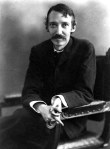
ROBERT LOUIS STEVENSON
Stevenson was living in Samoa for health reasons when he read Hyde’s letter. Stevenson had been friendly with Hyde, but had never met Damien.
But although he was susceptible to infections, he had traveled to the leper community after Damien’s death and remained there for eight days, asking questions about the priest’s ministry.
Based on what he had learned, Stevenson published a very long letter reprimanding Hyde. Stevenson conceded that Damien may have been “dirty,’’ “unwise,” and “tricky,” but added that the priest was also “ superb with generosity, residual candour, and fundamental good humour. … A man with all the grime and paltriness of mankind, but a saint and hero all the more for that.”
“Think of the poor lepers annoyed with this dirty comrade,’’ he wrote to the minister. “But the clean Dr. Hyde was at his food in a fine house. … (Y)ou, who were so refined, why were you not there, to cheer them up with the lights of culture?”
Stevenson – who later regretted the harshness but not the content of his response – predicted that in a hundred years Father Damien would be proclaimed a saint.
He was correct about Father Damien if not about the time frame. In April 2008, the Holy See formally acknowledged two miracles attributed to Father Damien’s intercession. In June of that year the Congregation on the Causes of Saints recommended that the church acknowledge the sanctity of the priest who, by choosing to minister to lepers, Stevenson wrote, “shut to with his own hand the door to his own sepulcher.”

STATUE OF FATHER DAMIEN IN HONOLULU
“There is only one pure state of acting … that you don’t know what you’re going to say.” — Shirley Knight
October 6, 2009

This story is based on an interview I had with Shirley Knight for the Home News Tribune and the Asbury Park Press.
NEW BRUNSWICK: Shirley Knight is in the cast of Arthur Laurents’ new play, but she will not give a single performance.
The actress — a Tony and Emmy winner and an Oscar nominee — will appear at George Street Playhouse in Laurents’ drama “Come Back, Come Back, Wherever You Are.”
She will create the role of Marion, a psychological therapist who — along with the other four characters in the play — is trying to cope with the implications of the death of her charismatic son, Paolo.
The others are Sara, a professional singer — played by Alison Fraser — who was married to Paolo for 27 years; Richard — played by John Carter — who was Paolo’s father; Michelle — played by Leslie Lyles — Paolo’s disaffected sister; and Dougal — played by Jim Bracchitta — who competes with Paolo’s lingering influence as he courts Sara.
Laurents, 92, who will direct this production, has woven into the play both the kind of introspective and unblinking discourse that has characterized most of his works and an underlying conviction that love is the most important factor in a human life.

ARTHUR LAURENTS
The playwright, who has recently directed the Broadway revival of “West Side Story,” for which he wrote the book, has introduced several plays and dozens of new characters on the George Street stage.
As Shirley Knight gives life to one of his newest characters, she said, she will approach the opportunity with a mindset that is necessary if Marion is to be spontaneous and, therefore, credible.
“I never give a performance,” the 73-year-old actress said. “Each night, I have another rehearsal. And that is essential because if you just do a rerun of what you did the night before or the week before or on opening night, it would be unbelievably boring.”
When she appears onstage at any time during the run of this play, Knight said, she won’t be acting Marion so much as she will be Marion. And that will mean that she won’t anticipate what will occur, no matter how many times she has heard it.

SHIRLEY KNIGHT IN 1966 ROLE
“There really is only one pure state of acting,” she said, “and that’s that you don’t know what you’re going to say, you don’t know what you’re going to do. You don’t know what the other person is going to say or do. You don’t know where the play is going. You have to do a play as if you haven’t read the play.
“Now, of course, you have read the play — but you cannot be in that state of knowing. You have to be in the state of going absolutely from moment to moment.”
The actress has honed this approach in 35 stage plays over the past five decades. She has also appeared in 49 films, 162 television productions, and a dozen radio dramas.
While she was engaged in this busy career, Knight — who holds a doctorate in fine arts — also managed to have a family life. Her husband, John R. Hopkins, was a prominent film and television writer. She has two daughters — actress-singer Kaitlin and TV-stage writer Sophie.

KAITLIN HOPKINS
“Kaitlin at the moment is doing something different,” Knight said. “She just finished a year’s tour of “Dirty Dancing,’ and she has taken over the theater department at Texas State University. My youngest daughter (Sophie) is writing plays and teaching school in Los Angeles. She has her master’s from Columbia in English and fiction writing, and now she wants to teach.”
From her own prolific and varied career, Knight can mention several high points, though she seems to have a special place in her heart and memory for “Dutchman,” a 1967 film she produced, an adaption of a play by Amiri Baraka about the explosive relationship between a coarse, racially biased young white woman and a mild black man.
The play won Knight the Volpi Cup as best actress at that year’s Venice Film Festival, and “Dutchman” was named best film of the year at Cannes.
“We shot it in five days,” she recalled. “It was on a shoestring. In the year 2000 when the Whitney Museum did “Great Art of the 20th Century,’ the only film they showed about civil rights was “Dutchman.’ That made me very happy.”

PORTRAIT OF SHIRLEY KNIGHT BY JASON TOWLEN OF GANNETT NEW JERSEY
Netflix Update No. 20: “One, Two, Three.”
October 4, 2009

JAMES CAGNEY
Once in a while I put a movie on my Netflix list, and by the time its number comes up I can’t remember why I picked it. That’s what happened with the 1961 movie we watched tonight — a Cold War farce co-written and directed by Billy Wilder. After we watched it, I still couldn’t remember why I picked it.
This film in black and white stars James Cagney, Arlene Francis, Pamela Tiffin, and Horst Bucholz. Although it is full of references to America-Soviet issues of the late ’50s and early ’60s, it was based on a play by the Hungarian dramatist Ferenc Molnar, who died in 1952.
The film concerns C.J. McNamara (Cagney), who heads Coca-Cola’s operations in West Berlin, but yearns to be named head of the company’s European operations, based in London. McNamara’s wife, Phyllis (Francis), is weary of life in foreign cities — and C.J.’s philandering — and pressures him to take her and the two McNamara kinder back to the United States.
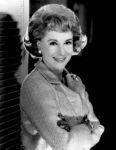
ARLENE FRANCIS
C.J.’s life becomes further complicated when his boss in Atlanta dispatches his daughter to Europe to get her away from her latest boyfriend and asks C.J. to take charge of the girl while she’s in Berlin. Scarlett (Tiffin) turns out to be more than the McNamaras can handle, and she meets, mates, and marries Otto Piffl (Bucholz), a fiery East German Communist. C.J. has to keep Otto and the pregnant Scarlett at bay while he figures out how to make the match palatable to the girl’s parents — who set off on a trip to Germany.
However well this film may have worked in 1961, it hits the wall with a thud in 2009. It is riddled with what are now stale allusions to the Soviet Union under Nikita Krushchev as well as a steady diet of really bad jokes. In addition, the movie is a school of overacting. Wilder directs it as though directing the Marx Brothers, but Chico and Harpo are nowhere to be seen, and the actors who are in sight don’t have the chops to make this kind of comedy work. Everyone in the film, except Arlene Francis, seems to have been told that farce is measured by how loudly and how rapidly an actor can speak and how fast they can rush from room to room. Cagney — in his last starring role — opens the film speaking as though he is auctioning tobacco, and he doesn’t let up for an hour and fifty minutes.

PAMELA TIFFIN and HORST BUCHOLZ
Tiffin and Bucholz and a bunch of supporting players do their best to keep up with Cagney’s pitch and pace, and the result is an exhausting experience with too few rewards to make it worthwhile. In one scene there is an attempt at humor in which Cagney threatens Bucholz with half a grapefruit — a pathetically obvious reference to the scene 30 years before in which he pushed a grapefruit into Mae Clarke’s face in “Public Enemy.” It was almost as though Wilder were saying, “You should be laughing at this, folks; after all, this is James Cagney.”
The high points in this train wreck are a scene in which the uncredited Red Buttons, playing an Army MP, does a fleeting imitation of Cagney for C.J.’s benefit, and the closing title in which C.J. is chagrined to get a bottle of Pepsi out of a Coke vending machine. There is also some fascination in watching Cagney and Bucholz work together inasmuch as it is well documented that they hated each other and made no secret of it on the set.
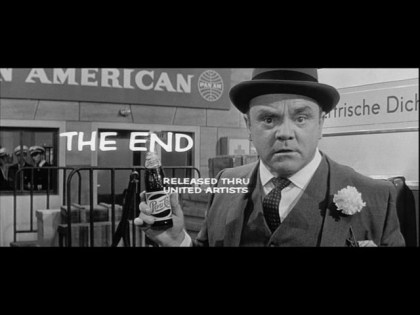
JAMES CAGNEY in the closing frame of "One, Two, Three."
“Una programma granda”
October 3, 2009

FLAVIO INSINNA

FLAVIO INSINNA AT WORK

SAMMY FAIN
We were having our evening tea with Gustav Mahler’s Symphony No. 3 playing in the background when Pat said to me, “What is this song?” I listened for a couple of seconds and said, “That’s ‘I’ll Be Seeing You,’ ” but as the music continued we realized that wasn’t correct. We had forgotten what we were listening to. Still, the theme was repeated a little later, and damned if that wasn’t “I’ll Be Seeing You.”
That happens to be one of my favorite songs. It was written in 1938 for a Broadway turkey called “Right This Way” – lyrics by Irving Kahal, music by Sammy Fain. The combination of the melody and the words is powerful, and the song had a particular resonance during World War II, when so many Americans were separated from loved ones fighting in Europe, Africa, or the Pacific.
 The song was resurrected as the main theme of a 1944 movie by the same name, starring Joseph Cotten and Ginger Rogers. Bing Crosby recorded it that same year, and the recording made it to the top of the charts.
But what of Gustav Mahler? It turns out that a British musicologist named Deryck Cooke, who was something of an authority on the Austrian composer, pointed out almost 40 years ago that the first four lines of Fain’s tune very closely resemble a repeated passage in Mahler’s Third.
We don’t miss much.
Mr. Fain — if you please — one more time:
I’ll be seeing you
In all the old familiar places
That this heart of mine embraces
All day through.
In that small cafe;
The park across the way;
The children’s carousel;
The chestnut trees;
The wishin’ well.
I’ll be seeing you
In every lovely summer’s day;
In every thing that’s light and gay.
I’ll always think of you that way.
I’ll find you
In the morning sun
And when the night is new.
I’ll be looking at the moon,
But I’ll be seeing you.
“It seems we’ve made a little faux pas” — Oliver Norville Hardy
September 29, 2009

GROUCHO MARX
Groucho Marx once attended an international film festival in Mexico City. One evening during the gathering, Groucho and a group of colleagues were informed by a government representative that they had been invited to meet the president of Mexico at 10 the following morning. Groucho raised his hand. “Yes, Mr. Marx?” “What assurance do we have that he will still be president at 10 o’clock tomorrow?”
This rude reflection on Mexico’s political history, coming from a professional wise-ass, did nothing to ingratiate the Marx Brothers to Mexico. It did not, however, prompt an orgy of self-hatred in which Americans wondered aloud if they had become a bit too boorish — “ugly” in the social sense of the word.
The Christian Science Monitor looked into a similar question regarding the recent peccadilloes on the part of Venus Williams, Kanye West, and Sen. Joe Williams. Can it be, the Monitor wonders, that in the age of social networking we have become social anarchists? Not to worry. The conclusion seems to be that there is nothing new about American bulls in the china shop of manners.

PRESTON BROOKS
The Monitor took the occasion to call attention to U.S. Rep. Preston Brooks who, as fate would have it, was from South Carolina. Brooks took umbrage at denigrating remarks about the institution of slavery, remarks that came from U.S. Sen. Charles Sumner of Massachusetts. Sumner was a leading advocate for abolition, and a progressive guy in general, as such things were measured before the Civil War. He was kind of a stiff. He once said that he would never assume a posture, even in the privacy of his own rooms, that he would not assume in the Senate of the United States. It makes one wonder how Sumner took care of certain, umm, personal necessities and intimate pleasures. Anyway, Brooks approached Sumner in the Senate and explained his objections by beating Sumner senseless with a cane. Joe Williams’ bad taste has earned him a million in political donations. Brooks’ fans sent him canes to replace the one he had shattered on Sumner’s head.

CHARLES SUMNER
With almost 300 million people in the country, it’s amusing to see how the news media try to find trends in incidents that involved one screwball, one red neck, and one short-tempered athlete. The Monitor found a couple of etiquette experts who agreed that the whole Shooting Match is going to the bow-wows, but there were also voices with a longer perspective. Public discourse in the 21st century is tame compared to the rough-and-tumble of the 17th and 18th. For one thing, we no longer answer insults with duels, as I was telling Mr. Hamilton just the other day.
The Monitor story is at the following link:
http://www.csmonitor.com/2009/0928/p23s01-ussc.html
“I’m little, but I’m loud” — Little Jimmy Dickens
September 27, 2009

ED GAEDEL
I once overheard an acquaintance of mine, who was 15 years old at the time, making a self-denigrating comment about her height. I told her, “If anyone had asked me to describe you, I might have said you were about five feet tall, but it would not have occurred to me to say that you were ‘short.’ You’re probably more self-conscious about your height than other people are conscious of it.” I said that from my vantage point a full foot above hers, but I’m sure the reality is that each person has his own standard – probably related to his own stature – for what height requires the adjective “short.”
Anyway, that conversation took place about three years ago, and it came to mind today when I saw a presentation on the Los Angeles Times web site regarding short people. It didn’t amount to much. It was the sort of thing newspaper companies put on their web sites in order to demonstrate something that itself has not yet been defined.

'LITTLE' JIMMY DICKENS
The Times said the feature had been inspired by an article in Pediatrics, a medical journal, about a study of the effect of short stature on emotional, behavioral, and social functioning. The Times explained, somewhat imprecisely: “This recent study from the journal Pediatrics, suggesting shorter 6th graders are not victimized any more than the average student, got us thinking: Aren’t lots of famous people really short?” This brief introduction was followed by photos of eight people whom the Times delicately described as “vertically challenged”: Voltaire, Charlotte Bronte, Edith Piaf, Andrew Carnegie, Henri de Toulouse-Lautrec, Pat Benatar, Wallace Shawn, and Gloria Swanson. The least tall of these was Edith Piaf at four-foot-eight; the tallest was Voltaire at five-foot-three. This information came a web site called Short Persons Support (www.shortsupport.org) which includes a list of 371 people ranging in height from Gul Mohammed at one-foot-ten and a half inches to nine persons (including Dustin Hoffman, T.E. Lawrence, and Horatio Nelson) at five-foot-five and a half inches.

ALBIE PEARSON
I was surprised that I didn’t find on that list five-foot-five Albie Pearson, an outfielder who batted .270 in a nine-year major league career and went on to have a very active life in Christian ministry.
Nor did I see another major leaguer — three-foot-seven Eddie Gaedel, who walked on four pitches in his only time at bat — a promotional stunt engineered by Bill Veeck, then the owner of the St. Louis Browns.
And I missed four-foot-eleven “Little” Jimmy Dickens, an iconic figure in country music when it really was country music. I’ll let Jimmy sing us out with one of his own compositions, particularly appropriate to the topic:
A lot of folks have told me
I was pulled ‘fore I was ripe
A winter apple picked off in the fall
But even as a youngin’
I was not the bashful type
‘Cause I could yell the loudest of them all.
CHORUS
I’m little, but I’m loud
I’m poor, but I’m proud
I’m countrified and I don’t care who knows it
I’m like a banty rooster
In a big, red rooster crowd
I’m puny, short and little, but I’m loud.
“The wish for healing has always been the half of health.” — Hippolytus
September 25, 2009

MAURA TIERNEY
In catching up on the news today, I learned — a few days after everyone else, it seems — that Maura Tierney has withdrawn from NBC’s projected new series “Parenthood.” The speculation is that Helen Hunt, another wonderful actress, will replace her.
NBC had postponed the debut of the series when Tierney was diagnosed with cancer. She has already had surgery, but has put aside the series in order to accommodate her further treatment.
Like everyone else, I hope she fully recovers. I almost feel selfish in my disappointment that she won’t be on a series this season. I had reserved “Parenthood” for the only series I’d watch, and that was only because Maura Tierney was in it.
While I’m thinking of myself, I’m also looking forward to her resuming her career, because I hope she does a lot more on the stage. We got a chance to see her in her two off-Broadway projects, and found her to be a natural in the theater. That magnetism that works so well for her on television is even more potent in the intimacy of an off-Broadway house.
May God bless her and make her well.
Netflix Update No.19:”Sweet Bird of Youth”
September 25, 2009

PAUL NEWMAN
Prompted by Shirley Knight’s impending appearance at the George Street Playhouse, we watched “Sweet Bird of Youth,” the 1962 film adaptation of Tennessee Williams’ 1959 Broadway play. I have never seen the play on stage, and I have read that the tale lost some of its edge with the modifications that had to be made to satisfy the sensibilities of the early ’60s. By today’s standards it’s tame, but it dealt with some tough subject matter for the Eisenhower era.
This film has one of those casts that dazzles the mind: Paul Newman, Geraldine Page, Rip Torn, and the wonderful Canadian actress and even more wonderful human being, Madeleine Sherwood, recreated their Broadway roles, and they were joined by the redoubtable Ed Begley Sr. Geraldine Page and Rip Torn both were nominated for Tony awards for their work in the play. Begley won an Oscar and Page and Knight were nominated for the film.

GERALDINE PAGE
Newman plays Chance Wayne, who returns from Hollywood to his hometown in Florida, almost literally dragging along with him a legendary movie star, Alexandra Del Lago (Page), who has sunk into a drug-and-alcohol-induced stupor after what she perceives as the failure of her latest film. On the surface, Chance Wayne is her driver and spear carrier. In reality, he is exploiting her — in every possible way — in the hope that she will give him what has been an elusive “big break” in the movies.
Alexandra travels to Florida with Chance because she has gone underground to avoid the fallout from what she has adjudged a box-office flop. Chance has another goal — to reunite with Heavenly Finley, the love of his life whose father, Tom “Boss” Finley (Begley), is a moralizing, corrupt, and ruthless political kingpin who doesn’t want Chance near his daughter.
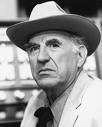
ED BEGLEY Sr.
Finley’s son, Tom Jr., who doesn’t have his father’s cunning but outdoes him in brutality, is played by Rip Torn.
This film, which in 1961 was off limits to audiences under 18, may have been sanded down from Williams’ original version, but it far outstrips the embarrassing 1989 television remake with Elizabeth Taylor and Mark Harmon as Alexandra and Chance and Rip Torn as “Boss” Finley. Even though its techniques are dated, the movie can play with your emotions as you try to sort out your feelings about the actress and her gigolo — both of whom are infuriating yet sympathetic — and frazzle your nerves as Chance keeps antagonizing the volatile and dangerous “Boss.” The players in this film aren’t stars first and foremost; they’re actors, doing their work as well as it can be done.
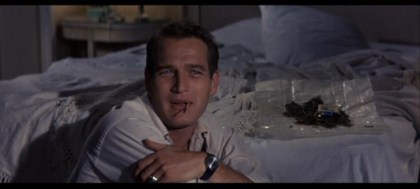
PAUL NEWMAN in a scene from "Sweet Bird of Youth."
“You’re sugar, you’re spice . . . .” — Bobby Burke
September 24, 2009

MACKENZIE PHILLIPS
About 28 or 29 years ago, I went up to what was then Fair Oaks Hospital to visit Mackenzie Phillips when she and her father, John Phillips, and his wife, Genevieve Waite, had completed a chemical therapy program to wean them off of illegal drugs. She looked healthy; she was upbeat. She was frank about the fact that she had grown up in an environment riddled with narcotics, and she talked in some detail about the condition her dad was in before the two of them checked in at Fair Oaks. I asked her if she knew why someone like her, who knew intellectually and had seen in the the flesh the consequences of drug abuse would take a chance on addiction herself. She said she didn’t know, and I believe her; plenty of people who didn’t spend their time with John Phillips, and who knew where drugs could lead them, are unable to answer the same question.

JOHN PHILLIPS
About 20 years ago, we bumped into Mackenzie at the Fairmount Hotel in San Francisco. The intervening years had included relapse and recovery, and she was at the hotel appearing with “The Mamas and the Papas” which her dad had reconstituted with Mackenzie and Elaine “Spanky” McFarlane singing the parts originally assigned to Michelle Phillips and Mama Cass Elliot. Again, Mackenzie looked terrific and had a positive outlook that wasn’t dimmed any by the new baby she was doting over at the time. We went to see the act and thought it was sufficiently evocative of the original to have a future.
Since then, I have talked to Mackenzie on the telephone a couple of times. Always I seemed to find her with her star a-rising and always I have hoped, for her, that it would last.
I have made a point of hearing as little as possible about the news Mackenzie is making this week. I’m a sap. I choose to hope, and pray, that this episode is something she needs to kick the demons away for good.
 CharlesPaolino's Blog