“Peek-a-boo! I see you!”
February 13, 2010

animal.discover
I have become a voyeur.
Many men reach this stage at a younger and more virile age, but I was waiting for better technology. It has come with the marriage of the Internet and the live streaming web camera. Here’s fair warning: You can run, but you can’t hide.
I’m developing an addiction for the streaming web cam. I’ve spent far too much time searching for the better and better live images from all over the world. I don’t know what the attraction is; television has been broadcasting live images from around the planet for more than 50 years. But on television, we get what we are given. On the Internet, we increasingly are gaining the power to peek in wherever we choose, usually without the knowledge — and I guess this is the key — of those we are watching. We can watch them in real time, and they don’t know we’re here.

TIMES SQUARE
One of the most attractive scenes, of course is Times Square, which is alive at any hour of the day or night. The camera is mounted high above Broadway across the street from the Marriott Marquis. The sound feed is dominated by traffic noise frequently including screaming sirens, but the mike also picks up the voices of the stream of humanity that is always passing by the camera.
The TimesSquare Cam provides a larger image than many webcam sites do, so there are more details to examine. You can look in on Times Square at THIS LINK.
Some of the live images available don’t hold my attention for very long. Earthcam.com, for example, has a feed from a live camera in Ho Chi Minh City, but it’s a long shot of a skyline and traffic moving on a highway – there are no people visible.

St. PETER'S
Hotels around the world have taken to using live webcams to pump up their web sites. The Atlante Star in Rome is one of them; its camera shows about a half-dozen live images of scenes that can be seen from the hotel, including the dome of St. Peter’s Basilica in the Vatican and the traffic and pedestrians moving along the Via Vitelleschi far below the lens. This site, which is more interesting when it’s daylight in Rome, is located HERE.
I have also been misspending my declining years by watching two sea otters, Milo and Tanu, who live in the Vancouver Aquarium. Milo, the male, was born in an aquarium in Lisbon, Portugal, and Tanu, a female, was born in the wild, so to speak, in the ocean off Alaska. I spy on these otters at THIS LINK, which has a camera trained on their pool.

Sea otter at the Vancouver Aquarium
This site requires a little patience, because the otters are not always in camera range. When they are, though, they are very lively. The site includes interesting explanations of the behavior the otters exhibit onthe screen, which is a small image but has decent resolution.
I have found the streaming to be a little cranky on this site, and I have to frequently refresh the page to restart the video.
My favorite site for now is linked to a live camera mounted in a public square in Bydgoszczy, Poland, a city of about a third of a million people located up there just south of Gdansk. This camera pans the square, which includes rows of businesses and an outdoor ice skating rink.

BYDGOSZCZY
This site — CLICK HERE — has become an addiction for me. I find the square itself and the activity within it attractive and absorbing. I watch the passers-by and speculate about who they are and where they are going. I marvel at the strollers who criss-cross the square regardless of the time. As I am writing this, it is 3 am in Poland, and there are people walking through that area and skating on that rink.
Another animal I visit on line is Lily, a black bear who at present is hibernating in her den in the North American Bear Center in Ely, Minnesota. Lily caused a flurry on the Web a few weeks ago when she gave birth a cub — an event that was caught on the camera that is trained on her lair. Lily has since gone back to sleep. You can see her live — sort of — at THIS LINK. I check on her now and then to make sure she’s still breathing. Of course, it’s like watching paint dry, or grass grow, or metal rust, or …. well, like watching a bear sleep.

JERRY SEINFELD
Many years ago, I wrote a story about a group of college students who were fans of the “Honeymooners” television series. These students hadn’t been born in the 1950s when the show had its initial run, but they couldn’t get enough of it. Although I do the same thing with “The Honeymooners” and some other vintage shows, I asked them why they watched the episodes so often that they could recite most of the dialog, and they told me that the way the writers and actors used language was one of the things that fascinated them.
Fast forward to “Seinfeld,” which still holds my interest partly because of the way the writers and actors used language — for instance, a particular device, very New York to my ear, used to evoke comparisons. This phraseology was used seven times in the series — five times by Jerry speaking to George or Elaine, once by Helen Seinfeld speaking to Jerry, her son, and once by George, speaking to Elaine.

LIZ SHERIDAN
The one instance in which Jerry wasn’t the speaker occurred in the series premiere, “The Stakeout,” in which Jerry tries to flirt with a woman he meets at a dinner party, annoying Elaine, who is, in effect, his date at the party. The next day, when Jerry’s visiting mother tells Jerry that Elaine called while he was out, he asks, “What was the tone of her voice? How did she sound?” To which Helen replies: “Who am I — Rich Little?”
In the episode known as “The Jacket,” Jerry makes a reference to composer Robert Schumann, but mispronounces the name, putting the accent on the first syllable. George says, “Artie Schumann, from Camp Hatchapee?” To which Jerry answers, “No, you idiot!” And George says, “Who are you — Bud Abbott? Why are you calling me an idiot?”

DIANA ROSS
In “The Trip,” in which Jerry invites George to accompany him on a trip to Los Angeles, George arrives at Jerry’s apartment with a big pile of luggage. Jerry looks at the bags and says: “It’s a three-day trip. Who are you — Diana Ross?”
In “The Revenge,” George plans to get back at the boss who fired him from a real estate firm by slipping the boss a “mickey” at the firm’s anniversary party. When George reveals this plan, the incredulous Jerry says: “Who are you — Peter Lorre?”
In “The Wink,” Elaine tells Jerry that she has agreed to go on a date with the man who calls from her wake-up service. Jerry says: “I still can’t believe you’re going out on a blind date.” Elaine answers: “I’m not worried. It sounds like he’s really good-looking.” To which Jerry answers: “You’re going by sound? What are we — whales?”

JASON ALEXANDER
And in “The Limo,” Jerry and George find themselves in a limousine with two neo-Nazis who think George is their leader. George suggests that they extricate themselves by jumping out of the moving car. “We’re doing sixty miles an hour!” Jerry says. “So we jump and roll,” George explains. “You won’t get hurt.” And Jerry replies: “Who are you — Mannix?”

GINA HECHT
Finally, in the episode in which NBC president Russell Dalrymple gets food poisoning after Elaine sneezes on his pasta primavera, George has a tumultuous session with his counselor, Dana, played by Gina Hecht. During the session, Dana tells George that she read the script for a sit-com pilot Jerry and George have pitched to NBC, and she was not impressed. When George repeats this to his friends, Elaine — who recommended Dana — says, “Maybe she didn’t think it was funny,” to which George replies, “Oh, she didn’t think it was funny? What is she – Rowan and Martin?”
Who are you? Who am I? A very “exerstential” question, as Elaine Benes observed.
For a list of actual people referred to in “Seinfeld” scripts, click on THIS LINK.
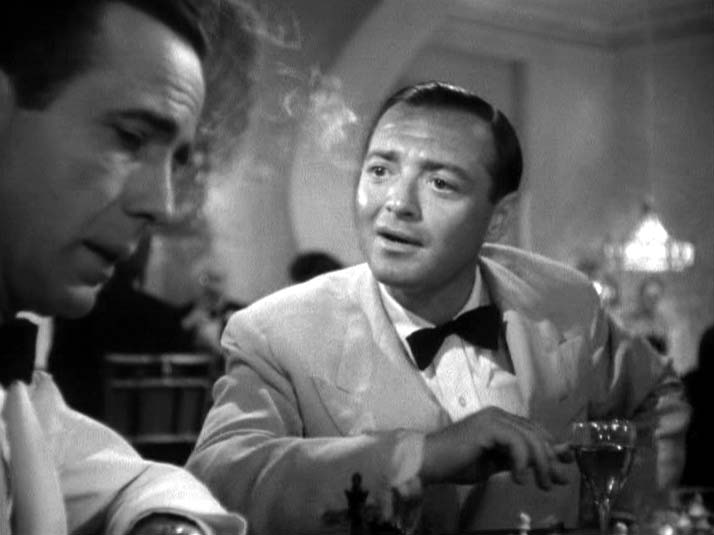
Humphrey Bogart and Peter Lorre in "Casablanca."



Netflix Update No. 28: “The Island on Bird Street”
February 1, 2010

JORDAN KIZIUK
We watched a 1997 Danish film, “The Island on Bird Street,” which tells of an 11-year-old boy’s attempt to survive while the Nazis are emptying out a Jewish ghetto in Poland and sending its inhabitants to the death camps.
This film is based on what I have seen described as a “semi-autobiographical” novel by Israeli writer Uri Orlev, a Holocaust survivor who has specialized in children’s literature. Although the violence in this film is understated compared to many films about Nazi brutality, it’s not a film for young children. Teenagers wouldn’t flinch.
The story line is that the boy, Alex (Jordan Kiziuk), his father, Stefan (Patrick Bergin) and uncle Baroch (Jack Warden), are among the Polish Jews who are confined to a neighborhood fenced off by the Nazis — much like the Warsaw Ghetto where Orlev was confined as a child. When Stefan and Baroch are swept up in one of the Nazis’ “selections” for transport to a concentration camp, they conspire to let Alex escape the transport. Before the boy runs off, Stefan promises that he will return to the ghetto, and the boy takes that promise seriously.

JACK WARDEN
Alex — who reads “Robinson Crusoe” and plays with his white mouse, Snow — manages through a combination of guile and luck to avoid detection while he dodges the German troops who are gradually emptying the ghetto. The boy encounters some other stragglers, including a few men who are involved in the Polish underground. He eventually begins to slip out of the ghetto into the city at large, but always returns to wait for his father.
Jordan Kiziuk, a British actor who won an Emmy in 1999, delivers a convincing performance as Alex. Most of the film is quite tense as Alex has one close call after another, and Kiziuk has a lot of the burden of sustaining it. In fact, he’s at the center of the drama to such a degree that the other players are largely accessories.
As credible as Kiziuk is in his role, the story itself strains credulity, especially given the persistence of the Nazis in tracking down every straggler in the ghetto. There is also a contradiction in his sometimes elaborate ingenuity and his naive faith that his father will somehow survive the brutality the boy has witnessed again and again. The film ends with Alex still in the ghetto, and a title reports simply that he “survived the war.” In actual fact, Orlev was eventually caught by the Nazis after he was left behind in the ghetto and was sent to the Bergen-Belsen concentration camp where he remained until it was liberated.

PATRICK BERGIN
This film is visually very dramatic. The location in Poland presents a bleak image of the ghetto that provides an effective setting for the Nazis’ disregard for human dignity, never mind human life. The direction and photography contributed to the considerable attention and critical approval the film received when it was released.
“The dreams that we cherish so often might perish” — Einar Swan
January 30, 2010
 I was listening to Jonathan Schwartz on WNYC a week ago today, and he played a recording by Frank Sinatra of one of my favorite songs from the 1930s — “When Your Lover Has Gone.” Schwartz is such an aficionado of recorded popular songs that he often dwells on minor points about such things as the arrangement or the instrumentation or even — as he did in one case that day — on the matter of which cut on a vinyl disk a song might have occupied.
I was surprised, then, that he didn’t discuss the fact that Sinatra didn’t sing my preferred introduction to Einar Swan’s song — which, by the way, was written in 1931 and featured in the film “Blonde Crazy” with James Cagney and Joan Blondell.

JONATHAN SCHWARTZ
On my favorite recording of that song, for instance — the one from Kate Smith’s concert at Carnegie Hall — Kate Smith sings this intro: “From ages to ages, the poets and sages, of love — wond’rous love — always sing ….” But Sinatra’s recording began with the second verse: “What good is the scheming, the planning, the dreaming, that come with each new love affair ….”
Swan, who died at 37, had only one hit song, but it did it right that one time. “When Your Lover Has Gone” has always been a favorite of vocalists and instrumentalists and it has been covered by Billie Holliday, Sarah Vaughan, Louis Armstrong, and Ethel Waters, among others. It turns out that most artists prefer the introduction that Sinatra chose, and they drop the first verse altogether. I would try to make an argument for my preference, but considering the talent arrayed against me, what would be the point?

Einar Aaron Swan in a photo, circa 1927, published in the Worcester (Mass.) Telegram
There is an interesting article about “When Your Lover Has Gone” with some samples of recording of the song at JazzStandards.com. Follow THIS LINK.
There is also an extensive article about Swan at JazzHistoryDatabase.com, and you can reach it at THIS LINK.
Netflix Update No. 27: “Jakob the Liar”
January 27, 2010
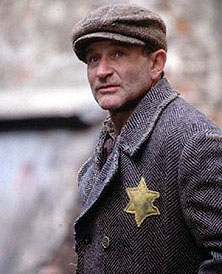
ROBIN WILLIAMS
We watched “Jakob the Liar,” a 1999 film starring its executive producer, Robin Williams.
In this story based on Jurek Becker’s novel, Williams plays the title role, a man confined to a Jewish ghetto in Poland during World War II. Jakob is summoned to the commandancy of the ghetto for being in the street after curfew, and while he is in an SS officer’s quarters, he hears a radio news report to the effect that the Red Army is advancing in the vicinity of the ghetto.
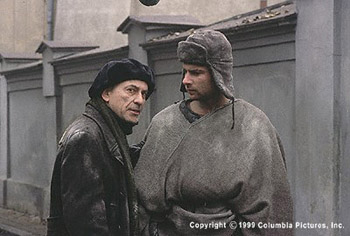
Alan Arkin and Liev Schreiber
When Jakob gives this information to his fellow inmate, Mischa (Liev Schreiber), Mischa draws the conclusion that Jakob himself has a radio — an offense punishable by death in the ghetto. Mischa shares his suspicion with others and soon the story is all over the ghetto, and nothing Jakob can say will put it to rest. The inmates beg him for more promising news, and he finally decides to lift their spirits by making up more “news” about the impending end of the war.

HANNAH GORDON
Jakob’s position becomes increasingly precarious, and it isn’t helped any by the fact that he is sheltering a young girl (Hannah Taylor-Gordon) who avoided boarding the transport that carried her parents to a death camp.
Given the fact that this movie features Williams in a dramatic role, includes fine actors such as Bob Balaban and Alan Arkin, and deals with this particular historical epoch, we expected to like it. We found, however, that the sum of the parts leaves the whole lacking.
The film is tedious and in some particulars implausible — for example, a scene in which Jakob defies and even intimidates an SS officer who, under real circumstances, would have shot him on the spot. And while Roberto Benigni proved that humor could be mixed into a serious Holocaust story, this film doesn’t strike the delicate balance between the two that the Italian movie achieved.
One that slipped by the eagle eyes
January 25, 2010

MARISA TOMEI
After we watch a movie, we get a kick out of going to the International Movie Database site and check on the “goofs” that others have found in the film we just saw. We are amazed sometimes at the obscure things that people notice. For example, we recently saw “The Blind Side” and were amused to read on imdb that in the scene in which the actor playing Michael Oher is talking to an NCAA official, a Maggiano’s Little Italy restaurant is visible through the office window, whereas – the “goofs” page points out – there is no Maggiano’s in Memphis, where the story took place.

CHRISTIAN SLATER
So the other night we watched on TV the 1993 movie “Untamed Heart” with Marisa Tomei and Christian Slater. There is a scene in that movie in which Slater’s character shows Tomei’s character a box containing several vinyl LPs that had been given to him by a nun when he left an orphanage. He puts one of the LPs on a turntable, and the first cut is a recording of Roger Williams playing “Nature Boy,” a song written by Eden Ahbez in 1947. At the end of the film, when Slater’s character has died, Tomei puts the same record on and listens to the same recording.

ENRICO CARUSO
What imdb’s “goofs” page has missed so far, is that the jacket that that LP was taken from in both scenes is the RCA album “Enrico Caruso in Opera and Song.” I have owned that album for several decades and have played it enough times that I spotted the images of the tenor on the back of the jacket both times that it appeared in the film.
I’m old, but I’m still awake.
“Ma, ma, where’s my pa? Gone to the White House, ha ha ha!”
January 22, 2010

JOHN EDWARDS
John Edwards’ melodrama is interesting because, among other things, of how it both resembles and departs from the experience of Grover Cleveland. Edwards was a viable candidate in last year’s presidential primary campaign, and he knew at the time that he had had an affair and fathered a child. Something similar happened to Cleveland during his presidential campaign against James G. Blaine in 1884. Blaine (“the continental liar from the State of Maine”) was beset with a corruption accusation, but the Republicans planned to counter by reporting that Cleveland had sired a child while he was an unmarried attorney in Buffalo. When this scandal started to emerge, Cleveland told his campaign staff — and here’s where the stories diverge — to “tell the truth.”

GROVER CLEVELAND
The truth was that Maria Crofts Halpin, the woman who had named Cleveland as the father of her child, had had relationships with other men. Cleveland didn’t know with certainty that he was the father of her child, but he accepted the responsibility and made support payments to the woman — apparently because he was the only one of her lovers who was unmarried. People had different values then.
There was no happy ending to that story. Mrs. Halpin had a troubled life, complicated by alcohol. Cleveland did what he could to help her and her son, but eventually the boy was adopted into a stable home and Cleveland’s connection ended.
The lesson, Sen. Edwards, is that Cleveland didn’t try to hide his mistake and he won the popular vote for president in 1884, 1888, and 1892. He came short on electoral votes in ’88, and took four years off. I don’t think the public has changed so much in all the intervening years that it doesn’t still suffer a bungler before a liar.

“…respecting an establishment of religion”
January 20, 2010

I am usually a proponent of the separation of church and state, agreeing wholeheartedly that both government and organized religions are better off if they keep their entanglements to a minimum. I do like some common sense with my coffee, however, and I don’t find any in the case of Donna Kay Busch, the Pennsylvania woman who was barred from reading five verses from the 118th Psalm to her son’s kindergarten class.

Getty Images
These are the verses, from the King James Version, that Mrs. Busch proposed to read:
O, give thanks unto the Lord, for He is good: because his mercy endureth forever. / Let Israel now say that his mercy endureth forever. / Let the house of Aaron now say, that his mercy endureth forever. / Let them now that fear the Lord say, that his mercy endureth forever. / Let them now that fear the Lord say, that his mercy endureth foever. / … The Lord is my strength and song, and is become my salvation.
 Mrs. Busch – an Evangelical Christian – said she chose these verses because they made no reference to Christianity. Here’s the explanation from the Christian Science Monitor:
The reading was to be part of an in-class assignment in which the children were invited to present important aspects of their lives to their classmates. As part of this “All About Me” week-long assignment, Busch’s son, Wesley, made a poster displaying photographs of himself, his hamster, his brothers, his parents, his best friend, and a construction-paper likeness of his church.
One part of the “All About Me” curriculum included inviting parents to “share a talent, short game, small craft, or story” with the class that would highlight something about their child. Busch said her son asked her to read the Bible to the class, an activity she and her son shared together at home.
Mrs. Busch told the kindergarten teacher in advance what she proposed to read, and the building principal objected to it on the grounds that reading a religious text to public-school children who were required to be present would amount to state-sponsored endorsement (“establishment”?) of one religion over others.
A federal judge and then a federal appeals court upheld the principal’s decision, and now the U.S. Supreme Court has, in effect, done the same by refusing to hear Mrs. Busch’s appeal.
I like a dissenting opinion from one of the appeals court judges who argued that the school had invited students and their families to participate in a program by expressing what they thought was important in their lives. Barring members of this family from expressing this particular aspect of their lives seems unfair, hypocritical, and overzealous. I wonder exactly what the school system and the courts thought would be the result if Mrs. Busch had read those verses to the kids? Which does more damage – reading a few verses of Hebrew scripture to children, perhaps with an explanation that Judaism and Christianity are two of many religions in the world, or pretending that a curriculum is preparing children to live in the wider world without educating them to the fact that religious expression is a major factor out there?
You can read the Monitor’s story on this case by clicking HERE.
“My mind is my own church” — Thomas Paine
January 17, 2010

GLENN BECK
In their learned discussion this week, political philosopher Glenn Beck and stateswoman Sarah Palin evoked the spirits of the “founding fathers” — a term, by the way, that was coined by an earlier genius, Warren G. Harding. After his own apotheosis of George Washington, Beck inquired of Gov. Palin, “Who is your favorite founder?” Apparently not wanting to offend the disciples of any one of our forbears, Gov. Palin demurred: “Ummm … you know … well, all of them.” Beck, clearly trying to uphold his reputation as a hard-hitting and objective interviewer, expressed his reservation by dismissing the governor’s attempt at delicacy as “bull crap” and demanded to know who was her favorite. The two great minds, as it turned out, were superimposed much like a prophetic convergence of heavenly bodies. Gov. Palin’s choice was George Washington. She made her reason clear: She empathized with Washington’s indifference to public office, except as a temporary duty, and his disdain for notoriety in general. So it was a natural choice for the former city council member, mayor, and governor, and unsuccessful candidate for lieutenant governor and vice-president — and recently engaged Fox News commentator. Neither Beck nor Palin brought up slave-holding or land speculation, but it was only a one-hour program.

THOMAS PAINE
Given the spiritual underpinnings of the two thinkers, their discourse naturally turned to religion. They agreed that religious faith was an important motivation for the “founding fathers,” although Glenn Beck darkly noted, “except Thomas Paine — we think he might have been an athiest.” As far as the others were concerned, Gov. Palin twice tried to assure Beck — who didn’t seem to be listening — that “we have the documents.”
Paine might have run afoul of Glenn Beck and Gov. Palin anyway inasmuch as he eventually described Washington with words like “hypocrite,” “apostate,” and “imposter.” However, unless the “we” who share Glenn Beck’s suspicions know something that historians do not know, Paine was not an athiest but a deist — deism being all the rage at the time, including among many of the “founders.”
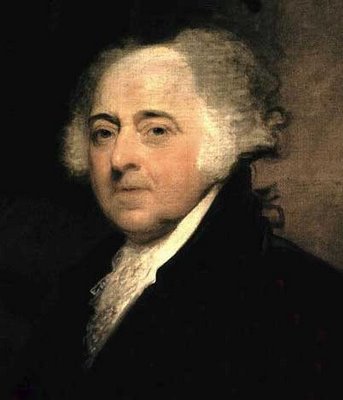 As for the “documents” the governor referred as evidence that the republic somehow was founded on religious principles, perhaps she will be specific when she settles into her role as a commentator or when she publishes her next book. Presumably she is not referring to the Declaration of Independence, which is not part of the organic law of the land, nor such things as Thanksgiving proclamations. Nor can she mean the treaty with Tripoli, ratified by the Senate and signed by the deist founding father and president, John Adams — a treaty that explicitly rejects the idea that the government of the United States was founded on Christian principles. If Gov. Palin can find religion — except a prohibition against establishing it — in the federal Constitution, which is the law of the land, she has an obligation to expose it for the rest of us.
 CharlesPaolino's Blog