“To be or not to be” – the movie
January 5, 2013
 Turner Classics the other night broadcast a fascinating relic of World War II, a dark comedy entitled To Be or Not to Be, starring Carole Lombard and Jack Benny. This 1942 film, directed by Ernst Lubitsch, is set in Warsaw during the invasion of Poland by Nazi Germany. The plot concerns a troupe of Polish actors who use the tools of their art to upend a plan by the Nazis to identify and track down families of Polish airmen fighting against the Third Reich.
Benny and Lombard play a married couple, Josef and Maria Tura, who are popular Shakespearean actors in the city. A young Polish airman, Stanislav Sobinski, played by 23-year-old Robert Stack, has become enamored of Maria and she, appreciating the attention, begins a clandestine romance with him. Josef deduces that the two are having an affair after Sobinski repeatedly leaves the theater to meet Maria just as Josef is beginning to recite the “to be or not to be” speech in Hamlet.
Sobinski, however, is sent off to England where he meets Alexander Siletsky, a Nazi spy who pretends to be a member of the Polish resistance in order to gather information about anti-German activists. In a conversation with Siletsky, Sobinski mentions Maria Tura and is suspicious when the supposed denizen of Warsaw doesn’t recognize her name.
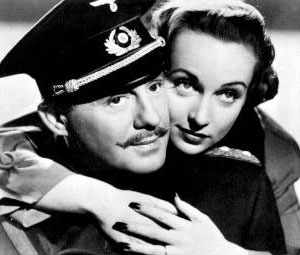
JACK BENNY and CAROLE LOMBARD
Based on Sobinski’s description of Maria, Siletsky, who travels to Poland to deliver to the Nazis a list of the families of Polish airmen, determines to enlist the actress as an informant. When he meets her, he also takes a more personal interest in her. But Sobinski has informed his superiors of his suspicions about Siletsky and is sent back to Warsaw to warn the resistance. When the acting company learns of this, they determine that the only solution is to murder Siletsky before he can turn over the names.
The plot proceeds as a classic farce in which one of the actors poses as Adolf Hitler in order to hoodwink the German authorities.
This film (which Mel Brooks remade in 1983) is regarded as a comedy classic, but it was controversial in its time. Some folks were uncomfortable with the humorous approach to the situation in Europe, which was anything but funny. Lubitsch began this project with Jack Benny in mind for the lead. Benny, whose birth name was Benjamin Kubelsky, met some resistance first-hand when his father, Meyer, walked out of the theater, scandalized by the sight of his son in Nazi uniform. Meyer reputedly changed his mind under Benny’s influence and eventually saw the movie more than forty times. Despite its humor, the film is very dark, though, and emphasizes the level of destruction the Germans rained on Warsaw.
To Be or Not to Be was the last film for Carole Lombard, who was the highest-paid Hollywood star at the time. Before this movie was released, she was killed in a plane crash while returning from a U.S. Bond tour.

CAROLE LOMBARD as Maria Tura and STANLEY RIDGES as Siletsky.
The first American film to attack Hitler and Nazism through ridicule was You Natzy Spy! a short subject by The Three Stooges. That was followed a few months later by Charles Chaplin’s The Great Dictator, Chaplin’s first true sound film and his first commercial success. In that movie, which appeared in 1940, before the United States and Germany were at war, Chaplin mercilessly pillories Hitler, fascism, anti-Semitism, and Benito Mussolini.
Walt Disney got into the act on January 1, 1943, by releasing In Der Fuhrer’s Face, a propaganda cartoon in which Donald Duck has a nightmare in which he is forced to work on the assembly line of a munitions factory in “Nutziland.” This film included some broad German, Japanese, and Italian caricatures, including send-ups of Hitler and Mussolini. The cartoon featured a song that had been recorded and already released by Spike Jones: “When the Fuhrer says, ‘We are the master race,’ we heil, we hiel, right in der Fuhrer’s face”
You can watch a high-quality video of this cartoon at THIS LINK.

Books: “Hallucinations”
December 30, 2012

Dr. OLIVER SACKS
I have often had the experience, as I am about to fall asleep, of seeing for a fleeting moment the image of a familiar person and hearing that person speak directly to me. Although I am always aware that the image and the voice are not real, they always seem to be real.
Phenomena of that kind are the subject of a chapter — “On the Threshold of Sleep” — in Hallucinations by Dr. Oliver Sacks, the neurologist and author. In this latest of his many books, Dr. Sacks discusses the wide range of circumstances under which some folks (many folks, as it turns out) see things, hear things, even smell things that do not exist in objective reality. These are not sights, sounds, or aromas that the hallucinator voluntarily conjures up in his or her own mind, but rather the products of extraordinary activity in various parts of the brain.
The hallucinations Dr. Sacks writes about may be associated with medical conditions that include epilepsy, narcolepsy, and partial or total blindness, and they may be associated with the use of certain drugs. What they usually are not associated with, Dr. Sacks writes, is mental illness. In fact, many people who experience hallucinations are aware that what appears real to them is, in fact, not real.
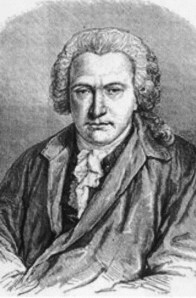
CHARLES BONNET
The condition Sacks explores first, setting a context for the rest of the book, is Charles Bonnet Syndrome, or CBS, which was first identified by an 18th century Swiss naturalist. Persons with CBS have deteriorating or deteriorated eyesight, and they have hallucinations that in a sense fill in the gap of visual sensory input. These hallucinations may be superimposed on the impaired visual field or they may fill in the blind spot of people who have lost sight in half the visual field. Sacks provides this contrast between hallucinations of this kind and dreams:
“Dreamers are wholly enveloped in their dreams, and usually active participants in them, whereas people with CBS retain their normal, critical waking consciousness. CBS hallucinations, even though they are projected into external space, are marked by a lack of interaction; they are always silent and neutral—they rarely convey or evoke any emotion. They are confined to the visual, without sound, smell, or tactile sensation. They are remote, like images on a cinema screen in a theater one has chanced to walk into. The theater is in one’s own mind, and yet the hallucinations seem to have little to do with one in any deeply personal sense.”

waynetownindiana.com
Dr.Sacks has spent his professional lifetime collecting case histories from his own interactions with patients, from his reading, and from correspondents who have shared their experiences with them. In this book as in most of his previous ones, he uses that knowledge to illuminate the growing understanding of the human brain.
Meanwhile, the subject matter of this book reminded me of the poem by Hughes Mearns:
Yesterday, upon the stair,
I met a man who wasn’t there
He wasn’t there again today
I wish, I wish he’d go away…
When I came home last night at three
The man was waiting there for me
But when I looked around the hall
I couldn’t see him there at all!
Go away, go away, don’t you come back any more!
Go away, go away, and please don’t slam the door… (slam!)
Last night I saw upon the stair
A little man who wasn’t there
He wasn’t there again today
Oh, how I wish he’d go away
That poem is called Antigonish because it was inspired by a ghost story in the Nova Scotia city of that name. Mearns, an educator who believed deeply in cultivating the creativity of children, wrote the lines for a play called Psyco-ed while he was a student at Harvard. It was published as a poem in 1922.
Netflix Update No. 75: “From Time to Time”
December 27, 2012

MAGGIE SMITH
I have written in this space about several movies that had time-travel themes, but none so elegant as From Time to Time, a 2009 British production directed by Julian Fellowes.
The story is set in a country estate in England at the end of World War II. A 13-year-old boy named Tolly, played by Alex Etel, is sent to stay at the old house with his grandmother, Mrs. Oldknow, played by Maggie Smith. Mrs. Oldknow’s son — who is Tolly’s father — has been missing in action, and Tolly is holding onto a conviction that his dad is still alive. Tolly’s mother, who has had a cool relationship with Mrs. Oldknow, is occupied with trying to determine her husband’s fate, and she believes Tolly would be safer in the country until the war is over.
Tolly is very interested in the house and in his ancestors who have lived there, and he is distressed to learn that his grandmother, who has a great affection for her home and loves to tell Tolly stories about its past, can no longer afford to keep the place up and is planning to sell it.

KWAYEDZA KUREYA, ALEX ETEL, and ELIZA BENNETT
As Tolly explores the house and the grounds, he begins slipping from the mid-twentieth century into a time two hundred years before. He enters a room and finds it occupied by his ancestors and their retinue. Chief among these figures is the master of the house, a magnanimous sea captain played by Hugh Bonneville. Most of these shadows are unaware of Tolly, but one who is immediately sensible of his presence is Capt. Oldknow’s blind young daughter, Susan (Eliza Bennett). Susan is inadvertently the cause of a family crisis when Capt. Oldknow returns from one of his voyages with a black boy, a fugitive American slave named Jacob (Kwayedza Kureya). This lad, the captain announces, is to be a companion for Susan, and he is to be treated as a member of the household, not as a servant. This is met by resistance from Capt. Oldknow’s restless wife, Maria (Carice van Houten), his spoiled son Sefton (Douglas Booth), and from a none too disinterested servant named Caxton (Dominic West). The jealousy and antagonism directed at Jacob when the captain is away from home sets off a chain of events that results in a mystery that is not resolved until Tolly, the inquisitive time traveler, sorts it out.

HUGH BONNEVILLE and CARISE van HOUTEN
This movie gets only fair to middlin’ reviews, but we found it entertaining and engaging. The quirky characters, including Pauline Collins as the latter-day household’s outspoken cook, Mrs. Tweedle, and Timothy Spall as the gruff Dickensian handyman whose bloodline has a critical place in the Oldknow family history.
Like a lot of people, I suspect, I have been fascinated by the idea of time travel since I was a kid and have fantasized about the day when I myself could visit the past. According to a physics book I read not long ago, time travel to the future is possible, but time travel to the past is out of the question. It’s not out of the question in the movies, though, so that’s where I do it, and it has never been more fun than in this film.

“God saw all that he had made, and it was very good” — Genesis, 1:31
December 25, 2012

Nativity group by Michel Anguier, St. Roch, Paris
This was my homily for Christmas Day:
Flags at half staff.
Moments of silence.
Tolling church bells.
Internet blackouts.
These are things that have contributed to the atmosphere of the past 12 days.
And there was another: Christmas lights gone dark for a night.
Maybe many of us feel a little awkward, a little guilty even, about celebrating the holiday at all
And yet, in a way, nothing could be more appropriate.
Nothing could be more fitting at this moment in our lives together in America than to celebrate the birth of Jesus of Nazareth and to remember what that birth means.
Some events — and surely an event that took place this month — may contribute to a certain pessimism about our human condition.
It’s the 21st century, we might say to ourselves in one way or another.
It’s the 21st century, and how far have we come if this is the best we can do?
What’s wrong with all of us, if some of us are capable of this, if none of us can prevent such things?
There are some philosophies — both religious and secular — that would answer those questions by saying, “What do you expect?”
“Human beings are fundamentally flawed creatures, and sooner or later they’re going to act on their worst instincts.”
But Christmas says otherwise.
What we celebrate today is that the child born in the manger was, in one person, both a human being and God himself.
We sometimes hear this expressed in negative terms.
We sometimes hear that God lowered himself, to take on the nature of miserable humankind.
But while we recognize that God is greater than any one of us, greater than all of us put together, we don’t have to look on the birth of Jesus — in fact, I suggest that we should not look on the birth of Jesus — as an act of condescension.
On the contrary, the birth of Jesus is an act of love.
In the birth of Jesus, God shows his love for us — not only because he was willing to obscure his divine nature with the physical appearance of humanity, but because he placed such a value on human nature that he wanted to show that the men and women and children he created were fit to live in his company, fit to coexist in the same person — in the child born in Bethlehem.
God is anything but pessimistic about human beings.
Jesus demonstrated that over and over again — with Matthew, with Zaccheus, with the woman at the well in Samaria, with the woman accused of adultery, with Peter, with the thief dying alongside him on a cross, and with Paul.
He told us about it in those parables that resound through the ages: the father and his two sons, the Good Samaritan, the one lost sheep from the ninety-nine.
Jesus, who looked on human beings with such optimism, encountered in his lifetime Herod and his sons, Judas Iscariot, Pontius Pilate, and people whose jealousy or paranoia inspired them to criticize him, attack him, ostracize him, eventually kill him.
But even at that extremity, the last thing he said about such people was, “Father, forgive them.”
And while we may not be able to look as deeply into those souls as Jesus did, we take him at his word.
Every now and then, someone — for reasons that we really do not understand — commits an act that might make us ask us just how low human nature can descend.
But we don’t have to look far — and we didn’t have to look far this month — to find far more people, including people sitting in this church, whose heroism and generosity help us to see just how high human nature can soar.
The Catholic Church teaches that human beings are essentially good.
Christmas — and perhaps this Christmas especially — is a good time to recall that and to celebrate it in the words of the hymn.
“Long lay the world in sin and error pining, then he appeared, and the soul felt its worth.”
Netflix Update No. 74: “Take Me Home”
December 23, 2012

SAM JAEGER
If you’re not in love with Sam and Amanda Jaeger after watching Take Me Home, promise me you’ll get professional help.
This 2011 film was written and directed by Sam Jaeger, who also plays the male lead. That character is Thom, a photographer who hasn’t been able to make a living with his art. He scrapes out a mean existence by illegally driving a New York City cab he bought at an auction, but even that is not enough to pay his rent, and he is evicted.
At this low point in his life, Thom meets Claire (Amanda Jaeger), a competent exec at a non-profit organization who discovers that her husband has been having an affair. This occurs almost simultaneously with news that her estranged father is seriously ill in California.

AMANDA JAEGER
With her head spinning, Claire hails Thom’s cab, tells him to drive without a destination and then is surprised to find herself in eastern Pennsylvania. After the shock wears off, she tells Thom to take her to California, but stops in Las Vegas to visit her quirky but amiable mother, Jill, played by Lin Shaye.
Claire eventually learns that Thom is penniless and that being a legitimate cab driver isn’t the only thing he has lied about. And since she left home without plan or preparation, her own resources are dwindling. Stuck with each other, they more or less claw their way to their destination despite several delays, a potential felony, and one real disaster. The experience inspires both of them to think again about how they have been living.
As outrageous as the odyssey seems, this is a believable and visually interesting story, amusing and thought-provoking at the same time. All of the performances are subtle and effective, and the Jaegers are irresistable.

Books: “Seward: Lincoln’s Indispensable Man”
December 18, 2012
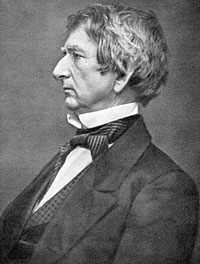
WILLIAM H. SEWARD
If the Chicago Tribune had it right, William H. Seward was the prince of darkness.
In 1862, when Seward was Abraham Lincoln’s secretary of state and the Civil War seemed as likely as not to permanently destroy the federal union, the “world’s greatest newspaper” knew whom to blame. Seward, the Tribune said, was “Lincoln’s evil genius. He has been president de facto, and has kept a sponge saturated with chloroform to Uncle Abe’s nose all the while, except one or two brief spells.” The Boston Commonwealth was about as delicate in its assessment of Seward: “he has a right to be idiotic, undoubtedly, but he has no right to carry his idiocy into the conduct of affairs, and mislead men and nations about ‘ending the war in sixty days.’ ”
This demonic imbecile, as some editors would have it, is the subject of Walter Stahr’s comprehensive and engaging biography, Seward: Lincoln’s Indispensable Man. Stahr has a somewhat different take than the Tribune’s Joseph Medill. While Stahr acknowledges that Seward was overly optimistic about prospects for the federal government to prevail over the seceding states, and while he acknowledges that Seward sometimes turned to political chicanery and downright dishonesty, he also regards Seward as second in importance during the Civil War era only to Lincoln himself.

ABRAHAM LINCOLN
Seward, a former governor of New York and United States Senator, was by Stahr’s account, very close to Lincoln personally, which probably contributed to the rancor directed at Seward from others in the government who wanted the president’s attention. Their relationship was interesting in a way that is analogous to the relationship between Barak Obama and Hillary Clinton in the sense that Seward was Lincoln’s chief rival for the Republican presidential nomination in 1860. Seward’s presidential ambitions, which were advanced by fits and starts by the political instigator Thurlow Weed of New York, are well documented in this book. But, as Stahr makes clear, Seward’s disappointment at losing the nomination to Lincoln did not prevent him from agreeing to serve with Lincoln at one of the most difficult periods in the nation’s history nor from serving him loyally.
As important an office as secretary of state is now, it was even more so in the 19th century, because its reach wasn’t confined to foreign affairs. It wasn’t uncommon for the secretary of state to be referred to as “the premier.” At first, Seward’s view of the office might have exceeded even the reality; he seems to have thought at first that he would make and execute policy and Lincoln provide the face of the administration. Lincoln soon made it clear who was in charge, and he and Seward worked well together from then on.

LEWIS PAYNE
Seward’s service in Lincoln’s administration nearly cost him his life on the night that Lincoln himself was murdered by John Wilkes Booth. One of Booth’s accomplices, Lewis Payne, forced his way into the house where Seward was lying in bed, recovering from injuries he had sustained in a serious carriage accident. Payne, who was a wild man, tore through the place, cutting anyone who tried to stop him, and he attacked Seward, slashing his face. Payne fled the house — he eventually hanged for his crime — and Seward survived.
After the double trauma of Lincoln’s death and Seward’s own ordeal, it would have been understandable if Seward had withdrawn from public life. Seward wasn’t cut of ordinary cloth, however, and he agreed to remain at his post in the administration of Lincoln’s successor, Andrew Johnson. Johnson was an outstanding American in many respects—he was the only southern member to remain in his U.S. Senate seat after secession, and he gave up the relative safety of the capital and took his life in his hands when Lincoln asked him to serve as military governor of Tennessee — but he was not suited for the role that was thrust on him by Booth.

ANDREW JOHNSON
Stahr explores the question of why Seward stayed on during the troubled years of Johnson’s tenure. He infers, for one thing, that Seward agreed with Johnson’s idea that the southern states should be quickly restored to their place in the Union without the tests that the Republican majority in Congress, and especially the “radical” wing of the party, wanted to impose. Stahr also writes that Seward believed that if Congress succeeded in removing Johnson on impeachment charges that were politically motivated it would upset the balance of power in the federal government for decades to come.
I mentioned Seward to a co-worker today, and she said, “of the folly?” She was referring to the purchase of Alaska, which Seward completed during Johnson’s administration. Stahr writes that much of the press supported the purchase of “Russian American” at first, and although the term “folly” was tossed about later, prompted in part by Seward’s further ambitions for expansion, the epithet was never widely used.

FRANCES SEWARD
Alaska was only one of Seward’s achievements. He was a skillful diplomat who was equipped to play the dangerous game that kept Britain and France from recognizing the Confederate States of America. Although he may have underestimated the threat of secession and the prospects for a protracted war, he was at Lincoln’s side every step of the way—playing a direct role, for instance, in the suspension of habeas corpus and the incarceration of suspected spies without trial. He was not an abolitionist—and in that respect he disagreed with his outspoken wife, Frances— but Seward was passionate about preventing the spread of slavery into the western territories. He believed that black Americans should be educated. He did not support fugitive slave laws and even illegally sheltered runaway slaves in his home in Auburn, N.Y.
Seward was a complicated character who stuck to high moral and ethical standards much of the time, but was capable of chicanery, deceit, and maybe even bribery if it would advance what he thought was a worthy purpose.
A world traveler, he was one of Washington’s leading hosts, known for his engaging manner, and yet with his omnipresent cigar and well-worn clothes he appeared to all the world as something akin to an unmade bed. Henry Adams, who admired Seward, described him as “the old fellow with his big nose and his wire hair and grizzled eyebrows and miserable dress” who nevertheless was “rolling out his grand, broad ideas that would inspire a cow with statesmanship if she understood our language.”
“The Best of Enemies”
December 2, 2012

ANN ATWATER and C.P. ELLIS
During a group discussion in our parish last month, we touched on the question of whether anyone is beyond redemption. We had in mind folks like the terrorists who carry out mass murders and suicide missions for what they perceive to be good or necessary causes. The question might have answered itself if any of us that night had thought of C.P. Ellis. I, for one, had never heard of him.
More recently, I learned about Ellis while I was writing about a play by Mark St. Germain entitled “The Best of Enemies.” The play, in turn, is based on a book by that title, written by Osha Gray Davidson. The enemies were Ellis, who in 1971 was the grand cyclops of a chapter of the Ku Klux Klan in Durham, North Carolina, and Ann Atwater, who was a black civil rights activist in the same city.

ANN ATWATER
Durham was late coming to the school desegregation party, and a community organizer named Bill Riddick arrived in town to get a public dialogue going. He proposed to conduct a series of town meetings, and he chose Atwater and Ellis — who couldn’t stand the sight of each other — as co-chairs. As the process unfolded, the unlikely pair gradually realized that as economically marginalized members of the community, and as parents who were concerned about the quality of their children’s education, they had more in common than they had thought. The experience also inspired Ellis to examine the reasons for his membership in the Klan. Ultimately, Ellis quit the Klan by tearing up his membership card at a public gathering; as a result, he was ostracized by his former friends and threatened with death.
C.P. Ellis
Ellis became a union leader, representing constituencies of mostly black workers. He and Atwater were friends until his death in 2005.
Mark St. Germain’s play was introduced at the Barrington Stage Company in Massachusetts and is currently on stage at the George Street Playhouse in New Brunswick.
You can read Studs Terkel’s interview with Ellis, in which Ellis talks about the reasons for his membership in the Klan and describes his encounter with Ann Atwater, by clicking THIS LINK.

AISHA HINDS as Ann Atwater and JOHN BEDFORD LLOYD as C.P. Ellis in Mark St. Germain’s play, “The Best of Enemies”
Netflix Update No. 73: “Mrs. Brown”
November 22, 2012
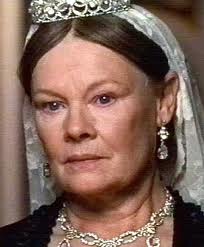 When we took a bus tour of London many years ago, the guide pointed out that all the iron work outside the apartment windows was painted black. She said this practice dated to the reign of Queen Victoria, who was so distraught by the death of her husband, Prince Albert, that she called for the paint job as a sign of mourning. That sounded a little hokey to me, but it made a good story.
Victoria’s mourning for Albert, who died in 1861, was no joke, however. The queen was plunged into a lengthy state of depression, and lived a comparatively isolated life for a British monarch, although surrounded by her children and official household. One person who managed to pierce the shell around the queen was John Brown, a Scottish servant. Their relationship is the subject of the 1997 film “Mrs. Brown,” which stars Judy Dench as Victoria and Billy Connolly as Brown.
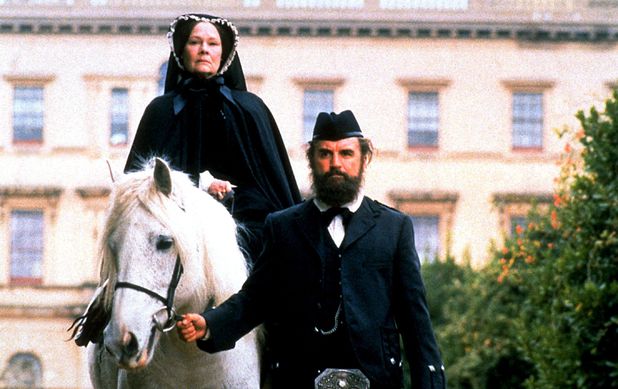
The queen had retired to Balmoral Castle after her husband’s death, and Brown — who had a long-standing association with the family — was sent there principally to care for her pony and accompany her when she chose to ride.
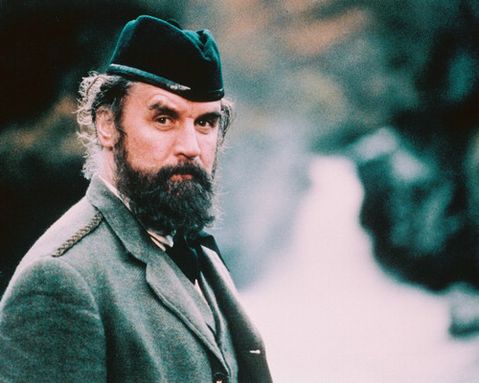
From the start, Brown showed the queen none of the truckling deference she was accustomed to. In fact he spoke to her rather bluntly, addressing her as “woman,” and said exactly what was on his mind. This appealed to Victoria, and she started to rely more and more on Brown’s advice, and he more and more took control of the affairs of the castle, and particularly of anything that had to do with the comings and goings of the queen.
This development along with Brown’s abrupt personality and penchant for drinking irritated pretty much everyone else in the household, especially Albert Edward, the prince of Wales, the queen’s son and later King Edward VII. Meanwhile, there was mounting pressure for Victoria to become more visible to her subjects — pressure that included a movement in Parliament to deinstitutionalize the monarchy. At first Brown supported the queen in her resistance to this pressure, but his change of heart on the matter led to a crisis in their relationship.

To what extent, if any, there was a romance between Victoria and John Brown is still a matter of conjecture. Certainly folks at the time thought there was something afoot, and that’s why the queen was derisively referred to as “Mrs. Brown.”
Although certain aspects of the story are fictionalized in this account, the movie basically portrays real events. The film was made by the BBC for television, but instead it was released as a theatrical property and made a lot of money. The performances, including Anthony Sher’s turn as a foppish Benjamin Disraeli, are outstanding. Judi Dench won a Golden Globe Award and was nominated for an Oscar.
Books: “Isaac’s Army”
November 10, 2012
 Warsaw came as a surprise to me. Because of my uneducated impressions of Eastern Europe, I expected the city to be grim, but it was not. Warsaw was lively, handsome, well-swept, festooned with parks, and imbued with the spirits of such as Paderewski, Chopin, and Wojtyla.
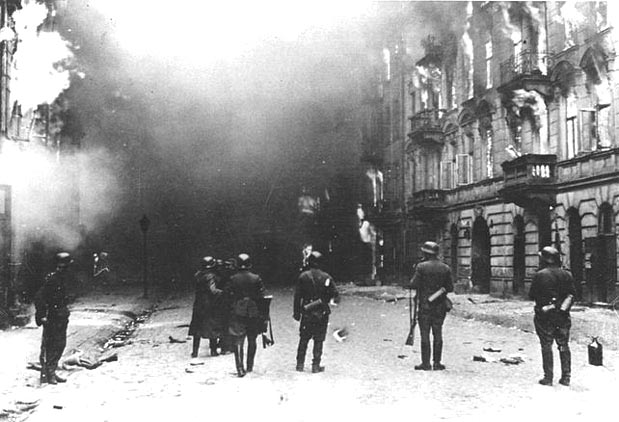
But as satisfying as it was to see the city thriving, it was impossible to escape reminders of its darkest days, when it was occupied and devastated by Nazi Germany — and its Jewish population virtually exterminated — a period that is described in vivid human detail in Matthew Brzezinski’s book, Isaac’s Army.

Brzezinski, who has been a reporter for the New York Times and the Wall Street Journal, concentrates in this book on the walled ghetto in which the Nazis confined hundreds of thousands of Jews in subhuman conditions until most of the poor people were either worked to death, killed by hunger and disease, shot to death in summary executions, burned to death in their homes and hiding places, or shipped off to death camps.
I saw remnants of the ghetto in Warsaw, but it seemed almost like an abstract idea. In Brzezinski’s book, however, the depth of the depravity with which the Nazis and their collaborators treated Polish Jews comes through with shocking force.
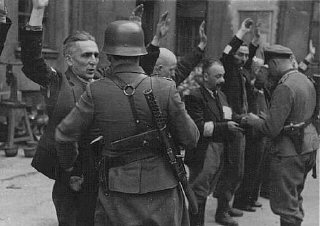 Brzezinski is particularly interested in a relatively small group of Jewish men and women who recognized from the beginning that the Nazi presence was an imminent danger to their community and were not willing to stand by and let the Germans proceed unhindered. The writer relates the stories of about a dozen individuals who were in that category. They belonged to underground paramilitary organizations that struggled to maintain some semblance of resistance to their persecutors. These folks defied and undermined the Nazi attempt to isolate the Jews and ultimately, in 1943, participated in the uprising that stunned and momentarily humiliated the SS when the “supermen” entered the ghetto with the object of leveling it.
Unfortunately, as Brzezinski relates, Polish Jews were not of a single mind about how they should respond to the Nazis or whether they should respond at all. They also were sharply divided over issues such as Marxism and Zionism.
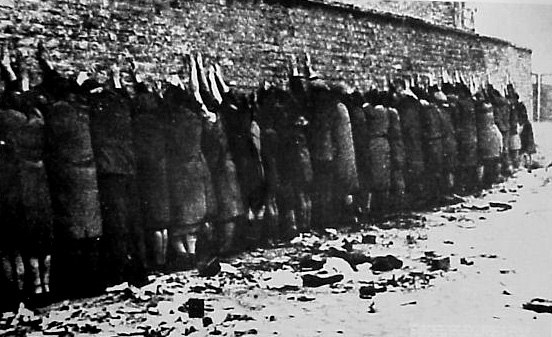
They were frustrated by the fact that so many people and nations were indifferent to their plight, and they had to resort to bribery and subterfuge to accumulate even the poor excuse for an arsenal they had to defend themselves against the combination of Adolf Hitler’s insanity and his military machine. Their situation may have been hopeless to start out with, but Brzezinski shows that some of them would not give up hope or, at least, would persist in their struggle against the Nazis even when hope was gone. While this book, on the one hand, records one of the worst examples of human cruelty, it also records one of the best examples of human resilience. The account of a few score sick and starving Jews escaping the ghetto by stumbling for hours through a sewer laden with human excrement, corpses, and rats is disgusting to the imagination. At the same time, it is uplifting to know that people who would not concede their right to dignity and justice were willing to undergo even that in order to deny Hitler his dream of eradicating Judaism in Europe.
“Babes in Arms”
November 4, 2012

JUDY GARLAND and MICKEY ROONEY
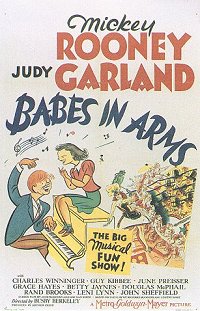
Knowing that a storm visitor was a fan of Judy Garland, I picked out Babes in Arms from the On Demand list, and wound up watching it myself. I did that because this 1939 film was based on a 1937 Broadway musical by Richard Rodgers and Lorenz Hart. I’ve always been curious about that show, but I’ve never seen it produced on stage. I knew well before the movie was over that the stage show has to have been better.
This was one of the “let’s put on a show” movies that Garland made with Mickey Rooney. It turns out that it was only loosely based on the Broadway show. In fact, I have since read that once the brains at MGM got the rights to the show, they made wholesale changes to the script and threw out all the songs except the unmemorable title song and the memorable “Where or When,” which was introduced on Broadway by Ray Heatherton (who later had a long run on television as the “Merry Mailman”) and Mitzi Green.

RAY HEATHERTON
That means, that MGM — specifically producer Arthur Freed — cut “My Funny Valentine,” “I Wish I Were in Love Again,” “Johnny One Note,” and “That’s Why the Lady is a Tramp” (which is heard only as incidental background music). Freed added two old songs of his own — “I Cried for You” and “You Are My Lucky Star” — and he and Nacio Herb Brown wrote “Good Mornin'” especially for this movie. E.Y. Harburg and Harold Arlen, who had contributed three classic songs to The Wizard of Oz, were employed on this movie to write “God’s Country,” a heavy-handed finale that was influenced by the war under way in Europe.
This film was directed by Buzby Berkeley in an era when the canteen didn’t stock de-caf coffee. It is, in a word, exhausting. The production numbers with their quick-step marches are dated and Rooney in particular, as talented as he is, is manic — a fault that is made more conspicuous by the fact that Garland’s performance is comparatively understated.
Apparently there was some racially insensitive material in the Broadway production, and there is an offensive minstrel sequence in the movie. Blackface was common into the 1950s; in fact, when I was a kid, my parish used to stage annual minstrels complete with end men in burnt cork exchanging idiotic banter with “Mr. Interlocutor.” It’s as hard to watch now as it should have been then.
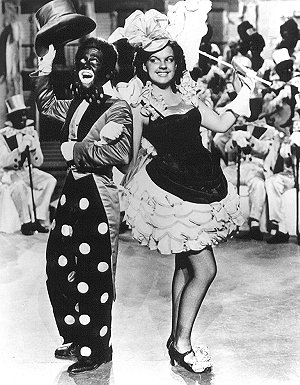
Rooney and Garland in blackface
I’ve read some attempts to rationalize this display, including one argument that the caricatures were mild, but there is nothing mild about Rooney’s lampooning in particular. He’s Jolson in overdrive.
There is a clever number in which Rooney and Garland do good-natured send ups of Franklin and Eleanor Roosevelt. This scene was cut from copies of the film distributed after FDR died in 1945, but it has been restored and is one of the most worthwhile things in the movie.
 CharlesPaolino's Blog