“How long ya’ gonna be gone?” — Ruby and Kalmar
May 14, 2010

Sheet music to "So Long, Oolong"
When Patricia T. O’Conner, author of popular books on English usage, visited the Leonard Lopate show on WNYC this week, the segment was introduced by a vocal of the song “Three Little Words,” which made me think of Harry Ruby. Ruby and his longtime colleague, Bert Kalmar, wrote that song in 1930 for what would now be considered an offensive movie.
The film was “Check and Double Check” — the only movie made by Freeman Gosden and Charles Correll in their blackface roles as Amos Jones and Andrew H. Brown — characters they made famous with their long-running radio series, “Amos ‘n’ Andy.” The song didn’t get small-time treatment in the film; it was performed by Bing Crosby and the Duke Ellington Orchestra.
The song also lent its name to the title of the 1950 film biography of Ruby and Kalman.

HARRY RUBY
Harry Ruby first came to my attention when I was a kid, and he made a guest appearance on the Danny Thomas television show, “Make Room for Daddy.” Ruby sang another song he had written with Kalman, one that — some might say mercifully — is not as well known as “Three Little Words.” The 1920 tune was “So Long, Oolong. How Long Ya’ Gonna be Gone,” which had racist overtones, as did so many Tin Pan Alley songs written in that era.
The song is about a Japanese girl named Ming Toy, whose boyfriend left for what was supposed to be a short spell but turned into a long spell. Hence the chorus: So long, Oolong, how long ya’ gonna be gone?”

BARBRA STREISAND
Ruby and Kalman were prolific, and some of their work was much more sophisticated than the Oolong affair. For example, they wrote “My Honey’s Lovin’ Arms,” which got a signature performance many years later in “The Barbra Streisand Album.” The pair also wrote “Who’s Sorry Now?” “Nevertheless (I’m in Love with You),” “A Kiss to Build a Dream On,” and the Betty Boop theme, “I Wanna be Loved by You,” among others.
As talented and productive as Ruby was as a songwriter, though, what I like best about him is that he always wanted to be a baseball player. He tried, unsuccessfully to make it into the pros, and he never missed a chance in later life to get close to the game. His devotion to the sport is the source of one of the great baseball anecdotes.

LOU GEHRIG
Ruby seized an opportunity to appear in “Elmer the Great,” a sports movie starring the comedian Joe E. Brown, who was also a devotee of baseball. The movie was shot at the old Wrigley Field, a minor league park in Los Angeles. One of the scenes called for an player, to be portrayed by Ruby, to drop a ball hit to him in the outfield. Ruby walked off the set, insisting that he wouldn’t drop a ball on purpose for any amount of money. Later, when Brown and Ruby happened to be in the company of Lou Gehrig, Brown told that story, figuring that Ruby would be embarrassed. Gehrig, with a straight face, said it was the greatest baseball story he had ever heard
“Free speech is life itself.” — Salman Rushdie
March 26, 2010

ANN COULTER
So Ann Coulter spoke at the University of Calgary last night, and Canada is still intact. There is no way to know whether Coulter’s remarks at the University of Ottawa – which she did not deliver because she was, in effect, driven away by a crowd of protesters – would have differed from the remarks she gave at Calgary, where she was treated almost politely.
The episode at Ottawa was interesting in its own way because the protesters presumably were to the left of Coulter on the political spectrum but were behaving a lot like people in the States have behaved recently — people who, one would assume, are in Coulter’s vicinity on the philosophical scale. So folks of all stripes are capable of intolerance.
This incident and others like it also expose the fact that many of us are almost infantile in our understanding of the very institutions we pretend to uphold.

NOAM CHOMSKY
In particular, people like those who hounded Coulter at Ottawa don’t grasp, or don’t want to accept, the radical principle that by whatever criterion we mitigate the rights of one person, we put our own rights in jeopardy. Such people also don’t grasp that they have to be willing to be offended if they want to live in a free society. It’s what the ancients called “a hard saying,” and far more of us subscribe to it rhetorically than like it when it’s put into practice. “If we don’t believe in freedom of expression for people we despise, we don’t believe in it at all,” as Noam Chomsky put it.
There’s a guy who occasionally sets up shop outside the post office down the street to spread his vitriol about Barack Obama — which I don’t agree with, and Nancy Pelosi — which is negotiable. I hear neighbors complaining about that guy, but to me he is just a part of the big portrait of America. I don’t like Ann Coulter, but I feel much more secure in my own life to the extent that she is allowed to say what’s on her mind.
The bigger they are . . . .
March 16, 2010

HUMPHREY BOGART
Once again the other morning, instead of getting up I clicked on the TV and turned to Turner Classic Movies. Never a good idea. We ended up watching “The Harder They Fall,” a 1956 movie starring Humphrey Bogart, Rod Steiger, and Virginia Mayo. It was Bogart’s last film; he died the following year.
“The Harder They Fall” was ostensibly based on the life of Primo Carnera, and if it was, it wasn’t meant as a compliment to the Italian boxer. The film concerns an Argentine giant who is brought to the United States by an unscrupulous promoter (Steiger) whose angle is to build up the unwitting and incapable kid through a series of fixed bouts and then bet against him when he fights for the heavyweight title. As far as I know there is no proof, but there is a persistent story Carnera was used in just that way.

Jersey Joe Walcott
The cast of “The Harder They Fall” included Jersey Joe Walcott, who won the world heavyweight title in 1951, when he was 37 years old. Walcott — who served as sheriff of Camden County and chairman of the N.J. State Athletic Commission — played a trainer in “The Harder They Fall,” and seemed comfortable in the part.
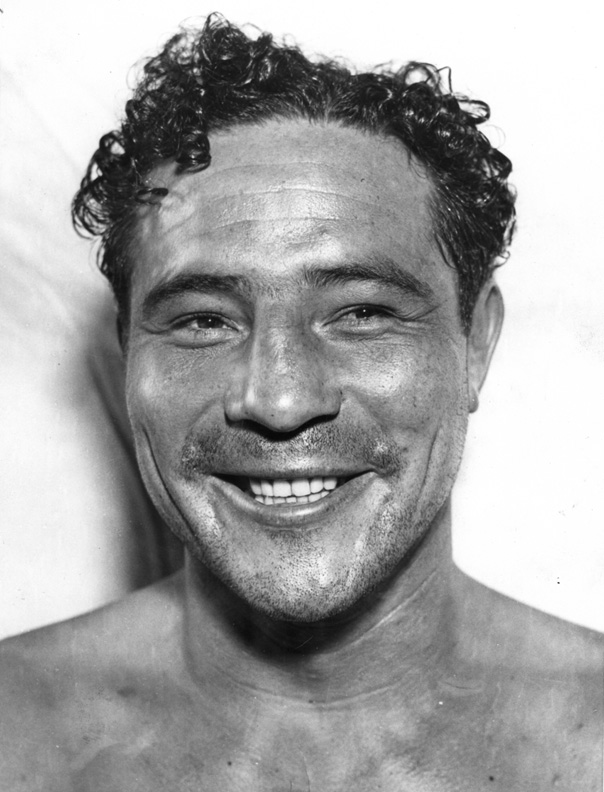
MAX BAER
Also in this cast was Max Baer, who played the heavyweight champion who beat the Argentine kid and put an end to his career. This appears to have been a none-to-subtle reference to the fact that Baer took the title from the 275-pound Carnera in 1934. There is also an episode in this film in which the boxer played by Baer gives his opponent such a beating that the man suffers brain damage and dies. That, too, happened in Baer’s career: In 1930, a fighter named Frankie Campbell — brother of Dodger star Dolph Camilli — died after a bout with Max Baer in San Francisco.

BUDDY BAER
Max Baer — father and namesake of the actor-director-producer who played Jethro in “The Beverly Hillbillies” — appeared in a couple of dozen movies and television productions. His brother, Buddy Baer — who was just as hard a puncher — had a record of 52 wins and 7 losses with 46 knockouts. He never won a title, but he had the distinction of once knocking Joe Louis out of the ring — in a fight that Louis ended up winning on a disqualification call. Baer claimed Louis had hit him and knocked him down after the bell ended the seventh round, and he refused to answer the bell for the eighth. Buddy Baer, too, appeared in numerous movies and television shows after he gave up boxing.
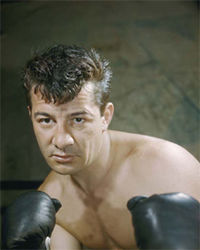
ROCKY GRAZIANO
There were other personable guys who dabbled in entertainment after they were through in the ring, including Rocky Graziano and “Slapsie” Maxie Rosenbloom.
Graziano was a New York street brawler and thief who did time on Riker’s Island and spent lots of time in other sorts of incarceration and under the protection of the Catholic Church. He went AWOL from the Army after punching an officer, and he was suspended from boxing for failing to report an attempted bribe and again for running out on a bout. He was a very good boxer and immortalized himself in the annals of the sport for his three bloody fights with Tony Zale in 1946, 1947, and 1948. The second of those fights made Graziano middleweight champion of the world.

MAXIE ROSENBLOOM
After his fighting career, Graziano — who, like a lot of guys with his background, was a charismatic figure — became a popular entertainer, especially on television comedies and variety shows.
Rosenbloom won the world light heavyweight title in 1932 and held it until 1934. On the one hand, his method of moving around the ring made it hard for opponents to land decisive blows, but that quality also meant that his fights often went the distance, and he took a lot of shots to the head. This eventually affected his physical health. Still, he capitalized on the image of a goofy pug and became a familiar figure on television. Although he wasn’t a serious actor, he played a significant role in Rod Serling’s “Requiem for a Heavyweight,” the iconic boxing story that starred Jack Palance and Ed and Keenan Wynn and included in its cast Max Baer.

PRIMO CARNERA
In an interesting parallel, Primo Carnera, who was even more unlikely an actor than Rosenbloom, also hit one high note in a limited screen career. Carnera was a giant. When he defended his heavyweight title against Paolino Uzcudun, the two fighters weighed a total of 488 3/4 pounds — the most weight ever in a title match. And when he defended the title against Tommy Laughran, the average weight of the two fighters was 227 pounds, but Laughran weighed only 184. It was the biggest disparity ever in a title bout.
Carnera used his size and generally menacing appearance to his advantage in the 1955 film “A Kid for Two Farthings,” and he won critical approval for his portrayal of villainous wrestler Python Macklin.

Rocky Graziano knocks Tony Zale through the ropes in their 1947 fight.

FRANK MORGAN
To hear Josh Olson tell it, he’s courting all kinds of trouble by writing a script for a proposed follow-up to MGM’s classic film, “The Wizard of Oz.” According to the Los Angeles Times interview with Olson, who wrote the 2005 film “A History of Violence” — don’t tell me he’s not versatile — he expects some pushback from purist fans of the original. Actually, what he said was the following: “You want to write something that takes people back to the fondness they had for the original. I’m aware of the fact that there are a couple million people who will come to your house and burn it down if you don’t get it right” — which would, after all, be one more chapter in the history of violence.

JUDY GARLAND and TOTO
However, the script Olson submitted to Warner Brothers is not intended as a re-make of the Judy Garland film, which is why I used the term “follow-up” earlier. The proposed new film, to be called simply “Oz,” would deal with a granddaughter of Dorothy Gale who visits the Other Side. This really would be in keeping with the history of the story introduced in 1900 in the form of a children’s book (“The Wonderful Wizard of Oz”) by L. Frank Baum. The book and a play adapted from it a couple of years later were very successful, and Baum — apparently nobody’s fool — wrote a total of 14 Oz books. Those books, plus 19 written by Ruth Plumly Thompson, two written by Frank Kramer, one written by Rachel Cosgrove, and a final one written in 1963 by Eloise Jarvis McGraw and Lauren Lynn McGraw, are considered the “canon” of Oz literature. Obviously, in the aggregate they wander far from the premises of the original story.

The title page from the original "Oz" book.
Literary critics with a lot of time on their hands have tried over the years to read political messages and other serious subtexts into Baum’s work, but Baum himself insisted that he had intended only to write stories for the entertainment of children. Oz, in other words, was not like Wonderland.
Olson’s premonition of an angry mob — tongue in cheek, of course — put me to mind of the furious gang that gathered outside the Binney & Smith plant in Easton, Pa., about a decade ago to protest the retirement of certain colors in the Crayola spectrum.
Change can be a buster.
The LA Times blog is at THIS LINK.

Dorothy meets the Cowardly Lion in W.W. Denslow's illustration of "The Wonderful Wizard of Oz."

CHAN HO PARK
The news that Chan Ho Park has signed to pitch for the Yankees got me to thinking about men from other countries who have played in the Bigs. Players from the Spanish-speaking Americas and from the Caribbean have been around the majors for a long time, but the signing of Park shows that there are still frontiers to be crossed: He is the first big-league player to have been born in South Korea — or in any Korea, for that matter.
The first player from outside the United States was probably Andy Leonard, who was a native of County Cavin, Ireland. Leonard broke in in 1876 as a second baseman and left fielder with the Boston Red Caps and appeared with that team until 1878. In 1880 he played shortstop and third base with the original Cincinnati Red Stockings.

ANDY LEONARD
Although Leonard was born on the Auld Sod, he was raised in Newark, N.J., and got some of his early playing experience with a club in Irvington. In ’76, when he broke into the majors, five other players from Ireland appeared with major league teams, along with five from England and one from Germany, which means that England and Ireland had more representatives in the big leagues than all but four states of the Union — New York, Pennsylvania, Massachusetts, and New Jersey.
Other than the United States, the Dominican Republic has contributed the most players to the Major Leagues — 494 through the 2009 season. Venezuela is second with 246 and Canada is third with 225. Puerto Rico, which is part of the United States, has chipped in with 228.

RENO BERTOIA
Considering all the Italian-Americans who have played Major League baseball — not the least of whom were the three DiMaggio brothers — it’s curious to find that there have been only six players who were born in Italy. The first of these was Lou Polli, who was born in Baveno, which is up there in the Piedmont region. Polli pitched a few innings of relief for the St. Louis Browns in 1932 and didn’t appear again until 1944 — a war year in which a lot of guys who otherwise wouldn’t have been in baseball got a crack at it while the regulars were Over There. In ’44, Polli pitched almost 36 innings for the Giants.
The most successful Italian-born player was Reno Bertoia, who might as well have been a Canadian inasmuch as his family moved there when Reno was a year old. He was born in St. Vito al Tagliamento in the comune of Udine, which is near the border of Slovenia. He played in the big leagues from 1953 to 1962, the first six and last two of those years with the Tigers. He was an infielder — a second and third baseman — and he had a lifetime batting average of .244 over 612 games. After he retired from baseball, he was a Catholic-school teacher for 30 years in Windsor.
The Baseball Almanac has a lot of stats about foreign-born baseball players at THIS LINK.
Netflix Update No. 26: “Vicky Cristina Barcelona”
January 7, 2010

REBECCA HALL
We finally got around to watching “Vicky Cristina Barcelona,” which was a very successful film for Woody Allen in 2008. Besides making a lot of money – in proportion to its budget – the film won and was nominated for a ton of awards, including a best supporting actress Oscar for Penelope Cruz.
Allen pursues his interest in neurotic people, but in an unusual environment for him — some very attractive locations in Spain. The story involves two young American women — Vicky (Rebecca Hall) and Cristina (Scarlett Johansson) — who get a chance to spend a summer in Spain in the home of a distant relative of Vicky’s, played by Patricia Clarkson. Vicky, who is a bit prim and self-assured is engaged to marry a well-groomed go-getter. Cristina, who hasn’t been successful at relationships, tentatively plays at being a free spirit. Allen uses a narrator – Christopher Evan Welch – to describe in a documentary fashion the summer in Spain in which the lives of both women are thrown into disarray.

SCARLETT JOHANSSON
The agent for the turmoil is Juan Antonio Gonzalo (Javier Bardem), an artist whose relationship with his wife, Maria Elena (Cruz), was disrupted when she stabbed him in a characteristic fit of rage. Though it is disrupted, the relationship is not over — certainly not in Gonzalo’s mind or loins. Despite Vicky’s protestations, Cristina becomes involved with Gonzalo — in fact, moves in with him — after he unsuccessfully invites both women to join him in a menage. Vicky disapproves and says so, but by now — thanks to Gonzalo — she’s not nearly as sure of herself.
Things get very complicated even before Maria Elena reappears — with a flourish — to play a wholly unexpected part or two in turning things upside down.

JAVIER BARDEM
The credibility of this story hangs heavily on Gonzalo’s charm, and Bardem has it to spare. It’s an interesting combination of raw magnetism and sexual grace that plausibly could, on the one hand, take advantage of Cristine’s confusion and, on the other hand, crumble Vicky’s moral fortifications, and — if there were a third hand — inspire Maria Elena’s capacity for both lust and murder.
As usual, when Allen is on his game, this film is well written, well directed, well cast, well photographed, and well acted.

Penelope Cruz and Javier Bardem in a scene from "Vicky Cristina Barcelona"
My homily for Christmas 2009
December 24, 2009
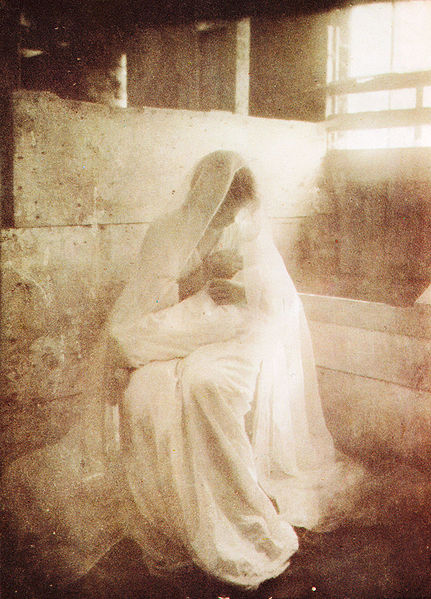
"The Manger" by American photographer Gertrude Kasebier (1852-1934).
The following is my homily for Masses on Christmas Eve and Christmas Day of 2009. The theme was prompted by Tania Mann’s article, “A Heart of Flesh,” in her on-line journal “This Very Life.”
The other night I watched an episode of the TV series “Dragnet” that was originally broadcast on Christmas Eve in 1953.
“Dragnet” was one of the first police shows on television, and it based all of its stories on cases in the files of the Los Angeles Police Department.
In this episode, two detectives investigate the disappearance of a statue of the infant Jesus from the manger scene in a church in a largely Mexican neighborhood.
The pastor of the church tells the detectives that the statue had almost no monetary value, and that he could replace it.
But it had been in the manger every Christmas for decades, and the people of this poor parish would find a new figure hard to accept.
The statue was returned in time for Christmas Day, and many Christians probably appreciate how important that was to the congregation.
Many families, like those parishioners, consider their manger scene a part of their tradition, and no matter how chipped or faded the figures may become, they are unpacked every year and put in their accustomed place.
Tradition plays a part in many Christmas observances, but this desire for continuity in the portrayal of the nativity is especially fitting.
Because the practice of erecting a manger scene as we know it, is itself 786 years old.
It was introduced by Francis of Assisi for a mass to be celebrated in Greccio, a hill town in Central Italy, at midnight on Christmas of the year 1223.
Francis used living figures, including animals, but his tableaux was the model from which the manger scenes of today have evolved.
He got permission from Pope Honorius III to create that display because he wanted to focus attention – including his own, he said – on the circumstances in which God entered the world in the form of the infant Jesus.
He wanted to be able to visualize – and help other people visualize – the humility with which God, in the person of Jesus, began the journey that would lead to the salvation of the world.
As a matter of faith, Francis and other Christians knew that God had put aside his divine nature – had covered it up, so to speak – and had taken on not only the appearance but the nature of a human being.
Francis and other Christians knew intellectually that that was an astounding act of love.
But Francis wanted to see for himself, and to show others, the full depth of that love that God had for his people – God, who did not come to save his people by overwhelming them or terrifying them, but by embracing them.
Francis wanted to experience that love – wanted others to experience that love – on more than the level of theology and philosophy.
And so he wanted to contemplate that improbable scene in which the Creator of the Universe, the source and cause of all that is, makes himself present not only in the form of a human being, but in the form of a poor, helpless infant – no wealthier, no stronger than the least of his own creatures.
That child, when he had grown to manhood, would say that there is no greater love than to lay down one’s life for his friends, and Francis knew that act of love began in the manger where God first gave himself – literally – to mankind.
Pope Benedict recently blessed hundreds of images of the infant Jesus that were brought to St. Peter’s Square by families preparing for Christmas.
And as he gave the blessing, the pope recalled the inspiration of St. Francis.
“The crib is a school of life,’’ the holy father said, “where we can learn the secret of true joy. This does not consist in having so many things, but in feeling loved by the Lord, (and ourselves) becoming a gift for others ….”
It is said that a teacher never knows where his influence ends, and St Francis, more than 700 years ago, cannot have known what he started.
But he taught his lesson well. It reverberates in our own time, as it did in the words of the late Cardinal Basil Hume:
“The birth of Jesus in the stable at Bethlehem is where all my questions begin to be answered.
“If I want to look on the face of utter love – if I want to see what the lover will do for the beloved – I … look on the image of the child lying in the manger.”
Netflix Update 24: “Edge of America”
December 21, 2009
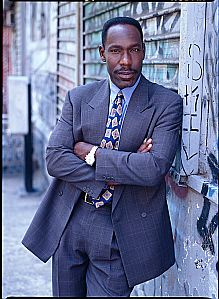
JAMES McDANIEL
We watched a 2003 Showtime movie, “Edge of America,” which concerns a black man who takes a job teaching English at a high school on an American Indian reservation. This was directed by Chris Eyre, the Cheyenne/Arapaho who was also responsible for “Smoke Signals,” and there are many similarities in mood and detail, including the wise-cracking radio personality.
Kenny Williams, McDaniels’ character, is maneuvered into taking over coaching duties for the school’s girls basketball team which, in a word, stinks. The short version is that he takes the team to the state championship finals, but not via the shortest distance. There are many obstacles, most of them born of Williams’ inability to quickly grasp the nuances of Indian culture and the realities of life for these impoverished and isolated people. He finds his way, however, with some prodding and shoving at the hands of the native people, and the movie becomes “To Sir With Love on the Rez.”

GERALDINE KEAMS
The story line and the outcome seem obvious, but there are excellent performances, including McDaniels’, which won him an Emmy. The Navajo actress Geraldine Keams is inspiring in the role of a tribal elder who is the skeptical mother of one of the team members, and Wes Studi, a Cherokee, is both credible and amusing as an auto mechanic who deftly helps the coach figure out his role in his unfamiliar surroundings. Irene Bedard, an Inuit/Metis actress, does a strong turn as a teacher who is forced to play conscience for the bungling Williams. An ensemble of young actors add a lot of guts to this film in their roles as players and students at the school.
“Edge of America” is based on the experience of Jerry Richardson, who died in an auto accident while he was head coach of the women’s basketball team at the University of Central Florida. This is how Richardson’s career was described on Humanities and Social Sciences Net Online:
Jerry Richardson, age 40, has been at UCF through four seasons and in that time has become a strong and quiet force on campus and in the community. He inherited a troubled program and last season took his team to a conference tournament championship and the NCAA tournament, a first for the UCF women’s program. Not only was he building a program, but more importantly he was having a significant impact on the lives of young women in Central Florida.
This of course is not surprising. Jerry Richardson came to UCF from the Navajo Nation Reservation in Shiprock, New Mexico, where he transformed a struggling high school women’s team into four-time State Champions. From 1982 to 1993 Jerry Richardson made the Lady Chieftans of Shiprock into a story of mythic dimensions. More importantly he changed the lives of the young women he coached. Eighty percent of them went on to college, mostly as non-athletes; this at a school with a fifty percent dropout rate in a population beset with poverty and alcoholism.
Richardson believed, and made his players believe, that there was nothing you could not do as long as you had two things: opportunity and a positive attitude. Jerry Richardson brought both to Shiprock and to UCF.
He was above all a teacher, not a coach. He understood the ephemeral character of victory on the courts, and the significance of preparing his women for life after basketball. “The trophies gather dust, the kids don’t, they keep moving,” he said. Jerry Richardson’s players moved on, well prepared for the world after basketball.
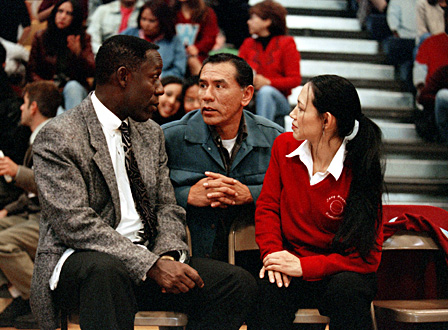
JAMES McDANIEL, WES STUDI, and IRENE BEDARD in "Edge of America"
“I will honor Christmas in my heart and try to keep it all the year.” — Ebenezer Scrooge (“A Christmas Carol”)
December 19, 2009

Alistair Sim as Ebenezer Scrooge and Brian Worth as his nephew, Frederick
“There are many things from which I might have derived good, by which I have not profited, I dare say,” returned the nephew. “Christmas among the rest. But I am sure I have always thought of Christmas time, when it has come round–apart from the veneration due to its sacred name and origin, if anything belonging to it can be apart from that–as a good time; a kind, forgiving, charitable, pleasant time; the only time I know of, in the long calendar of the year, when men and women seem by one consent to open their shut-up hearts freely, and to think of people below them as if they really were fellow-passengers to the grave, and not another race of creatures bound on other journeys. And therefore, uncle, though it has never put a scrap of gold or silver in my pocket, I believe that it has done me good, and will do me good; and I say, God bless it!”

Michael Hordern as the ghost of Jacob Marley and Alistair Sim as Ebenezer Scrooge
“It is required of every man,” the Ghost returned, “that the spirit within him should walk abroad among his fellowmen, and travel far and wide; and if that spirit goes not forth in life, it is condemned to do so after death. It is doomed to wander through the world–oh, woe is me!–and witness what it cannot share, but might have shared on earth, and turned to happiness!”
***
“Business!” cried the Ghost, wringing its hands again. “Mankind was my business. The common welfare was my business; charity, mercy, forbearance, and benevolence, were, all, my business. The dealings of my trade were but a drop of water in the comprehensive ocean of my business!”
***
“At this time of the rolling year,” the spectre said, “I suffer most. Why did I walk through crowds of fellow-beings with my eyes turned down, and never raise them to that blessed Star which led the Wise Men to a poor abode! Were there no poor homes to which its light would have conducted me!”

Francis de Wolff as the Spirit of Christmas Present and Alistair Sim as Ebenezer Scrooge
“There are some upon this earth of yours,” returned the Spirit, “who lay claim to know us, and who do their deeds of passion, pride, ill-will, hatred, envy, bigotry, and selfishness in our name, who are as strange to us and all our kith and kin, as if they had never lived. Remember that, and charge their doings on themselves, not us.”
***
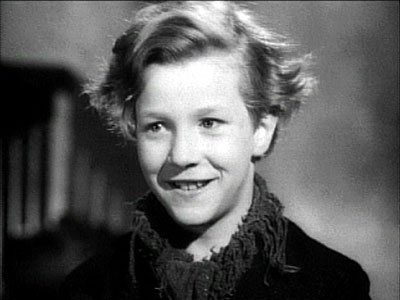
Glyn Desarman as Tiny Tim Cratchit
“Spirit,” said Scrooge, with an interest he had never felt before, “tell me if Tiny Tim will live.”
“I see a vacant seat,” replied the Ghost, “in the poor chimney-corner, and a crutch without an owner, carefully preserved. If these shadows remain unaltered by the Future, the child will die.”
“No, no,” said Scrooge. “Oh, no, kind Spirit! say he will be spared.”
“If these shadows remain unaltered by the Future, none other of my race,” returned the Ghost, “will find him here. What then? If he be like to die, he had better do it, and decrease the surplus population.”
Scrooge hung his head to hear his own words quoted by the Spirit, and was overcome with penitence and grief.
“Man,” said the Ghost, “if man you be in heart, not adamant, forbear that wicked cant until you have discovered What the surplus is, and Where it is. Will you decide what men shall live, what men shall die? It may be, that in the sight of Heaven, you are more worthless and less fit to live than millions like this poor man’s child. Oh God! to hear the Insect on the leaf pronouncing on the too much life among his hungry brothers in the dust.”
***

Glyn Dearman as Tiny Tim Cratchit and Alistair Sim as Ebenezer Scrooge
Scrooge was better than his word. He did it all, and infinitely more; and to Tiny Tim, who did NOT die, he was a second father. He became as good a friend, as good a master, and as good a man, as the good old city knew, or any other good old city, town, or borough, in the good old world. Some people laughed to see the alteration in him, but he let them laugh, and little heeded them; for he was wise enough to know that nothing ever happened on this globe, for good, at which some people did not have their fill of laughter in the outset; and knowing that such as these would be blind anyway, he thought it quite as well that they should wrinkle up their eyes in grins, as have the malady in less attractive forms. His own heart laughed: and that was quite enough for him.
He had no further intercourse with Spirits, but lived upon the Total Abstinence Principle, ever afterwards; and it was always said of him, that he knew how to keep Christmas well, if any man alive possessed the knowledge. May that be truly said of us, and all of us! And so, as Tiny Tim observed, God bless Us, Every One!
“To love at all is to be vulnerable” — C.S. Lewis
December 18, 2009
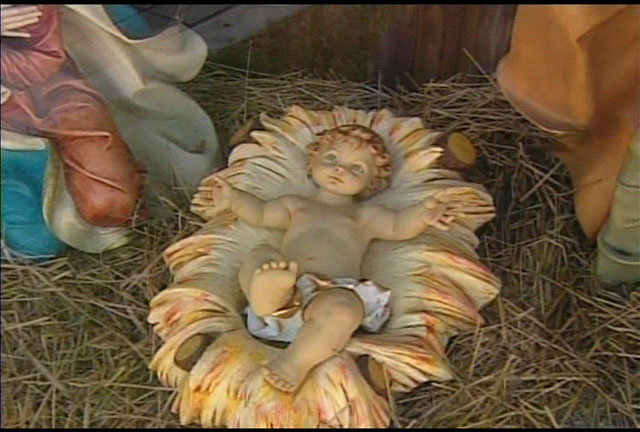 There are two things I still have to dig out in order to observe Christmas properly. One is the heirloom manger figures; the other is the DVD of the “Dragnet” episode in which the statue of the infant Jesus is stolen from a creche in a Los Angeles mission church. That’s the original 1953 version with Ben Alexander playing Frank Smith.

JACK WEBB and BEN ALEXANDER
For the benefit of the uninitiated, LA detectives Joe Friday (Jack Webb) and Frank Smith are called to a church in a Latino neighborhood by Father Rojas because the statue has gone missing as the Christmas morning Masses are approaching. The poker-faced cops mechanically set about looking for the culprit, but have to return to the church on Christmas Eve to tell the priest that they have come up dry. While they’re standing with him near the sanctuary, they hear a racket coming from the direction of the front doors, and a little boy, Paco Mendoza, comes up the center aisle pulling the statue in a wagon. When the priest questions him in Spanish, the boy explains that he had promised that if he got a wagon for Christmas, Jesus would get the first ride. Frank Smith wonders aloud that the boy has the wagon already, before Christmas arrives. In one of the great exchanges in television history, the priest explains that the wagon didn’t come from the usual source; it was one of the toys refurbished by members of the fire department. “Paco’s family,” he tells the detectives, “they’re poor.” To which Friday, glancing at the Christ child back in its crib, says in his monotone: “Are they, Father?”
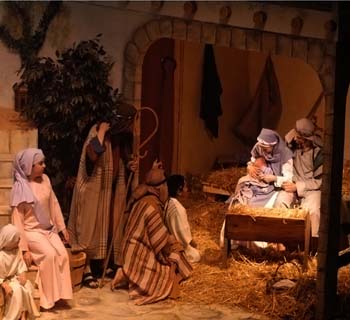 Our manger scene consists of white plaster figures, made in France, that belonged to my mother. She told me that she received the set from a Syrian priest when she was a child, and it wasn’t new then. Most of the figures have been broken and repaired one or more times, and one of the animals mysteriously disappeared about ten years ago. The set has a classic look to it, so we wouldn’t consider replacing it. It’s a few cuts above those translucent, illuminated plastic ones that have appeared on various lawns in the past week or so.
The tradition of assembling a manger scene — living or otherwise — originated in the 13th century with Francis of Assisi. The “Dragnet” crowd apparently wasn’t familiar with the tradition in which the image of the child is not placed in the manger until Christmas Eve, in time for the midnight Mass. A church like the one depicted in that episode would almost certainly have adhered to that custom. I have noticed that the child hasn’t been placed even in many of the lawn scenes that are out there now.
 The child, of course, is the centerpiece of the feast, the vulnerable, innocent child who is both God and man in the belief of hundreds of millions of Christians. Why would God appear in human form — and as a newborn child? There is a learned and lovely reflection on this question on the blog “This Very Life,” written by Tania Mann in Rome. Those who are going to celebrate this holy day — and are very busy getting ready for whatever it implies for them — might want to spend a few minutes contemplating the reason for it all. If so, click HERE.
 CharlesPaolino's Blog