Where have you gone, Carmen Miranda?
April 21, 2011
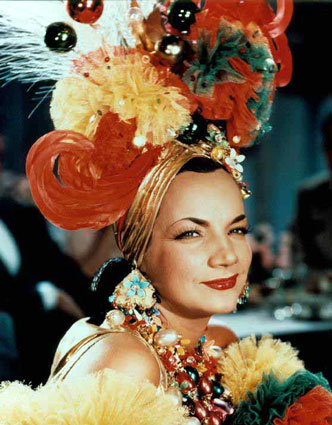 The allusion to Carmen Miranda on this week’s episode of “Modern Family” got us to thinking about her for the first time in recent memory. Our first reaction was to wonder how many people in, say, their 40s or less who were watching that show would have known who Carmen Miranda was. When she was in her heyday, there was no need to ask; she was very popular — with good reason — and she was very successful.
 Carmen Miranda was born in Portugal in 1909, but she grew up in Brazil. She began performing at an early age, although financial stresses on her family led her to a short-lived but profitable career as a milliner. She continued to pursue her musical career, though, and before she came to the United States in 1939, she was already established as a star on radio, recordings, and film. She ultimately made 14 Hollywood movies and at one point was the highest-paid woman in the industry. She also made occasional appearances in the variety-show format that was a staple in early American television.
 Carmen Miranda was subject to some criticism in Brazil during her lifetime on the grounds that she had become too Americanized and was presenting an inaccurate image of Brazilian culture. She was so upset by this evaluation of her work that she stayed away from Brazil for many years. Now, however, she is memorialized by museums in both Brazil and Portugal. She is also the namesake of Carmen Miranda Square at the intersection of Hollywood Boulevard and Orange Drive, across from Grauman’s Chinese Theater.
Talking baseball
March 10, 2011

PETER SCOLARI
But to put that story in context, Scolari told me that his father — attorney Art Scolari — had played baseball at East Side High School in Paterson (this would have been long before Joe Clark got there) and then was an All-American shortstop at Drew University. Paterson? I was born in Paterson. My dad, who was about 13 years older than Art Scolari, went to Central High School where he ran track — particularly relays — and later managed a semi-pro baseball team that played all around the Paterson area.

PETER SCOLARI / New York Daily News
I haven’t told Peter Scolari this yet, but after our conversation, my web browser stumbled on a story in a 1939 issue of the old Daily Record of Red Bank, N.J., reporting that a teenager named Lawrence Mahoney, who was from Lincroft, had successfully defended his state horseshoe pitching championship for the fifth time in a row. It was no snap, according to the story: breathing down Mahoney’s neck was 15-year-old Art Scolari of Paterson. Mahoney was 9-0 in the tournament; Scolari was 8-1.
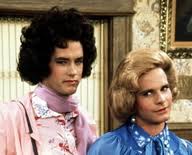
Tom Hanks and Peter Scolari in their "Bosom Buddies" regalia
I could have talked about baseball all night — it’s one of my many excuses to talk too much — but I was at the George Street Playhouse in New Brunswick to talk to Peter Scolari about his current project, a production of Ken Ludwig’s new play, “Fox on the Fairway.” This play, with a golf theme, had its world premiere last year in Washington, D.C. It’s a farce, and that’s a word that sends up the skyrockets, because farce done badly — or even done “all right” — is a painful experience for an audience. I’ve been there. Scolari, who knows a lot more about it than I do, made that point: “I don’t like to see a farce in which folks do an okay job. I’ll watch ‘The Sunshine Boys’ or ‘The Odd Couple’ and have a great time if everybody does a ‘good’ job. If I go to a farce and everybody does a ‘good’ job, I think, ‘Why did you do this?’ ”
I’ve read Ludwig’s play, but reading farce is like reading a recipe. It lays out the parts and the moves, but it can’t even hint at the reality. I have also read at least one negative review of the Washington production, but the fact that a farce doesn’t work with one company doesn’t mean it won’t work with another. Ludwig, after all, is the author of “Lend Me a Tenor” and “Crazy for You,” both of which won him Tony awards. And Scolari knows a thing or three about playing comedy in general and farce in particular.
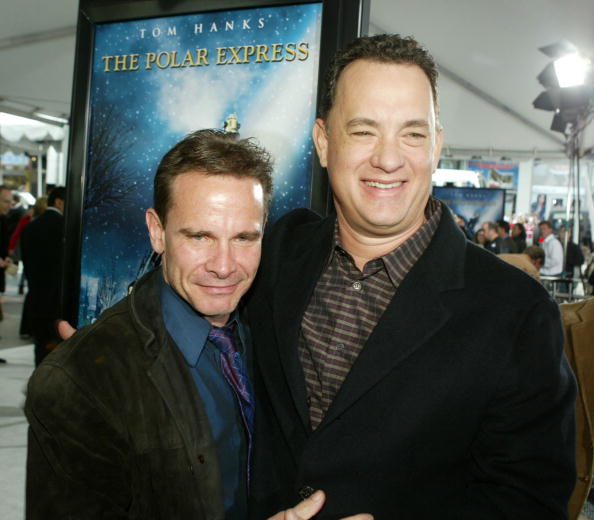
Peter Scolari and Tom Hanks in 2004 at the premiere of "Polar Express" in which they both appeared
Scolari first drew national attention in 1980 when he co-starred with Tom Hanks in “Bosom Buddies,” a TV sit-com about two young men who dress in drag so they can live in a women-only hotel where the rent is dirt cheap and about what they can afford. The show, which lasted a couple of seasons, was indirectly inspired by the Billy Wilder movie “Some Like it Hot.” Since then, Scolari has put together a long resume of television and stage appearances, mostly in comedies, including 142 episodes of Bob Newhart’s second hit series, “Newhart.”
Talking to Scolari, who is witty, thoughtful, and articulate, was an entertainment in itself. If I weren’t aware that I was keeping him from his train after he had spent a full day of rehearsal, I would have prompted him to talk for another hour, just so I could listen. If I had had unlimited time and he had had unlimited patience, I would have steered him back around to baseball, because no sport lends itself to talk as well as baseball does, and my guess is that Scolari appreciates that as much as I do. I asked him which New York team he roots for now that he is living on the East Coast again after his sojourn in California. He could have simply said that he roots for the Yankees, but this wasn’t a guy answering questions. This was a guy talking baseball:

Thurman Munson, Yankees catcher, captain, All-Star, and MVP, was killed in a plane crash in 1979. He was 32.
“I follow the Yankees. I make no apologies about it, but they’re not the Yankees. For me the Yankees who owned my heart ended with the captain, with Thurman Munson. I never got over that, to be honest with you, as a fan. So you come back, and they’re your team, and they’re in the Bronx, and that’s really important — but it’s not quite the same.”
Who is that woman?
June 15, 2010

ANNE SEYMOUR
At last, I know. I have been wondering for decades about an actress who had a brief role in an episode of “The Honeymooners,” and last night I found out by chance who she was.
The episode – one of the so-called “classic 39” – is a Christmas story in which Ralph Kramden saves money to buy Alice a present, but spends it on a bowling ball. Then he uses what money he has to buy a hairpin box that’s made of 2,000 match sticks glued together, believing the salesman’s story that the box came from the home of the Emperor of Japan. On Christmas Eve, before Ralph gives Alice this present, a neighbor – Mrs. Stevens – comes to the door and says she’s going to be away for the holiday and wants to give Alice a present before leaving. Of course, when Alice opens the package it’s a box just like the one Ralph bought, and the neighbor says she bought it at a novelty shop near the subway station.

ANNE SEYMOUR
The rest of that story doesn’t matter. What matters — to me, at least — is that I have always felt that the woman who played that small part was a wonderful actress. She created such a strong impression of Mrs. Stevens as warm and self-effacing that, even as a kid, I had a feeling that I’d like her to be my neighbor or even a member of my family — an aunt, maybe. Every time I see that episode, I’m entranced by that actress’s performance. But “The Honeymooners” producers were stingy with the credits, so the actress wasn’t identified.
So the other might I watched the 1949 version of “All the King’s Men” on TCM. The film is based on a Pulitzer Prize-winning novel by Robert Penn Warren, and it is the story of Willie Stark, a corrupt politician modeled after Huey Long. I had not seen it before, and the first time I heard the voice of the actress playing Stark’s wife, Sally, I knew my question had been answered. A little Googling confirmed that the Kramdens’ neighbor was portrayed by Anne Seymour.
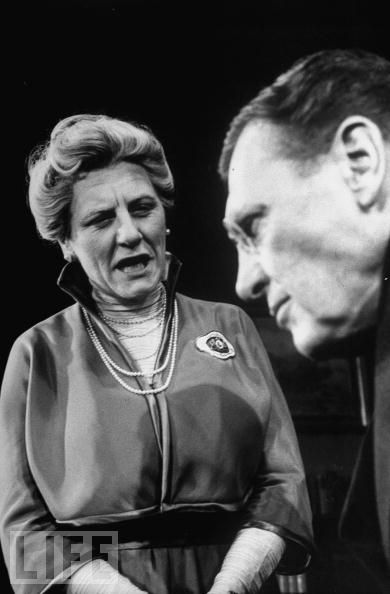
ANNE SEYMOUR and RALPH BELLAMY
Anne Seymour, it turns out, had an extensive career. The International Movie Database lists 121 film and television appearances for her between 1944 and 1988. “All the King’s Men” was her second movie. Her last was “Field of Dreams.” She played the newspaper publisher in Chisolm, Minnesota who helped Ray Kinsella learn about Dr. Archie “Moonlight” Graham.
The actress’s birth name was Anne Eckert, and her family was in the theater for at least seven generations dating back to the early 18th century in Ireland. Her brothers, James and John Seymour, were screen writers. Anne made her stage debut in 1928, and she later also worked in radio drama. Though she spent the bulk of her career working in television, she played Sara Delano Roosevelt, the mother of Franklin Roosevelt, in the 1958 Broadway production of “Sunrise at Campobello,” for which Ralph Bellamy won a Tony award for his portrayal of FDR. Although Anne Seymour got good review for her work in that play, she was not cast in the film version.

THOMAS AQUINAS
“The truth of our faith becomes a matter of ridicule among the infidels if any Catholic, not gifted with the necessary scientific learning, presents as dogma what scientific scrutiny shows to be false.”
Thus spake the Dominican priest Thomas Aquinas in the 13th century. Aquinas was a master of the syllogism, and his idea of scientific scrutiny was that conclusions had to be based on premises which themselves were either self evident or had been objectively demonstrated. I thought of Aquinas when I wrote a post yesterday about Albert Einstein, who was in the business of putting together premises and conclusions. In a sense, Aquinas and Einstein came at the question of the origins of the universe from opposite directions. Aquinas was a man of faith, but he believed — and sought to demonstrate in his “Summa Theologica” — that a person could arrive at the existence of a First Cause — God — through reason alone.
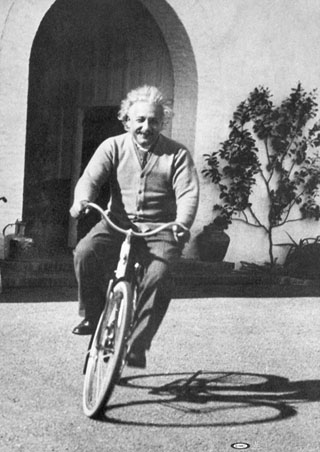
ALBERT EINSTEIN
Einstein didn’t believe in God in the sense that Jews and Christians and Muslims do. In that sense, he didn’t believe in a god at all, no matter how hard religious folks try to hear him saying otherwise. However, Einstein’s lifetime of inquiry into the physical laws that govern the universe did lead him to speculate — forgive me if I don’t express this precisely — that somewhere beyond the seemingly endless questions about the universe must lie some force that governs it.
I recently discussed all this — Aquinas, Einstein, God, the origin of the universe — with, of all people, the actress Sandy Duncan.

SANDY DUNCAN
By “of all people,” I don’t mean to imply that there is anything surprising about Sandy Duncan discussing such things. In fact, I gathered she gives such things quite a bit of thought and has had provocative conversations about them with her two adult sons. I only meant that I would be unlikely to talk to Sandy Duncan at all, except that she was scheduled to appear in a new play that examines the outfall that can occur when science and religion collide head-on. The actress was to play the title role in “Creating Claire” by Joe DiPietro, but she took ill, withdrew from the cast, and was replaced by another talented performer, Barbara Walsh.

JOE DiPIETRO
DiPietro’s play begins previews tomorrow night at the cradle of new theatrical works, the George Street Playhouse in New Brunswick. The title character, Claire Buchanan, is a teacher but now works as a docent at the Museum of Earth and Sky in upstate New York. She leads visitors on the Origins of Life Tour, reciting a script that focuses on the evolution of species. The script is the brainchild of Victoria Halstead, museum director and friend of Claire – in that order, as things work out. Victoria encourages a docent to “personalize” the presentation as long as the glosses are innocuous, but Claire is no automaton, especially when a reference in the script to “random mutation” complicates her attempt to understand a fact of her own life. Claire and her husband, Reggie, have an autistic 16-year-old daughter, Abigail, and Claire has been considering how the process described by Charles Darwin could result in an individual such as Abigail. Eventually, Claire’s contemplation creeps into her talks at the museum as she suggests to visitors that the processes of nature may have been – gasp! – designed. Once that genie is on the loose, there is hell to pay, as it were.

LYNN COHEN
Victoria — to be played by Lynn Cohen — puts her own belief in science and her vision for the museum ahead of friendship when she learns about Claire’s transgression. Reggie – a high school teacher who has considered his bond to Claire a “mixed marriage” only to the extent that he is an atheist and she is an agnostic — is stunned by this change of Claire’s train of thought. Disagreements over Abigail’s status have already revealed strains in the couple’s relationship; Claire’s public speculation about a “designer” pushes those strains to the breaking point.
This play, however, is not a death struggle between science and religion so much as an examination of intellectual openness and honesty. Claire is willing to at least entertain an idea that had been anathema to her but does not insist that others accept that idea. Victoria and Reggie opt to defend their “rightness,” as Duncan called it, regardless of the professional or personal consequences. The implications for contemporary political discourse may be painfully obvious.
Believe in God or not, but in the end it is Claire, and not the more “scientific” Victoria and Reggie, who seems to have heeded Einstein: “Only daring speculation can lead us further, and not accumulation of facts.”
“How long ya’ gonna be gone?” — Ruby and Kalmar
May 14, 2010

Sheet music to "So Long, Oolong"
When Patricia T. O’Conner, author of popular books on English usage, visited the Leonard Lopate show on WNYC this week, the segment was introduced by a vocal of the song “Three Little Words,” which made me think of Harry Ruby. Ruby and his longtime colleague, Bert Kalmar, wrote that song in 1930 for what would now be considered an offensive movie.
The film was “Check and Double Check” — the only movie made by Freeman Gosden and Charles Correll in their blackface roles as Amos Jones and Andrew H. Brown — characters they made famous with their long-running radio series, “Amos ‘n’ Andy.” The song didn’t get small-time treatment in the film; it was performed by Bing Crosby and the Duke Ellington Orchestra.
The song also lent its name to the title of the 1950 film biography of Ruby and Kalman.

HARRY RUBY
Harry Ruby first came to my attention when I was a kid, and he made a guest appearance on the Danny Thomas television show, “Make Room for Daddy.” Ruby sang another song he had written with Kalman, one that — some might say mercifully — is not as well known as “Three Little Words.” The 1920 tune was “So Long, Oolong. How Long Ya’ Gonna be Gone,” which had racist overtones, as did so many Tin Pan Alley songs written in that era.
The song is about a Japanese girl named Ming Toy, whose boyfriend left for what was supposed to be a short spell but turned into a long spell. Hence the chorus: So long, Oolong, how long ya’ gonna be gone?”

BARBRA STREISAND
Ruby and Kalman were prolific, and some of their work was much more sophisticated than the Oolong affair. For example, they wrote “My Honey’s Lovin’ Arms,” which got a signature performance many years later in “The Barbra Streisand Album.” The pair also wrote “Who’s Sorry Now?” “Nevertheless (I’m in Love with You),” “A Kiss to Build a Dream On,” and the Betty Boop theme, “I Wanna be Loved by You,” among others.
As talented and productive as Ruby was as a songwriter, though, what I like best about him is that he always wanted to be a baseball player. He tried, unsuccessfully to make it into the pros, and he never missed a chance in later life to get close to the game. His devotion to the sport is the source of one of the great baseball anecdotes.

LOU GEHRIG
Ruby seized an opportunity to appear in “Elmer the Great,” a sports movie starring the comedian Joe E. Brown, who was also a devotee of baseball. The movie was shot at the old Wrigley Field, a minor league park in Los Angeles. One of the scenes called for an player, to be portrayed by Ruby, to drop a ball hit to him in the outfield. Ruby walked off the set, insisting that he wouldn’t drop a ball on purpose for any amount of money. Later, when Brown and Ruby happened to be in the company of Lou Gehrig, Brown told that story, figuring that Ruby would be embarrassed. Gehrig, with a straight face, said it was the greatest baseball story he had ever heard

MAURA TIERNEY
I learned something about myself yesterday: I’m not hip. I thought otherwise, but yesterday I saw The Wooster Group’s musical play — at least, I think that’s what it was — at the Baryshnikov Arts Center in New York, and I realized that I am a Pod.
This play, which has been around in one form or another since 1983, is called “North Atlantic.” That’s because it is set on an American aircraft carrier, during the cold war, off the coast of the Netherlands. It’s 90 minutes long. The creators have opted for no intermission. No doubt they had in mind to maintain the continuity of the piece at which, in a certain sense, they succeeded. The piece certainly continued — so much so that 90 minutes seemed like a geologic epoch. Another benefit of eschewing a break, perhaps unintended, is that the audience stayed to the end. I know four people who would have opted for an earlier dinner at Park and Orchard.

FRANCES McDORMAND
Far from disliking experimental theater, I have always appreciated it. But then, I have always understood it. In 1969, for example, I saw Omar Shapli’s play, “Rules for the Running of Trains on the Erie Railroad to go into Effect on Jan. 1, 1882 – Section 10,” and I understood that the frenetic activity and the references to the Haymarket Riot and the reportage of Nelly Bly was painting a portrait of American life, and the hypocrisy that affected it, at the turn of the 20th century.
By contrast, at the Baryshnikov yesterday, I had no idea what was going on, and I’d wager that most of those in the theater who pretended that they did understand were embarrassed to admit the truth. The program was an unbroken stream of scrambling about, incongruous argument, unprovoked yelling, and filthy sexual repartee. The actors frequently and by design talked over each other so that any chance, however remote, that a clip of dialog here or there would make sense was conclusively thwarted. It may be apocryphal, but I heard a rumor that the playwright, James Strahs, appeared backstage in a fury after the show because he thought he had heard a coherent sentence.

A scene from "North Atlantic"
This play, which has been revised and revived several times over the decades, is offered as a spoof of programs such as, say, “South Pacific,” that portray life in the military. If I hadn’t learned better, I’d have thought that it was a sophomoric attempt at best. The constant stream of graphic references to penises and vaginae and variations of intercourse sounded more like a spoof of the conversations in the locker room at Passaic Valley High School, say around 1958. It turns out, though — as it frequently does in my life — that I was on the outside looking in. The critic in the Los Angeles Times, commenting on the West Coast run of this revival, said so in so many words: “The piece navigates in a zone that will be a delight to devoted fans and avant-garde hipsters but will probably leave ordinary theatergoers dog-paddling to safety.”
All this time, I thought I was an avant-garde hipster, whereas I was actually the duffer flapping around at the shallow end of the pool.
I have only myself to blame for this rather expensive faux pas. I talked my companions into seeing this play because Maura Tierney was in the cast. My wife and I had seen her two previous appearances on New York stages, and I didn’t think we needed any more evidence than her magnetic presence in those plays and my general conviction that she is a fine actress. It wasn’t discouraging at all to also note that Oscar winner and Tony nominee Frances McDormand is in the ensemble.
I’m going to see Boyd Gaines in A.J. Gurney’s play “Sylvia” later this week. It’s about a man who brings home a stray dog he finds in a park. I think I’ll understand it.

Some of the players in "North Atlantic"
Say, who is that guy, anyway?
December 23, 2009

HERB VIGRAN
When we were watching the “Dragnet” Christmas episode the other night, a familiar face appeared. It was the clerk at a fleabag hotel. And as we do every time we see him, we said, “Wow, that guy must have made a thousand movies and TV shows.”
This time for a change, I decided to find out who he was, and he turned out to be character actor Herb Vigran. According to the International Movie Database, he appeared in 314 TV episodes and movies between 1934 and 1987. His last film, “Amazon Women on the Moon,” was released the year after his death.
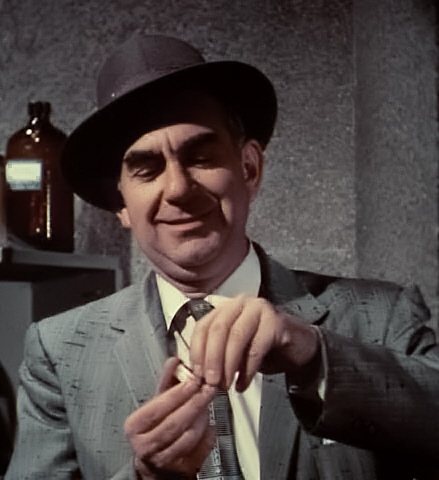
HERB VIGRAN
Vigran held a law degree, but he never practiced law because he was in love with acting. Besides all the TV and movies, he did some stage work, including the 1936 Broadway classic “Having a Wonderful Time” with John Garfield and Eve Arden. He also worked in radio and was a regular on “The Jack Benny Program” before doing three years of military service during World War II.
His hundreds of TV jobs included multiple appearances on “The Adventures of Superman,” the original “Dragnet” and the later revival, “The Jack Benny Show,” “I Love Lucy,” and “Gunsmoke.”
He was so successful as a character actor that he had one of the most familiar faces in America — he looked like your Uncle Ed — but he rarely played the same part twice and was known to most of his audience as “Wotzisname.”

Herb Vigran in an episode of "The Adventures of Superman"
“. . . one expects to find intelligence.” — Leopold Stokowski
November 26, 2009

ELIZABETH MOREHEAD "Noel"
When Elaine Benes broke up during a piano recital because Jerry Seinfeld had put a Pez dispenser on her knee, Noel the pianist played on. Oh, she was plenty upset, but she didn’t acknowledge the distraction and continued to play.
Not every artist has that kind of composure. About 45 years ago, I was at a concert at Seton Hall University at which Leopold Stokowski was conducting the American Symphony Orchestra. Some people came in after the concert had started. I guess we were all aware of the doors opening and closing and the latecomers making their way into the gymnasium, but — hey — it happens.
Well, tell that to Stokowski.
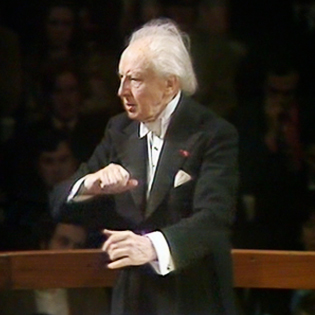
LEOPOLD STOKOWSKI
He stopped the orchestra in the middle of the first piece, turned around and glared into the darkened gym. When the place had settled down, he went to the microphone and said, “You have to excuse me. When one comes to a place of learning one expects to find intelligence.” Then he returned to his place and started the concert again.
Of course, that’s a reasonable expectation on both sides of the footlights, so to speak. But the principle apparently is lost on Ian Hart, who went to pieces during a performance of “Speaking in Tongues,” a play on London’s West End for which he has gotten good notices. And, according to an account in The Times of London, witnesses say Hart’s threatening verbal abuse of a patron in the theater was without any basis except in the actor’s imagination.
Gerald Earley — the target of Hart’s ranting — said that a certain point in the proceedings, the actor had become “pretty feral,” which I thought was a delightful choice of words. Hart brushed off the incident as silly, but he also admitted he doesn’t like acting in the theater because he doesn’t “enjoy the relationship between the audience and the actor,” and, may I say, there’s a simple solution to that.
For The Times’ account of Hart’s outburst, click HERE.
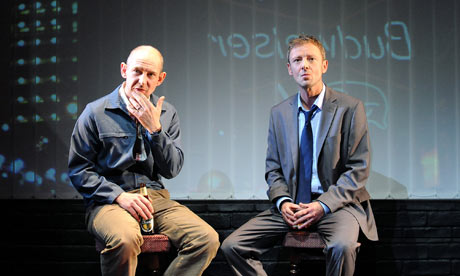
Ian Hart and John Simms in "Speaking in Tongues"
“Live and let live; love and let love.” — D.H. Lawrence
November 22, 2009

JANE ALEXANDER Photo by Jason Towlen/Gannett NJ
Every so often I see a play that takes such a piercing look at the interior lives of individuals and at the relationships with a family that I begin to feel as if I shouldn’t be watching it. I had that reaction the first time I saw Neil Simon’s “Lost in Yonkers,” and particularly the scene in which Bella explains her needs as a woman to her stern Prussian mother. I literally squirmed in my seat.
I got that feeling last night while we were watching Thom Thomas’s new play, “A Moon to Dance By,” which is about Frieda Lawrence, who was married to novelist D.H. Lawrence and was the inspiration for the principal women in several of his works.
The action in this play, which we saw at the George Street Playhouse in New Brunswick, N.J., takes place after the writer has died. Frieda has moved to New Mexico with her lover, Angelo Ravagli. Jane Alexander plays Frieda, and Robert Cuccioli plays Ravagli.

JANE ALEXANDER as Frieda Lawrence / George Street Playhouse
Frieda left her husband and three children to elope with Lawrence, who had been her husband’s student in England. Her contact with her children was sporadic after that, and while she was able to establish a more or less normal relationship her daughters, her son, Monty, remained distant. In this play, Monty — now a grown man with a family of his own — pays his first visit to Frieda in New Mexico.
The relationship between a mother and her son is a unique thing in nature and one that probably is not explored more than superficially in most families. It certainly wasn’t in my experience.
“I have a son and two step-sons,” Jane Alexander told me before this play opened, “and we’ve never had that conversation. I have it with my daughter-in-law. Mothers and daughters, I think, are far more intimate about life’s intimacies than mothers and sons.”
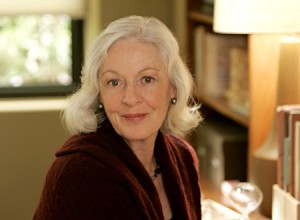
JANE ALEXANDER
Nonetheless, mother and son have “that conversation” in this play, and it is mesmerizing on the one hand and difficult to watch on the other. I know I wasn’t alone in that reaction; I talked to others in the audience afterwards, and they agreed — but they needn’t have, because the tension was palpable in the house.
It didn’t hurt that this wonderful script was being performed by Alexander and Cuccioli and that Monty was being played by a brilliant actor, Gareth Saxe, in one of the most finely nuanced performances I can remember. The young man arrives at his mother’s home hell-bent on expressing his disapproval and disappointment but not acknowledging even to himself what he really needs to get from her and what he needs to give her from the store of emotions he has bottled up for decades.
It was uncomfortable, and it was great theater.
“There is only one pure state of acting … that you don’t know what you’re going to say.” — Shirley Knight
October 6, 2009

This story is based on an interview I had with Shirley Knight for the Home News Tribune and the Asbury Park Press.
NEW BRUNSWICK: Shirley Knight is in the cast of Arthur Laurents’ new play, but she will not give a single performance.
The actress — a Tony and Emmy winner and an Oscar nominee — will appear at George Street Playhouse in Laurents’ drama “Come Back, Come Back, Wherever You Are.”
She will create the role of Marion, a psychological therapist who — along with the other four characters in the play — is trying to cope with the implications of the death of her charismatic son, Paolo.
The others are Sara, a professional singer — played by Alison Fraser — who was married to Paolo for 27 years; Richard — played by John Carter — who was Paolo’s father; Michelle — played by Leslie Lyles — Paolo’s disaffected sister; and Dougal — played by Jim Bracchitta — who competes with Paolo’s lingering influence as he courts Sara.
Laurents, 92, who will direct this production, has woven into the play both the kind of introspective and unblinking discourse that has characterized most of his works and an underlying conviction that love is the most important factor in a human life.

ARTHUR LAURENTS
The playwright, who has recently directed the Broadway revival of “West Side Story,” for which he wrote the book, has introduced several plays and dozens of new characters on the George Street stage.
As Shirley Knight gives life to one of his newest characters, she said, she will approach the opportunity with a mindset that is necessary if Marion is to be spontaneous and, therefore, credible.
“I never give a performance,” the 73-year-old actress said. “Each night, I have another rehearsal. And that is essential because if you just do a rerun of what you did the night before or the week before or on opening night, it would be unbelievably boring.”
When she appears onstage at any time during the run of this play, Knight said, she won’t be acting Marion so much as she will be Marion. And that will mean that she won’t anticipate what will occur, no matter how many times she has heard it.

SHIRLEY KNIGHT IN 1966 ROLE
“There really is only one pure state of acting,” she said, “and that’s that you don’t know what you’re going to say, you don’t know what you’re going to do. You don’t know what the other person is going to say or do. You don’t know where the play is going. You have to do a play as if you haven’t read the play.
“Now, of course, you have read the play — but you cannot be in that state of knowing. You have to be in the state of going absolutely from moment to moment.”
The actress has honed this approach in 35 stage plays over the past five decades. She has also appeared in 49 films, 162 television productions, and a dozen radio dramas.
While she was engaged in this busy career, Knight — who holds a doctorate in fine arts — also managed to have a family life. Her husband, John R. Hopkins, was a prominent film and television writer. She has two daughters — actress-singer Kaitlin and TV-stage writer Sophie.

KAITLIN HOPKINS
“Kaitlin at the moment is doing something different,” Knight said. “She just finished a year’s tour of “Dirty Dancing,’ and she has taken over the theater department at Texas State University. My youngest daughter (Sophie) is writing plays and teaching school in Los Angeles. She has her master’s from Columbia in English and fiction writing, and now she wants to teach.”
From her own prolific and varied career, Knight can mention several high points, though she seems to have a special place in her heart and memory for “Dutchman,” a 1967 film she produced, an adaption of a play by Amiri Baraka about the explosive relationship between a coarse, racially biased young white woman and a mild black man.
The play won Knight the Volpi Cup as best actress at that year’s Venice Film Festival, and “Dutchman” was named best film of the year at Cannes.
“We shot it in five days,” she recalled. “It was on a shoestring. In the year 2000 when the Whitney Museum did “Great Art of the 20th Century,’ the only film they showed about civil rights was “Dutchman.’ That made me very happy.”

PORTRAIT OF SHIRLEY KNIGHT BY JASON TOWLEN OF GANNETT NEW JERSEY
 CharlesPaolino's Blog