Netflix Update No. 55: “Lovely, Still”
November 14, 2011
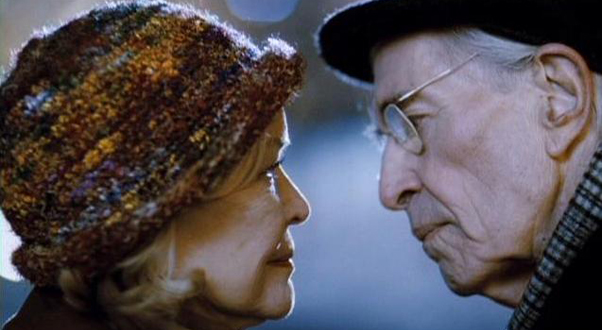
ELLEN BURSTYN and MARTIN LANDAU
After we watched Lovely, Still, a 2008 film starring Ellen Burstyn and Martin Landau, I poked around on the Web and found the widest possible range of opinons — from a contemptible piece of trash to a work of genius. Put me down as confused, which I guess is somewhere between the extremes. This movie, directed and written, in part, by Nicholas Facker, concerns elderly Robert Malone (Landau), who appears as a solitary man who lives alone and works at a nearby supermarket — near enough that he has been walking to work since he crashed his car into his garage door.

MARTIN LANDAU
During his lunch breaks at the market, Robert passes the time making pencil drawings that reveal a high level of skill that seems out of place in a man whose life is so drab and pointless. While he is drawing one day, he is approached by Mary (we are not told her last name), played by Burstyn. She introduces her self and tells him that she admires his drawing. When Robert returns home that evening, he finds the front door of his house ajar. Unaware that he didn’t close the door when he left for work, he cautiously enters the house to search for an intruder, and he finds one — Mary, who lives across the street with her daughter, Alex, played by Elizabeth Banks. As Mary tries to explain that she had seen the open door and wanted to make sure he was all right, the startled Robert screams at her to get out of his house.

ELIZABETH BANKS
When Robert calms down, however, he apologizes and the interchanges that follow end up with Robert accepting Mary’s invitation to take her to dinner the following night. Although Alex is wary of this, for reasons she does not state, Mary pursues the relationship which evolves into a romance, the first romance, Robert tells her, he has ever had. Meanwhile, Robert seeks and receives advice on courtship from his boss, Mike (Adam Scott), who seems to be more than reasonably solicitous of this confused old man, even going shopping with Robert to pick out Christmas presents for Mary. This movie is swathed in Christmas lights and sentimental music, and early on we became uneasy about the fairy tale. Eventually, Mary’s behavior and demeanor signal that something is seriously amiss — that there’s something she isn’t telling us. Sure enough, in the last few scenes, we learn that nothing in the film, including the relationships among the major characters, is what it seemed to be, and that the truth is as harshly real as the setup for it was cozily unreal. To complicate matters, we didn’t fully understand what had really happened and we couldn’t make heads or tails of the conclusion. As I poked around on the Web, I found that we were not alone. We speculated about what the writers might have been trying to convey, but we could find reasons to dismiss every theory we concocted.

ADAM SCOTT
That’s too bad, because in our view this film has a lot to recommend it: the musical choices, the photography, and particularly the exemplary performances by all four major players. The story, in spite of its obscure ending, also effectively calls attention to the loneliness of people whom we encounter in everyday life and to the possible consequences of old age.
So we liked it as far as we could, but we’re confused. Perhaps someone else will watch Lovely, Still and open our eyes.

Netflix Update No. 54: “Sunflower”
October 22, 2011
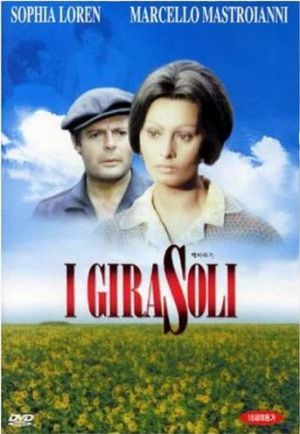 Having dabbled with Marcello Mastroianni in Macaroni and Marriage Italian Style, we went to the well once more in the form Sunflower, a film we had never heard of. The results were mixed.
This film, made in 1970, was the last directed by Vittorio De Sica, and —significantly — it was the first western film shot, in part, in the Soviet Union. Mastroianni, who was 46 when this movie was made, plays Antonio, a happy-go-lucky Neapolitan who is drafted into the Italian army during World War II. He is not a willing conscript, and his valor isn’t helped by the fact that he is in the middle of passionate fling with Giovanna, played by 36-year-old Sophia Loren. His attempt, with Giovanna’s connivance, to avoid military service results in a court-martial and his deployment to the Russian front — which was a brutal fate thanks to both the Red Army and the merciless winters.
When the war ends, Antonio doesn’t return, but Giovanna is convinced that he is still alive. After failing to get any satisfaction from public authorities, she travels to Russia to look for him. It’s not a spoiler to say she finds him, inasmuch as Mastroianni is the co-star. Some may find the circumstances and outcome predictable; some may not.
 Watching this film, which has Italian dialogue and English subtitles, is an uneven experience. Mastroianni and Loren are an irresistible combination, and they play their parts well, but the story itself is at times melodramatic and implausible. In what seems to have been an overreaching attempt to project the character’s moods, Loren is made to look at times as if she’s 30 and at other times as if she’s 50.
The photography in both Italy and Russia is eye-catching, and there is a very effective scene in which Giovanna visits a Russian hillside that is dotted with hundreds of wooden crosses marking the graves of Italian soldiers. The film also has a wonderful score by Henry Mancini that was nominated for an Oscar.

Netflix Update No. 53: “Marriage Italian Style”
October 10, 2011
 When we recommended to a neighbor that she watch the Marcello Mastroianni-Jack Lemmon film “Macaroni,” she countered by referring us to the 1964 movie “Marriage Italian Style,” in which Mastroianni stars with Sophia Loren. I had seen it about 40 years ago, but didn’t remember anything about it.
Filmed in Italian in Naples, this is the story of an amoral businessman who meets a teen-aged prostitute in a brothel during an Allied bombing raid, and then makes her his mistress when they meet again several years later. Domenico Soriano (Mastroianni) is in the baking business, and he puts Filumina Maturano (Loren) in charge of one of his stores while he keeps her — outside his home — in a very comfortable style. Filumena is not satisfied with this arrangement and she pressures “Dummi,” as she calls him, both to publicly acknowledge her and to make her a part of his household. Step-by-step she gains concessions that include a room in his house and recognition as the “lady” of the premises, but she does not get the final prize, marriage, until she employs a subterfuge that blows up in her face.
 Domenico’s passion for Filumena degrades into disgust, and he takes up a relationship with a young cashier at one of his shops.
Meanwhile, Filumena has a secret of her own — actually, three — namely a trio of sons she has borne as a result of her career, one of them by the unwitting Domenico.
 This film, directed by Vittorio De Sica and filmed in the earthy Neapolitan environment, is a combination of farce, tawdry melodrama, and implausible plot, that can’t be taken seriously. Considering the lengths De Sica went to in order to exploit Loren’s legendary physique – as opposed to the weight of her acting – the Oscar she won as “best actress in a foreign film” seems farcical in itself.
Having said that, I can report that the movie, taken for what it is, is funny and entertaining. The surroundings, whether indoor or out, are engaging, and Mastroianni himself is hard to completely dislike in any role. In this case, except for the ludicrous conclusion, he is worth watching as the rake trying to avoid the consequences of a misspent adulthood.
Netflix Update 52: “Macaroni”
September 28, 2011

Marcello Mastroianni in a tight spot in "Macaroni"
“Macaroni” — a 1985 film starring Jack Lemmon and Marcello Mastroianni — is an offbeat story set in always-interesting Naples. Lemmon plays Robert Traven, a careworn airline official who visits Naples for a business meeting after being absent since he served there with the U.S. military during World War II. Traven has no sooner flopped, exhausted, in his hotel room when he is disturbed by a visit from Antonio Jasoniello, who claims that not only were he and Traven acquainted during the war but that Traven had a romance with Jasoniello’s sister. Traven rudely denies ever having known Jasoniello or the sister, even when Jasoniello produces a snapshot of the Yankee soldier and the bella ragazza.
 After chasing Jasoniello away, Traven has second thoughts and seeks the man out, purportedly to apologize and to return the snapshot. He finds Jasoniello working in the refrigerated archives of the Bank of Naples, and what he may have intended to be a perfunctory visit turns into an increasingly complicated relationship with the whole Jasoniello clan — including Jasoniello’s son, a would-be rock musician who is a little reckless about how he tries to jump start his career.
Traven is puzzled by the fact that he is recognized and called by name by a succession of strangers in Jasoniello’s neighborhood. Jasoniello shrugs this off, but Traven eventually learns that his celebrity status was deliberately concocted and maintained for four decades by Jasoniello himself. Therein lies a touching and hilarious story.
“Macaroni” (I can’t account for that title) has a talented and almost entirely Italian cast. Mastroianni himself, of course, was the quintessential Italian film actor, though the combination of his heavy accent and the less-than-ideal sound quality on this DVD made him at times difficult to understand. Pairing him with Lemmon was a wise decision, and the movie is entertaining and uplifting.
Netflix Update No. 51: “The Angel Levine”
September 21, 2011
 The Angel Levine is one of the oddest movies we’ve watched, and from what I’ve read on the Internet it strikes people in many different ways. Some abhor and ridicule it and some like it and watch it repeatedly. A cast that includes Harry Belafonte, who produced this 1970 film, Zero Mostel, Ida Kaminska, and Milo O’Shea seems a promise of success, but the reality is more complicated.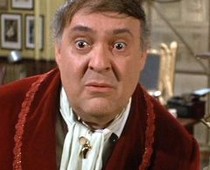
ZERO MOSTEL
Although the pessimistic Mishkin is not easily convinced of Levine’s purported state of existence, the pair slowly develop a relationship in which Mishkin becomes as interested in Levine’s welfare as Levine is interested in his.
The acting in this film — including that of Milo O’Shea in the unlikely role of the irascable Jewish doctor who attends to Fanny — is what one would expect of such reputable performers. The film is a showcase for Belafonte’s magnetism and Mostel’s mastery of the wobegone persona. Some scenes, however, are ponderous, including a long inaudible passage — which we witness from outside a drug store — in which Levine carries out a plot to get Fanny’s prescription without paying for it and a scene in which the Mishkins carry on a conversation in Yiddish, without subtitles.
The film is far from perfect, and yet it is provocative — especially in the way it portrays the dilemma of the Mishkins, who at life’s end are without the means to live in comfort and security.
Netflix Update No. 50: “Hey Hey It’s Esther Blueburger”
September 5, 2011

DANIELLE CANTANZARITI
In our quest to keep up with the career of Keisha Castle-Hughes, we came across a 2008 Australian film, “Hey Hey It’s Esther Blueburger.”
This is a rather blunt story — written and directed by Cathy Randall — about a 13-year-old girl, the title character, who attends a private school, where the snobbish and often brutal cliques ridicule and shun her, while she also navigates a home life made difficult by a rigid mother (Essie Davis) and thoughtless father (Russell Dykstra). Esther falls in with Sunni — Castle-Hughes — an older and more worldly wise student at a public school. The relationship introduces Esther to a gritty world she has been unaware of, and it teaches her a hard lesson about the hazards of trying to fit in by distorting one’s own identity.

DANIELLE CANTANZARITI
Esther is played by Danielle Cantanzariti, who got the part when she turned up for a cattle call audition for extras. The film-makers had screened about 3,000 candidates over a period of four months. The girl is excellent in the role. The character is quirky and smart, and Cantanzariti really goes to town on that. The story has both drama and humor, and this child is skilled at both. Some of the exchanges between her and her brother Jacob (Christian Byers) — who has his own share of complexes — are hilarious.
Castle-Hughes gives a smooth performance as Sunni, whose self-assured demeanor masks the tension in her life with an amiable but unfocused single mother, Mary– nicely played by Toni Collette. The delicate balance in Sunni’s own life is revealed when she loses control in her attempt to re-make Esther, and the younger girl goes too far in order to preserve her standing with her peers. Castle-Hughes played an 12-year-old Maori girl in “Whale Rider” and Mary, the mother of Jesus, in “The Nativity Story.”
The film has a soundtrack that is well tuned to Randall’s themes, including music related to the Blueberger family’s Jewish faith, which figures prominently in the story in a couple of ways.
“Hey Hey It’s Esther Blueburger” cost a lot to make and didn’t return much for the investors. It deserved better.

KEISHA CASTLE-HUGHES and TONI COLLETTE
“Oh, bother!”
July 22, 2011

JIM CUMMINGS
I was shocked when a colleague told me the other day that she had never read the Winnie-the-Pooh books, and I suppose I should have hidden my surprise better than I did. That’s a conceit of mine – that everyone’s life experiences should be the same as my own. Then again, we’re talking about Winnie-the-Pooh, for heaven’s sake.
This conversation was occasioned by the fact that Pat and I went on Sunday to see the new Disney movie, Winnie-the-Pooh, with our daughter and our two grandsons. The film is well done with hand-drawn images and a story line that are true to the spirit of both A.A.Milne, who wrote the books, and Ernest Shepard, who illustrated them.
Milne and Shepard, of course, provided text and pictures, but they did not provide the voices of the characters. That was left to the Disney studio, where some genius cast Sterling Holloway in the title role of Winnie-the-Pooh and the Honey Tree in 1966. Holloway played the part in two more Disney short features, and his high-pitched, plaintive voice became the voice of Pooh for a couple of generations of kids and adults who, by the mercy of God, have not fully grown up.

STERLING HOLLOWAY
Holloway retired in the 1970s, and the Disney casting office had another epiphany, choosing voice actor Jim Cummings – who can be heard in about a hundred films – to speak for Pooh, as it were. It was a tough assignment for an actor who, I’m sure, wanted to do his work without a ghost looking over his shoulder but also wanted to keep the character authentic in the minds of the audience. No problem. Cummings’ performance is distinctive, but it has the ring of a bear, and a hungry one at that, of very little brain.
Cummings knows something about following a tough act. He also took over the role of Tigger in the Pooh films after the retirement of Paul Winchell, who entertained audiences in the 50s and 60s with a ventriloquist act that featured the mannequin Jerry Mahoney, and who was also the first person to design and build an artificial heart.
I can’t say I missed Holloway while we were watching Winnie-the-Pooh, but I miss him in general. I first became aware of him when he appeared in the recurring role of eccentric but gentle Waldo Binney, a neighbor of the title family on the series The Life of Riley, which starred William Bendix as Chester A. Riley.

HOLLOWAY and ALTER EGO
Holloway was unique, sui generis, in the quirkiness of his appearance, his demeanor, and his voice, so it was always a pleasure to run across him in movies or TV shows – the latter including The Amazing Adventures of Superman. He appeared in about 150 screen and TV properties over all. In the 1970s, he also did voiceover commercials for Purina Puppy Chow dog food, and sang what was then a familiar jingle: “Puppy Chow / for a full year / till he’s fully grown.”
As often happens with performers who have long careers, two of Holloway’s landmark achievements are largely forgotten – namely the fact that he introduced two songs that became a permanent part of the American musical repertoire. This occurred when he was appearing on Broadway in the 1920s and the songs were “(I’ll take) Manhattan” and “Mountain Greenery,” both composed by Richard Rodgers and Lorenz Hart.
Holloway, who never married because – he said – he liked his life the way it was, died in 1992 at the age of 87.
Click on THIS LINK to see and hear Sterling Holloway singing “A Perfect Day,” a song written in 1909 by Carrie Jacobs Bond. Holloway’s touching rendition occurred in the 1940 film “Remember the Night.”

George Reeves and Sterling Holloway in an episode of the TV series "The Amazing Adventures of Superman."
Netflix Update No. 49: “Sabah”
July 10, 2011

ARSINEE KHANJIAN
The 2005 Canadian film Sabah has a lot to recommend it, but nothing more potent that Arsinee Khanjian, the actress in the title role.
The film concerns a family of Syrian Muslims living in Toronto. Sabah is an unmarried 40-year-old woman who is responsible for looking after her stylish but perhaps a little hypochondriac widowed mother. Unlike most of her family, Sabah wears drab traditional Muslim clothing — something that seems to symbolize the oppression she has been subjected to by her brother Majid (Jeff Seymour) since their father died. Majid wants Sabah at their mother’s side, and he monitors Sabah’s movements and finances as though he were her father.
In an unusual act of rebellion, Sabah — who loved to swim when she was a child — begins to surreptitiously visit an indoor pool in the city, despite her brother’s instruction that a Muslim woman is not seen in a bathing suit in public. At the pool, Sabah meets a secular Christian man, Stephen — played by Shawn Doyle — who is very courteous to her but also is clearly fascinated with the timid woman from their first encounter.

SHAWN DOYLE
The poolside meetings evolve into a sweet romance, but Sabah’s insistence on keeping the relationship a secret from her family tries Stephen’s patience. Meanwhile, Majid’s young niece defies him by refusing to accept his choice of a husband for her, as Majid wrestles with a broader family problem that he has been keeping from his mother and siblings.

JEFF SEYMOUR
This movie — sort of an Abie’s Irish Rose for the 21st century — infuses the familiar challenge of intermarriage with a well-written script and thoughtful direction, both by Ruba Nadda, a Canadian of Arab ancestry. Our only reservation about the book was that the resolution of the family’s complicated problems was a bit too sudden — especially given the earlier intransigence of Majid.
The characters are all well played, and Doyle in particular deserves credit for the nuances and subtleties he brings to the person of Stephen. But Arsinee Khanjian, who was 45 when she made this film, is irresistible in the part of Sabah. The initial vulnerability, the glimpses of fire beneath a stoic exterior, and the thrill of her growing awareness of a wider world than she has ever known make Sabah an unusually attractive figure.
This film was well received when it was introduced, and those of us who are catching up to it late can see why.
Netflix Update No. 48: “Broken English”
June 10, 2011

PARKER POSEY
In the 2007 film “Broken English,” Parker Posey plays the kind of character who makes you wish you could climb into the screen and either hug her or slap her. She is Nora Wilder, and if the name seems a little distingué, Nora isn’t. She has a nice little management job in a nice little Manhattan hotel, but she doesn’t have a successful love life. Other thirtiesh women do — or seem to, at least — but when Nora does start dating a man these days, the outcome is never good, what with the other girlfriend and the ex who can’t let go and like that. The situation isn’t made any better by Nora’s mother, Vivien — very well played by Gena Rowlands — a sweetheart for all other purposes who has a clumsy way of reminding Nora of her desperate condition.
Nora does meet one man who doesn’t seem to be dragging around the barnacles that weigh down her usual beaux – a thoughtful Parisian named Julien, played by Melvil Paupaud. Considering her experiences up to this point and the sharp contrast presented by this liaison, her tentative approach to this man is both understandable and frustrating.

MELVIL PAUPAUD
Julien returns to Paris, and the action of the movie follows him there, and from that point, you’re on your own.
This movie, which was written and directed by Zoe Cassavetes, got a lot of attention at the Sundance Film Festival, and with good reason. The story is effectively filmed in realistic surroundings in New York and Paris; there’s nothing obvious here. The writer does lean a little heavily on coincidence at one point, but so did Dickens. Cassavetes achieves just the right balance between the oppressive nature of Nora’s dilemma and the comic situations that arise from it.
What with the actors, the characters, the story and the cinematography, this is worth a couple of hours on the couch.
Where have you gone, Carmen Miranda?
April 21, 2011
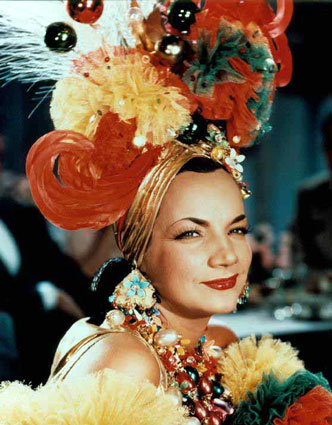 The allusion to Carmen Miranda on this week’s episode of “Modern Family” got us to thinking about her for the first time in recent memory. Our first reaction was to wonder how many people in, say, their 40s or less who were watching that show would have known who Carmen Miranda was. When she was in her heyday, there was no need to ask; she was very popular — with good reason — and she was very successful.
 Carmen Miranda was born in Portugal in 1909, but she grew up in Brazil. She began performing at an early age, although financial stresses on her family led her to a short-lived but profitable career as a milliner. She continued to pursue her musical career, though, and before she came to the United States in 1939, she was already established as a star on radio, recordings, and film. She ultimately made 14 Hollywood movies and at one point was the highest-paid woman in the industry. She also made occasional appearances in the variety-show format that was a staple in early American television.
 Carmen Miranda was subject to some criticism in Brazil during her lifetime on the grounds that she had become too Americanized and was presenting an inaccurate image of Brazilian culture. She was so upset by this evaluation of her work that she stayed away from Brazil for many years. Now, however, she is memorialized by museums in both Brazil and Portugal. She is also the namesake of Carmen Miranda Square at the intersection of Hollywood Boulevard and Orange Drive, across from Grauman’s Chinese Theater.
 CharlesPaolino's Blog