Jane Russell: There’s more to the story
December 7, 2013

JANE RUSSELL
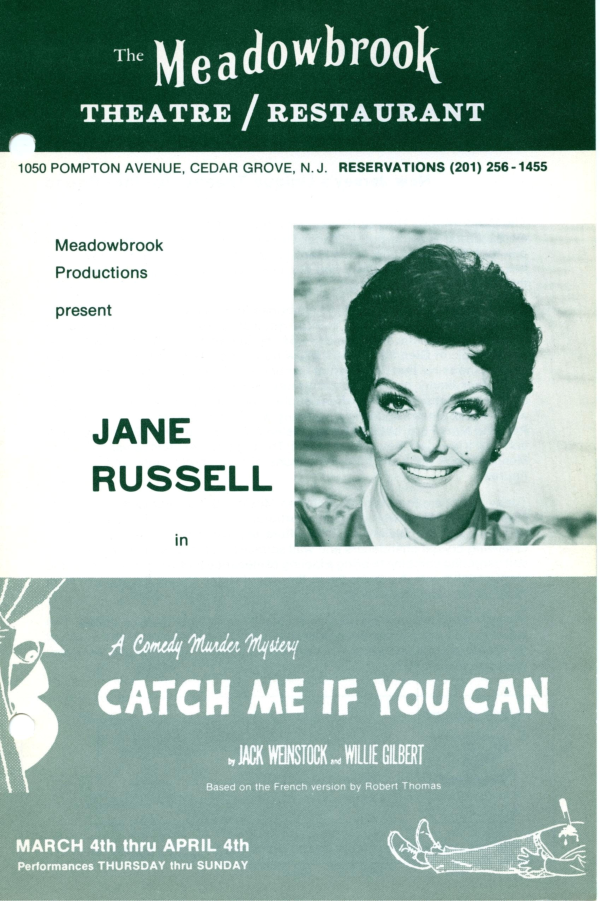
We saw the movie Philomena last night, and I was intrigued by the reference to Jane Russell. I think it’s well known by now that the movie deals with the practice of some convents and other institutions in Europe to force single young women to surrender their children for adoption and to require a large donation from American couples to take those children to the United States. The movie has to do with a particular instance in which a woman named Philomena Lee, whose child was taken from her in that manner, attempts decades later to find out what became of the boy.

Dame JUDI DENCH
In the more or less true account, Dame Judi Dench plays Philomena, who — in the company of a freelance writer — visits the convent where she was left by her father after becoming pregnant at the age of 18. The reporter notices among the photographs hanging in the reception room at the convent an autographed, provocative photo of Jane Russell. He asks a nun about the photo, and the clear implication is that Jane Russell was among the wealthy Americans who “bought” a child at this convent. That caught my interest because I met Jane Russell in 1971 when she was appearing here in New Jersey in a production of Catch Me If You Can. In fact, I had coffee with her in Manhattan and one of the topics of our conversation was adoption.

JANE RUSSELL
Jane Russell told me that during her first marriage, which was to Hall of Fame quarterback Bob Waterfield, she visited orphanages and similar institutions in five countries in Europe and was frustrated to find that it was nearly impossible for an American couple to adopt the children who were languishing there. She eventually did adopt three children, but her experience in Europe also inspired her in 1952 to found the World Adoption International Fund which eventually facilitated tens of thousands of adoptions. She became an advocate for adoptive parents and children, testifying before Congress in 1953 in favor of the Federal Orphan Adoption Bill which allowed American parents to adopt children fathered by American troops overseas. And in 1980 she lobbied for the Adoption Assistance and Child Welfare Act which provides financial assistance based on the particular circumstances of foster and adoptive parents and adoptive children.
From what I have read so far, I deduce that Jane Russell did not adopt a child from the convent that is the focus of Philomena. I did read an account of an interview in which she told a reporter that after having failed to adopt a child in England, she was going to try her luck in Ireland. Whether any of her eventual adoptions amounted to “buying” babies, I cannot tell. I do notice that news stories that refer to her as one of the wealthy Americans alluded to in Philomena do not go on to report her work on behalf of adoptive parents and children.
“When it’s twilight on the trail”
June 19, 2013

SLIM WHITMAN
I’ll wager that not many folks remember this lyric, but I’ll also wager that my son and daughters do:
Maggie dear won’t go out alone
Seems that she must have a chaperone
When we go out, no matter where we’re bound
There’s always someone around
She brings her father, her mother,
her sister and her brother
Oh, I never see Maggie alone
She brings her uncles, her cousins,
she’s got ’em by the dozens
I never see Maggie alone . . . .
That tune, with words by Harry Tilsley, was one of the songs I used to sing with or to my kids during our many car trips.
 I learned that song from an album by Slim Whitman, who died today at the age of 90. I still have that album and others by Whitman among the hundreds of vinyl LPs we retain and occasionally play. I obtained those Whitman albums in the 1950s, when I was caught up with what then constituted country-and-western music. The collection also includes Webb Pierce, Kitty Wells, Faron Young, Ferlin Husky, Little Jimmy Dickens, Hank Snow, Bob Gibson, Hank Williams, Elton Britt, Wilf Carter (Luke the Drifter), and Tex Ritter.
I was listening to doo-wop at the same time, and I already was immersed in opera and other classical music, but that brand of country appealed to me. My friend Michael P. Moran and I even had a country music show for a few years on the radio station at Seton Hall University.
Whitman had a significant following that was partly due to his romantic style. While many country singers liked to dwell on the futility of life (“There Stands the Glass”), Whitman favored love songs and romanticism in general. His voice was also more likely to appeal to an audience beyond the usual country crowd; he was a genuine crooner. And he was a wonderful yodeler — he and Elton Britt were my favorites in that regard.
I lost interest in country music as it became more and more the highly-produced form that defines it now. But I still go back to the vinyl from time to time to hear it done right. Speaking of that, listen to Slim Whitman at THIS LINK.
A touch of class
July 17, 2012
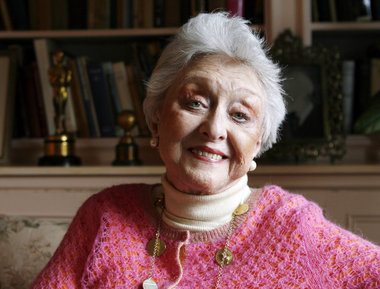 This is the kind of person Celeste Holm was.
In the 1970s I wrote about her somewhere that her favorite stage role was Anna in “The King and I,” a role she took over in 1951 at the request of Richard Rodgers after the original Anna, Gertrude Lawrence, died during the run of the show. Celeste saw that and called me. “I wonder if you’d do me a favor,” she said. “Would you send that article to Richard Rodgers. I want him to know how I feel about that role.” I asked her why she didn’t send it to him herself, and she said that she didn’t think it would be “appropriate” for her to send someone an article about herself. “Well,” I said, “don’t you think Richard Rodgers is going to think it’s peculiar that someone he never heard of sends him a newspaper clipping from out of nowhere.” “Oh,” she said with a laugh that she once told me was only slightly removed from wisdom, “you’re a writer. You’ll think of something to tell him.”
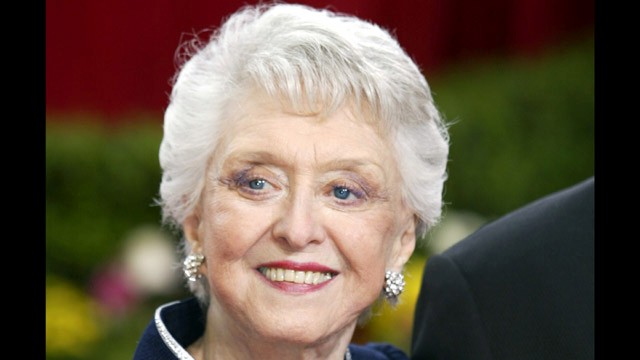 So I complied — Celeste was just regal enough that a person didn’t seriously consider not complying — and Richard Rodgers was delighted, as he told me by return mail.
The fact that she managed that transaction so carefully was part of the elegance that enveloped her — a kind of sophistication that I associated with women like Arlene Francis and Kitty Carlisle Hart. But Celeste was anything but distant. A lot has been published since her death this week about her many civic and charitable works. And while that involved titled roles with public and private organizations, it always involved Celeste’s heart.
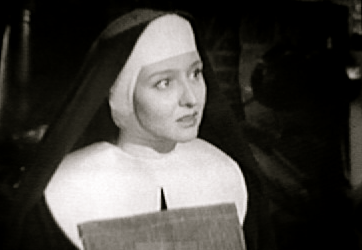 I saw that first hand on one occasion when I foolishly volunteered to produce a sort of cultural concert of music and drama to benefit an organization that provided services to mentally handicapped citizens. I recruited a bunch of professional performers, but I had no idea what I was doing. The program was what vaudeville used to call an olio — a bunch of unrelated parts, but in this case it was supposed to look like a coherent whole. To achieve that, I had written a script that tied the sundry parts together, and I asked Celeste if she would be the narrator. She, being Celeste, agreed, and I took the script up to her apartment on Central Park and together we tweaked it to fit her particular style of speaking.
 As the day of the performance approached, however, I was convinced that the disparate pieces of the concert were going to unravel into an incoherent melange — with about 900 paying customers in the audience. As I anticipated a complete run-through of the various acts on the afternoon before the performance, I called Celeste. She and her husband, actor Wesley Addy, not only came to the run-through but took command of it, checking sound and lighting, talking up the performers so as to assure a smooth transition from act to narration to act to narration.
That night, when the lights went up and Celeste stepped up to a lectern, she looked down at the seats directly in front of her and saw a group of mentally handicapped people whom we had invited to the event. Celeste hadn’t anticipated these guests. Her eyes filled with tears. Instead of beginning the narration, she walked to the edge of the stage: “Thank you!” she told those folks. “Thank you so much for coming!”
Books: “A Natural Woman”
April 27, 2012
 It may not be possible to dislike Carole King.
What’s not to like? She has written some of the best pop and rock songs of the past five decades, she has a record of social responsibility, and she’s a nice person.
In a way, her memoir, A Natural Woman, is similar: What’s not to like? It’s a conversational account of a remarkable American life; in some ways, it would be hard to believe if one didn’t already know that it’s true. King (Carol Klein) is a Brooklyn native who found herself in awkward straits in school because her mother enrolled her early, and then she skipped a grade — so she was perennially younger than her classmates and felt out of place.
She showed early signs of a bent for entertaining, and she was writing songs in her teens. In fact, she was only 18 when she and her husband, Gerry Goffin, wrote “Will You Still Love Me Tomorrow” for the Shirelles. She also became a mother for the first of four times at around the same time. Among the songs she has written since then, either on her own or with a collaborator, are “Where You Lead, I Will follow”; “I’m Into Something Good”; “It’s Too Late, Baby”; “The Loco-Motion”; “Take Good Care of My Baby”; “Go Away, Little Girl”; “I Feel the Earth Move;” “You’ve Got a Friend,” and “Natural Woman.’’

JAMES TAYLOR and CAROLE KING
For a long time, King saw herself as a writer and “sideman” — that is, one of the musicians playing and even singing behind a lead performer. By King’s account, James Taylor changed that single-handedly. It occurred in 1970 while Taylor was touring to promote his album “Sweet Baby James.” King was to play piano for Taylor at a performance at Queens College, which was her alma mater. As the show was about to begin, Taylor told King he wanted her to sing lead that night on “Up on the Roof,” a song she had written with Goffin and a favorite of Taylor’s (and mine, not that it matters).
King writes that she was taken aback by this request but had no time to talk Taylor out of it. When that spot in the set came around, Taylor introduced King to the audience as an alumna of the college and a co-writer of the song and, without rehearsal, she took her first turn as a lead singer. In time, of course, she become a good enough lead that her album Tapestry become one of the best selling collections of all time.

CAROLE KING and GERRY GOFFIN
King devotes a lot of space in this book to a personal life that is difficult for an outsider to fully understand. She married Goffin when she was 17, and the pair, barely more than children, settled into suburban life in West Orange. But Gerry got restless, he fooled around with drugs, he eventually plunged into serious depression. The marriage ended, but King and Goffin continued to be friends and collaborators. King had three more marriages, none of which, based on her own accounts, seem to have been well thought out. Two ended in divorce and one ended when her husband — who she says struck her on several occasions — died as a result of a drug overdose.
King emphasizes in this book that she didn’t like touring and that she didn’t seek stardom because of the baggage that came with it. She had a yen for a simple life, particularly as compared to life in the New York City and Los Angeles areas. From both a cultural and environmental point of view, she carried that quest to its logical extreme by buying a ranch in Idaho. Before she picked the spot, in fact, she and her fourth husband, Rick Sorensen, and her two youngest children lived for three years in a cabin that had no electricity, running water, or heat.
 When King first decided to make Idaho her principal residence, her oldest child, Louise, then 17, declined to make the move, and she stayed behind in Los Angeles. Eventually, all of King’s children would wind up in California. All of those children apparently have had fruitful lives, but King’s priorities are still a little hard to grasp.
I found it disconcerting, too, that she devoted a chapter to her decision to practice yoga, remarking that the discipline helped her find her “center.” She presents this as a life-shaping event, but she never explains what she means by finding her center, and except for one glancing reference, she never mentions yoga again.
Perhaps because she is such a nice person, King chooses her words carefully when she’s describing her interactions with other people, even the husband who brutalized her. While it wouldn’t necessarily be useful for her to share any rancor she might be harboring, her approach is tentative enough to make a reader wonder what else she chose to withhold.
King mentions an editor in the acknowledgments, but I was happy to find that it seemed as if this book was largely King’s own work. It has the feel of a kitchen-table conversation. Apparently it is as much as King wanted to share, so it will have to do for now.
Books: “The Nazi Séance”
February 27, 2012

One of the most bizarre characters among the opportunists, lackeys, and hangers-on who orbited around Adolf Hitler and the Nazi party was Erik Jan Hanussen — a mentalist who is the subject of Arthur J. Magda’s book The Nazi Séance.
Hanussen, who worked his way up from rinky-dink vaudevillian to international celebrity, lived on the edge. Driven almost entirely by his appetite for fame and fortune, he dazzled some people and irritated others, and while he was being applauded for his feats on stage he was also being hounded by skeptics and enemies.
His act consisted of such effects as finding people in an audience whose names had been written on slips of paper and sealed in envelopes, finding hidden articles, telling strangers details about their lives, and occasionally foretelling the future.
 Hanussen also conducted private consultations and séances for which he charged substantial sums.
He had many critics, but the most serious challenge to his credibility may have been a criminal case of fraud brought against him in Czechoslovakia. Although he probably had defrauded the people involved, he beat the charges after the judge, who seems to have been sympathetic anyway, allowed Hanussen to conduct a daring demonstration of his skills in the courtroom.
He also became a target of the communists who in the late ’20s and early ’30s were struggling with the Nazis for political control of Germany and who had no patience with such things as magic and spiritualism.
Some of the Nazis, on the other hand, including some high-ranking ones, were caught up in a post-World War I wave of interest in other-worldly things.
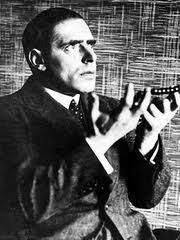
Hanussen, Magida writes, had no interest in politics or government, but he cast his lot with the Nazis to the extent that he used his charisma and manipulative skills to make some influential friends, not the least of whom was Count Wolf-Heinrich von Helldorf, head of the Nazi storm troopers in Berlin. Hanussen, who lived lavishly, entertained Helldorf in style and, while the Nazis were still trying to consolidate their power, the mentalist repeatedly lent money to Helldorf, holding onto the IOUs. Hanussen, who owned a newspaper in Berlin, used it to vigorously promote Adolf Hitler and his party.
Hanussen’s success was to a large extent a result of his hubris, and the primary example of that was the fact that he was not a Danish aristocrat, as he claimed, but an Austrian Jew named Hermann Steinschneider.
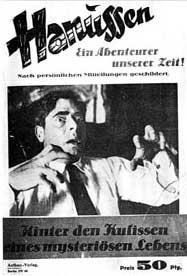
How he kept this from the Nazis for as long as he did is unclear, particularly since he continued to observe some Jewish rituals. In fact, one of his three wives converted to Judaism when she married him.
Eventually he was outed, first by a German communist newspaper and then by a Nazi publication. Even after this happened, he continued to behave with an extraordinary recklessness. He went too far, though, in February 1933, when he conducted a séance attended by some Nazi elite and tried to goad a hypnotized young actress into talking about a large fire. The following day, the Reichstag, seat of the German government, was torched. The circumstances surrounding that fire are still in dispute, but the Nazis blamed the communists. Magida writes that Hanussen, from his apartment, inexplicably telephoned the editor of a communist newspaper — a man he was otherwise unlikely to talk to — to inform him of the fire and warn him of the possible consequences.
In addition, Hanussen tried to use Helldorf’s IOUs to strong-arm the Nazis into letting him in on a lucrative business deal from which he had been shut out. The Nazis hadn’t been in power very long before three men took Hanussen for a ride. His body, with three shots in it, was found much later in the forest where he had been killed.
Unlike most of the Nazis’ millions of victims, Hanussen asked for it. Ironically, the success he enjoyed before he was eliminated was in part a result of an attitude that he shared with Hitler, who took advantage of the desperation and aimlessness of the German people after the combined blows of defeat in World War I and deprivation during the Great Depression. The following remarks are Hanussen’s, but they might have come from either man:
“”Their sadness comes from the fact that they don’t have a teacher, a father, a boss, a friend who impresses them enough that they can trust him. Why do these people come to me? Because I am stronger than they are, more audacious, more energetic. Because I have the stronger will. Because they are children and I am a man.”
Books: “Sleeping with the Enemy”
November 10, 2011
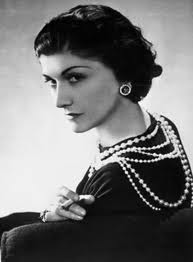 I don’t know if this is true, but I have read in several places that the government of France reports that Chanel No. 5 perfume sells at the rate of one vial every 30 seconds. By my calculation, that means 2,880 vials a day. Sephora gets $85 for 1.7 ounces and $115 for 3.4 ounces, so we’re talking about something like $100 million a year. Besides being such a hot commodity, this perfume is a monument to the woman who introduced it in 1921, the fashion designer Gabrielle “Coco” Chanel.
Chanel — the designer, not the perfume — is the subject of Sleeping with the Enemy: Coco Chanel’s Secret War, written by Hal Vaughan, who portrays her as a virulent anti-Semite who not only accommodated herself to the Nazi invasion of France but actually became a Nazi undercover agent.
When Chanel was 12, her mother had died and her father had left. She spent six years in the custody of Cistercian nuns and then stepped out into the world where she quickly progressed from cabaret singer and courtesan to fashion powerhouse. Her impact on style was enormous; her trade marks were jersey sportswear and the “little black dress” that made a lasting statement about the realtionship between simplicity and elegance.

When Germany invaded France in 1940, Chanel moved to the Ritz and accepted the occupation as the new normal. In fact, she took an influential German officer as one of her many lovers – and she continued to make millions. But Vaughn maintains that documents from that period show that Chanel did more than accept the reality of the Nazi presence, that she actually became an agent of the Abwehr intelligence agency and undertook secret missions in Berlin and Madrid. The book includes a copy of a document that seems to show that Chanel was designated Agent F-7124.
Significantly, Chanel, who was comfortable living in opulence in Paris while her countrymen suffered under the Nazi regime moved to neutral Switzerland for a while after the Third Reich collapsed. Vaughan points out that that move may have saved her from the fate of French collaborators who were publicly shamed, imprisoned or executed. Chanel was briefly arrested by the Free French, but she emerged from the war largely unscathed.
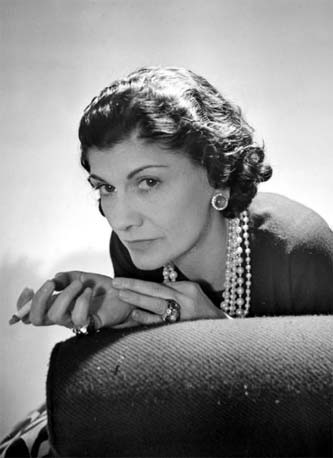
She returned to Paris in 1955 and resumed her career, getting a better reception in the United States than in France.
Vaughn portrays Chanel as anti-Semitic and speculates, without demonstrating it, that her antipathy toward Jews might have been instilled by her contact with the Catholic Church. He also reports in detail that after the initial success of the iconic perfume, Chanel transferred control of it to a Jewish family, the Wertheimers, in a deal that guaranteed her an annual return. Although she later tried unsuccessfully to get the franchise away from the family, and did negotiate a more favorable arrangement for herself, the Wertheimers still are the purveyors of Chanel No. 5.
Chanel was apolitical, and she actually fled Paris for a while in the uncertain aftermath of the invasion. There is nothing in Vaughn’s account to suggest that she was interested in the Nazis’ ambitions. Instead, it’s clear that her top priority was to continue her lavish, drug-ridden life. She also had a personal interest in staying on speaking terms with the Germans, because her nephew was a prisoner of war. She did everything she could until she got him released; in fact, Vaughan maintains that she was enticed to work for the Abwher in the first place because she thought her contacts could help her nephew.
Chanel had many liaisons with rich and powerful men, some of whom helped finance her career, but she never married, explaining that she “never wanted to weigh more heavily on a man than a bird.” An interesting aspect of the story as Vaughn tells it is that, despite her relationship with the Germans, she had many close friends in Great Britain, including Winston Churchill.
Books: “Wonder Girl”
August 31, 2011
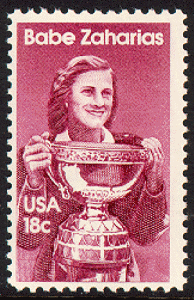 If ever an athlete embodied the phrase sic transit gloria mundi, it was Babe Didrikson Zaharias. There are a couple of generations of adults among whom she is virtually unknown, and yet she was such a combination of natural ability, hard work, and results, that she has no peer.
I’m not an expert on this subject. I had only the vaguest idea of who Babe Didrikson was until I read Don Van Natta’s excellent book, Wonder Girl. But thanks to Van Natta’s scholarship, his journalistic discipline, and his entertaining and literate writing style, I now know plenty about Babe – and I’m glad I learned, even at this late stage of my life.
Babe Didrikson died of cancer in 1956, when I was 16 years old. In those days, I followed baseball and boxing, so I had only the slimmest knowledge that she was a prominent golfer. What I learned from Van Natta’s book is that Babe Didrikson would have excelled at almost any sport she chose and that she made a considerable mark in both track-and-field and in basketball before she turned her whole attention to golf.
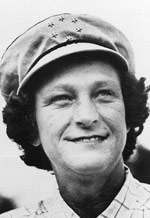 I’ll mention only one particular performance, because every time I think about it I am impressed all over again. Babe, who gave up on education before she finished high school, took a job with a Dallas-based insurance company, but not because she was interested in actuarial tables. Some companies in those pre-television days sponsored amateur sports teams that competed with each other around the country and acted as living advertisements for their employers. Babe’s principal job at the insurance company was playing basketball and track, both of which she did at a championship level. She was so extraordinary, in fact, that in 1933 her boss and coach sent her to the American Athletic Union’s national championship meet in Illinois.

DON VAN NATA JR.
I mean that literally. He didn’t send the rest of the team — only Babe. And competing against squads from around the U.S., she entered eight of the ten events and won the gold medal in broad jump, baseball throw, shot put, javelin, and the 80-meter hurdles and tied for first in the high jump. She collected a total of 30 points; the second-place team scored 22. In that meet, Babe qualified for the 1932 Olympic Games in Los Angeles, where she won two gold medals and a silver and set two world records and an Olympic record.
I had to tell that story. But Van Natta’s book isn’t engrossing only because it reports on that and Babe’s many other achievements. This book tells the story of an American life. Babe’s parents were faithful and hard-working natives of Norway who settled in Texas. They had a large family, and they lived from hand to mouth. Babe loved this family and she remained loyal to her parents and siblings and other connections, always including their financial well being in her reasons for driving herself so hard.
Babe was a tomboy, and when she grew older she was perceived as mannish. This plus the fact that she remained single for so long led busybodies, including prominent sports writers, to speculate about her sexual orientation. She also was the target of verbal abuse from sports writers and others who believed, as Joe Williams wrote in the New York World Telegram, that “it would be much better if she and her ilk stayed at home, got themselves prettied up and waited for the phone to ring.” The rough-and-tumble Babe broke through the barrier of snobbery that surrounded amateur golf at that time; she was a founding member of the LPGA.
She put an end to much but not all of that talk when she married popular pro wrestling villain George Zaharias in 1938. The marriage lasted a lifetime, but it was tumultuous. Zaharias was a compulsive promoter, and he insisted that Babe keep up an exhausting schedule of competition and personal appearances, even when she would rather have taken a break.
 An important factor in the story of Babe Didrikson’s life was her complicated personality, which was at the same time endearing and obnoxious. She was a bold braggart, constantly tooting her own horn. Van Natta reports that Babe would walk into the clubhouse before a golf match and announce herself by saying, “Babe’s here! Who’s gonna finish second?” And when she wasn’t bragging and even lying about her prowess, she was needling and annoying her opponents, deliberately trying to throw them off their game. But it is part of the genius of Van Natta that while he tells a great deal about this aspect of Babe Didrikson, he tells it in the wider context of her life, so that her braggadocio does not define her in the reader’s mind.
Babe Didrikson was diagnosed with rectal cancer and underwent a permanent colostomy. There would still be enough greatness in her to resume her golf career and win tournaments. But the cancer prompted her to rise to the occasion in another way. She became a tireless campaigner for funds to support cancer treatment and education, and she made a point of visiting cancer patients, especially children, to encourage them to go on with their lives.
Babe Didrikson: a life worth remembering.
Books: “What a Wonderful World”
August 13, 2011
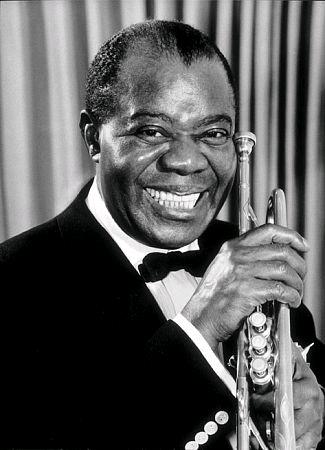
LOUIS ARMSTRONG
Sometime in the early 1960s, I went with a couple of my cousins to hear Louis Armstrong and his band play at Seton Hall University. I can’t remember how I decided to attend that show; there was not a single Armstrong recording among my LPs – which were dominated by operatic arias and country-and-western songs. I knew Armstrong from his television appearances, and I do recall finding him irresistible: not the trumpeter — I didn’t know from trumpets — the whole package. Whenever Armstrong’s image appeared on the black-and-white screen, I would pay attention. He was unique, and he was entertaining.
I was not aware until I read Ricky Riccardi’s recent book, What a Wonderful World, that the quality that attracted me to Louis Armstrong was the very thing that some folks found irritating, disappointing, even traitorous. Jazz purists objected to Armstrong’s departure from his musical roots in his native New Orleans, and many black Americans objected to his on-stage persona, in which they saw the perpetuation of the minstrel end man – a clown whose vocation was amusing white audiences. This was complicated by the fact that although Armstrong was at the height of his international fame in the heyday of the American civil rights movement, he played no visible part in the campaign — this, despite the fact that he and his band had often felt the sting of prejudice.
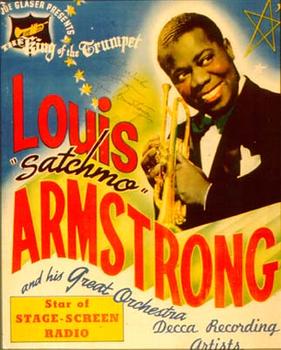
In fact, Armstrong refused for decades to appear in New Orleans as long as local laws prohibited mixed-race bands — perhaps an ironic position for him to take, given the fact that one of the raps on him was that he was willing to play before segregated audiences. His explanation was that he played where his manager booked him, and that he played for whoever wanted to hear him — and they were legion. Armstrong maintained that he contributed as much as anyone else to the progress of black Americans, because he paved the way for others to be received by white audiences.
His bookings are an interesting topic in Riccardi’s book. Armstrong’s manager during the last several decades of his career was Joe Glaser, a Chicago tough guy with a criminal background. There was some kind of bond between the two men — so much so that their arrangement was based on a handshake so that Glaser’s financial obligations to Armstrong were not spelled out. Glaser certainly got rich on the relationship, and Armstrong insisted that he had everything he wanted in life, including his daily regimen of marijuana and an herbal laxative that he treated as kind of a sacrament.
 Riccardi describes in some detail the schedule kept by Armstrong and his band, the All Stars. It’s exhausting just to read about it. It was not unusual for the musicians to perform forty one-nighters in a row without a break — and this went on for decades. Outsiders thought Glaser was taking advantage of Armstrong, wringing out every dime he could before the man dropped dead. Armstrong denied this; Riccardi doesn’t seem to accept it, but even in the material the author provides in this book — such as a letter in which Armstrong complains to Glaser about being treated “like a baby” — there’s a strong insinuation that the critics were right. Armstrong himself insisted that he was doing what he wanted to do, but he also complained from time to time about exhaustion, and he lost more than one player from the All Stars because the grind was just too much.
 Riccardi, who is a student of music and an authority on Armstrong, defends Armstrong’s repertoire; the subtitle of the book is The Magic of Louis Armstrong’s Later Years. Among the criticisms of Armstrong was that he played almost the same song set night after night, to which Armstrong replied that he played what the paying audience expected him to play. As for the indictment of Armstrong’ s wide grin and rolling eyes, it never occurred to me that those mannerisms were supposed to be a stereotype of a black man — if it had occurred to me, I would have been offended and would not have been at that show at Seton Hall. To me, Armstrong was just being himself. Still, his position on race, as Riccardi presents it in this book, was ambiguous at most. At times he would lose his temper and rant about the way black Americans were treated, but he was also capable of making a statement in which he adopted a shaky rationale based on a distinction between “lazy” black people and industrious ones like him. In the event, Armstrong had almost no black audience when he was recording his enormous pop hits, “Hello, Dolly” and “What a Wonderful World” and whether that was due to his play list or to his attitude toward his race remains a matter of conjecture.
You can watch and listen to Armstrong sing and play “Mack the Knife” by clicking HERE.
“Oh, bother!”
July 22, 2011

JIM CUMMINGS
I was shocked when a colleague told me the other day that she had never read the Winnie-the-Pooh books, and I suppose I should have hidden my surprise better than I did. That’s a conceit of mine – that everyone’s life experiences should be the same as my own. Then again, we’re talking about Winnie-the-Pooh, for heaven’s sake.
This conversation was occasioned by the fact that Pat and I went on Sunday to see the new Disney movie, Winnie-the-Pooh, with our daughter and our two grandsons. The film is well done with hand-drawn images and a story line that are true to the spirit of both A.A.Milne, who wrote the books, and Ernest Shepard, who illustrated them.
Milne and Shepard, of course, provided text and pictures, but they did not provide the voices of the characters. That was left to the Disney studio, where some genius cast Sterling Holloway in the title role of Winnie-the-Pooh and the Honey Tree in 1966. Holloway played the part in two more Disney short features, and his high-pitched, plaintive voice became the voice of Pooh for a couple of generations of kids and adults who, by the mercy of God, have not fully grown up.

STERLING HOLLOWAY
Holloway retired in the 1970s, and the Disney casting office had another epiphany, choosing voice actor Jim Cummings – who can be heard in about a hundred films – to speak for Pooh, as it were. It was a tough assignment for an actor who, I’m sure, wanted to do his work without a ghost looking over his shoulder but also wanted to keep the character authentic in the minds of the audience. No problem. Cummings’ performance is distinctive, but it has the ring of a bear, and a hungry one at that, of very little brain.
Cummings knows something about following a tough act. He also took over the role of Tigger in the Pooh films after the retirement of Paul Winchell, who entertained audiences in the 50s and 60s with a ventriloquist act that featured the mannequin Jerry Mahoney, and who was also the first person to design and build an artificial heart.
I can’t say I missed Holloway while we were watching Winnie-the-Pooh, but I miss him in general. I first became aware of him when he appeared in the recurring role of eccentric but gentle Waldo Binney, a neighbor of the title family on the series The Life of Riley, which starred William Bendix as Chester A. Riley.

HOLLOWAY and ALTER EGO
Holloway was unique, sui generis, in the quirkiness of his appearance, his demeanor, and his voice, so it was always a pleasure to run across him in movies or TV shows – the latter including The Amazing Adventures of Superman. He appeared in about 150 screen and TV properties over all. In the 1970s, he also did voiceover commercials for Purina Puppy Chow dog food, and sang what was then a familiar jingle: “Puppy Chow / for a full year / till he’s fully grown.”
As often happens with performers who have long careers, two of Holloway’s landmark achievements are largely forgotten – namely the fact that he introduced two songs that became a permanent part of the American musical repertoire. This occurred when he was appearing on Broadway in the 1920s and the songs were “(I’ll take) Manhattan” and “Mountain Greenery,” both composed by Richard Rodgers and Lorenz Hart.
Holloway, who never married because – he said – he liked his life the way it was, died in 1992 at the age of 87.
Click on THIS LINK to see and hear Sterling Holloway singing “A Perfect Day,” a song written in 1909 by Carrie Jacobs Bond. Holloway’s touching rendition occurred in the 1940 film “Remember the Night.”

George Reeves and Sterling Holloway in an episode of the TV series "The Amazing Adventures of Superman."
Books: “No Regrets: The Life of Edith Piaf”
May 22, 2011
 If it was Sunday night, I wanted to see Señor Wences. I did not want to see Edith Piaf, who turned up from time to time on Ed Sullivan’s TV show, “Toast of the Town.” It was all a part of being young and ignorant. I later learned to appreciate what an astounding singer Piaf was, but I knew nothing of her background before reading Carolyn Burke’s recent biography.
Piaf had a rough life in many respects. She was born in 1915 in a poor part of Paris to nearly indigent parents – her father an acrobat named Louis Gassion and her mother a drug-addicted street singer whose professional name, as it were, was Line Marsa. Louis and Line separated and Line played almost no part in Edith’s life except to occasionally surface and ask for money — which Edith usually provided. Louis took responsibility for his daughter, although that meant, for a time, that he left her to live in a brothel that was managed by his mother. He later reclaimed the girl and took her “on the road” with him — first while he performed with a circus and then when he returned to the streets. Edith had to work, keeping house, passing the hat when Louis performed on the street, and eventually singing for coins herself.
 When she was 16, Edith convinced her father to let her live on her own, but she maintained a close relationship with him for the rest of his life, which eventually meant supporting him. As a result of one of the first of a very long string of romantic and/or sexual relationships, she bore a child, a girl, who died at the age of two — an experience that affected Edith for the rest of her life. She gradually developed as a singer on the street and in Paris dives, but her career took off after she was discovered by a shady character named Louis Léplee, who booked her in his cabaret and taught her some things about performing before the public. He also dubbed her “piaf” — “sparrow” — because of her stature (4’10”) and her bird-like gestures.
Edith Piaf specialized in chasons réaliste, songs of realism that expressed the sorrows of the lower class — including the prostitutes, beggars, and love-starved sailors who were among the singer’s earliest acquaintances. Frustrated love was a constant theme in these songs and in Edith Piaf’s life.
 In addition to having a powerful and expressive voice, Edith Piaf was a prolific songwriter, creating the lyrics for many of the songs she introduced. Many of her love affairs were with men in whom she also had an artistic interest, and she played the mentor to them, demanding almost excruciatingly hard work but, almost without exception, helping them to solidify their careers. Edith herself became a star in several media in both hemispheres — night clubs, movies, records, radio, and television.
 Edith Piaf lived in France during the World War II period, and was criticized in her own time by people who thought she was too accommodating to the German occupation. But Burke reports that the singer was instrumental in helping Jewish friends hide from the Nazis and that she irritated the Nazis, perhaps deliberately, by singing the work of a Jewish songwriter. But Edith was even bolder than that, by Burke’s account. She agreed to visit French soldiers who were being held in prisons in Germany, and she made a point of being photographed with them. Then she returned, as part of a plot by the French Resistance, and slipped some of those soldiers false identification that included their faces cropped from those photos. Some 188 of those men escaped, using those fake credentials.
It’s an understatement to say that Edith Piaf didn’t take care of herself. She worked very hard, both in rehearsals and in a hectic schedule of bookings, partly because of the cost of maintaining not only her own lifestyle but also a coterie of friends, hangers-on, and just plain cheats, whom she deliberately cultivated as a sort of salon. She drank heavily and she became dependent on a complex of pain killers — for debilitating arthritis — sleeping pills, and uppers. This regimen apparently contributed to the ruin of her liver which in turn caused her death in 1963.
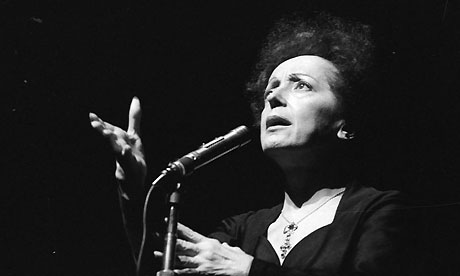 The poet Jean Cocteau — a close friend of the singer — described Edith Piaf as a genius and called her “this astonishing little person.” “A voice rises up from deep within,” he wrote, “a voice that inhabits her from head to toe, unfolding like a wave of warm black velvet to submerge us, piercing through us, getting right inside us. The illusion is complete. Edith Piaf, like an invisible nightingale on her branch, herself becomes invisible. There is just her gaze, her pale hands, her waxen forehead catching the light, and the voice that swells, mounts up, and gradually replaces her.”
For a good example of that voice, click HERE.
 CharlesPaolino's Blog