“Tell me a story before I go to bed” — Sam McBratney
March 1, 2010

The PJ Library
The Boston Globe has an interesting story today about a real estate magnate who was inspired by Dolly Parton to give away two million books to the children of Jewish families — and he’s just getting started.
The subject is Harold Grinspoon, who unloaded most of his expansive real estate holdings when he sniffed something sour in the market. Grinspoon is concerned about children who for any one of a variety of reasons are at risk of losing touch with their Jewish heritage, and his solution has been to establish the PJ Library — “pj” for pajamas — through which he sends books with Jewish themes to kids all over the country. The program is administered through local Jewish organizations that have to add their own financial contribution to Grinspooon’s funding. He intends to will his estate to the program as permanent endowment and envisions a day when its books will reach virtually every Jewish child in North America.

HAROLD GRINSPOON
Grinspoon, who started this project after hearing about Dolly Parton’s Imagination Library, isn’t just writing checks. He is intimately involved in the project, including the selections of titles. That kind of passion doesn’t come along every day.
The Globe’s Story is at THIS LINK. Information about PJ Library is at THIS LINK. And information about Dolly Parton’s program is at THIS LINK.
“Poor, poor little Alice!” — G.K. Chesterton
February 27, 2010

MIA WASIKOWSKA
So Tim Burton’s “Alice in Wonderland” opened in London, and Chris Tookey of the Daily Mail says it’s long on visuals and short on story. Tookey’s take — get it? — is that Linda Wooverton diluted the project with her attempt to write a sequel to Lewis Carroll’s “Alice” books instead of re-telling the original stories — or, at least, one of them. So everybody — including Mia Wasikowska as Alice, Johnny Depp as the Mad Hatter, and Anne Hathaway as the White Queen — looks great, but has nowhere to go.
“The story becomes a very different beast from the ones Lewis Carroll created,” Tookey writes. “It’s a tale of feminist empowerment, with an entrepreneurial, pro-capitalist ending that is unlikely to endear it to readers of the Guardian.” In other words, it’s a 3-D version of the health-care summit.
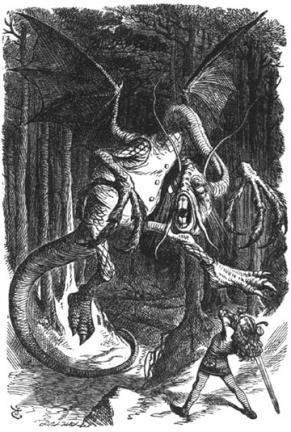
Sir John Tenniel's drawing of the Jabberwock
According to Tookey’s account, a central issue in this tale is that the Red Queen has enlisted the Jabberwock, the Jubjub Bird and the Bandersnatch as enforcers in her reign of terror. In Carroll’s dream within a novel, of course, these were characters in a poem, not “real” creatures. Alice reads about them in a looking-glass book, which means a book in which the print is backwards so that one has to hold it up to a mirror in order to read it.
This poem, which Carroll meant as a parody of overblown poetry and pointless criticism, has been subject to so much serious study that it’s a shame Carroll didn’t live to see it. G.K. Chesterton remarked on this in 1932: “Poor, poor, little Alice! She has not only been caught and made to do lessons; she has been forced to inflict lessons on others.”
“Jabberwocky,” incidentally, is a particular challenge to translators who want to make “Alice” available to the non-English-speaking world. There’s a French version that begins: Il brilque: les toves lubricilleux / Se gyrent en vrillant dans le guave …. A German translation begins: Es Brillig war. Die schlichte Toven / Wirrten und wimmelten in Waben ….
Chris Tookey’s review of Tim Burton’s film is at THIS LINK.
Book Review: “Newton and the Counterfeiter”
February 19, 2010

ISAAC NEWTON
I was working in the faculty room yesterday when one of the instructors asked the open air, “Does anyone know anything about Newtonian physics?” I told him his question was coincidental, because I had just finished reading a book about Isaac Newton, the 17th century physicist, mathematician, and natural philosopher.
I think I correctly answered my colleague’s question, which had to do with Newton’s Second Law of Motion: “A change in motion is proportional to the motive force impressed and takes place along the straight line in which that force is impressed.” But while the book I just read explained the achievements for which Newton is still regarded as one of the greatest of geniuses, its purpose is to recount the work of his later life, when he was warden of the Royal Mint — and particularly the relentless detective work with which he brought to justice Britain’s most brazen counterfeiter.

Statue of Isaac Newton - and the apple - at the Oxford Museum of Natural History
Newton did his signature scientific work at Trinity College in Cambridge, but he lobbied friends for many years to get him a political appointment in London. It finally came in the form of position at the mint, which made the silver coins that were Britain’s only hard currency at the time. When Newton arrived at his office in the Tower of London, the kingdom’s economy was on the verge of collapse, partly because of expensive military operations undertaken by William of Orange and partly because the royal currency was, in a word, disappearing. An old issue of coins was being degraded by so-called “clippers” who shaved bits of silver from the money to be melted down and sold. Meanwhile British silver was leaving the country altogether because it was worth more in exchange for gold in other countries than it was in exchange for commodities in England. The result was a bull market for counterfeiters, including the audacious and dangerous William Chaloner.
Newton’s predecessors as warden of the mint had not taken the job seriously except as a source of income, and that was expected of Newton, too. But he applied to the mint the same combination of energy and curiosity that had fueled his discoveries in fields like gravity and the behavior of light and his development of the mathematical system known as the calculus.

Isaac Newton's image on a one-pound note
First, Newton took control of a program already underway when he arrived – the recall and replacement of all British coins then in circulation. This project was limping along when Newton took over, and he put the means in place to accelerate it and get the job done in a fraction of the projected time. Then he turned his attention to the counterfeiters, employing a network of spies and informers and counter-agents and double crossers to gather information and pounce on “coiners” – eventually including Chaloner, whose career as a counterfeiter had had its ups and downs.
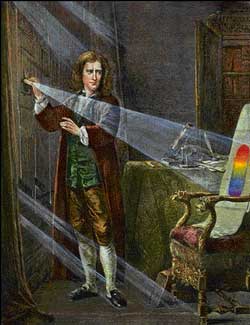
Isaac Newton investigates the refraction of light.
Like most such scoundrels, Chaloner made his share of mistakes, and one of them was to publicly claim that the heart of the nation’s counterfeiting problem was in the mint itself, and imply that Newton’s incompetence was partly to blame. Don’t knock the Rock. Newton went after Chaloner with a vengeance, spending hundreds of hours personally interrogating people who could help build a case against the fraud. Chaloner had been in and out of prison several times and had dodged the noose that was reserved for counterfeiters, whom British law regarded as traitors. In Newton, he had met his match and – ultimately – his maker.
“Newton and the Counterfeiter,” both informative and entertaining, was written by Thomas Levenson, who is a professor of science writing at MIT.
A topic that Levenson discusses throughout this book – in fact, it’s an important thread that runs through all of Newton’s activities – is Newton’s search for contact with God. In fact, Levenson reports that religious matters became the preoccupation of Newton’s life when he had put most scientific inquiry behind him. I discussed that aspect of the book in a column in the Catholic Spirit, and it’s available at THIS LINK.
Read the book
February 15, 2010

CHARLES LAUGHTON
I turned on a TV yesterday morning — an unlikely thing for me to do — and wound up watching part of “The Hunchback of Notre Dame” on Turner Classic Movies. It was the 1939 version starring Charles Laughton as Quasimodo and Maureen O’Hara as Esmeralda. It is one of at least 14 movie and television adaptations of Victor Hugo’s novel “Notre Dame de Paris” — the formal name of the cathedral in Paris — and is generally accepted as the best of the lot. Among silent films, the 1923 version starring Lon Chaney was a benchmark achievement on several accounts — the sets recreating 15th century Paris, Lon Chaney’s portrayal of the deformed bell ringer, and the box office receipts of more than $3 million, Universal’s highest gross in the silent era.
I was pretty young when I first read Hugo’s novel, which is always marketed under the misleading title used on most of the films — misleading in that while Quasimodo might, ironically, be the most attractive figure in the story, he is not more important to the story than Esmeralda or Claude Frollo. Although the story has been retold 14 times on film TV, none of the re-tellings are entirely true to the original. Writers and directors have departed in many ways from Hugo’s plot and characters.
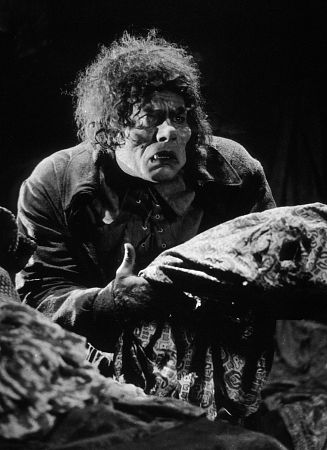
LON CHANEY
It is central to the tragedy of Hugo’s story that Esmeralda is executed and Quasimodo vanishes after her death, and Hugo leads his readers to believe that the bell ringer died in his grief, embracing Esmeralda’s body in a cemetery for social castoffs. In the Laughton version both characters are alive at the end of the film; in the Chaney version Quasimodo dies, but Esmeralda lives. These are not details; they are significant deviations from Hugo’s intent.
Among the other actors who have played Quasimodo are men as different as Anthony Quinn, Anthony Hopkins, and Mandy Patinkin — the latter in a TNT cable production in 1997. Quinn was paired with Sophia Loren in a 1956 French production in which he and Loren were the only actors who spoke English. The rest of the dialogue had to be dubbed over the French.
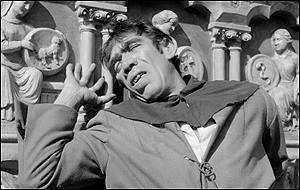
ANTHONY QUINN
That was the first color film based on the novel. Whereas Patinkin tried to duplicate as closely as possible Laughton’s image of Quasimodo, Quinn’s makeup was mild, not coming close to the grotesque features that Hugo describes and that constitute the context for the bell ringer’s place in — or, rather, outside of — society. In that version, Esmeralda is killed accidentally which, of course, dilutes the injustice inherent in the story. But who would want to execute Sophia Loren?

Walt Disney Productions
There have also been a couple of attempts to stray so far from Hugo’s work as to turn Quasimodo into a huggable cutie — as in Walt Disney’s 1996 animated feature — or even a comic figure, as in the 1999 French romp, “Quasimodo d’El Paris.”
I hope that folks who have seen even the best of these films don’t think they’ve experienced what Victor Hugo created in his novel. On the other hand, who has the patience to read classical novels in the Twitter age?
Incidentally, the bell ringer was named Quasimodo because, as an infant, he was abandoned at the cathedral by his mother and found on Quasimodo Sunday — the first Sunday after Easter. The Introit of the Mass for that day is taken from the second chapter of the First Letter of Peter: Quasi modo geniti infantes, rationabile, sine dolo lac concupiscite ut in eo crescatis in salutem si gustastis quoniam dulcis Dominus. That passage is often translated, As newborn infants do, long for pure spiritual milk so that through it you may grow into salvation, for you have tasted that the Lord is good.
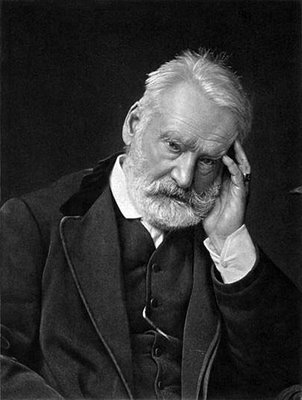
VICTOR HUGO
I have read what I consider to be a spurious explanation that Quasimodo’s name was a play on words — an idea that depends on translating quasi modo to mean “partly made” — meaning that Quasimodo was born incomplete. I can’t find my Cassell’s Latin Dictionary right now, but if memory serves me right, the literal translation of the first two words of the passage is not “partly made” but “in a similar way.”
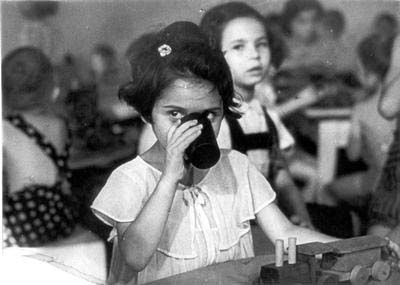
Children at Theresienstadt. Yad Vashem Archives.
It’s been a good reading season squeezed in between semesters. The pace will slow down when classes resume next week, though I just started a fascinating book about Isaac Newton’s little-known career as the scourge of counterfeiters. Of that, more later.
I just finished “The Girls of Room 28” by Hannelore Brenner, which describes the lives of children who were incarcerated at the Jewish ghetto in Theresienstadt, Czechoslovakia, between 1941 and 1944. An estimated 13,000 children passed through there; 25 survived. Some died of disease or other consequences of neglect. Most died in the concentration camps further east. Brenner presents first-hand accounts from some of the survivors as well as material from diaries and other such documents. She also records how the Nazis bamboozled the International Red Cross into thinking that Theresienstadt was a model community for Jews, founded on the benevolent nature of Adolf Hitler. There is a lot of information and photographs about the ghetto on the YAD VASHEM web site.

Abraham Lincoln reading to his son Tad.
I can’t read too many books about Abraham Lincoln, and I was delighted with “Lincoln, Life-Size,” a volume that includes digitized reproductions of all 114 known photographs of Lincoln, most of them portraits. The book was assembled by three descendants of Frederick Meserve, one of the best-known collectors of Lincoln images. The authors used high technology to calculate the size of Lincoln’s head. The head was cropped from each of several dozen photographs and reproduced on the facing page in life size. The result is fascinating and, at times, unsettling. The authors also accompany each photograph with texts drawn from a variety of sources, some putting the photo in context, others illuminating some aspect of Lincoln’s public or private life.

GERTRUDE EDERLE
“America’s Girl” is a biography of Gertrude Ederle, a young woman from New York City who, in 1926, not only became the first woman to swim the English Channel, but far surpassed the previous record — set, obviously, by a man. Ederle did not lead an exciting life in the long term, but in the weeks and months after her achievement, she was a celebrity of proportions that have only rarely been exceeded — even in our own age of instant notoriety. More important, really, is that her accomplishment had a significance that transcended her personal fortunes. Ederle confounded the widely accepted assumption that women were not capable of feats like the one she performed. Her crossing helped to accelerate brewing changes in how women were regarded and what they were permitted to do in a society in which only men were allowed to vote until only five years before. The book was written by Tim Dahlberg with Mary Ederle Ward – the swimmer’s niece – and Brenda Green.

Yogi Berra jumps into Don Larsen's arms after the last out of the perfect game.
“Perfect” by Lew Paper, is based on Don Larsen’s perfect game in the 1956 World Series between the New York Yankees and the Brooklyn Dodgers. Paper examines the well-worn but still fascinating fact that this feat – achieved only once since the World Series was inaugurated in 1903 – was carried out by a mediocre pitcher whose name would long have been forgotten if it hadn’t been for that day. But Paper makes his book good winter reading for baseball fanatics by devoting each of his 18 chapters to one the half-innings in that game, and focusing each chapter on one of the players who participated. In one instance only, he profiles two players – Jackie Robinson and Gil McDouglald – in a single chapter. In each case, Paper recounts the personal history that brought the player – Mickey Mantle, Enos Slaughter, Gil Hodges, Pee Wee Reese – to that historic moment in sports. Not the least of these figures is Dale Mitchell of the Dodgers who was pinch hitting for starting pitcher Sal Maglie in the top of the ninth when he took the called strike that sealed Larsen’s place in history. Mitchell, who had one of the best batting eyes of his era, thought the pitch was high. So, according to Paper, did most of the Yankees on the field. But, as one baseball wag observed, when the umpire calls strike three on you, even God can’t get you off.

Authorities estimated that a third of the population of New York City - about two million people - turned out for this ticker-tape parade for Gertrude Ederle. It remains the largest such event to honor an individual athlete. (© Underwood & Underwood/CORBIS)
“It was contagious … seventy pages.” — Jimmy Durante
October 15, 2009

THE FORMER MEYER BROTHERS
Every time I leave Paterson after teaching my classes, I pass the ornate building that once housed Meyer Brothers Department Store. Before the malls sucked the life out of downtown districts, Meyer Brothers was the place to shop in North Jersey. The big attraction for me when my mother shopped there was the book store, which was located on an elegant little mezzanine at the head of a grand staircase. Mom could take her time elsewhere, because once she dropped me off in the book store, she knew where she’d find me no matter how much time had elapsed. The keepers of the shop must have a patient bunch, because I used it as if it were a library. We went there fairly often, and I returned to the same books again and again, hoping they wouldn’t be sold out before I had read them through.

Browsing at Meyer Brothers provided my first opportunities to buy books, which had not been part of the routine in our house. Both of my parents read a lot, but they read periodicals. I read the newspapers and magazines, too, but once I got the feel and smell of books into my system, I slipped into a lifelong addiction. Mom accommodated me when I started buying the “Peanuts” anthologies that began to appear in the very early 1950s, and humorous little “history” books by Richard Armour.
When chains like Borders and Barnes & Noble started making it fashionable to hang out in the stacks it seemed as if book browsing had become a post-modern institution, but now the trend toward buying and reading books on line threatens to make that experience a thing of the past — like Meyer Brothers, with its boarded-up windows and its for-rent signs.
Carolyn Kellogg, who blogs about books for the LA Times wrote about the trend this week. Her blog is at this link:
http://latimesblogs.latimes.com/jacketcopy/2009/10/in-praise-of-browsing.html
Two hearts that stopped as one
September 2, 2009

ART CARNEY
In a 1956 episode of “The Honeymooners,” Ed Norton (Art Carney) is advising Ralph Kramden (Jackie Gleason) that one of their neighbors reads all the mail that comes into the building. To illustrate his point, Norton tells Ralph what the Kramdens’ gas bill was the previous month. And then he congratulates Ralph for breaking the all-time low gas bill record set by the Collyer Brothers in 1931.
The studio audience laughs, because they remember the Collyer Brothers, whose macabre death had occurred only about nine years before that episode was filmed. Homer and Langley Collyer, offspring of a well-to-do family, lived in a mansion in what was then high-fashion Harlem — remaining there after their father inexplicably abandoned them in 1919 and moved downtown. By that time the brothers were well educated — at least one of them had graduated from nearby Columbia — but instead of pursuing careers in engineering or admiralty law, they gradually withdrew from society, living like hermits and literally filling the house with tons of newspapers, bicycles, firearms, electric motors, musical instruments — a collection far too varied to be characterized, although it is usually referred to as “junk.”

LANGLEY COLLYER
In 1947, the two men died in the house under tragic circumstances. Langley Collyer had been killed by one of the booby traps he had assembled to ward off intruders and Homer, who was blind and largely helpless, had died of starvation, just a few feet from his brother’s body. Police and laborers removed 103 tons of material from the house, which was condemned and razed.
E.L. Doctorow has written a novel, “Homer and Langley,” being released this month, which consists of what Doctorow describes of his “reading” of the Collyer Brothers’ lives. By that he means that the book is not a history; in fact, he said he did no research, which may be an exaggeration, but he makes his point. He was curious, not about morbid details that had been repeated again and again, but about what motivated the two men to shut the world out of their lives or rather, as he puts it, to “emigrate” to a life within their home, a life lived on their own terms.
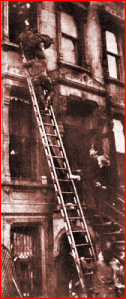
HOMER COLLYER'S BODY IS REMOVED FROM THE HOUSE
Doctorow was interviewed on NPR today — specifically, on “All Things Considered: — and his remarks suggested more respect for the Collyers than they usually are afforded. Certainly he eschewed the ridicule that an Ed Norton couldn’t help but attach to the names. The writer apparently doesn’t begin with a judgment about the brothers — or about people who don’t choose to live as others do. He begins with curiosity about how their lives fit into the whole picture of life in their time. He also said that he was saddened by a comment made in the novel by Homer, who is the narrator: “What could be more terrible than to be turned into a mythic joke?”
A story based on the Doctorow interview, the audio, and an excerpt from the novel are at this link:
http://www.npr.org/templates/story/story.php?storyId=112346577
“It all depends.” — George Ade
August 19, 2009
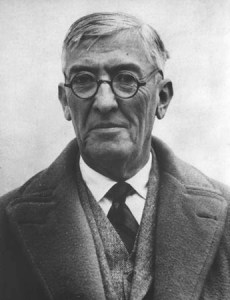
GEORGE ADE
I don’t know when it began. It seems to me that I have always been an obsessive reader. I had to have been fairly young when my mother started complaining that she couldn’t leave a milk container or a box of cereal on the table without my reading every bit of text.
I have considered that the tendency is inborn. My grandfather’s father and both of my parents were pretty much always reading something — mostly periodicals. So maybe I was always a reader, although I believe my romance with books in particular began with a mysterious incident that occurred on one summer Sunday. We came home from our lake house and found that someone had left on our front step a cardboard box loaded with old books. We never learned where it came from. I was the only person interested, so I rooted through the box and found several things of interest, including “Breaking Into Society” by George Ade. I had never heard of Ade, but I read some of the short stories — which Ade called “fables in slang” — and I became a fan. I became a fan not only of George Ade, but of books in general, and I became a regular client at the Paterson Public Library, which was no mean trick since it was nowhere near our house.
I also started buying cheap paperbacks at a local store, because that was easier than going to the library. I had odd taste for a kid, which helps to account for my stunted social life in those days. I bought and read a book about the Borgia popes, “The Nazarene” by Sholem Asch, “The Hunchback of Notre Dame” by Victor Hugo, and a collection of papal encyclicals edited by Anne Freemantle. I got stuck on “Mitt Brennender Sorge (With great anxiety)” by Pope Pius XI — in English, of course — and I read it over and over again.

FRANK NORRIS
I favored non-fiction until my senior year of college when I took a course in the American novel simply because I couldn’t fit anything else into my schedule. On the first day of class, the professor provided us with a syllabus that indicated that we would be reading 21 novels in 15 weeks. I thought about dropping the course, but that would have meant walking all the way over to the registrar’s office, so I read the novels instead — works including “McTeague” by Frank Norris, “The Crisis” by Winston Churchill (the American one), “Winesburg, Ohio” by Sherwood Anderson, and “Miss Ravenel’s Conversion from Secession to Loyalty” by John William DeForest. That course inspired me to read many more American novels that I might have otherwise neglected.
While I was still in college, I worked for a company that provided billing and shipping services to a number of book publishers, including Charles Scribners Sons. One of the managers was always slipping me books from the warehouse, and I spent about two years in the company of F. Scott Fitzerald and Ernest Hemingway.
Once I was out in the working world, a colleague mentioned Charles Dickens’ “Bleak House” to me. At the time, I had read only “A Tale of Two Cities,” which had been assigned to us in high school.

CHARLES DICKENS
I didn’t have to much confidence in this particular colleague, because she claimed to be a descendant of John Wilkes Booth, who had no descendants. But when I admitted to her that I had never read “Bleak House,” she brought me a paperback copy of it. I read it and then read it again. Then I read every one of Dickens’ novels — all of which I have read at least twice — and all the stories and articles of his that I could find.
My mind is wandering; why am I writing about this?
Oh, I remember.
David L. Ulin has a column in the Los Angeles Times in which he laments that he finds it increasingly difficult to read. Our culture has evolved, he says, into an environment that miltates against the state of silence that is necessary to read — to really read — a book.
“These days,” he writes, “… after spending hours reading e-mails and fielding phone calls in the office, tracking stories across countless websites, I find it difficult to quiet down. I pick up a book and read a paragraph; then my mind wanders and I check my e-mail, drift onto the Internet, pace the house before returning to the page. Or I want to do these things but don’t. I force myself to remain still, to follow whatever I’m reading until the inevitable moment I give myself over to the flow.”
So far, I haven’t had that problem. Time can be an impediment to reading, but not the lure of other media. I fact, I have read far more books since I was laid off in December than in any equivalent period since I left graduate school. Still, Ulin’s observations probably will resonate with many folks. You can read his column at this link:
http://www.latimes.com/features/books/la-ca-reading9-2009aug09,0,1920172.story?track=rss
What’s that? You’ve never read George Ade? And you call yourself an American? Check him out here:
“That’s right – you’re wrong!” — Kay Kyser
August 7, 2009
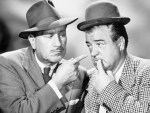
ABBOTT and COSTELLO
I just reviewed a book of photographs taken at the New Jersey Shore between the late 19th century and the 1970s. As frequently happens when I read books these days, I was annoyed to distraction by the careless errors in the text – the text, in this case, consisting of chapter introductions and photo captions.
The author of the text, a New Jersey resident vaguely identified as a history teacher, must have a loose view of what constitutes history. For example, he identified the birthplace of comedian Lou Costello as “Patterson.” He also made several references to a shore community that he called “Tom’s River.” Who “Tom” is, I am not aware.

MARGARET GORMAN
The book includes three photos of Margaret Gorman, dressed in an outlandish outfit for her “coronation” as the first Miss America at the pageant that originated and persisted for many years in Atlantic City. In one photo she is accompanied by a man dressed up as King Neptune; in another, she poses on the boardwalk with a group of young girls in dancing costumes; in the last, she is being borne along the boardwalk by in what looks like a sedan chair in the shape of a seashell. The writer explains — twice — that Gorman was installed as Miss America in 1922. It was 1921.

JOE WARDELL
In one of several stunning photos of the amusement areas in Atlantic City, a marquee announces that the live entertainment on the Steel Pier includes The Three Stooges. Taking note of that, the writer adds to the name of the act the names of the individual characters — “Moe, Larry, and Curly Joe.” The photo was taken in 1938. Curly Joe Wardell didn’t join The Three Stooges until 1958. Perhaps the history teacher was thinking of Curly Howard.
Is this sort of thing the result only of downsizing in the workshops of publishing houses, or is it symptomatic of a more general disregard for precision? There was a time when it would might have taken hours for a writer to double-check the date of the first Miss America, the spellings of well-known places in his own home state, and the chronology of the evolution of a comedy act. In the 21st century, all of that would take no more than fifteen minutes.

GOV. MARK SANFORD
It goes without saying that Gov. Mark Sanford wasn’t the first person to take a powder because of an affair of the heart. What may be more rare is the response from the governor’s wife, Jenny, who quoted the Fourth Psalm and Archbishop Desmond Tutu in explaining to the Associated Press why she might forgive her husband for his transgressions. The archbishop’s take, according to Jenny Sanford, is that “forgiveness is the grace by which you enable the other person to get up, and get up with dignity, to begin anew.” Presumably, Dina McGreevey doesn’t subscribe to this formula.
In a way, Sanford’s adventure has been done to death, but it turns out that the novelist Agatha Christie had a unique take on the unexplained disappearance. She vanished for 11 days in 1926 because her husband was having an affair. After throwing the British public into a panic and providing the newspapers with a sensational story, Christie turned up at a resort hotel where she had registered under the name of her husband’s paramour. This was never publicly explained, but it seems to have been part of an elaborate scheme to prod her husband — who had already asked for a divorce — into reconciling with her. It didn’t work, and she ended up in a satisfactory relationship with another man.
This is all spelled out in a new biography of Christie by Richard Hack. There’s an entertaining review in the Los Angeles Times:
http://www.latimes.com/features/books/la-et-book2-2009jul02,0,2014380.story

AGATHA CHRISTIE
 CharlesPaolino's Blog