Books: “Don’t Know Much about the American Presidents”
October 13, 2012
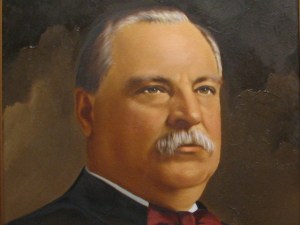
GROVER CLEVELAND
Some colleagues and I were traveling to Caldwell College recently, and just before we turned off Bloomfield Avenue onto the campus, I pointed out a cottage across the street. “That’s the birthplace of Grover Cleveland,” I said. Someone in the car might have grunted — I’m not sure — but otherwise there was no reaction.
How could this be? Cleveland was the only president born in New Jersey and one of only two who died here. But we get to count him twice, because he was both the 22nd and 24th presidents. And nobody cares?
OK, he wasn’t Mr. Glamor — no Washington, Jackson, Lincoln, or either of the Roosevelts. In fact, he was part of that lineup of boring personalities from Rutherford B. Hayes to William McKinley. Even his non-consecutive terms aren’t enough to make his name a household word, or even vaguely familiar.

Grover Cleveland’s birthplace
Well, my colleagues might disregard Cleveland, but he gets a lot of attention in Kenneth C. Davis’s new book, Don’t Know Much about the American Presidents. Davis reports that Cleveland was only four years old when his family moved to New York and that he didn’t return to New Jersey until after he had retired from the presidency.
Cleveland, a former mayor of Buffalo and governor of New York, was president during a period of violent labor strife in both of his terms and near economic calamity in his second. It the era of robber barons, rampant corruption in business and politics. The United States was still on the gold standard at that time and nearly ran out of reserves before Cleveland struck a deal in which J.P. Morgan, the Rothschilds and other financial interests bought American bonds, in several sales, to replenish the gold and stabilize what was then largely a free-market economy.

GROVER CLEVELAND
Davis gives final grades to most of the presidents he writes about, sparing those who died too soon after taking office and Barack Obama, who hasn’t yet served a whole term. Cleveland gets a B, not because he was a visionary or an inspiring leader, but because he was scrupulously honest and because he was the first president since the ill-starred Andrew Johnson to stand up to Congress and restore at least some of the prestige and power the presidency had lost after the murder of Abraham Lincoln.

PEYTON RANDOLPH
Davis provides some context for his discussions of the 44 presidential administrations with an opening section on how the presidency, more or less as we know it, was created. He points out that the title “president of the United States in Congress assembled” was conferred on 14 men — including John Hancock, who held the title twice — before the election of George Washington as the more succinctly named “president of the United States.” The first of these was Peyton Randolph of Virginia, who presided over the Continental Congress in 1774. Davis explains that the failures of the Articles of Confederation made it clear to many American leaders that the government needed a strong executive presence, but determining what that executive should consist of was problematic. There was no model to base it on, and many Americans were wary of a strong executive because they feared abuse of power and the possibility of the kind of hereditary succession they had left behind in Great Britain. Indeed, he writes, one of the reasons Washington was a favorite to take on the newly fashioned presidency was that he had no heirs. Davis follows his presidential profiles with a section in which he discusses what the office has become and what should be done with it.

FRANKLIN PIERCE
With its compact chapters and its career highlights and timelines, this book provides a means of scanning the whole sweep of American history from the adoption of the Constitution of 1787 to the present. The book also reminds us of the wide range of personalities who have occupied the presidency during that period, from the brooding and self-sacrificing Lincoln, whose murder plunged even some of his bitterest enemies into despair, to the handsome but hapless Franklin Pierce, whose spineless failure to deal with the crisis that led to the Civil War left him in such disrepute that he was the only former president whose death was not officially mourned.
Books: “I’d Like to Apologize to Every Teacher I Ever Had”
October 8, 2012

When I was teaching English grammar and composition at a New Jersey prison, one of my students told me about a visit he had received from his grandmother. “She told me she got the first letter from me that wasn’t all one sentence! That’s your fault, Mr. Paolino!” It was one of the nicest things anyone had ever said to me.
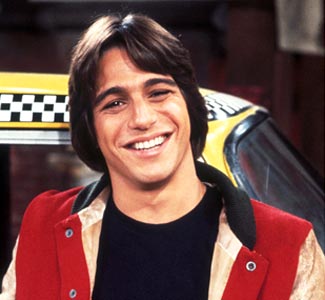
Tony Danza as Tony Banta in “Taxi“
I have never been a full-time teacher, but I have taught many college classes over the past 40 years or so, and in some cases the students really weren’t prepared for college. In recent years, I taught a lot of remedial English courses; the number of kids who need remedial English after graduation from high school is quite a scandal.
My experiences gave me a little extra appreciation of this book — I Want to Apologize to Every Teacher I Ever Had — written by the actor Tony Danza after he spent a year teaching an English class at Northeast High School in Philadelphia.
Danza, who first became a nationally known figure for his portrayal of cabbie and boxer Tony Banta in the TV series Taxi, writes that he had always harbored an ambition to be a teacher. When his most recent TV show was cancelled, he decided to fulfill that ambition. According to him, he loathes reality TV and did not intend for his experiment to become a television series, but it happened anyway.

TONY DANZA
The A&E network set out to create a series based on Danza’s stint in the classroom, but Danza writes that it was an uneasy relationship because the network wanted drama and was willing to stage it if it didn’t occur naturally, and Danza writes that he wanted the camera to record only what happened in the normal course of events.
Danza taught a double class … two 45-minute periods with the same students. But he had to show up in the morning at the same time as the other teachers and take on all the obligations they had outside the classroom: truancy duty, coaching sports, chaperoning dances, and attending planning meetings and in-service programs.
Not everyone in the school was happy to have him there, and there were several instances in which he got into trouble for violating procedures. For example, he took his students on a field trip to Washington, D.C., but he didn’t tell their other teachers that the kids would be absent from school that day.

Danza was feeling his way in teaching an English course for the first time, but it sounds as if he became a pretty creative instructor, particularly in the way he presented literature and prompted the students to see its relevance to everyday life. In that urban setting, Danza writes, he came face to face with the problems that many kids lug around with them every day, kids with dysfunctional families, kids who live in an atmosphere of violence, kids with no self esteem. And, of course, he came face to face with the impact such problems have on teachers.
Danza, who writes that he was a problem student at a Long Island high school, rode an emotional roller coaster at Northeast, sometimes parenting troubled kids, sometimes losing his temper — not an unusual experience for him — and sometimes succumbing in tears.
Danza came away from Northeast with some strong feelings about public education being underfunded, and about teachers and administrators being under appreciated, under compensated, and stymied by bureaucratic interference.
Of course, I didn’t accompany Danza to Northeast High School, so I can’t vouch for everything he writes about his time there. What I especially like about this book, though, is that it seems to be written in his voice. Anyone who is familiar with Danza as an actor can hear him speaking these words, and that makes them seem all the more credible.

Books: “The Caliph’s Splendor”
September 1, 2012

ABBASID PLACE, BAGHDAD
When I attended elementary and high school (that was between 1947 and 1960) history was taught as though its only dynamic was a westward movement from Europe to the Pacific Coast of North America. One result of this skewed point of view was that Islam was mentioned only with respect to the Crusades.
In actual fact, however, the history of Islam is an integral part of the history of the whole world; in particular, it was an important factor in shaping the western world we know today.
Benson Bobrick takes on a part of that subject in his popular history “The Caliph’s Splendor,” focusing especially on the ninth and tenth centuries. His topic is an institution that is virtually unknown to westerners—the caliphate. This was the structure under which most of Islam was governed for generations following the death of the Prophet Muhammad.

ABU BAKR
Islam was divided on the subject of who should succeed the Prophet as the administrative and political leader. The role fell first to Muhammad’s father-in-law and confidant, Abu Bakr as-Saddiq, who was supported by the Sunni. Abu Bakr was the first caliph (successor), a position he held only a few years until his death. In the centuries following his death, Islam spread through the Near East, North Africa, and Europe. Because of the difference of opinion about succession, and because of geopolitical realities, not one but several caliphs ruled over Muslim territories.
The focal point of Bobrick’s book is Caliph Harun al-Rashid, the fabled “Sword of God,” who ruled over a territory that spread from Spain across southern Europe and North Africa through the Middle East and Arabia to the western edges of China. Most modern westerners who may be at least vaguely aware of the later Ottoman Empire are unaware of the extent to which Islam spread from its beginnings in what is now Saudi Arabia. Nor are many aware of the level of wealth that the caliphs accumulated. In 766, Harun, who was a caliph of the Abbasid dynasty, established his capital at Baghdad, which became one of the most influential cities of its time.

ABBASID PALACE, BAGHDAD
Bobrick writes that the administration of Baghdad “managed to harness the Tigris and Euphrates rivers for the cultivation of grain, and a brilliant system of canals, dikes, and reservoirs drained the surrounding swamps…. There were many rich bazaars and covered shops along the embankments, where all sorts of artisans and craftsmen—marble workers from Antioch, papyrus makers from Cairo, potters from Basra, calligraphers from Peking—plied their trades. … There was a large sanitation department, many fountains and public baths, and, unlike the European towns and cities of the day, streets that were regularly washed free of refuse and swept clean. Most households had water supplied by aqueducts. …”
By comparison, Bobrick writes, London and Paris during that same era were pest holes.

UMMAYAD COIN
As with the expansion of all empires, of course, the spread of Islam was accomplished in part by brute and bloody force, it was also accompanied at times by significant advances in learning, literature, and scientific discovery in areas such as mathematics and astronomy. The “intellectual awakening” that took place during the reigns of Hasrun and his son Mamun—and with their participation—was, Bobrick writes, “one of the most significant in the whole history of culture and thought.”
As much as it might fit some political agendas to believe that Islam arose and grew in a primitive desert context, nothing could be farther from the truth. It is well established, in fact, that a large body of western learning, including the works of such geniuses as Aristotle and Plato, would have been lost forever during the Dark Ages had they not been translated by Muslim scribes and preserved in Muslim libraries until they could be rediscovered by European scholars of a later period. Bobrick wrote this book for popular audience, and a popular audience might understand modern history a little better by learning more about such epochs as the “golden age of Baghdad.”
Books: “Master of the Mountain”
August 22, 2012

THOMAS JEFFERSON
My master’s thesis focused on an aspect of the impeachment trial of Andrew Johnson. As a grad student at Penn State, I had access to the stacks at Butler Library in order to do some of the research. That would have been a good thing for a person with singleness of purpose, but not for an undisciplined scholar like me. The route to the “Jo” section of the stacks took me through the “Je” section, where I frequently stopped to browse through the papers of Thomas Jefferson. I have always found his intellect irresistible, and he has had an important influence on my writing. Accordingly, my research in the “Jo” section took a lot longer than it should have.
Jefferson, of course, had his flaws, just as we all do. His biggest one, unfortunately, ruined the lives of hundreds of people over several generations — the people he held in slavery, this herald of equality for “all men.”
That’s the topic of Master of the Mountain: Thomas Jefferson and His Slaves,” a book by Henry Wiencek scheduled for publication in October.

MARTHA WAYLES JEFFERSON
Jefferson, by Wiencek’s account, carefully constructed a society of slaves to do the work at Monticello, Jefferson’s plantation estate in Virginia. Those slaves, like slaves on many other properties in that era, were arranged in a sort of hierarchy based on several factors: Jefferson’s assessment of their potential, the nature of the work they were consigned to, and their relationship to Jefferson. That’s “relationship” in the literal sense, because many of Jefferson’s slaves had a family connection to his wife, Martha. That relationship originated in a liaison between Jefferson’s father-in-law, Thomas Wayles, and one of his slaves, Betty Heming. There were several children born of that relationship and the whole lot, Betty included, became Jefferson’s property when Wayles died. One of those children was Sally Hemings, with whom, Wiencek and many others believe, Jefferson himself was intimate long after Martha Jefferson had died. That subject has gotten a lot of attention in recent years as researchers have tried to determine with certainty whether or not Jefferson fathered children with Sally Hemings. Wiencek presents arguments on both sides but is convinced by the evidence in favor of paternity, including contemporary accounts of household servants bearing a striking resemblance to the lord of the manor himself.

The MARQUIS de LAFAYETTE
Sexual relationships between masters and slaves were commonplace. If Jefferson and Sally Hemings had such a relationship it would not be nearly so remarkable as the fact that Jefferson owned slaves at all. “We hold these truths to be self-evident, that all men are created equal, that they are endowed by their Creator with certain unalienable rights, that among these are life, liberty, and the pursuit of happiness.” Tommy J wrote that. He also publicly denounced slavery and mixed-race sexual relations and argued for emancipation and citizenship for black Americans. He simply didn’t apply those principles to his own life and “property.” Privately he argued — although he knew from the achievements of his own slaves that he was lying — that he didn’t believe black people were capable of participating in a free society, that they were, in fact, little more than imbeciles. He compared them to children. Wiencek writes and documents that Jefferson once even privately speculated that African women had mated with apes. (CP: Mr. Wiencek points out in his comments below that Jefferson made this observation publicly.)
Perhaps Jefferson was trying to make himself feel better about his real motive for keeping people in bondage: profit. He had meticulously calculated what an enslaved human being could generate in income, and it was enough for a long time to allow him to live a privileged life, entertaining a constant train of distinguished guests and satisfying his own thirst for fine French wines, continental cuisine, and rich furnishings.
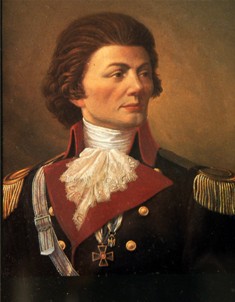
TADEUSZ KOSCIUSZKO
Jefferson wasn’t the only “founding father” to engage in this behavior. James Monroe, James Madison, and George Washington all kept slaves; Washington freed his only in his will. (CP: This is true but out of context, as Mr. Wiencek explains in his comment below.) It is often written in defense of such men that they had grown up in an atmosphere of slavery and were simply products of their time. That’s an idea that Wiencek debunks, both because Jefferson himself had so often excoriated the institution of slavery and because he had been urged by some of his contemporaries to free his slaves. In fact, Jefferson was upbraided by the Marquis de Lafayette, a hero of the American Revolution, who visited the United States in 1824 and bluntly expressed his disappointment not only that slavery was still in place but that Jefferson himself was still holding people in bondage.
Wiencek also reports that at the request of the Polish patriot Tadeusz Kosciuszko, who also had participated in the Revolution, Jefferson assisted in the preparation of Kosciuszko’s will in which he left $20,000 with which Jefferson was to buy and free slaves. When Kosciuszko died, Jefferson refused to carry out the will.
Wiencek’s book is a good opportunity to take a close look at how slavery was constituted, how enslaved men, women, and children lived in Virginia in the early 19th century. But its real value is in stripping away the veneer that has been placed over men like Jefferson in an effort to legitimize modern political philosophy through a distorted view of the purity of their motives and personal lives.

Books: “John Quincy Adams”
August 3, 2012

JOHN QUINCY ADAMS
A man of about my grandfather’s vintage was telling me that he once owned a house in Brooklyn and the candy store on the first floor. When I asked what had become of the property, he brought his hands together in a loud clap and said, “Mr. Hoover.” The implication was that he had lost the house and store as a result of the Great Depression and that the Great Depression was Mr. Hoover’s fault.
The history of the economic calamity of the 1930s is complex, and while Herbert Hoover’s approach to it is open to criticism, it is simplistic to argue that he was responsible for the losses suffered by millions of people. Unfortunately for Hoover, most Americans who can identify him at all are likely to describe him as the president who failed to solve the Depression. And that means that most Americans have forgotten — or more likely have never known — that Hoover was a great public servant and, in several instances, an American hero. As Casey Stengel said, you could look it up: Hoover organized the evacuation of Americans from Europe at the outbreak of World War I; he organized the delivery of millions of tons of food to Belgium after it had been invaded by Germany; he ran the commission that made sure American food supplies were conserved so that there would be enough to supply U.S troops in Europe during the war; he ran the administration that fed millions of people in Central Europe after the war; he oversaw the government response to the Great Mississippi Flood in six states in 1927; he organized a program that fed school children in impoverished occupied Germany after World War II; and under presidents Truman and Eisenhower he headed two commissions that successfully recommended reorganization and efficiencies in the federal government.
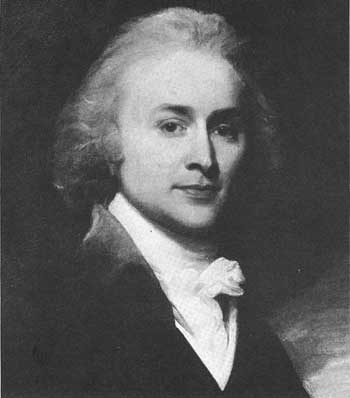
JOHN QUINCY ADAMS
Hoover had his failings and even his dark side, but the country’s ignorance of his accomplishments — to say nothing of his long career as an engineer and businessman — is out of whack.
Hoover is not alone in this. John Quincy Adams’ legacy has suffered a similar fate, as Harlow Giles Unger explains in a biography of the sixth president that will be published in September. Adams’ presidency was a dud, but he otherwise led one of the most outstanding public lives in the history of the country. He was the son of brilliant parents — Abigail and John Adams — and they expected big things of him. Unger reports, in fact, that John Adams, the second president, expected his son to eventually follow him into that office, after getting a classical education and learning and practicing law. John Q. grew up in the midst of the American Revolution; in fact, he and his mother were eye witnesses to the Battle of Bunker Hill.
Defining events in his life, though, were successive trips to Europe with his father, who was engaged in diplomacy. Those trips led to a career in diplomacy for the younger Adams who was not excelled by anyone serving in that capacity before or since. He later served as secretary of state in the administration of James Monroe and again did outstanding work, including his authorship of what became known as the Monroe Doctrine. He was, Unger argues, one of the most important experts on foreign affairs in American history.

ABIGAIL ADAMS
John Quincy Adams was elected to the presidency without campaigning for the office, and in a certain sense he wasn’t elected at all. The wildly popular war hero Andrew Jackson won more popular votes in the election of 1824 but not enough electoral votes to carry the day. Henry Clay threw the election into Adams’ lap by instructing the Kentucky delegation to vote for Adams, who had not won an electoral vote in that state. When John Q took office, he named Clay secretary of state, which was a much more powerful office then than it is now. Although it would have been out of character for Adams to have conspired with Clay in order to gain the presidency, that’s how many Americans read it, Unger writes, and it got Adams’ administration off to a poor start.
Adams had an ideal that would sound odd to Americans today: he believed that principle was more important than party. Tell that to John Boehner and Nancy Pelosi. Adams carried this idea to extremes, going to the mat first with his own Federalist party and then with the opposition Republicans on one issue or another. As a result, he really had no party, while Andrew Jackson was building the new Democratic party into a meaningful force. He also gave no thought to even conventional patronage when he appointed his cabinet, and so he was, as Jimmy Durante used to say, “surrounded by assassins.”

The short version is that Adams’ presidency didn’t amount to much, and he left office in a significant funk after losing the election to Jackson. But he was invited to run for Congress from a district in his native Massachusetts, and so he became one of three presidents to hold public office after leaving the White House. (The others were Andrew Johnson, who was elected to the U.S. Senate and William Howard Taft, who was appointed chief justice of the United States.)
Adams spent 17 years in the House of Representatives and it was, as Unger recounts in dramatic fashion, a wild scene. Adams hated slavery, which he had first seen up close when he traveled to Poland as a teenager. The House leadership didn’t want the subject broached in the chamber and passed rules to prevent the word “slavery” from being uttered or petitions against slavery from being presented. Adams fought furiously against this procedure, violating the rules repeatedly, and demanding over and over to know, “Am I gagged? Am I gagged?” He eventually became a highly respected figure in the House, even by those who disagreed with him, and reputedly was one of a handful of the best who ever served there.

SS Amistad
During this period, Adams also got involved in the legal case of a group of more than fifty African men and women who were being transported as slaves from one port in Cuba to another when they seized control of the ship, the Amistad. The ship was taken into custody in American waters, and the Africans on board sued to keep from being returned to bondage.
Adams gave a seven-hour argument before the U.S. Supreme Court which, although most of the justices were hard-nosed southern slave holders, ruled unanimously that the Africans should be set free.
In recounting Adams’ career, Unger provides a close look into the life of the distinguished and patriotic Massachusetts family: the relationship between John Q. Adams and his redoubtable parents, and between John Q. and his wife, Louisa, who at times lost patience with the demands her husband’s public service made on family life.
Unger’s book brings this good and great man back to life at least on the printed page. It was a life that deserves much more attention than it gets.
Books: “The Longest Fight”
July 16, 2012

JOE GANS
Prize fighting was part of my growing up.
My parents associated with some people who were connected to the boxing game: a promoter, a ring announcer, a cut man. At times, Mom and Dad would attend fights; I remember Mom coming home after one of those occasions with flecks of blood on her pink suit. Apparently they were at ringside.
In those days, the 1950s, we could watch fights on broadcast television, and we saw Carmine Basilio, Ezzard Charles, Jersey Joe Walcott, Sugar Ray Robinson, and Archie Moore.
Then, as now, I was a little schizophrenic when it came to boxing. I liked watching fighters like the ones I named, but I didn’t approve of boxing and thought it should be banned. I thought, and think now, that an enterprise in which the object is to knock your opponent senseless has no place in a civilized society.

WILLIAM GILDEA
Boxing was, in fact, illegal in most of the United States in the period discussed in William Gildea’s book, The Longest Fight. Where it was legal, one of the most prominent practitioners of “the sweet science” was Joe Gans, Gildea’s subject, the lightweight champion of the world and the first African-American to hold a world boxing title.
Gans held the lightweight title from 1902 to 1908 and he won the welterweight title as well in 1906. A native of Baltimore, he was strikingly handsome, well spoken, witty, courteous, and charming. Those qualities plus his nearly matchless skill in the ring attracted a large following, including white folks in numbers that were unusual for a black athlete in the days when Jim Crow was in such full vigor that racial epithets and garish cartoon figures of black Americans were commonplace in daily newspapers.

A postcard promoting the first Gans-Nelson fight.
Gildea recounts that Gans put up with plenty of abuse during his career, but he had learned the wisdom of restraint, and he practiced it in and out of the ring. When a white opponent spat in Gans’s face while the referee was going through the ritual of instructions, Gans bided his time until the fight began. His demeanor in everyday life was disarming, and he won over many people who otherwise would have included him in their overall prejudices about black people.
Gildea reports that people such as promoters and managers took advantage of Gans, because they knew a black athlete had no recourse and often was risking his life just by climbing into the ring with a white boxer.
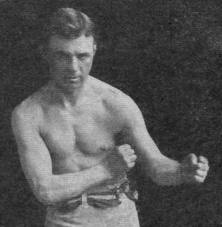
”BATTLING” NELSON
In what was arguably the biggest fight of Gans’s career — the “long fight” referred to in the title of this book — the manager of Oscar “Battling” Nelson insisted that Gans submit to three weigh-ins on the day of the contest, and under unheard of conditions. Gans just stood for it. No one, he knew, wins at the weigh-in.
That fight took place in September 1906 under a broiling sun in the Nevada desert town of Goldfield. Gans defended his lightweight title against Nelson, whom Jack London called “the abysmal brute” for both his free-swinging style and his penchant for dirty tactics like groin punches and head-butting. Nelson was also an unapologetic racist who made no bones about his revulsion for Gans and black people in general. It was a fight to the finish, and the finish didn’t come until the referee disqualified Nelson for a low blow in the 42nd round, after two hours and 48 minutes of combat.
By that time, Gans had beat the tar out of Nelson whose face, Gildea writes, was almost unrecognizable, but if Nelson had one positive attribute it was that he could take punishment, so he was still standing when the referee made Gans the winner.

Gans during one of the three weigh-ins before the fight in Goldfield.
Gildea describes the “fight to a finish” in episodes running through the book, interrupting the account from time to time to relate other aspects of Gans’s career and private life, including the two dives he acknowledged, his warm relationship with his mother, his romantic ties, his establishment of a Baltimore hotel and saloon that was a drawing card for a stylish crowd, both black and white, and his early death.
Gildea, whose carefully crafted narrative makes this book especially enticing, clearly explains the quality that made Gans a perennial winner. He blocked his opponents’ punches, moved as little as possible, threw a punch only when he saw an opening. And when he did punch, the blow was short and direct — in fact, Gildea writes, Gans introduced the technique of reaching out to touch his opponent and freezing the distance in his mind.
Gans is largely forgotten today, but as Gildea demonstrates, he was an important figure in the history of boxing and, more significantly, in the history of black citizens in the United States. Like the black men and women who were the first to venture into other fields, Gans took a barrage of slings and arrows for the team, and he did it with style.
Books: “The Mark Inside”
July 14, 2012

J. FRANK NORFLEET
I was a neophyte reporter in Perth Amboy when I first heard the term “flim flam.” I came across it on a police report during my daily visit to headquarters, and I was to see it many times during the two and a half years I covered the city. This term can be used to mean more than one thing, but in the parlance of Perth Amboy police in the mid ’60s, it meant a scam that was run on the sidewalk outside a bank. In those days, before there were banks every thousand feet, Perth Amboy was a banking center and therefore a favorite haunt of a certain kind of con artist.
In Perth Amboy, flim flam meant that an older person who had just emerged from one of the banks on Smith Street would be approached by an amiable stranger who appeared to be both excited and confused. The stranger had found a bank envelope stuffed with cash and with no identification. While the stranger explained this to the unwitting target, a third party would “observe” the scene and approach the pair to ask what was up. Eventually, the ring leader would offer to split the money with the dupe — something that wouldn’t make sense if the easy mark wasn’t drunk with the smell of found money. There was a catch: the sucker would have to put up a significant among of money to show “good faith.” Usually, the victim would go back into the bank and withdraw that money, agree to meet the pair later to split up the dough, and you know the rest.
 This gag followed the same pattern every time. The first few times I read flim flam reports, I asked anyone who would listen how a person could fall for such a scheme. Cops who knew more about human nature than I did told me it was about greed, but it was also about trust. That’s the “con” in “con man” — a guy gets away with a stunt like that because he wins the confidence of his prey.
That phenomenon — the ability to con — is the subject of Amy Reading’s sassy, informative, and sometimes provocative book, The Mark Inside. In this book, Reading, who holds a Yale doctorate in American Studies, traces the origins and development of the con game in America, finding its roots in the humbug of showmen such as Phineas T. Barnum and following its evolution into the modern age — an age, she writes, in which the con is no longer the sole province of showmen and criminals but a vital tool in the commerce of everyday life.

AMY READING
Radical changes in American life, Reading deduces, led to this vastly increased reliance on the con. These changes included systems of rapid transportation — notably the railroad, the rise of cities, and finally the emergence of a “managerial class,” very different from the classes that once lived and traded only with what their own hands had produced, a class whose lingua franca was trust, the ability to get others to like them. Some critics have argued that Reading exaggerates the pervasive influence of this development, but the anecdotal evidence of the daily news — and even our own behavior, if we’re honest about it — seems to support her. What is our first concern in any transaction if not that the other party likes and trusts us, whether or not the trust is well placed?
As Reading is describing this aspect of American history, she is also telling the story of J. Frank Norfleet, a successful Texas rancher who in 1919 went to Dallas to conduct a legitimate transaction designed to improve his land holdings. When he arrived in the city, he almost immediately became the target of a gang of swindlers overseen by Joseph Furey, a gang that prowled cities like Dallas on the lookout for people exactly like Norfleet.
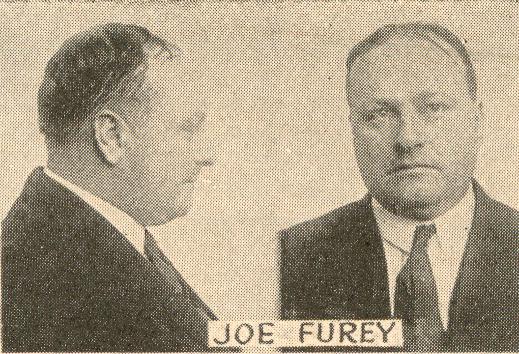
JOSEPH FUREY
Through an ostensibly chance encounter not unlike those on the streets of Perth Amboy, the gang drew Norfleet into a web that eventually involved phony securities investments and wound up costing him what today would be well over a million dollars. The Furey gang had this swindle down to an art form; every person involved knew his part well. What they didn’t count on was the personality of Frank Norfleet. Unlike con-game victims who usually slunk way in shame and fear, Norfleet put his personal affairs aside and went after the six characters who had done him wrong. He spent a fortune, took big chances, chased down leads from state to state, coped with corrupt cops and politicians, and benefited from dumb luck. Eventually, he succeeded utterly, and all six of the gangsters were prosecuted.

LOU BLONGER
When Norfleet traced the last of the six to Denver, he became the target of yet another con game, this one engineered by an organization run by Lou Blonger, who for 25 years was the crime kingpin in the city. Blonger himself ended up being toppled, thanks to the amateur detective, J. Frank Norfleet.
Norfleet, by Reading’s account, quickly warmed to his role as a relentless and fearless sleuth, and he loved to tell the story, even if he exaggerated at times. Reading’s own detective work sorts through fiction and fact, and the fact turns out to be compelling and even astounding on its own terms. After Norfleet had disposed of his quarry, he wrote an autobiography, appeared on vaudeville stages, delivered lectures, and started to produce a silent movie about himself. He became, Reading writes, a con man in his own right, selling J. Frank Norfleet to whoever would buy.
Books: “The Divorce of Henry VIII”
July 4, 2012
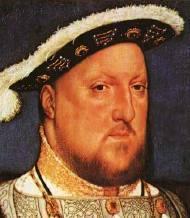
HENRY VII
The story of Henry VIII and his marriage to Anne Boleyn is widely known in its broad essentials. But such a thing as the divorce and remarriage of a king of England is not simply done — particularly when the nuptial rearrangement is frowned upon by the pope and the Holy Roman Emperor.
Henry’s decision to put aside his first wife, Catherine of Aragon, in favor of Anne Boleyn came at the dawn of the Renaissance when the political life of Europe could not have been more complicated. It was that complexity rather than any such goal on Henry’s part that protracted and inflamed the matter to the point that it resulted in a permanent breach between the English crown and the papacy and, of course, the founding of what we know as the Church of England.
In her history, “The Divorce of Henry VIII,” Catherine Fletcher puts Henry’s case in the context of Europe in the mid 16th century in terms of both the shifting relationships among kingdoms and other political entities and in terms of the swarm of diplomatic agents who scurried around the continent eavesdropping, spying, stealing, bribing, kidnapping, crossing and double crossing, and often living the high life that went along with representing a monarch.

Catherine of Aragon
In fact, the author tells the story largely in terms of these last, these “diplomats,” with particular attention to Gregorio Casali, a native of Rome who represented Henry at the papal court when the divorce issue began to brew. Fletcher, who seems to have done a lot of detective work to trace the activities of this relatively obscure character, explains that it was not unusual in Europe in that era for men to hire themselves out as ambassadors for countries other than their native land. In fact, she writes, it wasn’t unusual for men to hire themselves out as ambassadors to more than one crowned head at a time. This kind of activity was an industry in itself — a family business for the Casali clan that included Gregorio and several siblings who pursued the same career.
Because of the slow pace of communications, envoys working at a distance from their patrons were often given wide latitude in the conduct of their offices; particularly while Cardinal Wolsey was Henry’s chancellor, Gregorio often acted on his own when the circumstances seemed to demand it. On the other hand, in the days before electronic cash transfers, people in Gregorio’s line of work frequently had to shell out their own cash to keep up appearances or even to keep eating and hope that the payments due would be forthcoming. And these diplomats, as it were, had their work cut out for them, what with the constant warfare in Europe and the resulting ebb and flow of military and political power. Gregorio’s course in representing Henry before the pope wasn’t made any easier by the fact that Catherine of Aragon was the emperor’s niece. When the issue of a divorce first arose, the pope and the emperor were seriously at odds, which theoretically weighed in Henry’s favor in the Vatican, but while the matter dragged on, Clement and the emperor made peace. And that complication was superimposed on many other considerations involving the major powers in Europe and the many states, including the papal ones, that made up what is now Italy.

POPE CLEMENT VII
The question Henry raised was tricky. He had married Catherine in the first place with a papal dispensation because she was the widow of his brother. But in his frustration over Catherine’s failure to provide a male heir, and in his infatuation with Anne Boleyn, Henry now decided that the marriage to Catherine was null because it conflicted with a principle stated in the Book of Leviticus, and he wanted the pope to say so. Clement had to deal with both the philosophical and moral issues raised by that request and balance his decision against what effect it would have on his position in the grand scheme of European politics. For most of the six years that Henry’s campaign went on, Clement stalled.
As Henry became more and more impatient and less and less concerned about the authority of the pope, Gregorio’s position became increasingly tenuous. But that seemed to be an almost inevitable experience for those who wanted to play in the high stakes games Fletcher describes in this book.
Books: “You Stink!”
June 8, 2012

President Franklin Roosevelt asks Congress to declare war on Japan.
The authors of a new book on baseball describe the Japanese attack on Pearl Harbor, which occurred on Dec. 7, 1941. The writers continue: “The next day, calling it ‘a day of infamy,’ President Franklin Roosevelt asked Congress to declare war on the Japanese and their allies, Germany and Italy.”
The ambiguous pronoun makes it unclear which day Roosevelt was referring to — December 7 or “the next day” — but the record shows that was December 7 and that Roosevelt did not call it ‘a day of infamy’ but ‘a date that will live in infamy.’ The record also shows that Roosevelt did not mention Italy or Germany, both of which declared war on the United States about a month later.
The title of this book is “You Stink!” It is a compilation of what the authors, Eric Wittenberg and Michael Aubrecht, regard as the worst teams, players, plays, and decisions in the history of major league baseball.

In my opinion, the book is pointless and, despite the authors’ disclaimer to the contrary, mean spirited. What else but a mean spirit would prompt writers to spend their time compiling a monotonous stream of statistics to memorialize the failures and disappointments of one team and one player after another. There is nothing original about that, despite the author’s claim that their purpose was to write something original about baseball. Any baseball fan knows that there is much more failure than success in the game; reporting on the failures alone, without the context of the successes, is sophomoric.

JOHN HUMPHRIES
But, then, everything about this book is childish, which is especially jarring because of the credentials the writers present: one is an “award-winning Civil War historian,” and the other “dedicated his studies to the histories of Major League Baseball, the Civil War, and the American Revolution.” These history buffs report that the Brooklyn Dodgers won the 1953 World Series. It was the Yankees.
The adjectives alone are suffocating. How bad was that batting average, that ERA, that season, that decision? It was “atrocious,” “staggering,” “eye-popping,” “wretched,” “anemic,” “terrible,” “mind-boggling,” “horrible,” “pathetic,” “dismal,” “stunning,” “miserable,” “incredible,” “ghastly,” “abysmal.”
There are grammatical errors, a few misspellings, and outrages in style that affect almost every sentence. There is a quote from Roger Maris used twice in the same chapter and numerous other lapses that suggest that this book and a competent editor were never in the same county.
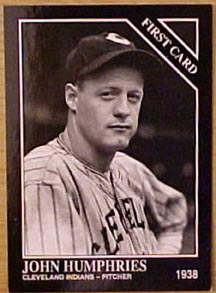
JOHN HUMPHRIES
One of the most conspicuous signs that this book is headed for deep discount is the case of poor John Humphries, whom the authors singled out for opprobrium as the worst catcher of all time. Humphries appeared in a total of 103 games over two seasons in the 1880s. He played catcher in only 75 of those games. It is true that Humphries committed 74 errors in those 75 games, but no serious student of baseball would take into account such a short career in ranking fielders. To emphasize their point about Humphries, the writers included a photograph of him, except that any 15-year-old kid would know that that picture wasn’t taken in the 19th century.
That’s a picture of the other John Humphries, who is in the photo above left, the John Humphries who pitched in the majors in the 1930s and 1940s. The John Humphries whose humiliation was probably sufficient without any help from these writers, is in the photo above.
Wait for the movie.
Books: “How to Teach Relativity to Your Dog”
June 3, 2012
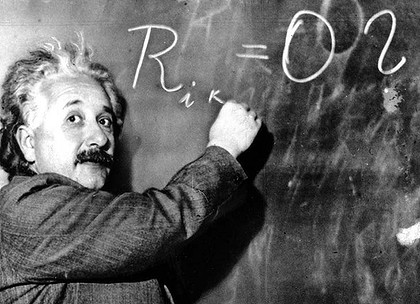
ALBERT EINSTEIN
I still argue with the voice on my GSP. Don’t look at me that way: You do it, too! The voice has a British accent; we call her Petula. And I still argue when I want to stay on I-95 and she tries to send me onto US-1. But I do have a little more respect for her — or, at least, for the device — now that I’ve read Chad Orzel’s book “How to Teach Relativity to Your Dog.”
Orzel, a professor who also wrote “How to Teach Physics to your Dog,” explains in this more recent book that the technology of global positioning systems relies on a principle of the theories of relativity first formulated by Albert Einstein. A principle of the special theory of relativity holds that a clock that is in motion will “tick” increasingly more slowly as the speed of its motion increases. The general theory of relativity, on the other hand, holds that a clock runs faster the higher it is — that is, the greater its altitude in the gravitational field.

The atomic clocks aboard the GPS satellites speed up because of their altitude and slow down because of the speed at which the satellites orbit the earth. At the altitude of those satellites, the clocks are quickened more than they are slowed, but they are still keeping time at a different rate than clocks on the surface of the earth. Each satellite emits a radio signal with the time on its atomic clock. The GPS unit picks up two or three of those signals, calculates the difference between the time on the satellite clock and the time on the surface of the earth, and uses that information to determine the distance to each satellite and, from that, the location of the unit on the ground.
Pretty cool, huh?
Still, I don’t read about physics because I’m interested in the practical applications so much as because I’m interested in the theories and principles. It can be mind-bending stuff, but if given enough concentration and persistence, it can lead to some moments of enlightenment about how the universe works. And studying the theories of relativity, in particular, can be an eye-opening series of reminders that things are not always what they appear to be.
 Orzel’s technique in this book is to explore the special and general theories of relativity, and some other matters, as though he were discussing them with his real-life dog, Emmy. This is the writer’s way of making the material more accessible to people like me, but frankly, it gets tiresome. The dog’s constant references to Orzel as “Dude” and the overworked jokes about Emmy’s appetite, disdain for cats, and fixation with chasing rabbits, grow old pretty quickly. And the premise crumbles as the dog begins to talk about physics as if she were a graduate student at Princeton.
I think anyone who picked up this book thinking that the dialogue with the dog, and the use of dog-world examples, would make physics easier to understand would be disappointed. Orzel’s explanations are clear, but he could have been just as clear without the input from the dog. More important, with or without the dog, a reader won’t get much out of this book without focusing attention on it, frequently stopping to think hard about what Orzel has just written, frequently re-reading paragraphs or whole sections and consulting the glossary at the back of the book.
 Both the special and general theories of relativity depend on the idea that the laws of physics work the same for observers who are in motion and observers who are stationary, even though an event — such as a person dropping a ball from above his head to the floor at his feet on a moving train — will appear differently to the person dropping the ball and a person observing the event while standing still on the station platform.
An interesting thing that comes up again and again in Orzel’s book is the fact that researchers are still discovering implications of these theories that Einstein expounded at the beginning of the 20th century. Already Einstein’s work has led to the understanding that the mass of an object is a measure of its energy and the two properties are connected by the constant e=mc²; that time and space are expressions of the same thing; that gravity bends light; that large objects bend space; that a moving object shrinks in length in the direction in which it is moving — the faster it moves, the more it shrinks.
Orzel’s also discusses black holes, those concentrations of mass so dense that even light can’t escape their gravity; the principles behind nuclear energy — both the relatively weak energy that holds atoms together and the enormous energy that can power cities or destroy them; the discovery that the universe is expanding at a constantly increasing rate; and the likelihood that this expanding universe began as a single point that exploded in what we know call the “big bang.”
The dog? I can take or or leave her. But reading this book — some of it two or three times — was worth the energy (which, by the way, equals mass times the speed of light squared)
 CharlesPaolino's Blog