Books: “The Man who Broke Into Auschwitz”
August 26, 2011

DENIS AVEY/BBC photo
The title of the book is misleading. Denis Avey, a British soldier during World War II, didn’t break into Auschwitz. He was a POW there, so he was already within the walls, as it were. He and the other inmates had been put to work building an enormous industrial plant in which a German company planned to manufacture synthetic rubber and methanol. From the first, Avey was deeply disturbed by the condition of the Jewish prisoners – the “stripeys” he called them because of their pajama-like uniforms. He was so distressed in fact, that he became obsessed with the need to see for himself the section of the Auschwitz complex where the Jewish inmates lived. If he survived the prison himself, Avey wanted to be a witness.

AVEY with Prime Minister GORDON BROWN/BBC
So compelling was this need in Avey’s mind that on two occasions he swapped clothing with a Jewish inmate and shuffled off with the other Jewish prisoners at the end of the work day. What he found was at least as bad as he had imagined.
That part of Avey’s story is recounted in “The Man who Broke into Auschwitz,” which he co-wrote with Rob Broomby, a BBC reporter who worked very hard to help Avey reconstruct the experience 60 years after the fact.
Before he was sent to Auschwitz, Avey had seen plenty of combat in North Africa. He was part of the force that first drove the Italian army out of Egypt and across Libya and then went on the defensive when Erwin Rommel brought his Afrika Korps into the fray and reversed the tide of battle for a time.

ERWIN ROMMEL
Avey, who explains that he went to war in the first place for adventure, not for King and country, was a brash sort whose chutzpah both got him into scrapes and enabled him to survive on both the battlefield and in prison. Once he was captured, he escaped several times including one final time during a forced march eastward in the dead of winter when the Nazis abandoned Auschwitz in order to elude the advancing allies.
On one occasion, Avey watched while an SS officer repeatedly beat a Jewish inmate until the young man died. Avey was already frustrated by both the fact that the Nazis were deliberately working the Jews to death and by the knowledge that he couldn’t do anything about it. When that young man died, Avey shouted a crude German insult at the officer, who responded by cold cocking Avey with the butt of a hand gun. The injury cost Avey his sight and eventually the eye itself.
But the worst injury he suffered was psychological. When he finally returned home, his own family – including his father, who had also enlisted – didn’t want to discuss the war at all, and others wanted to hear only about derring-do on the battlefield. No one was interested in, or capable of confronting, the truth about the concentration camp.
 Avey himself stopped talking about it for decades, and he suffered nightmares and other signs of post traumatic stress disorder – a problem that was not recognized and therefore not treated at the time.
There is much more to this story, including the unexpected outcome of a small favor Avey was able to do for one Jewish inmate, but that’s best read in the pages of Avey’s book. It was largely because of Broomby’s work that Avey was eventually able to talk openly, and write, about what he experienced. The two men have performed an important service, because it is critical that knowledge of what the Nazis did be kept alive in the public consciousness.
That’s true both because of the crimes committed by the Third Reich and its collaborators but also because such atrocities have been committed again and again since then – the difference being only one of scale.

Books: “No Regrets: The Life of Edith Piaf”
May 22, 2011
 If it was Sunday night, I wanted to see Señor Wences. I did not want to see Edith Piaf, who turned up from time to time on Ed Sullivan’s TV show, “Toast of the Town.” It was all a part of being young and ignorant. I later learned to appreciate what an astounding singer Piaf was, but I knew nothing of her background before reading Carolyn Burke’s recent biography.
Piaf had a rough life in many respects. She was born in 1915 in a poor part of Paris to nearly indigent parents – her father an acrobat named Louis Gassion and her mother a drug-addicted street singer whose professional name, as it were, was Line Marsa. Louis and Line separated and Line played almost no part in Edith’s life except to occasionally surface and ask for money — which Edith usually provided. Louis took responsibility for his daughter, although that meant, for a time, that he left her to live in a brothel that was managed by his mother. He later reclaimed the girl and took her “on the road” with him — first while he performed with a circus and then when he returned to the streets. Edith had to work, keeping house, passing the hat when Louis performed on the street, and eventually singing for coins herself.
 When she was 16, Edith convinced her father to let her live on her own, but she maintained a close relationship with him for the rest of his life, which eventually meant supporting him. As a result of one of the first of a very long string of romantic and/or sexual relationships, she bore a child, a girl, who died at the age of two — an experience that affected Edith for the rest of her life. She gradually developed as a singer on the street and in Paris dives, but her career took off after she was discovered by a shady character named Louis Léplee, who booked her in his cabaret and taught her some things about performing before the public. He also dubbed her “piaf” — “sparrow” — because of her stature (4’10”) and her bird-like gestures.
Edith Piaf specialized in chasons réaliste, songs of realism that expressed the sorrows of the lower class — including the prostitutes, beggars, and love-starved sailors who were among the singer’s earliest acquaintances. Frustrated love was a constant theme in these songs and in Edith Piaf’s life.
 In addition to having a powerful and expressive voice, Edith Piaf was a prolific songwriter, creating the lyrics for many of the songs she introduced. Many of her love affairs were with men in whom she also had an artistic interest, and she played the mentor to them, demanding almost excruciatingly hard work but, almost without exception, helping them to solidify their careers. Edith herself became a star in several media in both hemispheres — night clubs, movies, records, radio, and television.
 Edith Piaf lived in France during the World War II period, and was criticized in her own time by people who thought she was too accommodating to the German occupation. But Burke reports that the singer was instrumental in helping Jewish friends hide from the Nazis and that she irritated the Nazis, perhaps deliberately, by singing the work of a Jewish songwriter. But Edith was even bolder than that, by Burke’s account. She agreed to visit French soldiers who were being held in prisons in Germany, and she made a point of being photographed with them. Then she returned, as part of a plot by the French Resistance, and slipped some of those soldiers false identification that included their faces cropped from those photos. Some 188 of those men escaped, using those fake credentials.
It’s an understatement to say that Edith Piaf didn’t take care of herself. She worked very hard, both in rehearsals and in a hectic schedule of bookings, partly because of the cost of maintaining not only her own lifestyle but also a coterie of friends, hangers-on, and just plain cheats, whom she deliberately cultivated as a sort of salon. She drank heavily and she became dependent on a complex of pain killers — for debilitating arthritis — sleeping pills, and uppers. This regimen apparently contributed to the ruin of her liver which in turn caused her death in 1963.
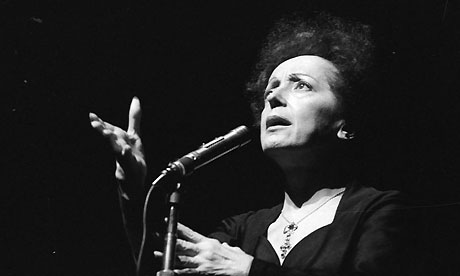 The poet Jean Cocteau — a close friend of the singer — described Edith Piaf as a genius and called her “this astonishing little person.” “A voice rises up from deep within,” he wrote, “a voice that inhabits her from head to toe, unfolding like a wave of warm black velvet to submerge us, piercing through us, getting right inside us. The illusion is complete. Edith Piaf, like an invisible nightingale on her branch, herself becomes invisible. There is just her gaze, her pale hands, her waxen forehead catching the light, and the voice that swells, mounts up, and gradually replaces her.”
For a good example of that voice, click HERE.
Netflix Update No. 34: “Some Like it Hot”
July 22, 2010

MARILYN MONROE
We stumbled across an old TV interview with Tony Curtis recently, and that prompted us to watch “Some Like it Hot,” the 1959 Billy Wilder film, which neither of us had seen. The premise of this movie is that dance band musicians Jerry and Joe, played by Jack Lemmon and Tony Curtis, inadvertently witness the “St. Valentine’s Day Massacre” in a Chicago garage in 1929 and have to leave town to avoid being killed themselves. They do that by dressing in drag and joining an all-girl band that is on its way to an engagement in Florida. (The Florida scenes, curiously, were filmed at the instantly recognizable Hotel Del Coronado in California.) Both of the fugitives are immediately attracted to the zaftig singing ukulele player, Sugar Kane Kowalczyk, played by Marilyn Monroe. Joe (aka Josephine) seizes the advantage with Sugar Kane by posing as the millionaire scion of an oil magnate, and that leads to a steamy encounter aboard a yacht. In that role, Curtis does a hilarious imitation of Cary Grant’s voice. Meanwhile, Jerry (aka Daphne) gets drawn into a relationship with an older sugar daddy, played by Joe E. Brown, in which the gender issue gets a little hazy.

JOE E. BROWN and JACK LEMMON
This film combines violence and overt sexuality with implausible farce. It wouldn’t stir up the pond today, but it was controversial in its own time. Marilyn Monroe’s make-out scene with Tony Curtis – and a couple of very revealing dresses she wore – contributed to the negative reactions the film got in what was clearly a different era than our own. The cast, which also included George Raft and Pat O’Brien deliberately type-cast as fictional mob boss “Spats” Colombo and Chicago police Detective Mulligan, was a talented aggregation and made the odd mix of dark and light themes work very well. The film was shot in black-and-white, which somehow seems appropriate to the ’20s setting, but I read that the decision was driven by the fact that the makeup Lemmon and Curtis wore did not reproduce well in color.
As much as I liked this movie, I was surprised to learn that it has been described in laudatory terms ranging from one of the best comedies ever made to the best comedy ever made, to one of the best pictures ever made. I always look askance at statements like that because of the volume of work – done by a wide variety of artists in a wide variety of times and circumstances – that has to be dismissed to make such an evaluation true. It’s enough to say that “Some Like it Hot” was a very good movie. It won an Oscar and was nominated for seven others, and it won Golden Globe awards for Marilyn Monroe and Jack Lemmon and as best picture of the year.

JOE E. BROWN
A lot has been written about the making of this movie, including accounts of how much trouble Marilyn Monroe caused during the production — which must have particularly irked Wilder, who originally planned to use Mitzi Gaynor in that part. Monroe was chronically late and often couldn’t remember her lines and had to read them from cues concealed on the set. She was also pregnant, and appears overweight – even for her – in several scenes.
On the other hand, it was a rare pleasure to watch a performance by Joe E. Brown, who is largely forgotten now but had a keen sense of comedy and was one of the gentlemen of the film industry.

JOE E. BROWN
Although Bob Hope got a lot of attention for the amount of time he devoted to American servicemen and women, Joe E. Brown did his share, too, particularly during World War II. He was a regular figure at the Hollywood Canteen, where he personally interacted with the visiting troops, and he paid his own way to travel more than 200,000 miles into war zones to entertain, often under difficult conditions. He was often known to repeat his whole show for hospitalized soldiers who had been unable to attend the regular performance. He also carried sacks of mail from servicemen and women back to the United States so that it would be delivered through the regular postal service and reach their families more quickly. Brown and Ernie Pyle were the only two civilians awarded the Bronze Star during World War II.
Joe E. Brown was also one of the few public figures who spoke out in favor of admitting refugee Jewish children into the United States while Adolf Hitler was consolidating his power in Europe. In 1939 – flying in the face of both anti-Semitism and isolationism – Brown appealed to a Congressional committee to pass a bill that would have allowed 20,000 German Jewish children into the U.S. “We shouldn’t be smug about this,” Brown told the committee, “and say that we are getting along all right so let the rest of the world take care of itself.”

Joe E. Brown testifies before the House Immigration and Naturalization Committee, 1939
“She’s making history, working for victory” — Evans and Loeb
March 28, 2010
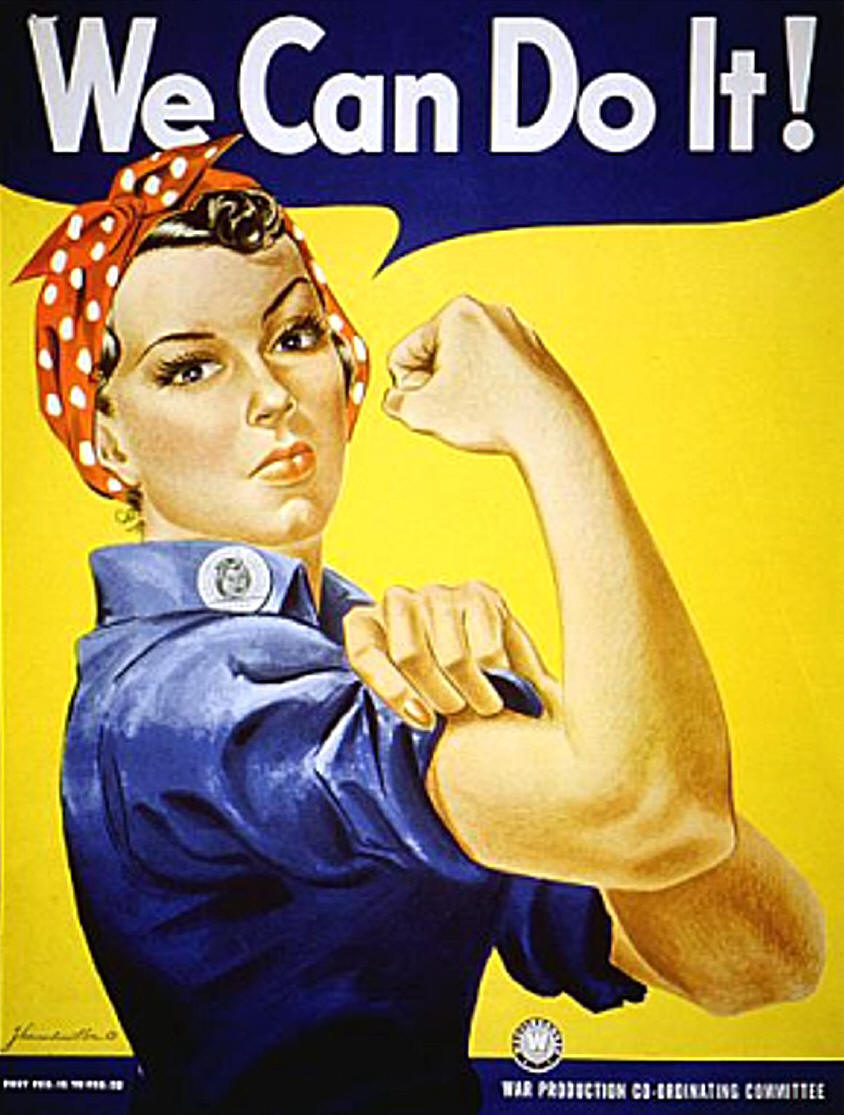
"Rosie the Riveter"poster from World War II era
Like many people, I guess, I frequently brood over the questions I should have asked when I was a kid. One category that came to mind today is related to my father’s work in an aircraft assembly plant during World War II. All I know is that Dad was not drafted into military service, but was assigned to work at the Curtiss-Wright Corp., I presume in Caldwell. He was 29 years old when my brother was born in 1941, and his age might have had something to do with his exemption. He told me that he worked in my family’s grocery store during the day and at Curtiss-Wright at night, but how long he worked at the plaht and what he did, I didn’t ask. Along about 1976, it became too late. I can’t blame it on the ignorance of youth, either; by the time Dad died, I was in my 30s, and I still hadn’t asked.
Fortunately, most people are smarter than I am, including some filmmakers who are tracking down women who worked in the defense industry during the war — the fabled labor force that shared the sobriquet “Rosie the Riveter.”
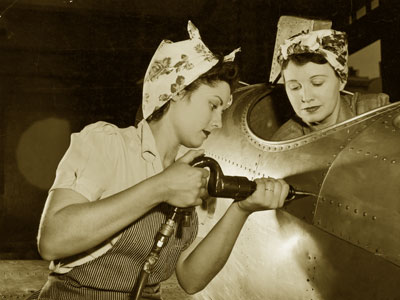
Women at work in a defense plant during World War II
I saw a note on the web site of the Detroit Free Press indicating that the filmmakers plan to visit Michigan next month looking for women in that state who had supported the war effort by building aircraft and manufacturing munitions and other matériel. This is a project of New York University’s Tamiment Labor Archives; it’s explained in some detail at THIS LINK.
Several years ago, a project in Morris County, here in New Jersey, conducted several lengthy interviews with women who had been part of the Rosie brigade. The interviews, and photos of those women, are available at THIS LINK.
The term “Rosie the Riveter” was first used in 1942 in a song by that name written by Redd Evans and John Jacob Loeb. In poking around on this subject, I also learned that the women who did this indispensable work have been commemorated in the Rosie the Riveter Charter High School in Long Beach, Calif., a school that gives girls an opportunity to learn non-traditional trades.

A student at Rosie the Riveter Charter High School learns to operate a power saw.
Ike as in “like”
May 2, 2009

DWIGHT EISENHOWER
I just finished reading “Ike: An American Hero,” the 2007 biography of Dwight Eisenhower by Michael Korda, a former RAF pilot whose books include a biography of Ulysses S. Grant. This book seemed almost as long as the Second World War, but it provides a lot of insight into the military realities of the allied campaign for control of North Africa, Sicily, and ultimately the European mainland via the beaches of France.
Korda, who is British, tries to sort out the conflicting judgments about Eisenhower’s military leadership, which varies in direct relationship to which side of the Atlantic it comes from. That’s an interesting point in itself, because what Korda finds to be the key to Eisenhower’s genius is that he was able to manage and manipulate the constant head-banging among allied leaders – Winston Churchill, Charles DeGaulle, Joseph Stalin, and Franklin Roosevelt – who seemed to have few common interests beyond defeating Nazi Germany, and – on the other hand – who had many interests that were in conflict.
Scholarly rankings of the presidents – a pointless exercise in many respects – usually place Eisenhower among the top 10. Korda – while acknowledging several embarrasments and failures in the administration – gives Eisenhower a balanced report card for his eight years in office, but devotes most of the book to Eisenhower’s military career and particularly to the war. He emphasizes a point that may be lost on later generations, namely that as Supreme Allied Commander in Europe, Eisenhower exercised – and successfully – what was arguably the greatest measure of military and political power ever placed in the hands of a single person, before or since. He acted in some cases – for instance, in dealings with Stalin – as though he himself were a head of state.
Korda discusses Eisenhower’s analysis of the Korean War – namely that it couldn’t be won without an American military commitment that probably would have sparked another world conflict; his refusal to send American combat troops into what he considered the French colonial war in Vietnam, and his caution against American military involvement in the Middle East – a bitter lesson for Eisenhower himself in Lebanon.
I got to see Eisenhower in person in 1964 or 1965, when I was a graduate student at Penn State. I was working in the public information office and heard there that Eisenhower, who lived in Gettysburg at that time, was going to visit State College to address a group of high school students. Eisenhower was the first person to be protected under the Former Presidents Act, but you couldn’t tell it from his appearance at Waring Hall. I had no business there, but no one stopped me from going in and sitting in a balcony looking down on Eisenhower as he stood alone on the stage talking to those teenagers.

PORTRAIT OF EISENHOWER
He spoke to the students about civic responsibility, about not exercising their democratic rights by standing on the sidelines of political life. He was in his late 70s then and had suffered some serious health problems, but he stood ramrod straight with the military bearing that had been drilled into his DNA. He also had that good-natured ease of manner that Korda repeatedly argues contributed as much as anything else to Eisenhower’s success in the Army and in civilian life.
 CharlesPaolino's Blog