You’re lookin’ swell, Dolly!
December 30, 2024

September 17, 1932
I use this photo as wallpaper on my computers, because it is one of the best baseball action shots I have ever seen. The play took place on September 17, 1932 at the Baker Bowl in Philadelphia. The airborne player is Dick Bartell of the Phillies. The catcher, waiting to make the tag, is Gabby Hartnett of the Cubs. His teammates, visible in the first-base dugout, seem rather nonchalant about the play, but not so the fans—consisting largely of men in suits—who are on their feet. This was the first game of a double header. In the fourth inning, with the Phillies ahead 6 to 1, Bartell was trying for an inside-the-park home run. He was out on the play, but the Phillies would win the game, 7 to 1, and drop the second game, 5 to 1.
Although this episode is all about Bartell and Hartnett, I have always been drawn to the umpire, the trim figure crouching behind the plate, his mask off, his eyes glued to the anticipated point of impact. This is Albert “Dolly” Stark, an innovative, complicated, and ultimately tragic member of baseball’s dramatis personae. One of Stark’s distinctions was that he was the first Jewish umpire in baseball’s modern era and perhaps only the second Jewish umpire since baseball’s beginnings. I don’t know how we can be certain of this, but Jacob Pike, who umpired in the National Association in 1875 , is said to have been the only Jewish arbiter before Stark.

Stark was born in 1897 on the lower East Side of Manhattan. When Stark was a youngster, his dad died, and his mother lost her eyesight. After a police officer found the boy sleeping on a city street, Stark was consigned for a while to a facility for homeless children. Later, in an attempt to earn money for himself and for his family, he played second base for semi-pro and minor league teams. He tried out with the Yankees and Senators, but at 115 pounds, he could not compete at that level. It was during his playing days that he picked up the nickname “Dolly,” a reference to Monroe “Dolly” Stark, a shortstop with the Cleveland Naps and Brooklyn Superbas. Despite the surname, the Dollys were not related.
Albert Stark first umpired at the University of Vermont in 1921. By 1927, he was umpiring in the Eastern League where he did well enough to earn a promotion to the National League. At the time, Stark was also coaching basketball at Dartmouth College and continued until 1936. It might seem to us only common sense that an umpire does not remain stationary on the field but moves around in order to get the best view of a play. However, this was not a common practice until Stark introduced it, shifting positions behind the plate and running alongside fielders and runners to get the best view of plays.
The enmity between players and umpires, if is a staple of baseball lore, and at times it weighed heavily on Stark. And yet, when the Sporting News conducted a poll among players in 1934, they voted Stark the most competent umpire in the National League. If there were an award for the best-dressed umpire, Stark might have won that one too. He was very conscious of his appearance and always impeccably attired on the field in those days when umpires were decked out in suits, dress shirts, and ties, In 1935, Stark became the only umpire before or since to be honored at a day of his own. The event was held at the Polo Grounds in upper Manhattan where National League president Ford Frick presented Stark with a new car that had been purchased with small donations from Stark’s many fans.
In spite of this adulation, Stark’s relationship with baseball was sometimes tumultuous. In 1928, for instance, he wanted to quit in the middle of the season, because he didn’t think he was doing his job well. Bill Klem, one of the great umpires of that period, talked him out of it. Then, after the 1929 season, Stark again thought of quitting, this time because of the tense and lonely nature of umpiring, but he did continue in the 1930 season.
In 1936, Stark quit umpiring because, he said, he wasn’t being paid enough. His salary at the time was $9,000 per season which, according to some sources, was the equivalent of more than $200,000 today. Stark told Ford Frick—by then, the commissioner of baseball—that he would like to stay in the game in a different role, such as business manager or scout, but he never found such an assignment. He resumed umpiring in 1937 but had to retire in 1940 because of a knee injury.
Stark found other outlets for his talents. Among other things, he started a line of women’s apparel—the “Dolly Stark Dress; in 1936, he and Bill Dyer were the first radio team broadcasting Phillies games on WCAU; and he was co-host of an early television sports program, Your Sports Special, on the CBS network in 1948 and 1949.
Stark had a troubled private life. He financially supported his mother and sister, and his sister, who was chronically unwell, took her own life. He married in 1952 but was divorced after four years. Stark died in New York City in 1968.
 Brian Vanderbeek, Facebook friend and Modesto Bee sports writer, called attention today to a report from Bloomberg that the Little League World Series — played each summer in South Williamsport, Pa. — has expanded the use of video replays to resolve disputed calls. When replays were introduced to the tournament in 2008, they affected only plays at the outfield fence — home runs, ground-rule doubles, and issues of fan interference. Last year, questions of fair and foul balls were added. Now replays can be used to review force outs, tags on the basepaths, hit batsmen, and missed bases.
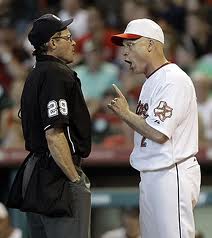 In addition, the original rule was that only umpires could call for review of a replay. Under the new rubrics, a team manager is entitled to one unsuccessful challenge in the first six innings of a game and one in extra innings. The league’s complete explanation of the procedure is available by clicking HERE.
The league emphasized in its announcement that replay appeals have been rare so far and that no appeal has yet resulted in reversal of a call. From my point of view, that information means that if the league comes to its senses and stops monkeying with a game that is not broken, it won’t make much difference.
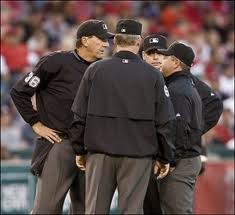 The introduction of instant replay appeals in baseball is the latest ill-advised, unnecessary change that alters the nature of the game. The designated hitter rule was one; it took away an exciting element of strategy in which the manager of a team frequently had to decide whether to stay with a pitcher who was doing well or yank him for a pinch hitter. The DH also eliminated those situations in which the pitcher batted in a crucial situation and tried to use his limited offensive skills to move baserunners along. What did baseball gain by getting rid of those elements? I also object to artificial turf, but there’s no point in belaboring that here.
 It is an intrinsic part of baseball to rely on the judgment of the umpires and to suffer over their bad calls. That’s been going on for more than 160 years, and the Republic has endured. In that respect, it’s a lot like life in general. What exactly is the league trying to teach pre-teen children by taking that human side out of baseball — that it isn’t a game after all? Or is this more about self-important adults than it is about kids?
I have to share Brian’s comment: “(I) can’t wait for an overturned North Korean home run to spark nuclear war.”
 CharlesPaolino's Blog