
HERM DOSCHER
One of the wonderful things about baseball is that it provides players with so many ways to be remembered — and many of those ways have little or nothing to do with success on the field.
Herm Doscher was an example. So was his son, Jack. In fact, together they constitute one example, because they were the first father and son combination to play the major leagues. Herm played third base for five different teams in the National Association and the National League from 1872 to 1882 – a spotty career for which there don’t seem to be a lot of statistics – and he was later a major league umpire. He was reputed to be hard-nosed in that role. He once ejected Rochester Broncos outfielder Sandy Griffin for arguing a call and, when Griffin wouldn’t leave the field, Doschler forfeited the game to the St. Louis Browns — who were leading 10-3 in the eighth inning anyway.
Jack Doscher (actually John Henry Doscher Jr.) was a pitcher from 1903 to 1908 with three teams including the Brooklyn Superbas, appearing in only 27 games. Doscher died in 1971 at the age of 90 and was at one point recognized as the oldest surviving player for the Brooklyn Dodgers, successors to the Superbas.
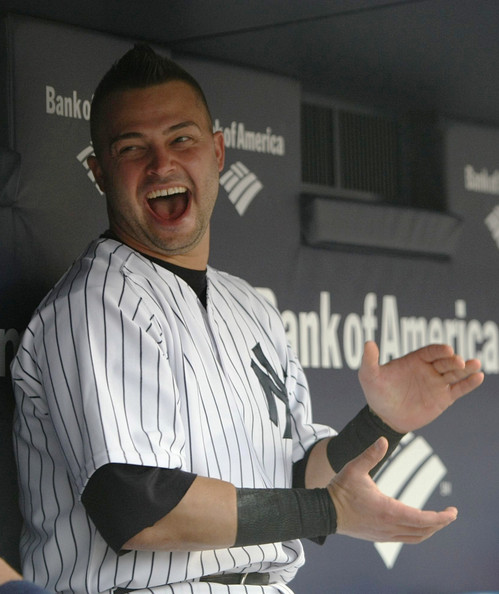
NICK SWISHER
The Doschers come to mind today because Major League Baseball announced this evening that Yankees outfielder Nick Swisher had been elected to the All Star Team. Whatever one thinks of the wacky manner in which those players are chosen these days, Swisher last season and this has made a good case for himself on the field. This is the first time Nick Swisher has been named to the All Star team, and it puts him in an exclusive baseball group — fathers and sons who have made the team. Swisher’s dad, Steve – a National League catcher for 10 years in the ’70s and ’80s – was on the 1976 team when he was with the Cubs, although he didn’t get to play. One of Steve Swisher’s colleagues on that ’76 team was Ken Griffey Sr., whose son also became an All Star — many times.
Altogether, 195 men who have played in the majors had sons who followed. A handful had two sons make it to the bigs. Three men — Sammy Hairston, Ray Boone, and Gus Bell — sent sons and grandsons to the majors. The Hairstons hold the record for multigenerational families with five major league players, although the Delahanty family had five of the same generation.

STEVE SWISHER
The Swishers are the tenth family to have a father and at least one son on the All Star team. (There have been three such families in the World Series.)
I was introduced to baseball by my father, who had managed a semi-pro team and knew a lot about the game. I would like to have been a better baseball player for his sake, but that gene went missing. Dad never expressed any disappointment about my weak performance; he wasn’t cut out that way. We made up for it with the many hours we spent together watching the Yankees in the Bronx and on TV or listening to them on the radio in our grocery store. We did other things together, but baseball provided the strongest bond. Dad’s been gone for more than 30 years, but I still watch baseball with him in mind. Meanwhile, it’s fun to speculate about the satisfaction Steve Swisher must be deriving from Nick’s success in general and from this benchmark in particular.
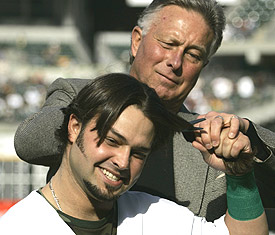
Steve Swisher cuts Nick Swisher's hair in 2007 on the field at the Oakland Coliseum. Nick Swisher had let his hair grow for 10 month so that he could donate it to a program that assists cancer patients.
 On April 19, I wrote about a 22-inning baseball game in 1962 in which the Yankees beat the Tigers, 9-7, thanks to the only home run of Jack Reed’s career. I mentioned in that post that Tigers outfielder Rocky Colavito went seven-for-ten in that game. That attracted a response from Gloria, who is a member of a group that is campaigning for the Veterans Committee to elect Colavito to the National Baseball Hall of Fame this year.
It’s well known by now that the Hall of Fame is not the Hall of Justice. I have commented here, for example, on the fact that Pete Rose — an obnoxious SOB, but one of the best hitters of all time — is ineligible because he gambled on baseball, but Adrian “Cap” Anson stares smugly from his plaque despite his critical role in keeping two or three generations of black players out of the major leagues. So if Rocky Colavito hasn’t been elected, there is no reason to be surprised.
I have a good perspective on this question, because I saw Colavito play at Yankee Stadium many times. I was fortunate enough to have a father who was devoted to both baseball and the Yankees, and at one point in the 1950s and 1960s, we attended an average of three games a week when the Yankees were home. We saw Colavito through most of his career.

BOBBY LOWE
Colavito’s stats as a hitter and as a fielder speak for themselves. They are readily available on the Internet, so I won’t recite them all here. I will mention that in 116 years, only 15 men have hit four home runs in one game; Colavito was one of them. That in itself doesn’t qualify him for the Hall of Fame, but in the context of the career he had at the plate, it can’t be ignored. The feat was first accomplished by Bobby Lowe of the Boston Beaneaters in 1894. Lowe was playing in the dead-ball era, but he was also playing in Boston’s Congress Street Park, which had a short left-field line. All four of his homers were hit to left. The only other player in the 19th century to hit four home runs in one game was Ed Delahanty of the Phillies, who did it in 1896. Records are incomplete, but it is known that at least two of Delahanty’s homers that day were inside the park.
 Another thing that distinguishes Colavito’s share of this record is that he is one of only six men in major league history to hit four home runs in consecutive at-bats in a single game. The others were Lowe, Lou Gehrig, Mike Schmidt, Mike Cameron, and Carlos Delgado. As rare an accomplishment as that is, it was typical of Colavito in the sense that he always brought excitement to the game; he put derrières in the seats, as it were, and it’s hard to calculate the value of that. It’s unusual for the fans at a baseball stadium to jump to their feet because of an outfielder’s throw, but Colavito’s arm was a high-caliber gun, and I was often among those who bolted out of our seats when he uncorked one toward the infield.
Rocky Colavito belongs in the Hall of Fame. If you want to read more about Colavito or sign a petition to the Veterans Committee, you can do both at THIS SITE.

Rocky Colavito, right, with pitching great Herb Score in 2006, when they and five others were inducted into the Cleveland Indians Hall of Fame.
“… till it’s over”
April 19, 2010
JACK REED
The 20-inning game the Mets won on Saturday got me to thinking about a 22-inning game between the Yankees and the Tigers in June 1962. I was watching that game at home, but I left, drove about 10 miles to visit a friend for several hours, and then drove home and found my brother watching the Yankees and the Tigers. That was long before VCRs and the YES Network’s “encores,” and I was dumbfounded when Tony told me it was the same game I had been watching before I left. It ended exactly seven hours after it had started. The Yankees won, 9-7.
As if the game wasn’t enough of a curiosity in itself, the way it ended was one of those delightful surprises that baseball is so good at providing. For a few years back then, the Yankees carried on their roster an outfielder named Jack Reed, whose job was to play center field in the very late innings so that Mickey Mantle, near the end of his career, could rest his battered and diseased legs.

CLETIS BOYER
Nothing more was expected of Reed, and usually nothing more was forthcoming. But the young man from Silver City, Mississippi, picked the top of the 22nd inning in that game to hit the only home run of his career, providing the Yankees with the runs they needed to win. Reed, incidentally, may not have spent much time in major league baseball, but he is one of a handful of players who can boast of appearing in both the World Series and a college bowl game – three games with the Yankees in the 1961 fall classic, and the 1953 Sugar Bowl with Ole Miss.
Yankee third baseman Cletis Boyer had hit a three-run homer in the first inning off Tigers starter Frank Lary, who was usually hard on the Yankees.

ROCKY COLAVITO
And while Rocky Colavito probably would have said that he’d rather the Tigers had won, even if he had gone hitless — ballplayers always say things like that — he had one of the biggest days of his career, collecting seven hits in ten times at bat. Meanwhile, the Tigers pitchers held the Yankees scoreless for 19 consecutive innings in that game — two shutouts, end to end.
Another note: Yogi Berra, who was 37 years old, caught the complete game.

CHAN HO PARK
The news that Chan Ho Park has signed to pitch for the Yankees got me to thinking about men from other countries who have played in the Bigs. Players from the Spanish-speaking Americas and from the Caribbean have been around the majors for a long time, but the signing of Park shows that there are still frontiers to be crossed: He is the first big-league player to have been born in South Korea — or in any Korea, for that matter.
The first player from outside the United States was probably Andy Leonard, who was a native of County Cavin, Ireland. Leonard broke in in 1876 as a second baseman and left fielder with the Boston Red Caps and appeared with that team until 1878. In 1880 he played shortstop and third base with the original Cincinnati Red Stockings.

ANDY LEONARD
Although Leonard was born on the Auld Sod, he was raised in Newark, N.J., and got some of his early playing experience with a club in Irvington. In ’76, when he broke into the majors, five other players from Ireland appeared with major league teams, along with five from England and one from Germany, which means that England and Ireland had more representatives in the big leagues than all but four states of the Union — New York, Pennsylvania, Massachusetts, and New Jersey.
Other than the United States, the Dominican Republic has contributed the most players to the Major Leagues — 494 through the 2009 season. Venezuela is second with 246 and Canada is third with 225. Puerto Rico, which is part of the United States, has chipped in with 228.

RENO BERTOIA
Considering all the Italian-Americans who have played Major League baseball — not the least of whom were the three DiMaggio brothers — it’s curious to find that there have been only six players who were born in Italy. The first of these was Lou Polli, who was born in Baveno, which is up there in the Piedmont region. Polli pitched a few innings of relief for the St. Louis Browns in 1932 and didn’t appear again until 1944 — a war year in which a lot of guys who otherwise wouldn’t have been in baseball got a crack at it while the regulars were Over There. In ’44, Polli pitched almost 36 innings for the Giants.
The most successful Italian-born player was Reno Bertoia, who might as well have been a Canadian inasmuch as his family moved there when Reno was a year old. He was born in St. Vito al Tagliamento in the comune of Udine, which is near the border of Slovenia. He played in the big leagues from 1953 to 1962, the first six and last two of those years with the Tigers. He was an infielder — a second and third baseman — and he had a lifetime batting average of .244 over 612 games. After he retired from baseball, he was a Catholic-school teacher for 30 years in Windsor.
The Baseball Almanac has a lot of stats about foreign-born baseball players at THIS LINK.
“Half the lies they tell about me ain’t true” — Yogi Berra
February 21, 2010

MICKEY MANTLE
I’m ready to talk baseball, not that I ever stop. The camps are up and running, Johnny Damon has signed with the Tigers, George Steinbrenner was out watching his grandson play in a high school game, and the Yankees are starting to say “Chamberlain” and “bullpen” in the same sentence with more and more consistency.
The more things stay the same, they more they stay the same, and Yogi Berra turned out for yet another spring training. It seems to me that there is a doctoral dissertation in Yogi Berra, maybe in American Studies. Some scholar should examine the history of Berra’s public image, which is more like Babe Ruth’s image than is immediately apparent. The man hasn’t been a day-to-day part of baseball for decades, and his name is still known to people who know nothing about the game, who weren’t yet born when Berra played his last game or, for that matter, managed his last game. He has ears like flapjacks and a hound-dog mug that now looks like a relief map of northern Greece. And we love him.

LAWRENCE PETER BERRA
It is a little early for serious talk about the 2010 season, what with Joe Girardi saying things like this: “I think our No. 1 concern is ironing out our lineup. When I say it’s a concern, I’m not concerned that we don’t have the players to do it, I’m concerned with where you place them.” Uh, did he read that in one of Casey Stengel’s old notebooks?
In my search for some baseball intelligence, the most interesting thing I found today was about a game played in 1953. Several sites have picked up on this story, originally published in the New York Times. This is a hilarious account of Whitey Ford and Mickey Mantle arguing about how the Yankees aborted an 18-game winning streak by losing a game to the St. Looie Browns. As the writer demonstrated, both players were sure of themselves and both had it very very wrong. It’s an object lesson for the rest of us when we’re cock sure of our memories. You can read it by clicking HERE.
“How about that?” — Mel Allen
October 9, 2009

JOHN STERLING
I was amused to read an Associated Press story today by a writer who had the naivete to suggest that John Sterling is a successor to Mel Allen. It is true that Sterling has a job analogous to Mel’s old job, but he’s about as much a successor to Mel as I am a successor to St. Stephen.
The writer refers to Sterling as “the voice of the Yankees,” which is what Suzan Waldman calls Sterling when she introduces him on the radio broadcasts. Frank Messer, who took over when Mel was inexplicably fired, had the grace to always introduce Mel as “the only real voice of the Yankees.”
Sterling and some other baseball broadcasters today are like carnival barkers. I had to laugh the other night when he was making his usual complaints about all the noise in the Blue Jays stadium. What about the noise he makes on the air during every game? Every home run is “high” and “far” whether it’s high and far or not …. and some fly balls are “high” and “far” that aren’t home runs at all. Anyone can find an old Yankee broadcast on the Internet and hear the difference between that and Mel’s mellow “going, going, gone.” And that’s to say nothing about the contrast between Mel’s “and the ballgame is over” and Sterling’s “theeeeeeeee Yankees win!!!!!!” Whenever I hear that I chuckle about the critics who used to call Mel a “homer” — meaning a Yankee partisan.

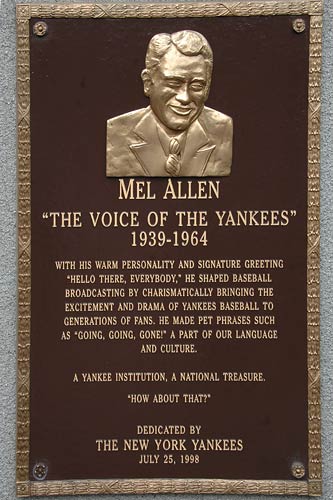
MEL ALLEN
The quality of baseball broadcasts isn’t helped any, of course, by the fact that almost every word that comes out of the announcers’ mouths is commercialized. The fifteenth out is sold, the call to the bullpen is sold. It won’t be long before there’s a sponsor for every time Nick Swisher looks up at the sky to make sure God is still there. “This look to the heavens is brought to you by ….” Announcers like Mel and Red Barber had it easier; they could talk about baseball for whole half innings at a time. But frankly, I’d rather hear Mel pitching White Owl cigars or Ballantine ale then listen to Sterling shrieking, “the Melkman delivers … that’s the Melky way!”
The AP report says Swisher likes that stuff.
He would.
The AP story is at the following link: http://www.google.com/hostednews/ap/article/ALeqM5jUoeWQsFlz_CsbkUuN-rVb6x3AGgD9B72ASG2
The land of the free
April 3, 2009
 I realized this morning while I was shaving that when I first visited Yankee Stadium, it was not yet 30 years old. (Shaving is like hitting, Yogi: It’ s better not to think while you’re doing it.) Anyway, that calculation got me to thinking about the new “Yankee Stadium” – as though there could be such a thing – and I got angry all over again about Macombs Dam Park, a wonderful, expansive facility that was destroyed so that the Yankees could build a stadium better suited to fleecing high rollers. The park is supposed to be replaced – at an enormous expense to taxpayers, most of whom will not benefit at all from either the new stadium or the so-called replacement parks. And no matter what the city does, when it gets around to it, it will never really replace Macombs Dam Park, which was a jewel in the midst of a hard-knocks, congested neighborhood. If the Yankees and the city wanted to tell the people of the South Bronx once and for all, “You don’t matter,” this was the way to do it.
“How about that?”
March 2, 2009

HANK BAUER, TOM STURDIVANT, and MICKEY MANTLE
It wasn’t enough that this snow storm is disrupting my life; I had to wake up to the news that Tom Sturdivant had died. There may be more glamor attached to Yankee teams of other eras, but when names like Tom Sturdivant, Art Ditmar, Andy Carey, and Hank Bauer bob to the surface, I am again sitting on a summer evening on the step in front of our grocery store, tuning my GE transistor radio until I hear the voices of Mel Allen and Red Barber. I was in paradise, and I knew it: I’m glad of that, at least. During Sturdivant’s brief time as a top starter for the Yankees, I was in high school, I wasn’t serious about life, and others were looking after my welfare. I wasn’t concerned because Mickey Mantle was a drunk, Billy Martin was a brawler, and Enos Slaughter was a racist. These were my gods when they were on the field; I asked nothing more. I won’t look back at more recent Yankee teams with the same naive sentiment – and not because the teams and players have changed, except in the details of their fallibility. I already know – intellectually, at least – that I’ll never sit on that front step again and listen to those southern voices turn the progress of a game into poetry. On this cold day, I didn’t need to be reminded.
 CharlesPaolino's Blog