Netflix Update No. 22: “Phoebe in Wonderland”
October 26, 2009

ELLE FANNING
We watched “Phoebe in Wonderland,” a 2008 fantasy written and directed by Daniel Barnz.
This film is an off-beat tale about a nine-year-old girl, Phoebe Lichten (Elle Fanning), who is brilliant and creative, but who confounds her parents and her rigid teachers and principal with outbursts of inappropriate remarks and behavior.
Phoebe’s mother, Hillary (Felicity Huffman as a brunette), is frustrated by her inability to find time — amid housekeeping and raising two little girls — to convert her academic dissertation on Lewis Carroll’s “Alice” novels into a book. With her mother’s encouragement, Phoebe has immersed herself in Carroll’s fanciful neighborhoods to the point that she has frequent imaginary encounters with his characters. The competing forces in Phoebe’s psyche are effectively portrayed by Barnz through the blurring of identities between people in Phoebe’s real life and Humpty Dumpty, the Caterpillar, the White Rabbit, the Red Queen, and the Mad Hatter

PATRICIA CLARKSON
Coincidentally — or not, depending on your point of view — Miss Dodger, the new, idiosyncratic drama teacher (Patricia Clarkson) is mounting a musical production based on Carroll’s stories. This enterprise becomes a kind of sanctuary for Phoebe — the one place where she can overcome her compulsive outbursts. But there is too much amiss with the little girl, and with her parents, and with the management of the school, to stave off a crisis and an unexpected if not totally comfortable resolution.
Like the film “Millions” which I wrote about here on October 19, this is not for viewers who take things literally or insist on reality in their movies. The film is blessed by a talented cast — also including Bill Pullman as Peter Lichten, Phoebe’s father, and Bailee Madison as Olivia, Phoebe’s sister. The beautiful Tessa Albertson has a brief but haunting non-speaking role as Alice.

TESSA ALBERTSON
This film argues that a person cannot be defined by one or two aspects of her personality. The world around Phoebe — her parents, her siblings, her peers, and most of her teachers — failed her as long as they embraced only the “acceptable” parts of the girl or hoped to make the whole girl acceptable to them by badgering or ridiculing her.
The inscrutable Miss Dodger and the fleeting figure of Alice — who may be better acquainted than they let on at first — provide the only unqualified reassurance Phoebe receives that she, with her strengths and her weaknesses, is a person of value.

FELICITY HUFFING, ELLE FANNING, and BILL PULLMAN
Netflix Update No. 21: “Millions”
October 19, 2009

ALEX ETEL
We watched “Millions,” a British fantasy from 2004 in which a seven-year-old boy finds a small fortune in English pounds and learns a few things about the good and bad potential in money.
Frank Cottrell Boyce adapted his novel for this screenplay and the film is directed, with a lot of whimsy, by Danny Boyle.
The story revolves around a fictional event, the deadline for Britons to either deposit their pounds in the bank or convert them into euros. A very large amount of the obsolete currency is being shipped by rail to a destination where it will be burned. A ring of thieves conspire to steal the money and toss it off the train bag by bag to be recovered by colleagues who are waiting trackside. One of the bags goes bounding into a cardboard “rocket ship” and brings it crashing down onto young Damian Cunningham (Alex Etel), who constructed it out of cartons and was playing inside.

LEWIS McGIBBON
Damian confides in his older brother Anthony (Lewis McGibbon), and the brothers immediately disagree on how to dispose of the cash before it becomes worthless. Damian, who is obsessed with saints to the point that he regularly meets and converses with them, wants to use the money to help the poor — though he isn’t quite sure what condition qualifies as “poor.” Anthony wants to spend some of the money on creature comforts and invest the rest — in real estate, for instance.
The windfall, and the manner in which the boys handle it, eventually brings their father, Ronnie (James Nesbitt), to grief — as though he didn’t have enough trouble, what with being recently widowed and trying to shepherd his sons on his own. The domestic and financial matters are further complicated when Ronnie meets and connects with, as it were, an attractive woman named Dorothy (Daisy Donovan), who met the boys — and inadvertently discovered their wealth — while conducting a charity drive at their school. In the end, thanks to filthy lucre, all the principals learn something about themselves and about each other.

KATHRYN POGSON
This is a difficult film to categorize, because it mixes some childhood hijinx with some serious themes. I have found some heated debate on movie web sites about whether it is even suitable for children, although the two boys dominate most of the scenes. Among the most ingenious and entertaining passages are Damian’s encounters with saints, including Joseph, Peter, Francis of Assisi, Nicholas, and Clare. These are not necessarily reverent portrayals, although the insight Damian gains from these conversations is usually therapeutic. And, after all, these are not presented as the actual saints but the saints as they exist in the imagination of a seven-year-old boy. Kathryn Pogson as St. Clare (“patron saint of television … it keeps me busy”) and Enzo Cilenti as St. Peter (“I’m on the door”) are especially hilarious.
Approach this with an open mind, and it’s a worthwhile experience.

LEWIS McGIBBON and ALEX ETEL
Netflix Update No. 20: “One, Two, Three.”
October 4, 2009

JAMES CAGNEY
Once in a while I put a movie on my Netflix list, and by the time its number comes up I can’t remember why I picked it. That’s what happened with the 1961 movie we watched tonight — a Cold War farce co-written and directed by Billy Wilder. After we watched it, I still couldn’t remember why I picked it.
This film in black and white stars James Cagney, Arlene Francis, Pamela Tiffin, and Horst Bucholz. Although it is full of references to America-Soviet issues of the late ’50s and early ’60s, it was based on a play by the Hungarian dramatist Ferenc Molnar, who died in 1952.
The film concerns C.J. McNamara (Cagney), who heads Coca-Cola’s operations in West Berlin, but yearns to be named head of the company’s European operations, based in London. McNamara’s wife, Phyllis (Francis), is weary of life in foreign cities — and C.J.’s philandering — and pressures him to take her and the two McNamara kinder back to the United States.

ARLENE FRANCIS
C.J.’s life becomes further complicated when his boss in Atlanta dispatches his daughter to Europe to get her away from her latest boyfriend and asks C.J. to take charge of the girl while she’s in Berlin. Scarlett (Tiffin) turns out to be more than the McNamaras can handle, and she meets, mates, and marries Otto Piffl (Bucholz), a fiery East German Communist. C.J. has to keep Otto and the pregnant Scarlett at bay while he figures out how to make the match palatable to the girl’s parents — who set off on a trip to Germany.
However well this film may have worked in 1961, it hits the wall with a thud in 2009. It is riddled with what are now stale allusions to the Soviet Union under Nikita Krushchev as well as a steady diet of really bad jokes. In addition, the movie is a school of overacting. Wilder directs it as though directing the Marx Brothers, but Chico and Harpo are nowhere to be seen, and the actors who are in sight don’t have the chops to make this kind of comedy work. Everyone in the film, except Arlene Francis, seems to have been told that farce is measured by how loudly and how rapidly an actor can speak and how fast they can rush from room to room. Cagney — in his last starring role — opens the film speaking as though he is auctioning tobacco, and he doesn’t let up for an hour and fifty minutes.

PAMELA TIFFIN and HORST BUCHOLZ
Tiffin and Bucholz and a bunch of supporting players do their best to keep up with Cagney’s pitch and pace, and the result is an exhausting experience with too few rewards to make it worthwhile. In one scene there is an attempt at humor in which Cagney threatens Bucholz with half a grapefruit — a pathetically obvious reference to the scene 30 years before in which he pushed a grapefruit into Mae Clarke’s face in “Public Enemy.” It was almost as though Wilder were saying, “You should be laughing at this, folks; after all, this is James Cagney.”
The high points in this train wreck are a scene in which the uncredited Red Buttons, playing an Army MP, does a fleeting imitation of Cagney for C.J.’s benefit, and the closing title in which C.J. is chagrined to get a bottle of Pepsi out of a Coke vending machine. There is also some fascination in watching Cagney and Bucholz work together inasmuch as it is well documented that they hated each other and made no secret of it on the set.
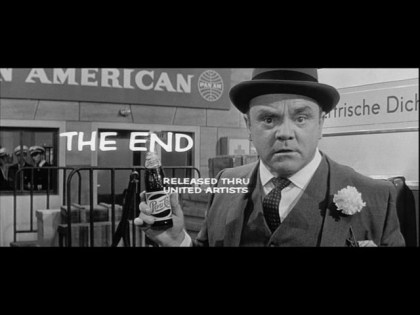
JAMES CAGNEY in the closing frame of "One, Two, Three."
Netflix Update No.19:”Sweet Bird of Youth”
September 25, 2009

PAUL NEWMAN
Prompted by Shirley Knight’s impending appearance at the George Street Playhouse, we watched “Sweet Bird of Youth,” the 1962 film adaptation of Tennessee Williams’ 1959 Broadway play. I have never seen the play on stage, and I have read that the tale lost some of its edge with the modifications that had to be made to satisfy the sensibilities of the early ’60s. By today’s standards it’s tame, but it dealt with some tough subject matter for the Eisenhower era.
This film has one of those casts that dazzles the mind: Paul Newman, Geraldine Page, Rip Torn, and the wonderful Canadian actress and even more wonderful human being, Madeleine Sherwood, recreated their Broadway roles, and they were joined by the redoubtable Ed Begley Sr. Geraldine Page and Rip Torn both were nominated for Tony awards for their work in the play. Begley won an Oscar and Page and Knight were nominated for the film.

GERALDINE PAGE
Newman plays Chance Wayne, who returns from Hollywood to his hometown in Florida, almost literally dragging along with him a legendary movie star, Alexandra Del Lago (Page), who has sunk into a drug-and-alcohol-induced stupor after what she perceives as the failure of her latest film. On the surface, Chance Wayne is her driver and spear carrier. In reality, he is exploiting her — in every possible way — in the hope that she will give him what has been an elusive “big break” in the movies.
Alexandra travels to Florida with Chance because she has gone underground to avoid the fallout from what she has adjudged a box-office flop. Chance has another goal — to reunite with Heavenly Finley, the love of his life whose father, Tom “Boss” Finley (Begley), is a moralizing, corrupt, and ruthless political kingpin who doesn’t want Chance near his daughter.
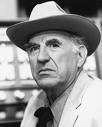
ED BEGLEY Sr.
Finley’s son, Tom Jr., who doesn’t have his father’s cunning but outdoes him in brutality, is played by Rip Torn.
This film, which in 1961 was off limits to audiences under 18, may have been sanded down from Williams’ original version, but it far outstrips the embarrassing 1989 television remake with Elizabeth Taylor and Mark Harmon as Alexandra and Chance and Rip Torn as “Boss” Finley. Even though its techniques are dated, the movie can play with your emotions as you try to sort out your feelings about the actress and her gigolo — both of whom are infuriating yet sympathetic — and frazzle your nerves as Chance keeps antagonizing the volatile and dangerous “Boss.” The players in this film aren’t stars first and foremost; they’re actors, doing their work as well as it can be done.
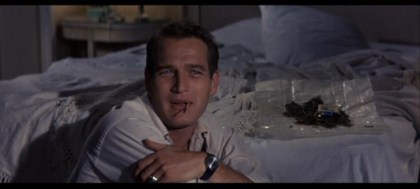
PAUL NEWMAN in a scene from "Sweet Bird of Youth."
Netflix Update No. 18: “Nothing in Common”
September 14, 2009

TOM HANKS
We watched “Nothing in Common,” a 1986 film directed by Garry Marshall, starring Tom Hanks, Jackie Gleason, Eva Marie Saint, Sela Ward, Bess Armstrong, and Hector Elizondo.
Hanks plays David Basner, who is on a rapid rise in the advertising industry; he has money, friends, women. What he doesn’t have is any sense of self, thanks to a dysfunctional upbringing by parents — Eva Marie Saint as Lorraine Basner and Gleason, in his last role, as Max– whose marriage limped along for more than 30 years without a raison d’etre, and now, at a critical moment in David’s career, has collapsed. Both parents bring the issue to David, who has kept his distance since he left home and has never developed a relationship with either of them.
Bess Armstrong plays a high school friend and one-time flame to whom David often turns for understanding or simple emotional release. Sela Ward plays Cheryl Ann Wayne, a hard-nosed but seductive agency executive with whom David becomes entangled, in more ways than one, as he tries to land a major airline account. Elizondo is David’s boss, and Barry Corbin is the head of the airline and Wayne’s father.
JACKIE GLEASON
All of these actors turn in strong performances. Hanks gets a chance to show his full range, from borderline nuts to pensive and insecure. Gleason, conceding a year before his death that he is an old and infirm man, uses just enough of the Charlie Bratton bombast and the Poor Soul pathos to make Max a complicated and interesting character. Gleason avoids what to him was always a temptation to chew the scenery. When he had it under control, Gleason had an intuition for drama, and he puts it to work here, particularly in brief passages in which he doesn’t speak. Eva Marie Saint, who I think is among the most unappreciated of actresses, is very moving as the broken-hearted wife and mother.

EVA MARIE SAINT
This movie takes on some difficult, almost embarrassing themes — the reasons for the failure of this marriage and the impact of a bad marriage on the child it generated — and it deals with them realistically, not looking for easy answers.
Marshall managed to achieve a delicate balance between comedy and drama that in some ways is almost tragedy. This film hasn’t got a lot of attention, but it should.
Netflix Update No. 17: “October Sky”
September 5, 2009

JAKE GYLLENHAAL
We watched “October Sky,” a 1999 film based on the real life of Homer Hickam Jr., who became a NASA engineer after initially experimenting with rocket flight against his father’s wishes.
Homer is played by Jake Gyllanthaal and his father — called John in the movie — is played by Chris Cooper.
John Hickam is a supervisor in a West Virginia coal mine, and he expects Homer to follow him into the trade, as most boys in the town have followed their own dads. The unexpected launch of the Soviet satellite Sputnik in October 1957 inspires Homer to work with some of his friends to build and fire a succession of rockets, gradually refining the devices. Homer’s open desire to escape from what seems to him the pointless existence in his hometown — and specifically to enter a national science fair in order to get a college scholarship causes increasing tension between him and his father.

CHRIS COOPER
This movie is a little melodramatic, but it presents a stark picture of the lives of people in a company town that depends for its mean existence on a failing mine.
Cooper gives a credible performance as a man whose own courage and determination with respect to protecting the mine and the livelihoods of his employees does not help him recognize his son’s courage and determination, though directed at a different goal.
Laura Dern plays the idealized role of a high school teacher whose mission is to help the boys and girls in these grim surroundings to pursue their dreams.
Netflix Update No. 16: “The Andersonville Trial”
August 14, 2009

WILLIAM SHATNER
We watched the 1970 television production of “The Andersonville Trial,” which was an adaptation of a 1959 play by Saul Levitt. The play is based on the trial in 1865 of Henry Wirz, commandant of the Confederate military prison at Andersonville, Georgia. Some 13,000 Union soldiers died while incarcerated there under inhumane conditions. Wirz was found culpable by a military court and was hanged, but the degree of his blame was the subject of controversy then as it is now.
Levitt’s play focuses, as the actual trial did not, on the moral question of whether Wirz had an obligation in conscience to disobey his superiors and provide relief for the inmates. That issue may sound familiar to 21st century audiences as may another issues raised in the play — the rights of prisoners held under military law and the propriety of trying Wirz by a military court when the war had ended.

CAMERON MITCHELL
The play, presented in three acts, stars Richard Basehart as Wirz; William Shatner as Lt. Col. Norton Chipman, who prosecuted Wirz; Cameron Mitchell as Gen. Lew Wallace, who presided at the trial; Jack Cassidy as Otis Baker, the civilian attorney who defended Wirz; and Buddy Ebsen as a physician who was assigned to the prison and testified at the trial.
Shatner, Basehart, Mitchell, and Cassidy should have paid to appear in this production — it was that much of a tour de force for each of them. All of them gave intense performances that together provide a glimpse of the brutal and corrosive character and consequences of a war that has since been wrapped up in too much glory and nostalgia.
Shatner has at times been rightfully criticized for chewing the scenery, but in this case he brought the appropriate passion to his role — an army officer who knew that the moral questions he was putting to Wirz also applied to him. One distraction, though, is what has to be the worst of the bad hairpieces Shatner has worn during his long career.

JACK CASSIDY
Cassidy was a master of cool, and he used his controlled reactions to make Baker a chilling opponent for the over-the-top prosecutor. Mitchell was equally effective as Wallace — a lawyer and military man who later wrote “Ben Hur” — who was impatient with the proceeding itself and with the constantly bickering attorneys and unruly defendant.
I last saw this presentation when it first appeared on PBS in 1970, but Basehart’s performance in particular remained vivid in my memory. Wirz — a native of Switzerland — was presented here as a man tortured by Chipman’s questions, by his own assessment of his behavior, and by his concern for the legacy he was leaving his family.

RICHARD BASEHART
Basehart was so thoroughly invested in these aspects of his character that it is almost as uncomfortable to watch and listen to him as it would have been to sit in that courtroom.
I had forgotten about the performance by Michael Burns, who did a skillful turn as a shell-shocked soldier called to testify about the atrocities at the prison. His disoriented posture and vacant look was disturbing even as a dramatization. Burns was an interesting figure who left acting early in life and became a respected history professor and author.
This production was directed by George C. Scott who played Chipman on Broadway. The only actor from the Broadway production who appeared in the television adaptation was Lou Frizzell who did not, however, play the same role.
Some of the dialogue in this play is taken from the trial, but the overall portrayal of the proceeding is Levitt’s interpretation. Even so, it is a valuable reflection on the role of conscience in the Civil War and war in general.

HENRY WIRZ
Netflix update No. 15: “Mrs. Palfrey at The Claremont”
August 13, 2009
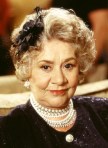
JOAN PLOWRIGHT
We watched the 2005 film “Mrs. Palfrey at The Claremont,” which director Dan Ireland and screenwriter Ruth Sacks adapted from a novel by the late British writer, Elizabeth Coles Taylor. We are in our Joan Plowright period, and that wonderful actress plays the title role in this film — Mrs. Palfrey, that is, not The Claremont.
The Claremont is a past-its-prime London hotel where the aged, refined widow, Mrs. Palfrey, takes up temporary residence in the hope of establishing a relationship with her only grandson, Desmond. The grandson, who labors in the archives of the British Museum — one can only imagine — does not return her telephone calls, leaving Mrs. Palfrey to fill her days reading Wordsworth and cautiously interacting with the odd collection of residents at the hotel, who gradually begin to suspect that Desmond doesn’t exist.

RUPERT FRIEND
Mrs. Palfrey’s life takes an unexpected turn when she stumbles, literally, into the acquaintance of a nearly destitute writer Ludovic Meyer, played by Rupert Friend. The story of their relationship explores the question of what actually constitutes family.
This is a deceptively intense film that pokes at some potentially painful issues that many of us will confront in reality sooner or later — issues of loneliness, vulnerability, and fulfillment.
Joan Plowright is magnetic and moving as always, and she is supported by several skilled performers, including those who play the quirky guests and staff at The Claremont, and the stunning Zoe Tapper, who appears as the lover Meyer finds only because his path first crossed that of Mrs. Palfrey.
Don’t pass this one up.

RUPERT FRIEND and JOAN PLOWRIGHT
Netflix Update No. 14: “Enchanted April”
July 27, 2009

JOAN PLOWRIGHT
We watched “Enchanted April,” a production that was made for British television in 1991 and was released to American theaters the following year. It was nominated for three Oscars and won two Golden Globe awards.
This is sort of a fantasy about four British women – previously strangers to each other – who rent a castle on the coast of northern Italy for a month-long vacation from lives that have become stifiling — in a different way for each of them. Lottie Wilkins (Josie Lawrence) who instigates the sojourn, is suffocating in her relationship with a husband who appreciates her cooking but shows her no affection and makes her account, in writing, for every penny she spends.

JOSIE LAWRENCE
Rose Arbuthnot (Miranda Richardson) is a devout woman married to a tipsy writer whose books focus on the lives of scandalous women in history and who describes his wife as “a disappointed madonna.”
Mrs. Fisher (Joan Plowright) is an aged socialite who is preoccupied with her circle of notable literary friends, all of whom have been dead for many years.
Caroline Dester (Polly Walker) is a stunning member of the titled elite who is constantly the center of attention, but not the sort of attention that contributes to her emotional wellbeing.

POLLY WALKER
This movie, much of it filmed at the villa that inspired the 1920 novel on which it is based, is visually enchanting. That turns out to be an appropriate quality, because the story — both dramatic and humorous in its way — depends on faith in enchantment. No matter what the four women, and their unexpected guests, may have intended when they traveled to Italy, the results of their month among the lush green hills overlooking the sea transform all of them for good.
The casting is flawless and the performances are engrossing. This film has received a lot of compliments, and they all are richly deserved. I’m not sure a person can watch it once and be satisfied.
Netflix Update No. 13: “I Am David.”
June 27, 2009

BEN TIBBER
We watched the 2003 movie “I Am David,” which is based on “North to Freedom,” a novel for children written by Ann Holm in 1965. The book was first published in Denmark, where it was a best seller.
The story concerns a 12-year-old boy who has spent his life in a Soviet labor camp in Bulgaria. The boy — the David of the title — is played by Ben Tibber. Although it isn’t overly graphic, the film makes the point that these camps were similar in their brutality to the Nazi concentration camps that the public is more familiar with. David, whose parents are inexplicably absent, is heavily influenced in the camp by an adult inmate, Johannes, played by James Caviezel.

JAMES CAVIEZEL
From the beginning of the movie, a disembodied voice urges David to escape from the camp, tells him how to accomplish it, directs him to travel to Denmark, and advises him to blend in as well as possible with the people he meets and to trust no one. David’s understanding and application of this last instruction is the battery that drives the story.
The unseen voice tells the boy to pick up a bundle that has been left for him outside the prison fence. This contains a bar of soap – heavily symbolic, as it turns out – a piece of bread, a folding knife, a compass, and a sealed envelope he is to deliver unopened to “the authorities” in Denmark.
The bulk of the movie follows David as he makes his way through Italy and Switzerland, a process that is made easier for him because life in the polygot culture of the labor camp has made him multilingual.
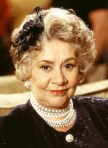
JOAN PLOWRIGHT
A pivotal figure in David’s journey is an artist, Sophie, whom he stumbles on while wandering northward in Italy. This character is played by the redoubtable Joan Plowright.
This film, directed by Paul Feig and shot in Bulgaria, is visually appealing. A contrast is repeatedly and effectively drawn between the harsh conditions in the labor camp and the bright and colorful outside world that David experiences for the first time but is hesitant to adopt as his own.
The actors are all exemplary, particularly Ben Tibber, who seems to have understood well how a child of that age would be affected by the inhuman treatment he received from his jailers and by the lack of a normal education in social life.
Perhaps because its source was designed for children, this film’s principal weakness is that it repeatedly strains credulity. Happenstance plays too frequent a part in David’s journey for this story to be taken seriously – or, rather, for it to be taken literally. It can be taken seriously as a kind of fable about fear and trust – including the tendency of the state, at times, to fear the people in whom its trust would be well invested.

BEN TIBBER and JOAN PLOWRIGHT
 CharlesPaolino's Blog