Netflix Update No. 32: “What Just Happened”
May 27, 2010

ROBERT De NIRO
We watched “What Just Happened,” an odd film starring Robert De Niro, who can’t be accused of never making interesting choices — “interesting” being a relative term.
This film was released in 2008 and was shown at the Cannes Film Festival that year. That was fair play inasmuch as the festival itself plays an important part in the movie. Although the title begins with an interrogative pronoun, it does not end with a question mark, which — as I tell my English students — mean that it is not a complete idea. The film is based on a novel which does have a question mark: “What Just Happened? Bitter Hollywood Takes from the Front Line” by Art Linson.

ART LINSON

BRUCE WILLIS

Bruce Willis, Robert De Niro, and Stanley Tucci in a scene from "What Just Happened"
Netflix Update No. 31: “Everybody’s Fine”
May 6, 2010

ROBERT DE NIRO
We watched the 2009 film “Everybody’s Fine,” starring Robert De Niro and Drew Barrymore, and it was — well — fine. The movie, which also stars Kate Beckinsale and Sam Rockwell, is based on an Italian flick, “Sono Tutti Bene.” The American version has earned about half of what it cost.
The premise is that a widower, Frank Goode (De Niro), who lives alone in upstate New York, has his mind set on getting his four children to gather around the same table. A reunion at the family home has been arranged, but the kids cancel on Frank. Frustrated by this outcome, he decides to travel across the country and visit them — unannounced — one by one. His first stop is New York City to see David, who is an artist, but David is not at home, and does not come home. Frank moves on to visit daughter Amy (Beckinsale), who is an advertising executive — married and the mother of one boy. Lying ineffectively because she’s hiding bad news about David and about her marriage, Kate tells Frank that his visit was ill timed, and she hustles him out of town as quickly as possible.

KATE BECKINSALE
Frank moves on to Denver, where, he mistakenly believes, son Robert (Rockwell) conducts a symphony orchestra. Robert also bluffs, says he’s about to leave on a tour, and gets rid of Frank — breaking his promise not to call ahead to sister Rosie (Barrymore), a dancer in Las Vegas with a couple of secrets of her own. Rose gives Frank a warmer welcome, but this time he is the one who decides to cut the visit short because he lost a needed medication during a mugging incident on his travels.
What Frank’s children are keeping from him concerning David is made clear from early in the movie. What unfolds gradually as Frank sees through the lies his offspring tell him is that they and their mother systematically shielded him from bad news in the family while he labored to support them by coating telephone lines with a toxic insulation.

DREW BARRYMORE
The children also nurse a vague notion that Frank was a bit too hard on them when they were growing up, but this turns out to have been more complex than they describe.
De Niro is surrounded by talented actors in this film, but the movie also provides him with a low-key tour de force in which an aging man figures out who he has been and who he is going to be for the rest of his life. The children discover that Frank is sharper than they gave him credit for, and he discovers that, as his children, they have fulfilled any worthwhile ambition he may have had for them.
“Everybody’s Fine” didn’t get a lot of attention, but De Niro did win the Hollywood Film Festival “best actor” award, and Paul McCartney’s original theme, “(I Want to) Come Home,” was nominated for several awards, including a Golden Globe.
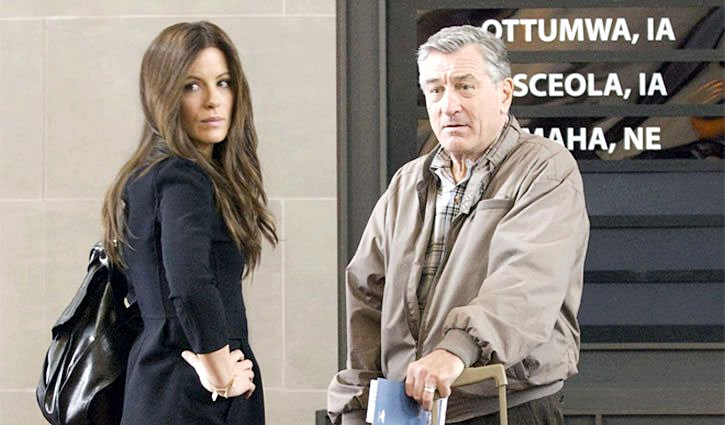
Kate Beckinsale and Robert De Niro in a scene from "Everybody's Fine"
Netflix Update No. 30: “A Kid for Two Farthings”
April 24, 2010
 We watched a 1955 Carol Reed movie, “A Kid for Two Farthings,” which is clumsy in some respects, but quirky enough to hold our interest.
The story takes place in a crowded mercantile neighborhood in London’s East End, where a young boy named Joe and his mother room with an aged Jewish tailor named Kandinsky. Joe’s father has been in South Africa for two years on a vaguely described quest to make his fortune. Whether he’s ever coming back is an open question, and the uncertainty is a source of anxiety for the boy and his mother.

DIANA DORS
Kandinsky has an assistant in the shop, a muscle-bound young man named Sam, who has been engaged for four years to a bleached blonde named Sonia, but hasn’t been able to afford a ring.
Sam hopes to win an international bodybuilding title so that he can afford to buy the ring, marry Sonia, and set up housekeeping, but a wrestling promoter, Blackie Isaacs, keeps pressuring him to take on a few rigged matches with the promise that he’ll earn enough quickly to carry out his plans. Under pressure from Sonia, Sam finally agrees to a rigged match with a has been that will lead to a bigger bout with a giant named Python Macklin.
Macklin ridicules Sam and bad blood develops between two, adding to the implications of their scheduled match.

PRIMO CARNERA
Joe, the little boy, spends a lot of time listening to Kandinsky’s philosophy and learns from the old man about the magical properties of unicorns — specifically that they are capable of making dreams come true. The boy has a lot of dreams — his father’s return from South Africa, a ring for Sonia, and a steam presser for Kandinsky, who is still using an ancient iron. When Joe’s pet chick dies, Kandinsky gives the boy money to buy a dog, but Joe comes back with a sickly goat that has a single horn growing from its forehead. The arrival of this “unicorn” — real or imagined — drives the rest of the story.
This film is a visual treat because much of it takes place in the teeming market place, Kandinsky’s rusty old shop, and a seedy wrestling arena.

DAVID KOSSOFF
Celia Johnson as Joe’s mother, Joanna; David Kossoff as Kandinsky; and Lou Jacobi as Blackie Isaacs give especially good performances. Some commentators have speculated that Kandinsky is a metaphor for the lives of Jews in Europe after the Holocaust and the Second World War, and there is a rabbi in Old World clothing, praying and listening to an old Gramophone, who appears several times in the marketplace – including in the final scene of the movie.
In way that is unique to his own personality, Primo Carnera — the colossal former world heavyweight boxing champion — is very effective as the evil Macklin. On the other hand, Diana Dors as Sonia and Joe Robinson as Sam display as much acting acumen as two blocks of mahogany.
All in all, this is a sentimental, brooding, haunting film — far from perfect, but worth the time.
Netflix Update No. 29: “Speak”
March 20, 2010

KRISTEN STEWART
We watched “Speak,” a 2004 television movie based on a well-received novel by Laurie Halse Anderson, who specializes in books for teens and young adults. “Speak” focuses on Melinda Sordino — played by Kristen Stewart — who is entering high school at a pivotal time in her young life. She has been the victim of a sexual assault, and she has not been able to confide in anyone — a frequent dilemma for women and girls who have been abused. The assault on Melinda has indirectly estranged her from her former clique so that she enters the new school environment as a solitary and lonely figure. Her parents — played by Elizabeth Perkins and D.B. Sweeney — are not completely inattentive to Melinda, but they are preoccupied with their own problems and clueless about hers. In the event, as she is increasingly isolated, Melinda becomes less and less willing to engage anyone in conversation. The only people with whom she has any satisfactory relationships are a rebellious art teacher — played by Steve Zahn — who alternately goads and encourages Melinda to express her self through images of trees, and her lab partner — played by Michael Angarano — who seems immune to the social dynamics of the high school.

STEVE ZAHN
This is a well written and well told story. It’s all about Melinda, and therefore all about Kristen Stewart. And Kristen Stewart is up to the challenge. She is this movie, and the other players, perhaps with some help from director and screenplay writer Jessica Sharzer, give Stewart space. The actress has been busy since she made this movie at the age of 13, and it’s reasonable to expect that she’ll stay that way.
Melinda is presented as an observer of her own life, and her narration is laced through the story. Stewart’s understated delivery of the quick-witted teenager’s sardonic remarks adds palpable substance to the film. “It’s time for a mental health day,” Melinda explains. “So conjugate this: I cut class. You cut class. He/she/it cuts class.”
The Lifetime Channel will broadcast this film at 9 p.m. on Tuesday, March 23.
Netflix Update No. 28: “The Island on Bird Street”
February 1, 2010

JORDAN KIZIUK
We watched a 1997 Danish film, “The Island on Bird Street,” which tells of an 11-year-old boy’s attempt to survive while the Nazis are emptying out a Jewish ghetto in Poland and sending its inhabitants to the death camps.
This film is based on what I have seen described as a “semi-autobiographical” novel by Israeli writer Uri Orlev, a Holocaust survivor who has specialized in children’s literature. Although the violence in this film is understated compared to many films about Nazi brutality, it’s not a film for young children. Teenagers wouldn’t flinch.
The story line is that the boy, Alex (Jordan Kiziuk), his father, Stefan (Patrick Bergin) and uncle Baroch (Jack Warden), are among the Polish Jews who are confined to a neighborhood fenced off by the Nazis — much like the Warsaw Ghetto where Orlev was confined as a child. When Stefan and Baroch are swept up in one of the Nazis’ “selections” for transport to a concentration camp, they conspire to let Alex escape the transport. Before the boy runs off, Stefan promises that he will return to the ghetto, and the boy takes that promise seriously.

JACK WARDEN
Alex — who reads “Robinson Crusoe” and plays with his white mouse, Snow — manages through a combination of guile and luck to avoid detection while he dodges the German troops who are gradually emptying the ghetto. The boy encounters some other stragglers, including a few men who are involved in the Polish underground. He eventually begins to slip out of the ghetto into the city at large, but always returns to wait for his father.
Jordan Kiziuk, a British actor who won an Emmy in 1999, delivers a convincing performance as Alex. Most of the film is quite tense as Alex has one close call after another, and Kiziuk has a lot of the burden of sustaining it. In fact, he’s at the center of the drama to such a degree that the other players are largely accessories.
As credible as Kiziuk is in his role, the story itself strains credulity, especially given the persistence of the Nazis in tracking down every straggler in the ghetto. There is also a contradiction in his sometimes elaborate ingenuity and his naive faith that his father will somehow survive the brutality the boy has witnessed again and again. The film ends with Alex still in the ghetto, and a title reports simply that he “survived the war.” In actual fact, Orlev was eventually caught by the Nazis after he was left behind in the ghetto and was sent to the Bergen-Belsen concentration camp where he remained until it was liberated.

PATRICK BERGIN
This film is visually very dramatic. The location in Poland presents a bleak image of the ghetto that provides an effective setting for the Nazis’ disregard for human dignity, never mind human life. The direction and photography contributed to the considerable attention and critical approval the film received when it was released.
Netflix Update No. 27: “Jakob the Liar”
January 27, 2010
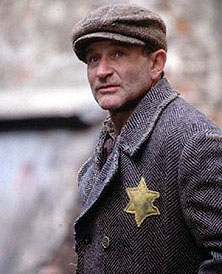
ROBIN WILLIAMS
We watched “Jakob the Liar,” a 1999 film starring its executive producer, Robin Williams.
In this story based on Jurek Becker’s novel, Williams plays the title role, a man confined to a Jewish ghetto in Poland during World War II. Jakob is summoned to the commandancy of the ghetto for being in the street after curfew, and while he is in an SS officer’s quarters, he hears a radio news report to the effect that the Red Army is advancing in the vicinity of the ghetto.
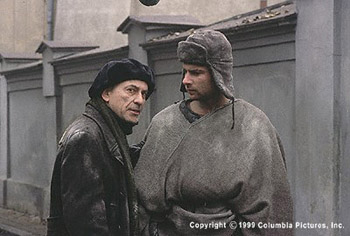
Alan Arkin and Liev Schreiber
When Jakob gives this information to his fellow inmate, Mischa (Liev Schreiber), Mischa draws the conclusion that Jakob himself has a radio — an offense punishable by death in the ghetto. Mischa shares his suspicion with others and soon the story is all over the ghetto, and nothing Jakob can say will put it to rest. The inmates beg him for more promising news, and he finally decides to lift their spirits by making up more “news” about the impending end of the war.

HANNAH GORDON
Jakob’s position becomes increasingly precarious, and it isn’t helped any by the fact that he is sheltering a young girl (Hannah Taylor-Gordon) who avoided boarding the transport that carried her parents to a death camp.
Given the fact that this movie features Williams in a dramatic role, includes fine actors such as Bob Balaban and Alan Arkin, and deals with this particular historical epoch, we expected to like it. We found, however, that the sum of the parts leaves the whole lacking.
The film is tedious and in some particulars implausible — for example, a scene in which Jakob defies and even intimidates an SS officer who, under real circumstances, would have shot him on the spot. And while Roberto Benigni proved that humor could be mixed into a serious Holocaust story, this film doesn’t strike the delicate balance between the two that the Italian movie achieved.
Netflix Update No. 26: “Vicky Cristina Barcelona”
January 7, 2010

REBECCA HALL
We finally got around to watching “Vicky Cristina Barcelona,” which was a very successful film for Woody Allen in 2008. Besides making a lot of money – in proportion to its budget – the film won and was nominated for a ton of awards, including a best supporting actress Oscar for Penelope Cruz.
Allen pursues his interest in neurotic people, but in an unusual environment for him — some very attractive locations in Spain. The story involves two young American women — Vicky (Rebecca Hall) and Cristina (Scarlett Johansson) — who get a chance to spend a summer in Spain in the home of a distant relative of Vicky’s, played by Patricia Clarkson. Vicky, who is a bit prim and self-assured is engaged to marry a well-groomed go-getter. Cristina, who hasn’t been successful at relationships, tentatively plays at being a free spirit. Allen uses a narrator – Christopher Evan Welch – to describe in a documentary fashion the summer in Spain in which the lives of both women are thrown into disarray.

SCARLETT JOHANSSON
The agent for the turmoil is Juan Antonio Gonzalo (Javier Bardem), an artist whose relationship with his wife, Maria Elena (Cruz), was disrupted when she stabbed him in a characteristic fit of rage. Though it is disrupted, the relationship is not over — certainly not in Gonzalo’s mind or loins. Despite Vicky’s protestations, Cristina becomes involved with Gonzalo — in fact, moves in with him — after he unsuccessfully invites both women to join him in a menage. Vicky disapproves and says so, but by now — thanks to Gonzalo — she’s not nearly as sure of herself.
Things get very complicated even before Maria Elena reappears — with a flourish — to play a wholly unexpected part or two in turning things upside down.

JAVIER BARDEM
The credibility of this story hangs heavily on Gonzalo’s charm, and Bardem has it to spare. It’s an interesting combination of raw magnetism and sexual grace that plausibly could, on the one hand, take advantage of Cristine’s confusion and, on the other hand, crumble Vicky’s moral fortifications, and — if there were a third hand — inspire Maria Elena’s capacity for both lust and murder.
As usual, when Allen is on his game, this film is well written, well directed, well cast, well photographed, and well acted.

Penelope Cruz and Javier Bardem in a scene from "Vicky Cristina Barcelona"
Netflix Update No. 25: “My Louisiana Sky”
December 29, 2009

Michael Cera as Jesse Wade Thompson and Kelsey Keel as Tiger Ann Parker in "My Louisiana Sky"
We watched a 2001 children’s movie from Showtime, “My Louisiana Sky,” and we weren’t surprised afterward to learn that it had won numerous awards — including the Andrew Carnegie Award and three daytime Emmys — and had been nominated for more.

JULIETTE LEWIS
Based on a novel by Kimberly Willis Holt, the story concerns Tiger, a 12-year-old girl, who lives on a farm in Louisiana with her mentally handicapped parents — Corinna and Lonnie Parker — and her maternal grandmother, Jewel Ramsey. Corinna (Amelia Campbell) is childlike, less mature now than her own daughter, and Lonnie (Chris Owens) is barely literate but is savvy enough to not only hold down a job on a nearby farm but to win the trust and respect of the owner. Jewel (Shirley Knight) keeps the house, maintains order, and does per-diem farm work — sometimes with the help of Tiger (Kelsey Keel), to earn some cash.

AMELIA CAMPBELL
There is one prodigal family member — Jewel’s other daughter, Dorie, played by the redoubtable Juliette Lewis — who has left rural life behind for a career in Baton Rouge.
Tiger experiences isolation and rejection because of the way other children regard her parents. The only child who pursues a friendship with her is Jesse Wade Thompson (Michael Cera), and Tiger has trouble accepting his exuberance. When life at home deteriorates, she considers but does not leap at the prospect offered by Dorie of a comfortable and exciting life in the city.

KELSEY KEEL
While adults may find it simplistic, the portrayal of a girl deciding where her true happiness lies can be a valuable object lesson for children.
Under the direction of Adam Arkin — whose brother Anthony is married to Amelia Campbell — every cast member delivers a strong performance. Arkin and Kelsey Keel won two of the Emmys.
Netflix Update 24: “Edge of America”
December 21, 2009
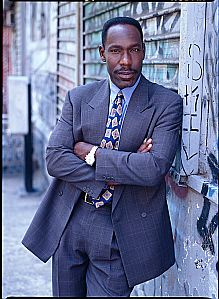
JAMES McDANIEL
We watched a 2003 Showtime movie, “Edge of America,” which concerns a black man who takes a job teaching English at a high school on an American Indian reservation. This was directed by Chris Eyre, the Cheyenne/Arapaho who was also responsible for “Smoke Signals,” and there are many similarities in mood and detail, including the wise-cracking radio personality.
Kenny Williams, McDaniels’ character, is maneuvered into taking over coaching duties for the school’s girls basketball team which, in a word, stinks. The short version is that he takes the team to the state championship finals, but not via the shortest distance. There are many obstacles, most of them born of Williams’ inability to quickly grasp the nuances of Indian culture and the realities of life for these impoverished and isolated people. He finds his way, however, with some prodding and shoving at the hands of the native people, and the movie becomes “To Sir With Love on the Rez.”

GERALDINE KEAMS
The story line and the outcome seem obvious, but there are excellent performances, including McDaniels’, which won him an Emmy. The Navajo actress Geraldine Keams is inspiring in the role of a tribal elder who is the skeptical mother of one of the team members, and Wes Studi, a Cherokee, is both credible and amusing as an auto mechanic who deftly helps the coach figure out his role in his unfamiliar surroundings. Irene Bedard, an Inuit/Metis actress, does a strong turn as a teacher who is forced to play conscience for the bungling Williams. An ensemble of young actors add a lot of guts to this film in their roles as players and students at the school.
“Edge of America” is based on the experience of Jerry Richardson, who died in an auto accident while he was head coach of the women’s basketball team at the University of Central Florida. This is how Richardson’s career was described on Humanities and Social Sciences Net Online:
Jerry Richardson, age 40, has been at UCF through four seasons and in that time has become a strong and quiet force on campus and in the community. He inherited a troubled program and last season took his team to a conference tournament championship and the NCAA tournament, a first for the UCF women’s program. Not only was he building a program, but more importantly he was having a significant impact on the lives of young women in Central Florida.
This of course is not surprising. Jerry Richardson came to UCF from the Navajo Nation Reservation in Shiprock, New Mexico, where he transformed a struggling high school women’s team into four-time State Champions. From 1982 to 1993 Jerry Richardson made the Lady Chieftans of Shiprock into a story of mythic dimensions. More importantly he changed the lives of the young women he coached. Eighty percent of them went on to college, mostly as non-athletes; this at a school with a fifty percent dropout rate in a population beset with poverty and alcoholism.
Richardson believed, and made his players believe, that there was nothing you could not do as long as you had two things: opportunity and a positive attitude. Jerry Richardson brought both to Shiprock and to UCF.
He was above all a teacher, not a coach. He understood the ephemeral character of victory on the courts, and the significance of preparing his women for life after basketball. “The trophies gather dust, the kids don’t, they keep moving,” he said. Jerry Richardson’s players moved on, well prepared for the world after basketball.

JAMES McDANIEL, WES STUDI, and IRENE BEDARD in "Edge of America"
Netflix Update No. 23: “Daphne Laureola”
November 9, 2009

JOAN PLOWRIGHT
On the theory that there’s no such thing as too much of Joan Plowright, we watched “Daphne Laureola,” a 1978 British television production of a 1949 play by James Bridie, actually a Scottish physician born Osborne Henry Mavor. Sir Laurence Olivier, who rated this play as one of the six best in the 20th century, appears in this adaptation along with Plowright, who was his third wife.
In this romantic comedy, Olivier plays the elderly Sir Joseph Pitts and Plowright plays his 50-year-old wife whose first name — perhaps deliberately — is never given. When Lady Pitts dines alone at a restaurant in London’s Soho district, her overindulgence in alcohol launches her into a uncontrolled monologue that alternately amuses and horrifies the other patrons. The one exception is Ernst, a young Polish student who becomes infatuated with her — comparing her place in his life to that of the nymph Daphne in the life of the Greek god Apollo.

LAURENCE OLIVIER and JOAN PLOWRIGHT in "Daphne Laureola"
Lady Pitts collects the names and addresses of seven of the customers — including Ernst — and promises to invite them to tea. She does, but by the time the appointed hour arrives, she has forgotten not only the invitations but the guests and the circumstances under which she met them.
Ernst has not forgotten, though, and his pursuit of an ill-defined relationship with Lady Pitts — and the manner in which Sir John and his lady deal with Ernst — provides the substance of the play.
The cast, which I believe was chosen by Olivier, is outstanding. Clive Arrindell as the deadly earnest young man who is blind to the absurdity of his situation gives a bravura performance. Bryan Marshall has a strong turn as Vincent, the Pitts’ despicable house servant and driver who doesn’t approve of Ernst nor, it seems, of Sir John, Lady Pitts, or their marriage. Olivier is moving as the baronet who knows his life is nearing its conclusion, and Plowright, of course, is Plowright. Lady Pitts is designed to befuddle the other characters and the audience, and Plowright is the woman to make her ladyship do it.

DAPHNE LAUREOLA
In the course of the play, Lady Pitts instructs Vincent to have a daphne laureola plant installed in the garden at her home, a plant Sir John insists will die because it has been planted in the fall. Lady Pitts refers to the plant as a laurel, but the daphne laureola is not a laurel — in fact, it’s a noxious weed, which was perhaps an obscure insinuation by the playwright.
The clash in this play between the nearly insane romantic obsession of the young student and the decidedly non-poetic disposition of the people around him provides the fun, the drama, and the heartbreak of this work.
We stumbled on this in the kind of accident that often occurs on a site like Netflix, and we’re glad we did.
 CharlesPaolino's Blog