Netflix Update 52: “Macaroni”
September 28, 2011

Marcello Mastroianni in a tight spot in "Macaroni"
“Macaroni” — a 1985 film starring Jack Lemmon and Marcello Mastroianni — is an offbeat story set in always-interesting Naples. Lemmon plays Robert Traven, a careworn airline official who visits Naples for a business meeting after being absent since he served there with the U.S. military during World War II. Traven has no sooner flopped, exhausted, in his hotel room when he is disturbed by a visit from Antonio Jasoniello, who claims that not only were he and Traven acquainted during the war but that Traven had a romance with Jasoniello’s sister. Traven rudely denies ever having known Jasoniello or the sister, even when Jasoniello produces a snapshot of the Yankee soldier and the bella ragazza.
 After chasing Jasoniello away, Traven has second thoughts and seeks the man out, purportedly to apologize and to return the snapshot. He finds Jasoniello working in the refrigerated archives of the Bank of Naples, and what he may have intended to be a perfunctory visit turns into an increasingly complicated relationship with the whole Jasoniello clan — including Jasoniello’s son, a would-be rock musician who is a little reckless about how he tries to jump start his career.
Traven is puzzled by the fact that he is recognized and called by name by a succession of strangers in Jasoniello’s neighborhood. Jasoniello shrugs this off, but Traven eventually learns that his celebrity status was deliberately concocted and maintained for four decades by Jasoniello himself. Therein lies a touching and hilarious story.
“Macaroni” (I can’t account for that title) has a talented and almost entirely Italian cast. Mastroianni himself, of course, was the quintessential Italian film actor, though the combination of his heavy accent and the less-than-ideal sound quality on this DVD made him at times difficult to understand. Pairing him with Lemmon was a wise decision, and the movie is entertaining and uplifting.
Netflix Update No. 51: “The Angel Levine”
September 21, 2011
 The Angel Levine is one of the oddest movies we’ve watched, and from what I’ve read on the Internet it strikes people in many different ways. Some abhor and ridicule it and some like it and watch it repeatedly. A cast that includes Harry Belafonte, who produced this 1970 film, Zero Mostel, Ida Kaminska, and Milo O’Shea seems a promise of success, but the reality is more complicated.
ZERO MOSTEL
Although the pessimistic Mishkin is not easily convinced of Levine’s purported state of existence, the pair slowly develop a relationship in which Mishkin becomes as interested in Levine’s welfare as Levine is interested in his.
The acting in this film — including that of Milo O’Shea in the unlikely role of the irascable Jewish doctor who attends to Fanny — is what one would expect of such reputable performers. The film is a showcase for Belafonte’s magnetism and Mostel’s mastery of the wobegone persona. Some scenes, however, are ponderous, including a long inaudible passage — which we witness from outside a drug store — in which Levine carries out a plot to get Fanny’s prescription without paying for it and a scene in which the Mishkins carry on a conversation in Yiddish, without subtitles.
The film is far from perfect, and yet it is provocative — especially in the way it portrays the dilemma of the Mishkins, who at life’s end are without the means to live in comfort and security.
Netflix Update No. 50: “Hey Hey It’s Esther Blueburger”
September 5, 2011

DANIELLE CANTANZARITI
In our quest to keep up with the career of Keisha Castle-Hughes, we came across a 2008 Australian film, “Hey Hey It’s Esther Blueburger.”
This is a rather blunt story — written and directed by Cathy Randall — about a 13-year-old girl, the title character, who attends a private school, where the snobbish and often brutal cliques ridicule and shun her, while she also navigates a home life made difficult by a rigid mother (Essie Davis) and thoughtless father (Russell Dykstra). Esther falls in with Sunni — Castle-Hughes — an older and more worldly wise student at a public school. The relationship introduces Esther to a gritty world she has been unaware of, and it teaches her a hard lesson about the hazards of trying to fit in by distorting one’s own identity.

DANIELLE CANTANZARITI
Esther is played by Danielle Cantanzariti, who got the part when she turned up for a cattle call audition for extras. The film-makers had screened about 3,000 candidates over a period of four months. The girl is excellent in the role. The character is quirky and smart, and Cantanzariti really goes to town on that. The story has both drama and humor, and this child is skilled at both. Some of the exchanges between her and her brother Jacob (Christian Byers) — who has his own share of complexes — are hilarious.
Castle-Hughes gives a smooth performance as Sunni, whose self-assured demeanor masks the tension in her life with an amiable but unfocused single mother, Mary– nicely played by Toni Collette. The delicate balance in Sunni’s own life is revealed when she loses control in her attempt to re-make Esther, and the younger girl goes too far in order to preserve her standing with her peers. Castle-Hughes played an 12-year-old Maori girl in “Whale Rider” and Mary, the mother of Jesus, in “The Nativity Story.”
The film has a soundtrack that is well tuned to Randall’s themes, including music related to the Blueberger family’s Jewish faith, which figures prominently in the story in a couple of ways.
“Hey Hey It’s Esther Blueburger” cost a lot to make and didn’t return much for the investors. It deserved better.

KEISHA CASTLE-HUGHES and TONI COLLETTE
Netflix Update No. 49: “Sabah”
July 10, 2011

ARSINEE KHANJIAN
The 2005 Canadian film Sabah has a lot to recommend it, but nothing more potent that Arsinee Khanjian, the actress in the title role.
The film concerns a family of Syrian Muslims living in Toronto. Sabah is an unmarried 40-year-old woman who is responsible for looking after her stylish but perhaps a little hypochondriac widowed mother. Unlike most of her family, Sabah wears drab traditional Muslim clothing — something that seems to symbolize the oppression she has been subjected to by her brother Majid (Jeff Seymour) since their father died. Majid wants Sabah at their mother’s side, and he monitors Sabah’s movements and finances as though he were her father.
In an unusual act of rebellion, Sabah — who loved to swim when she was a child — begins to surreptitiously visit an indoor pool in the city, despite her brother’s instruction that a Muslim woman is not seen in a bathing suit in public. At the pool, Sabah meets a secular Christian man, Stephen — played by Shawn Doyle — who is very courteous to her but also is clearly fascinated with the timid woman from their first encounter.

SHAWN DOYLE
The poolside meetings evolve into a sweet romance, but Sabah’s insistence on keeping the relationship a secret from her family tries Stephen’s patience. Meanwhile, Majid’s young niece defies him by refusing to accept his choice of a husband for her, as Majid wrestles with a broader family problem that he has been keeping from his mother and siblings.

JEFF SEYMOUR
This movie — sort of an Abie’s Irish Rose for the 21st century — infuses the familiar challenge of intermarriage with a well-written script and thoughtful direction, both by Ruba Nadda, a Canadian of Arab ancestry. Our only reservation about the book was that the resolution of the family’s complicated problems was a bit too sudden — especially given the earlier intransigence of Majid.
The characters are all well played, and Doyle in particular deserves credit for the nuances and subtleties he brings to the person of Stephen. But Arsinee Khanjian, who was 45 when she made this film, is irresistible in the part of Sabah. The initial vulnerability, the glimpses of fire beneath a stoic exterior, and the thrill of her growing awareness of a wider world than she has ever known make Sabah an unusually attractive figure.
This film was well received when it was introduced, and those of us who are catching up to it late can see why.
Netflix Update No. 48: “Broken English”
June 10, 2011

PARKER POSEY
In the 2007 film “Broken English,” Parker Posey plays the kind of character who makes you wish you could climb into the screen and either hug her or slap her. She is Nora Wilder, and if the name seems a little distingué, Nora isn’t. She has a nice little management job in a nice little Manhattan hotel, but she doesn’t have a successful love life. Other thirtiesh women do — or seem to, at least — but when Nora does start dating a man these days, the outcome is never good, what with the other girlfriend and the ex who can’t let go and like that. The situation isn’t made any better by Nora’s mother, Vivien — very well played by Gena Rowlands — a sweetheart for all other purposes who has a clumsy way of reminding Nora of her desperate condition.
Nora does meet one man who doesn’t seem to be dragging around the barnacles that weigh down her usual beaux – a thoughtful Parisian named Julien, played by Melvil Paupaud. Considering her experiences up to this point and the sharp contrast presented by this liaison, her tentative approach to this man is both understandable and frustrating.

MELVIL PAUPAUD
Julien returns to Paris, and the action of the movie follows him there, and from that point, you’re on your own.
This movie, which was written and directed by Zoe Cassavetes, got a lot of attention at the Sundance Film Festival, and with good reason. The story is effectively filmed in realistic surroundings in New York and Paris; there’s nothing obvious here. The writer does lean a little heavily on coincidence at one point, but so did Dickens. Cassavetes achieves just the right balance between the oppressive nature of Nora’s dilemma and the comic situations that arise from it.
What with the actors, the characters, the story and the cinematography, this is worth a couple of hours on the couch.
Netflix Update No. 47: “City Island”
March 7, 2011
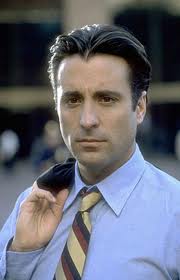
ANDY GARCIA
We watched the 2009 movie, “City Island,” starring Andy Garcia and Julianna Margulies with an Alan Akin-esque supporting role for Alan Arkin.
This is an edgy and often humorous story, written and directed by Raymond DeFelitta, about a dysfunctional family living on an island in The Bronx. Vince Rizzo (Garcia) is a corrections officer who doesn’t like to be called a “prison guard” and who really wants to be an actor. He steals off to Manhattan to attend an acting class led by the grizzled but insightful Michael Malakov (Arkin). Vince assumes that his wife, Joyce (Margulies) would ridicule his ambition, so he explains his weekly absences by saying he is playing poker. She thinks he’s having an affair.
The Rizzos have a son and a daughter together. Vince Jr. (Ezra Miller) secretly has a feeding fetish, and Vivian – played by Garcia’s daughter, Dominik (sic) – is a college student who secretly has lost her scholarship and is stripping to earn tuition money.
Vivian reluctantly comes home on a break at about the same time that Vince realizes that a new prison inmate is his son, Tony (Steven Strait), the product of a liaison Vince had while he was still in his late teens. In keeping with the family practice, Vince has not told Joyce about this.

JULIANNA MARGULIES
Not one to complicate matters by thinking them through, Vince tells Tony only that Tony’s dissolute mother was a “friend,” and he arranges to have Tony released in his custody. He takes Tony home, giving Joyce only the explanation he had given Tony, and the result is even more dissent in the Rizzo household.
Meanwhile, Vince has developed a close, but not romantic, relationship with Molly (Emily Mortimer), a fellow student in Malakov’s class. Molly – who has secrets of her own – pushes Vince to have more confidence in his prospects as an actor. He inadvertently jars her into reconsidering some of the lies she has been living.
The quirky characters, odd-ball story, and strong performances by all the actors make this movie unpredictable and compelling. The environment adds to the interest. The film was shot on location at City Island which looks as if it’s a piece of New England that wandered away and couldn’t find its way back. The characteristics of the place – at least as Vince describes them in the movie – provide a credible context for his self-image and his behavior.

ALAN ARKIN
It’s almost always a treat to find Alan Arkin in a movie. He is in his element in this one, playing a crusty drama teacher who is up to here with actors who want to emulate Marlon Brando. Malakov is especially impatient with students who inexplicably pause instead of speaking their dialogue – a Brando trade mark. Presumably, Malakov wouldn’t have had much time for William Shatner. Vince, as it happens, is a Brando devotee.
This movie makes a point about the consequences of deceit among people whose relationship implies intimacy. It may be an obvious point, but the empirical evidence is that it can’t be made too often.

Vince Rizzo studies up on Marlon Brando in "City Island"
Netflix Update No. 46: “Walk Don’t Run”
February 18, 2011

Jim Hutton, Cary Grant, and Samantha Eggar in a scene from "Walk Don't Run"
We watched the 1969 film “Walk Don’t Run,” which was notable for being Cary Grant’s last movie. He retired, so the story goes, because he realized that he could no longer pull off the leading man image and didn’t think his fans would accept him in supporting roles. So he was “retired” for 20 years, as far as the movies were concerned.

CARY GRANT
In “Walk Don’t Run,” Grant plays a prominent British businessman, Sir William Rutland, who visits Tokyo during the 1964 Olympic Games, arrives two days ahead of schedule and can’t find a hotel room. He spots a notice posted by someone wanting to share an apartment and goes to the address. The “someone” is Christine Easton (Samantha Eggar), a nervous young lady who is engaged to a supercilious employee of the British Embassy. She isn’t interested in sharing her apartment with a strange man, but Rutland ignores her protests, confuses her with the kind of fast talk that Grant was so good at, and moves in. Christine tries to make the arrangement as hard as possible on Rutland by imposing an impossibly tight schedule for use of the bathroom, but Rutland – though totally unable to keep up with the timetable – isn’t that easily dissuaded.

JIM HUTTON
During a business call in Tokyo, Rutland meets brash American Steve Davis, who is a member of an American Olympic team — though he won’t say which one — and who also is without a place to stay until the Olympic quarters open. Davis is played by the ill-starred Jim Hutton. Rutland and Davis are at odds at first, but Rutland ends up subletting half of his room to Davis — without asking Christine, of course. She objects when she finds out, but she is no match for the two of them. Rutland, who is happily married and old enough to be Christine’s father, doesn’t like Christine’s fiancée and thinks Davis would be a better match for her. Therein lies the story, although there’s a subplot in which Davis is accused of being a spy.
This is a good-natured film, and the three principal actors do it justice. Grant was about 62 when he made this movie, and he hadn’t lost any of his appeal or energy.

SAMANTHA EGGAR
The movie was shot on location in Japan, and that adds to its interest. Tokyo is a busy place, and the outdoor shots were done in the middle of the daily bustle.
This movie is based on a highly-regarded 1943 film, “The More the Merrier,” which I haven’t yet seen. That stars Charles Colburn, Joel Macrae, and Jean Arthur. It tells the same general story, but it takes place in Washington, D.C., and makes fun of the housing shortage there during World War II. Colburn plays the businessman, and he was widely praised for his performance. He and Grant were very different personalities, but I can picture Colburn playing the role.
Netflix Update No. 45: “Last Chance Harvey”
February 16, 2011


DUSTIN HOFFMAN
We watched the 2008 film “Last Chance Harvey” which stars Dustin Hoffman and Emma Thompson. Apparently this film attracted some attention when it was released, but I must have been out of town, because I don’t remember hearing about it. Hoffman and Thompson both got Golden Globe “best” nominations, so somebody was paying attention.
This movie got mixed reviews, but I’ll cast my lot with the yea-sayers.
Hoffman plays Harvey Shine, a song writer and musician who wanted to be a jazz pianist but settled for writing commercial jingles. Now that that industry depends far more on digital sound than on the black-and-whites, he’s having a hard time keeping up, so much so that his job is in jeopardy — hence the title of the film.

LIANE BALABAN
Meanwhile, Harvey is due to fly to London to attend the wedding of his daughter, Susan (Liane Balaban), who is tighter with her mom and stepfather than with Harvey, her dad. In fact, Harvey feels very much in the way at the dinner on the eve of the ceremony.
Meanwhile, the film follows the life of Londoner Kate Walker (Thompson), a lonely woman who works as a survey taker at Heathrow Airport. Despite a friend’s clumsy attempts to find her a match, Kate seems almost willingly trapped in a drab existence punctuated by constant phone calls from her aged and equally lonely mother.

EMMA THOMPSON
OK, it’s obvious early on that Kate and Harvey are going to cross paths, but these characters are so well drawn by the actors, and their situations are so familiar, that it’s hard not to get interested in them. I read that Hoffman and Thompson had had a positive experience working together in a previous film and that Hoffman agreed to this role on the condition that he and Thompson ad lib some of their dialog. The relationship between them seems natural, so that strategy paid off.
Some viewers might be distracted by the age difference between Hoffman and Thompson — which is emphasized in a certain way by the difference in their heights — but there is no suggestion that their interest in each other is primarily sexual, or sexual at all, and the things that do attract them to each other make perfect sense. I, for one, am not cynical enough to dismiss the way Harvey’s personality is rejuvenated under the influence of a timid, self-conscious, but witty and intelligent woman. If one starts with the premise that Joel Hopkins’ script starts with — that both of their lives were at a dead end — the idea that they could form a relationship is both plausible and redemptive.

Hoffman and Thompson
Netflix Update No. 44: “Caramel”
January 27, 2011

NADINE LABAKI
When we visited Lebanon toward the end of the Clinton administration, the country was still occupied by the Syrian army. The occupation was a nuisance, because we frequently came across checkpoints where the cousin who was driving us around had to explain himself — or ourselves — to these interlopers. To bog things down a little more, the Lebanese army had its own checkpoints. Besides being an obstruction, the presence of the Syrians served as a constant reminder of the tense atmosphere that has too often prevailed in the country.
My maternal grandparents were born in Lebanon, and our principal reason for going there was to visit members of my grandmother’s family. Thanks to my cousin’s generosity with his time, we also saw a good deal of the antiquity and natural beauty Lebanon has to offer. Coming from a country that hadn’t had a war on its soil in well over a century, we couldn’t help being struck by the contrast between the competing armies with their automatic weapons and the Lebanese people going about their everyday lives.

NADINE LABAKI
That came to mind when we watched “Caramel,” a film made in Beirut, co-written and directed by Nadine Labaki, who also plays the central character, Layale. The story is about six women, three of whom work in a beauty salon, which is the axis around which the action revolves. The title, incidentally, refers to a sweet concoction used in the salon for hair removal; it actually figures in the plot in two instances.
The characters in the story are Layale, who is in a self-destructive relationship with a married man; Nisrine (Yasmine al Masri), who is about to be married to a man who doesn’t know of her previous sexual experiences; Rima (Joanna Moukarzel), who is attracted to other women – including Siham (Fateh Safa), a stunning customer at the salon; Jamale (Giselle Aouad), a frequent client at the salon, an aspiring actress who is having trouble coping with age; and Rose (Sihame Haddad), an elderly seamstress who cares for an unbalanced older sister, Lili, (Aziza Semaan), and is conflicted when she gets what apparently is her only chance at romance.
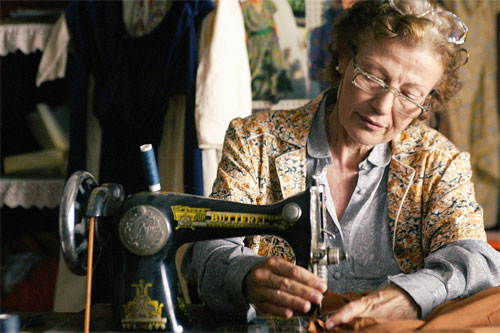
SIHAME HADDAD
Labake — whose eyes, by the way, are hypnotic — tells the stories of these women with a loving, delicate, sometimes even dreamy touch. The blend of drama and comedy is just right. The performances, without exception, are credible and affecting. All of the characters, including the distracted Lili, are endearing and sympathetic.
The choice of settings adds to the quality of this film, because Labake keeps the camera’s eye on the story, and doesn’t go exploring the city for its attractive waterfront or its war-scarred ruins, or its slums. In fact, there are no allusions to the recent history of Beirut; this story is about the interior lives of these women.

YASRINE AL MASRI
An interesting cultural aspect of this story is that Nisrine is the only Muslim in the circle of friends; the other women are Christians. Nisrine’s family is very traditional — and, presumably, so is her fiancée, which is why — with the support and encouragement of her friends, she takes a drastic step to deceive her groom about her virginity.
The dialog in this film is in Arabic, and we watched it with English subtitles. It’s fun to listen to the actual dialog, because — as we noted when we visited there — the Lebanese mix French and English into their Arabic. This movie was well received when it appeared in 2007, and the attention was well deserved.

A policeman questions Lili, who collects paper -- including parking tickets -- in the streets of Beirut.
Netflix Update No. 43: “Love in the Afternoon”
January 10, 2011
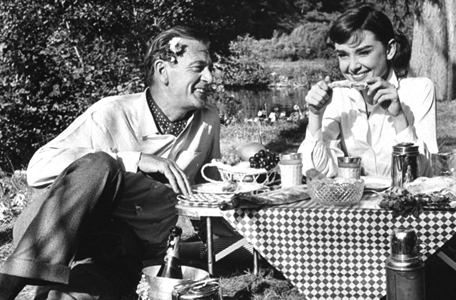
Gary Cooper and Audrey Hepburn in "Love in the Afternoon"
“Love in the Afternoon,” a 1957 movie directed and co-written by Billy Wilder, is entertaining in several ways, but it is also seriously flawed. The principal flaw was in the casting, no matter how good the names Gary Cooper, Audrey Hepburn, and Maurice Chevalier, may sound when listed in the same credits.

Audrey Hepburn
The film, which is said to have been Wilder’s paean to director Ernst Lubitsch, is a subtle, witty, lightly slapstick romantic comedy concerning a Parisian private detective, his cellist daughter, and an international playboy with whom they both become involved. Detective Claude Chavasse (Chevalier) is engaged by Monsieur X, a cuckolded husband played by John McGiver — later the accommodating jewelry salesman in “Breakfast at Tiffany’s” — who wants to know who his wife has been seeing. Chavasse determines that the guilty party is millionaire Frank Flannagan (Cooper) a globe-hopping businessman with at least a girl in every port. Chavasse’s daughter, Ariane (Hepburn), who studies cello at a Paris conservatory, is fascinated by her father’s profession and questions him incessantly about his clients and, in the face of his reticence, snoops in his files. After she overhears Chavasse’s client declare that he will go to the Hotel Ritz and shoot Flannagan, she feels compelled to warn the target — whose photos in the files have beguiled her.
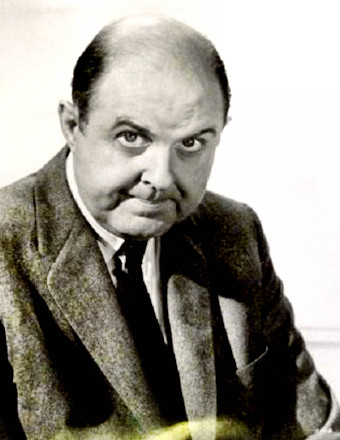
John McGiver
Ariane, after getting no satisfaction from the police, goes to the hotel herself and makes her way into Flannagan’s room just in time to allow the paramour to escape so that the husband discovers Flannagan with Ariane instead. This encounter, of course, is the beginning of a series of meetings between Flannagan and Ariane, but she refuses to give him any information about her identity, and he takes to calling her “thin girl.” As is his habit, Flannagan eventually leaves Paris for other resorts, and it appears that the “affair” — to all appearances a chaste one — is over. But about a year later, he is back in Paris and the two accidentally meet at an opera house and the liaison, such as it is, continues, with Ariane filling Flannagan with fibs about the many men in her life — many of them based on things she has read in her father’s case files. Flannagan doesn’t know whether to believe these stories or not; that, plus the lack of any information about the girl, increasingly agitates him.

Maurice Chevalier and Audrey Hepburn
This being a movie, Flannagan and Monsieur X happen to meet in a Turkish bath and Monsieur X — still clueless about his wife’s dalliance — discerns the broad outlines of what is troubling Flannagan and recommends that he engage Chavasse to find out the truth about the “thin girl.” Flannagan does so, and Chavasse quickly figures out that the girl Flannagan is talking about is Ariane. Since Chavasse, through his investigations, is intimately acquainted with Flannagan’s track record with women — kiss them and run — he reveals the truth to Flannagan and urges the tycoon to leave Ariane in peace. Flannagan sets out to do that, but at the last moment, as his train is already beginning to roll out of the Paris station, he lifts the tearful Ariane on board and the two ride off in each other’s arms.
There are a couple of leaps in logic in this plot. One is that Chavasse had reported that Monsieur X’s wife was having an affair with Flannagan, but Ariane’s intervention made it appear that Chavasse had been wrong. That raises the question of why Monsieur X would recommend Chavasse as an outstanding detective. Another is that at the end of the film, after Chavasse has tried so hard to convince Flannagan to leave Ariane alone, the old man stands on the train platform with a satisfied smile on his face as his daughter rides off with the playboy.

Billy Wilder
Hepburn, Chevalier, and McGiver are delightful in this film. The big flaw — which was pointed out by critics at the time — was that Gary Cooper, who was 55, was much too old to be a credible partner for Hepburn, who was 28. Cary Grant, 53 at the time, had turned down the role because of the age difference. To complicate matters, Cooper — a friend of Wilder’s — was not in good health. He looked older than he was, and he looked drawn and tired, and that was exacerbated by the fact that the film was in black and white.
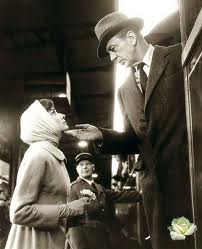
Audrey Hepburn and Gary Cooper in the closing scene.
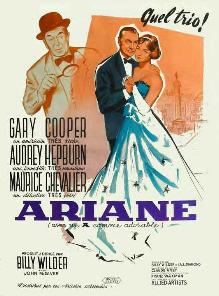
An interesting sidelight is that this film had two endings — one for American theaters and one for European. In the European version, which was released under the title “Ariane,” the audience was left to use its imagination about what took place between Flannagan and Ariane after the train left the station and closing titles started rolling.
In the American version, however, because extramarital sex was at least publicly frowned upon in the mid-1950s, the film closed with a voice-over in which Chevalier explains that Flannagan and Ariane got married and were “serving a life sentence in Manhattan.” The film was a failure in the U.S., but it was a hit in Europe.
 CharlesPaolino's Blog
