Netflix Update No. 64: “Pay it Forward”
April 30, 2012
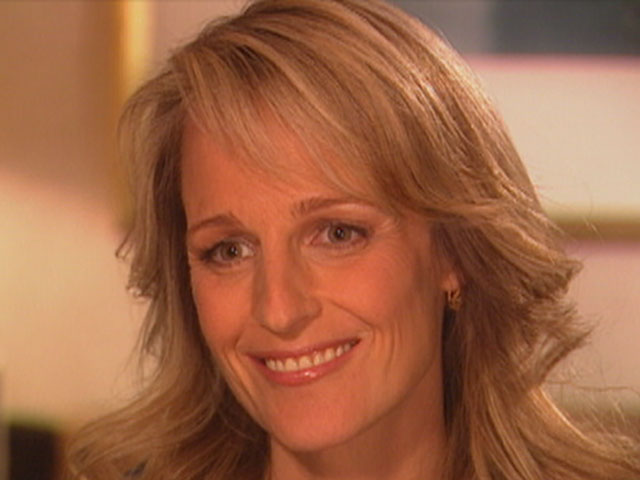
Helen Hunt
The concept of “paying forward” evidently has been rattling around for a long time—at least as long ago as 317 BC, when it was woven into the plot of Dyskolos, a play by the Greek writer Menander.
We encountered the idea, known in sociology as “generalized reciprocity,” much more recently, namely in the 2000 film Pay it Forward, with Helen Hunt, Kevin Spacey, Haley Joel Osment, Jon Bon Jovi, and Angie Dickinson.
Hunt plays Arlene McKinney, a woman estranged from her husband and trying to raise her son by working both as a pole dancer and as a waitress in a Las Vegas casino. Arlene and her absent husband, Rickey (Jon Bon Jovi) are both problem drinkers; Arlene, who is in a program for alcoholics, still sneaks a nip when she’s under stress, which is most of the time.
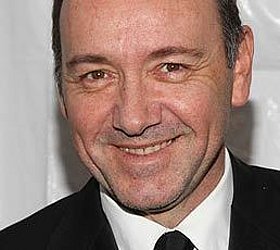
Kevin Spacey
Arlene’s son, Trevor (Osment), is assigned to a seventh-grade social studies class taught by Eugene Simonet (Spacey) who has a badly scarred face. On the first day of class, Simonet gives his students a year-long assignment, which is to devise and at least attempt to carry out a plan that will change the world forever. Unlike many of his classmates, Trevor takes this assignment seriously, and he decides that his project will involve “paying forward,” by which he means that he will do a favor for each of three strangers and ask each of them to return the favor not to Trevor but to three other strangers. The goal, of course, is to set off an ever-expanding chain reaction of good will.
Trevor’s first attempt at putting this idea into practice is to invite a homeless drug addict to take a shower and have a meal at the McKinney home and to stay overnight. When Arlene discovers this plan already in progress, she has a predictable and understandable reaction, and it isn’t positive.

Haley Joel Osment
The incident inspires Arlene to visit the school and reprimand Simonet for making the assignment. The two don’t understand each other, and the interview is not successful. But Trevor decides to make the solitary Simonet the beneficiary of the next favor by tricking the teacher and Arlene into having dinner together, a scheme that does not succeed.
The story becomes increasingly complicated as Trevor runs away from home, Arlene and Simonet take a second look at their relationship, and Ricky reappears with the announcement that he is sober to stay.
This film begins with a sequence in which a Los Angeles reporter, Chris Chandler (Jay Mohr), stops at a crime scene and watches as a patrol car drives into his own vehicle, wrecking it beyond repair. A passer-by, an older and prosperous looking gent, hands Chandler the keys to a Jaguar, tells him to take it, and refuses to explain himself.

Jon Bon Jovi and Helen Hunt
Chandler eventually determines that this incident is part of a series of good deeds that he traces back to Trevor Chandler.In the process, Chandler comes across a woman identified only as Grace, a homeless alcoholic played by Angie Dickinson and a key figure in the McKinney drama.
I go along with the Rotten Tomatoes assessment of this film: the story line is much too emotionally manipulative, but the performances by everyone in the cast nearly redeem the movie. I think most viewers would also find the conclusion of the story, which I won’t spoil here, to be contrived and unsatisfying.
Watch it, but keep your expectations under control.
Netflix Update No. 63: “Father’s Little Dividend”
March 12, 2012
 Spencer Tracy got away with playing the same character a lot of the time, and with good reason: It worked. A case in point is his role in the 1951 comedy Father’s Little Dividend, which was a sequel to Father of the Bride.
Tracy plays Stanley Banks, a suburbanite who looks forward to forging a new kind of life with his wife, Ellie (Joan Bennett), now that their three children are grown. He’s especially thinking about travel — Europe, maybe, or the beach at Waikiki. This dream is disrupted by the announcement that the Banks’ daughter, Kay Dunstan (Elizabeth Taylor), is pregnant.
 Ellie is delighted with this news, but Stanley is worried, depressed, and angry. He correctly suspects that first the pregnancy and then the baby will absorb Ellie’s attention to the exclusion of all other things. He also dislikes the prospects of being a grandfather, because he doesn’t like confronting his age.
The pregnancy, as pregnancies will, proceeds with or without Stanley’s endorsement. Meanwhile Ellie becomes increasingly irritated by Kay’s in-laws, who seem determined to take control of every aspect of the baby’s life, including its name and the decor of its nursery.

JOAN BENNETT
To complicate matters further, Kay leaves her husband whom she suspects of having an affair, and Ellie is distraught over the obstetrician’s theories, apparently revolutionary in 1951, about a mother being totally awake during childbirth and bonding immediately with her infant.
This film, which was shot in 22 days, was directed by Vincente Minelli. It’s typical of the style of the times, including the overdressed actors. (I was old enough in 1951 that I can testify that men did not wear suits to do everything but sleep and have sex.) It’s also thoroughly entertaining in the way of the comedies of that period, no little thanks to the irresistible Spencer Tracy. For anyone who has seen neither film, it might be fun to watch Father of the Bride first, but it’s not necessary in order to appreciate the sequel.
 An image that is perhaps too typical of the time is the black maid, in this case Delilah, played by Marietta Canty. She appeared in more than 40 films — including Rebel without a Cause, The Spoilers, and Father of the Bride — mostly in this kind of role and often without receiving credit. Like her colleagues, she braved the criticism often directed at black actors who accepted such parts and conducted herself with skill and dignity. She retired from show business in the late 1950s. She was a political and social activist for the next three decades. She was also a nurse and a justice of the peace. Her home in Hartford, Connecticut, is on the National Registry of Historic Sites.

Netflix Update No. 62: “The Last Time I Saw Paris”
January 29, 2012
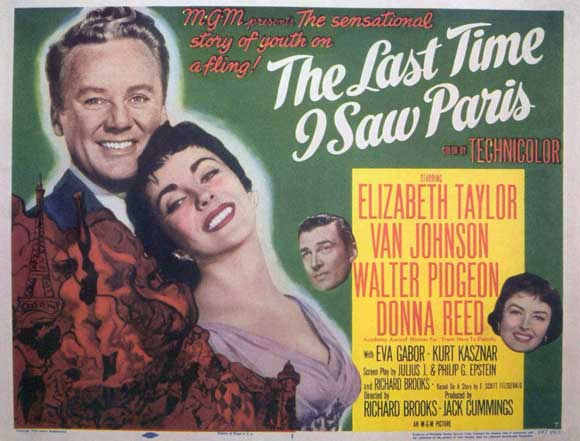 A couple of things Van Johnson told me about himself have stuck in my mind for more than 30 years. One was that he had a lifelong ambition to ride an elephant during the opening of a Ringling Brothers & Barnum and Bailey Circus performance. The other was that he was disappointed that living in a Manhattan apartment meant that children would never come to his door on Halloween.

VAN JOHNSON
I’ve been thinking about those things today because last night we watched Van Johnson in the 1954 film The Last Time I Saw Paris. He co-starred with Elizabeth Taylor. Others in the cast were Walter Pidgeon, Donna Reed, Eva Gabor, George Dolenz, and Sandy Descher.
This film, which was loosely based on F. Scott Fitzgerald’s short story “Babylon Revisited,” is a long flashback to Paris at the end of World War II in Europe. Johnson plays Charlie Wills, a soldier and aspiring novelist who works as a reporter for the military newspaper Stars and Stripes. At the beginning of the tale, he has returned to Paris from the United States, and he reminisces about the bitter circumstances under which he had left the City of Light: During the celebratory bedlam in Paris when the war ended, Charlie winds up at a party at the home of James Elwirth (Pidgeon), an impecunious American chancer who believes in living high even if one can’t afford it. Charlie is invited to the home by Elwirth’s quite proper daughter Marion (Reed), but is quickly infatuated with Marion’s ne’er-do-well sibling, Helen (Taylor).
Charlie and Helen marry and have a daughter, Vicki, played by Descher. Marion — who is broken-hearted over losing Charlie to the sister of whom she disapproves, settles on a rebound match with a thoughtful Frenchman, Claude Matine (Dolenz).

ELIZABETH TAYLOR
The marriage of Charlie and Helen goes well, even while they’re living from hand to mouth, but Charlie is gradually losing confidence in himself as one publisher after another rejects his novels. Then their world is permanently altered as oil is discovered on Texas land, thought to be barren, that Elwirth jokingly gave the couple as a wedding gift. While Helen struggles to maintain stability in the family, Charlie sinks further and further into a morass of depression and decadence.
When this movie was released, some critics savaged it. It is true that the story is implausible and that some of the acting is either arch or wooden. Eva Gabor, as socialite Lorraine Quarl, who plays a supporting role in Charlie’s decline, gives exactly the kind of performance one expected of the Gabors. Descher, who was only nine years old, is gag-me cute in the role of Vicki –and she inexplicably never ages as the years roll by.

SANDY DESCHER
Van Johnson’s light comedy is entertaining, but his drunk scenes are simply unbelievable. I once heard from a stage veteran that an actor who can’t play a convincing drunk is no actor at all. That might be too harsh a judgment on Johnson, but this film suggests that faux inebriation was not his strong suit.

WALTER PIDGEON
Elizabeth Taylor and Donna Reed did passably well as the sisters, although a scene in which Taylor’s character is mortally ill is so unconvincing as to be ludicrous. Walter Pidgeon, on the other hand, is delightful as the irresponsible but charismatic Ellswirth and Dolenz plays Claude as the most realistic figure in the film.
I don’t know if this is true, but I have read that the producers didn’t use the title of Fitzgerald’s story because they were afraid movie-goers would think the film had a biblical theme. I wondered about the title they did use, particularly because its lyrics express sentiments exactly opposite of those in this film. The song “The Last Time I Saw Paris” is heard in the background throughout the movie. It turns out that song was written in 1940 by Jerome Kern and Oscar Hammerstein, and it was sung by Ann Sothern in the 1941 film Lady be Good. It won the Oscar for best song. The song was composed in the aftermath of the German occupation of France. There were six versions of the song on the hit charts by the end of 1940, and Kate Smith bought the exclusive right to sing it on the radio for six months.
 As is often the case with movies, the shortcomings of The Last Time I Saw Paris do not add up to a failure. The film is nicely photographed — much of it in Paris, it captures the mood and mores of the early ‘fifties, and it is entertaining. It’s also an inoffensive opportunity to spend a couple of hours indulging oneself in the kind of escapism provided by “golden-age” stars such as Van Johnson and Elizabeth Taylor.
You can hear the title song, presented in the mood in which it was written, by clicking HERE. The performance is by Anne Shelton, a fine British vocalist who devoted a lot of time and energy to entertaining troops via radio and in person.
Neflix Update No. 61: “Alice”
December 20, 2011
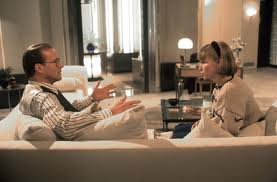
WILLIAM HURT and MIA FARROW in "Alice"
I don’t know if it’s possible to not be in love with Mia Farrow, but watching the 1990 Woody Allen film Alice is not the way to avoid it.
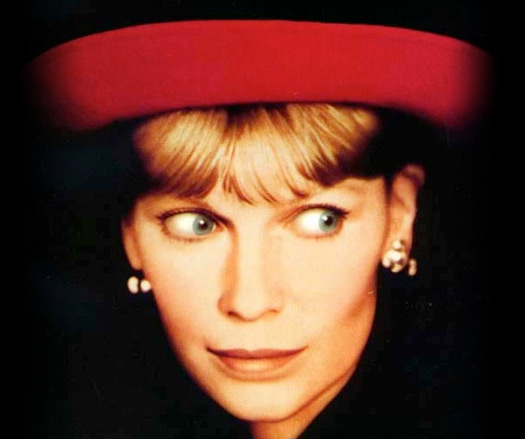
MIA FARROW
In this wonderful fantasy, written and directed by Allen, Farrow plays Alice Tate, the wife of wealthy businessman Doug Tate (William Hurt). Alice lives in a world in which her biggest concern is how to fit all the pampering she receives into her busy schedule. She and Doug have children, and Alice seems genuinely attached to them, but the kids spend most of their time with a nanny while Mom is with the personal trainer or the hair dresser or with her equally spoiled and gossipy lady friends.
Her routine is disrupted at her childrens’ private school when she meets and is attracted to Joe (Joe Mantegna), the divorced father of one of the other children. Shy and at least nominally Catholic, Alice suppresses her interest in Joe at least for a while. Right around this time, her usual hypochondria becomes focused on a chronic pain in her back, which drives her to consult an herbalist in a crummy building in Chinatown.
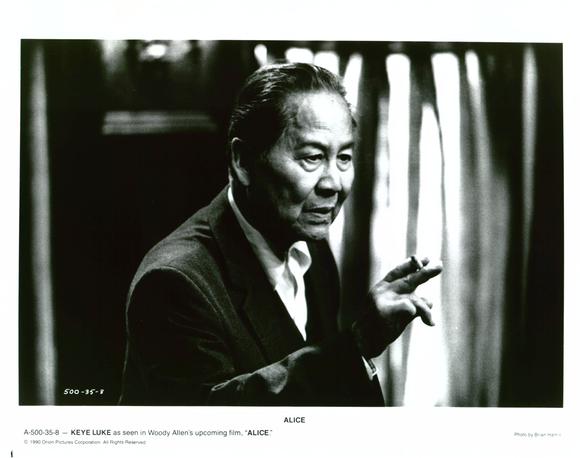
KEYE LUKE
Dr. Yang, played in a marvelous performance by Keye Luke — his last role — understands immediately that there is nothing wrong with Alice’s back. He hypnotizes her and then introduces her to a series of herbs that have extraordinary effects on her, and eventually on Joe, including invisibility. Alice and Joe learn a great deal about themselves and about their spouses (ex-spouse, in Joe’s case). The result is a total change in both of their lives, although not in the way that might seem obvious.
Yang, who barks at any sign of self-indulgence in Alice and consistently refers to himself in the third person, is a unique and hilarious character.
As usual with Woody Allen, every character in this film is perfectly cast, including a brief turn by Bernadette Peters as a mystical “muse” who addresses Alice’s ambition to be a writer; Gwen Verdon as Alice’s memory of her mother; Blythe Danner as Alice’s somewhat estranged sister; and Alec Baldwin as the ghost of Alice’s first lover. Even the tiny role of an interior decorator is enhanced by Allen’s choice of Julie Kavner.

GWEN VERDON
As for Farrow, she is simply irresistible.
The film is outstanding for its photography and for the writing, which got Allen an Oscar nomination.
Alice was loosely based on Juliet of the Spirits, a 1965 Italian movie directed by Federico Fellini, the first feature-length film he shot in color.
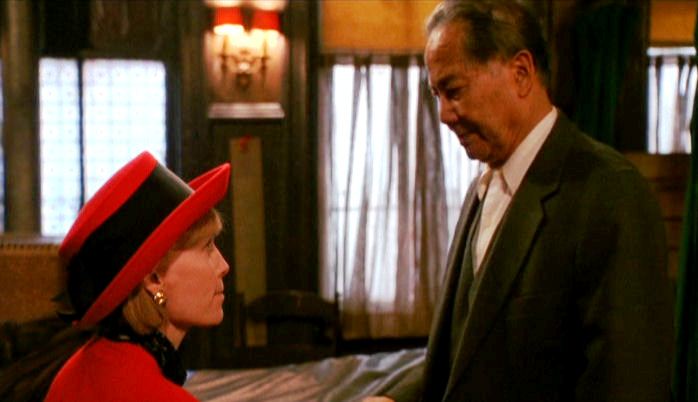
MIA FARROW and KEYE LUKE in "Alice"
Netflix Update No. 58: “Happy Accidents”
December 10, 2011

Vincent Donofrio and Marisa Tomei in "Happy Accidents"
I’ve been reading some articles about time travel; it’s a good way to make your head spin without the aid of alcohol.
The subject came up because we watched “Happy Accidents,” with Marisa Tomei and Vincent Donofrio. In this film, released in 2000, Tomei plays Ruby Weaver, a woman chronically unlucky in her relationships with men. She thinks her luck has changed when she becomes involved with Sam Deed (Donofrio), until he tells her that he is a traveler from the future – specifically from the year 2470.

VINCENT DONOFRIO
Sam claims that he saw Ruby’s picture when he was living in Dubuque, and that he traveled through time, to Brooklyn, in search of her – though he doesn’t say why. As any person would, Ruby initially thinks Sam is either joking or deranged, but Sam won’t budge off his story. Ruby is particularly disturbed by a notebook in which Sam has repeatedly sketched the face of a woman — he claims it’s Ruby’s face — and written the words Chrystie Delancey — he claims she’s his “contact,” another time traveler who was assigned to give him his orientation when he arrived in the past — that is, the present.
This tale grows quite intense; in fact, I was surprised to see it listed on IMDb as a comedy, because there’s nothing funny about it. It keeps us guessing whether we’re watching a fantasy in which Sam is telling the truth, or a tragedy in which Sam is either playing mind games with Ruby or is insane.
Underlying the story itself is the paradox that the notion of time travel to the past always poses — the question of causality. Namely, if time travel to the past were possible, would the time travelers, either by their mere presence or by their overt actions, change the course of events, change the future.
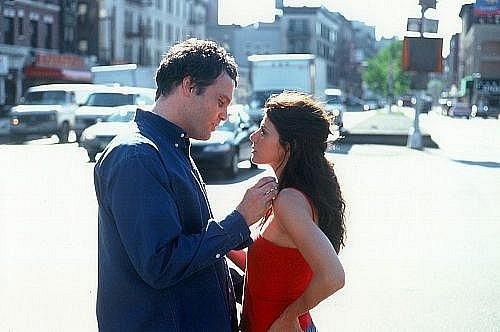
Donofrio and Tomei
I don’t think this movie did very well at the box office, but it’s a worthwhile property. The story is compelling, Tomei and Donofrio are both magnetic, and there are strong supporting performances by Tovah Feldshuh as Ruby’s mother, Holland Taylor as Ruby’s therapist — a pivotal role, and Nadia Dajani as Ruby’s best friend.
Several years ago, I read a book entitled The Physics of the Impossible by theoretical physicist Michio Kaku. In that book, Kaku explored some ideas that have been presented over the years in science fiction literature, films, and TV shows, and organized them according to how plausible they were. As I recall, he concluded that under the known laws of physics, time travel into the past was impossible and time travel into the future was possible, but not likely to become reality for many many years. If you’d like to see a somewhat comprehensible explanation of Albert Einstein’s view of time travel, click HERE.
Netflix Update No. 57: “Tortilla Soup”
December 4, 2011

HECTOR ELIZONDO
I have to begin by saying that I was predisposed to like Tortilla Soup because I am predisposed to like Hector Elizondo, who is the focal point of this film. Tortilla Soup, a 2001 remake of the 1994 Taiwanese movie Eat Drink Man Woman, concerns Martin Naranjo (Elizondo), a semi-retired Mexican-American gourmet chef who is the widowed father of three beautiful young women. His daughters still live at home and — at the beginning of the story, at least — gingerly try to accommodate his fixed ideas what their lives, and family life, should be.
The oldest daughter, Leticia (Elizabeth Peña) is loveless and unhappily employed as a high school chemistry teacher. She has broken with her father only to the extent that she has left the Roman Catholic Church in favor of evangelical Christianity. The second daughter, Carmen (Jacqueline Obradors), would have liked to follow in her father’s culinary footsteps, but she caved into his pressure to become a businesswoman. The youngest girl, Maribel (Tamara Mello), disdains the degree of her sisters’ conformity and is potentially the most rebellious.
In a parallel story story line, Yolanda (Constance Marie), a divorced friend of the family, introduces her mother, Hortensia (Raquel Welch), into the Naranjo household. The flamboyant Hortensia quickly decides that she will marry Martin and mistakenly believes that he shares her ambition.

ELIZABETH PEÑA
As Martin strives to keep his family together with a constant stream of elaborate meals, each of his daughters starts to drift away – Letitia into the arms of an athletic coach at the high school, Carmen to a lucrative job in Barcelona, and Maribel to the side of a young man who is more of an alternative to her father than he is a lover.
Although the situation is hackneyed and the denouement is predictable, this is a charming movie. That’s attributable to the attractive and talented cast, the intimate nature of both the story and the manner in which it is told, and the lively and evocative musical background.
Elizondo, whose stodginess is altogether benign, is irresistible, and the actresses who portray his daughters establish a credible combination of affection and tension among themselves and between them and their father.
I don’t recommend watching this film on an empty stomach, because the enormous amount of food that cascades across the screen as one meal follows another is mouth-watering.
Netflix Update No. 56: “Then She Found Me”
November 17, 2011
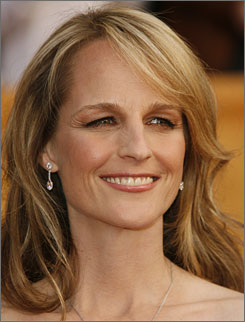
HELEN HUNT
A lot of ills come from being in the wrong place at the wrong time, and Helen Hunt provides an example in the 2007 film “And Then She Found Me,” based on Elinor Lipman’s 1990 novel.
The film was produced, directed, and written in part by Helen Hunt, who also plays the “me” in the title. Perhaps she was having trouble concentrating.
The premise of this dour property that is passed off as a “romantic comedy” is that 39-year-old April Epner’s adoptive mother has died — shortly after denying April’s charge that mom had favored her biological son. This comes on the heels of the collapse of April’s marriage to Ben Green (Broderick), who abruptly gives her the “I just can’t do this anymore” routine. Ben hasn’t cooled off too much to have a last barnyard fling with April on the kitchen floor, and that provides the delicate nuance of an awkward pregnancy — hers, not his.
April doggedly goes on with her career as a Brooklyn schoolteacher, which puts her in contact with Frank (Firth), the conveniently divorced father of one of her pupils. Frank, a sandy-haired teddy bear, has the earthy charm of the British Isles about him, and the romantic sheen of an unemployed and, one presumes, unappreciated writer. He isn’t too charming or romantic to resent the fact that Ben, thanks in part to the pregnancy, still has one foot in his relationship with April.

- HELEN HUNT and BETTE MIDLER
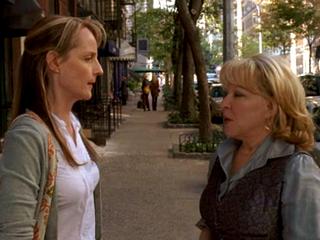
As though April’s life weren’t interesting enough, a messenger comes to a school with a letter in which a woman who does not identify herself at first claims to be April’s biological mother. The woman turns out to be daytime television talk-show host Bernice Graves (Midler). April is skeptical about Bernice’s claim, infuriated by her badly contrived lies, and put off by her overbearing attempts to play mother.
 If the resolution of this tangled tale seems satisfactory, it may be only because the resolution means the film is over. It’s kind of like a cricket match in that regard.
Clearly we’re supposed to find humor somewhere in this story, but there is none. There certainly is none coming from Hunt, who can be described only as grim.
Incidentally, in the scenes in which April and a shifting cast of companions visit the gynecologist, the doctor is portrayed by Salman Rushdie. I read somewhere that Hunt recruited him because she wanted to make sure all the major faiths were represented in a scene in which there is prayer. I’m not sure which faith he represents.
Hunt didn’t take the hint when she was turned down by the studios before making this film herself on a shoestring budget. Broderick, Firth, and Midler agreed to work for scale, which seems appropriate. If they had accepted their usual salaries for this film, their names should be on the placards in Zuccotti Park.
Netflix Update No. 55: “Lovely, Still”
November 14, 2011
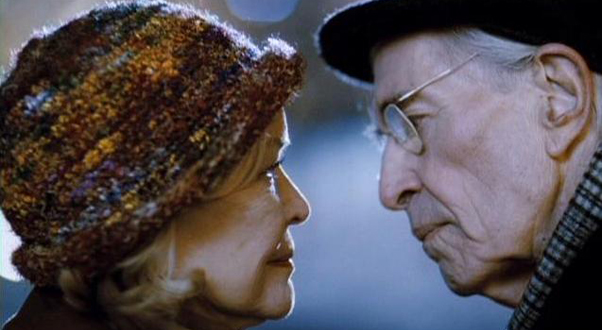
ELLEN BURSTYN and MARTIN LANDAU
After we watched Lovely, Still, a 2008 film starring Ellen Burstyn and Martin Landau, I poked around on the Web and found the widest possible range of opinons — from a contemptible piece of trash to a work of genius. Put me down as confused, which I guess is somewhere between the extremes. This movie, directed and written, in part, by Nicholas Facker, concerns elderly Robert Malone (Landau), who appears as a solitary man who lives alone and works at a nearby supermarket — near enough that he has been walking to work since he crashed his car into his garage door.

MARTIN LANDAU
During his lunch breaks at the market, Robert passes the time making pencil drawings that reveal a high level of skill that seems out of place in a man whose life is so drab and pointless. While he is drawing one day, he is approached by Mary (we are not told her last name), played by Burstyn. She introduces her self and tells him that she admires his drawing. When Robert returns home that evening, he finds the front door of his house ajar. Unaware that he didn’t close the door when he left for work, he cautiously enters the house to search for an intruder, and he finds one — Mary, who lives across the street with her daughter, Alex, played by Elizabeth Banks. As Mary tries to explain that she had seen the open door and wanted to make sure he was all right, the startled Robert screams at her to get out of his house.

ELIZABETH BANKS
When Robert calms down, however, he apologizes and the interchanges that follow end up with Robert accepting Mary’s invitation to take her to dinner the following night. Although Alex is wary of this, for reasons she does not state, Mary pursues the relationship which evolves into a romance, the first romance, Robert tells her, he has ever had. Meanwhile, Robert seeks and receives advice on courtship from his boss, Mike (Adam Scott), who seems to be more than reasonably solicitous of this confused old man, even going shopping with Robert to pick out Christmas presents for Mary. This movie is swathed in Christmas lights and sentimental music, and early on we became uneasy about the fairy tale. Eventually, Mary’s behavior and demeanor signal that something is seriously amiss — that there’s something she isn’t telling us. Sure enough, in the last few scenes, we learn that nothing in the film, including the relationships among the major characters, is what it seemed to be, and that the truth is as harshly real as the setup for it was cozily unreal. To complicate matters, we didn’t fully understand what had really happened and we couldn’t make heads or tails of the conclusion. As I poked around on the Web, I found that we were not alone. We speculated about what the writers might have been trying to convey, but we could find reasons to dismiss every theory we concocted.

ADAM SCOTT
That’s too bad, because in our view this film has a lot to recommend it: the musical choices, the photography, and particularly the exemplary performances by all four major players. The story, in spite of its obscure ending, also effectively calls attention to the loneliness of people whom we encounter in everyday life and to the possible consequences of old age.
So we liked it as far as we could, but we’re confused. Perhaps someone else will watch Lovely, Still and open our eyes.
Netflix Update No. 54: “Sunflower”
October 22, 2011
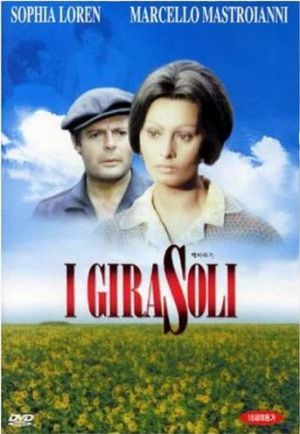 Having dabbled with Marcello Mastroianni in Macaroni and Marriage Italian Style, we went to the well once more in the form Sunflower, a film we had never heard of. The results were mixed.
This film, made in 1970, was the last directed by Vittorio De Sica, and —significantly — it was the first western film shot, in part, in the Soviet Union. Mastroianni, who was 46 when this movie was made, plays Antonio, a happy-go-lucky Neapolitan who is drafted into the Italian army during World War II. He is not a willing conscript, and his valor isn’t helped by the fact that he is in the middle of passionate fling with Giovanna, played by 36-year-old Sophia Loren. His attempt, with Giovanna’s connivance, to avoid military service results in a court-martial and his deployment to the Russian front — which was a brutal fate thanks to both the Red Army and the merciless winters.
When the war ends, Antonio doesn’t return, but Giovanna is convinced that he is still alive. After failing to get any satisfaction from public authorities, she travels to Russia to look for him. It’s not a spoiler to say she finds him, inasmuch as Mastroianni is the co-star. Some may find the circumstances and outcome predictable; some may not.
 Watching this film, which has Italian dialogue and English subtitles, is an uneven experience. Mastroianni and Loren are an irresistible combination, and they play their parts well, but the story itself is at times melodramatic and implausible. In what seems to have been an overreaching attempt to project the character’s moods, Loren is made to look at times as if she’s 30 and at other times as if she’s 50.
The photography in both Italy and Russia is eye-catching, and there is a very effective scene in which Giovanna visits a Russian hillside that is dotted with hundreds of wooden crosses marking the graves of Italian soldiers. The film also has a wonderful score by Henry Mancini that was nominated for an Oscar.

Netflix Update No. 53: “Marriage Italian Style”
October 10, 2011
 When we recommended to a neighbor that she watch the Marcello Mastroianni-Jack Lemmon film “Macaroni,” she countered by referring us to the 1964 movie “Marriage Italian Style,” in which Mastroianni stars with Sophia Loren. I had seen it about 40 years ago, but didn’t remember anything about it.
Filmed in Italian in Naples, this is the story of an amoral businessman who meets a teen-aged prostitute in a brothel during an Allied bombing raid, and then makes her his mistress when they meet again several years later. Domenico Soriano (Mastroianni) is in the baking business, and he puts Filumina Maturano (Loren) in charge of one of his stores while he keeps her — outside his home — in a very comfortable style. Filumena is not satisfied with this arrangement and she pressures “Dummi,” as she calls him, both to publicly acknowledge her and to make her a part of his household. Step-by-step she gains concessions that include a room in his house and recognition as the “lady” of the premises, but she does not get the final prize, marriage, until she employs a subterfuge that blows up in her face.
 Domenico’s passion for Filumena degrades into disgust, and he takes up a relationship with a young cashier at one of his shops.
Meanwhile, Filumena has a secret of her own — actually, three — namely a trio of sons she has borne as a result of her career, one of them by the unwitting Domenico.
 This film, directed by Vittorio De Sica and filmed in the earthy Neapolitan environment, is a combination of farce, tawdry melodrama, and implausible plot, that can’t be taken seriously. Considering the lengths De Sica went to in order to exploit Loren’s legendary physique – as opposed to the weight of her acting – the Oscar she won as “best actress in a foreign film” seems farcical in itself.
Having said that, I can report that the movie, taken for what it is, is funny and entertaining. The surroundings, whether indoor or out, are engaging, and Mastroianni himself is hard to completely dislike in any role. In this case, except for the ludicrous conclusion, he is worth watching as the rake trying to avoid the consequences of a misspent adulthood.
 CharlesPaolino's Blog