Netflix Update No. 59: “The Yellow Handkerchief”
December 16, 2011

WILLIAM HURT
“The biggest disease today,” Mother Teresa is supposed to have said, “is not leprosy or tuberculosis, but rather the feeling of being unwanted.” Mother Teresa may have been referring primarily to the kind of people she ministered to, people who are poor and disfranchised, but the problems she identified can affect people of all kinds. Three people who are suffering from the “disease” of feeling cut off from any human community are the princpal characters in The Yellow Handkerchief , a 2008 film loosely based on a story by Pete Hamill.
These folks are Brett Hanson (William Hurt), who has just been released after a six-year term in prison; Martine (Kristen Stewart), a 15-year-old girl who has wandered away from her inattentive, single father and her friendless life; and Gordy (Eddie Redmayne), a Native American teenager who is on an aimless odyssey. Martine hitches a ride with Gordy after being rejected by a boy who had taken advantage of her, and Brett, who meets the pair chance, joins them on the first leg of his trip back to New Orleans to find his former wife, May (Maria Bello). May, a beautiful but solitary woman bound to the waterways of New Orleans, had married Brett after overcoming what might have been more sensible instincts, and he divorced her as a way of freeing her after the incident that landed him in prison.

EDDIE REDMAYNE
This was an odd trio in that Gordy was attracted to Martine, who regarded him as eccentric and immature, and Brett — although he was protective of the teenagers — considered them only as a means to an end, namely returning to New Orleans to find out if May would accept him after the callous way he had left her. As they continue to travel together, however, the three gain more and more insight into each other’s psyches and problems and find that in their isolation and their desire to be “a part of something” they are more alike than they had imagined.
This film was shot against the background of post-Katrina Louisiana. Besides being visually interesting, the grim landscapes and the devastation provide metaphors for loneliness on the one hand and a longing for rebirth on the other.
In spite of Hurt’s persona, this is a true ensemble piece in which he, Stewart, Redmayne, and Bello give credible and sympathetic performances.

WILLIAM HURT and KRISTEN STEWART
Netflix Update No. 58: “Happy Accidents”
December 10, 2011

Vincent Donofrio and Marisa Tomei in "Happy Accidents"
I’ve been reading some articles about time travel; it’s a good way to make your head spin without the aid of alcohol.
The subject came up because we watched “Happy Accidents,” with Marisa Tomei and Vincent Donofrio. In this film, released in 2000, Tomei plays Ruby Weaver, a woman chronically unlucky in her relationships with men. She thinks her luck has changed when she becomes involved with Sam Deed (Donofrio), until he tells her that he is a traveler from the future – specifically from the year 2470.

VINCENT DONOFRIO
Sam claims that he saw Ruby’s picture when he was living in Dubuque, and that he traveled through time, to Brooklyn, in search of her – though he doesn’t say why. As any person would, Ruby initially thinks Sam is either joking or deranged, but Sam won’t budge off his story. Ruby is particularly disturbed by a notebook in which Sam has repeatedly sketched the face of a woman — he claims it’s Ruby’s face — and written the words Chrystie Delancey — he claims she’s his “contact,” another time traveler who was assigned to give him his orientation when he arrived in the past — that is, the present.
This tale grows quite intense; in fact, I was surprised to see it listed on IMDb as a comedy, because there’s nothing funny about it. It keeps us guessing whether we’re watching a fantasy in which Sam is telling the truth, or a tragedy in which Sam is either playing mind games with Ruby or is insane.
Underlying the story itself is the paradox that the notion of time travel to the past always poses — the question of causality. Namely, if time travel to the past were possible, would the time travelers, either by their mere presence or by their overt actions, change the course of events, change the future.
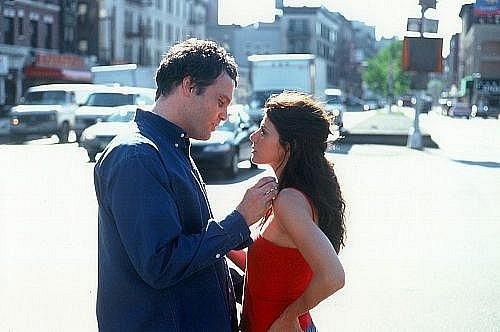
Donofrio and Tomei
I don’t think this movie did very well at the box office, but it’s a worthwhile property. The story is compelling, Tomei and Donofrio are both magnetic, and there are strong supporting performances by Tovah Feldshuh as Ruby’s mother, Holland Taylor as Ruby’s therapist — a pivotal role, and Nadia Dajani as Ruby’s best friend.
Several years ago, I read a book entitled The Physics of the Impossible by theoretical physicist Michio Kaku. In that book, Kaku explored some ideas that have been presented over the years in science fiction literature, films, and TV shows, and organized them according to how plausible they were. As I recall, he concluded that under the known laws of physics, time travel into the past was impossible and time travel into the future was possible, but not likely to become reality for many many years. If you’d like to see a somewhat comprehensible explanation of Albert Einstein’s view of time travel, click HERE.
Netflix Update No. 57: “Tortilla Soup”
December 4, 2011

HECTOR ELIZONDO
I have to begin by saying that I was predisposed to like Tortilla Soup because I am predisposed to like Hector Elizondo, who is the focal point of this film. Tortilla Soup, a 2001 remake of the 1994 Taiwanese movie Eat Drink Man Woman, concerns Martin Naranjo (Elizondo), a semi-retired Mexican-American gourmet chef who is the widowed father of three beautiful young women. His daughters still live at home and — at the beginning of the story, at least — gingerly try to accommodate his fixed ideas what their lives, and family life, should be.
The oldest daughter, Leticia (Elizabeth Peña) is loveless and unhappily employed as a high school chemistry teacher. She has broken with her father only to the extent that she has left the Roman Catholic Church in favor of evangelical Christianity. The second daughter, Carmen (Jacqueline Obradors), would have liked to follow in her father’s culinary footsteps, but she caved into his pressure to become a businesswoman. The youngest girl, Maribel (Tamara Mello), disdains the degree of her sisters’ conformity and is potentially the most rebellious.
In a parallel story story line, Yolanda (Constance Marie), a divorced friend of the family, introduces her mother, Hortensia (Raquel Welch), into the Naranjo household. The flamboyant Hortensia quickly decides that she will marry Martin and mistakenly believes that he shares her ambition.

ELIZABETH PEÑA
As Martin strives to keep his family together with a constant stream of elaborate meals, each of his daughters starts to drift away – Letitia into the arms of an athletic coach at the high school, Carmen to a lucrative job in Barcelona, and Maribel to the side of a young man who is more of an alternative to her father than he is a lover.
Although the situation is hackneyed and the denouement is predictable, this is a charming movie. That’s attributable to the attractive and talented cast, the intimate nature of both the story and the manner in which it is told, and the lively and evocative musical background.
Elizondo, whose stodginess is altogether benign, is irresistible, and the actresses who portray his daughters establish a credible combination of affection and tension among themselves and between them and their father.
I don’t recommend watching this film on an empty stomach, because the enormous amount of food that cascades across the screen as one meal follows another is mouth-watering.
Netflix Update No. 56: “Then She Found Me”
November 17, 2011
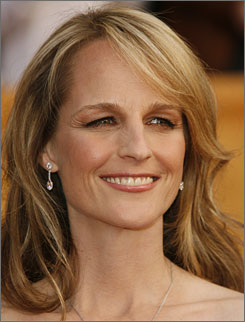
HELEN HUNT
A lot of ills come from being in the wrong place at the wrong time, and Helen Hunt provides an example in the 2007 film “And Then She Found Me,” based on Elinor Lipman’s 1990 novel.
The film was produced, directed, and written in part by Helen Hunt, who also plays the “me” in the title. Perhaps she was having trouble concentrating.
The premise of this dour property that is passed off as a “romantic comedy” is that 39-year-old April Epner’s adoptive mother has died — shortly after denying April’s charge that mom had favored her biological son. This comes on the heels of the collapse of April’s marriage to Ben Green (Broderick), who abruptly gives her the “I just can’t do this anymore” routine. Ben hasn’t cooled off too much to have a last barnyard fling with April on the kitchen floor, and that provides the delicate nuance of an awkward pregnancy — hers, not his.
April doggedly goes on with her career as a Brooklyn schoolteacher, which puts her in contact with Frank (Firth), the conveniently divorced father of one of her pupils. Frank, a sandy-haired teddy bear, has the earthy charm of the British Isles about him, and the romantic sheen of an unemployed and, one presumes, unappreciated writer. He isn’t too charming or romantic to resent the fact that Ben, thanks in part to the pregnancy, still has one foot in his relationship with April.

- HELEN HUNT and BETTE MIDLER
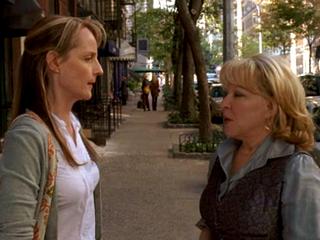
As though April’s life weren’t interesting enough, a messenger comes to a school with a letter in which a woman who does not identify herself at first claims to be April’s biological mother. The woman turns out to be daytime television talk-show host Bernice Graves (Midler). April is skeptical about Bernice’s claim, infuriated by her badly contrived lies, and put off by her overbearing attempts to play mother.
 If the resolution of this tangled tale seems satisfactory, it may be only because the resolution means the film is over. It’s kind of like a cricket match in that regard.
Clearly we’re supposed to find humor somewhere in this story, but there is none. There certainly is none coming from Hunt, who can be described only as grim.
Incidentally, in the scenes in which April and a shifting cast of companions visit the gynecologist, the doctor is portrayed by Salman Rushdie. I read somewhere that Hunt recruited him because she wanted to make sure all the major faiths were represented in a scene in which there is prayer. I’m not sure which faith he represents.
Hunt didn’t take the hint when she was turned down by the studios before making this film herself on a shoestring budget. Broderick, Firth, and Midler agreed to work for scale, which seems appropriate. If they had accepted their usual salaries for this film, their names should be on the placards in Zuccotti Park.
Netflix Update No. 55: “Lovely, Still”
November 14, 2011
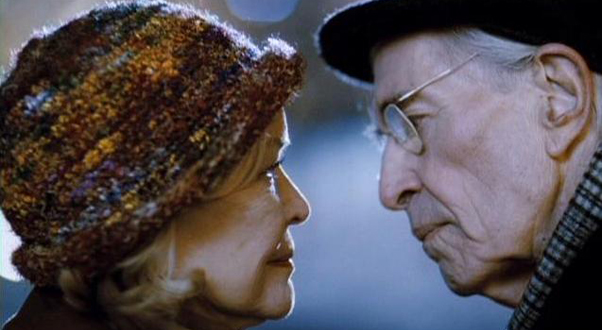
ELLEN BURSTYN and MARTIN LANDAU
After we watched Lovely, Still, a 2008 film starring Ellen Burstyn and Martin Landau, I poked around on the Web and found the widest possible range of opinons — from a contemptible piece of trash to a work of genius. Put me down as confused, which I guess is somewhere between the extremes. This movie, directed and written, in part, by Nicholas Facker, concerns elderly Robert Malone (Landau), who appears as a solitary man who lives alone and works at a nearby supermarket — near enough that he has been walking to work since he crashed his car into his garage door.

MARTIN LANDAU
During his lunch breaks at the market, Robert passes the time making pencil drawings that reveal a high level of skill that seems out of place in a man whose life is so drab and pointless. While he is drawing one day, he is approached by Mary (we are not told her last name), played by Burstyn. She introduces her self and tells him that she admires his drawing. When Robert returns home that evening, he finds the front door of his house ajar. Unaware that he didn’t close the door when he left for work, he cautiously enters the house to search for an intruder, and he finds one — Mary, who lives across the street with her daughter, Alex, played by Elizabeth Banks. As Mary tries to explain that she had seen the open door and wanted to make sure he was all right, the startled Robert screams at her to get out of his house.

ELIZABETH BANKS
When Robert calms down, however, he apologizes and the interchanges that follow end up with Robert accepting Mary’s invitation to take her to dinner the following night. Although Alex is wary of this, for reasons she does not state, Mary pursues the relationship which evolves into a romance, the first romance, Robert tells her, he has ever had. Meanwhile, Robert seeks and receives advice on courtship from his boss, Mike (Adam Scott), who seems to be more than reasonably solicitous of this confused old man, even going shopping with Robert to pick out Christmas presents for Mary. This movie is swathed in Christmas lights and sentimental music, and early on we became uneasy about the fairy tale. Eventually, Mary’s behavior and demeanor signal that something is seriously amiss — that there’s something she isn’t telling us. Sure enough, in the last few scenes, we learn that nothing in the film, including the relationships among the major characters, is what it seemed to be, and that the truth is as harshly real as the setup for it was cozily unreal. To complicate matters, we didn’t fully understand what had really happened and we couldn’t make heads or tails of the conclusion. As I poked around on the Web, I found that we were not alone. We speculated about what the writers might have been trying to convey, but we could find reasons to dismiss every theory we concocted.

ADAM SCOTT
That’s too bad, because in our view this film has a lot to recommend it: the musical choices, the photography, and particularly the exemplary performances by all four major players. The story, in spite of its obscure ending, also effectively calls attention to the loneliness of people whom we encounter in everyday life and to the possible consequences of old age.
So we liked it as far as we could, but we’re confused. Perhaps someone else will watch Lovely, Still and open our eyes.

Netflix Update No. 54: “Sunflower”
October 22, 2011
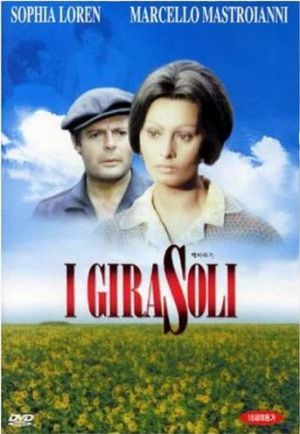 Having dabbled with Marcello Mastroianni in Macaroni and Marriage Italian Style, we went to the well once more in the form Sunflower, a film we had never heard of. The results were mixed.
This film, made in 1970, was the last directed by Vittorio De Sica, and —significantly — it was the first western film shot, in part, in the Soviet Union. Mastroianni, who was 46 when this movie was made, plays Antonio, a happy-go-lucky Neapolitan who is drafted into the Italian army during World War II. He is not a willing conscript, and his valor isn’t helped by the fact that he is in the middle of passionate fling with Giovanna, played by 36-year-old Sophia Loren. His attempt, with Giovanna’s connivance, to avoid military service results in a court-martial and his deployment to the Russian front — which was a brutal fate thanks to both the Red Army and the merciless winters.
When the war ends, Antonio doesn’t return, but Giovanna is convinced that he is still alive. After failing to get any satisfaction from public authorities, she travels to Russia to look for him. It’s not a spoiler to say she finds him, inasmuch as Mastroianni is the co-star. Some may find the circumstances and outcome predictable; some may not.
 Watching this film, which has Italian dialogue and English subtitles, is an uneven experience. Mastroianni and Loren are an irresistible combination, and they play their parts well, but the story itself is at times melodramatic and implausible. In what seems to have been an overreaching attempt to project the character’s moods, Loren is made to look at times as if she’s 30 and at other times as if she’s 50.
The photography in both Italy and Russia is eye-catching, and there is a very effective scene in which Giovanna visits a Russian hillside that is dotted with hundreds of wooden crosses marking the graves of Italian soldiers. The film also has a wonderful score by Henry Mancini that was nominated for an Oscar.

Netflix Update No. 53: “Marriage Italian Style”
October 10, 2011
 When we recommended to a neighbor that she watch the Marcello Mastroianni-Jack Lemmon film “Macaroni,” she countered by referring us to the 1964 movie “Marriage Italian Style,” in which Mastroianni stars with Sophia Loren. I had seen it about 40 years ago, but didn’t remember anything about it.
Filmed in Italian in Naples, this is the story of an amoral businessman who meets a teen-aged prostitute in a brothel during an Allied bombing raid, and then makes her his mistress when they meet again several years later. Domenico Soriano (Mastroianni) is in the baking business, and he puts Filumina Maturano (Loren) in charge of one of his stores while he keeps her — outside his home — in a very comfortable style. Filumena is not satisfied with this arrangement and she pressures “Dummi,” as she calls him, both to publicly acknowledge her and to make her a part of his household. Step-by-step she gains concessions that include a room in his house and recognition as the “lady” of the premises, but she does not get the final prize, marriage, until she employs a subterfuge that blows up in her face.
 Domenico’s passion for Filumena degrades into disgust, and he takes up a relationship with a young cashier at one of his shops.
Meanwhile, Filumena has a secret of her own — actually, three — namely a trio of sons she has borne as a result of her career, one of them by the unwitting Domenico.
 This film, directed by Vittorio De Sica and filmed in the earthy Neapolitan environment, is a combination of farce, tawdry melodrama, and implausible plot, that can’t be taken seriously. Considering the lengths De Sica went to in order to exploit Loren’s legendary physique – as opposed to the weight of her acting – the Oscar she won as “best actress in a foreign film” seems farcical in itself.
Having said that, I can report that the movie, taken for what it is, is funny and entertaining. The surroundings, whether indoor or out, are engaging, and Mastroianni himself is hard to completely dislike in any role. In this case, except for the ludicrous conclusion, he is worth watching as the rake trying to avoid the consequences of a misspent adulthood.
Netflix Update No. 51: “The Angel Levine”
September 21, 2011
 The Angel Levine is one of the oddest movies we’ve watched, and from what I’ve read on the Internet it strikes people in many different ways. Some abhor and ridicule it and some like it and watch it repeatedly. A cast that includes Harry Belafonte, who produced this 1970 film, Zero Mostel, Ida Kaminska, and Milo O’Shea seems a promise of success, but the reality is more complicated.
ZERO MOSTEL
Although the pessimistic Mishkin is not easily convinced of Levine’s purported state of existence, the pair slowly develop a relationship in which Mishkin becomes as interested in Levine’s welfare as Levine is interested in his.
The acting in this film — including that of Milo O’Shea in the unlikely role of the irascable Jewish doctor who attends to Fanny — is what one would expect of such reputable performers. The film is a showcase for Belafonte’s magnetism and Mostel’s mastery of the wobegone persona. Some scenes, however, are ponderous, including a long inaudible passage — which we witness from outside a drug store — in which Levine carries out a plot to get Fanny’s prescription without paying for it and a scene in which the Mishkins carry on a conversation in Yiddish, without subtitles.
The film is far from perfect, and yet it is provocative — especially in the way it portrays the dilemma of the Mishkins, who at life’s end are without the means to live in comfort and security.
Netflix Update No. 50: “Hey Hey It’s Esther Blueburger”
September 5, 2011

DANIELLE CANTANZARITI
In our quest to keep up with the career of Keisha Castle-Hughes, we came across a 2008 Australian film, “Hey Hey It’s Esther Blueburger.”
This is a rather blunt story — written and directed by Cathy Randall — about a 13-year-old girl, the title character, who attends a private school, where the snobbish and often brutal cliques ridicule and shun her, while she also navigates a home life made difficult by a rigid mother (Essie Davis) and thoughtless father (Russell Dykstra). Esther falls in with Sunni — Castle-Hughes — an older and more worldly wise student at a public school. The relationship introduces Esther to a gritty world she has been unaware of, and it teaches her a hard lesson about the hazards of trying to fit in by distorting one’s own identity.

DANIELLE CANTANZARITI
Esther is played by Danielle Cantanzariti, who got the part when she turned up for a cattle call audition for extras. The film-makers had screened about 3,000 candidates over a period of four months. The girl is excellent in the role. The character is quirky and smart, and Cantanzariti really goes to town on that. The story has both drama and humor, and this child is skilled at both. Some of the exchanges between her and her brother Jacob (Christian Byers) — who has his own share of complexes — are hilarious.
Castle-Hughes gives a smooth performance as Sunni, whose self-assured demeanor masks the tension in her life with an amiable but unfocused single mother, Mary– nicely played by Toni Collette. The delicate balance in Sunni’s own life is revealed when she loses control in her attempt to re-make Esther, and the younger girl goes too far in order to preserve her standing with her peers. Castle-Hughes played an 12-year-old Maori girl in “Whale Rider” and Mary, the mother of Jesus, in “The Nativity Story.”
The film has a soundtrack that is well tuned to Randall’s themes, including music related to the Blueberger family’s Jewish faith, which figures prominently in the story in a couple of ways.
“Hey Hey It’s Esther Blueburger” cost a lot to make and didn’t return much for the investors. It deserved better.

KEISHA CASTLE-HUGHES and TONI COLLETTE
Netflix Update No. 49: “Sabah”
July 10, 2011

ARSINEE KHANJIAN
The 2005 Canadian film Sabah has a lot to recommend it, but nothing more potent that Arsinee Khanjian, the actress in the title role.
The film concerns a family of Syrian Muslims living in Toronto. Sabah is an unmarried 40-year-old woman who is responsible for looking after her stylish but perhaps a little hypochondriac widowed mother. Unlike most of her family, Sabah wears drab traditional Muslim clothing — something that seems to symbolize the oppression she has been subjected to by her brother Majid (Jeff Seymour) since their father died. Majid wants Sabah at their mother’s side, and he monitors Sabah’s movements and finances as though he were her father.
In an unusual act of rebellion, Sabah — who loved to swim when she was a child — begins to surreptitiously visit an indoor pool in the city, despite her brother’s instruction that a Muslim woman is not seen in a bathing suit in public. At the pool, Sabah meets a secular Christian man, Stephen — played by Shawn Doyle — who is very courteous to her but also is clearly fascinated with the timid woman from their first encounter.

SHAWN DOYLE
The poolside meetings evolve into a sweet romance, but Sabah’s insistence on keeping the relationship a secret from her family tries Stephen’s patience. Meanwhile, Majid’s young niece defies him by refusing to accept his choice of a husband for her, as Majid wrestles with a broader family problem that he has been keeping from his mother and siblings.

JEFF SEYMOUR
This movie — sort of an Abie’s Irish Rose for the 21st century — infuses the familiar challenge of intermarriage with a well-written script and thoughtful direction, both by Ruba Nadda, a Canadian of Arab ancestry. Our only reservation about the book was that the resolution of the family’s complicated problems was a bit too sudden — especially given the earlier intransigence of Majid.
The characters are all well played, and Doyle in particular deserves credit for the nuances and subtleties he brings to the person of Stephen. But Arsinee Khanjian, who was 45 when she made this film, is irresistible in the part of Sabah. The initial vulnerability, the glimpses of fire beneath a stoic exterior, and the thrill of her growing awareness of a wider world than she has ever known make Sabah an unusually attractive figure.
This film was well received when it was introduced, and those of us who are catching up to it late can see why.
 CharlesPaolino's Blog