Netflix Update No. 71: “A Thousand Years of Good Prayers”
August 29, 2012

FEIHONG YU and HENRY O
It’s been done to death in the movies: an aging parent travels to visit an estranged child in an effort to repair the relationship. It was done again in the 2007 film “A Thousand Years of Good Prayers,” and with satisfactory results.
This film, directed by Wayne Wang, was adapted from a short story by Yiyun Lee , for whom this was a first turn at a screen play. The story concerns Mr. Shi (Henry O), who travels from Beijing to Spokane to visit his recently divorced daughter, Yilan (Feihong Yu). It is clear from the moment Yilan meets Mr. Shi at the airport that the two are barely on speaking terms and that she is not enthusiastic about his visit.

FEIHONG YU
When father and daughter are together, Yilan rarely makes eye contact with Mr. Shi and she says as little as possible to him, particularly in response to his softspoken but blunt observations and questions about her personal life. Subtitles are employed when they speak to each other in Mandarin Chinese. Soon Yilan invents excuses to be absent from her apartment, even when she has no reason to be.

HENRY O and VIDA GHAHREMANI
Left on his own, Mr. Shi finds evidence in Yilan’s apartment that she has been planning to send him on tours of other parts of the United States. He also spends time in a nearby park, where he strikes up a relationship with a mature Iranian woman, whom he knows only as “Madam.” Neither of them speaks much English, but in the skilfully directed scenes, they manage to make themselves understood to each other as they discuss their families. Madam is eagerly expecting the birth of a grandchild — something Mr. Shi devoutly wishes his only child would also provide — but the curve of Madam’s life takes an unexpected turn that Mr. Shi would have no reason to envy.
Mr. Shi, who proudly tells anyone he meets that he was a “rocket scientist” in China — a half truth, it turns out — is, philosophically at least, a devout communist, something that contributes to the distance between him and his daughter. He also acknowledges that he was not a good parent because he was away from home so much, and he answers Yilan’s complaint that he was cold with the rationale that he and her mother were “quiet people.”

VIDA GAHREMANI
But the most significant factor in the estrangement is Yilan’s resentment of what she construes to be her father’s infidelity — an ironic complaint in the light of his condemnation of her relationship with a married man. But neither knows all of what has happened in the life of the other, and the story hangs on the likelihood that people so closed off from each other for so long can ever repair the damage.
The movie is beautifully photographed with a high-end high-definition camera and even viewers with conventional receivers will notice the sharpness of the images. Silence is an important element in the drama itself and it plays an important part in the film. It’s a thoughtful story that will appeal to a thoughtful audience.
Netflix update No. 70: “The Answer Man.”
July 31, 2012
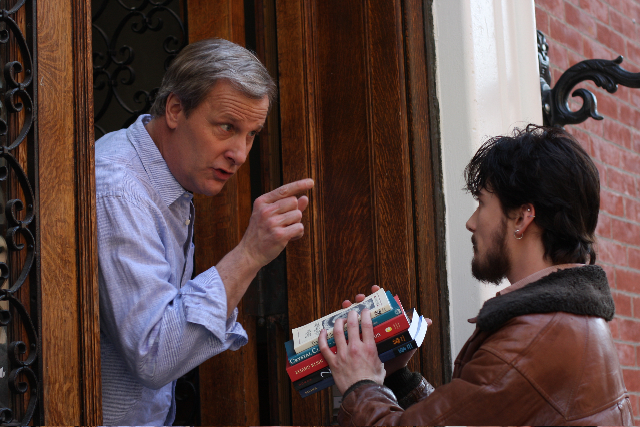
JEFF DANIELS and LOU TAYLOR PUCCI
When I saw a film named The Answer Man in the Netflix catalog, I thought it might be about Albert C. Mitchell, who had a radio show by that name that was still running when I was a kid. In that show, Mitchell offered to answer any question that was called or mailed in by a listener. The show was contrived to give the impression that Mitchell could answer these questions off the top of his head, but that wasn’t the case. Steve Allen famously did a parody of this show in which he played the “Question Man.” He would be given an answer, and he would provide the question. One answer, for example, was “the cow jumped over the moon.” The question was, “What happened when lightning hit the milking machine?”

LAUREN GRAHAM and JEFF DANIELS
Anyway, the movie isn’t about that. Instead, it’s about a writer named Arlen Faber (Jeff Daniels) whose one success was a book called Me and God, in which he revealed that he had had a personal encounter with the Creator of all that is . The book took the form of a series questions and the Almighty’s answers. This one success was the only one Faber needed. The original book and a wide variety of spin-offs — including a cook book — written by other people made him a wildly popular celebrity.

MAX ANTISELL
But Faber wasn’t interested in fame. In fact, in the 20 years after the book appeared, he hasn’t made a public appearance or consented to an interview, despite the pleas of his publisher. He spends most of his time in his Philadelphia apartment and, on the rare occasion that he speaks directly to another human being, his behavior ranges from disagreeable to obnoxious.
His routine is upset, however, when his life intersects with those of two disconnected strangers: Elizabeth (Lauren Graham), a single mother who has just opened a chiropractic office, and Kris Lucas (Lou Taylor Pucci), a young man whose bout with alcoholism has put at risk the book store he runs with his assistant Dahlia (Kat Dennings).
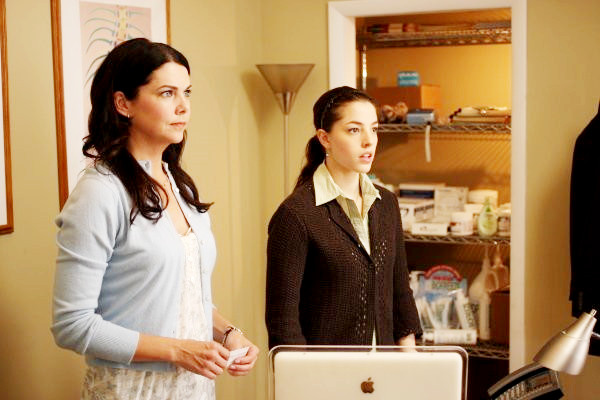
LAUREN GRAHAM and OLIVIA THIRLBY
Faber comes in contact with Lauren because he needs treatments for his bad back. Lauren and her receptionist, Anne (Olivia Thirlby), don’t know what to make of the volatile and manipulative Faber, but Faber is attracted to Laurenr — the first such attraction for him in decades — and he develops an uncharacteristically benign relationship with her young son, Alex (Max Antisell). Faber wants to get rid of some of the books that he has accumulated in his apartment, and he tries to sell them to Kris, who has no cash to buy them with. The impending loss of his store is not the worst of Kris’s problems, though. His effort to stay sober isn’t helped by the fact that he lives with an endearing but alcoholic father. In a desperate attempt to keep from slipping under the waves, Kris blackmails Faber into an arrangement in which Kris will take a few of Faber’s excess books off his hands each time Faber, drawing on his supposed supernatural source of wisdom, answer one of Kris’s questions .

JEFF DANIELS and MAX ANTISELL
There is, of course, a reason why Faber has hidden from public view for two decades, and that back story eventually comes out into the daylight.
This film, which was made in 2008, got mediocre reviews, but we found it engaging. I did object to some unnecessary physical humor, but the premise is unusual, the main characters are interesting, and the actors are effective in those roles. Although this is described as a romantic comedy, Pucci’s performance as a young man in the grip of addiction is particularly disturbing.
Don’t believe the critics.

Neflix Update No. 69:”Lou”
July 11, 2012

LILLY BELL TINDLEY
On that list of “films I’m going to see someday,” put down Lou, an Australian production from 2010.
This movie, shot entirely in New South Wales, takes up a well worn topic — the relationship between a child and an elderly relative — but does it with a sensitive and touching twist. The story, written and directed by Belinda Chayko, focuses on a rural family that consists of a young mother and her three daughters, living in difficult straits since the husband-father walked off about ten months before. The mother, Rhia (Emily Barclay), is under enormous pressure because of unpaid bills, her inability to properly parent her children, and her need for a male figure in her life.
Rhia’s oldest daughter, 11-year-old Lou (Lilly Bell Tindley) is particularly troubled by the family’s circumstances which have poisoned her relationship with her mother. In a desperate attempt to increase the family’s income, Rhia agrees through a social service agency to take care of her husband’s father, Doyle (John Hurt), who is exhibiting symptoms of dementia. Since Rhia works, this arrangement means that Doyle is often left in the custody of Lou, who already resents his presence in the house. Over time, though, the girl develops first an interest in Doyle, a former merchant seaman who loves to talk about his adventures in the Pacific, and then an affection for the old man.

JOHN HURT and LILY BELL TINDLEY
The time Doyle spends with the three girls — including an unauthorized trip to the beach — lifts his spirits but further alienates Lou from her disapproving mother. Doyle often fixes his imagination on his former wife, who left him many years before, and he begins to believe that she has returned to him in the person of Lou — an idea that Lou at first discourages but then, out of compassion for Doyle, permits to continue.
This is a slow-paced story in a bucolic setting but the sustained tension in the family’s life and the dangerous potential in Lou’s alliance with Lou makes the movie compelling.
This movie was the debut Lilly Bell Tindley, who was 11 at the time, and that makes her performance all the more remarkable. Chayko liked to put the camera right in Tindley’s beautiful and expressive face, and Tindley made the most of it. We should be hearing more from this young lady.
The well-traveled John Hurt is a heart-breaking but endearing figure as Doyle, and Barclay is wholly convincing as the confused and beleaguered mother.
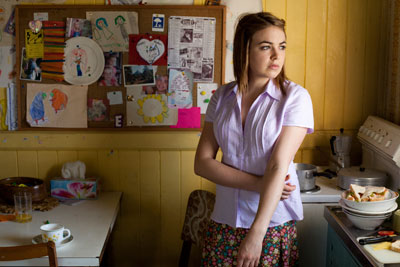
EMILY BARCLAY
Netflix Update No. 68: “Kiss Me Goodbye”
July 10, 2012
 By coincidence, we watched Barbara Walters’ absurd “documentary” about heaven two days after watching the 1982 comedy Kiss Me Goodbye. The Walters program didn’t refer to that film, but it did include clips from Ghost and other entertainment properties that alluded in some way to life after death.
In Kiss Me Goodbye, the person who has managed to live on after his physical death is a Broadway musical star and choreographer named Jolly (James Caan) who expired after he fell down a staircase during a party in his Manhattan home. As the film opens, Jolly’s widow, Kay (Sally Field), is about to move back into the house after having abandoned it for several years. Kay is engaged to Rupert (Jeff Bridges), a moderately conservative man, and she wants to begin the marriage in the stylish digs.
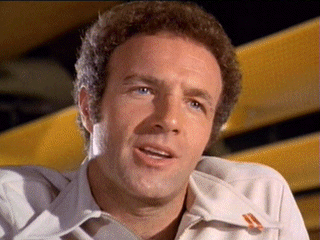
JAMES CAAN
Her plans are disrupted when she discovers that Jolly’s ghost inhabits the place and claims that he wants to reestablish their relationship. Kate’s erratic behavior worries and confuses Rupert and the others in her circle, and eventually she worries them even more by telling them about her encounters with Jolly.
Rupert, who is already jealous of the attention Kate gets from Jolly’s former colleagues, is upset by her ghost stories, but not enough to leave her. Instead, he pretends that he, too, can see Jolly and suggests that the three of them take a trip in the country together. The result, of course, is chaos.
The key to the story is found in Jolly’s real reason for manifesting himself to Kate — and the reason is not what he claims and not what may seem obvious.

SALLY FIELD
This is light fare, something on the order of milkweed spores. A story that barely stands on its own isn’t helped by some excessively broad comedy, including a particularly annoying bit of slapstick about exorcising a spirit from a dog. I read in what I admit is not an authoritative source that James Caan disliked this movie, took the part for the money, and considered the time he spent making the film one of the worst periods of his life — probably an exaggeration unless he’s had an especially charmed existence. Still, his soave, self-assured character provides by far the most fun in the film.
Sally Field was nominated for a Golden Globe as best actress in a comedy, which makes sense, I suppose, because she was, as usual, playing herself, something she should be good at after so much practice.
Kiss Me Goodbye is a remake of Dona Flors e Seus Dois Maridos, a 1976 Brazilian film which, in turn, was based on a 1966 novel, by the same name, written by Jorge Amado.
Kiss Me Goodbye was the last theatrical movie made by the distinguished actress Claire Trevor, who appears as Kay’s meddling mother, Charlotte.
Netflix Update No. 66: “How About You?”
June 29, 2012

JOAN O’HARA and HAYLEY ATWELL
Every so often, acting trumps story. That’s the case with “How About You?”, a 2007 Irish film based on a short story by Maeve Binchy.
I can’t speak for the short story, but the film is predictable. Thirty-something Kate Harris (Orla Bradley) runs a residence that is occupied by older people, including four who are particularly nasty. Kate’s sister, Ellie (Hayley Atwell), appears unexpectedly to ask Kate to help her finance a trip around the world Ellie is planning with her boyfriend. Kate clearly doesn’t approve of Ellie’s lifestyle but grudgingly gives her a job cleaning the house and attending to the needs of the residents. Ellie develops an interest in sweet, fragile Alice Peterson (Joan O’Hara), and tries to take the edge off Alice’s loneliness — with a little smoke as part of the remedy.
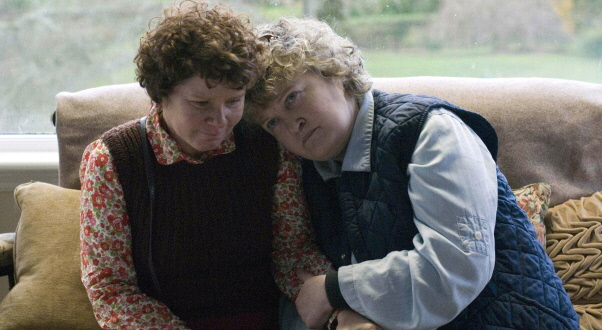
IMELDA STAUNTON and BRENDA FRICKER
But Ellie has no patience with the sour quartet that includes the widowed former judge Donald Vanston (Joss Ackland); the spinster Nightingale sisters, Heather (Brenda Fricker) and Hazel (Imelda Staunton); and former singer-actress Georgia Platts (Vanessa Redgrave).
As Christmas approaches, most of the residents leave for the holiday, but not these four. Meanwhile, Kate receives word that her mother has suffered a stroke. Kate wants to be with her mother and leaves the reluctant Ellie to manage the house and look after the unholy quartet.

VANESSA REDGRAVE
Kate warns Ellie that the house is constantly being inspected by a local health official who could drop in at any time. With Kate gone, Ellie makes an effort to maintain control, but the unreasonable demands of the residents wear out her limited patience.
In her climactic conflict with the group, Ellie confronts them with the unvarnished truth about the way they are living. They take her remarks to heart, and gradually they reveal the events in their past lives that brought them to this house and turned them into such bitter human beings.
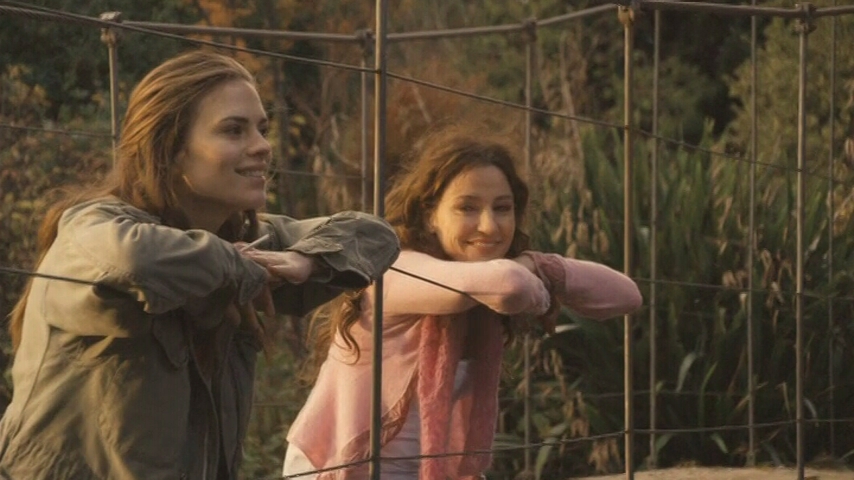
HAYLEY ATWELL and ORLA BRADY
I won’t describe how the story turns out, but suffice it to say that not many viewers would be surprised.
In spite of the see-it-coming-a-mile-away resolution, the film is worthwhile because all of the characters are interesting and all of the actors are talented. The most complex figures are the Nightingale sisters, one of whom is a skillful artist and the other a pool shark. We learn only enough about their dark family background to be tantalized, but we never hear the details and we never witness the denouement.
The title of the film is a reference to the song by Burton Lane and Ralph Freed that Mickey Rooney and Judy Garland introduced in the 1941 film Babes on Broadway. The song is heard several times during this movie, including a barroom rendition by Vanessa Redgrave.
Netflix Update No. 64: “Pay it Forward”
April 30, 2012
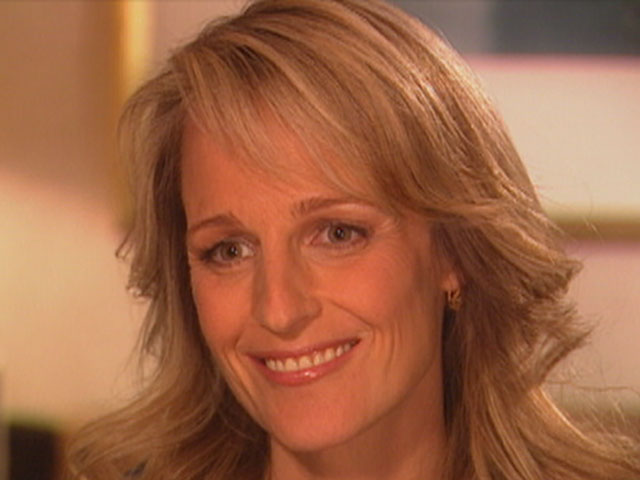
Helen Hunt
The concept of “paying forward” evidently has been rattling around for a long time—at least as long ago as 317 BC, when it was woven into the plot of Dyskolos, a play by the Greek writer Menander.
We encountered the idea, known in sociology as “generalized reciprocity,” much more recently, namely in the 2000 film Pay it Forward, with Helen Hunt, Kevin Spacey, Haley Joel Osment, Jon Bon Jovi, and Angie Dickinson.
Hunt plays Arlene McKinney, a woman estranged from her husband and trying to raise her son by working both as a pole dancer and as a waitress in a Las Vegas casino. Arlene and her absent husband, Rickey (Jon Bon Jovi) are both problem drinkers; Arlene, who is in a program for alcoholics, still sneaks a nip when she’s under stress, which is most of the time.
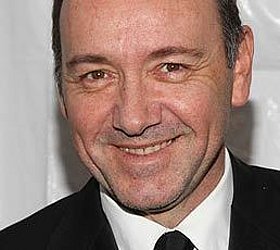
Kevin Spacey
Arlene’s son, Trevor (Osment), is assigned to a seventh-grade social studies class taught by Eugene Simonet (Spacey) who has a badly scarred face. On the first day of class, Simonet gives his students a year-long assignment, which is to devise and at least attempt to carry out a plan that will change the world forever. Unlike many of his classmates, Trevor takes this assignment seriously, and he decides that his project will involve “paying forward,” by which he means that he will do a favor for each of three strangers and ask each of them to return the favor not to Trevor but to three other strangers. The goal, of course, is to set off an ever-expanding chain reaction of good will.
Trevor’s first attempt at putting this idea into practice is to invite a homeless drug addict to take a shower and have a meal at the McKinney home and to stay overnight. When Arlene discovers this plan already in progress, she has a predictable and understandable reaction, and it isn’t positive.

Haley Joel Osment
The incident inspires Arlene to visit the school and reprimand Simonet for making the assignment. The two don’t understand each other, and the interview is not successful. But Trevor decides to make the solitary Simonet the beneficiary of the next favor by tricking the teacher and Arlene into having dinner together, a scheme that does not succeed.
The story becomes increasingly complicated as Trevor runs away from home, Arlene and Simonet take a second look at their relationship, and Ricky reappears with the announcement that he is sober to stay.
This film begins with a sequence in which a Los Angeles reporter, Chris Chandler (Jay Mohr), stops at a crime scene and watches as a patrol car drives into his own vehicle, wrecking it beyond repair. A passer-by, an older and prosperous looking gent, hands Chandler the keys to a Jaguar, tells him to take it, and refuses to explain himself.

Jon Bon Jovi and Helen Hunt
Chandler eventually determines that this incident is part of a series of good deeds that he traces back to Trevor Chandler.In the process, Chandler comes across a woman identified only as Grace, a homeless alcoholic played by Angie Dickinson and a key figure in the McKinney drama.
I go along with the Rotten Tomatoes assessment of this film: the story line is much too emotionally manipulative, but the performances by everyone in the cast nearly redeem the movie. I think most viewers would also find the conclusion of the story, which I won’t spoil here, to be contrived and unsatisfying.
Watch it, but keep your expectations under control.
Netflix Update No. 63: “Father’s Little Dividend”
March 12, 2012
 Spencer Tracy got away with playing the same character a lot of the time, and with good reason: It worked. A case in point is his role in the 1951 comedy Father’s Little Dividend, which was a sequel to Father of the Bride.
Tracy plays Stanley Banks, a suburbanite who looks forward to forging a new kind of life with his wife, Ellie (Joan Bennett), now that their three children are grown. He’s especially thinking about travel — Europe, maybe, or the beach at Waikiki. This dream is disrupted by the announcement that the Banks’ daughter, Kay Dunstan (Elizabeth Taylor), is pregnant.
 Ellie is delighted with this news, but Stanley is worried, depressed, and angry. He correctly suspects that first the pregnancy and then the baby will absorb Ellie’s attention to the exclusion of all other things. He also dislikes the prospects of being a grandfather, because he doesn’t like confronting his age.
The pregnancy, as pregnancies will, proceeds with or without Stanley’s endorsement. Meanwhile Ellie becomes increasingly irritated by Kay’s in-laws, who seem determined to take control of every aspect of the baby’s life, including its name and the decor of its nursery.

JOAN BENNETT
To complicate matters further, Kay leaves her husband whom she suspects of having an affair, and Ellie is distraught over the obstetrician’s theories, apparently revolutionary in 1951, about a mother being totally awake during childbirth and bonding immediately with her infant.
This film, which was shot in 22 days, was directed by Vincente Minelli. It’s typical of the style of the times, including the overdressed actors. (I was old enough in 1951 that I can testify that men did not wear suits to do everything but sleep and have sex.) It’s also thoroughly entertaining in the way of the comedies of that period, no little thanks to the irresistible Spencer Tracy. For anyone who has seen neither film, it might be fun to watch Father of the Bride first, but it’s not necessary in order to appreciate the sequel.
 An image that is perhaps too typical of the time is the black maid, in this case Delilah, played by Marietta Canty. She appeared in more than 40 films — including Rebel without a Cause, The Spoilers, and Father of the Bride — mostly in this kind of role and often without receiving credit. Like her colleagues, she braved the criticism often directed at black actors who accepted such parts and conducted herself with skill and dignity. She retired from show business in the late 1950s. She was a political and social activist for the next three decades. She was also a nurse and a justice of the peace. Her home in Hartford, Connecticut, is on the National Registry of Historic Sites.

Netflix Update No. 62: “The Last Time I Saw Paris”
January 29, 2012
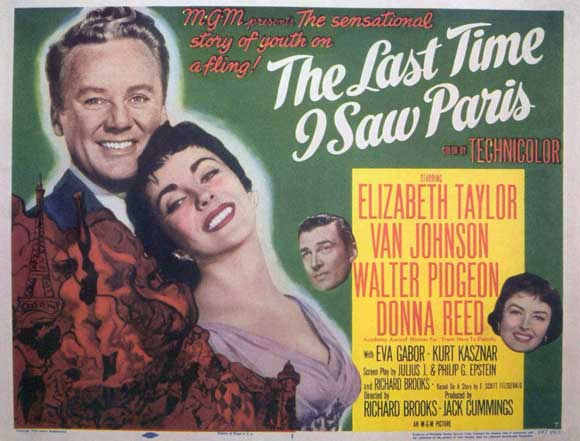 A couple of things Van Johnson told me about himself have stuck in my mind for more than 30 years. One was that he had a lifelong ambition to ride an elephant during the opening of a Ringling Brothers & Barnum and Bailey Circus performance. The other was that he was disappointed that living in a Manhattan apartment meant that children would never come to his door on Halloween.

VAN JOHNSON
I’ve been thinking about those things today because last night we watched Van Johnson in the 1954 film The Last Time I Saw Paris. He co-starred with Elizabeth Taylor. Others in the cast were Walter Pidgeon, Donna Reed, Eva Gabor, George Dolenz, and Sandy Descher.
This film, which was loosely based on F. Scott Fitzgerald’s short story “Babylon Revisited,” is a long flashback to Paris at the end of World War II in Europe. Johnson plays Charlie Wills, a soldier and aspiring novelist who works as a reporter for the military newspaper Stars and Stripes. At the beginning of the tale, he has returned to Paris from the United States, and he reminisces about the bitter circumstances under which he had left the City of Light: During the celebratory bedlam in Paris when the war ended, Charlie winds up at a party at the home of James Elwirth (Pidgeon), an impecunious American chancer who believes in living high even if one can’t afford it. Charlie is invited to the home by Elwirth’s quite proper daughter Marion (Reed), but is quickly infatuated with Marion’s ne’er-do-well sibling, Helen (Taylor).
Charlie and Helen marry and have a daughter, Vicki, played by Descher. Marion — who is broken-hearted over losing Charlie to the sister of whom she disapproves, settles on a rebound match with a thoughtful Frenchman, Claude Matine (Dolenz).

ELIZABETH TAYLOR
The marriage of Charlie and Helen goes well, even while they’re living from hand to mouth, but Charlie is gradually losing confidence in himself as one publisher after another rejects his novels. Then their world is permanently altered as oil is discovered on Texas land, thought to be barren, that Elwirth jokingly gave the couple as a wedding gift. While Helen struggles to maintain stability in the family, Charlie sinks further and further into a morass of depression and decadence.
When this movie was released, some critics savaged it. It is true that the story is implausible and that some of the acting is either arch or wooden. Eva Gabor, as socialite Lorraine Quarl, who plays a supporting role in Charlie’s decline, gives exactly the kind of performance one expected of the Gabors. Descher, who was only nine years old, is gag-me cute in the role of Vicki –and she inexplicably never ages as the years roll by.

SANDY DESCHER
Van Johnson’s light comedy is entertaining, but his drunk scenes are simply unbelievable. I once heard from a stage veteran that an actor who can’t play a convincing drunk is no actor at all. That might be too harsh a judgment on Johnson, but this film suggests that faux inebriation was not his strong suit.

WALTER PIDGEON
Elizabeth Taylor and Donna Reed did passably well as the sisters, although a scene in which Taylor’s character is mortally ill is so unconvincing as to be ludicrous. Walter Pidgeon, on the other hand, is delightful as the irresponsible but charismatic Ellswirth and Dolenz plays Claude as the most realistic figure in the film.
I don’t know if this is true, but I have read that the producers didn’t use the title of Fitzgerald’s story because they were afraid movie-goers would think the film had a biblical theme. I wondered about the title they did use, particularly because its lyrics express sentiments exactly opposite of those in this film. The song “The Last Time I Saw Paris” is heard in the background throughout the movie. It turns out that song was written in 1940 by Jerome Kern and Oscar Hammerstein, and it was sung by Ann Sothern in the 1941 film Lady be Good. It won the Oscar for best song. The song was composed in the aftermath of the German occupation of France. There were six versions of the song on the hit charts by the end of 1940, and Kate Smith bought the exclusive right to sing it on the radio for six months.
 As is often the case with movies, the shortcomings of The Last Time I Saw Paris do not add up to a failure. The film is nicely photographed — much of it in Paris, it captures the mood and mores of the early ‘fifties, and it is entertaining. It’s also an inoffensive opportunity to spend a couple of hours indulging oneself in the kind of escapism provided by “golden-age” stars such as Van Johnson and Elizabeth Taylor.
You can hear the title song, presented in the mood in which it was written, by clicking HERE. The performance is by Anne Shelton, a fine British vocalist who devoted a lot of time and energy to entertaining troops via radio and in person.
Neflix Update No. 61: “Alice”
December 20, 2011
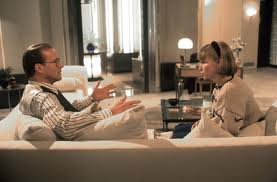
WILLIAM HURT and MIA FARROW in "Alice"
I don’t know if it’s possible to not be in love with Mia Farrow, but watching the 1990 Woody Allen film Alice is not the way to avoid it.
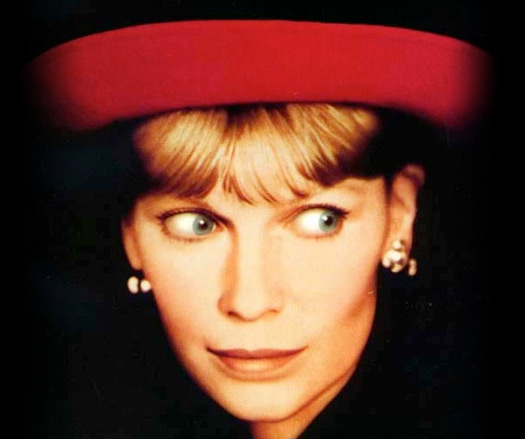
MIA FARROW
In this wonderful fantasy, written and directed by Allen, Farrow plays Alice Tate, the wife of wealthy businessman Doug Tate (William Hurt). Alice lives in a world in which her biggest concern is how to fit all the pampering she receives into her busy schedule. She and Doug have children, and Alice seems genuinely attached to them, but the kids spend most of their time with a nanny while Mom is with the personal trainer or the hair dresser or with her equally spoiled and gossipy lady friends.
Her routine is disrupted at her childrens’ private school when she meets and is attracted to Joe (Joe Mantegna), the divorced father of one of the other children. Shy and at least nominally Catholic, Alice suppresses her interest in Joe at least for a while. Right around this time, her usual hypochondria becomes focused on a chronic pain in her back, which drives her to consult an herbalist in a crummy building in Chinatown.
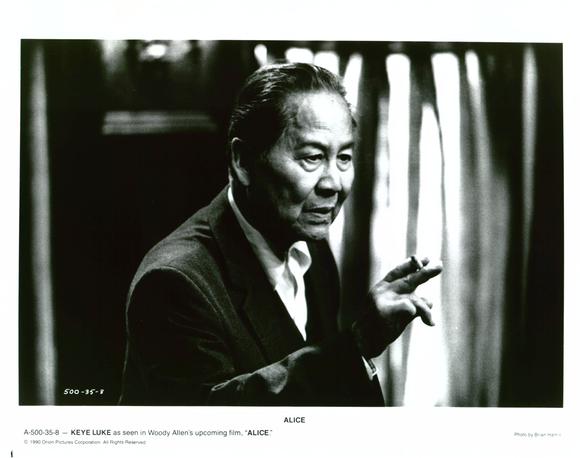
KEYE LUKE
Dr. Yang, played in a marvelous performance by Keye Luke — his last role — understands immediately that there is nothing wrong with Alice’s back. He hypnotizes her and then introduces her to a series of herbs that have extraordinary effects on her, and eventually on Joe, including invisibility. Alice and Joe learn a great deal about themselves and about their spouses (ex-spouse, in Joe’s case). The result is a total change in both of their lives, although not in the way that might seem obvious.
Yang, who barks at any sign of self-indulgence in Alice and consistently refers to himself in the third person, is a unique and hilarious character.
As usual with Woody Allen, every character in this film is perfectly cast, including a brief turn by Bernadette Peters as a mystical “muse” who addresses Alice’s ambition to be a writer; Gwen Verdon as Alice’s memory of her mother; Blythe Danner as Alice’s somewhat estranged sister; and Alec Baldwin as the ghost of Alice’s first lover. Even the tiny role of an interior decorator is enhanced by Allen’s choice of Julie Kavner.
GWEN VERDON
As for Farrow, she is simply irresistible.
The film is outstanding for its photography and for the writing, which got Allen an Oscar nomination.
Alice was loosely based on Juliet of the Spirits, a 1965 Italian movie directed by Federico Fellini, the first feature-length film he shot in color.
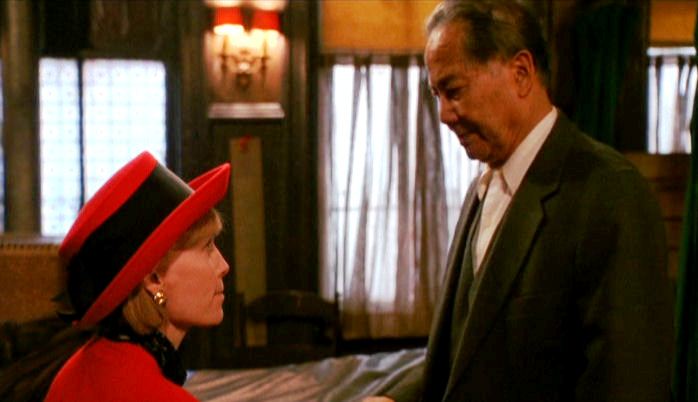
MIA FARROW and KEYE LUKE in "Alice"
Netflix Update No. 60: “A New Life”
December 19, 2011

ALAN ALDA
I don’t think I’ve ever disliked Alan Alda in a role, his role in the 1988 film “A New Life” is no exception. But this film has the added advantage of having been written and directed by Alda, so it is shot through with his wit and his sense of timing.
In truth, “A New Life” is a piece of fluff, but the combination of Alda and his art with a cast that includes Hal Linden, Ann-Margret, and Veronica Hamel give the fluff enough substance to keep it interesting.
Alda plays Steve Giardino (who makes up these names?), a Wall Street trader whose gearshift is perpetually in overdrive. Among the things he neglects are his wife, Jackie, played by Ann-Margret. Jackie finally has enough — or, more accurately, not enough — and she and Steve split. Both are disoriented in the single state, and Steve is further confused by his stock-market colleague Mel Arons (Hal Linden), a profligate who tries to prod Steve into a similar way of life. Jackie eventually takes up with a much younger and overly attentive sculptor, Doc (John Shea), who is a waiter in real life. Steve settles in, or so it seems, with a medical doctor, Kay Hutton (Veronica Hamel). The truth in this movie is that stable relationships are not easy to come by, and both Steve and Jackie will have more work to do.

HAL LINDEN
This is a delightful ensemble, as the names of the actors promise. Linden is especially entertaining as a kind of Mephistopheles figure to the confused and somewhat naive Steve. “What are you making such a big deal about happiness for?” he asks Steve. “Look at me. I trade all day against guys who would cut my heart out of an eighth. I drink too much, I eat rich food, I make love to women half my age. You think I’m happy?”
(He grins) “That’s the advantage of being shallow.”
Fans of such Alda-esque dialogue will find it throughout this film.
Look for Alda’s daughter, Beatrice, in the limited role of Steve’s adult daughter, Judy.

Ann-Margret and Alan Alda on the set of "A New Life"
 CharlesPaolino's Blog