Play “Misty” for me
March 27, 2025

Bruce Klauber, a journalist, producer, and musician, last year quoted Barbra Streisand as saying, ““There are a number of good singers, a smaller handful of truly great singers, and then there’s Johnny Mathis.” Johnny Carson put it another way after a performance on the “Tonight Show” in which Mathis held the final note of “Pieces of Dreams” for about 30 seconds. “I guess,” Carson said, “that takes care of that song,” meaning, of course, that no one else needs to sing it. One could say that of so many songs that are identified with Mathis, and vice-versa, although his repertoire is so much larger in style and genre than the titles that first come to mind.
My wife, Pat, and I were wondering aloud just the other day how much longer Mathis would continue to tour, and today he answered us, and everyone else, by announcing his retirement. I’m not much younger than Mathis and still working full time, but I’m also at the age when death is no longer an abstract idea. An event such as Johnny Mathis retiring is one more tick of the clock that will not tick forever.
Mathis came into prominence in the mid 1950s, just in time for Pat and me to become fans, an affection we wouldn’t share until we started dating about eight years later. We danced to “The Twelfth of Never” at our wedding; that’s “our song” 61 years later. We have gone to several Mathis concerts including one at which he sang five songs during his encore–a suitable reward, I thought, for the folks who beat it for the exits when he finished his regular set.
I spent many years in the newspaper business covering or supervising coverage of local affairs including municipal and county government. I took advantage of the access that job gave me by developing a sideline interviewing people in entertainment and sports. On one occasion, which happened to be Pat’s birthday, I arranged to attend a “press availability” Mathis was subjecting himself to in advance of a concert here in New Jersey. Without telling her where we were going, I took Pat with me. We were ushered into a room where there were only two other reporters who, it turned out, didn’t seem to know anything about Mathis nor care to find out. They were mute.
Johnny Mathis came into the room, wearing a sweat shirt and a pair of torn jeans, and sat on the edge of a wooden table, and Pat engaged him in conversation. He agreed when she told him that at the beginning of his career he seemed uncomfortable on stage but that he had gradually developed a graceful presence. She asked him if he had ever considered dramatic acting, and he said that he had expressed that ambition but that no one would take him seriously. They went on like that for almost an hour as though they had forgotten that anyone else was in the room until, at one point, Mathis looked at me and said with a laugh, “My God! He’s writing this down!”
We once found on YouTube a long interview with Mathis in which the interviewer asked, in effect, “After making so many recordings over so many years, which ones do you like to listen to most?” “I don’t listen to my records,” Mathis said. “After sixty years, I’m tired of the sound of my own voice!” Well, we haven’t heard his voice as much as he has, but the passage of nearly seventy years now has done nothing to make it any less thrilling and soothing and mesmerizing. Johnny Mathis is retiring, but we have stacks of CDs and vinyls to keep him with us till the ticking stops.
Play ‘Misty’ for me
May 22, 2016
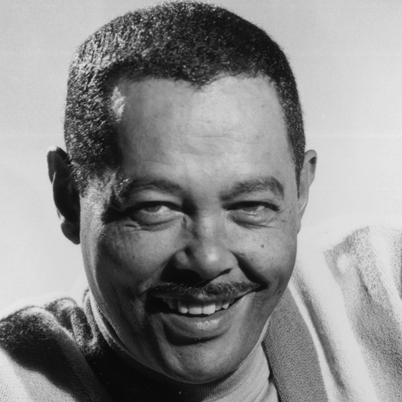
We recently attended a concert by Johnny Mathis and he, of course, sang “the holy trinity.”
Those who have followed this singer’s career know that he applies this sobriquet to three songs—”Chances Are,” “The Twelfth of Never,” and “Misty”—that he sings at virtually every appearance, whether he wants to or not.
These songs are identified with Mathis, and his fans expect to hear them.
In fact, from my point of view, they are so identified with Mathis, that no one else need bother to sing them. When the psychotic fan calls Clint Eastwood’s disk-jockey character in that 1971 thriller and whispers, “Play ‘Misty’ for me,” she doesn’t have to say which version she means, although by that time the Errol Garner-Johnny Burke song had also been recorded by stars that included Ella Fitzgerald, Sarah Vaughan, and Della Reese.
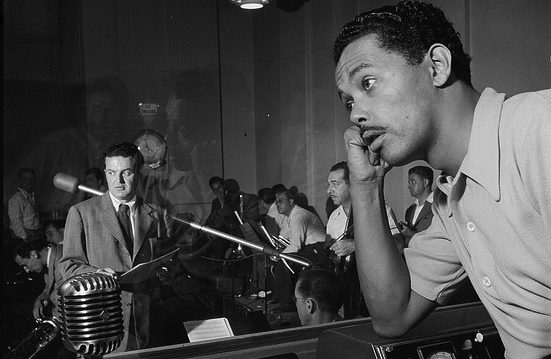
And not long after Johnny Mathis first recorded “Misty” for an album released in 1959, Billy Eckstine set down his version, which you can hear by clicking HERE.
Eckstine, who died in 1993, is largely forgotten, but he was an influential jazz musician and bandleader, a pioneer in be-bop, and a very successful singer. His vocal hits included “Blue Moon,” “Everything I Have is Yours,” “Caravan,” “My Foolish Heart,” and “I Apologize.” His recordings of “Cottage for Sale” and “Prisoner of Love” were million-sellers. He released more than forty-four albums. He had a rich bass-baritone voice with both subtlety and power, and a distinctive vibrato. A lot of his work, including his recordings with Sarah Vaughan and Dizzie Gillespie, is available on CD or MP3.
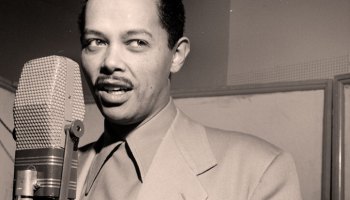
In 1950, LIFE magazine published a three-page feature on Eckstine that included photographs by Martha Holmes. One of the photos showed Eckstine, who was one of the first “cross-over” black musical performers, with a group of female fans, all of them white. The whole group is laughing over something, and one of the women has her hand on Eckstine’s right shoulder and her face against the lapel of his jacket as she laughs. Because of the mores—or, I should say, prejudices—of that era, LIFE published the photo only with the approval of its publisher, Henry Luce. LIFE received many letters objecting to the picture, and many people turned against Eckstine. TIME magazine reproduced the photo to mark the centenary of Ekstine’s birth. You can see it by clicking HERE.
Eckstine, whose life included its share of personal turmoil, was a civil rights activist and a close friend of Rev. Martin Luther King Jr.
“It’s all in the game”
October 28, 2012
 As we left for a long drive the other day, I grabbed a Johnny Mathis CD to play along the way. Among the songs was “All in the Game,” a favorite of mine and a song with a unique history: It’s the only song with a melody written by a man who both served as vice president of the United States and won the Nobel Peace Prize.
The composer was Charles G. Dawes, who served as vice president in the Calvin Coolidge administration — from 1925 to 1929. Dawes is forgotten today, but he was a prominent man in his time. His great-great grandfather was William “Billy” Dawes, who rode with Paul Revere, but somehow escaped Longfellow’s notice. The latter Dawes was a lawyer, banker, politician, and humanitarian. He was an army officer during World War I, and then President Warren G. Harding appointed him the first director of the Bureau of the Budget. In 1923, President Calvin Coolidge appointed him to the Allied Reparations Commission, and Dawes shared in the Nobel Peace Prize for his work on a plan to stabilize the economy of Germany, which had been devastated by the war and its aftermath.

CALVIN COOLIDGE and CHARLES G. DAWES
Dawes was about the fourth choice to run for vice president with Coolidge, who was elected to a full term of his own after finishing the term of Warren Harding, who had died in office. Dawes was clumsy in the position and alienated Coolidge from the first day of the administration. President Herbert Hoover appointed Dawes ambassador to Great Britain, and Dawes served effectively in that post for three years.
In 1911, Dawes, who played the piano and the flute, wrote a composition called “Melody in A Major.” The sheet music was published without Dawes’ knowledge, and it became an popular violin piece; in fact, the great violinist Fritz Kreisler used it to close his recitals.
In 1951, after Dawes had died, songwriter Carl Sigman modified the melody somewhat and wrote the lyrics that made the song a standard in American popular music: “Many a teardrop will fall , but it’s all in the game. …”
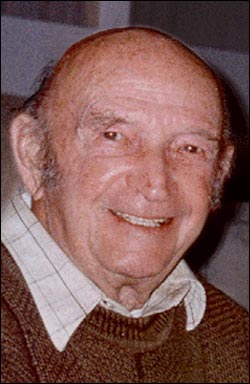
CARL SIGMAN
Sigman, who was a member of the New York Bar and a hero in World War II, compiled quite a track record for writing memorable lyrics. His songs include “Arrivederci, Roma,” “Ebb Tide,” “Shangri-la,” “What Now, My Love,” and the theme from the film Love Story.
“All in the Game” has been recorded by Dinah Shore, Nat King Cole, Louis Armstrong, Andy Williams, Robert Goulet, Johnny Ray, Jackie DeShannon, Cass Elliot, Van Morrison, Neil Sedaka, Merle Haggard, Barry Manilow, and many others.
Tommy Edwards had a major hit with it in 1958, and that recording is ranked No. 38 on Billboard’s Top-100 list. You can hear Tommy Edwards’ recording at THIS LINK.
“Oh, to be torn ‘twixt love and duty” — Ned Washington
December 31, 2009

GARY COOPER
So anyway, I didn’t want to get up yesterday morning, and Turner Classics was playing “High Noon.” I had seen it only about three dozen times, so I decided to watch. It never gets old. Its reputation has grown with the years, and deservedly so. The idea of telling a story in real time when there is virtually no action until the last couple of minutes was a master stroke — although there seems to be some dispute over whose stroke it was.
Unlike most westerns of that period – 1952 – this film is deeply cynical. It seeks to confirm my father-in-law’s frequent pronouncement that “people are no damned good,” as an entire town folds under the threat of the returning reprobate, Frank Miller, and leaves Marshal Will Kane to face Miller and his gang alone – or so they think.
Gary Cooper played the marshal – a good choice for the cerebral lawman, although there were some doubters because Cooper was so much older than his love interest in the film, Grace Kelly.
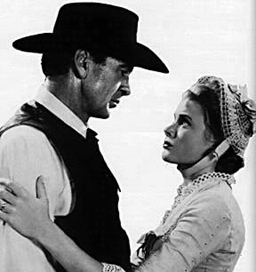
GARY COOPER and GRACE KELLY
This film was controversial in a way that illustrates the philosophical polarization of American society at the time. Carl Foreman wrote the screenplay and was a co-producer with Stanley Kramer, but when Foreman refused to cooperate with the House Unamerican Activities Committee, Kramer basically forced him out of the project and took away his credit as a producer.
John Wayne publicly denounced this film as an allegory about those who failed to support actors and other creative artists who were being badgered by the House committee. Ostensibly, he made “Rio Bravo” as a right-wing response to “High Noon.” On the other hand, Ronald Reagan took the story at face value and said he liked the portrayal of the marshal as dedicated to law and order and more concerned about the well being of the town than about his own life. Dwight Eisenhower was a fan of “High Noon,” and Bill Clinton had it screened 17 times while he was president.

TEX RITTER
Besides the concept itself, the cinematography, and the performances by Cooper and the rest of a strong cast — including Lloyd Bridges and Thomas Mitchell — this film owes its status to the title song with words by Ned Washington and music by Dmitri Tiomkin. The song, performed by the great western singer Tex Ritter, drifts into the background again and again, adding to the tension. Frankie Laine’s recording of this song sold a million copies, and I like his performance, but listening to someone other than Ritter sing “High Noon” is like listening to someone other than Johnny Mathis sing “Misty.”
The title song won an Academy Award that year. British film writer Deborah Allison maintains that the film played a pivotal role in movie-movie history. Her interesting article as at THIS LINK.
 CharlesPaolino's Blog