Books: “John Quincy Adams”
August 3, 2012

JOHN QUINCY ADAMS
A man of about my grandfather’s vintage was telling me that he once owned a house in Brooklyn and the candy store on the first floor. When I asked what had become of the property, he brought his hands together in a loud clap and said, “Mr. Hoover.” The implication was that he had lost the house and store as a result of the Great Depression and that the Great Depression was Mr. Hoover’s fault.
The history of the economic calamity of the 1930s is complex, and while Herbert Hoover’s approach to it is open to criticism, it is simplistic to argue that he was responsible for the losses suffered by millions of people. Unfortunately for Hoover, most Americans who can identify him at all are likely to describe him as the president who failed to solve the Depression. And that means that most Americans have forgotten — or more likely have never known — that Hoover was a great public servant and, in several instances, an American hero. As Casey Stengel said, you could look it up: Hoover organized the evacuation of Americans from Europe at the outbreak of World War I; he organized the delivery of millions of tons of food to Belgium after it had been invaded by Germany; he ran the commission that made sure American food supplies were conserved so that there would be enough to supply U.S troops in Europe during the war; he ran the administration that fed millions of people in Central Europe after the war; he oversaw the government response to the Great Mississippi Flood in six states in 1927; he organized a program that fed school children in impoverished occupied Germany after World War II; and under presidents Truman and Eisenhower he headed two commissions that successfully recommended reorganization and efficiencies in the federal government.
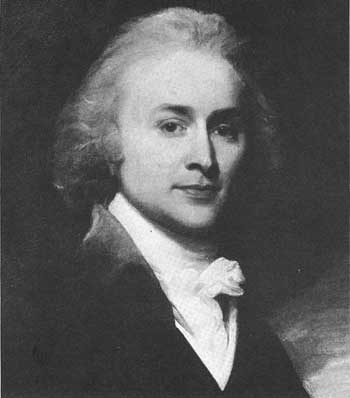
JOHN QUINCY ADAMS
Hoover had his failings and even his dark side, but the country’s ignorance of his accomplishments — to say nothing of his long career as an engineer and businessman — is out of whack.
Hoover is not alone in this. John Quincy Adams’ legacy has suffered a similar fate, as Harlow Giles Unger explains in a biography of the sixth president that will be published in September. Adams’ presidency was a dud, but he otherwise led one of the most outstanding public lives in the history of the country. He was the son of brilliant parents — Abigail and John Adams — and they expected big things of him. Unger reports, in fact, that John Adams, the second president, expected his son to eventually follow him into that office, after getting a classical education and learning and practicing law. John Q. grew up in the midst of the American Revolution; in fact, he and his mother were eye witnesses to the Battle of Bunker Hill.
Defining events in his life, though, were successive trips to Europe with his father, who was engaged in diplomacy. Those trips led to a career in diplomacy for the younger Adams who was not excelled by anyone serving in that capacity before or since. He later served as secretary of state in the administration of James Monroe and again did outstanding work, including his authorship of what became known as the Monroe Doctrine. He was, Unger argues, one of the most important experts on foreign affairs in American history.

ABIGAIL ADAMS
John Quincy Adams was elected to the presidency without campaigning for the office, and in a certain sense he wasn’t elected at all. The wildly popular war hero Andrew Jackson won more popular votes in the election of 1824 but not enough electoral votes to carry the day. Henry Clay threw the election into Adams’ lap by instructing the Kentucky delegation to vote for Adams, who had not won an electoral vote in that state. When John Q took office, he named Clay secretary of state, which was a much more powerful office then than it is now. Although it would have been out of character for Adams to have conspired with Clay in order to gain the presidency, that’s how many Americans read it, Unger writes, and it got Adams’ administration off to a poor start.
Adams had an ideal that would sound odd to Americans today: he believed that principle was more important than party. Tell that to John Boehner and Nancy Pelosi. Adams carried this idea to extremes, going to the mat first with his own Federalist party and then with the opposition Republicans on one issue or another. As a result, he really had no party, while Andrew Jackson was building the new Democratic party into a meaningful force. He also gave no thought to even conventional patronage when he appointed his cabinet, and so he was, as Jimmy Durante used to say, “surrounded by assassins.”

The short version is that Adams’ presidency didn’t amount to much, and he left office in a significant funk after losing the election to Jackson. But he was invited to run for Congress from a district in his native Massachusetts, and so he became one of three presidents to hold public office after leaving the White House. (The others were Andrew Johnson, who was elected to the U.S. Senate and William Howard Taft, who was appointed chief justice of the United States.)
Adams spent 17 years in the House of Representatives and it was, as Unger recounts in dramatic fashion, a wild scene. Adams hated slavery, which he had first seen up close when he traveled to Poland as a teenager. The House leadership didn’t want the subject broached in the chamber and passed rules to prevent the word “slavery” from being uttered or petitions against slavery from being presented. Adams fought furiously against this procedure, violating the rules repeatedly, and demanding over and over to know, “Am I gagged? Am I gagged?” He eventually became a highly respected figure in the House, even by those who disagreed with him, and reputedly was one of a handful of the best who ever served there.

SS Amistad
During this period, Adams also got involved in the legal case of a group of more than fifty African men and women who were being transported as slaves from one port in Cuba to another when they seized control of the ship, the Amistad. The ship was taken into custody in American waters, and the Africans on board sued to keep from being returned to bondage.
Adams gave a seven-hour argument before the U.S. Supreme Court which, although most of the justices were hard-nosed southern slave holders, ruled unanimously that the Africans should be set free.
In recounting Adams’ career, Unger provides a close look into the life of the distinguished and patriotic Massachusetts family: the relationship between John Q. Adams and his redoubtable parents, and between John Q. and his wife, Louisa, who at times lost patience with the demands her husband’s public service made on family life.
Unger’s book brings this good and great man back to life at least on the printed page. It was a life that deserves much more attention than it gets.
Books: “The Longest Fight”
July 16, 2012

JOE GANS
Prize fighting was part of my growing up.
My parents associated with some people who were connected to the boxing game: a promoter, a ring announcer, a cut man. At times, Mom and Dad would attend fights; I remember Mom coming home after one of those occasions with flecks of blood on her pink suit. Apparently they were at ringside.
In those days, the 1950s, we could watch fights on broadcast television, and we saw Carmine Basilio, Ezzard Charles, Jersey Joe Walcott, Sugar Ray Robinson, and Archie Moore.
Then, as now, I was a little schizophrenic when it came to boxing. I liked watching fighters like the ones I named, but I didn’t approve of boxing and thought it should be banned. I thought, and think now, that an enterprise in which the object is to knock your opponent senseless has no place in a civilized society.

WILLIAM GILDEA
Boxing was, in fact, illegal in most of the United States in the period discussed in William Gildea’s book, The Longest Fight. Where it was legal, one of the most prominent practitioners of “the sweet science” was Joe Gans, Gildea’s subject, the lightweight champion of the world and the first African-American to hold a world boxing title.
Gans held the lightweight title from 1902 to 1908 and he won the welterweight title as well in 1906. A native of Baltimore, he was strikingly handsome, well spoken, witty, courteous, and charming. Those qualities plus his nearly matchless skill in the ring attracted a large following, including white folks in numbers that were unusual for a black athlete in the days when Jim Crow was in such full vigor that racial epithets and garish cartoon figures of black Americans were commonplace in daily newspapers.

A postcard promoting the first Gans-Nelson fight.
Gildea recounts that Gans put up with plenty of abuse during his career, but he had learned the wisdom of restraint, and he practiced it in and out of the ring. When a white opponent spat in Gans’s face while the referee was going through the ritual of instructions, Gans bided his time until the fight began. His demeanor in everyday life was disarming, and he won over many people who otherwise would have included him in their overall prejudices about black people.
Gildea reports that people such as promoters and managers took advantage of Gans, because they knew a black athlete had no recourse and often was risking his life just by climbing into the ring with a white boxer.
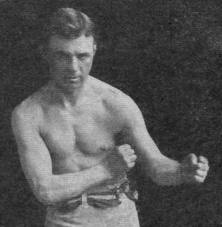
”BATTLING” NELSON
In what was arguably the biggest fight of Gans’s career — the “long fight” referred to in the title of this book — the manager of Oscar “Battling” Nelson insisted that Gans submit to three weigh-ins on the day of the contest, and under unheard of conditions. Gans just stood for it. No one, he knew, wins at the weigh-in.
That fight took place in September 1906 under a broiling sun in the Nevada desert town of Goldfield. Gans defended his lightweight title against Nelson, whom Jack London called “the abysmal brute” for both his free-swinging style and his penchant for dirty tactics like groin punches and head-butting. Nelson was also an unapologetic racist who made no bones about his revulsion for Gans and black people in general. It was a fight to the finish, and the finish didn’t come until the referee disqualified Nelson for a low blow in the 42nd round, after two hours and 48 minutes of combat.
By that time, Gans had beat the tar out of Nelson whose face, Gildea writes, was almost unrecognizable, but if Nelson had one positive attribute it was that he could take punishment, so he was still standing when the referee made Gans the winner.

Gans during one of the three weigh-ins before the fight in Goldfield.
Gildea describes the “fight to a finish” in episodes running through the book, interrupting the account from time to time to relate other aspects of Gans’s career and private life, including the two dives he acknowledged, his warm relationship with his mother, his romantic ties, his establishment of a Baltimore hotel and saloon that was a drawing card for a stylish crowd, both black and white, and his early death.
Gildea, whose carefully crafted narrative makes this book especially enticing, clearly explains the quality that made Gans a perennial winner. He blocked his opponents’ punches, moved as little as possible, threw a punch only when he saw an opening. And when he did punch, the blow was short and direct — in fact, Gildea writes, Gans introduced the technique of reaching out to touch his opponent and freezing the distance in his mind.
Gans is largely forgotten today, but as Gildea demonstrates, he was an important figure in the history of boxing and, more significantly, in the history of black citizens in the United States. Like the black men and women who were the first to venture into other fields, Gans took a barrage of slings and arrows for the team, and he did it with style.
Books: “You Stink!”
June 8, 2012

President Franklin Roosevelt asks Congress to declare war on Japan.
The authors of a new book on baseball describe the Japanese attack on Pearl Harbor, which occurred on Dec. 7, 1941. The writers continue: “The next day, calling it ‘a day of infamy,’ President Franklin Roosevelt asked Congress to declare war on the Japanese and their allies, Germany and Italy.”
The ambiguous pronoun makes it unclear which day Roosevelt was referring to — December 7 or “the next day” — but the record shows that was December 7 and that Roosevelt did not call it ‘a day of infamy’ but ‘a date that will live in infamy.’ The record also shows that Roosevelt did not mention Italy or Germany, both of which declared war on the United States about a month later.
The title of this book is “You Stink!” It is a compilation of what the authors, Eric Wittenberg and Michael Aubrecht, regard as the worst teams, players, plays, and decisions in the history of major league baseball.

In my opinion, the book is pointless and, despite the authors’ disclaimer to the contrary, mean spirited. What else but a mean spirit would prompt writers to spend their time compiling a monotonous stream of statistics to memorialize the failures and disappointments of one team and one player after another. There is nothing original about that, despite the author’s claim that their purpose was to write something original about baseball. Any baseball fan knows that there is much more failure than success in the game; reporting on the failures alone, without the context of the successes, is sophomoric.

JOHN HUMPHRIES
But, then, everything about this book is childish, which is especially jarring because of the credentials the writers present: one is an “award-winning Civil War historian,” and the other “dedicated his studies to the histories of Major League Baseball, the Civil War, and the American Revolution.” These history buffs report that the Brooklyn Dodgers won the 1953 World Series. It was the Yankees.
The adjectives alone are suffocating. How bad was that batting average, that ERA, that season, that decision? It was “atrocious,” “staggering,” “eye-popping,” “wretched,” “anemic,” “terrible,” “mind-boggling,” “horrible,” “pathetic,” “dismal,” “stunning,” “miserable,” “incredible,” “ghastly,” “abysmal.”
There are grammatical errors, a few misspellings, and outrages in style that affect almost every sentence. There is a quote from Roger Maris used twice in the same chapter and numerous other lapses that suggest that this book and a competent editor were never in the same county.
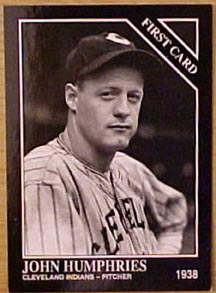
JOHN HUMPHRIES
One of the most conspicuous signs that this book is headed for deep discount is the case of poor John Humphries, whom the authors singled out for opprobrium as the worst catcher of all time. Humphries appeared in a total of 103 games over two seasons in the 1880s. He played catcher in only 75 of those games. It is true that Humphries committed 74 errors in those 75 games, but no serious student of baseball would take into account such a short career in ranking fielders. To emphasize their point about Humphries, the writers included a photograph of him, except that any 15-year-old kid would know that that picture wasn’t taken in the 19th century.
That’s a picture of the other John Humphries, who is in the photo above left, the John Humphries who pitched in the majors in the 1930s and 1940s. The John Humphries whose humiliation was probably sufficient without any help from these writers, is in the photo above.
Wait for the movie.
Books: “A Natural Woman”
April 27, 2012
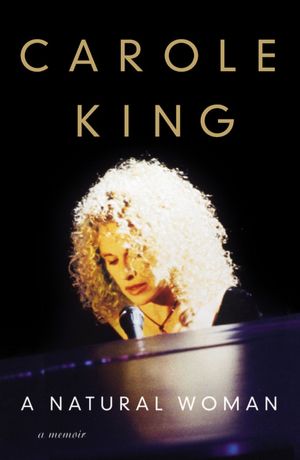 It may not be possible to dislike Carole King.
What’s not to like? She has written some of the best pop and rock songs of the past five decades, she has a record of social responsibility, and she’s a nice person.
In a way, her memoir, A Natural Woman, is similar: What’s not to like? It’s a conversational account of a remarkable American life; in some ways, it would be hard to believe if one didn’t already know that it’s true. King (Carol Klein) is a Brooklyn native who found herself in awkward straits in school because her mother enrolled her early, and then she skipped a grade — so she was perennially younger than her classmates and felt out of place.
She showed early signs of a bent for entertaining, and she was writing songs in her teens. In fact, she was only 18 when she and her husband, Gerry Goffin, wrote “Will You Still Love Me Tomorrow” for the Shirelles. She also became a mother for the first of four times at around the same time. Among the songs she has written since then, either on her own or with a collaborator, are “Where You Lead, I Will follow”; “I’m Into Something Good”; “It’s Too Late, Baby”; “The Loco-Motion”; “Take Good Care of My Baby”; “Go Away, Little Girl”; “I Feel the Earth Move;” “You’ve Got a Friend,” and “Natural Woman.’’

JAMES TAYLOR and CAROLE KING
For a long time, King saw herself as a writer and “sideman” — that is, one of the musicians playing and even singing behind a lead performer. By King’s account, James Taylor changed that single-handedly. It occurred in 1970 while Taylor was touring to promote his album “Sweet Baby James.” King was to play piano for Taylor at a performance at Queens College, which was her alma mater. As the show was about to begin, Taylor told King he wanted her to sing lead that night on “Up on the Roof,” a song she had written with Goffin and a favorite of Taylor’s (and mine, not that it matters).
King writes that she was taken aback by this request but had no time to talk Taylor out of it. When that spot in the set came around, Taylor introduced King to the audience as an alumna of the college and a co-writer of the song and, without rehearsal, she took her first turn as a lead singer. In time, of course, she become a good enough lead that her album Tapestry become one of the best selling collections of all time.

CAROLE KING and GERRY GOFFIN
King devotes a lot of space in this book to a personal life that is difficult for an outsider to fully understand. She married Goffin when she was 17, and the pair, barely more than children, settled into suburban life in West Orange. But Gerry got restless, he fooled around with drugs, he eventually plunged into serious depression. The marriage ended, but King and Goffin continued to be friends and collaborators. King had three more marriages, none of which, based on her own accounts, seem to have been well thought out. Two ended in divorce and one ended when her husband — who she says struck her on several occasions — died as a result of a drug overdose.
King emphasizes in this book that she didn’t like touring and that she didn’t seek stardom because of the baggage that came with it. She had a yen for a simple life, particularly as compared to life in the New York City and Los Angeles areas. From both a cultural and environmental point of view, she carried that quest to its logical extreme by buying a ranch in Idaho. Before she picked the spot, in fact, she and her fourth husband, Rick Sorensen, and her two youngest children lived for three years in a cabin that had no electricity, running water, or heat.
 When King first decided to make Idaho her principal residence, her oldest child, Louise, then 17, declined to make the move, and she stayed behind in Los Angeles. Eventually, all of King’s children would wind up in California. All of those children apparently have had fruitful lives, but King’s priorities are still a little hard to grasp.
I found it disconcerting, too, that she devoted a chapter to her decision to practice yoga, remarking that the discipline helped her find her “center.” She presents this as a life-shaping event, but she never explains what she means by finding her center, and except for one glancing reference, she never mentions yoga again.
Perhaps because she is such a nice person, King chooses her words carefully when she’s describing her interactions with other people, even the husband who brutalized her. While it wouldn’t necessarily be useful for her to share any rancor she might be harboring, her approach is tentative enough to make a reader wonder what else she chose to withhold.
King mentions an editor in the acknowledgments, but I was happy to find that it seemed as if this book was largely King’s own work. It has the feel of a kitchen-table conversation. Apparently it is as much as King wanted to share, so it will have to do for now.
Books: “A Soldier’s Sketchbook”
January 13, 2012

KATE SMITH
During World War II, the popular radio star Kate Smith used to end her daily broadcasts by saying, “And remember … if you don’t write, you’re wrong!” Kate Smith, who was a major supporter of the war effort in general and of American troops in particular, was prodding those at home to send letters to soldiers and sailors. I don’t know whether Kate Smith introduced that expression, and that inspired a songwriter, or the other way around. I do know that a writer named Olive Kriser wrote a song by that title in 1943, and it, too, urged families and friends to write to the troops.
For me, that phrase has always evoked what I imagine was a melancholy aspect of the war years: young men and women suddenly separated from their families, friends, neighbors, familiar surroundings, everyday routines, and hurled into the maelstrom, wondering about the folks, about ever seeing them again, longing for a mundane conversation around the kitchen table, a cheese sandwich made by Mom. And yearning, yearning, for a word from home.
That was the real-life experience of tens of thousands of young people, including Joseph Farris of Danbury, Connecticut, who was drafted, trained, and shipped off to the fighting fields of France and Germany shortly after leaving high school.
 Farris, who has become a very successful cartoonist and illustrator, has recreated his experience in A Soldier’s Sketchbook, an elegant volume published by National Geographic. Farris got lots of letters, but in this book, he reproduces many of the letters that he wrote to his parents and two brothers during the three years, beginning in May 1943, that he spent in the United States Army. The book also contains facsimiles of some of those letters and of other documents, photographs of Farris and some of his colleagues, and watercolors and drawings that he did while he was in service.
Farris provides a narrative in which he demonstrates how he pulled his punches in his letters home, both because military censorship sharply restricted what combatants could write about and because he didn’t want to worry his family. The folks wouldn’t know until it was well over that Farris — who wound up heading a heavy machine-gun platoon — came under heavy fire, watched his fellows soldiers being blown away, shivered in the cold and wet of the foxhole, and confronted the fact that any hour could the last in his brief life.
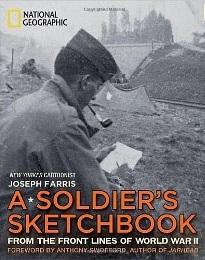 By the time Farris got into combat, Italy had surrendered, Athens had been liberated, France had been invaded, and the German siege of Leningrad had been broken. The jig was up for the Third Reich. So although he experienced the worst of the war, he also had some less lethal duty, moving through towns in France and Germany and temporarily occupying houses that were far more comfortable than a hole in the ground.
A touching aspect of this book is the writer’s lack of self pity and his consistent concern for the well being of his parents and brothers. While he was still in harm’s way, he wrote to his younger brother George, “Dad, Mom, & I are exceedingly grateful, kid, that you are around to help out. Mom & Dad depend a helluva lot on you, so don’t let them down. You may work a little harder than many other fellows your age but in the long run it’s going to pay. You don’t know how thankful I am for the training I got in the store” — a reference to his family’s Danbury Confectionery — “not only the business experience but the systematic method necessary. You’re fortunate in having the swellest folks possible. If I can treat my future children half as good as Mom & Dad have treated us I’ll feel that (I) have done my job well.”
Throughout his military service, Farris thought about his plans for a career in art, and often asked his family to send him supplies. His work has appeared in the New Yorker and in other major publications. You can see many of his cartoons and illustrations by clicking HERE.
For another interesting aspect of World War II, click HERE to read about the Women’s Land Army. The site includes many letters written home by Genevieve Wolfe, who was one of a group of 40 young women from West Virginia who traveled to a camp in Ohio to provide labor needed on farms in the northern part of the state.
Books: “Eva Braun: Life with Hitler”
December 29, 2011
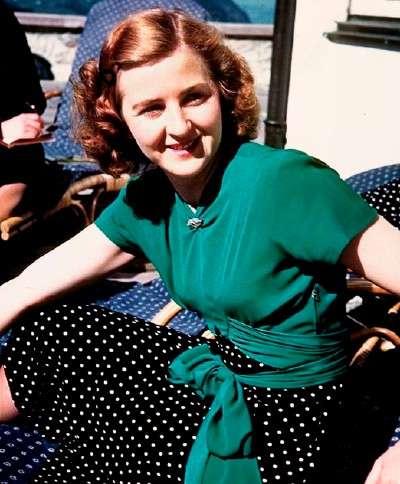 Chelsea, an aspiring actress, tells Cosmo Kramer during an episode of the TV series Seinfeld that her manager is “trying to put together a miniseries for me on Eva Braun. I mean think about it, is that a great idea? We know nothing about Eva Braun, only that she was Hitler’s girlfriend. . . . What was it like having sex with Adolf Hitler? What do you wear in a bunker? What did her parents think of Hitler as a potential son-in-law? I mean it could just go on and on….”
It could and it will, because while it isn’t true that we know nothing about Eva Braun, it is true that we know relatively little, considering that she was the consort of one of the most recognizable and most reviled men in human history.
Heike B. Görtemaker, tries to bring some clarity to this subject in Eva Braun: Life with Hitler, which was originally published in German. The very things that have made Braun an obscure figure up to now were obstacles to the author’s work, beginning with the fact that Hitler wanted to be perceived as a solitary messiah whose life and energy were devoted to lifting Germany and its people from the ignominious consequences of World War I.
 In order to maintain his image, Hitler kept the very existence of Eva Braun a secret from the German people, and he kept her at least at arm’s length and often much farther when they were in the company of his inner circle. Hitler married Braun on the day before they both committed suicide in a bunker in April 1945 while the Red Army was literally striding through the Reichstag grounds about 25 feet above their heads. He once said that he had never married because he needed the political support of German women and that he would lose some of his appeal if he had a wife. “It’s the same with a movie actor,” Hitler said. “When he marries he loses a certain something from the women who adore him. Then he is no longer their idol as he was before.”
When I read that in Görtemaker’s book, I wondered what “certain something” Hitler had that would attract any woman, never mind millions of them. Evidently the author wonders about that, too. When she writes that Braun’s life was shaped by Hitler’s power, his world view, and his “charismatic attraction,” she adds parenthetically, “however difficult it may be to explain what that consisted in.”
 Görtemaker is convinced that neither Braun nor the other women around Hitler — principally the wives of men like Albert Speer and Joseph Goebbels — were simply adornments who were expected to be seen but not heard. On the other hand, the author finds it impossible to say definitively how much Braun and the others knew about German policy, and particularly about the Holocaust. They had to know of the persecution of Jews in Europe; it was no secret. But discussion of the extermination program in Hitler’s presence was forbidden when he was in his “family circle,” as it were, meaning the crowd that frequented Berghof, Hitler’s frequent refuge in Bavaria.
 Hitler met Braun in 1929 when he was 40 and she was 17 and working as an assistant to Dietrich Hoffmann who became the privileged official photographer of the Nazi party and the Third Reich. Görtemaker speculates that the couple were not intimate until 1933 when Braun had become an adult . At first they saw each other only intermittently, and this apparently weighed on Braun and was the cause of two suicide attempts. After the second incident, Hitler arranged for Braun to have her own home in Munich and to have regular access to Berghof, where her assertion of her prerogatives irritated some of Hitler’s coterie.
Whatever attracted Braun to Hitler in the first place, long before it was clear that he would lead the German nation, her commitment to him was complete. Görtemaker writes that the level of her loyalty was the object of admiration to at least some of Hitler’s associates and it may have been the one thing that most endeared her to him. There’s no evidence that she pressured him to marry her or that she complained about being kept out of the public eye. And, in the most dramatic possible demonstration of her constancy, however misguided, she went to Berlin against Hitler’s wishes with the clear intention of dying with him while many others, including Speer and Hoffmann, were already concocting lies about being “outsiders” in Hitler’s camp. The normal confidentiality of the culture in which Hitler lived, coupled with the loss and destruction of written records and the unreliability of later testimony by turncoats trying to save their own hides and reputation may mean that we’ll never know more about Eva Braun than Görtemaker has been able to tell us in this book. That’s unfortunate, not because Braun was so different from others who supported Hitler, but because she was so like them. She was in all respects an ordinary person who came under the still elusive spell of a bumbling, absurd little man who terrorized the world for more than a decade
Books: “1493”
December 17, 2011

aka CHRISTOPHER COLUMBUS
One of my chores at Paolino’s Market when I was a kid was to open up fifty-pound bags of potatoes and divide the spuds into ten- and five-pound bags. “Packing potatoes,” as we called it, was a frequent part of the routine in our store, and that was appropriate in its way, because what could be more routine than a potato — one of the most plain, most simple, and least consequential of vegetables.
Or so I thought until I read 1493 by Charles C. Mann, author of 1491.
In this substantial and exhaustively researched volume, Mann describes the impact of the voyages of Christopher Columbus, whom he calls Cristóbal Colón, the name the explorer answered to in Spain. Overall, Mann explains, the impact of those voyages was to globalize life on earth, sending folks traveling to hemispheres they had perhaps only dreamed about and distributing other forms of life, ranging from mosquitoes to horses, from tobacco plants to rubber trees, to spots where they had never existed before — a phenomenon known as the Columbian Exchange. Simultaneously, languages and cultural traditions and man-made products were scattered across the planet. So were doleful phenomena such as malaria and potato blight.

The process that Columbus launched, and personally participated on his first trips across the Atlantic Ocean and back, is so complex and far-reaching, as Mann describes it, that I can’t adequately summarize it here. But the potato is a good example of the upheaval Columbus touched off.
Little did I know last June, when I was watching my cousins hoeing potatoes in their massive garden in Il Valle di Sessa Cilento, that potatoes, which were first domesticated in the Andes, weren’t exported to Europe in quantity until the second half of the 16th century, when some species of them were being cultivated in the Canary Islands and shipped off to the mainland.
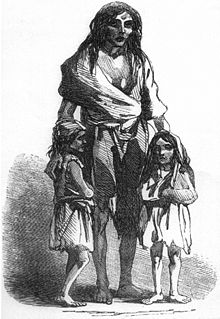
Irish mother and her children during the potato famine in 1849
The consequences of this, Mann writes, were enormous for a continent that was accustomed to frequent food shortages. In fact:
“Many scholars believe that the introduction of S. tuberosum to Europe was a key moment in history. This is because their widespread consumption largely coincided with the end of famine in northern Europe. (Maize, another American crop, played a similar but smaller role in southern Europe.) More than that, the celebrated historian William H. McNeill has argued, S. tuberosum led to empire: ‘[P]otatoes, by feeding rapidly growing populations, permitted a handful of European nations to assert dominion over most of the world between 1750 and 1950.’ Hunger’s end helped create the political stability that allowed European nations to take advantage of American silver. The potato fueled the rise of the West.”
There is much, much more just to the potato story, including the fact that a blight that also originated in the Andes migrated first to North America and then to Europe in the mid 19th century, causing almost incomprehensible hunger and illness, especially but not solely in Ireland.
Mann discusses the potato itself and its geographical history in minute detail, and he does the same with a broad range of subjects including slavery, the mixing of races in the “new world,” and the impact of world economies — most notably that of China — of the Spanish trade of silver from South America. His discussions frequently extend down to the present day, and this book in general is a valuable aid in understanding how the world evolved from the 15th century to the 21st.
Books: “Pearl Harbor Christmas”
December 15, 2011

I grew up among the remnants of war. I was born in September 1942 when the United States had been engaging Nazi Germany and Japan for less than a year. By the time I was old enough to be aware of my surroundings, there still were handwritten letters from the front, brass uniform buttons, photos of soldiers, sailors, and marines, patriotic records, and newspaper clippings reporting on the service of relatives and friends, including cousin Mike Aun, who was awarded the Bronze Star twice, the Silver Star, and the Purple Heart with three oak-leaf clusters.

FRANKLIN D. ROOSEVELT
I also recall that for a long time after 1945, my parents and other adults would frame their conversations in terms of what had occurred before, during, and after “the war.” They needn’t say which war.
So although I don’t remember the war itself, I feel that it was a part of my life, and I eagerly learn as much about it as I can. My most recent opportunity came in the form of Pearl Harbor Christmas, a new book by Stanley Weintraub.
In this compact book, Weintraub describes events at home and abroad from December 22, 1941, to January 1, 1942 — devoting a chapter to each day. The dominant personalities by far are Franklin Roosevelt and Winston Churchill. Churchill was staying at the White House after crossing the submarine-infested Atlantic in winter seas. He couldn’t wait to get to Washington, because Pearl Harbor had accomplished what he could not, forcing the United States into a war that Britain probably could not survive otherwise. But, although the newborn American belligerence was directed mostly at Japan, Churchill wanted to make sure, and did, that the U.S. would go to war first against Nazi Germany.

WINSTON CHURCHILL
Churchill addressed a joint session of Congress, spoke at the Christmas tree-lighting ceremony on the White House lawn — the only time he and Roosevelt spoke from the same platform — and dashed up to Ottawa to speak before the Canadian Parliament. What with his blustering, his cigar-smoking, and his drinking, he was quite the counterpoint to patrician, dignified Roosevelt. Actually, he came across more like Lyndon Johnson: Weintraub describes an incident on December 26 when Churchill was dictating to a male secretary notes for the address to Congress. Churchill was in his bath when he started dictating. He got out, wrapped a towel around himself, walked to an adjoining bedroom, dropped the towel, and continued dictating, stark naked. Suddenly, the secretary recalled, “President Roosevelt [in his wheelchair] entered the bedroom and saw the British Prime Minister completely naked walking around the room dictating to me. WSC never being lost for words said, ‘You see, Mr. President, I have nothing to conceal from you.”’
While Roosevelt and Churchill and others were in Washington working issues of joint command, Adolf Hitler was in Berlin or Bavaria trying to chew the great deal he had bitten off.

ADOLF HITLER
Hitler’s troops were in trouble on the Russian front, and even those closer to home were suffering from a lack of adequate supplies. Hitler actually had Joseph Goebbels run a clothing drive to help keep his soldiers warm. In a radio address, Goebbels told the German people that they “would not deserve a moment’s peace if a single German soldier was exposed to the harshness of winter without articles of warm clothing.”
Meanwhile, the situation in the Pacific continued to deteriorate as the Japanese took advantage of their momentum and munched away at the region. Churchill had not yet publicly acknowledged the reality, Weintraub writes, and continued to waste resources trying to defend ground that was already as good as lost.
Even more closely involved in such a charade was U.S. Army Gen. Douglas MacArthur, who had to abandon his headquarters and retreat with his wife and son to a tunnel in Corregidor while he continued to send out dispatches about tank battles, with nonexistent tanks, putting up a fight that wasn’t occurring.
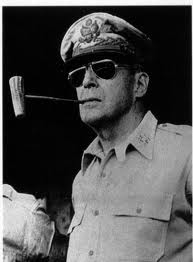
DOUGLAS MACARTHUR
Weintraub explains that there was a certain ambivalence about the war in the United States at first; it still seemed far away.
Still, the government took the impending conflict seriously enough to pack up the founding documents — the Declaration of Independence, the Constitution, and the Bill of Rights — and ship them off under heavy security to repose in Fort Knox for the duration.
The holidays went on as usual. Despite security concerns, Roosevelt insisted that the national tree be on the White House lawn, not in Lafayette Park where the Secret Service wanted it. There were presents, too, including eight thousand cigars sent to Churchill from various sources.
The new year was marked by a couple of oddities – Churchill making a rare visit to a church, attending a service with Roosevelt in Alexandria, Va., and the beleaguered Hitler publicly invoking “the Lord” in hoping that 1942 would bring positive results for the German people.
Throughout the United States, however, the prospects of what would come in the next three and half years did not weigh heavily on the celebratory spirit, and that, Weintraub writes, included the biggest celebration of all:
“ ‘If there was uneasiness over the possibility of Axis bombs falling into Times Square,’ the Times reported, ‘you could not read it in the celebrants’ faces.’ Despite Pearl Harbor and the reality of world war, it had not yet reached very far into the American psyche.’’
Books: “Clarence Darrow: Attorney for the Damned”
November 11, 2011

Richard Loeb (left) and Nathan Leopold
I was surprised to find in some recent conversations that acquaintances my age don’t remember the “Free Nathan Leopold” movement. I was in my teens when it reached its climax, and I remember reading about it in newspapers and hearing about it on broadcast news. I probably was more attuned to it, because I read a paperback book about Leopold and his friend Richard Loeb, who in 1924 had murdered a 14-year-old boy just to show that they could do it. It was characterized for many years as “The Crime of the Century.” Leopold and Loeb were very rich and very bright young men, not yet 20, and they had gotten caught up in the philosophy of Friedrich Nietzsche. They decided that they fit the mold of Nietzsche’s “superman” and that they were above the law — an idea that the State of Illinois didn’t share.
This is one of the cases John A. Farrell writes about to support the title of his excellent book, Clarence Darrow: Attorney for the Damned. It was one of the two cases for which Darrow is best remembered — the other being the Scopes trial, which involved the teaching of evolution in a Tennessee school — but, as Farrell describes in detail, there was much more to Darrow himself and his tumultuous legal career.

Clarence Darrow
Darrow was a complicated man, a mass of contradictions. He was also one of the great celebrities of his era, attracting enormous crowds to courtrooms and to the streets outside with his eloquence and logic and with his theatrical, sometimes outrageous style of questioning witnesses and addressing juries.
Darrow defended John Thomas Scopes, who was tried in 1925 in the evolution case. That trial was a charade, because Scopes was a willing dupe who agreed to face the charge in order to get the subject before the courts.
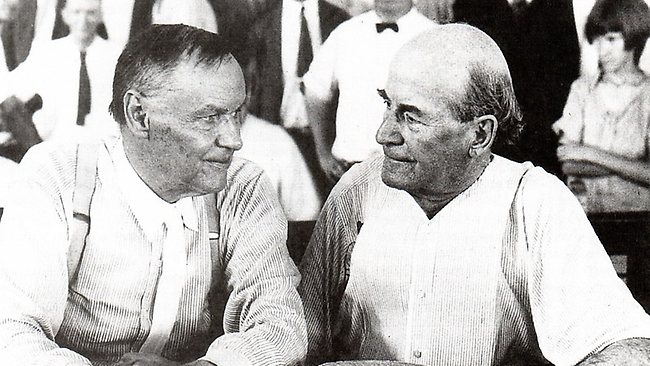
Clarence Darrow and William Jennings Bryan
The case set up an historic confrontation between the agnostic, libertarian Darrow and the three-time Democratic presidential candidate, William Jennings Bryan, who won the case in the sense that Scopes was convicted but who squirmed as Darrow’s questions showed Bryan’s ignorance of both history and the Bible.
The subtitle of the book refers to Darrow’s penchant for taking on clients whose fate seemed sealed – and frequently bringing in an unexpected result.

Dr. Ossian Sweet
At times he stood for underdogs – such as Dr. Ossian Sweet, his brother Henry, and nine other black men charged with murder after a bystander was shot to death while the Sweets and their friends defended the doctor’s Detroit home from a violent white mob.
It was 1925 and the jury was white — hardly the circumstances a lawyer would hope for — but Darrow, who had been hired by the NAACP – got a hung jury in the first trial and acquittal when Henry Sweet was retried alone.

Clarence Darrow
As he often did, Darrow moved the focus of the proceedings off the immediate charge before the court and drew attention to a broader principle: “There is nothing but prejudice in this case,” he told the jury. “If it was reversed, and eleven white men had shot and killed a black while protecting their home and their lives against a mob of blacks, nobody would have dreamed of having them indicted . . . . .
“That’s all there is to this case,” he said. “Take the hatred away and you have nothing.’’
The same Darrow who stood up for that black family was just as willing to defend people of privilege, such as Leopold and Loeb, and just as skillful in doing it. Inasmuch as Leopold and Loeb admitted the murder, those following the case expected them to enter a plea of guilty by reason of insanity. But Darrow entered a plea of guilty and said he would rely on the mercy of the court. In a performance that no judge would allow today, he concluded the penalty trial with an eight-hour argument in which he presented “these boys” as “immature and diseased children . . . wandering around in the dark.’’ Speaking, as he always did, without notes, Darrow cited the lack of precedent in Chicago for hanging defendants under the age of 21, and for hanging defendants who had pleaded guilty.
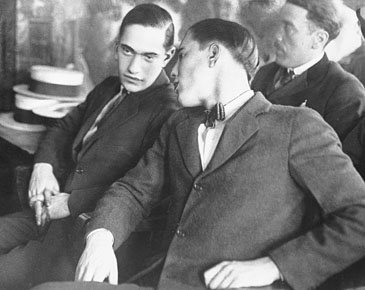
Leopold and Loeb
Darrow dismissed the death penalty itself as “one long slaughter house,” and he brought tears to the eyes of onlookers, including the defendants, when he spoke of their mothers and the mother of the slain Bobby Franks: “The mother who looks into the blue eyes of her little babe cannot help wonder what will be the end of this child, whether it will be crowned with the greatest promises which her mind can imagine, or whether he may meet death from the gallows.’’
Leopold and Loeb were sentenced to life in prison for the murder plus 99 years for kidnapping. Loeb was killed by another inmate, but Leopold led an exemplary and productive life in prison, which eventually inspired public pressure on his behalf. He was paroled in 1958 and moved to Puerto Rico, where he was a model citizen.
Farrell devotes a lot of attention to Darrow’s work on behalf of labor during an epoch in which workers were resorting to violence in order to free themselves from exploitation – whether in the mines of Pennsylvania or in the headquarters of the Los Angeles Times, which was liquidated by explosives in 1910.
Farrell also writes of the brooding, disheveled, boozy attorney’s insatiable thirst for women, his literary ambitions, and his wildly vacillating economic fortunes. As Farrell illustrates and explains, Darrow at times seemed to be an idealist who would take on a lost cause for no pay and at other times seemed to be an opportunist, interested only in money and his own aggrandizement.The jury, as it were, is still out on those questions, but Farrell does make one thing clear: Whatever else Darrow was, he is one of the most memorable characters of his time.
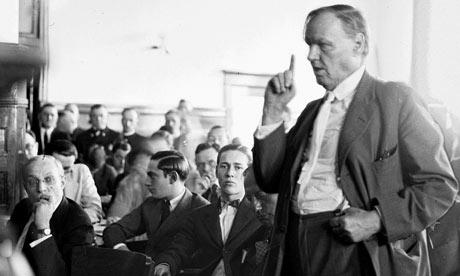
Clarence Darrow in the courtroom during the trial of Richard Loeb and Nathan Leopold, seen to Darrow's right in this picture.
Amelia Earhart: Is it you at last?
February 22, 2011
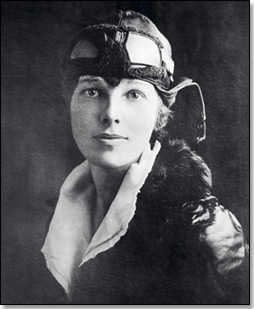
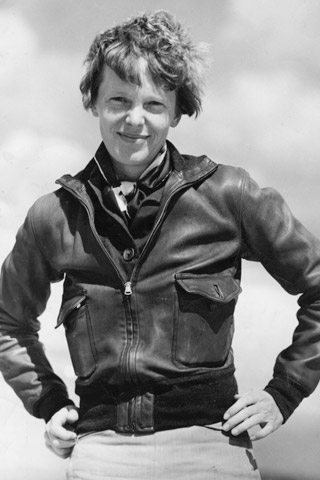 I see by the papers, as it were, that a scientist in British Columbia is going to try to identify bone fragments believed to be those of Amelia Earhart by using DNA technology. Earhart went missing in July of 1937 and was presumably killed along with navigator Fred Noonan during their attempt to fly around the world along the equator. Their bodies were never found, but bone fragments that were found on a Pacific island late last year are being examined at the University of Oklahoma to determine if they are the remains of Earhart. A story published today by The Canadian Press reported that a forensic archeologist at Fraser University in Vancouver is going to try to recover Earhart’s DNA from envelopes that contained letters written by Earhart. The letters were opened at the ends, so the flaps are intact. The premise of the study is that Earhart probably licked those flaps in order to seal the envelopes and that DNA from her saliva may still be present.
 This news breaks while I’m in the midst of reading a recent biography of Earhart by Kathleen C. Winters. I’ll probably post a review here in a few days.
From a practical point of view, it may not matter very much whether those bones are Earhart’s or not. As there always are in such cases, there are folks who want to believe that the explanation for her disappearance is more complicated than that her plane went down, but there is no evidence to support them. On the other hand, anyone with a sense of history hates stories with missing conclusions. So a definitive finding that those bones belonged to Amelia Earhart would serve two purposes – putting unfounded theories to rest and putting the period to an historical epoch.
 CharlesPaolino's Blog