Which president was the best football player?
January 8, 2010
 The relationship between baseball and presidents of the United States has been well documented; in fact, there is a room devoted to the subject at the National Baseball Hall of Fame in Cooperstown, NY. The earliest association seems to be with Abraham Lincoln and it is most graphically represented by this Currier & Ives political cartoon, published in 1860, after Lincoln had outlasted three opponents to win the presidency. Lincoln is saying, “Gentleman, if ever you should take a hand in another match at this game, remember that you must have a good bat to strike a fair ball and make a clean score and a home run.”

ANDREW JOHNSON
How close Lincoln was to the game seems to be a matter of debate, but it is documented that his successor, Andrew Johnson, was the first president to witness an intra-city game and the first president to invite a baseball team into the White House. Among his papers are several honorary membership cards in baseball organizations.
Another president who had a particular connection to baseball was Dwight Eisenhower, who loved the game and said more than once that he would have liked to have played professionally. There is a lingering discussion about whether he did, in fact, once play semi-pro ball under an assumed name — something that would have fouled the amateur status under which he played football at West Point. A number of prominent witnesses said that Eisenhower had admitted to this in later life, but Eisenhower never publicly owned up to it.

GERALD FORD
Meanwhile, the Christian Science Monitor has looked into the subject of presidents and football — specifically, which president was the best player. The candidates are Eisenhower, John F. Kennedy, Richard Nixon, Gerald Ford, and Ronald Reagan.
Even after one gets over the image of Nixon playing football, the answer isn’t as obvious as it may seem.
If you can’t guess, you can read about it at THIS LINK.
“Hard to get happy after that one.” — Andy Kaufman (“Taxi”)
December 5, 2009

Sen. JIM BUNNING
Some baseball players lose their edge over time, but Jim Bunning ain’t one of ’em. He can still put them over the plate, as he demonstrated last week in his verbal assault on Ben Bernanke, who was appearing before a U.S. Senate committee that was considering Bernanke’s nomination to continue as head of the Federal Reserve.
Bunning, a Republican senator from Kentucky and one of the most conservative members of Congress, made a statement at the hearing in which he explained not only why Bernanke shouldn’t be reappointed but why — as my brother might put it — he has no reason to exist. Amid a detailed dissection of what Bunning considers Bernanke’s contributions to the nation’s financial crisis, the senator said: “You are the definition of a moral hazard … Your time as Fed Chairman has been a failure.” The complete statement was published by the Huffington Post at THIS link.

JIM BUNNING
Bunning holds a degree in economics, so for all I know he could be right about Bernanke and about Bernanke’s predecessor, Alan Greenspan, for whom the senator has at least as much affection. On the other hand, his political career has been peppered with bizarre incidents and statements, including his prediction of the death of Supreme Court Justice Ruth Ginsburg and his public pronouncement that he doesn’t read newspapers and gets all his information from Fox News. His approval ratings, for what they’re worth, are at present in the sewer. He has been unable to raise campaign funds — which he blames on a conspiracy against him within his own party — and he will not run for reelection.
Well, if his political career hasn’t been exemplary, that fact will never outweigh his baseball career. He was one of the very best pitchers of his time and is a member of the National Baseball Hall of Fame. He could throw strikes — oh, could he ever! He struck out 2,855 batters while walking only 1,000. Bunning was one of only 40 pitchers in the history of baseball to strike out the side by throwing nine pitches — all strikes. Try that sometime.
“You sing a bingo bango bingo” — Tom Glazer
October 27, 2009
 During the last ALCS game, I got this lyric stuck in my head: “So who would want these diamond gems? / They’re diamonds in the rough. / A baseball team needs nine good men. / One guy just ain’t enough.”
I remember hearing that on television about 50 years ago. It was sung to the tune of “Yankee Doodle,” and it got stuck in my head. Every once in a while it comes to the surface.
When it came to the surface the other day, I decided to do what I always tell my students to do — look it up. In the Internet age, that’s a lot easier than it used to be, although this song seemed so obscure that I didn’t expect to track it down.
 By searching on a phrase from that lyric I actually found one reference to it. It turns out that it’s part of a jingle that was used in one of a series of public service announcements sponsored by the American Jewish Committee. An application for a grant to help fund the series turned up on a site that houses the archives of the AJC. Among the documents was a page from an issue of TV Guide dated April 28, 1951. On the page was a short article about this animated short that was part of a larger, award-winning anti-bigotry campaign by the AJC. The short was designed to reinforce the idea that people of many backgrounds contributed to life in the United States.
 The animated cartoons were by Fred Arnott and the song was written by Lynn Rhodes. I could find out nothing more about either of them. However, the song was sung by Tom Glazer, who had a decent reputation as a folk singer. A lot of people of a certain generation will remember his novelty song “On Top of Spaghetti,” a children’s song he recorded in 1963. He also wrote “Because All Men Are Brothers,” which was recorded by the Weavers and by Peter Paul, and Mary, and “Talkin’ Inflation Blues,” which was recorded by Bob Dylan. Glazer wrote idiotic and kind of racist lyrics to “Skokian,” a Zimbabwean song that was popular in multiple versions. Glazer’s version was recorded by the Four Lads.
Anyway, the song he sang for the AJC went like this:
Though every player is top flight / Our team just falls to pieces / With every game they have to play / The number of flubs increases.
To figure why they fall apart / You needn’t be too clever / With no teamwork the team’s big star / Will die on third forever.
The shortstop simply cannot play / With the jerk who’s second sacker / The pitcher can pitch to anyone / But certainly not to his catcher.
So who would want these diamond gems? ‘/ They’re diamonds in the rough / A baseball team needs nine good men / One guy just ain’t enough.
A nation’s like a baseball team / It’s run by teamwork too. / And every race and every creed / Works with Y-O-U.
Play ball with all your neighbors / Pitch in a little more / Americans, join your teammates all / Roll up a winning score.
“Out in right field — it’s easy ya know” — Noel Paul Stookey
August 26, 2009
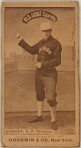
BILLY SUNDAY Chicago White Stockings
As I was picking up my suitcases at the airport in Savannah the other day, my cell phone rang. It was my brother, who wanted to know when major league baseball players stopped leaving their gloves on the field while their team was at bat. And why did they do that in the first place?
Between us, my brother and I have been working for years on collecting all human knowledge. This was just the latest installment. The only answer I had at the moment, as I yanked a suitcase off the carousel, was that the practice was still in place when I first went to a game at Yankee Stadium in 1951, and I was certain it had been discontinued by ’57 or ’58. So my guess was that it stopped in the early ’50s.
Since then, I learned that a rule requiring that all equipment be removed from the field at the end of each half inning was adopted in 1953 and took effect for the 1954 season.
As for how the practice began, the information is sketchy. It is certain that when organized baseball emerged in the middle of the 19th century, fielders didn’t wear gloves at all. When gloves first appeared, on an individual basis, they were work gloves — probably used to protect an injured finger or hand — and a player would stuff those gloves in his pocket when he left the field.

ADMIRAL SCHLEI New York Giants
As gloves made specifically for baseball appeared, they were too large to fit in a pocket, so that was no longer an option. Those early gloves were left on the field at the end of a half inning because they were used by players on both teams. As gloves and mitts became more customized, players no longer shared them, but they continued to leave them on the field. If a thrown or batted ball hit a glove that was lying on the field, that ball was in play. If a fielder tripped over a glove, that was his tough luck.
The rule adopted in 1953 was in a way based on the idea that a glove lying on a field constituted a hazard to navigation. Gloves and mitts by that time had become much larger than their forbears — though not nearly as large as those in use today — that baseball officials decided the practice should be discontinued.
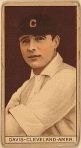
HARRY DAVIS Philadelphia Athletics
The fact that gloves were left on the field for so many years suggests that there weren’t many incidents in which players were injured or the outcome of a game was affected. That doesn’t mean there were never repercussions from the odd habit. On September 28, 1905, for instance, Harry Davis of the Philadelphia Athletics hit a ball that struck a glove left on the outfield grass by teammate Topsy Hartsel, and the carom enabled Hartsel to score the winning run in a 3-2 victory over the Chicago White Sox.
“But baseball has marked the time.”
July 8, 2009

BOSTON RED SOX
One thing that is unlikely to appear in a photograph of Boston Red Sox players is red socks. Players for Boston, like most players in professional baseball, have forsaken the knickers and high stockings that have been a distinctive element of the baseball uniform for 140 years.
According to the National Baseball Hall of Fame web site, knickers were introduced to the game in 1868 by the Cincinnati Red Stockings. The innovation met with some resistence. The Hall of Fame site reports as follows:
“The showing of the manly leg in varied-colored hose … [was] unheard of, and when [team captain] Harry Wright occasionally appeared with the scarlet stockings, young ladies’ faces blushed as red, and many high-toned members of the club denounced the innovation as immoral and indecent.”
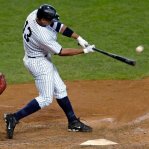
ALEX RODRIGUEZ
But stockings quickly became de riguer in the game and remained so for many decades. Now, however, in this epoch in which everyone does what he pleases, this tie to the past has been withering away. During last night’s game between the Yankees and the Twins, I counted only four men on the field wearing high stockings: Alex Rodriguez, R.A. Dickey, Joe Crede, and Brendan Harris. The rest looked like they were wearing their pajama bottoms — and walking on the hems at that. Besides looking foolish, they’re monkeying with something essential about The Game — its tradition.
Remember what Terence Mann told Ray Kinsella at the climax of “Field of Dreams”?
“The one constant through all the years, Ray, has been baseball. America has rolled by like an army of steamrollers. It has been erased like a blackboard, rebuilt and erased again. But baseball has marked the time.”

1869 CINCINNAT RED STOCKINGS
Let’s play two … or more.
May 19, 2009

JOE OESCHGER
The announcement that post-season baseball games broadcast on Fox will start before bedtime this year is better than no progress at all. Games that were running well over three hours and ending after midnight on the East Coast were hard on fans who have to get up early, and they were precluding many kids from watching – and that’s an audience baseball shouldn’t take for granted.
Of course it wasn’t the bleary-eyed fan or the starry-eyed kid who inspired this change. It was the poor ratings for last year’s American League playoffs and for the World Series, both of which threaten revenues from advertisers who were probably nodding off while their own commercials were playing.
If the advertisers get nervous enough, maybe the post-season process itself will be streamlined so that it isn’t crowding Thanksgiving. Meanwhile, the announcement by Fox that many of the games will start earlier has evoked comments about the fact that the games are too long no matter how early they start. I, for one, am in no hurry when I watch baseball on TV or listen to it on the radio, and at the prices we pay now to see a game in person, I figure the longer it takes the more I get for my money. After all, one of the things that makes baseball unique among American spectator sports is that it has no clock; a game – in theory, at least – can go on forever. That’s what Katie Casey was referring to in the lyric of Jack Norworth’s song: “Buy me some peanuts and Cracker Jack. I don’t care if I never get back.”
To some extent, nothing can be done about the length of games that are held hostage to the radio and TV commercial schedule. The plate umpire still carries out his responsibility and strides ominously toward the mound if the pitcher and catcher confer for more than 20 seconds, but he’s not about to interfere with the shilling that creates the wide gap between half innings. Nor will he reprimand the batter who steps out after every pitch to adjust his golfing gloves.

LEON CADORE
To put the modern, televised, 3 1/2-hour game in perspective, the Boston Braves and the Brooklyn Dodgers played to a 1-1 tie in 26 innings on May 1, 1920. That game took 3 hours and 50 minutes so the teams, in effect, played one game every hour and a quarter. There was no pitch count in those days, fewer calls to the bullpen, and the starting pitchers – Joe Oeschger for Boston and Leon Cadore for Brooklyn – both pitched complete games (and, incidentally, lived to pitch another day). There was no lack of offense – a total of 25 hits – and there was a total of 8 walks. To look at it another way, on Sept. 26, 1926, the St. Louis Browns and the New York Yankees played a nine-inning game in 55 minutes, the Browns winning 6-2. That projects to a little less than 2 3/4 hours if that game had gone on at the same pace for 26 innings.
When I was a kid in elementary school, and the World Series was played in the daytime as God intended, instruction was suspended, and we were told to work quietly at our desks while the play-by-play was piped in through the public-address system. It all depends on what’s important to you.
Ducks on a Pond
May 1, 2009
static.howstuffworks.com
Mike Adamick, blogging for the Los Angeles Times, says his three-year-old daughter has become fascinated with the jargon of baseball. For instance, she loves the term “dying quail,” which refers to a fly ball that suddenly loses steam and drops to the ground. “Where are the quails?” the little one asks whenever a ball is hit into the air. She also likes “worm burner,” a hot ground ball that skids across the grass. “Poor worms!” she says after every hard grounder.
I recently gave a short talk about this subject as part of a job application process. I asked the group I was speaking to if any of them were baseball fans, and several hands went up, but none of them could decipher the terms “can of corn” (an easily caught fly ball), “cup of coffee” (a player’s short stay in the major leagues before returning to the minors), or “cutting the pie” (deliberately rounding first or third base without touching the bag). They were befuddled by the hypothetical statement: “Jeter tried to shoot the cripple with ducks on the pond, but he started a Lawrence Welk,” which means that, with the bases loaded, Jeter tried to get a hit off an ineffective pitcher but grounded into a double play from the pitcher to the catcher to the first baseman – a play that is scored one-two-three (a-one and a-two and a-three).
My audience was able, however, to distinguish between the hot dog who shows off making one-handed grabs and the hot dog that costs six bucks at the concession stand.
The land of the free
April 3, 2009
 I realized this morning while I was shaving that when I first visited Yankee Stadium, it was not yet 30 years old. (Shaving is like hitting, Yogi: It’ s better not to think while you’re doing it.) Anyway, that calculation got me to thinking about the new “Yankee Stadium” – as though there could be such a thing – and I got angry all over again about Macombs Dam Park, a wonderful, expansive facility that was destroyed so that the Yankees could build a stadium better suited to fleecing high rollers. The park is supposed to be replaced – at an enormous expense to taxpayers, most of whom will not benefit at all from either the new stadium or the so-called replacement parks. And no matter what the city does, when it gets around to it, it will never really replace Macombs Dam Park, which was a jewel in the midst of a hard-knocks, congested neighborhood. If the Yankees and the city wanted to tell the people of the South Bronx once and for all, “You don’t matter,” this was the way to do it.
“His life was gentle ….”
March 25, 2009
GEORGE KELL
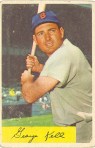
I see by the papers that George Kell died yesterday. He was 86 years old. Kell played major league baseball, and played it well, for 15 years. He narrowly beat Ted Williams out of the 1949 American League batting title, and he is a member of the Baseball Hall of Fame – based largely on his tenure as the third baseman for the Detroit Tigers. The story about the 1949 batting race is one of the most often repeated episodes in the history of the game. On the last day of the season, the Tigers were playing the Cleveland Indians who inexplicably sent in their prize starter, Bob Feller, as a reliever. With Williams and Kell tied for the title, Tigers manager Red Rolfe suggested a pinch hitter for Kell in the ninth inning, but Kell refused to sit on the bench and win the title by not making an out. As it turned out, the game ended before he had to bat, and he beat Williams .34291 to .34276. Kell was reputedly one of the best contact hitters in the modern era. He was also a man universally admired, both as a baseball player and a baseball broadcaster. People speak of him with affection that a later generation might not have for, say, Alex or Manny Rodriguez. An bit of information in the reports of Kell’s death was that he lived in the same house in Swifton, Ark., from his birth in 1922 until the house burned down in 2001, and then lived – and died – in the house that was built on the same spot. It was an appropriate detail in the biography of a man known for steadiness, dependability. A salesman who used to call at my grandfather’s grocery store told me one day that he figured that I would stay in that store in that town for the rest of my life, as had my father and his father before him. That wasn’t for him, he said, he was going to see the world. I don’t know whatever happened to that man, but I doubt that his death will evoke the kind of sentiment I have seen today in papers around the country, prompted by the passing of a quiet man from Arkansas who never strayed from home.
 CharlesPaolino's Blog