George Weber: Requiescat in pace
March 26, 2009

GEORGE WEBER
Barry Nelson, a fine actor, once gave me an unanticipated lecture about judging other people. I had asked Nelson – in the context of our conversation – whether he felt responsible for the content of films or television shows or plays in which he appeared. I asked him specifically if he would decline to appear in a property if he felt the content was, say, pornographic. Nelson said he would not necessarily decline to appear in a property because of its sexual content and that, in a broader way, he didn’t feel that appearing in a property meant that he was making the writer’s viewpoint his own – or, to put it another way, that he was giving approbation to a viewpoint that the writer had expressed in the script. Nelson didn’t stop there. He went on to caution me that each person has his own needs and has to find his own ways to satisfy them. Not everyone is attractive, Nelson said. Not everyone has good social skills and can draw to himself friends and lovers. Not everyone can easily obtain the intimacy that is a fundamental requirement of a healthy human spirit. What I might reject as pornography, Nelson said, might be providing another person with release or comfort or excitement that he would otherwise live without.

BARRY NELSON
I could have spent the rest of the day debating the definition of pornography and the connection between pornography – in at least some of its definitions – and activity that ranges from degrading human nature to criminal. However, I think Barry Nelson used pornography as his talking point only because I myself had raised it. His broader point about judging other people’ s needs and behavior had the impact I think he intended. That conversation took place many years ago, and it came to mind this week while I was reading about the death of George Weber, the radio newsman who was murdered in his Brooklyn apartment. According to the news accounts, Weber contacted a disturbed teenager via the Internet and offered to pay him $60 to engage in rough sex. The encounter spun out of control, and the teenager, John Katehis, stabbed Weber multiple times. Police say Katehis admitted to that.
My initial reaction was revulsion to the idea that Weber had sought out a teenaged stranger for a sexual thrill. The bare fact, if it is a fact, that he would exploit a boy of that age – never mind one who seems to have had deep-seated problems of his own – is inexcusable. I still think so. But over the past few days, I have been thinking of the loneliness and the compulsion that may have, must have, contributed to this catastrophe in two lives. My moral judgment about decisions that George Weber made doesn’t matter, except to me. Like tens of thousands of other people, I heard George Weber’s lively, good-natured voice many times, never having a reason to wonder about the heart and soul that fed it. If I wonder now, Mr. Nelson, it’s only because I mourn his death and regret whatever emptiness he was trying to fill in his life.
George Weber’s blog: http://georgeweberthenewsguy.blogspot.com/
“His life was gentle ….”
March 25, 2009
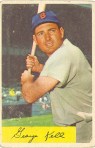
GEORGE KELL
I see by the papers that George Kell died yesterday. He was 86 years old. Kell played major league baseball, and played it well, for 15 years. He narrowly beat Ted Williams out of the 1949 American League batting title, and he is a member of the Baseball Hall of Fame – based largely on his tenure as the third baseman for the Detroit Tigers. The story about the 1949 batting race is one of the most often repeated episodes in the history of the game. On the last day of the season, the Tigers were playing the Cleveland Indians who inexplicably sent in their prize starter, Bob Feller, as a reliever. With Williams and Kell tied for the title, Tigers manager Red Rolfe suggested a pinch hitter for Kell in the ninth inning, but Kell refused to sit on the bench and win the title by not making an out. As it turned out, the game ended before he had to bat, and he beat Williams .34291 to .34276. Kell was reputedly one of the best contact hitters in the modern era. He was also a man universally admired, both as a baseball player and a baseball broadcaster. People speak of him with affection that a later generation might not have for, say, Alex or Manny Rodriguez. An bit of information in the reports of Kell’s death was that he lived in the same house in Swifton, Ark., from his birth in 1922 until the house burned down in 2001, and then lived – and died – in the house that was built on the same spot. It was an appropriate detail in the biography of a man known for steadiness, dependability. A salesman who used to call at my grandfather’s grocery store told me one day that he figured that I would stay in that store in that town for the rest of my life, as had my father and his father before him. That wasn’t for him, he said, he was going to see the world. I don’t know whatever happened to that man, but I doubt that his death will evoke the kind of sentiment I have seen today in papers around the country, prompted by the passing of a quiet man from Arkansas who never strayed from home.
“Smoke, if ya’ got ’em.”
March 24, 2009


BARBARA EDEN
The Daily Star in Beirut is running an ad on its web site for hookahs and tobacco. If I’m not mistaken, that’s Barbara Eden in the ad. It certainly doesn’t look like any Lebanese women I know. I guess the agency figured that since “I Dream of Jeannie” is still in vogue in the United States – well, it’s one of the series that gets re-run ad nauseam while better ones stay on the shelf – then Barbara would be a good image for this campaign. I’ve been told that my grandmother, Selma Aoun, whom I never met, smoked a hookah, which the Lebanese and Syrians call something like arghille. (I have pictures of my grandmother; she looked more like Salma Hayek than like Barbara Eden.) Another common Arabic term for the water pipe is shisha, which evokes one of the materials a person might smoke in such a device. I have never smoked more than a few cigars, but I have always envied the image of the smoker. Not the crowd I recently saw huddled outside the back door of a restaurant in Morristown, but the thoughtful pose of the Edward R. Murrow. I have always wanted to place a Meerschaum between my teeth during a conversation and nod from behind the blue haze as though to say, “Hmmmmm. I’ll have to see what Spinoza had to say about that.” According to family lore, my grandmother’s arghille had several pipes, so that she could share it with her visitors. I fantasize about getting out that fez I bought at the Moroccan restaurant at Epcot, sitting cross-legged on the floor, and squinting through the smoke at two or three men in dark glasses as we plan the raid on Aqaba. Of course, even if I could sit cross-legged on the floor at my age, I couldn’t get up without assistance.
“Better left unsaid.”
March 22, 2009

GOV. SARAH PALIN
The fact that Gov. Sarah Palin found it necessary to comment on President Obama’s careless remark about the Special Olympics shows how far she has to go to be considered a serious candidate for national office. Consider, by contrast, President Bush’s response in Calgary last week when he was asked about Obama’s administration. What Obama needs from me, Bush said, is my silence. I have done work on behalf of handicapped people for several decades, and I blanched when I heard Obama make that comment to Jay Leno. It was a clumsy thing to say – more so for a person who usually chooses his words so carefully – and one always wonders in such cases if the unguarded remark is indicative of the speaker’s point of view. But did that remark reveal that Obama has disregard or even disdain for handicapped people – this man who last month dispatched the vice president to the Special Olympics and who has appointed the first special presidential assistant on disability policy?
The Obama tongue has slipped before. During the campaign, he spoke about putting lipstick on a pig, and partisans of the governor accused him of referring to her. It was clear in the context that he was not speaking of Gov. Palin, but he should have known better than to use that expression during a contest in which there was the rare circumstance of a female candidate for national office. He set himself up.
On the other hand, when Obama, during the debates, had an opportunity to have at Gov. Palin, he wisely took a pass. That’s what she should have done in this case. She already had the stink of opportunism about her, and this further exposes her lack of elegance, of tact, of class. Whatever one thinks of Obama’s politics and policies, he has set the bar high with respect to demeanor. Palin, it seems, can’t reach that bar, even on tiptoes.
“Down to the sea in ships”
March 22, 2009

SS UNITED STATES
Travelers driving south on I-195 in Philadelphia might glance to their left and see a sight both thrilling and melancholy – the sepulchral remains of the SS United States, mouldering away at Pier 82. This is the passenger ship that in 1952 crossed the Atlantic Ocean from Britain to New York in three days, 12 hours, 12 minutes – averaging 38 knots. That broke the record held by RMS Queen Mary, which is now a hotel in Long Beach, California. The United States record still stands.
It was sometime around 1952 when my elementary school class took a trip to see the United States in her berth in New York. At that age, I hadn’t been anywhere outside of Totowa but Lavalette, Seaside Heights, and Erskine Lake, so this colossal ship made a lasting impression on me. I would be married with children before I set foot on a ship again. Ignorant and inexperienced as I was, it had never occurred to me that a ship would be that big, or that it would have amenities such as a movie theater
My son, from an early age, has been knowledgeable about passenger ships, and he asked me once, when we had plans to visit Norfolk, if we could visit the United States, which was then lying there in a derelict state. That wasn’t difficult to arrange, as it turned out. I was surprised, though, when we went down to the pier one day and were casually told by a caretaker to go on aboard and look around. Chris and I were the only human beings on the vessel, and we made the most of the freedom, looking into every corner. She had been stripped, but there were a few scattered scraps of her past, and Chris came away with a table linen with the ship’s green-and-white checked pattern, and a menu. One sight we were unprepared for was a coffin – held in reserve, I suppose, in case one of the kitchens had a bad night.

RMS QUEEN MARY
Among the sights was the movie theater, now in tatters, that had enthralled me when I was about the age Chris was when we went to Norfolk. There have been several reports over the years of the ship being sold, sometimes with the exciting insinuation that she might be restored and returned to service. The Norwegian Cruise Line was the most recent buyer with dreams of bringing the historic vessel back to life, but this is hardly the economic climate for such an undertaking, and it will not happen. Lovers of the United States are worried again about the real spectre of the scrap yard. There are organizations that are devoted to preservation of the grand old ship, including the SS United States Foundation and the SS United States Conservancy. Dan McSweeney, vice president of the conservancy, recently wrote about the plight of the United States and his vision of its possible future – including a role as either a floating hotel or a ship devoted to international relief services. McSweeney thinks in terms of a public-private partnership to achieve such a goal, probably a hard sell at this moment in history, but a dream we’re not embarrassed to dream with him.
Dan McSweeney’s column is at this link:
http://www.philly.com/inquirer/opinion/20090305_SOS_for_a_national_treasure.html?referrer=facebook
They are not gone; they are away.
March 21, 2009
 Today I am making sfiha, a meat pie of Middle Eastern origin. I don’t know what a regulation sfiha consists of. I have seen many recipes in our cookbooks and on line. No two of them are the same, and none of them are like the ones I make. I learned to make sfiha from my mother, and she learned it from her mother. If my mother and grandmother made it this way, this way must be legitimate, I figure. Even if that weren’t true, I wouldn’t change anything. I make them this way partly because we like them this way, but also because it is a means of perpetuating the palpable presence in this world of my Lebanese grandmother – whom I did not know – and my mother. Perhaps it’s part of a larger neurosis, but I am very conscious of things like that. In order to make sfiha – the way I make it and they made it – I have to cut a whole bunch of celery into thin slices. Before I do, I remove the leaves. My mother said the leaves have a taste – not unpleasant but a little bitter – that the stalks do not have, and that taste has no place in sfiha. Not the way we make it. It’s just as well, because my Italian grandmother taught me to save celery leaves and eat them with olive oil and a little salt. A simple thing, but a great delicacy. I eat celery leaves that way because I like them, but also because the taste of them makes my grandmother’s influence on me and her care for me alive again in a material way. For the same reason, I eat cold, sliced, boiled potatoes with olive oil and a little salt. Grandma taught me that. There’s nothing quite like it because, as she told me, the neutral taste of the potatoes is a perfect medium for the subtle tastes – plural – in virgin olive oil. For a similar reason, I prepare hard-boiled eggs by mashing them with a fork until they are the consistency of powder, and then eat them – lightly salted – with a spoon. I learned that from my Lebanese grandfather, who sits with me whenever I have hard-boiled eggs. And I learned from my Italian grandfather to baste a grilling steak with a mixture of vinegar and olive oil. He stands there a step or two behind me while the aroma of the drops hitting the flame take me back to summer afternoons long gone and a man never forgotten.
“You talkin’ to me?”
March 20, 2009

President Obama was on Jay Leno’s show last night, and showed again how comfortable he is in his clothes. He could have changed seats with Leno, and the show would have been none the worse for it. But Obama has an annoying speech mannerism that I first noticed during the campaign and that showed up three or four times last night. When he is asked a question, he frequently takes a breath and begins the answer with,”Look ….” The inflection suggests impatience if not condescension. Cokie Roberts has the same mannerism with the same inflection. Maybe some coach can help Obama get rid of it. Of course, the context for this observation is that Obama is president of the United States, Roberts is an NPR political analyst, and I’m an unemployed journalist and, oh, such a critic.
“Hello, I must be going.”
March 20, 2009

BARACK OBAMA
The television networks are getting impatient with President Obama’s requests for prime time. He’s holding a press conference on Tuesday, and that will mean – among other things – that “American Idol” will have to shift to a Wednesday-Thursday schedule. More than that, the networks will again lose top-dollar revenue that they can never recoup. Doesn’t the economic recovery program apply to them, they ask. I had a fleeting thought that the problem could be solved simply by moving Obama’s prime-time appearances off the major networks; that would separate the men from the boys, as it were, when Neilsen reported how the president did when he was up against Adam Lambert. I’d like to cast the networks as villains in this, but I can see their point even if I don’t think their revenues are more important than a public well informed on what the president is thinking in the present circumstances. I don’t have to balance their books. What concerns me more is that Obama is already overexposed, and the public may get weary of him and stop listening in the same way that it stopped paying attention to the color-coded terrorism alerts from the previous administration. As it is, expectations were unreasonably high when he took office, and the weeks since then have disabused most people from thinking they’ll see postive results overnight or in a week or a month or a year. His live TV appearances – especially following on an administration that avoided such exposure – may still be raising expectations, but that is likely to wear off. I read somewhere today that Obama is considering a series of much shorter appearances – something along the lines of Franklin Roosevelt’s radio addresses.
That reminds me of the movie “Room Service” and a scene in which Groucho Marx is trying to convince a playwright to go home to Oswego, appealing to the young man to picture his mother waiting by the fireside. “We don’t have a fireside,” the playwright says. “No fireside?” says Groucho. “How do you listen to the president’s speeches?”
“Papa played the dobro this-a-way”
March 18, 2009

ADAM LAMBERT
This morning, I came across an account in the Los Angeles Times of last night’s “American Idol” broadcast. I missed it. How careless of me to have accepted an invitation to a dinner party on “Idol” night. Well, truth be told, I wouldn’t have watched it anyway. In fact, I have never seen more than a minute or two of an “Idol” broadcast, and that only two or three times when someone else was watching it. This has as much to do with my not watching television very much as it has to do with any objection to that show in particular. But what caught my attention in this article was the reference to the contestants’ “reverence for the most traditional of American genres – country music.” What did the writer mean by “country music”? How did country music – whatever the writer meant by it – become more “traditional” than folk music – whatever I mean by that? And, Miss Turner, what’s “reverence” got to do with it?
I presume the writer had a straight face when he or she wrote that several contestants delivered “solid but respectful versions of country standards by Garth Brooks, Dolly Parton, and Carrie Underwood.” That’s Carrie Underwood – the “American Idol” graduate who was salutatorian of her high school class in Oklahoma. And the writer soberly added that Adam Lambert’s “psychedelic, sitar-backed” rendition of “Ring of Fire” was – according to an audience member visiting from Missouri – “disrespectful to country music.”
If we owe some sort of “respect” to country music, is it to be found in the over-produced material that Dolly Parton has been disgorging for the past few decades? To me that’s as “country” as Jackie Wilson’s “Alone at Last” was classical. “Country” has the smell of stale beer about it. “Country” is what we used to find in the 1960s at the old Coral Bar in East Paterson when Elton Britt, a singer with gold hanging on his wall, would drive himself up from Maryland to perform for a few dozen patrons who would recognize his voice even if their vision was blurred. “Country” is what we found back then at open-ended shows at the old Mosque Theater in Newark, where headline acts sometimes had to be nudged off the stage to make room for Little Jimmy Dickens or Ray Price or Webb Pierce, who were waiting in the wings. If a singer appeared in a torquoise outfit covered with rhinestones, the clothes just emphasized the common nature of the man or woman inside. “Country” was real, and if there was anything to respect in it, it was the unfiltered, unapologizing reality. But then, “reality” has taken on a different meaning in our time.
“The swiftness of wind, the depth of the sea ….”
March 17, 2009
 One thing we can learn from St. Patrick is not to dismiss the ideas of other people as though they had no value. Patrick converted people from old Celtic religions to Christianity, but he seems to have realized the merit in those traditions. The prayer attributed to him and recorded after his lifetime in the Book of Armagh exhibits something easily overlooked about so-called pagan faiths – that they recognized perhaps more clearly than monotheistic religious communities sometimes do the immanence of the divinity in everything that exists. That came across to us in Iceland a couple of years ago when we accidentally came across a group of people welcoming the summer solstice with an ancient ritual that addressed the gods present in nature. My generation of Catholics was taught at an early age, from the old Baltimore Catechism, that God is “the Supreme Being who made all things and keeps them in existence.” In our eagerness to imagine God in a form we can understand – which often means turning him into a human image and, therefore, not God at all” – perhaps we miss the chance to understand what that means: “and keeps them in existence.” Patrick’s prayer implies that he did not miss that chance:
“I bind to myself today the power of heaven, the light of the sun, the brightness of the moon, the splendor of fire, the flashing of lightning, the swiftness of wind, the depth of the sea, the stability of earth, the compactness of rocks.”
 CharlesPaolino's Blog