Thoughts while painfully idle
June 25, 2009

BLUE BUG
I’ve stayed as far away from the Octomom story as one can get while remaining on this planet. Still, I felt uncomfortably close when I stumbled over a photo in the Los Angeles Times. It shows a display mounted on the outside wall of a Volkswagen parts business in Whittier, Calif., where Nadya Suleman lived until recently. (It’s something on the subject of my distance from this story that I learned the woman’s name for the first time today. For real.)
The item in the Times reads, in part, as follows:
Back in February, the world’s media converged on Whittier hoping to get a glimpse of octuplets mother Nadya Suleman and her 14 children.
There, drivers can’t help but chuckle at a display owners Ralph and Diva Chase have set up. Mounted on the wall of the building is half a grabber-blue 1969 Volkswagen Beetle. Inside, a black-hair mannequin — respectfully named Teri, not Nadya — is sitting with her legs crossed and is surrounded by babies. A box of diapers sits on the bug’s roof.
Ralph Chase said his 22-year-old niece, Jenna White, put the display together, meant as a tribute to Suleman and her mark on Whittier. “She’s Teri’s stylist,” he joked.
They sometimes change Teri’s clothes to freshen her look, and some people have come by to donate clothes for the display.
What caught me up short was the blue Beetle. See, I drive a blue Beetle. It’s not a ’69; it’s a ’99 with more than 167,000 miles on it, but from a distance it looks uncomfortably like the one Teri and the kids are sitting in.
'THAT MAN'
So this is “a tribute to Suleman and her mark on Whittier.” It got me to wondering, if I were to sacrifice my Beetle to commemorate someone’s mark on Whittier, whom do I envision beaming out from behind the wheel. Oscar de la Hoya? Nomar Garciaparra? Andy Etchebarren? Eric Stoltz? Or – should I even say it? – That Man who, the tapes tell us, wanted to “destroy” Thomas Eagleton – “pipsqueak that he is”?
I have to go with Andy Etchebarren. He was the last player to bat against Sandy Koufax – and he hit into a double play. That seems about right.
Hillary’s folly?
June 24, 2009

INUIT WOMAN sciencepoles.org
It was always the subject of some mirth, in the heyday of the Soviet Union, that the name of the most prominent newspaper there – Pravda – meant “truth.” The paper was shut down in 1991, but the name lives on in several forms, including another daily paper and an independent web site — pravda.ru.
I have never seen the newspaper, but the web site, if anything, is worth even more laughs than the old Soviet sheet. While it carries a lot of breaking news stories, much of the content would fit in well at the supermarket checkout line. Among the headlines on the site today, for example, are “Atlantis Found Under Antarctica,” “Russian Scientists Contact Nether World,” and “U.S. Scientists Unveil Secrets About Cities on the Moon.”

GREENLAND ICE MELTING
There was also a headline that I found especially compelling: “Greenland to Become 51st State of the United States.” The bulk of the story was about a law passed by the Danish parliament that expands Greenland’s autonomy in a couple of ways related to management of natural resources and foreign policy. The writer was tentative about some of the facts, remarking, for example, that Greenland is “presumably populated by the Eskimos” and that “the majority of Greenlanders are presumably employed in the fish-processing industry.”
One doesn’t have to read between the lines to get the impression that the writer has a low opinion of the native people in Greenland — who prefer to be called Inuit, not Eskimos. The story reported, for example, that “Many in Denmark believe that the Greenlanders are not ready for their independence. It’s not for the high level of social problems, alcoholism and suicide rate. The majority of Greenland’s qualified specialists come from Denmark. The gap between them and the culture of hunters and fishers is too large.” Well, excuse me for living!
The only thing in the story that supports the headline is the last paragraph:
“There is another relevant reason which puts Greenland’s independence into question. The island may quickly become the 51st state of the United States if it acquires sovereignty. The White House has been showing interest in the island since the 20s of the 19th century.”
Where is William Seward when you need him?
Netflix 12: “Changeling”
June 23, 2009

ANGELINA JOLIE
We watched “Changeling,” a 2008 film produced and directed by Clint Eastwood and starring Angelina Jolie and John Malkovich. This film which, I gather from independent reading, sticks fairly close to the facts, recounts the story of a 1928 kidnapping case in Los Angeles. Walter Collins, a nine year old boy, disappeared from his home and was never seen again. A boy found several months later in DeKalb, Illinois, claimed to be Walter Collins, but Walter’s mother, Christine (played by Jolie), told police the boy was not her son. The LAPD – which at the time was ridden with scandal and under public pressure to solve the Collins case — insisted that the boy was Walter and that the mother was delusional. Eventually, under a prerogative the police had at the time, police Capt. J.J. Jones (played by Jeffrey Donovan) had the woman committed to the psychiatric wing of a Los Angeles Hospital. A seemingly unrelated immigration case led police to Gordon Norcott (played by Jason Butler Harner), a murderous Canadian whose arrest figured in the somewhat incomplete resolution of the complicated case.

JASON BUTLER HARNER
This film is two hours and 22 minutes long — and that’s after two scenes were cut from the final version. It is arresting, however, even for that long — and that’s due at least in part to the awareness that the bizarre events being portrayed on the screen actually occurred.
Angelina Jolie was nominated for a “best actress” Oscar for this role, but there were equally powerful performances by Harner and Donovan. Harner appears on the screen for the first time in an inocuous situation — his car has overheated — and he has no known connection to the story, but he plays that scene in such a way that it’s immediately apparent that there is something very wrong with him. The more we see of him, the more he makes our skin crawl.

JEFFREY DONOVAN
Jeffrey Donovan is effective as the bullheaded and myopic police captain. His behavior so defies simple logic that he would have fit in well at the trial of the Knave of Hearts. Donovan’s unyielding demeanor makes the character the personification of self-justifying bureaucracy. Malkovich presents a study of the Rev. Gustav Briegleb, a Presbyterian minister who campaigned against political corruption and other things he regarded as immoral, and who provided Christine Collins with support that turned out to be critical to her own well being. Briegleb is portrayed here as a radio preacher, but he was not a broadcaster in real life. He was also known to publicly express his anti-Semitism. However, this film sets out to tell the story of Christine Collins, not of Gustav Briegleb, and other sources suggest that Malkovich correctly plays the minister as tough and single-minded.
There are some upsetting albeit not overly graphic scenes involving murder and an execution, but these things are worth facing in a film that reminds us of how much damage can be inflicted on individual lives by corrupted public institutions.

JOHN MALKOVICH
Grasping at straws
June 22, 2009

THE GIGLIO
You have to see this to appreciate it: Men of Our Lady of Mount Carmel parish in Williamsburg dancing through the streets with a 65-foot-high, three-ton tower on their shoulders. It’s such an exquisite demonstration of — well, I’m not quite sure what it demonstrates — that it would be sacreligious to question it. Like Jerry Lewis’s career and the popularity of sushi, it just is.
The occasion is a belated celebration of the feast of San Paolino. The feast day is today, but the dance of the giglio will take place on July 12 during the parish’s annual street fair.
My attention was attracted to this, of course, because of the name of the saint. On an English church calendar, one finds him listed as St. Paulinus of Nola. His full name, rendered in Latin, was Pontius Meropius Anicius Paulinus. The dance of the giglio is a tradition that was imported to Brooklyn and a few other spots in these United States from Nola, the Italian city where Paolino was bishop in the fifth century. Although his feast is celebrated with sausage and peppers and zeppoli, he wasn’t Italian. This is part of a pattern in which one national group attaches itself to a saint who actually is from somewhere else: St Anthony of Padua from Portugal, St Nicholas of Bari from what is now Turkey, St Patrick from Britain, for example.
Paolino, or Paulinus, was born in Bordeaux. He was highly bred and wealthy and he had political power, but he and his wife put all that aside for religious life. Paolino became very influential in the church and was closely associated with St. Jerome and St. Augustine, among others, and his poetry is still highly regarded and, in fact, is the subject of a current book.

SAN PAOLINO
At one point, before he entered religious life, Paolino was Roman governor of Campagna, which is not far from where my family lives. However, I must confess that my connection to him is tenuous – what with him being French and celibate and all. But I take what I can get and throw his name around whenever I get the chance.
The giglio, incidentally, is a tower covered with paper lilies – hence the Italian term giglio — with a statue of the saint perched on top. The tower rests on a platform on which a small band is seated, and the men of the parish carry this whole assembly on their shoulders.
Although I have to admit, when challenged, that San Paolino and I probably have nothing to do with each other beyond our common baptism, I still feel I have made some progress.

PAOLINO UZCUDUN
After all, when I was a kid and hadn’t yet heard of the saint from Nola, I clung to a clumsy heavyweight named Paolino Uzcudun, whose claim to fame was that his title fight with Primo Carnera represented the greatest combined weight ever in a championship bout.
Here’s your hat. What’s your hurry?
June 19, 2009

HRH ELIZABETH II
AUDREY HEPBURN
 Bill McGraw writes in the Detroit Free Press about what seems like the increasing tendency of political figures to invoke the name of God to justify virtually anything. The immediate inspiration for McGraw’s column was a remark by Detroit City Councilwoman Monica Conyers, who is in the crosshairs of a potential federal bribery indictment. “On Tuesday,” McGraw writes, “when it became clear the feds were closing in on Conyers, she described herself to viewers of her weekly TV show as ‘a child of God,’ and told viewers ‘if you’re not praying for me, then you’re just adding to the problem.’ Then she added: ‘All these things that are going on right now … I believe in my heart that God will deliver me from them.’ ”
McGraw went on to reminisce about invocations of the Diety by Detroit public figures over the past couple of decades, including former Police Chief William Hart who was charged in 1989 with using public funds to subsidize $72,000 in rent on his daughter’s former home in Beverly Hills. “With God as my witness,” Hart said, “I swear I did not do that.” He was subsequently convicted of stealing $2.3 million.
 McGraw observed that few office holders have made as many public references to God as did George W. Bush while president of these United States. “I trust God speaks through me,” the president told an audience in Lancaster, Pa., in July 2004. “Without that, I couldn’t do my job.” I’ve seen that quote many times, and I’ve always suspected that the president said, or at least meant, “I trust God speaks to me.” I don’t know about George Bush, but I don’t think I would attribute to God many of the things that come out of my mouth.
“Shoot me a pot, and I’ll pour me a shot.”
June 15, 2009
THE INK SPOTS
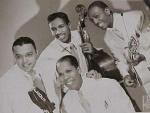
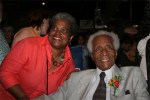
Whatever may be wrong with the age we live in, it has this advantage: Anything can pop into your head and you can find it on line. The Ink Spots, for instance. The other day I noticed an obituary for Huey Long – not the Kingfish from Louisiana, but the Texan who was among the legitimate members of the Ink Spots singing group.
One has to qualify members as “legitimate,” because successful singing groups often have a kind of pseudo-life that goes on and on long after the original DNA has sputtered and died. Anything “legit” about the Ink Spots had disappeared by the early ’60s, but today there are still guys billing themselves under the group’s name.
By some counts, there were eleven men who could call themselves Ink Spots without running afoul of the criminal code, and Huey Long, who died last week at the age of 105, was one of them.
HUEY LONG AT 103
Reading about Huey Long’s death put a song in my head — “If I Didn’t Care.” This song is one of my earliest musical memories; I remember hearing it on the radio that was on all day in our house when I was growing up. Also, my parents had several of the group’s Decca recordings. I looked around on line and soon found a video of the real Ink Spots singing that song. They approached many of their songs in the same way: the tenor sang the melody and a bass then recited either the same lyric or the bridge, embellishing it with terms like “honey chile’ ” and “darlin’ .”
One of my favorites among the Ink Spots recordings is “Java Jive,” which I found at http://www.archive.org/details/JavaJive . I think that song was original with them. The only rendition I like as much as theirs is Christopher Lloyd as Jim Ignatowski, singing it in the Sunshine Cab Co. garage on “Taxi,” but that’s a whole other thing. I also like the Ink Spots recording of “My Prayer” by George Boulanger and Jimmy Kennedy — which was the number 3 record in the country for a while in 1939. It’s been recorded by at least 40 different artists, ranging from the Platters to the Mantovani Orchestra. The Ink Spots version is at http://www.last.fm/music/The+Ink+Spots/_/My+Prayer
Joy, joy, joy
June 13, 2009

JOY BEHAR
I don’t know why this took so long, but I’m glad to see that Joy Behar is finally going to have her own TV talk show. It will be on at 9 p.m. weekdays on HLN, the network formerly known as Headline News.
I listened reguarly to Behar’s radio show on WABC in New York. I didn’t always agree with her – particularly on religious issues – but I was drawn in by the combination of wit, intelligence, and common sense and by her willingness to listen to other points of view. In fact, I called in to her show several times, and she always gave me enough time to say what was on my mind.

JOY BEHAR
While she was still doing that radio show, I wrote a long profile of her. I remember the lead: “Joy Behar is a chiacchierone” – that being the Italian term for “chatterbox.” I spent about an hour with her at WABC, and I later talked by phone to the station manager, who told me Behar’s show was doing well and that he had just signed her to a new contract. It wasn’t long after that that she was fired, not a surprising turn of events in radio. She seemed too liberal and too outspoken in general for the management of that station, but she wound up working for the same parent company when she got her position as a co-host of “The View.”

ANN COULTER
It isn’t possible to judge Behar’s potential as a TV host based on “The View,” because guests aren’t given enough time on that show and the hosts often talk simultaneously. There was a better example of her work recently when she substituted for Larry King and interviewed Ann Coulter. When Coulter appeared on “The View” the conversation deteriorated into babble as everyone tried to make her point at the same time in a contentious atmosphere. On the King show, however, Behar and Coulter were able to have a linear conversation in which – though they may be polar opposites in many ways – they showed each other mutual respect and the viewer got a chance to learn something from the dialogue.
At last, something to look forward to in the bleak landscape of television.
A little man passes from the scene
June 11, 2009
STEPHEN T. JOHNS
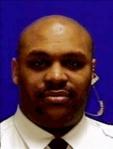
So James von Brunn finally got what he wanted. After years of sitting around drinking red wine and spouting anti-Semitic and anti-black rhetoric, the little man made himself important. The only justice in the matter is that von Brunn is nearly dead and that most of us will soon forget his name. Like the melting wax the psalmists liked to write about, he will be unimportant and useless – a fate that probably would have annoyed the hell out of him. It’s tragic and sad that Stephen Johns, a man who mattered, had to cross paths with von Brunn at the Holocaust Memorial Museum just when the non-entity was being important.
But long after we have to ask each other the name of the jerk that shot Stephen Johns, the more insidious purveyors of anti-Semitism and racism will be doing their work in deserved but dangerous obscurity. Like the priest I once knew who told another priest in the presence of two young altar servers that the actor Mickey Rooney wasn’t a “Mick” but had changed his name to hide the fact that he was a “Hebe.” Rooney did change his name from Yule, but I don’t know that he was Jewish. He’s been a Christian for many years. But whatever the facts about Rooney may be, it was an offensive way to refer to Irish and Jewish people and an offensive imputation about Rooney’s motives. When I asked the priests if they realized the boys had heard their conversation, their rationale was that the kids wouldn’t know who Rooney was and probably didn’t understand those terms.
A neighbor recently was explaining at a party how Jewish people were responsible for a lot of the current economic difficulties because, as we all know, they control the wealth. Apparently because he knows I’m a clergyman, he leaned toward me and asked, “That’s what Jesus had against them, isn’t it?” “Jesus was Jewish,” I said, “and most of the people he spent his life with were Jewish.” And my neighbor blushed a little and scratched his head and said, “Oh yeah. That’s right.”
In the long run, people we meet in everyday situations, people who go around confirming in casual conversation age-old stereotypes, often to willing or indifferent audiences, are at least as insidious as people like von Brunn who nurse the same mindless errors until they blow their tops.
Netflix Update No. 11: “Dear Frankie”
June 10, 2009

EMILY MORTIMER
We watched “Dear Frankie,” a 2004 movie shot in Scotland, directed by Shona Auerbach. The story concerns Lizzie Morrison, played by Emily Mortimer, a single mother who has spent years avoiding her husband, Davy, who physically abused her and their son, Frankie (Jack McElhone). As the film opens, mother and son — accompanied by Lizzie’s mother, Nell (Mary Riggans), have moved again to a seaport town in Scotland.
To shield Frankie from the hard facts of his past, Lizzie has maintained the fiction that the boy’s father is a merchant seaman who travels the world aboard HMS Accra. She regularly writes letters to Frankie over his father’s name — often including exotic postage stamps — and Frankie writes back in letters that Lizzie retrieves when they are returned to the post office.

JACK McELHONE
Frankie is deaf and rarely speaks — though he can — but he is exceptionally bright and excels at reading lips. One of his schoolmates discovers in a newspaper shipping news item that the Accra, which Frankie thinks is headed for the Cape of Good Hope, is actually to dock in that Scottish town in a few days. This information spurs Lizzie to search for a man who can pose as Davy for a few days. Through one of her few friends in town, she hires a man whom she requires to have “no past, no present, no future,” and he appears — with no name as well — in the form of Gerard Butler. He presents a grim figure, but it appears from the beginning of his relationship with the Morrison family that their bizarre situation piques first his curiosity and then his interest.

GERARD BUTLER
As Lizzie and the nameless imposter carry on the charade with Frankie, Nell discovers that Davy or someone on his behalf has been searching for Lizzie and is close at hand.
This story, which was written by Andrea Gibb, could easily have disintegrated into absurdity, but no such thing happens. Offbeat as they are, the issues in this film are family issues, and they are presented in terms of the private pain and fear and disappointment that are not strange to many people. These characters and their situation have about them the smell of reality, and Auerbach firmly grounds them with every aspect of her direction, but particularly with her use of real time — pauses, stillness, silence that some directors might be afraid to employ. There is, perhaps famously by now, a scene in which Lizzie and the imposter stare at each other for what seems like minutes, though it seems that long only because it is longer than many directors would dare to abandon motion and sound. In lesser movies, their mutual stare might have led to a cheap and easy consequence, but not here.
One caveat. As annoying as subtitles can be, we left them on, because some of the actors’ pronunciation makes the dialogue difficult to follow.
 CharlesPaolino's Blog