Netflix Update No. 23: “Daphne Laureola”
November 9, 2009
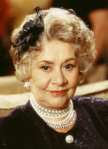
JOAN PLOWRIGHT
On the theory that there’s no such thing as too much of Joan Plowright, we watched “Daphne Laureola,” a 1978 British television production of a 1949 play by James Bridie, actually a Scottish physician born Osborne Henry Mavor. Sir Laurence Olivier, who rated this play as one of the six best in the 20th century, appears in this adaptation along with Plowright, who was his third wife.
In this romantic comedy, Olivier plays the elderly Sir Joseph Pitts and Plowright plays his 50-year-old wife whose first name — perhaps deliberately — is never given. When Lady Pitts dines alone at a restaurant in London’s Soho district, her overindulgence in alcohol launches her into a uncontrolled monologue that alternately amuses and horrifies the other patrons. The one exception is Ernst, a young Polish student who becomes infatuated with her — comparing her place in his life to that of the nymph Daphne in the life of the Greek god Apollo.

LAURENCE OLIVIER and JOAN PLOWRIGHT in "Daphne Laureola"
Lady Pitts collects the names and addresses of seven of the customers — including Ernst — and promises to invite them to tea. She does, but by the time the appointed hour arrives, she has forgotten not only the invitations but the guests and the circumstances under which she met them.
Ernst has not forgotten, though, and his pursuit of an ill-defined relationship with Lady Pitts — and the manner in which Sir John and his lady deal with Ernst — provides the substance of the play.
The cast, which I believe was chosen by Olivier, is outstanding. Clive Arrindell as the deadly earnest young man who is blind to the absurdity of his situation gives a bravura performance. Bryan Marshall has a strong turn as Vincent, the Pitts’ despicable house servant and driver who doesn’t approve of Ernst nor, it seems, of Sir John, Lady Pitts, or their marriage. Olivier is moving as the baronet who knows his life is nearing its conclusion, and Plowright, of course, is Plowright. Lady Pitts is designed to befuddle the other characters and the audience, and Plowright is the woman to make her ladyship do it.

DAPHNE LAUREOLA
In the course of the play, Lady Pitts instructs Vincent to have a daphne laureola plant installed in the garden at her home, a plant Sir John insists will die because it has been planted in the fall. Lady Pitts refers to the plant as a laurel, but the daphne laureola is not a laurel — in fact, it’s a noxious weed, which was perhaps an obscure insinuation by the playwright.
The clash in this play between the nearly insane romantic obsession of the young student and the decidedly non-poetic disposition of the people around him provides the fun, the drama, and the heartbreak of this work.
We stumbled on this in the kind of accident that often occurs on a site like Netflix, and we’re glad we did.
“I wish to be left alone. Since you ask me what I wish … that is my answer.” — Ebenezer Scrooge
November 7, 2009

JIM CARREY
I wasn’t surprised by the tone of Becky Sharkey’s review — in the Los Angeles Times — of Robert Zemeckis’ production of “A Christmas Carol,” yet another corruption of Charles Dickens’ morality story.
Sharkey gives the filmmaker some credit for the effects he creates:
“The film really does work the 3-D application in remarkable ways, possibly the best that we’ve seen from filmmakers, almost making the cost of those weird glasses worth it.
“But the most affecting multidimensional moments are not the blown-out action sequences with this or that tumbling toward you, which is what you might expect. Instead, it’s the way you seem to float through the snow and over the rooftops of London, the sensation of movement and depth making it feel as if you’re perched on the cameraman’s shoulder as he swings the lens around, capturing the city and its citizens from all sides.”

JIM CARREY
Overall, though, Sharkey found the film overbearing and in no way endearing.
I’m on record ad nauseam as disdaining movie makers who think they can tell the stories of a Dickens or a Lewis Carroll or a Victor Hugo better than the authors themselves. I’m too tired to beat that drum right now.
I was amused, however, by two passages in this review:
“We won’t linger on the story, since you’ve no doubt caught one of the countless adaptations since the Charles Dickens piece was first published in 1843.”
“The dialogue includes lines many of us could recite by rote from watching various tellings of the story over the years (an excellent version with George C. Scott is one of my favorites).”
It didn’t occur to Sharkey, apparently, that someone might have actually read the story.
You can read Sharkey’s review at this link:
http://www.latimes.com/entertainment/news/la-et-christmas-carol6-2009nov06,0,1734067.story
 It’s hard to imagine in our time any amount of hype being dismissed as “too much,” but that’s how former President Bill Clinton’s handlers have described the marketing of a planned joint appearance by Clinton and former President George W. Bush. The event, which was to have taken place at Radio City Music Hall on February 25, has been cancelled on the grounds that it was oversold as the toughest face-off since Leo the Great and Attila the Hun.
Ticket prices for this event, in which the two former chief executives were to have discussed various issues of domestic and foreign policy, were to range from $60 to $160.
 This would not have been the first time the two men have shared the same platform; they did it in Toronto in May. Although there were some reports that each was paid $150,000 for that gig, that has not been confirmed, nor has any information been forthcoming about what they might have been paid if the Radio City event had gone on as planned.
News reports of the Toronto appearance indicated that Clinton and Bush did not sharply disagree on many issues, so the language used to promote the New York appearance struck me as odd from the outset. The context is that Clinton and the first President Bush have formed a good post-White House relationship, and the younger Bush hasn’t been at all politically combative since he left office. If Harry Truman could make peace with Herbert Hoover, why not Clinton and the Bushes. This was looking like a love fest despite the marketing lingo.
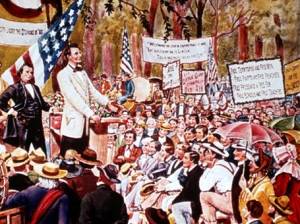
I was especially amused by the description of the encounter that has now been cancelled as “the hottest ticket in political history.” I wonder what Mr. Lincoln and Mr. Douglas — wherever they now repose — think of that.

WARREN SPAHN
I know all about that, Mr. Damon. Baseball is all about chickens and hatching and not counting prematurely.
I was at the fourth game of the 1958 World Series with my father, my brother, and Mike Ferrante. The Yankees lost that day to Warren Spahn, one of the greatest pitchers of all time. The Milwaukee Braves, who had beaten the Yankees in the ’57 World Series, were ahead three games to one. When we got home, some of our friends were there, waiting for their chance to gloat over what looked like certain annihilation.
But it was not to be. The Yankees won the next three games and the title.
Of course history and the odds are not in the Phillies’ favor. Teams that have won three of the first four games have gone on to win the World Series 34 of 40 times. The last time a team bucked that trend was 1985, when the St. Louis lost the last three games to Kansas City.
If the Pirates’ manager, John Russell, wants to know how he can pull off such a miracle this year, I can only offer him Casey Stengel’s explanation after the Yankees sunk the Braves in ’58: “I couldn’t have done it without the players.”
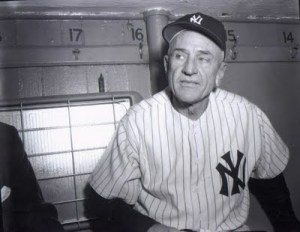
CASEY STENGEL
“Buy me some peanuts and Cracker Jack.” — Jack Norworth
November 1, 2009

CC SABATHIA
The image of CC Sabathia lumbering out to the mound tonight as the Yankees and Phillies continue the World Series naturally got me to wondering about how Sabathia sizes up, as it were, among the largest players in baseball history. We baseball fanatics always like to know about the extremes. Determining Sabathia’s rank, it turns out, is an inexact process for several reasons: teams don’t always report accurate weights for their players, players’ weight can fluctuate significantly over the course of their careers, and records from the early days of major league ball are unreliable or nonexistent.
With those caveats in mind, I note that Sabathia’s weight has been reported this year as 290 pounds, which is very heavy for a baseball player. The weight of most of about 16,000 players who have appeared since 1876 has ranged from 160 to 200 pounds. Only 1,057 players during that period weighed under 160, which– for example — was Phil Rizzuto’s playing weight.

ALBIE PEARSON horsing around with Angels manager BILL RIGNEY
Being a lightweight hasn’t necessarily impeded a player’s success. Rizzuto is one example. Albie Pierson, whom I mentioned here recently in another connection, weighed only about 140 pounds, but he had a respectable career as an American League outfielder, batting .270 over nine seasons. I don’t know who the lightest legitimate major league player was, but there have been 13 who weighed under 130 pounds. Eddie Gaedel, of course, who made a single plate appearance with the St. Louis Browns — a stunt by Browns owner Bill Veeck — weighed only 65 pounds. Because Gaedel had been signed to a contract and completed an at-bat, he is officially the lightest major leaguer.
The person currently being recognized as the heaviest player in history is Walter Young, a first baseman who appeared in 14 games with the Baltimore Orioles in 2005. Young’s weight that year is placed at 322 pounds. He is six-foot-five. Sabathia is six-foot-seven.
I haven’t been able to determine if Young is still in pro baseball. After his stint in Baltimore, he played in the Padres’ and Astros’ organizations — though not in the majors — and he played with several other clubs until August of this year, when he was released by the Edmonton Capitals of the Golden Baseball League.

WALTER YOUNG
Young wasn’t with the Orioles long enough to demonstrate how a man of his size could perform in the major leagues. He had 33 charged at-bats in 14 games and hit .303 with one home run. Although it’s difficult to imagine a man of such girth making the kinds of stops made by, say, Mark Teixeira, Young played 54 innings at first base that year, participated in nine double plays and made no errors. All of this projects out to a good full season, but we likely will never know if Young could have played at that level for 162 games.
If Young is through with baseball — or is it the other way around? — he did leave his mark in a certain way. He spent part of the 2008 season with the Sioux City Explorers, who are affiliated with the Yankees and the Indians, and he played an important part in the Explorers’ American Association championship. Young appeared in 26 games and hit .367 with 5 home runs and 29 RBIs.

HIPPO VAUGHN
The player whose nickname made the most blunt reference to his weight was James “Hippo” Vaughn, who pitched in the majors from 1908 to 1921, including a couple of seasons with the New York Highlanders, as the Yankees were originally known. Vaughn was six-foot-four and weighed 215 pounds. His bulk apparently worked to his advantage in some way, because he won 20 games in five different seasons — a rare achievement, relatively speaking.
Vaughn, incidentally, was involved in one of the oddest games ever played in the majors — a 1917 contest in which Vaughn started for the Chicago Cubs and Fred Toney started for the Cincinnati Reds. That was the only game in history in which neither starting pitcher allowed a hit for nine innings — a double no-hitter. Vaughn lost the game in the tenth inning. Because of a rule change that occurred much later, Vaughn does not get credit for a no-hitter, which is absurd. Fred Toney, who does get credit, weighed 195 pounds.
“It’s very simple: Keep your eye on the ball.” — Joe Sewell
October 31, 2009
 The coverage this week of Derek Jeter receiving the Roberto Clemente Award got me to wondering again about how he will be regarded a few decades from now. I’m not questioning Jeter’s qualifications; the performance and the stats are there. But baseball immortality, if that’s the right word, comes in more than one form. Many players of at least Jeter’s ability are enshrined in the Hall of Fame, and their statistics are indelibly spread upon the record book, but they are largely forgotten except by people like me who have nothing better to occupy their minds.
Jeter isn’t done, and his career base-hits total promises that his name will come up again and again when that category is open for discussion. But whether he will take on a more transcendent presence in the baseball conversation of the future — especially outside the New York area — is not at all certain.
 A player who comes to mind in this regard is Joe Sewell, who was a starting infielder in the American League from 1920 to 1933, the last three years with the Yankees and the rest with the Cleveland Indians. Sewell got into the Indians’ everyday lineup as a replacement for Ray Chapman, who was killed by a pitch thrown by the Yankees’ Carl Mays. A couple of Sewell’s batting statistics compare favorably to Jeter’s. His lifetime batting average was .312 compared to Jeter’s .317, and his on-base percentage was .391 compared to Jeter’s .388. But hidden in that on-base percentage was a factor that made Sewell one of the most remarkable players in history.
 Sewell was the hardest man to strike out in the history of the game. Not by a little bit, by a lot. No one else comes close. He came to bat 7,132 times, and he struck out 114 times. Nick Swisher, to pick a convenient example, strikes out more than that every year — 129 times in 2009, for instance. There were four seasons in which Sewell played every day and struck out only four times — only three times in 1932, which is the all-time record. He once went 115 consecutive at-bats without a strikeout — also the record. Over his career, he averaged one strikeout per 63 at-bats. The closest challenger is George Stone who, over seven years in the early 20th century, struck out once in every 50 at-bats.
It’s always risky to talk about sports records that will never be broken, but it’s safe to say that I’ll be shagging flies with Shoeless Joe and “Moonlight” Graham long before anyone makes contact better than Old Whatshisname.
 We have attended several of the Metropolitan Opera’s live theater broadcasts — most recently “Aida” last Saturday. If you haven’t tried it, you should. Not an opera fan? That could be just the point. Seeing these operas on the big screen with cinematic camera shots is a different experience from the crow’s nest at the Met. For anyone who has been thinking of taking a first look at opera through this program, I strongly recommend “Carmen” on January 16. Buy early and show up at the theater an hour before the broadcast. These broadcasts all sell out.
 The next opera we’re going to see is “Turandot” on November 7, and we’re very interested in Verdi’s “Simon Boccanegra” on February 6, both because we’ve never seen it and because Placido Domingo will appear in a baritone role. He sang it for the first time last week in Europe.
This business of a singer switching ranges is rare but not unheard of. Enrico Caruso, is should be no surprise to learn, could sing well in all three male voices and made a recording, which is still available, of “Vecchia Zimarra,” a basso aria from Giacomo Puccini’s “La Boheme.” That aria is often overlooked — after all, the tenor doesn’t sing it — but it is touching, especially in the context of the story. Colline is about to sell his old coat to buy medicine for the dying Mimi.
 What’s even more interesting than that recording is that Caruso once sang that aria during a performance in Philadelphia. The basso, Andres de Segurola, had complained earlier of a sore throat, and Caruso — who was singing Rodolfo — anticipated trouble. Sure enough, de Segurola signalled that he couldn’t sing “Vecchia Zimmara,” so Caruso sang it while the basso mouthed the words. The audience, for the most part, was unaware of what was occurring. That’s de Segurola at the left in a caricature drawn by Caruso.
There’s more about Enrico Caruso at this link:
http://medicine-opera.com/2009/04/03/the-recordings-of-enrico-caruso-1914-1916/
The Times of London reports on Domingo’s debut as a baritone:
http://entertainment.timesonline.co.uk/tol/arts_and_entertainment/music/article6889879.ece
“You sing a bingo bango bingo” — Tom Glazer
October 27, 2009
 During the last ALCS game, I got this lyric stuck in my head: “So who would want these diamond gems? / They’re diamonds in the rough. / A baseball team needs nine good men. / One guy just ain’t enough.”
I remember hearing that on television about 50 years ago. It was sung to the tune of “Yankee Doodle,” and it got stuck in my head. Every once in a while it comes to the surface.
When it came to the surface the other day, I decided to do what I always tell my students to do — look it up. In the Internet age, that’s a lot easier than it used to be, although this song seemed so obscure that I didn’t expect to track it down.
 By searching on a phrase from that lyric I actually found one reference to it. It turns out that it’s part of a jingle that was used in one of a series of public service announcements sponsored by the American Jewish Committee. An application for a grant to help fund the series turned up on a site that houses the archives of the AJC. Among the documents was a page from an issue of TV Guide dated April 28, 1951. On the page was a short article about this animated short that was part of a larger, award-winning anti-bigotry campaign by the AJC. The short was designed to reinforce the idea that people of many backgrounds contributed to life in the United States.
 The animated cartoons were by Fred Arnott and the song was written by Lynn Rhodes. I could find out nothing more about either of them. However, the song was sung by Tom Glazer, who had a decent reputation as a folk singer. A lot of people of a certain generation will remember his novelty song “On Top of Spaghetti,” a children’s song he recorded in 1963. He also wrote “Because All Men Are Brothers,” which was recorded by the Weavers and by Peter Paul, and Mary, and “Talkin’ Inflation Blues,” which was recorded by Bob Dylan. Glazer wrote idiotic and kind of racist lyrics to “Skokian,” a Zimbabwean song that was popular in multiple versions. Glazer’s version was recorded by the Four Lads.
Anyway, the song he sang for the AJC went like this:
Though every player is top flight / Our team just falls to pieces / With every game they have to play / The number of flubs increases.
To figure why they fall apart / You needn’t be too clever / With no teamwork the team’s big star / Will die on third forever.
The shortstop simply cannot play / With the jerk who’s second sacker / The pitcher can pitch to anyone / But certainly not to his catcher.
So who would want these diamond gems? ‘/ They’re diamonds in the rough / A baseball team needs nine good men / One guy just ain’t enough.
A nation’s like a baseball team / It’s run by teamwork too. / And every race and every creed / Works with Y-O-U.
Play ball with all your neighbors / Pitch in a little more / Americans, join your teammates all / Roll up a winning score.
Netflix Update No. 22: “Phoebe in Wonderland”
October 26, 2009

ELLE FANNING
We watched “Phoebe in Wonderland,” a 2008 fantasy written and directed by Daniel Barnz.
This film is an off-beat tale about a nine-year-old girl, Phoebe Lichten (Elle Fanning), who is brilliant and creative, but who confounds her parents and her rigid teachers and principal with outbursts of inappropriate remarks and behavior.
Phoebe’s mother, Hillary (Felicity Huffman as a brunette), is frustrated by her inability to find time — amid housekeeping and raising two little girls — to convert her academic dissertation on Lewis Carroll’s “Alice” novels into a book. With her mother’s encouragement, Phoebe has immersed herself in Carroll’s fanciful neighborhoods to the point that she has frequent imaginary encounters with his characters. The competing forces in Phoebe’s psyche are effectively portrayed by Barnz through the blurring of identities between people in Phoebe’s real life and Humpty Dumpty, the Caterpillar, the White Rabbit, the Red Queen, and the Mad Hatter

PATRICIA CLARKSON
Coincidentally — or not, depending on your point of view — Miss Dodger, the new, idiosyncratic drama teacher (Patricia Clarkson) is mounting a musical production based on Carroll’s stories. This enterprise becomes a kind of sanctuary for Phoebe — the one place where she can overcome her compulsive outbursts. But there is too much amiss with the little girl, and with her parents, and with the management of the school, to stave off a crisis and an unexpected if not totally comfortable resolution.
Like the film “Millions” which I wrote about here on October 19, this is not for viewers who take things literally or insist on reality in their movies. The film is blessed by a talented cast — also including Bill Pullman as Peter Lichten, Phoebe’s father, and Bailee Madison as Olivia, Phoebe’s sister. The beautiful Tessa Albertson has a brief but haunting non-speaking role as Alice.

TESSA ALBERTSON
This film argues that a person cannot be defined by one or two aspects of her personality. The world around Phoebe — her parents, her siblings, her peers, and most of her teachers — failed her as long as they embraced only the “acceptable” parts of the girl or hoped to make the whole girl acceptable to them by badgering or ridiculing her.
The inscrutable Miss Dodger and the fleeting figure of Alice — who may be better acquainted than they let on at first — provide the only unqualified reassurance Phoebe receives that she, with her strengths and her weaknesses, is a person of value.

FELICITY HUFFING, ELLE FANNING, and BILL PULLMAN
“All the kids are my family.” — Willie Jefferson
October 25, 2009

CHLOE SMITH and WILLIE JEFFERSON / Copyright StoryCorps
The custodians at Memorial School when I entered kindergarten in 1947 were Charles Dunkerly, Archibald Brown, and George Schmidt. Mr. Dunkerly retired a couple of years later, and there was a tear-filled party for him in the lunchroom. He was replaced by Henry Knoblock.
While I was there, Memorial School mounted a production of “The Marriage of Tom Thumb” which, as the name implies, was a wedding in miniature. Staging this wedding was, I think, a popular diversion in schools at that time. It got its name from an historic event — the marriage in 1863 of Charles Sherwood Stratton and Livinia Warren Bumpus at Grace Episcopal Church in Manhattan. Both were diminutive performers who were employed by showman P.T. Barnum. Stratton’s professional name was “General Tom Thumb.”

CHARLES STRATTON and LIVINIA BUMPUS
The school program used the name “Tom Thumb” but did not otherwise allude to the 19th century ceremony beyond the fact that the whole wedding party and all the guests, not just the bride and groom, were little people — namely we kids. Jackie Carroll, who lived about six blocks from us, was picked to appear as my father, who was chief of the fire companies in our town. At that time, I was put off by that decision, but it has occurred to me since that whoever cast the wedding went to a neutral party rather than choose between my brother and me. They needn’t have bothered. I would have nominated my brother, who shared our father’s name.
My brother and I were chosen to appear as Mr. Brown and Mr. Schmidt — the custodians. I took that as a compliment, because these men were treated with great deference at school and they were very patient and friendly with me, even when I haunted their room in the basement. They gave me little jobs to do around the building — sometimes even getting me out of class to help with some project. With their warmth and self-assurance, they helped create, for me at least, an atmosphere of welcome and safety in that school. When I circulated my autograph book just before graduation, I made sure the custodians signed along with my other friends.
I thought of those men on Friday when I listened to the latest installment in StoryCorps on NPR. The subjects were Chloe Smith, 13-year-old girl who attends a Catholic school in Atlanta, and Willie Jefferson, a custodian she has known since she entered that school in kindergarten. Their conversation is sweet and its implications are profound. You can hear it at this link:
http://www.storycorps.org/listen/stories/chloe-smith-and-willie-jefferson
 CharlesPaolino's Blog