Em cee squared
May 17, 2010

A blackboard with formulas written by Albert Einstein, preserved in the Museum of the History of Science at the University of Oxford.
 Several decades ago, I began to make a point of reading several books each year on subjects about which I knew little or nothing — including subjects that I found repulsive. Among those subjects have been mathematics and physics, both of which bedeviled me when I had to study them in high school and college. As I have mentioned here before, at least with respect to mathematics, I have derived a great deal of satisfaction from pondering these subjects when examinations and grades are not at issue, and I have found that those who claim that there is beauty and wonder in these fields are telling the truth
 That background explains why I grabbed the opportunity to review a popular biography entitled “Einstein: The Life of a Genius” by Walter Isaacson. This is a coffee table book that contains a limited amount of text in proportion to the number pages and illustrates its points with many photographs and also with facsimiles of several letters and documents. Among these are Einstein’s letter to Franklin D. Roosevelt in which the scientist advised the president to call together a group of experts to study the possibility of developing an atom bomb — something Nazi Germany was known to be doing at the time. As it happened, Einstein — a pacifist whose work in physics helped pave the way to such weapons — was considered too great a security risk to work on the project himself, what with him being a native of Germany, a socialist, and a Jew.
 Isaacson records that one of Einstein’s early physics instructors described him as “an extremely clever boy,” but added, “You have one great fault: You’ll never let yourself be told anything.” It wasn’t meant as compliment, but still, this tendency as much as anything else led to Einstein’s achievements in theoretical physics. Einstein — like Isaac Newton before him — would not accept anything as settled just because it was handed on to him by authoritative sources. He wondered and questioned and “experimented” with physical phenomena such as light and motion by forming images in his mind, and he changed the world.
Einstein is a curiosity in a way, because he was one of the most widely known celebrities of his time and his name is part of our language more than 50 years after his death, and yet most of us have little or no idea what he was up to. That doesn’t matter. He deserves his place in our culture if for no other reason than his persistence in questioning even his own conclusions.
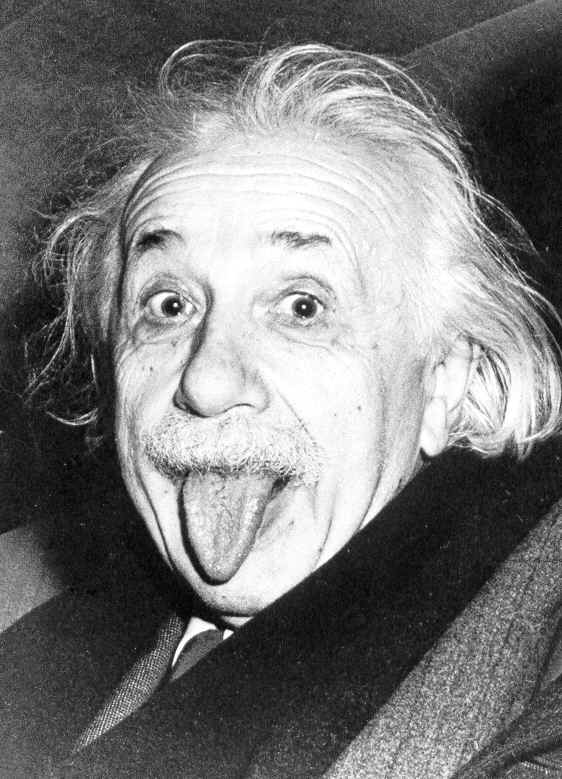
“She’s making history, working for victory” — Evans and Loeb
March 28, 2010
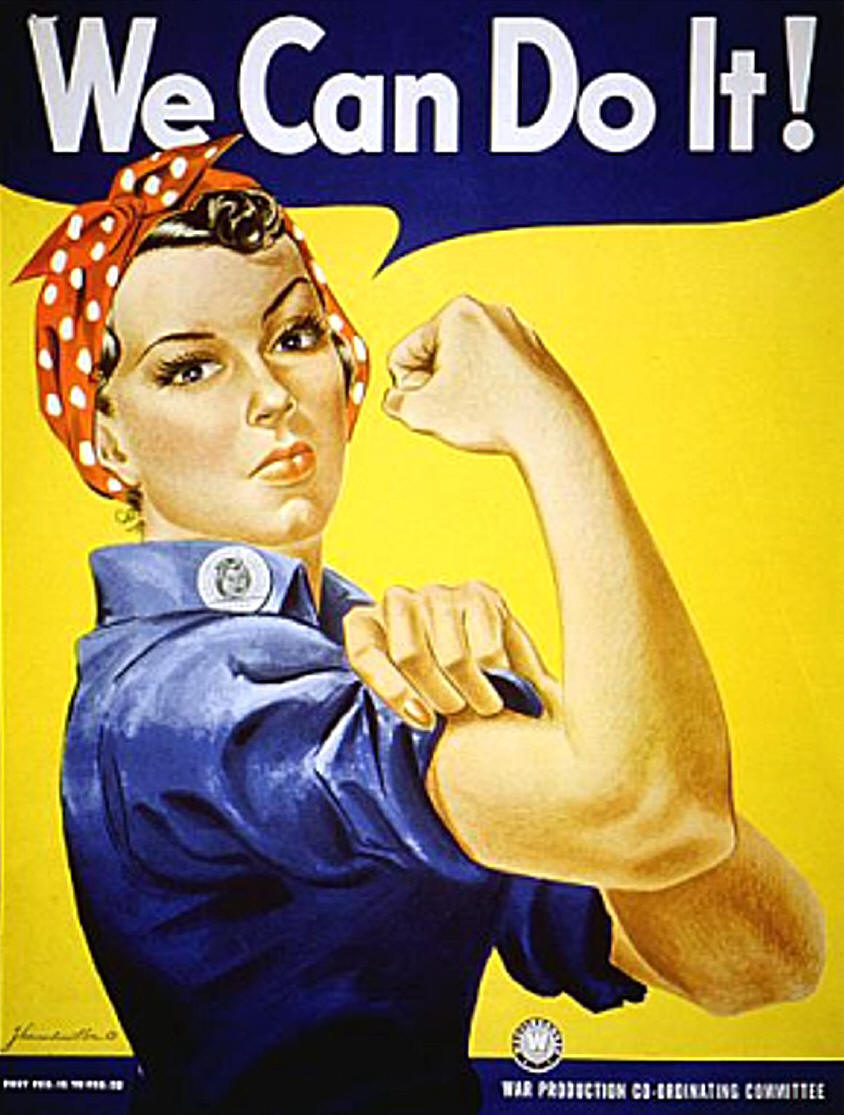
"Rosie the Riveter"poster from World War II era
Like many people, I guess, I frequently brood over the questions I should have asked when I was a kid. One category that came to mind today is related to my father’s work in an aircraft assembly plant during World War II. All I know is that Dad was not drafted into military service, but was assigned to work at the Curtiss-Wright Corp., I presume in Caldwell. He was 29 years old when my brother was born in 1941, and his age might have had something to do with his exemption. He told me that he worked in my family’s grocery store during the day and at Curtiss-Wright at night, but how long he worked at the plaht and what he did, I didn’t ask. Along about 1976, it became too late. I can’t blame it on the ignorance of youth, either; by the time Dad died, I was in my 30s, and I still hadn’t asked.
Fortunately, most people are smarter than I am, including some filmmakers who are tracking down women who worked in the defense industry during the war — the fabled labor force that shared the sobriquet “Rosie the Riveter.”
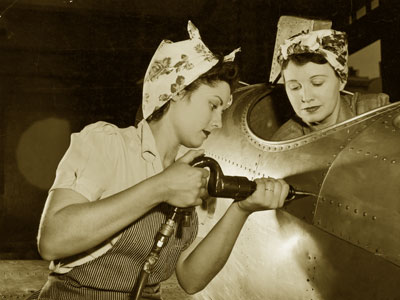
Women at work in a defense plant during World War II
I saw a note on the web site of the Detroit Free Press indicating that the filmmakers plan to visit Michigan next month looking for women in that state who had supported the war effort by building aircraft and manufacturing munitions and other matériel. This is a project of New York University’s Tamiment Labor Archives; it’s explained in some detail at THIS LINK.
Several years ago, a project in Morris County, here in New Jersey, conducted several lengthy interviews with women who had been part of the Rosie brigade. The interviews, and photos of those women, are available at THIS LINK.
The term “Rosie the Riveter” was first used in 1942 in a song by that name written by Redd Evans and John Jacob Loeb. In poking around on this subject, I also learned that the women who did this indispensable work have been commemorated in the Rosie the Riveter Charter High School in Long Beach, Calif., a school that gives girls an opportunity to learn non-traditional trades.
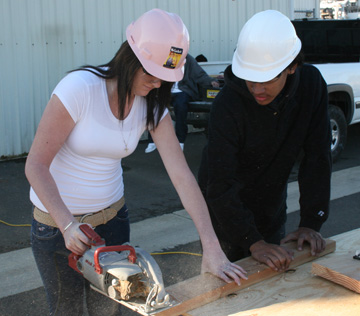
A student at Rosie the Riveter Charter High School learns to operate a power saw.
“. . . and shall forever be revered by his fellow countrymen.” — George Washington, establishing the Badge of Military Merit”
March 6, 2010
 Richard Owen died on June 6, 1944. Yes, what the date implies is true: He died during the Allied invasion of Normandy. Sgt. Owen was a paratrooper with the Army’s 101st Airborne, 506th PIR-E Company — the “Band of Brothers.” His plane was hit during the early hours of the operation; it crashed during a landing attempt and burned for three days.
Sgt. Owen was posthumously awarded the Purple Heart, one of the most precious possessions for an American or his or her family. I was born a little less than two years before Sgt. Owen died. As I was growing up, remnants of the war were still evident in our house. My Dad was 30 years old when the war began, and I guess that’s why he was assigned to civil defense and aircraft construction on the Home Front. But there were letters and uniform buttons on shelves and in drawers that evoked the recent service of our cousins, Mike Aun in Europe and his brother Fred in the Pacific, and our dear friend Jack Mawhinney, also in Europe.

The Silver Star
Among the keepsakes from the recent war were clippings from the Paterson Evening News, and there I read that Mike Aun, who by then had married and moved to Lexington, S.C., had been awarded the Bronze Star, the Silver Star, and the Purple Heart with three Oak Leaf Clusters. I asked my Mom, to whom Mike was like a brother, what those awards meant. She explained as best she could to an ignorant child, but I was much older before I understood the implications of “meretorious service” and “gallantry in action.” I already understood, though, what she meant when she said that Mike had been hurt four times while he was “overseas,” as my Mom always expressed it. I loved Mike for a lot of reasons, but I idolized him for that Purple Heart. No doubt because I was introduced to the award in such a personal way, I have always paused over references to men and women who have earned the Purple Heart, and so I was particularly attracted to the story of Sgt. Owen, whose award certificate turned up at a Salvation Army center in a box of donated household tchotchke.
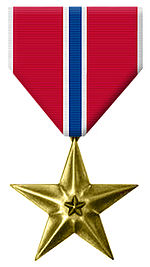
The Bronze Star
Personnel at the Salvation Army, Capt. Ron Heimbrock and Darlene Pelkey, were aware of the importance of that certificate, and they were upset to think of it as discarded along with things of no value. They launched a search that eventually involved many other folks, and the combined effort led to members of Sgt. Owen’s family who honor his memory. One of them has custody of the medal itself, and she treasures it.
The fact that people who had no direct connection to Sgt. Owen thought enough of what that certificate represented is a comment on their own sensitivity. It is also a fitting salute, across the decades, to one of the many who never should be forgotten.
You can read the Washington Post story about Sgt. Owen himself and about the discovery of the certificate and the search for Sgt. Owen’s family by clicking HERE.
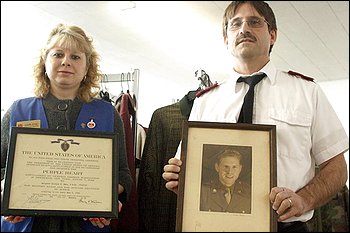
Darlene Pelkey and Salvation Army Capt. Ron Heimbrock with the Purple Heart Citation and a photo of Sgt. Richard Owen / Daily Courier-Observer photo by Bob Beckstead
 CharlesPaolino's Blog