“To be or not to be” – the movie
January 5, 2013
 Turner Classics the other night broadcast a fascinating relic of World War II, a dark comedy entitled To Be or Not to Be, starring Carole Lombard and Jack Benny. This 1942 film, directed by Ernst Lubitsch, is set in Warsaw during the invasion of Poland by Nazi Germany. The plot concerns a troupe of Polish actors who use the tools of their art to upend a plan by the Nazis to identify and track down families of Polish airmen fighting against the Third Reich.
Benny and Lombard play a married couple, Josef and Maria Tura, who are popular Shakespearean actors in the city. A young Polish airman, Stanislav Sobinski, played by 23-year-old Robert Stack, has become enamored of Maria and she, appreciating the attention, begins a clandestine romance with him. Josef deduces that the two are having an affair after Sobinski repeatedly leaves the theater to meet Maria just as Josef is beginning to recite the “to be or not to be” speech in Hamlet.
Sobinski, however, is sent off to England where he meets Alexander Siletsky, a Nazi spy who pretends to be a member of the Polish resistance in order to gather information about anti-German activists. In a conversation with Siletsky, Sobinski mentions Maria Tura and is suspicious when the supposed denizen of Warsaw doesn’t recognize her name.
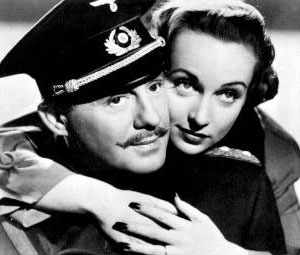
JACK BENNY and CAROLE LOMBARD
Based on Sobinski’s description of Maria, Siletsky, who travels to Poland to deliver to the Nazis a list of the families of Polish airmen, determines to enlist the actress as an informant. When he meets her, he also takes a more personal interest in her. But Sobinski has informed his superiors of his suspicions about Siletsky and is sent back to Warsaw to warn the resistance. When the acting company learns of this, they determine that the only solution is to murder Siletsky before he can turn over the names.
The plot proceeds as a classic farce in which one of the actors poses as Adolf Hitler in order to hoodwink the German authorities.
This film (which Mel Brooks remade in 1983) is regarded as a comedy classic, but it was controversial in its time. Some folks were uncomfortable with the humorous approach to the situation in Europe, which was anything but funny. Lubitsch began this project with Jack Benny in mind for the lead. Benny, whose birth name was Benjamin Kubelsky, met some resistance first-hand when his father, Meyer, walked out of the theater, scandalized by the sight of his son in Nazi uniform. Meyer reputedly changed his mind under Benny’s influence and eventually saw the movie more than forty times. Despite its humor, the film is very dark, though, and emphasizes the level of destruction the Germans rained on Warsaw.
To Be or Not to Be was the last film for Carole Lombard, who was the highest-paid Hollywood star at the time. Before this movie was released, she was killed in a plane crash while returning from a U.S. Bond tour.

CAROLE LOMBARD as Maria Tura and STANLEY RIDGES as Siletsky.
The first American film to attack Hitler and Nazism through ridicule was You Natzy Spy! a short subject by The Three Stooges. That was followed a few months later by Charles Chaplin’s The Great Dictator, Chaplin’s first true sound film and his first commercial success. In that movie, which appeared in 1940, before the United States and Germany were at war, Chaplin mercilessly pillories Hitler, fascism, anti-Semitism, and Benito Mussolini.
Walt Disney got into the act on January 1, 1943, by releasing In Der Fuhrer’s Face, a propaganda cartoon in which Donald Duck has a nightmare in which he is forced to work on the assembly line of a munitions factory in “Nutziland.” This film included some broad German, Japanese, and Italian caricatures, including send-ups of Hitler and Mussolini. The cartoon featured a song that had been recorded and already released by Spike Jones: “When the Fuhrer says, ‘We are the master race,’ we heil, we hiel, right in der Fuhrer’s face”
You can watch a high-quality video of this cartoon at THIS LINK.

Books: “Isaac’s Army”
November 10, 2012
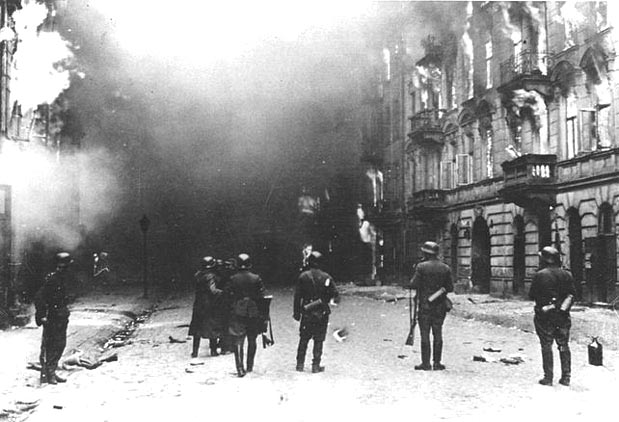 Warsaw came as a surprise to me. Because of my uneducated impressions of Eastern Europe, I expected the city to be grim, but it was not. Warsaw was lively, handsome, well-swept, festooned with parks, and imbued with the spirits of such as Paderewski, Chopin, and Wojtyla.
But as satisfying as it was to see the city thriving, it was impossible to escape reminders of its darkest days, when it was occupied and devastated by Nazi Germany — and its Jewish population virtually exterminated — a period that is described in vivid human detail in Matthew Brzezinski’s book, Isaac’s Army.

Brzezinski, who has been a reporter for the New York Times and the Wall Street Journal, concentrates in this book on the walled ghetto in which the Nazis confined hundreds of thousands of Jews in subhuman conditions until most of the poor people were either worked to death, killed by hunger and disease, shot to death in summary executions, burned to death in their homes and hiding places, or shipped off to death camps.
I saw remnants of the ghetto in Warsaw, but it seemed almost like an abstract idea. In Brzezinski’s book, however, the depth of the depravity with which the Nazis and their collaborators treated Polish Jews comes through with shocking force.
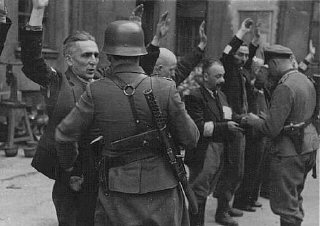 Brzezinski is particularly interested in a relatively small group of Jewish men and women who recognized from the beginning that the Nazi presence was an imminent danger to their community and were not willing to stand by and let the Germans proceed unhindered. The writer relates the stories of about a dozen individuals who were in that category. They belonged to underground paramilitary organizations that struggled to maintain some semblance of resistance to their persecutors. These folks defied and undermined the Nazi attempt to isolate the Jews and ultimately, in 1943, participated in the uprising that stunned and momentarily humiliated the SS when the “supermen” entered the ghetto with the object of leveling it.
Unfortunately, as Brzezinski relates, Polish Jews were not of a single mind about how they should respond to the Nazis or whether they should respond at all. They also were sharply divided over issues such as Marxism and Zionism.
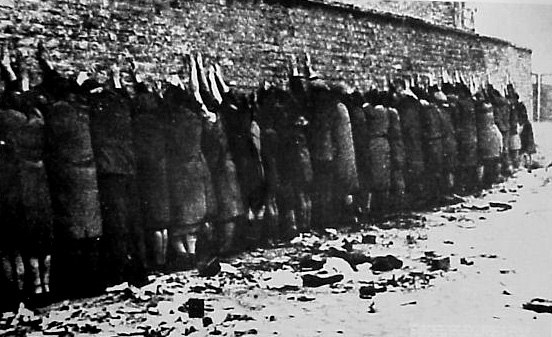
They were frustrated by the fact that so many people and nations were indifferent to their plight, and they had to resort to bribery and subterfuge to accumulate even the poor excuse for an arsenal they had to defend themselves against the combination of Adolf Hitler’s insanity and his military machine. Their situation may have been hopeless to start out with, but Brzezinski shows that some of them would not give up hope or, at least, would persist in their struggle against the Nazis even when hope was gone. While this book, on the one hand, records one of the worst examples of human cruelty, it also records one of the best examples of human resilience. The account of a few score sick and starving Jews escaping the ghetto by stumbling for hours through a sewer laden with human excrement, corpses, and rats is disgusting to the imagination. At the same time, it is uplifting to know that people who would not concede their right to dignity and justice were willing to undergo even that in order to deny Hitler his dream of eradicating Judaism in Europe.
“You’ve got to be taught to hate and fear”
October 23, 2012
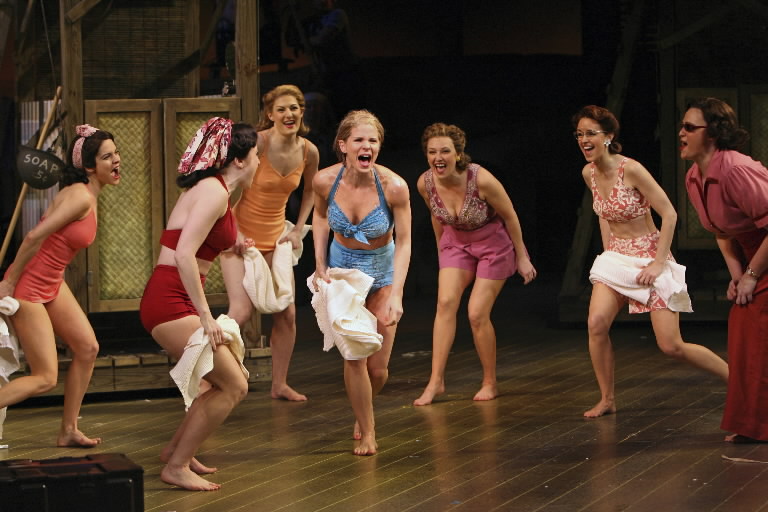
Nellie Forbush (Kelli O’Hara) and the navy nurses sing “I’m Gonna Wash that Man Right Outta My Hair” in the Lincoln Center revival of “South Pacific”
On one of our first dates, I took Pat, now my wife, to see a major production of South Pacific, the Rodgers and Hammerstein musical. Betsy Palmer played Nellie Forbush and William Chapman played Emile de Becque. Neither of us had ever seen the show on stage, but both of us had seen the 1958 film with Mitzi Gaynor and Rossano Brazzi (with Giorgio Tozzi dubbing Brazzi’s songs), and both of us owned the cast albums from that film and from the original Broadway production with Mary Martin and Ezio Pinza.

JAMES MINCHENER
The musical play, which first appeared in 1949, was based on James Minchener’s 1947 book, Tales of the South Pacific. This book, which won the Pulitzer Prize, is a collection of loosely connected stories based on Michener’s experiences as a Navy officer on the island of Espiritu Santo. I find it an absorbing book because of its ability to transport the reader into the unique environment of the Pacific Islands during that war.
Rodgers and Hammerstein combined three of Michener’s stories to create the musical play, and they determined to deal with two instances in which romantic liaisons were disrupted by racial prejudice. One of those situations arises when Navy nurse Nellie Forbush, whose previous life experience was confined to Little Rock, Arkansas, falls in love with French planter Emile de Becque but discovers that he had previously lived and had children with a Polynesian woman. For reasons that she herself cannot articulate, Nellie is repulsed by the idea, and she undergoes a wrenching internal struggle.

EZIO PINZA and MARY MARTIN
The other conflict involves a Marine lieutenant, Joe Cable, who falls in love with a Tonkinese girl who is not yet an adult, but refuses to marry the girl because of the color of her skin. In a scene in which De Becque and Cable discuss their contradictory crises, De Becque declares that he does not believe that racial prejudice is inborn, and Cable punctuates that idea with a lyric: “You have to be taught to hate and fear / You have to be taught from year to year / It has to be drummed in your dear little ear / You have to be carefully taught … to hate all the people your relatives hate.”
This lyric brought opprobrium down on Rodgers and Hammerstein from some quarters in the United States. Cable’s song was described as not only indecent, because by implication it encouraged interracial sex and — God forbid! — breeding, but that it was pro-communist because who but a communist would carry egalitarianism so far? Some Georgia politicians actually tried to stifle the song through legislation. Rodgers and Hammerstein’s position was that the song was about what the play was about and that, even if it sank the show, the song would stay.

RICHARD RODGERS and OSCAR HAMMERSTEIN
We saw the recent revival of South Pacific at the Lincoln Center twice, and this past weekend, we had the opportunity to see it again in a production at the non-profit Ritz Theatre in Haddon Township, New Jersey. One of the impediments to mounting this show is that it requires an outstanding cast and company; it can’t be faked. The Ritz was up to that challenge in every respect. In fact, Pat and I agreed that Anabelle Garcia was the best Nellie Forbush we had ever seen.
South Pacific was written shortly after World War II. The original production won a Pulitzer Prize and ten Tony Awards. In fact, sixty-two years later, it is still the only musical to win all four Tony Awards for acting.
What is striking about South Pacific is that although it is necessarily performed entirely in the milieu of the 1940s, it does not get old. Racism is still a serious issue in the United States, and some of the criticism directed at this show for addressing that issue sounds disturbingly like rhetoric we can still hear today.
Books: “Eisenhower: The White House Years”
March 25, 2012
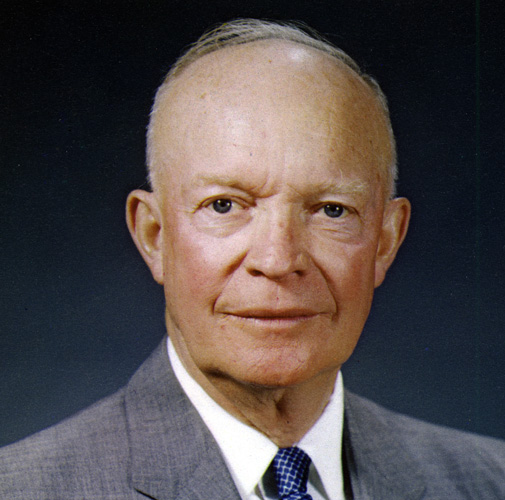 When I was a grad student at Penn State, former President Dwight Eisenhower visited the campus. It wasn’t a public event; he was speaking to a group of students from State College High School. But I was working in the public information office and found out about it and simply walked into Waring Hall at the appointed time. It was 1964 — a different era. Nobody asked who I was.
Eisenhower had been out of office for about four years. He was 74 and had suffered heart attacks and a stroke. Still, he stood at the edge of the stage with his head high and his shoulders back — in short, with the military bearing long associated with him. He encouraged those kids to take an interest in civic affairs and not to expect other folks to do all the work either inside or outside of government.
Eisenhower had been an iconic figure in our house, both because of his role in World War II and because he had kept the presidency out of Democratic hands for eight years.
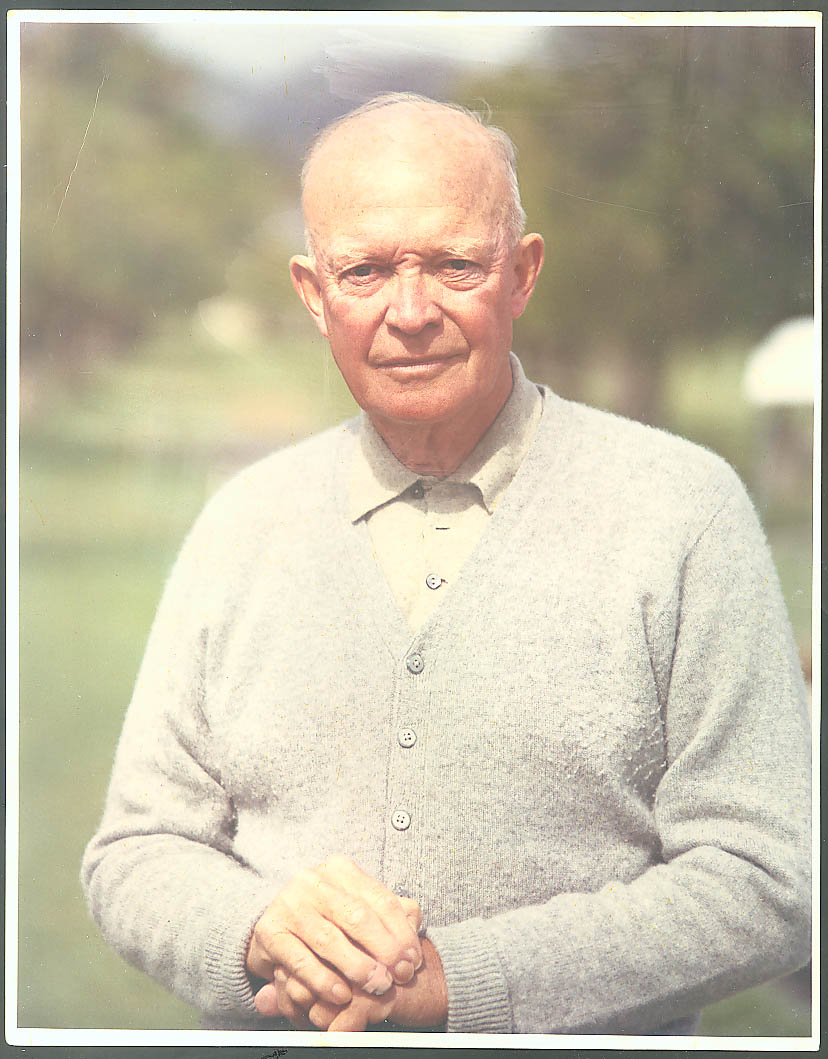
Some of the family’s faith in Ike was well placed, even given the straight party-line mentality, but of course he was more complicated than he was portrayed around our place.
And, in fact, the Dwight Eisenhower that Jim Newton describes in Eisenhower: The White House Years is a complicated guy. While he was still in office, especially during his second term, he was often lampooned as an absentee president who golfed while the Soviets and Chinese plotted to conquer the world.
While it’s true that Eisenhower tried to fit golf and bridge into his routine, that characterization seemed ludicrous at the time, and Newton demonstrates well that it was fantasy. He shows that, on balance, Eisenhower’s administration, which kept the United States out of a shooting war for eight years, launched the interstate highway system and the St. Lawrence Seaway, and left the country with its last budget surplus until 1999, was an overall success.
Newton doesn’t discuss this in detail in this book, but Eisenhower’s achievements as supreme allied commander in Europe during World War II were in a significant way due to his firm but understated command as well as his personal diplomacy as he coordinated military officers and heads of state who had little or nothing in common except an enemy.

Similar qualities came into play when Eisenhower took on the presidency. He wasn’t inclined to the grand gesture, and his credo was what he called “the middle way,” meaning that on any issue he looked for the ground that was equidistant from extremes on either right or left.
Meanwhile, while Ike might have seemed like a man obsessed with cutting down on his slice, he was engaging in intense discussions concerning the rising belligerence of the Soviets and Chinese, more than once talking his military brass out of resorting to nuclear weapons. He was also overseeing covert activities undertaken by the CIA to overthrow foreign governments whose behavior was perceived as inimical to American interests — Iran and Guatemala among them. Eisenhower also made flight-by-flight decisions about high altitude surveillance of the USSR, and his administration was embarrassed when one of the planes was shot down and the pilot captured.
From our perspective, two of the most disappointing things about Eisenhower were his unwillingness to take the lead on civil rights for black citizens and his public silence about the demagoguery of Sen. Joseph McCarthy.
 Eisenhower was content with the concept of “separate but equal,” and he was unhappy with the Supreme Court ruling in Brown vs the Board of Education. When the Board of Education in Little Rock, Arkansas, decided to obey the spirit of that ruling by admitting nine black teenagers to Central High School, there was immediately a crisis of authority as Gov. Orval Faubus, the Arkansas National Guard, and a howling white mob prevented the kids from entering. Eisenhower tried to finesse the problem by summoning Faubus to Washington and bargaining with him, but Faubus double-crossed Ike by withdrawing both the National Guard and himself from the scene. So Eisenhower was forced to do something distasteful to him, sending members of the 101st Airborne Division, with bayonets fixed, to escort the students into the school.
Eisenhower didn’t say or do anything publicly about McCarthy’s paranoid campaign of terror against real and imagined communists until the senator overreached and directed his venom at the U.S. Army. Then the president issued an order forbidding employees of the executive department from providing evidence to McCarthy’s committee.
 Eisenhower’s reticence concerning McCarthy extended to the point that Ike let McCarthy pillory Gen. George Marshall, Ike’s mentor and possibly the man he most admired. Eisenhower ostensibly regretted that for the rest of his life, but the damage had been done.
Newton probably is a little easy on Eisenhower, but if he is, he’s easy on a man who led one of the most unselfish and productive lives of public service in American history, a life untouched by the personal and professional corruption and the blind partisanship that has affected major figures in American history before and after him.
The motto of Eisenhower’s election campaign — “I like Ike” — was particularly apt. He had his flaws as we all do, but the quality of his public service flowed to a large extent from his character: He was a nice man.
Books: “A Soldier’s Sketchbook”
January 13, 2012

KATE SMITH
During World War II, the popular radio star Kate Smith used to end her daily broadcasts by saying, “And remember … if you don’t write, you’re wrong!” Kate Smith, who was a major supporter of the war effort in general and of American troops in particular, was prodding those at home to send letters to soldiers and sailors. I don’t know whether Kate Smith introduced that expression, and that inspired a songwriter, or the other way around. I do know that a writer named Olive Kriser wrote a song by that title in 1943, and it, too, urged families and friends to write to the troops.
For me, that phrase has always evoked what I imagine was a melancholy aspect of the war years: young men and women suddenly separated from their families, friends, neighbors, familiar surroundings, everyday routines, and hurled into the maelstrom, wondering about the folks, about ever seeing them again, longing for a mundane conversation around the kitchen table, a cheese sandwich made by Mom. And yearning, yearning, for a word from home.
That was the real-life experience of tens of thousands of young people, including Joseph Farris of Danbury, Connecticut, who was drafted, trained, and shipped off to the fighting fields of France and Germany shortly after leaving high school.
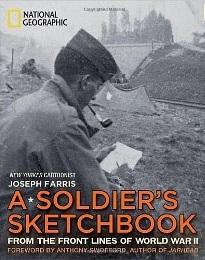
 Farris, who has become a very successful cartoonist and illustrator, has recreated his experience in A Soldier’s Sketchbook, an elegant volume published by National Geographic. Farris got lots of letters, but in this book, he reproduces many of the letters that he wrote to his parents and two brothers during the three years, beginning in May 1943, that he spent in the United States Army. The book also contains facsimiles of some of those letters and of other documents, photographs of Farris and some of his colleagues, and watercolors and drawings that he did while he was in service.
Farris provides a narrative in which he demonstrates how he pulled his punches in his letters home, both because military censorship sharply restricted what combatants could write about and because he didn’t want to worry his family. The folks wouldn’t know until it was well over that Farris — who wound up heading a heavy machine-gun platoon — came under heavy fire, watched his fellows soldiers being blown away, shivered in the cold and wet of the foxhole, and confronted the fact that any hour could the last in his brief life.
 By the time Farris got into combat, Italy had surrendered, Athens had been liberated, France had been invaded, and the German siege of Leningrad had been broken. The jig was up for the Third Reich. So although he experienced the worst of the war, he also had some less lethal duty, moving through towns in France and Germany and temporarily occupying houses that were far more comfortable than a hole in the ground.
A touching aspect of this book is the writer’s lack of self pity and his consistent concern for the well being of his parents and brothers. While he was still in harm’s way, he wrote to his younger brother George, “Dad, Mom, & I are exceedingly grateful, kid, that you are around to help out. Mom & Dad depend a helluva lot on you, so don’t let them down. You may work a little harder than many other fellows your age but in the long run it’s going to pay. You don’t know how thankful I am for the training I got in the store” — a reference to his family’s Danbury Confectionery — “not only the business experience but the systematic method necessary. You’re fortunate in having the swellest folks possible. If I can treat my future children half as good as Mom & Dad have treated us I’ll feel that (I) have done my job well.”
Throughout his military service, Farris thought about his plans for a career in art, and often asked his family to send him supplies. His work has appeared in the New Yorker and in other major publications. You can see many of his cartoons and illustrations by clicking HERE.
For another interesting aspect of World War II, click HERE to read about the Women’s Land Army. The site includes many letters written home by Genevieve Wolfe, who was one of a group of 40 young women from West Virginia who traveled to a camp in Ohio to provide labor needed on farms in the northern part of the state.
Books: “Eva Braun: Life with Hitler”
December 29, 2011
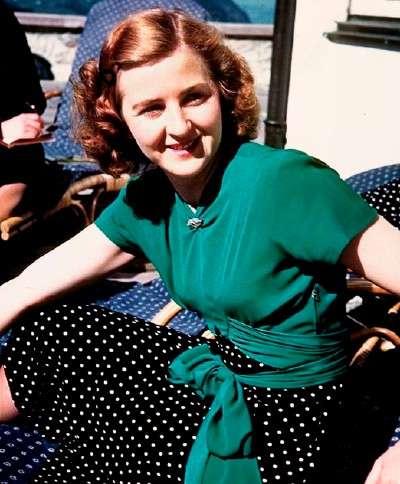 Chelsea, an aspiring actress, tells Cosmo Kramer during an episode of the TV series Seinfeld that her manager is “trying to put together a miniseries for me on Eva Braun. I mean think about it, is that a great idea? We know nothing about Eva Braun, only that she was Hitler’s girlfriend. . . . What was it like having sex with Adolf Hitler? What do you wear in a bunker? What did her parents think of Hitler as a potential son-in-law? I mean it could just go on and on….”
It could and it will, because while it isn’t true that we know nothing about Eva Braun, it is true that we know relatively little, considering that she was the consort of one of the most recognizable and most reviled men in human history.
Heike B. Görtemaker, tries to bring some clarity to this subject in Eva Braun: Life with Hitler, which was originally published in German. The very things that have made Braun an obscure figure up to now were obstacles to the author’s work, beginning with the fact that Hitler wanted to be perceived as a solitary messiah whose life and energy were devoted to lifting Germany and its people from the ignominious consequences of World War I.
 In order to maintain his image, Hitler kept the very existence of Eva Braun a secret from the German people, and he kept her at least at arm’s length and often much farther when they were in the company of his inner circle. Hitler married Braun on the day before they both committed suicide in a bunker in April 1945 while the Red Army was literally striding through the Reichstag grounds about 25 feet above their heads. He once said that he had never married because he needed the political support of German women and that he would lose some of his appeal if he had a wife. “It’s the same with a movie actor,” Hitler said. “When he marries he loses a certain something from the women who adore him. Then he is no longer their idol as he was before.”
When I read that in Görtemaker’s book, I wondered what “certain something” Hitler had that would attract any woman, never mind millions of them. Evidently the author wonders about that, too. When she writes that Braun’s life was shaped by Hitler’s power, his world view, and his “charismatic attraction,” she adds parenthetically, “however difficult it may be to explain what that consisted in.”
 Görtemaker is convinced that neither Braun nor the other women around Hitler — principally the wives of men like Albert Speer and Joseph Goebbels — were simply adornments who were expected to be seen but not heard. On the other hand, the author finds it impossible to say definitively how much Braun and the others knew about German policy, and particularly about the Holocaust. They had to know of the persecution of Jews in Europe; it was no secret. But discussion of the extermination program in Hitler’s presence was forbidden when he was in his “family circle,” as it were, meaning the crowd that frequented Berghof, Hitler’s frequent refuge in Bavaria.
 Hitler met Braun in 1929 when he was 40 and she was 17 and working as an assistant to Dietrich Hoffmann who became the privileged official photographer of the Nazi party and the Third Reich. Görtemaker speculates that the couple were not intimate until 1933 when Braun had become an adult . At first they saw each other only intermittently, and this apparently weighed on Braun and was the cause of two suicide attempts. After the second incident, Hitler arranged for Braun to have her own home in Munich and to have regular access to Berghof, where her assertion of her prerogatives irritated some of Hitler’s coterie.
Whatever attracted Braun to Hitler in the first place, long before it was clear that he would lead the German nation, her commitment to him was complete. Görtemaker writes that the level of her loyalty was the object of admiration to at least some of Hitler’s associates and it may have been the one thing that most endeared her to him. There’s no evidence that she pressured him to marry her or that she complained about being kept out of the public eye. And, in the most dramatic possible demonstration of her constancy, however misguided, she went to Berlin against Hitler’s wishes with the clear intention of dying with him while many others, including Speer and Hoffmann, were already concocting lies about being “outsiders” in Hitler’s camp. The normal confidentiality of the culture in which Hitler lived, coupled with the loss and destruction of written records and the unreliability of later testimony by turncoats trying to save their own hides and reputation may mean that we’ll never know more about Eva Braun than Görtemaker has been able to tell us in this book. That’s unfortunate, not because Braun was so different from others who supported Hitler, but because she was so like them. She was in all respects an ordinary person who came under the still elusive spell of a bumbling, absurd little man who terrorized the world for more than a decade
Books: “Pearl Harbor Christmas”
December 15, 2011

I grew up among the remnants of war. I was born in September 1942 when the United States had been engaging Nazi Germany and Japan for less than a year. By the time I was old enough to be aware of my surroundings, there still were handwritten letters from the front, brass uniform buttons, photos of soldiers, sailors, and marines, patriotic records, and newspaper clippings reporting on the service of relatives and friends, including cousin Mike Aun, who was awarded the Bronze Star twice, the Silver Star, and the Purple Heart with three oak-leaf clusters.

FRANKLIN D. ROOSEVELT
I also recall that for a long time after 1945, my parents and other adults would frame their conversations in terms of what had occurred before, during, and after “the war.” They needn’t say which war.
So although I don’t remember the war itself, I feel that it was a part of my life, and I eagerly learn as much about it as I can. My most recent opportunity came in the form of Pearl Harbor Christmas, a new book by Stanley Weintraub.
In this compact book, Weintraub describes events at home and abroad from December 22, 1941, to January 1, 1942 — devoting a chapter to each day. The dominant personalities by far are Franklin Roosevelt and Winston Churchill. Churchill was staying at the White House after crossing the submarine-infested Atlantic in winter seas. He couldn’t wait to get to Washington, because Pearl Harbor had accomplished what he could not, forcing the United States into a war that Britain probably could not survive otherwise. But, although the newborn American belligerence was directed mostly at Japan, Churchill wanted to make sure, and did, that the U.S. would go to war first against Nazi Germany.

WINSTON CHURCHILL
Churchill addressed a joint session of Congress, spoke at the Christmas tree-lighting ceremony on the White House lawn — the only time he and Roosevelt spoke from the same platform — and dashed up to Ottawa to speak before the Canadian Parliament. What with his blustering, his cigar-smoking, and his drinking, he was quite the counterpoint to patrician, dignified Roosevelt. Actually, he came across more like Lyndon Johnson: Weintraub describes an incident on December 26 when Churchill was dictating to a male secretary notes for the address to Congress. Churchill was in his bath when he started dictating. He got out, wrapped a towel around himself, walked to an adjoining bedroom, dropped the towel, and continued dictating, stark naked. Suddenly, the secretary recalled, “President Roosevelt [in his wheelchair] entered the bedroom and saw the British Prime Minister completely naked walking around the room dictating to me. WSC never being lost for words said, ‘You see, Mr. President, I have nothing to conceal from you.”’
While Roosevelt and Churchill and others were in Washington working issues of joint command, Adolf Hitler was in Berlin or Bavaria trying to chew the great deal he had bitten off.

ADOLF HITLER
Hitler’s troops were in trouble on the Russian front, and even those closer to home were suffering from a lack of adequate supplies. Hitler actually had Joseph Goebbels run a clothing drive to help keep his soldiers warm. In a radio address, Goebbels told the German people that they “would not deserve a moment’s peace if a single German soldier was exposed to the harshness of winter without articles of warm clothing.”
Meanwhile, the situation in the Pacific continued to deteriorate as the Japanese took advantage of their momentum and munched away at the region. Churchill had not yet publicly acknowledged the reality, Weintraub writes, and continued to waste resources trying to defend ground that was already as good as lost.
Even more closely involved in such a charade was U.S. Army Gen. Douglas MacArthur, who had to abandon his headquarters and retreat with his wife and son to a tunnel in Corregidor while he continued to send out dispatches about tank battles, with nonexistent tanks, putting up a fight that wasn’t occurring.
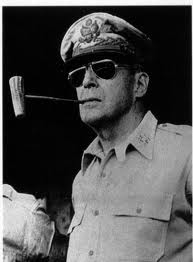
DOUGLAS MACARTHUR
Weintraub explains that there was a certain ambivalence about the war in the United States at first; it still seemed far away.
Still, the government took the impending conflict seriously enough to pack up the founding documents — the Declaration of Independence, the Constitution, and the Bill of Rights — and ship them off under heavy security to repose in Fort Knox for the duration.
The holidays went on as usual. Despite security concerns, Roosevelt insisted that the national tree be on the White House lawn, not in Lafayette Park where the Secret Service wanted it. There were presents, too, including eight thousand cigars sent to Churchill from various sources.
The new year was marked by a couple of oddities – Churchill making a rare visit to a church, attending a service with Roosevelt in Alexandria, Va., and the beleaguered Hitler publicly invoking “the Lord” in hoping that 1942 would bring positive results for the German people.
Throughout the United States, however, the prospects of what would come in the next three and half years did not weigh heavily on the celebratory spirit, and that, Weintraub writes, included the biggest celebration of all:
“ ‘If there was uneasiness over the possibility of Axis bombs falling into Times Square,’ the Times reported, ‘you could not read it in the celebrants’ faces.’ Despite Pearl Harbor and the reality of world war, it had not yet reached very far into the American psyche.’’
Books: “Sleeping with the Enemy”
November 10, 2011
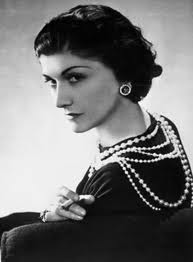 I don’t know if this is true, but I have read in several places that the government of France reports that Chanel No. 5 perfume sells at the rate of one vial every 30 seconds. By my calculation, that means 2,880 vials a day. Sephora gets $85 for 1.7 ounces and $115 for 3.4 ounces, so we’re talking about something like $100 million a year. Besides being such a hot commodity, this perfume is a monument to the woman who introduced it in 1921, the fashion designer Gabrielle “Coco” Chanel.
Chanel — the designer, not the perfume — is the subject of Sleeping with the Enemy: Coco Chanel’s Secret War, written by Hal Vaughan, who portrays her as a virulent anti-Semite who not only accommodated herself to the Nazi invasion of France but actually became a Nazi undercover agent.
When Chanel was 12, her mother had died and her father had left. She spent six years in the custody of Cistercian nuns and then stepped out into the world where she quickly progressed from cabaret singer and courtesan to fashion powerhouse. Her impact on style was enormous; her trade marks were jersey sportswear and the “little black dress” that made a lasting statement about the realtionship between simplicity and elegance.

When Germany invaded France in 1940, Chanel moved to the Ritz and accepted the occupation as the new normal. In fact, she took an influential German officer as one of her many lovers – and she continued to make millions. But Vaughn maintains that documents from that period show that Chanel did more than accept the reality of the Nazi presence, that she actually became an agent of the Abwehr intelligence agency and undertook secret missions in Berlin and Madrid. The book includes a copy of a document that seems to show that Chanel was designated Agent F-7124.
Significantly, Chanel, who was comfortable living in opulence in Paris while her countrymen suffered under the Nazi regime moved to neutral Switzerland for a while after the Third Reich collapsed. Vaughan points out that that move may have saved her from the fate of French collaborators who were publicly shamed, imprisoned or executed. Chanel was briefly arrested by the Free French, but she emerged from the war largely unscathed.
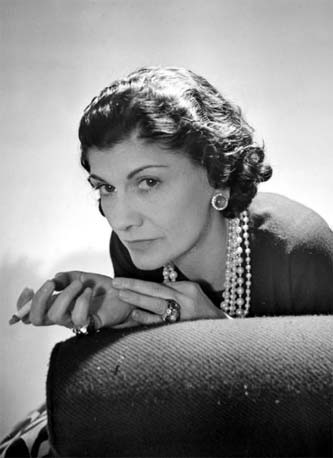
She returned to Paris in 1955 and resumed her career, getting a better reception in the United States than in France.
Vaughn portrays Chanel as anti-Semitic and speculates, without demonstrating it, that her antipathy toward Jews might have been instilled by her contact with the Catholic Church. He also reports in detail that after the initial success of the iconic perfume, Chanel transferred control of it to a Jewish family, the Wertheimers, in a deal that guaranteed her an annual return. Although she later tried unsuccessfully to get the franchise away from the family, and did negotiate a more favorable arrangement for herself, the Wertheimers still are the purveyors of Chanel No. 5.
Chanel was apolitical, and she actually fled Paris for a while in the uncertain aftermath of the invasion. There is nothing in Vaughn’s account to suggest that she was interested in the Nazis’ ambitions. Instead, it’s clear that her top priority was to continue her lavish, drug-ridden life. She also had a personal interest in staying on speaking terms with the Germans, because her nephew was a prisoner of war. She did everything she could until she got him released; in fact, Vaughan maintains that she was enticed to work for the Abwher in the first place because she thought her contacts could help her nephew.
Chanel had many liaisons with rich and powerful men, some of whom helped finance her career, but she never married, explaining that she “never wanted to weigh more heavily on a man than a bird.” An interesting aspect of the story as Vaughn tells it is that, despite her relationship with the Germans, she had many close friends in Great Britain, including Winston Churchill.
Books: “The Man who Broke Into Auschwitz”
August 26, 2011

DENIS AVEY/BBC photo
The title of the book is misleading. Denis Avey, a British soldier during World War II, didn’t break into Auschwitz. He was a POW there, so he was already within the walls, as it were. He and the other inmates had been put to work building an enormous industrial plant in which a German company planned to manufacture synthetic rubber and methanol. From the first, Avey was deeply disturbed by the condition of the Jewish prisoners – the “stripeys” he called them because of their pajama-like uniforms. He was so distressed in fact, that he became obsessed with the need to see for himself the section of the Auschwitz complex where the Jewish inmates lived. If he survived the prison himself, Avey wanted to be a witness.

AVEY with Prime Minister GORDON BROWN/BBC
So compelling was this need in Avey’s mind that on two occasions he swapped clothing with a Jewish inmate and shuffled off with the other Jewish prisoners at the end of the work day. What he found was at least as bad as he had imagined.
That part of Avey’s story is recounted in “The Man who Broke into Auschwitz,” which he co-wrote with Rob Broomby, a BBC reporter who worked very hard to help Avey reconstruct the experience 60 years after the fact.
Before he was sent to Auschwitz, Avey had seen plenty of combat in North Africa. He was part of the force that first drove the Italian army out of Egypt and across Libya and then went on the defensive when Erwin Rommel brought his Afrika Korps into the fray and reversed the tide of battle for a time.

ERWIN ROMMEL
Avey, who explains that he went to war in the first place for adventure, not for King and country, was a brash sort whose chutzpah both got him into scrapes and enabled him to survive on both the battlefield and in prison. Once he was captured, he escaped several times including one final time during a forced march eastward in the dead of winter when the Nazis abandoned Auschwitz in order to elude the advancing allies.
On one occasion, Avey watched while an SS officer repeatedly beat a Jewish inmate until the young man died. Avey was already frustrated by both the fact that the Nazis were deliberately working the Jews to death and by the knowledge that he couldn’t do anything about it. When that young man died, Avey shouted a crude German insult at the officer, who responded by cold cocking Avey with the butt of a hand gun. The injury cost Avey his sight and eventually the eye itself.
But the worst injury he suffered was psychological. When he finally returned home, his own family – including his father, who had also enlisted – didn’t want to discuss the war at all, and others wanted to hear only about derring-do on the battlefield. No one was interested in, or capable of confronting, the truth about the concentration camp.
 Avey himself stopped talking about it for decades, and he suffered nightmares and other signs of post traumatic stress disorder – a problem that was not recognized and therefore not treated at the time.
There is much more to this story, including the unexpected outcome of a small favor Avey was able to do for one Jewish inmate, but that’s best read in the pages of Avey’s book. It was largely because of Broomby’s work that Avey was eventually able to talk openly, and write, about what he experienced. The two men have performed an important service, because it is critical that knowledge of what the Nazis did be kept alive in the public consciousness.
That’s true both because of the crimes committed by the Third Reich and its collaborators but also because such atrocities have been committed again and again since then – the difference being only one of scale.

Books: “No Regrets: The Life of Edith Piaf”
May 22, 2011
 If it was Sunday night, I wanted to see Señor Wences. I did not want to see Edith Piaf, who turned up from time to time on Ed Sullivan’s TV show, “Toast of the Town.” It was all a part of being young and ignorant. I later learned to appreciate what an astounding singer Piaf was, but I knew nothing of her background before reading Carolyn Burke’s recent biography.
Piaf had a rough life in many respects. She was born in 1915 in a poor part of Paris to nearly indigent parents – her father an acrobat named Louis Gassion and her mother a drug-addicted street singer whose professional name, as it were, was Line Marsa. Louis and Line separated and Line played almost no part in Edith’s life except to occasionally surface and ask for money — which Edith usually provided. Louis took responsibility for his daughter, although that meant, for a time, that he left her to live in a brothel that was managed by his mother. He later reclaimed the girl and took her “on the road” with him — first while he performed with a circus and then when he returned to the streets. Edith had to work, keeping house, passing the hat when Louis performed on the street, and eventually singing for coins herself.
 When she was 16, Edith convinced her father to let her live on her own, but she maintained a close relationship with him for the rest of his life, which eventually meant supporting him. As a result of one of the first of a very long string of romantic and/or sexual relationships, she bore a child, a girl, who died at the age of two — an experience that affected Edith for the rest of her life. She gradually developed as a singer on the street and in Paris dives, but her career took off after she was discovered by a shady character named Louis Léplee, who booked her in his cabaret and taught her some things about performing before the public. He also dubbed her “piaf” — “sparrow” — because of her stature (4’10”) and her bird-like gestures.
Edith Piaf specialized in chasons réaliste, songs of realism that expressed the sorrows of the lower class — including the prostitutes, beggars, and love-starved sailors who were among the singer’s earliest acquaintances. Frustrated love was a constant theme in these songs and in Edith Piaf’s life.
 In addition to having a powerful and expressive voice, Edith Piaf was a prolific songwriter, creating the lyrics for many of the songs she introduced. Many of her love affairs were with men in whom she also had an artistic interest, and she played the mentor to them, demanding almost excruciatingly hard work but, almost without exception, helping them to solidify their careers. Edith herself became a star in several media in both hemispheres — night clubs, movies, records, radio, and television.
 Edith Piaf lived in France during the World War II period, and was criticized in her own time by people who thought she was too accommodating to the German occupation. But Burke reports that the singer was instrumental in helping Jewish friends hide from the Nazis and that she irritated the Nazis, perhaps deliberately, by singing the work of a Jewish songwriter. But Edith was even bolder than that, by Burke’s account. She agreed to visit French soldiers who were being held in prisons in Germany, and she made a point of being photographed with them. Then she returned, as part of a plot by the French Resistance, and slipped some of those soldiers false identification that included their faces cropped from those photos. Some 188 of those men escaped, using those fake credentials.
It’s an understatement to say that Edith Piaf didn’t take care of herself. She worked very hard, both in rehearsals and in a hectic schedule of bookings, partly because of the cost of maintaining not only her own lifestyle but also a coterie of friends, hangers-on, and just plain cheats, whom she deliberately cultivated as a sort of salon. She drank heavily and she became dependent on a complex of pain killers — for debilitating arthritis — sleeping pills, and uppers. This regimen apparently contributed to the ruin of her liver which in turn caused her death in 1963.
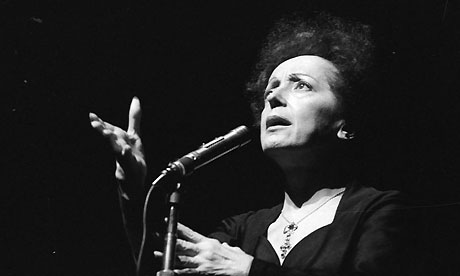 The poet Jean Cocteau — a close friend of the singer — described Edith Piaf as a genius and called her “this astonishing little person.” “A voice rises up from deep within,” he wrote, “a voice that inhabits her from head to toe, unfolding like a wave of warm black velvet to submerge us, piercing through us, getting right inside us. The illusion is complete. Edith Piaf, like an invisible nightingale on her branch, herself becomes invisible. There is just her gaze, her pale hands, her waxen forehead catching the light, and the voice that swells, mounts up, and gradually replaces her.”
For a good example of that voice, click HERE.
 CharlesPaolino's Blog