“Time is blind, but man is stupid.” — Victor Hugo
August 19, 2010

CHARLES LAUGHTON
I heard a promo recently about a segment on Public Radio, and the gist of it was, “What book did you read when you were young that changed your life?” I heard only the promo, but it got me to thinking about the question, and my answer — momentous if not quite life-changing — seemed to be Victor Hugo’s 1831 novel known in English as “The Hunchback of Notre Dame” and in French as “Notre Dame de Paris.” I was around 13 or 14 years old when I spotted a paperback copy of the novel on one of those carousels in a sweet shop near our house. I think I was attracted to it because of the suggestive illustration of the gypsy girl Esmeralda on the cover. (Did I mention that I was about 14?) In those days a paperback book cost less than a buck, so I bought it and sneaked it into the house, figuring the cover might attract unwanted attention.
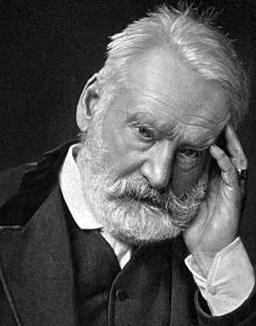
VICTOR HUGO
I went to elementary school from the late ’40s to the mid ’50s, and the most provocative thing I read was Henry Wadsworth Longfellow’s “Hiawatha.” I was taking quite a leap from that curriculum to Victor Hugo — although I didn’t know it at the outset because writers like Victor Hugo weren’t mentioned at Memorial School. I was mesmerized by the book. I read it over and over. I certainly had never read such descriptions of lust and violence, and I was scandalized but fascinated by the idea of all this immorality in the Church.
What I found most absorbing, however, was not the salacious aspects of the plot nor the images of Esmeralda but the deformed bell ringer, Quasimodo, who has become the popular symbol of this story. As I mentioned in a post about six months ago, Quasimodo was so named because when he was an infant his mother abandoned him at the cathedral of Our Lady of Paris (“Notre Dame de Paris”) on Quasimodo Sunday — the first Sunday after Easter. The Introit of the Mass for that day is taken from the second chapter of the First Letter of Peter: Quasi modo geniti infantes, rationabile, sine dolo lac concupiscite ut in eo crescatis in salutem si gustastis quoniam dulcis Dominus. That passage is often translated, As newborn infants do, long for pure spiritual milk so that through it you may grow into salvation, for you have tasted that the Lord is good.
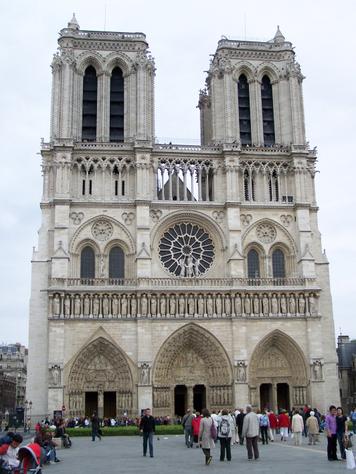
NOTRE DAME DE PARIS
When I first read the novel, I was especially energized by the passage in which Quasimodo defies both public and ecclesiastical authority and rescues Esmeralda from imminent execution, and I was deflated by his ultimate failure to save her. Aside from the drama, though, one seemingly innocuous phrase in the translation I read had a permanent impact on me — so much so that I recall it more than 50 years later. It was Hugo’s reference to Quasimodo as “the unfortunate man.”
In the popular retelling of this story, what is frequently lost is that core reality that the grotesque figure who plays a critical part in it was a human being with the same desires and sensibilities that motivate all human beings. The very fact that the story is popularly known as “The Hunchback of Notre Dame” — as though his misshapen spine defined Quasimodo as a person — suggests a disregard for, or at least an ignorance of, Hugo’s intention to present Quasimodo as a man motivated by two understandable feelings — a sense of loyalty to the archdeacon Claude Frollo, Esmeralda’s nemesis, who had provided the foundling with a home, and a chaste affection for Esmeralda, the only person to show Quasimodo compassion.

LON CHANEY
This experience of the fictional Quasimodo resonates in the experience of the real Joseph Merrick, the 19th century Englishman who was known to his contemporaries and is widely known now as “the elephant man” because he was so “unfortunate” as to suffer from a disease that badly deformed his body. Life gave Merrick two choices — to be alternately displayed and hounded as a freak or to withdraw from society almost entirely and live in seclusion in London Hospital. I think it is a telling detail in Merrick’s biography that once he was living permanently at the hospital he asked to be confirmed in the Church of England. I suppose that request was an indication of his hope, or faith, that in the mind of God he was as much a human being as any other amalgamation of body and soul.
Hugo’s novel was my answer to the NPR question both because it introduced me to classical fiction and because it made me aware for the first time of the whole creature that may be imperfectly displayed in the features and posture of a man, woman, or child — something, I am sorry to say, I have had to be reminded of many times since.
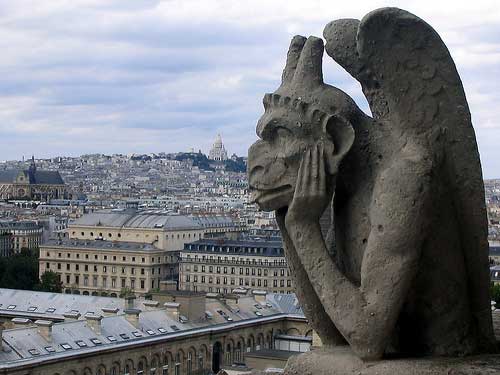
Gargoyle at Notre Dame de Paris
While I have been musing over the question posed by NPR, I have learned that among Hugo’s many concerns was what he construed as a threat to the integrity of architecture in Paris and throughout Europe. In his mind, Hugo connected this fear with what he worried would be the numbing effect of the recently-invented printing press, an idea he touches on in “Notre Dame de Paris.”
The cathedral itself, which was begun in the 12th century and completed in 1345, was in disrepair in the early 19th century, partly as a result of the protracted political turmoil in the city and partly because of simple neglect. Hugo writes:
The church of Notre-Dame de Paris is still, no doubt, a majestic and sublime edifice. But, beautiful as it as been preserved in growing old, it is difficult not to sigh, not to wax indignant, before the numberless degradations and mutilations which time and men have both caused the venerable monument to suffer, without respect for Charlemagne, who laid its first stone, or for Philip Augustus, who laid the last
On the face of this aged queen of our cathedrals, by the side of a wrinkle, one always finds a scar. “Tempus edax, homo edacior,” which I should be glad to translate: Time is blind, man is stupid.
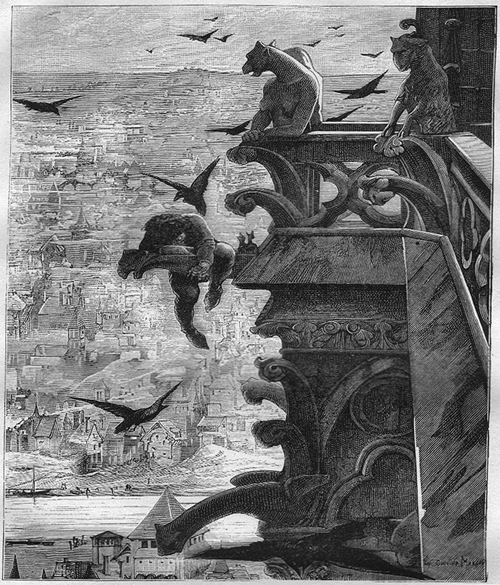
The attention Hugo called to the condition of the cathedral was at least partly responsible for a major renovation of the structure, which is the focal point for many visitors to Paris. You can see interactive panoramic views of the cathedral by clicking HERE.Alfred Barbou illustration from the first edition of the novel.
Netflix Update No. 34: “Some Like it Hot”
July 22, 2010

MARILYN MONROE
We stumbled across an old TV interview with Tony Curtis recently, and that prompted us to watch “Some Like it Hot,” the 1959 Billy Wilder film, which neither of us had seen. The premise of this movie is that dance band musicians Jerry and Joe, played by Jack Lemmon and Tony Curtis, inadvertently witness the “St. Valentine’s Day Massacre” in a Chicago garage in 1929 and have to leave town to avoid being killed themselves. They do that by dressing in drag and joining an all-girl band that is on its way to an engagement in Florida. (The Florida scenes, curiously, were filmed at the instantly recognizable Hotel Del Coronado in California.) Both of the fugitives are immediately attracted to the zaftig singing ukulele player, Sugar Kane Kowalczyk, played by Marilyn Monroe. Joe (aka Josephine) seizes the advantage with Sugar Kane by posing as the millionaire scion of an oil magnate, and that leads to a steamy encounter aboard a yacht. In that role, Curtis does a hilarious imitation of Cary Grant’s voice. Meanwhile, Jerry (aka Daphne) gets drawn into a relationship with an older sugar daddy, played by Joe E. Brown, in which the gender issue gets a little hazy.

JOE E. BROWN and JACK LEMMON
This film combines violence and overt sexuality with implausible farce. It wouldn’t stir up the pond today, but it was controversial in its own time. Marilyn Monroe’s make-out scene with Tony Curtis – and a couple of very revealing dresses she wore – contributed to the negative reactions the film got in what was clearly a different era than our own. The cast, which also included George Raft and Pat O’Brien deliberately type-cast as fictional mob boss “Spats” Colombo and Chicago police Detective Mulligan, was a talented aggregation and made the odd mix of dark and light themes work very well. The film was shot in black-and-white, which somehow seems appropriate to the ’20s setting, but I read that the decision was driven by the fact that the makeup Lemmon and Curtis wore did not reproduce well in color.
As much as I liked this movie, I was surprised to learn that it has been described in laudatory terms ranging from one of the best comedies ever made to the best comedy ever made, to one of the best pictures ever made. I always look askance at statements like that because of the volume of work – done by a wide variety of artists in a wide variety of times and circumstances – that has to be dismissed to make such an evaluation true. It’s enough to say that “Some Like it Hot” was a very good movie. It won an Oscar and was nominated for seven others, and it won Golden Globe awards for Marilyn Monroe and Jack Lemmon and as best picture of the year.

JOE E. BROWN
A lot has been written about the making of this movie, including accounts of how much trouble Marilyn Monroe caused during the production — which must have particularly irked Wilder, who originally planned to use Mitzi Gaynor in that part. Monroe was chronically late and often couldn’t remember her lines and had to read them from cues concealed on the set. She was also pregnant, and appears overweight – even for her – in several scenes.
On the other hand, it was a rare pleasure to watch a performance by Joe E. Brown, who is largely forgotten now but had a keen sense of comedy and was one of the gentlemen of the film industry.

JOE E. BROWN
Although Bob Hope got a lot of attention for the amount of time he devoted to American servicemen and women, Joe E. Brown did his share, too, particularly during World War II. He was a regular figure at the Hollywood Canteen, where he personally interacted with the visiting troops, and he paid his own way to travel more than 200,000 miles into war zones to entertain, often under difficult conditions. He was often known to repeat his whole show for hospitalized soldiers who had been unable to attend the regular performance. He also carried sacks of mail from servicemen and women back to the United States so that it would be delivered through the regular postal service and reach their families more quickly. Brown and Ernie Pyle were the only two civilians awarded the Bronze Star during World War II.
Joe E. Brown was also one of the few public figures who spoke out in favor of admitting refugee Jewish children into the United States while Adolf Hitler was consolidating his power in Europe. In 1939 – flying in the face of both anti-Semitism and isolationism – Brown appealed to a Congressional committee to pass a bill that would have allowed 20,000 German Jewish children into the U.S. “We shouldn’t be smug about this,” Brown told the committee, “and say that we are getting along all right so let the rest of the world take care of itself.”

Joe E. Brown testifies before the House Immigration and Naturalization Committee, 1939
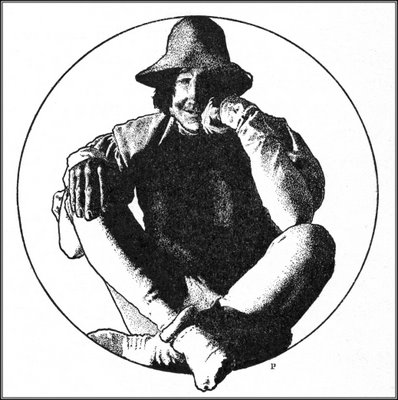
"The Man in the Moon" by Maxfield Parrish

Pixar/Disney
This issue has been treated in literature – notably, as far as my limited knowledge goes, by Kenneth Grahame and by A.A. Milne. Grahame, who was the author of “The Wind in the Willows,”also wrote “The Golden Age” and its sequel, “Dream Days,” which consist of a collection of stories told from the viewpoint of a family of Victorian children. The best known of these stories is “The Reluctant Dragon,” but the whole body of work is remarkable for its portrayal of a world in which adults — the children refer to them as “Olympians” — have forgotten the experience of being young. This subject also concerned Sir James Matthew Barrie (“Peter Pan”) and P.L. Travers (“Mary Poppins”).

KENNETH GRAHAME
The connexion was not entirely broken now–one link remained between us and them. The Noah’s Ark, with its cargo of sad-faced emigrants, might be hull down on the horizon, but two of its passengers had missed the boat and would henceforth be always near us; and, as we played above them, an elephant would understand, and a beetle would hear, and crawl again in spirit along a familiar floor. Henceforth the spotty horse would scour along far-distant plains and know the homesickness of alien stables; but Potiphar, though never again would he paw the arena when bull-fights were on the bill, was spared maltreatment by town-bred strangers, quite capable of mistaking him for a cow.
Jerry and Esmeralda might shed their limbs and their stuffing, by slow or swift degrees, in uttermost parts and unguessed corners of the globe; but Rosa’s book was finally closed, and no worse fate awaited her than natural dissolution almost within touch and hail of familiar faces and objects that had been friendly to her since first she opened her eyes on a world where she had never been treated as a stranger.

CHRISTOPHER ROBIN and POOH
“Yes?” said Pooh.
“When I’m–when—Pooh!”
“Yes, Christopher Robin?”
“I’m not going to do Nothing any more.”
“Never again?”
“Well, not so much. They won’t let you.”
Pooh waited for him to go on, but he was silent again.
“Yes, Christopher Robin?” said Pooh helpfully.
“Pooh, when I’m–you know–when I’m not doing Nothing, will you come up here sometimes?”
“Just Me?”
“Yes, Pooh.”
“Will you be here too?”
“Yes, Pooh, I will be, really. I promise I will be, Pooh.”
“That’s good,” said Pooh.
“Pooh, promise you won’t forget about me, ever. Not even when I’m a hundred.”
Pooh thought for a little.
“How old shall I be then?”
“Ninety-nine.”
Pooh nodded.
“I promise,” he said.
Still with his eyes on the world Christopher Robin put out a hand and felt for Pooh’s paw.
“Pooh,” said Christopher Robin earnestly, “if I–if I’m not quite—-” he stopped and tried again—”Pooh, whatever happens, you will understand, won’t you?”
“Understand what?”
“Oh, nothing.” He laughed and jumped to his feet. “Come on!”
“Where?” said Pooh.
“Anywhere,” said Christopher Robin.

HOWDY DOODY
I have hung onto some shreds of my childhood, and I wish I had kept more. Fortunately, I wasn’t reared by Olympians. On one occasion many years ago, when I was delivering a homily to a class of children who were about to receive First Eucharist, I brought along an admittedly silent friend for moral support. At the end of my sermon I told the kids, “Some day grownups are going to tell you that you are too old for toys, and that you’ll be getting clothes and other boring things for gifts from then on. When they tell you that, you tell them that when the deacon was 50 years old, his mother gave him this Howdy Doody doll.
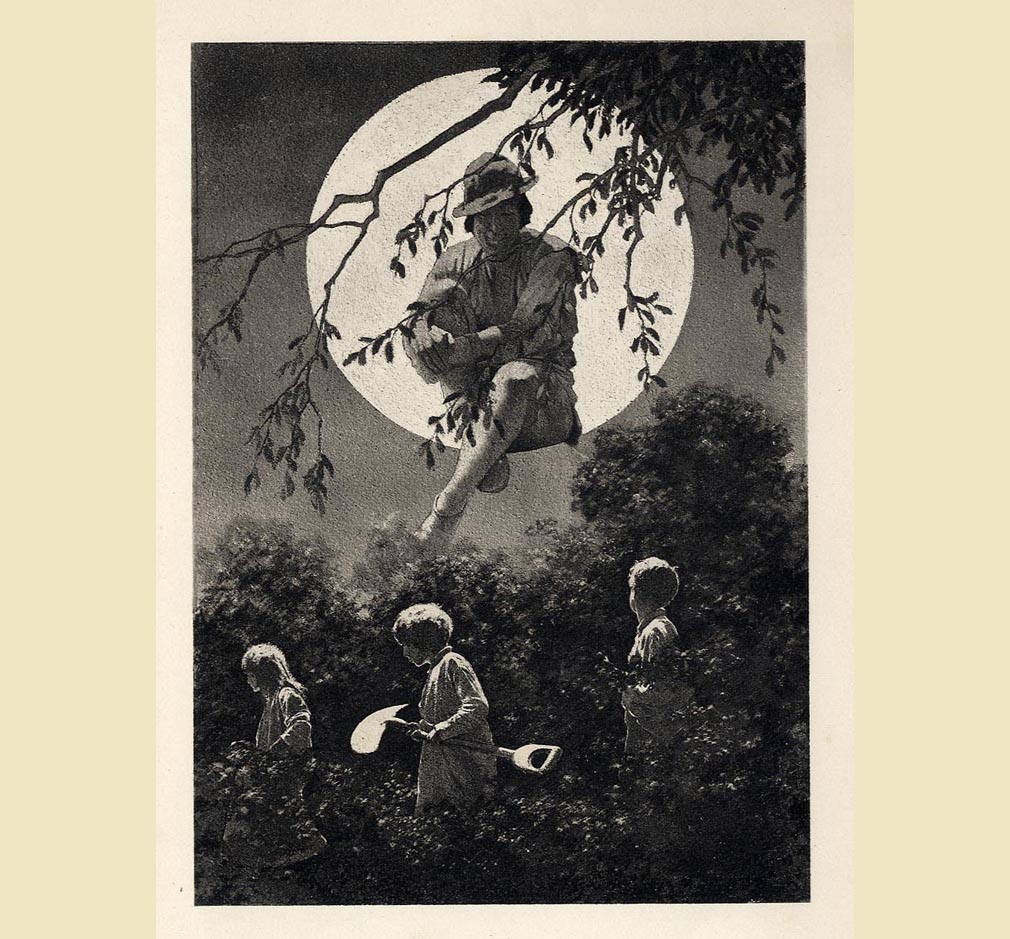
The children take things into their own hands as the Man in the Moon looks on / Maxfield Parrish
As we turned to go, the man in the moon, tangled in elm-boughs, caught my eye for a moment, and I thought that never had he looked so friendly. He was going to see after them, it was evident; for he was always there, more or less, and it was no trouble to him at all, and he would tell them how things were still going, up here, and throw in a story or two of his own whenever they seemed a trifle dull. It made the going away rather easier, to know one had left somebody behind on the spot; a good fellow, too, cheery, comforting, with a fund of anecdote; a man in whom one had every confidence. – Kenneth Grahame, “Dream Days.”
Who is that woman?
June 15, 2010

ANNE SEYMOUR
At last, I know. I have been wondering for decades about an actress who had a brief role in an episode of “The Honeymooners,” and last night I found out by chance who she was.
The episode – one of the so-called “classic 39” – is a Christmas story in which Ralph Kramden saves money to buy Alice a present, but spends it on a bowling ball. Then he uses what money he has to buy a hairpin box that’s made of 2,000 match sticks glued together, believing the salesman’s story that the box came from the home of the Emperor of Japan. On Christmas Eve, before Ralph gives Alice this present, a neighbor – Mrs. Stevens – comes to the door and says she’s going to be away for the holiday and wants to give Alice a present before leaving. Of course, when Alice opens the package it’s a box just like the one Ralph bought, and the neighbor says she bought it at a novelty shop near the subway station.

ANNE SEYMOUR
The rest of that story doesn’t matter. What matters — to me, at least — is that I have always felt that the woman who played that small part was a wonderful actress. She created such a strong impression of Mrs. Stevens as warm and self-effacing that, even as a kid, I had a feeling that I’d like her to be my neighbor or even a member of my family — an aunt, maybe. Every time I see that episode, I’m entranced by that actress’s performance. But “The Honeymooners” producers were stingy with the credits, so the actress wasn’t identified.
So the other might I watched the 1949 version of “All the King’s Men” on TCM. The film is based on a Pulitzer Prize-winning novel by Robert Penn Warren, and it is the story of Willie Stark, a corrupt politician modeled after Huey Long. I had not seen it before, and the first time I heard the voice of the actress playing Stark’s wife, Sally, I knew my question had been answered. A little Googling confirmed that the Kramdens’ neighbor was portrayed by Anne Seymour.
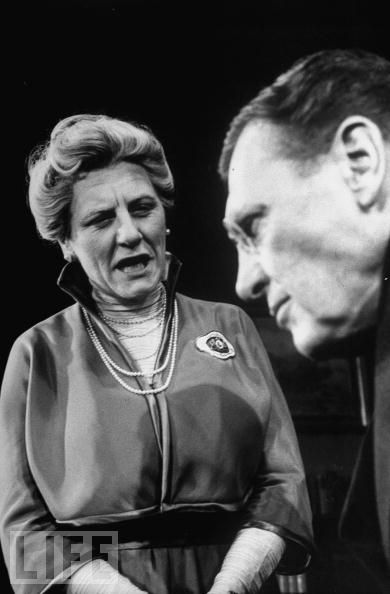
ANNE SEYMOUR and RALPH BELLAMY
Anne Seymour, it turns out, had an extensive career. The International Movie Database lists 121 film and television appearances for her between 1944 and 1988. “All the King’s Men” was her second movie. Her last was “Field of Dreams.” She played the newspaper publisher in Chisolm, Minnesota who helped Ray Kinsella learn about Dr. Archie “Moonlight” Graham.
The actress’s birth name was Anne Eckert, and her family was in the theater for at least seven generations dating back to the early 18th century in Ireland. Her brothers, James and John Seymour, were screen writers. Anne made her stage debut in 1928, and she later also worked in radio drama. Though she spent the bulk of her career working in television, she played Sara Delano Roosevelt, the mother of Franklin Roosevelt, in the 1958 Broadway production of “Sunrise at Campobello,” for which Ralph Bellamy won a Tony award for his portrayal of FDR. Although Anne Seymour got good review for her work in that play, she was not cast in the film version.
Netflix Update No. 33: “Melinda and Melinda”
June 10, 2010

Will Ferrell and Amanda Peet in a scene from "Melinda and Melinda"
We watched the 2004 film “Melinda and Melinda,” which was written and directed by Woody Allen. It was an uneven experience, and I think that was because the balance between comedy and tragedy — which goes to the heart of the film — wasn’t achieved. In my view, at least, the tragedy is to profound to be counterbalanced by the romance. The tragedy is what I expect to stay with me.
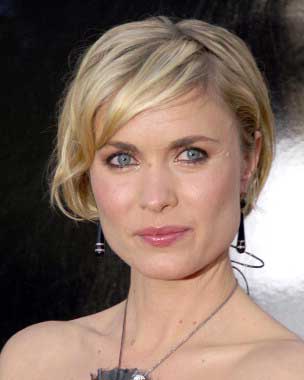
RADHA MITCHELL
The story, as one might expect of a Woody Allen film, is based on an offbeat premise. Two playwrights and several of their friends have dinner in a Manhattan restaurant, and their conversation drifts into the subject of tragedy and comedy as defining elements of everyday life. These playwrights, by the way, are limited parts wonderfully played by Larry Pine and Wallace Shawn. One of the dinner party describes what she says was a real-life incident in which a domestic dinner party was interrupted by the unexpected arrival of a female friend of the hosts. The two playwrights then concoct full-blown stories from that premise — one a tragedy and one a romantic comedy. In both instances, the unexpected visitor is Melinda – played in both cases by the magnetic Radha Mitchell.

TRAGIC MELINDA
In the tragic version, Melinda is a suicidal woman who — by her own account — squandered an idyllic life with her physician husband and two loving children, because she had grown bored with existence and blundered her way into the arms of an Italian photographer. That adventure cost her not only the marriage but any opportunity to even see her kids. She returns to Manhattan in a confused effort to build a new life for herself, but she winds up disrupting the lives of the couple she barges in on, a minor actor and a music teacher played by Johnny Lee Miller and Chloe Sevigny.

COMIC MELINDA
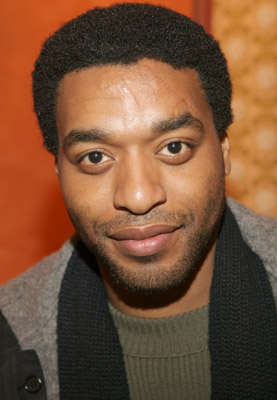
CHIWETEL EJIOFOR
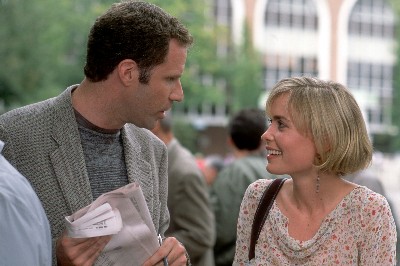
Will Ferrell and Radha Mitchell in a scene from "Melinda and Melinda"
Books: “The Codes of Baseball”
June 1, 2010

MICKEY MANTLE

WILLIE MAYS
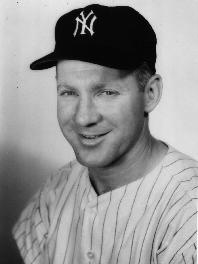
WHITEY FORD

DENNY McLAIN

JIM PRICE
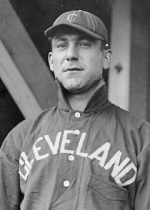
NAPOLEON LAJOIE

TY COBB
Netflix Update No. 32: “What Just Happened”
May 27, 2010

ROBERT De NIRO
We watched “What Just Happened,” an odd film starring Robert De Niro, who can’t be accused of never making interesting choices — “interesting” being a relative term.
This film was released in 2008 and was shown at the Cannes Film Festival that year. That was fair play inasmuch as the festival itself plays an important part in the movie. Although the title begins with an interrogative pronoun, it does not end with a question mark, which — as I tell my English students — mean that it is not a complete idea. The film is based on a novel which does have a question mark: “What Just Happened? Bitter Hollywood Takes from the Front Line” by Art Linson.

ART LINSON
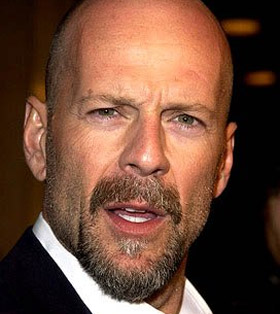
BRUCE WILLIS

Bruce Willis, Robert De Niro, and Stanley Tucci in a scene from "What Just Happened"
Book Review: “Top of the Order”
May 21, 2010

KIRBY PUCKETT
The only time I have carried on a conversation with a naked man, the man was Kirby Puckett. I met him in the Twins’ locker room after a game at Yankee Stadium, and although I had no real business there, and although he had no idea who I was, and although he had just finished playing nine innings and hadn’t showered yet, Puckett couldn’t have been friendlier. The conversation confirmed Puckett’s reputation as Mr. Nice Guy, which is a good reputation to go along with one of the outstanding baseball careers of the 20th century.
Unfortunately, Puckett’s image and Puckett himself eventually came to grief. He was accused and acquitted of sexually assaulting a woman at a Minneapolis restaurant, and he was described in a column by Frank Deford as someone very different from his teddy bear image. He also developed glaucoma and suffered a stroke and died when he was only 45.
Things like that happen to a lot of people, but they take on Shakespearean proportions when they happen to the kinds of heroes and flops that baseball creates in a way that other team sports seldom do. That’s because baseball, unlike other team sports, pauses so often to focus attention on an individual player at an individual moment in time. This is why baseball has contributed so much to literature and film.
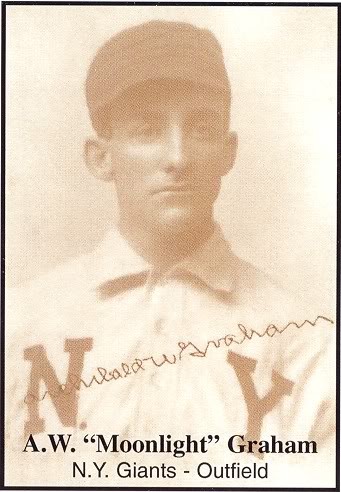
"MOONLIGHT" GRAHAM

JIM BOUTON
Em cee squared
May 17, 2010

A blackboard with formulas written by Albert Einstein, preserved in the Museum of the History of Science at the University of Oxford.
 Several decades ago, I began to make a point of reading several books each year on subjects about which I knew little or nothing — including subjects that I found repulsive. Among those subjects have been mathematics and physics, both of which bedeviled me when I had to study them in high school and college. As I have mentioned here before, at least with respect to mathematics, I have derived a great deal of satisfaction from pondering these subjects when examinations and grades are not at issue, and I have found that those who claim that there is beauty and wonder in these fields are telling the truth
 That background explains why I grabbed the opportunity to review a popular biography entitled “Einstein: The Life of a Genius” by Walter Isaacson. This is a coffee table book that contains a limited amount of text in proportion to the number pages and illustrates its points with many photographs and also with facsimiles of several letters and documents. Among these are Einstein’s letter to Franklin D. Roosevelt in which the scientist advised the president to call together a group of experts to study the possibility of developing an atom bomb — something Nazi Germany was known to be doing at the time. As it happened, Einstein — a pacifist whose work in physics helped pave the way to such weapons — was considered too great a security risk to work on the project himself, what with him being a native of Germany, a socialist, and a Jew.
 Isaacson records that one of Einstein’s early physics instructors described him as “an extremely clever boy,” but added, “You have one great fault: You’ll never let yourself be told anything.” It wasn’t meant as compliment, but still, this tendency as much as anything else led to Einstein’s achievements in theoretical physics. Einstein — like Isaac Newton before him — would not accept anything as settled just because it was handed on to him by authoritative sources. He wondered and questioned and “experimented” with physical phenomena such as light and motion by forming images in his mind, and he changed the world.
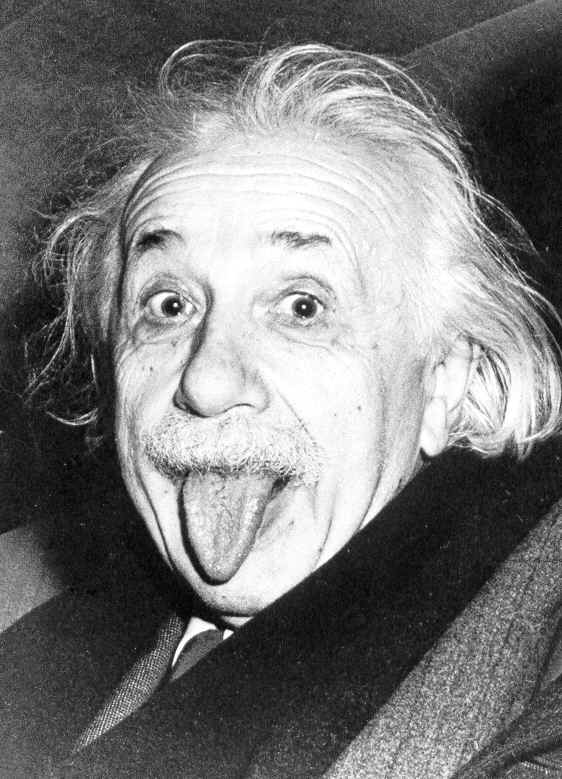
Einstein is a curiosity in a way, because he was one of the most widely known celebrities of his time and his name is part of our language more than 50 years after his death, and yet most of us have little or no idea what he was up to. That doesn’t matter. He deserves his place in our culture if for no other reason than his persistence in questioning even his own conclusions.
Out of the depths
May 14, 2010


GIACOMO PUCCINI
I finally remembered the password to my previous blog, and I rescued a few posts that I particularly liked — narcissist that I am. This is one of them, from June 11, 2006:
I WAS SITTING the car yesterday, waiting. I ran the windows down because sun was bright and the temperature was rising. It was windy – no doubt, you noticed that. The wind blowing through the car was simultaneously chilling and cleansing. The sky was brilliant, decorated only with racing puffs of moisture. I checked the cassette to see what CDs the usual driver had stored there. “La Boheme.” I put it on and concentrated to see how much of the opening dialogue I could decipher. What can you say about Puccini? Although he once sued Al Jolson, claiming that Jolson had filched the first few chords of “Avalon” from a passage in “E Lucevan le stelle” – specifically, “O dolci baci. O languide carezze.” The court thought that whatever reprehensible things Jolson might have done in his life, this wasn’t one of them.
DOWN AND ACROSS the street was a bar. On this bright, blue, breezy day, the dark room was crowded. One man, with a belly the size of a St Bernard, came out onto the sidewalk, sat on a high stool, put his foot up on another, and lit a cigar. He carefully arranged the stools before he sat down. He does this often. Whiles away a bright spring day in the darkness of that bar and comes outside to smoke, sitting on one stool with his foot up on another. One by one, others joined him from inside the bar, including two women and a boy who looked to be about 10. He hugged one of the women in a way that suggested she was his mother. A man pulled his car into an adjoining parking lot and walked toward the gaggle of folks outside the bar. The boy ran toward him – sort of the reverse of the father and son in the parable. The man exchanged a few words with the woman, took the boy with him to the car and drove away. The woman watched them until they were in the car, and then she turned back to her friends. One by one they went back inside. The man with the belly got up and carefully put the stools back in their places. He was the last one to disappear again into the darkness, leaving behind the wind and the sun and the clouds and the sky.
 CharlesPaolino's Blog