Don’t mess with Mr. Whipple
October 21, 2013

In a crossword puzzle I did recently, one of the answers was: “Don’t squeeze the Charmin.” This was a reference to what must have been one of the most successful series of television commercials ever produced. The centerpiece of these spots was the fictional supermarket manager Mr. Whipple, played by Dick Wilson, who was portrayed as catching customers squeezing the Charmin bathroom tissue because, of course, it was so soft. When he had a chance, Mr. Whipple, too, squeezed the rolls of paper. Who can resist that softness?
Dick Wilson played Mr. Whipple more than 500 times, beginning in 1964, and research showed that the commercials made the actor one of the most recognized people in the United States. And the expression itself, “Please don’t squeeze the Charmin,” could be heard echoing throughout the land. As marketing home runs go, this was a grand slam.

Although he was vigilant about the manhandling of Charmin, Mr. Whipple was presented as a mild-mannered fellow, but that’s a credit to Dick Wilson’s acting. He was no shrinking violet. He performed in more than 80 properties, including television series in which he appeared multiple times, including Get Smart, Sgt. Preston of the Yukon, M Squad, and The Lawless Years.
Wilson was born in Lancashire, England, to an Italian father and a British mother; his given name was Ricardo DiGuglielmo. Both of his parents were performers. The family moved to Canada where Wilson graduated from the Ontario College of Art & Design and began working in radio and vaudeville. During World War II, he enlisted in the Royal Canadian Air Force. That seemingly bashful grocery man was among the fighter pilots who went head-to-head with the Luftwaffe in the Battle of Britain in 1940.

After the war, Wilson became an American citizen and, after working as a dancer in New York, moved to California and launched what turned out to be a long career. According to a story published in the Hamilton Spectator in Ontario, Wilson earned $300,000 annually for about twelve days of work on the Charmin commercials. Considering the impact he made, the bunch at Charmin no doubt considered it money well spent. But Wilson said the job was no snap. According to the same article, Wilson said doing commercials was “the hardest thing to do in the entire acting realm. You’ve got 24 seconds to introduce yourself, introduce the product, say something nice about it and get off gracefully.”
Dick Wilson died in 2007 at the age of 91. Click HERE to see him in a Charmin commercial in which he catches Teri Garr in flagrante.

During the movie Same Time, Next Year, which was the topic of my last post, Alan Alda’s character sits down at a piano a few times, and one of the songs he plays is “If I Knew You Were Coming, I’d Have Baked a Cake.” I don’t think I’ve heard anyone perform that song in decades, but I do remember when it was a big hit. That was in 1950, and in that era, novelty songs, as they were called, often made it to the charts and sometimes in a big way.
The one Alda played was written by a committee: Al Hoffman, Bob Merrill, and Clem Watts (a pseudonym for bandleader Al Trace). Like many popular songs, it was an expansion of an expression, the title, that already existed in popular culture. The lyric went, in part:
If I knew you were comin’ I’d’ve baked a cake
baked a cake, baked a cake
If I knew you were comin’ I’d’ve baked a cake
Howd-ya do, howd-ya do, howd-ya do
Had you dropped me a letter, I’d a-hired a band
Grandest band in the land
Had you dropped me a letter, I’d a-hired a band
And spread the welcome mat for you
Oh, I don’t know where you came from
’cause I don’t know where you’ve been
But it really doesn’t matter
Grab a chair and fill your platter
And dig, dig, dig right in.

The first and iconic recording of this song was made by Eileen Barton. The tune arrived on the Billboard magazine chart in March 1950 and stayed for 16 weeks, peaking at No. 1. A recording made that same year by Georgia Gibbs was on the Billboard chart for six weeks. The best-known performance of the song, with good reason, was by Ernie in an encounter with the Cookie Monster in 1969 during the first season of Sesame Street. You can see that scene by clicking HERE.
Another of Al Hoffman’s collaborations, this one with Jerry Livingston and Milton Drake, was the nonsense song “Mairzy Doats,” which the trio composed in 1943. The song has been recorded, and has charted, many times. The Merry Macs, a popular harmony group, took it to Number 1 in March 1944. According to Drake, the inspiration for the song was an English verse he heard his young daughter singing: “Cowzy tweet and sowzy tweet and liddle sharksy doisters.” (Cows eat wheat and sows eat wheat and little sharks eat oysters.)
You can hear the Merry Macs’ hit recording by clicking HERE. This song was a particularly good fit for the wack-a-doodle bandleader Spike Jones, and you can hear his recording by clicking HERE.
“Of castles on the Rhine, candlelight and wine . . .”
September 27, 2013

SHIRLEY ROSS and BOB HOPE sing “Thanks for the Memory” in “The Big Broadcast of 1938.”
Jack Benny occasionally played his theme song on the violin, but to my knowledge, he never sang it on the air, if at all. That makes Benny and “Love in Bloom,” the topics of my last post, unusual among performers and their signature songs. Perhaps the best example of the more typical approach is Bob Hope and “Thanks for the Memory.”
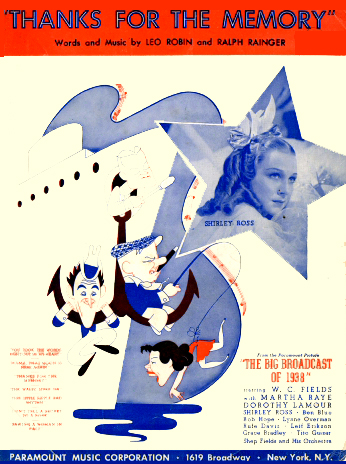
Hope’s theme, as it happens, was written by the same artists who wrote “Love in Bloom.” Ralph Rainger composed the music, and Leo Robin provided the lyrics.
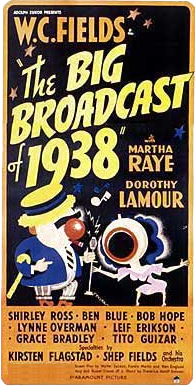
Rainger and Robin wrote the song for The Big Broadcast of 1938, the last in a series of such musical films from Paramount. This plot for this one involved a trans-Atlantic race by two ocean liners. The ensemble included W.C. Fields, Hope and Ross, Martha Raye, Dorothy Lamour, Ben Blue, and Kirsten Flagstad.
Ross and Hope play a couple who are near the point of divorce. In “Thanks for the Memory,” they reminisce about the high and low points of their relationship — a relationship, incidentally, which survives after all. The song won an Academy Award.
Ross and Hope got to team up the following year and sing another song that became an American classic: “Two Sleepy People” by Frank Loesser and Hoagy Carmichael. That duet was in a film titled “Thanks for the Memory.”
Hope adopted “Thanks for the Memory” as his theme, and sang it at the end of his live and televised performances for the rest of his career, changing the lyrics to fit the situation. It was an interesting choice for a comedian, because its original meaning was melancholy, and even when Hope’s writers put humorous lines in it, the sad undercurrent was always there. That was particularly true when Hope sang “Thanks for the Memory” at the end of the many shows he performed for American troops.
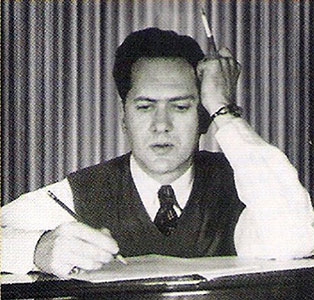
RALPH RAINGER
Ralph Rainger wrote scores for at least 40 movies. He would have written for many more, but he was killed in an air collision in 1942 when he was only 41 years old. The DC-3 he was traveling on collided with a U.S. Army Air Corps bomber over Palm Springs.
You can see and hear Bob Hope and Shirley Ross singing “Thanks for the Memory” in The Big Broadcast of 1938″ by clicking HERE.
Netflix Update No. 80: “The Jack Benny Show”
August 22, 2013

EDDIE ANDERSON and JACK BENNY
My lack of interest in current television is at the point where I have a very limited diet. I’m not going to make an argument for the “golden age,” because I don’t think it’s valid. There have been many excellent shows since the 1950s. Still — and I’m willing to call this a matter of taste — I am attracted to early programming, and especially to situation comedies such as Make Room for Daddy, Burns and Allen, and the proto-sitcom, The Goldbergs.
Thank heaven, then, for services like Netflix, which makes many of these shows available, including The Jack Benny Show. Benny is a favorite of mine, not only because he was such a unique character and was so skillful in portraying his fictional persona — the miser who wouldn’t admit to being older than 39 — but because of his place in American show business history.

A poster advertises a broadcast of Jack Benny’s radio show on a station in Seattle. LSMFT, for the benefit of the younger crowd, stood for “Lucky Strike Means Fine Tobacco.”
The production values of television shows in the 1950s do not compare favorably with what we have become used to sixty years later, but the era got its “golden age” reputation because of the cadre of writers and performers who had migrated to television on a path that led from vaudeville, burlesque, and the legitimate theater by way of radio. Jack Benny and many of his contemporaries had worked very hard to develop their sense of what audiences at the time thought was funny or dramatic, and to develop the timing and delivery that would work in the new medium. They learned their lessons well; Jack Benny’s slow burn is still funny, even when you can see it coming from a mile away.
An interesting aspect of Benny’s show was his relationship with Eddie “Rochester” Anderson, a gravel-voiced black actor who was part of the Benny stock company which included, among others, announcer Don Wilson and Irish crooner Dennis Day.
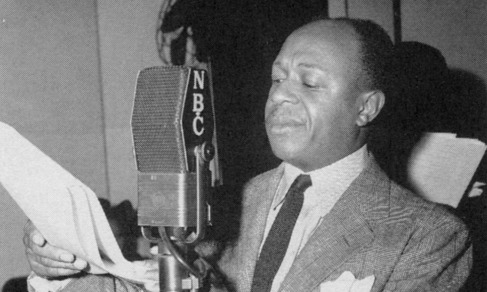
EDDIE ANDERSON
Anderson who, like Benny, got his start in vaudeville, started working with Benny in radio in 1937, first in a few bit parts and then playing Benny’s valet. He played that role on radio and television until 1965. He was the first black performer to have a regular role on radio, but that meant that he was faced with what became a classic conundrum for black artists — the question of whether to play a subservient character or not work in movies, radio, or TV. It was a difficult question for the actors as well as for the black Americans who were being treated as second-class citizens if as citizens at all.
Given the racial climate at the time, The Jack Benny Show took an unusual approach by presenting Rochester as a quick-witted and sarcastic character who was always a little smarter than his boss. The approach was unusual also because this plot element juxtaposed two deadpan figures and the combination was hilarious and was sustained for nearly thirty years. At first, in radio, there was often a racial aspect to the humor surrounding Rochester, but after World War II, Benny — who took an unambiguous public stand in favor of racial harmony — insisted that all racial content be eliminated from his scripts.
Eddie Anderson was one of the most popular and highest-paid actors of his time. He appeared in many movies, including Green Pastures and Gone With the Wind. He handled his money wisely and was both wealthy and generous. Among other enterprises, he owned a company that manufactured parachutes for the American military during World War II.
You can see Jack Benny and Eddie Anderson in a typically funny scene by clicking here.
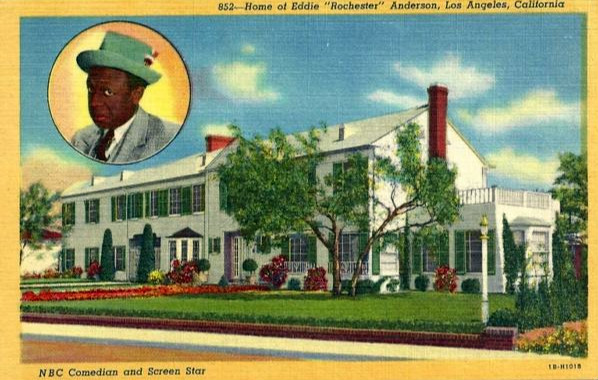
Eddie Anderson’s home on a street named after him in the West Adams district of Los Angeles.
King of the Hill, in a manner of speaking
July 6, 2013
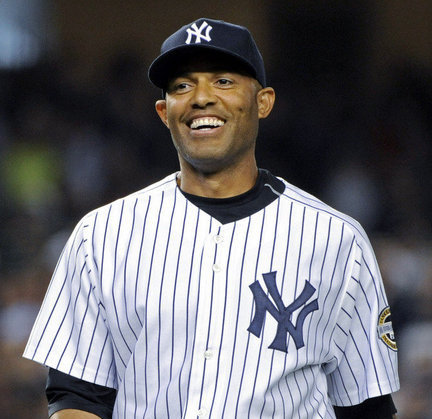
MARIANO RIVERA
The Times, perhaps because it realizes that the window of opportunity is rapidly closing, published a story on June 30, in which Joshua Prager makes the case that by “just about every metric, simple or complex, (Mariano) Rivera is the greatest relief pitcher ever.”
I love Mariano Rivera, and baseball metrics, as much as the next fellow, but I have a problem with words like “ever” in comparisons like this one.
In the recent Times account, the marquee statistic among those used to make this case is the so-called WHIP, which is the average of walks plus hits per innings pitched. When the story was written, Rivera’s average was 1.0035, meaning that in the 1086 innings that Rivera has pitched in his career as of this moment, he has allowed about one hit or walk per inning. A WHIP average approaching this has been rare over the history of baseball. That statistic wasn’t kept until relatively recently, but it has been calculated retroactively and, as The Times points out, Rivera’s average is the third lowest among pitchers who have thrown 1000 or more innings.
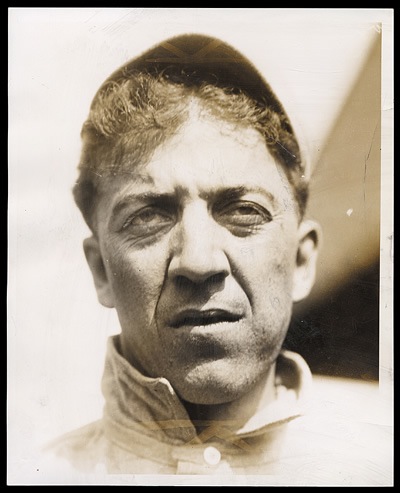
ADDIE JOSS
The lowest WHIP average, 0.9678, belongs to Addie Joss, who pitched for the American League Cleveland franchise from 1902 to 1910 and also was a very popular sports writer in Toledo and Cleveland. Joss pitched a one-hitter in his major league debut, pitched the second perfect game in major league history, and pitched another no-hitter. He was ill throughout most of his career and died at 32 after contracting malaria. Because he pitched only nine seasons, he was not eligible for election to the National Baseball Hall of Fame, but he was admitted under a special rule.
Second place on the WHIP list, with an average of 0.9996, is Ed Walsh, who pitched from 1904 to 1917, virtually all of it with the Chicago White Sox. He also holds the record for lowest career earned-run average: 1.82. His finest individual season came in 1908 when he went 40–15 with 269 strikeouts, 6 saves and a 1.42 ERA.
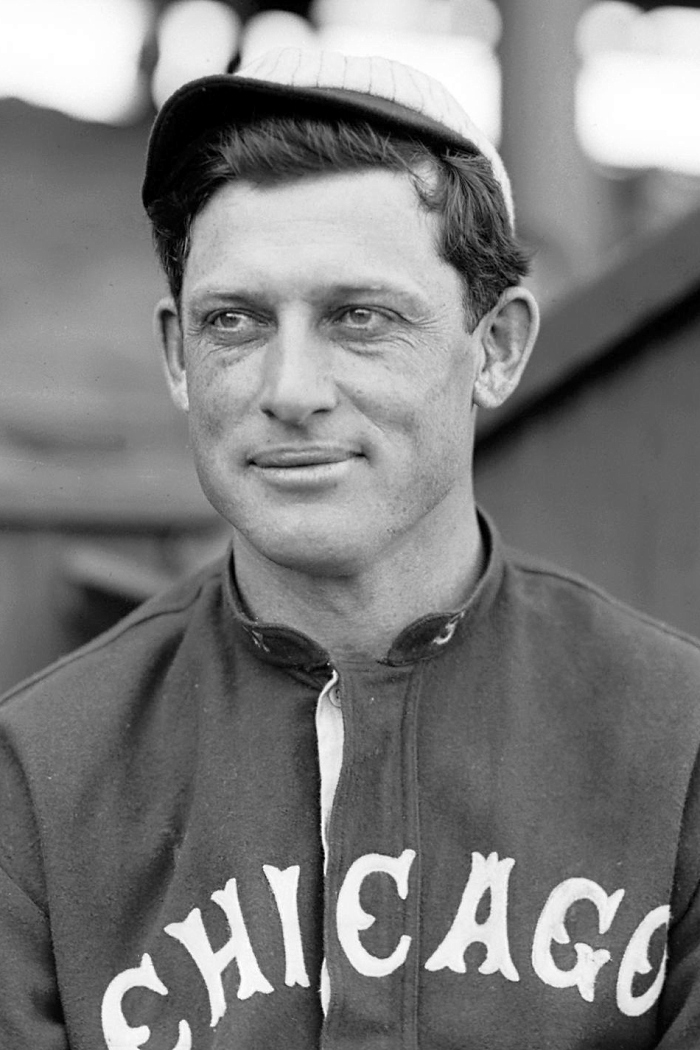
ED WALSH
Inasmuch as The Times called attention to these two players, I will cite their records in order to make my own point. As The Times story mentions, most of Rivera’s relief appearances consist of one inning. Addie Joss and Ed Walsh were starters, not relievers. But the relief specialist as we now know him — the middle reliever, the set-up man, the closer — didn’t exist in that era or for many decades afterward. Ed Rommel’s 17-inning relief appearance in 1932 was an anomaly, to be sure, but relievers for most of baseball history could not count on pitching one inning per appearance.
In compiling his WHIP average, Joss appeared in 286 games and pitched 2327 innings, an average of 8.14 innings per game. Walsh appeared in 430 games and pitched 2964 innings, an average of 6.89 innings per game. To cite a later example, Hoyt Wilhelm, who pitched mostly relief for many teams from 1952 to 1972, appeared in 1070 games and pitched 2254 innings, an average of 2.10 innings per game.
At this writing, Rivera had appeared in 1086 games and pitched only 1251 innings, an average of 1.15 innings per game. His performance has been astounding. It is unheard of for a pitcher to achieve his level of success, to be virtually unhittable, while throwing only one pitch. But pitching one inning per game is a modern, one might say post-modern, phenomenon in baseball. It’s pointless to speculate about how Rivera would have fared if he had been a starter or a long reliever or the jack-of-all-trades that was common in the earlier history of the game. We can certainly appreciate him for the unique player he has been, but “the greatest relief pitcher ever” — EVER? In a game like baseball, that has been played by so many men and that has evolved over so many years, that kind of statement is impossible to defend.
Last year I reviewed a book about Erik Jan Hanussen, a mentalist and con man who first flourished and then crashed and burned in Berlin during the Nazi era — an Austrian Jew posing as a Danish aristocrat. Hanussen struck me as one of the most bizarre characters in the drama of that time, but he has to make room in the pantheon for a puny Jewish teenager who is the subject of Jonathan Kirsch’s arresting book, The Short Strange Life of Herschel Grynszpan.
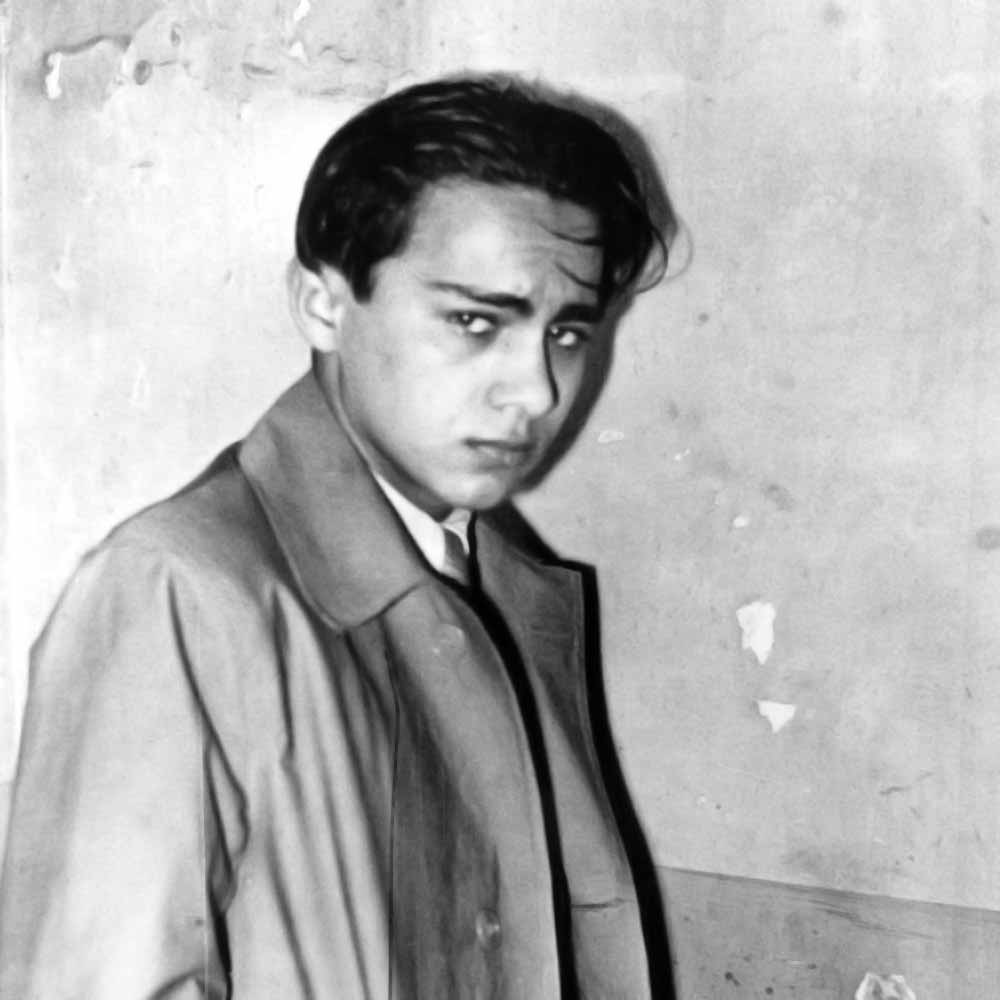 Herschel was living with his Polish parents in Hamburg, Germany, when the Nazis came to power. During the run-up to the Holocaust, when Adolf Hitler’s scheme was to make life so unbearable for Jews that they would leave the Third Reich by their own volition, Herschel’s parents became concerned about his wellbeing. Their solution was to send him west when he was 15 years old, and he wound up living with his uncle and aunt in Paris.
During his sojourn, Herschel’s parents and siblings were among about 12,000 Polish Jews who were abruptly taken from their homes by the Nazis and deposited on the Polish side of the border with Germany. From the refugee camp there, Herschel’s sister wrote to him, describing the harsh conditions.
After an argument with his uncle over the question of helping the Grynszpans financially, Herschel bolted from the apartment and, on the following day, bought a revolver, entered the German embassy on a pretext, and shot a young diplomatic aide, who died from the wounds.
 When he was taken into custody by French authorities, Herschel, who saw himself as some kind of avenging angel, immediately and then repeatedly told them that he had shot the man, Ernst Vom Rath, in response to the treatment of Polish Jews and, in particular, of his own family.
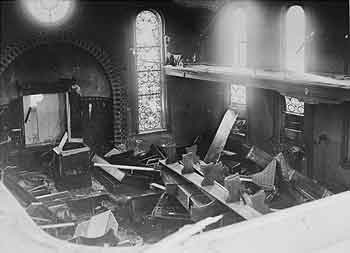
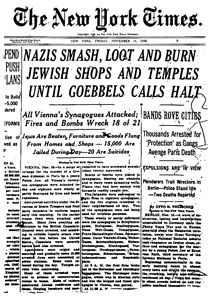
The Nazis reacted to the murder with the carefully staged mob rampage that destroyed Jewish businesses and synagogues and terrorized Jewish people throughout Germany and Austria on the night of November 9 and 10, 1938 — the so-called Kristallnacht.
Meanwhile, Hitler and his partners in paranoia had a different take on the crime. They saw it as the work of the “international Jewish conspiracy” that actually existed only in their nightmares. Hitler sent representatives to both observe, manipulate, and exploit the proceedings against Herschel.
Before the case was played out, however, Germany invaded France, and after Herschel, with the connivance of the French, dodged the grasp of the Nazis in a chain of events that sounds like a Marx Brothers scene, he fell into German control.
 Hitler, employing a brand of logic of which only he was capable, decided to stage a show trial so that the international community would conclude from this solitary crime that Jews everywhere were plotting to take control of Germany if not the whole world.
Kirsch describes the elaborate investigations and other preparations the Nazis made for this spectacle, inquiring into the most remote details of Herschel’s background.
But Hitler didn’t know whom he was up against. The hundred-pound dropout pulled the rug out from under the Nazi propaganda machinery by telling interrogators that he and Vom Rath had actually been involved in a homosexual relationship that went sour. It was a idea that had been suggested to him by one of his lawyers while he was still in French custody. The Nazis were stymied. Given Hitler’s horror of homosexuality, they couldn’t let the show trial go ahead and take a chance that Herschel’s claim would become public. On the other hand, they also couldn’t simply do away with Herschel after making such a big deal about how the case would be tried in public. The trial was postponed — indefinitely, as it turned out.
In a way, that’s where this story ends. No one knows what became of Herschel Grynszpan, although the debate goes on about whether he was a megalomaniac lone ranger or an overlooked hero of the Jewish resistence.
It’s a wonderful yarn, and Kirsch tells it like a novelist, exploring the psyche of an oddball teenager who played a quirky role in the biggest historic epoch of the twentieth century.
Netflix Update No. 78: “The Magic of Belle Isle”
April 14, 2013

MORGAN FREEMAN
Sometimes it’s better to accept the plot of a movie and move on. The Magic of Belle Isle is a case in point.
This feel-good film, released in 2012, was written by Guy Thomas and directed by Rob Reiner. The story concerns Monte Wildhorn (Morgan Freeman), who was once a successful author of novels about a cowboy named Jubal McLaws. Disappointments in his life have dried up his creativity, and he is spending a summer at a borrowed house in fictional Belle Isle (actually Greenwood Lake, N.Y.), where he plans to drink and be disagreeable.
Partly due to his Victorian manners, he grudgingly develops relationships with people in the neighborhood, including Charlotte O’Neil (Virginia Madsen) the attractive divorcee next door, and her three daughters.

VIRGINIA MADSEN
Monte especially becomes engaged with Charlotte’s middle daughter, Finnegan (Emma Fuhrmann), for whom the concept of imagination is elusive. There is also an undisguised chemistry between Monte and Charlotte — an improbable couple by reason of their widely different ages.
In a side plot not wholly irrelevant to the main story, the O’Neil children are going through the pain of separation from their father — an issue that creates a great deal of tension between Charlotte and her oldest girl, Willow (Madeline Carroll).
There is also a sidebar concerning Monte’s positive influence on a mentally or emotionally challenged young man (Ash Christian) who likes to hop around town like a bunny.
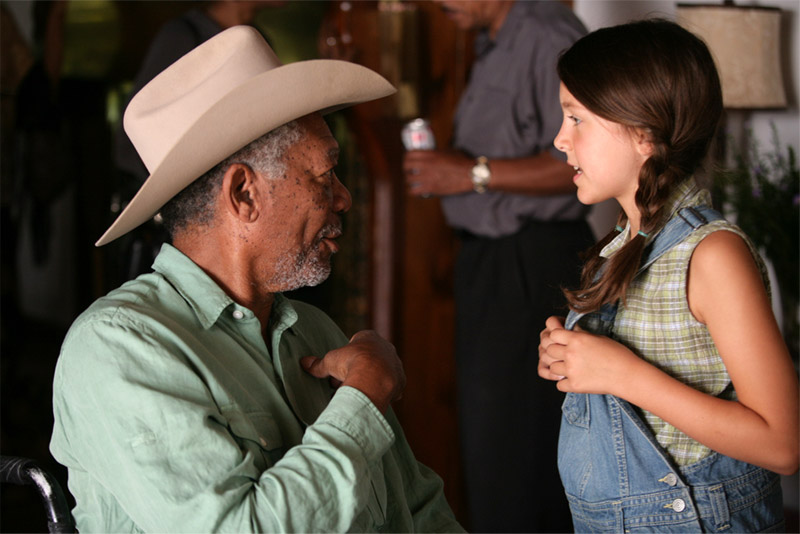
MORGAN FREEMAN and EMMA FUHRMANN
If one wonders too hard about how Monte, who has no use of his left arm and leg, can manage to do all the things that go along with living alone, or how he can drink as much as he does and sober up enough to be a good neighbor … well, if wonders too hard about a lot of things in this story, one may miss the benefits of good acting by a talented cast, a visually pleasing presentation, and a little optimism about human nature.
Books: “Explosion at Morgan”
March 28, 2013

Residents of South Amboy leave the city on foot as fires and explosions rock the Gillespie shell-loading plant.
During the four decades I spent covering the news of Central New Jersey, there were sporadic stories about artillery shells being unearthed up and down the coast in Middlesex and Monmouth counties. These were the lingering legacy of a catastrophe that occurred in 1918, an event described in Explosion at Morgan: The World War I Middlesex Munitions Disaster by Randall Gabrielan. The title refers to a series of fires and explosions at the T.A. Gillespie Loading Co., a shell-loading operation, on October 4 and 5, 1918 — just a few weeks before the end of World War I.
The plant, which was located in the Morgan section of Sayreville, was one of four identical facilities hastily built in New Jersey to supply the firepower needed by the allied armies in Europe. Operations at the plant were overseen by U.S. government inspectors
The loading of shells required the handling and processing of huge amounts of TNT and ammonium nitrate, which were combined and heated to produce amatol, a highly explosive material. There is no certainty as to what sparked the calamity, but Gabrielan writes that the first explosion probably occurred in a kettle in which 2,600 pounds of amatol was being brewed.
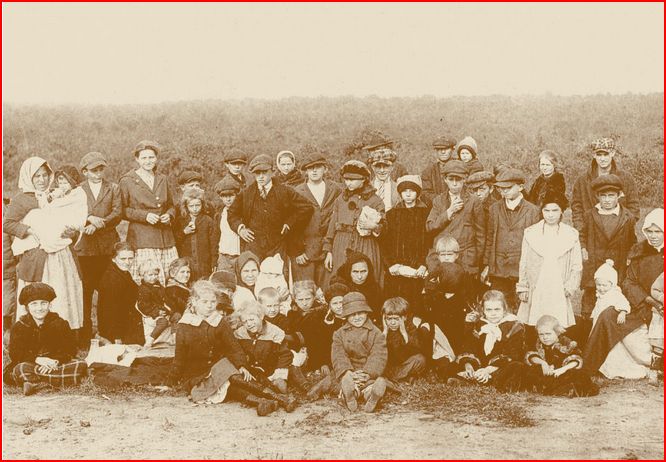
People displaced by the explosions congregate in Perth Amboy.
Once the trouble started, it spread into chaos, with fires raging and shells flying in all directions. The concussions caused property damage over a wide area surrounding the plant, but particularly in the City of South Amboy, where virtually every window was broken. People started fleeing the city simply out of fright, but eventually authorities ordered an evacuation. There were at least 100 people killed in the plant, although the actual total is not known because some of the victims were vaporized in the explosions. Gabrielan also reports that there were about 150 injuries.
This book is carefully researched and precisely written, and its value is not only in its reconstruction of the Gillespie disaster, but in putting both the Gillespie plant itself and the explosions in the wider context of the history of that time. Gabrielan points out that, despite the occasional recovery of a shell, the dramatic and destructive incident has largely faded from the collective memory of the community that was affected by it.

One of the large craters created by the explosions at the Gillespie plant. If you look carefully you can see a man standing in the chasm.
Books: “Words from the White House”
March 20, 2013

NOAH WEBSTER
When we were watching episodes of Downton Abbey on a DVD, we turned on the English subtitles, because we had trouble understanding a couple of the actors — particularly Rob James-Collier as Thomas Barrow and Sophie McShera as Daisy Mason.
It turned out that while some of our difficulty with the dialogue had to do with the one actor’s mumbling and the other one’s accent, some of it also had to do with the vocabulary itself — British terms that we did not know.
Most of us are familiar with terms like “lorry,” “loo,” and “lift,” but we saw others in the captions that we had never heard before.
It was to be expected that the English used in Britain and the English used in the United States would evolve differently, but I learned recently that that didn’t happen only over time but was done deliberately, on our side of the ocean, soon after the American Revolution.
That’s what Paul Dickson reports in his book Words from the White House, which is a compilation of words and phrases that either were either coined or made popular by presidents and other prominent Americans.
According to Dickson, an 18th century sentiment shared by Thomas Jefferson and Noah Webster, was that Americans had to craft for themselves a language that was distinct from the “king’s English.”
Webster was so confident that this goal could be achieved that he wrote in 1806 that “In fifty years from this time, the American-English will be spoken by more people than all the other dialects of the language.”

THOMAS JEFFERSON
Part of the process by which language evolves is “neologizing” — that is, inventing words or phrases from whole cloth.
Dickson writes that the word “neologize” was itself neologized by Jefferson in 1813 in a letter to John Adams.
So Theodore Roosevelt, who — for my money — is disproportionately represented in this book, was neologizing when he invented the term “pussyfooter,” and his distant cousin FDR was doing the same when he created the useful word “iffy.”
Some presidents have been accused of using non-standard terms, not because they were being inventive but because they didn’t know any better.
In this regard, for instance, Dickson mentions Warren G. Harding and George W. Bush.
Harding has often been ridiculed for his 1920 campaign promise of a “return to normalcy,” but Dickson points out that the word “normalcy” had been already in use in several fields, including mathematics.
Harding’s innovation was to give the term a political meaning — and, the author reminds us, it worked.
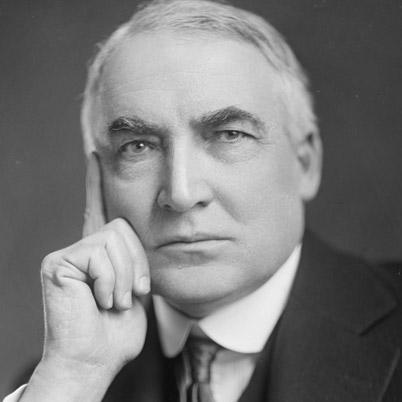
WARREN G. HARDING
The second Bush — who could be hard on English — was kidded mercilessly for his used of the term “decider” which he applied to himself when the press asked him about calls for the resignation of Defense Secretary Donald Rumsfeld (“I’m the decider, and I decide what’s best.”) Dickson gives Bush credit for coining this word, but apparently the author didn’t check a dictionary: that word was around before George Bush was president, meaning exactly what he used it to mean.
Books: “The Pope’s Jews”
February 12, 2013
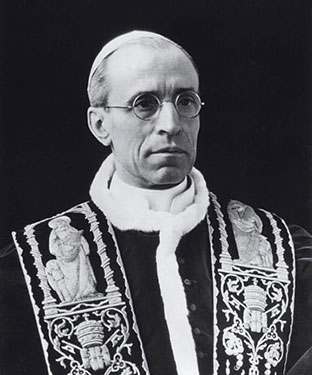
POPE PIUS XII
I don’t know if this is still true, but when I was at the Truman Library in Independence, Missouri, visitors were invited to write in a large book their opinions of President Harry S Truman’s decision to deploy the atom bomb against Japan in 1945. My opinion is that it’s easy to make Harry Truman’s decisions if you’re not Harry Truman. The same thing can be said for all such figures, including Pope Pius XII.
A great deal has been written about what the pope did or did not do with respect to the Jewish people who were being systematically exterminated by the Nazis during World War II. The latest contribution, if it can be called that, is Gordon Thomas’s book, The Pope’s Jews, which is designed to show that Pope Pius was clear in his condemnation of the Nazi regime and that he was directly involved in a variety of schemes to either help Jewish people escape from Italy or hide them in church properties, including the Vatican itself, during the German invasion.
The best that can be said for this book is that it is superfluous and that it is so badly executed as to be an embarrassment to the publisher and an insult to the reader.
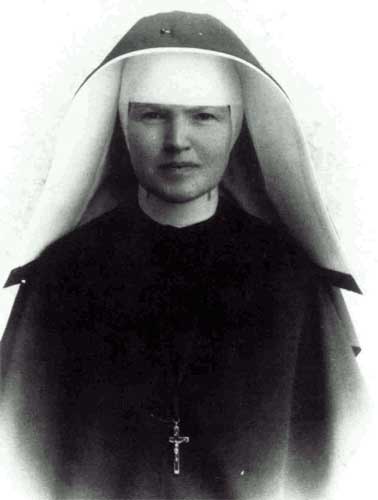
SISTER PASCALINA LENHERT
Most if not all of what the author reports here has been published before. It has been well recorded that Pius, a former papal nuncio to Bavaria, was confronted with the murderous Nazis, on the one hand, who had a track record for wreaking indiscriminate vengeance whenever they met opposition or resistance, and the godless Soviets, on the other hand, who were eager to extend their dominance over as much of Europe as possible. The pope was also the head of a neutral state, and the safety of untold human beings depended on the guarantees that accompanied that neutrality.
There also has been a great deal written about the various bishops, priests, and nuns who either helped Jewish people get out of harm’s way or hid them in church properties, including the Vatican itself. Among those complicit in this was Sister Pascalina Lenhert, who was both housekeeper and confidant to Pius XII. Many sources have reported that the pope himself was not only aware of these activities but was directly involved in some of them.
Thomas writes about all this, and he also writes in some detail about the Jewish people living in the Jewish ghetto in Rome (most of whom died in a Nazi concentration camp), the Jewish resistance movement in Rome, and those working — and, in many cases, hiding — in a Jewish hospital on an island in the Tiber.

Msgr. HUGH O’FLAHERTY
Thomas includes a lot of information about the work of Monsignor Hugh O’Flaherty, who had charge of a network of church operatives who hid Jewish people in multiple safe houses.
Most of this, as I say, comes from secondary sources, and that’s what the bibliography in this book consists of. In the several instances in which the writer does refer to primary sources, he provides no footnotes and no reference to those documents in the bibliography.
Moreover, this book is so carelessly written and edited that the quality of such scholarship as there was must be questioned. The author has a maddening fascination with the past perfect tense of the verb and uses it liberally, especially when it’s not appropriate. That plus awkward or downright improper sentence structure makes reading the text a chore.
And then there are the factual errors. St. Paul was crucified (we don’t know how he died, but the tradition is that he was beheaded); St. Paul had a vision of the risen Jesus in Rome (that happened on the road from Jerusalem to Damascus); Pius XII canonized St. Catherine of Siena (that was Pius II in 1461); Pius XII silenced the anti-Semitic radio priest Charles Coughlin (the Vatican didn’t approve of Coughlin, but didn’t take any action against him; he was forced off the air via regulation by the National Association of Broadcasters after he opposed U.S. involvement in what became World War II).
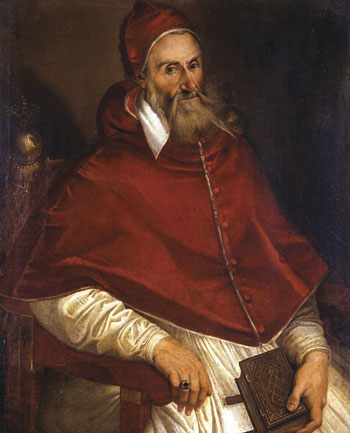
POPE PIUS IV
In his apparent zeal to cast the Catholic Church as a friend of the Jewish people, Thomas writes that Pope Pius IV in the 16th century relaxed a variety of restrictions on Jewish life that had been imposed by his predecessor, Paul IV, but the author does not point out that the restrictions were restored by Pius V.
Immediately after a reference to Pius IV, who assumed the papacy in 1562, Thomas writes this: “The Nicene Creed, the core of the church for centuries, would teach that Pontius Pilate was ultimately responsible for Christ’s death sentence, and that it was the gentiles (sic) who had mocked, scourged, and crucified Jesus.” The Nicene Creed dates from the fourth century, not the 16th, and it doesn’t say anything at all about Gentiles as such: it mentions only Pilate. The Apostle’s Creed, which dates from much earlier than the one adopted by the Council of Nicaea, says exactly the same thing about Pilate. Considering the crimes committed against the Jews over the past 20 centuries, those creeds can hardly be used to make the Church look benign. It was the Second Vatican Council in the 1960s that specifically repudiated the idea that the Jewish people had some corporate responsibility for the death of Jesus; that council also forbid the Church to teach that the Jewish people had somehow been rejected by God (see the council’s document Nostra aetate).
In the decades since the Second Vatican Council, the Church has made a serious effort to improve its relationship with the Jewish people and to condemn any form of anti-Semitism. The present pope, who is about to abdicate, has been very active in that area. Although it does seem that Pius XII gets a bad rap from people who didn’t have to deal with the complex situation he faced, there’s no denying the trouble history between the Church and the Jews. It’s good to think that it might all be behind us.
 CharlesPaolino's Blog