
MAURA TIERNEY
I was sorry to read this week that Maura Tierney is ill. The nature of her illness has not been disclosed, as far as I know, and that is a good thing – especially in view of the recent excesses in the reporting on the illnesses and deaths of Farrah Fawcett and Michael Jackson. If Maura Tierney can keep the details of her health to herself — or at least be allowed to reveal them when, how, and if she chooses, there may still be a chance for civilization.
Her illness will cause an eight-week delay in production of “Parenthood,” an NBC project that is based on a 1989 film by that name. I am not a big television fan, but I was a devotee of “ER,” and Maura Tierney was one reason for that. With “ER” off the air, I have been left with “Seinfeld” reruns, baseball in season, Charlie Rose, and the occasional film on American Movie Classics. My sense is that if Maura Tierney thinks “Parenthood” is a worthwhile project, it will be worth a look.
I hope the fact that Tierney has signed on to another television series doesn’t mean she won’t pursue her stage career. She has appeared in two off-Broadway shows — Neil LaBute’s “Some Girl(s)” in 2006 and Nicky Silver’s “Three Changes” in 2008. We saw both — particularly because Tierney was in the casts. I don’t know how these plays were received critically, but they clearly established that Tierney has a feel for the stage and can make a live audience accept her character — in fact, to want more of it.

MAURA TIERNEY Wireimage Photo
There’s something quirky — one might almost say broken — about Tierney, and from what I’ve read it isn’t an act. It certainly is appealing. She evidently doesn’t lack for composure, however, because she apparently is a good poker player. That fits with one aspect of her genius as an actress — her ability to project a wide range of emotions with a much narrower range of expressions. We saw that often in “ER,” and it also serves her well on stage. In fact, one of the way she fascinates me is by so often making me wonder, “What is she really thinking.”
Be well, Maura Tierney.
Never say never in Neverland
July 11, 2009

MICHAEL JACKSON
The Christian Science Monitor has joined the chorus whose song is that Michael Jackson was likely one of the the last “mega-stars.”
A story in the Monitor this week, written by Stephen Humphries, included these passages:
That Jackson could command such an audience is testament to the kind globe-straddling star power that was possible in an earlier, simpler entertainment age. Amid today’s fragmented popular culture, in which an unlimited buffet of mass media has segregated consumers into niche-oriented tribes, Jackson was arguably one of the world’s last superstars.
“It isn’t just that Michael Jackson was the last superstar because he was one of the last people to benefit from an unfragmented media,” says Timothy Burke, a cultural historian at Swarthmore College in Pennsylvania. “He may also have been one of the last people who could surprise us with a stunning innovation where we didn’t have that sense already of being so jaded by the ubiquity of spectacularly good entertainment. That someone could just leap on the stage and do this thing, and you could go, ‘Wow, I’ve never seen that before!’ “

LUCIANO PAVAROTTI
I don’t know that either niche marketing or a need for innovation supports the bold prediction that no one after Jackson will be able to appeal to a global audience.
Luciano Pavarotti, for example — whose estate was worth about a half billion dollars the last I read about it — appealed to millions of people all over the world, including people who knew nothing about opera, including people who did not want to know anything about opera, and he didn’t appeal to them because he was an innovator — certainly not in the sense that Michael Jackson was. Pavarotti’s performance was pretty much traditional. Whether he was, as a friend of mine claimed, “the second greatest tenor in history,” is a matter of conjecture — and conjecture, I might add, that has no real meaning. Most of those who bought Pavarotti’s recordings, attended his concerts, and watched his television appearances, wouldn’t know if he were second greatest or not. What they knew was that they liked him, and that was all that mattered. The implication of my friend’s remark was that Enrico Caruso was the greatest tenor in history, and Caruso and Pavarotti were alike in this: There was something about each of them that simply appealed to people, including those not normally in the opera crowd. The very fact that the something can’t be quantified, while both tenors’ enormous audiences and coincident earnings can be quantified, should tell us that it’s foolhardy to predict that no such performer will appear again.

SUSAN BOYLE
Susan Boyle’s experience is also instructive. The record-setting video on YouTube featured Boyle, not Jackson. That doesn’t imply any parallel between the two as performers, and that’s exactly the point. Boyle’s appeal was unpredictable. No one saw it coming. And I dare say that even experts in the field, if they had heard Susan Boyle perform before her appearance on the British TV competition, would not have forseen her appeal, which has cut across all the usual borders of musical taste and which, it is important to note, has been a function of a new mode of almost universal communications whose implications and whose future we can’t even imagine. Jackson only got to scratch the surface of the rapidly evolving technology. Even if Susan Boyle turns out to be a comet that will soon fade to black, we don’t know that there won’t be another Susan Boyle who will burst out into the world via YouTube or some unforseen successor to it and re-define the concept of a “star” in ways we haven’t dreamed of.
Remain calm
July 10, 2009

SILVIO BERLUSCONI
Personal attacks may be driving Sarah Palin from public office, but not so the prime minister of Italy. Silvio Berlusconi told G8 leaders gathered in L’Aquila, “You all know very well they are making personal attacks on me, but don’t worry, I will be leading my country for another four years.”
Berlusconi’s perceived dalliances and affairs and his tumultuous marriage have made for lively reading, and they have also made for no end of righteous explanations from the prime minister. He and Gov. Palin have this in common: Neither has done anything wrong.
It’s unusual, to say the least, for the head of a government to address an internal matter like Berlusconi’s circus of a life before a gathering of his peers, but this is no ordinary man. Perhaps the most interesting thing about his statement was the tone of reassurance: “Don’t worry,” he told his colleagues, “ma state tranquilli” — the expression literally means “but remain calm.” Here was Berlusconi — within himself seriously concerned about the battering his reputation has taken in capitals around the world — expressing his determination to remain in office in terms that make him sound not vulnerable, but indispensible.
On balance, even coming from Berlusconi, it was more heroic than anything we’ve seen in Wasilla.
“These silly things remind me of you.”
June 30, 2009

JANE RUSSELL
Several decades ago, I made an appointment to meet the actress Jane Russell in Manhattan. While I was waiting for her in a bar off the lobby of her hotel, a man came in and asked if I was who, as it turned out, I was. He made small talk that included apologizing for the delay, an apology Jane Russell had already adequately made via the house phone. Somewhere in the chit-chat, the man said, “By the way, it might not be a good idea to ask her about Howard Hughes.” Nothing, I told him, was farther from my mind. Jane Russell’s association with Howard Hughes — which dated back to the 1943 film “The Outlaw” — had been documented ad nauseam. In fact, I wasn’t primarily interested in the career in which she established herself as a talented entertainer. I was there to talk to Jane Russell about an organization she founded that did pioneering work in placing children from overseas in adoptive homes in the United States. As far as I know, this organization — the World Adoption International Fund — is still functioning.

HOWARD HUGHES
I understood the motivation for the emissary’s advice. Jane Russell’s life had its “paths and detours,” as the title of her autobiography noted, but she was hardly alone in that regard. In the short time I spent with her, she seemed like a nice woman, and I believe that is her reputation. But it was hard for her to escape questions about Hughes — who had first made her a national celebrity.
Hughes was an unusual figure, an engineer, an award-winning aviator, an aeronautical innovator, an airline and aerospace mogul, a film producer and director, and a philanthropist. He was also eccentric, and over time his eccentricities took on more and more bizarre and self-destructive characteristics. There had been a flurry of news reports about his mental condition around the time I visited with Jane Russell — whose connection to him was far behind her — and it must have been inevitable that someone would seek her opinion. Hughes’ behavior was at least as outlandish as that attributed to Michael Jackson, whose death prompted me to think about Hughes. One can only imagine how his life would have been covered by today’s media.

MICHAEL JACKSON
I do not understand the subject well enough to know what to make of all the hyperbole about Michael Jackson’s transforming influence on popular music. Even if it’s valid, it hardly compares with Hughes’ contributions, but it does present a similar paradox — a man endowed with more than the usual share of talent and insight and the will and savvy to put it to use, and yet a man so deeply flawed that his insanity becomes more an object of public fascination than his achievements.
The man who approached me in the bar didn’t think I was going to ask Jane Russell about Hughes’ design for the H-4 Hercules. Given the man’s apparent age, in fact, I’m not sure he would have known enough to think that. Hughes was already known more for his frailties than for his works, and his experience evokes the question of how Michael Jackson will be remembered in the long run.
“Grace was in all her steps, heav’n in her eye, in every gesture dignity and love” — John Milton
June 28, 2009

SYLVIA LEVIN AT WORK Ken Hively/LAT
If this isn’t a record, it might as well be.
Sylvia Levin of Santa Monica, Calif., registered approximately 47,000 men and women to vote. It can’t be established formally, but authorities on the subject say that total exceeds anything accomplished by an individual in the state.
Sylvia didn’t achieve this distinction overnight. She did it by setting up her rickety card table six days a week for 36 years and calling out to passers-by: “Are you registered to vote?”
Sylvia Levin died Thursday — the same day as Michael Jackson — at the age of 91. Her son, Chuck Levin, who has his own history of registering voters, told the Los Angeles Times that his mother “lived a long and full life of adventure and grace, simplicity and openness, of love and hope — no regrets or fear.”
“Grace, simplicity and openness” — a nice epitaph for a woman whose death attracted no crowds of voyeurs, no lurid headlines, no morbid speculation, just the appreciation of the relatively few who know what she contributed to the well-being of us all.
The full story about Sylvia Levin appears here:
http://www.latimes.com/news/obituaries/la-me-sylvia-levin28-2009jun28,o,1025723.story

- MICHAEL JACKSON
When I learned last night that Michael Jackson had died, I was at a fair – kiddie rides, foot-long hot dogs, funnel cakes – in a town in Bergen County. I drove about an hour and half to get there — not for the hot dogs, which were fine, but to listen to Noise from the Basement, a band in which my son plays keyboard. I would do it again.
When I got home and checked my blog here on wordpress, I saw that traffic on my journal had already soared beyond the normal number of daily visits – by a factor of eight. This was caused by the death of Farrah Fawcett. Her passing apparently sent many people scurrying to a search engine, and some of their searches tripped over two entries I have made in the past couple of months complaining about the way some of the media and some of the public were reacting to her illness.
It might be fortuitous for Farrah Fawcett’s memory that she and Michael Jackson died almost simultaneously. Because of the complicated life that Jackson led, there is likely to be an endless stream of speculation about the nature of his death, and even some serious commentary on the meaning of his life.
I have to say that Michael Jackson meant nothing to me, one way or the other. I didn’t pay close attention to the coverage of his life, but I did see and hear enough to know that the difference between fact and fiction was difficult to discern. If the far more sedate lives of Charles Dodgson (Lewis Carroll) and Sir James Matthew Barrie are any example, some of the questions about Jackson’s behavior will never go away.
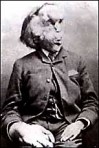
- JOSEPH MERRICK
One small issue in Jackson’s life that did get my attention was the report in 1987 that he had offered to buy the remains of Joseph Carey Merrick, known in popular culture as “John” Merrick, the “elephant man,” a 19th century Englishman who was severely deformed by a disease that has not been conclusively identified. I have spent far more time learning about Merrick than I have ever devoted to Michael Jackson, because I have been interested in Merrick’s determination to achieve some sort of human dignity despite a condition that, through no fault of his own, made it impossible for him to live in society. In fact, he had to be protected from the public. It’s worth noting that Dr. Frederick Treves, who was principally responsible for providing Merrick with a home at London Hospital, had misgivings about his own role in making Merrick something of a darling of British society, including the royal family.
My initial reaction when I heard that Jackson had tried to buy Merrick’s remains was disgust. I couldn’t imagine any legitimate purpose to such a thing, and I felt strongly that Jackson would be violating Merrick’s memory by removing what remains of him from the hospital that gave him the only true sanctuary he ever knew. Although there have been many public reports that Jackson did, indeed, acquire Merrick’s “bones,” my reading indicates that it never happened. Some have claimed that Jackson himself deliberately spread that rumor after having viewed the remains in London, but I haven’t found any substantiation of that idea. The bizarre tones and the uncertainty of this bit of Jackson’s history or legend is a microcosm of the odd and often mysterious biography that will be written and re-written for years to come.
Peter Conrad wrote an interesting essay in The Guardian about Michael Jackson in anticipation of Jackson’s appearance in London next month. It’s at http://www.guardian.co.uk/music/2009/jun/14/michael-jackson
Tammy Paolino — the name is no coincidence — also wrote an insightful piece about the impact of Jackson’s death. It’s at http://blogs.courierpostonline.com/mamadrama/ in an entry dated June 26.
Grasping at straws
June 22, 2009

THE GIGLIO
You have to see this to appreciate it: Men of Our Lady of Mount Carmel parish in Williamsburg dancing through the streets with a 65-foot-high, three-ton tower on their shoulders. It’s such an exquisite demonstration of — well, I’m not quite sure what it demonstrates — that it would be sacreligious to question it. Like Jerry Lewis’s career and the popularity of sushi, it just is.
The occasion is a belated celebration of the feast of San Paolino. The feast day is today, but the dance of the giglio will take place on July 12 during the parish’s annual street fair.
My attention was attracted to this, of course, because of the name of the saint. On an English church calendar, one finds him listed as St. Paulinus of Nola. His full name, rendered in Latin, was Pontius Meropius Anicius Paulinus. The dance of the giglio is a tradition that was imported to Brooklyn and a few other spots in these United States from Nola, the Italian city where Paolino was bishop in the fifth century. Although his feast is celebrated with sausage and peppers and zeppoli, he wasn’t Italian. This is part of a pattern in which one national group attaches itself to a saint who actually is from somewhere else: St Anthony of Padua from Portugal, St Nicholas of Bari from what is now Turkey, St Patrick from Britain, for example.
Paolino, or Paulinus, was born in Bordeaux. He was highly bred and wealthy and he had political power, but he and his wife put all that aside for religious life. Paolino became very influential in the church and was closely associated with St. Jerome and St. Augustine, among others, and his poetry is still highly regarded and, in fact, is the subject of a current book.

SAN PAOLINO
At one point, before he entered religious life, Paolino was Roman governor of Campagna, which is not far from where my family lives. However, I must confess that my connection to him is tenuous – what with him being French and celibate and all. But I take what I can get and throw his name around whenever I get the chance.
The giglio, incidentally, is a tower covered with paper lilies – hence the Italian term giglio — with a statue of the saint perched on top. The tower rests on a platform on which a small band is seated, and the men of the parish carry this whole assembly on their shoulders.
Although I have to admit, when challenged, that San Paolino and I probably have nothing to do with each other beyond our common baptism, I still feel I have made some progress.
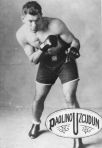
PAOLINO UZCUDUN
After all, when I was a kid and hadn’t yet heard of the saint from Nola, I clung to a clumsy heavyweight named Paolino Uzcudun, whose claim to fame was that his title fight with Primo Carnera represented the greatest combined weight ever in a championship bout.
Here’s your hat. What’s your hurry?
June 19, 2009

HRH ELIZABETH II
AUDREY HEPBURN
Joy, joy, joy
June 13, 2009

JOY BEHAR
I don’t know why this took so long, but I’m glad to see that Joy Behar is finally going to have her own TV talk show. It will be on at 9 p.m. weekdays on HLN, the network formerly known as Headline News.
I listened reguarly to Behar’s radio show on WABC in New York. I didn’t always agree with her – particularly on religious issues – but I was drawn in by the combination of wit, intelligence, and common sense and by her willingness to listen to other points of view. In fact, I called in to her show several times, and she always gave me enough time to say what was on my mind.

JOY BEHAR
While she was still doing that radio show, I wrote a long profile of her. I remember the lead: “Joy Behar is a chiacchierone” – that being the Italian term for “chatterbox.” I spent about an hour with her at WABC, and I later talked by phone to the station manager, who told me Behar’s show was doing well and that he had just signed her to a new contract. It wasn’t long after that that she was fired, not a surprising turn of events in radio. She seemed too liberal and too outspoken in general for the management of that station, but she wound up working for the same parent company when she got her position as a co-host of “The View.”

ANN COULTER
It isn’t possible to judge Behar’s potential as a TV host based on “The View,” because guests aren’t given enough time on that show and the hosts often talk simultaneously. There was a better example of her work recently when she substituted for Larry King and interviewed Ann Coulter. When Coulter appeared on “The View” the conversation deteriorated into babble as everyone tried to make her point at the same time in a contentious atmosphere. On the King show, however, Behar and Coulter were able to have a linear conversation in which – though they may be polar opposites in many ways – they showed each other mutual respect and the viewer got a chance to learn something from the dialogue.
At last, something to look forward to in the bleak landscape of television.
 I should know better. Members of my high school class — Passaic Valley Regional, the Class of 1960 — are making noises about holding a reunion next year. So I’m blowing the figurative dust off the class records, and that meant adding the name of one of Our Own who died recently. I should have just put Gene’s name on the list and closed the file, but no — I had to count the names. There were about 35. There were 299 of us on graduation day.
We started losing members almost immediately after we got our diplomas. One of the first we lost was Terry McBride, whom I had known since kindergarten. My mother used to say that Terry had been my first girlfriend. That was because of the snow storm. Most of us walked to school in those days and it took really bad weather to spare us the trip. One day while we were in school — we were about 7 years old –there was a heavy snowfall, and when we came out, Terry was upset about the prospect of walking all the way home. Her walk was more than twice as long as mine, so I volunteered to go all the way to her house with her and then walk back home.
My mother started to worry when I didn’t arrive in time. When I finally came home with a running nose, beet-red ears and numb hands and feet, she was a little annoyed, but she gently kidded me about it for years. It was a trivial thing, but I’m glad it happened. It’s the keepsake that makes me smile whenever I think of Terry, and I think of her all the time.
 CharlesPaolino's Blog