
KURT COBAIN
I suppose Kurt Cobain had it both ways — he was who he wanted to be, and he wasted the person he was, if such things can be measured by longevity alone. But it’s a little late to moralize about how his life was spent. Without intending it, although he might have enjoyed it, Cobain is at the center of a tempest in Aberdeen, Wash., his hometown. More specifically, a monument to the musician placed in a public park, and even more specifically, a word on that monument, has the pond stirred up.
The monument in question bears a picture of Cobain and seven quotes from him. “The duty of youth is to challenge corruption,” for instance. One of the quotes begins with the words “Drugs are bad for you ….” — a sentiment that should play well in Aberdeen, if you’ll pardon the stereotype. But the rest of that quote includes a word that shocks the sensibilities of some Aberdeenians, a word one seldom sees engraved on public monuments, the word, if you get my drift.

ROBERT DE NIRO
“I don’t like that word,” said one member of the Aberdeen governing body. “The city pays thousands of dollars a year just to remove it from our parks — painting and sandblasting.”
“The majority of the people who are going to make their way down there, it’s not like that’s the first time they’re ever going to see that word,” said another councilman, who was a founder of the official Kurt Cobain Memorial Committee in a city that appreciates Cobain’s talent and his contributions to music.
Language is so interesting. One word is widely regarded as offensive and another word that means precisely the same thing is fit to be pronounced in a middle-school sex-education class. It’s all in the connotation, isn’t it?
One night about 20 years ago a couple came to spend the evening with us and, on the way, they picked up a video — “Midnight Run.” While we watched, our female guest blushed and apologized profusely for bringing that movie, because she hadn’t expected Robert De Niro’s language which was laced with a word fit for — well, for a Kurt Cobain monument. Meanwhile, we all roared at that movie, which, thanks to De Niro and Charles Grodin, is one of the funniest of its kind ever made.

KURT COBAIN
Years later, I watched that movie on television, and it wasn’t nearly as funny. That was partly because I had already seen it, but it was also partly because De Niro’s language had been dubbed out with language that sounded ridiculous coming from the mouth of such a character. It’s hard to know what to make of that. It’s only a word, after all, and people like De Niro’s character use it so habitually that they aren’t even aware of it. And yet, many of us, like the Aberdeen councilman, don’t like it and don’t want to hear it or see it cut into granite in a public park.
It’s one of those things that makes us human beings so fascinating.
The Los Angeles Times reported on the Aberdeen dispute and how it was resolved. The story is at this link:
http://www.latimes.com/news/nationworld/nation/la-na-hometown-aberdeen16-2009aug16,0,19620.story
“Down the road of life we’ll fly.” — Vincent C. Bryan
August 3, 2009
 The controversy of the federal government’s “cash-for-clunkers” program dramatizes the odd position we Americans have put ourselves in as victims of our own success.
The program provides a $4,500 subsidy for a qualified buyer who wants to trade in an old inefficient vehicle for a new and “greener” one. Everybody wins in this program: the buyer can afford a new car, the auto dealer and — by extension — the manufacturer gets rid of inventory, the environment is subject to one less outrage, and the junk yard gets another heap to turn back into cash. The program is so beneficial, and consequently so popular, that it went broke in a hurry, and the question of whether to re-fund it is now being debated in Congress.
 One of those opposed to more funding for this program is U.S. Sen. John McCain — Sarah Palin’s former running mate. McCain thinks this program is an unfair subsidy of the auto industry, as distinct from other classes of business that are at risk in this economic downturn. But the auto industry is getting this attention because it has become such a pervasive part of the overall economy; if it goes down, according to conventional wisdom, everything else goes with it.
 At the root of this phenomenon is the American obsession with cars and with new cars in particular. This has been out of control for a long time, but we were too giddy to notice. The industry produces too many cars, and whole sectors of the economy have grown around that practice like barnacles. This has happened in a country that has failed miserably at building an efficient mass-transit system, though it talks endlessly, and without blushing, about the need to get travelers off the roads and onto trains and buses and monorails and — while we’re daydreaming — into teletransporters. I don’t know if this is what McCain means by his opposition to this latest proposal to expand the federal deficit, but despite the rhetoric about reforming the auto industry, the game plan really seems to be to help it continue overproduction. And what do we think will happen in the long run if we win at that game? I admit to a prejudice here, because I drive a car until it has well over 150,000 miles on the clock, but if we continue the same behavior and expect a different outcome, aren’t we all — by definition — crazy?

"Beam me up"
Gratuitum prandium non existet.
July 31, 2009

PRESIDENT REAGAN
Back in the days when I was somebody, I had lunch a couple of times at the White House. Well, in the interest of full disclosure I should admit that I had lunch at the White House precisely because I was nobody. I don’t know if this is still true, but for a couple of administrations anyway the White House would invite “out-of-town” editors to stop in for a day — “out of town” editors meaning those whose publications were not significant enough to have regular representation in the capital.
One of my visits occurred during the Reagan administration. It consisted of a series of individual briefings by the top cabinet members and by George H. W. Bush, who was then vice president. I took some great pictures of Jeane Kirkpatrick, giving no thought to what I would do with them.
At lunch time, we out-of-towners were ushered into the East Room, which had been done up for a banquet. A Marine chamber group played and we lunchers were served by the liveried staff as though we … well, as though we were somebody. There were other guests there — no doubt a little more influential than any of us — and Ronald Reagan gave a talk. That was our contact with the president.

PRESIDENT CARTER
My first visit was during the Carter administration. There were morning briefings similar to those in the Reagan era and a discussion in the Cabinet Room in which we and Jimmy Carter were the only participants. Between the briefings and the meeting with the president, we were ushered into a large mundane business office whose occupants apparently had been shooed away. On one of the desks were trays of sandwiches and canned soda. This, we were told, was “a Carter lunch.” Presumably there were messages in all this about access to the president and about care for the public’s money.
I see by the papers that the Obama administration has taken the second part of that message a little further and is requiring some visitors, and even some staff members, to pay for what they eat when they are chatting with his excellency. Calvin Coolidge would have liked that.
The story, from the Christian Science Monitor, is at this link:
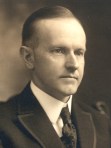
CALVIN COOLIDGE
By turning a dispute that began and belonged in Cambridge into the latest wave of media excess, how has President Obama helped matters? Instead of a serious discussion about the status and condition of black men in the United States, the media have spent the past day falling over themselves in their attempts to find the most clever angle to the White House beer party. Is the president concerned about what has been done to black men in this country since they were sold out in the Compromise of 1877, or is he concerned about restoring the image he dented by butting into the Cambridge issue in the first place? Just as the president’s response to a reporter’s question should have been, “I do not wish to interfere in a local matter — particularly because it involves a personal friend,” the White House answer to questions about what brand of beer would be consumed should have been, “That is not important.” But, of course, the president himself had set the stage for Bud Light to temporarily steal the spotlight from the Michael Jackson case by making a transparent attempt to convert the Cambridge matter into a cracker-barrel jaw session that might make everybody feel better.
Here’s an interesting op-ed, from the New York Times, on the subject of black men in America:
“Say it ain’t so, Joe.”
July 28, 2009

PETE ROSE
There has been a story circulating this week to the effect that Bud Selig, to whom some refer as the commissioner of baseball, may be softening the Major Leagues’ position regarding Pete Rose. At present, Rose, who has admitted gambling on baseball when he was a player and a manager, is barred from having anything to do with baseball beyond buying a ticket as do the rest of the hoi poloi. The Major League ban also means that Rose can’t be elected to the baseball Hall of Fame.
This last is understandable. If you go to Cooperstown and take the time to read the plaques that record the accomplishments of the 202 men inducted so far, you’ll find that by a singular coincidence there wasn’t an SOB among them. Or, at least, you will get that impression. It’s akin to reading the sanitized biographies of the presidents on the White House web site.

ANDRIAN 'CAP' ANSON
One of the men you can read about at Cooperstown is Adrian “Cap” Anson who played 27 straight seasons in the Major Leagues in the 18th century and was the first player to accumulate 3,000 base hits. His plaque briefly summarizes his accomplishments, but it really doesn’t give him enough credit for his influence. Anson was the first real “superstar” in baseball, and he carried a lot of weight. Using his clout, he played a decisive public role in banning black players from Major League baseball, an injustice that lasted from 1888 until 1947, destroying the hopes of thousands of potential big league players.
While you will find Cap Anson represented in the Hall of Fame, you will not find Joe Jackson.

JOE JACKSON
Jackson was banned from baseball along with seven other Chicago White Sox players who were accused of participating in a scheme to throw the 1919 World Series to the Cincinnati Reds. There are conflicting reports about how culpable Jackson was in the scheme; he himself admitted to taking a $5,000 bribe though there is no documented evidence that he did anything to give the series to Cincinnati. In fact, he had a fine series at the plate. A criminal jury acquitted Jackson and the others, but Kennesaw Mountain Landis, the first baseball commissioner, banned them from the game. There is a perenniel campaign to permit election of Jackson to the Hall of Fame, both because of the perception of many that he was a hapless dupe, and because he was one of the greatest players in the history of the game — a man with a .356 lifetime batting average and a .408 season to his credit.
What does it mean to be enshrined in the Hall of Fame — that a man was Prince Charming or that he was a good ballplayer? Pete Rose is an obnoxious character but, on balance, Cap Anson did a lot more harm to baseball. Jackson, so far as anyone can show, did none.
Selig said just ten years ago that Jackson’s case was under review. I hope Rose isn’t holding his breath.
Netflix Update No. 14: “Enchanted April”
July 27, 2009

JOAN PLOWRIGHT
We watched “Enchanted April,” a production that was made for British television in 1991 and was released to American theaters the following year. It was nominated for three Oscars and won two Golden Globe awards.
This is sort of a fantasy about four British women – previously strangers to each other – who rent a castle on the coast of northern Italy for a month-long vacation from lives that have become stifiling — in a different way for each of them. Lottie Wilkins (Josie Lawrence) who instigates the sojourn, is suffocating in her relationship with a husband who appreciates her cooking but shows her no affection and makes her account, in writing, for every penny she spends.

JOSIE LAWRENCE
Rose Arbuthnot (Miranda Richardson) is a devout woman married to a tipsy writer whose books focus on the lives of scandalous women in history and who describes his wife as “a disappointed madonna.”
Mrs. Fisher (Joan Plowright) is an aged socialite who is preoccupied with her circle of notable literary friends, all of whom have been dead for many years.
Caroline Dester (Polly Walker) is a stunning member of the titled elite who is constantly the center of attention, but not the sort of attention that contributes to her emotional wellbeing.

POLLY WALKER
This movie, much of it filmed at the villa that inspired the 1920 novel on which it is based, is visually enchanting. That turns out to be an appropriate quality, because the story — both dramatic and humorous in its way — depends on faith in enchantment. No matter what the four women, and their unexpected guests, may have intended when they traveled to Italy, the results of their month among the lush green hills overlooking the sea transform all of them for good.
The casting is flawless and the performances are engrossing. This film has received a lot of compliments, and they all are richly deserved. I’m not sure a person can watch it once and be satisfied.

JOHNNY DEPP

- LINDA WOOLVERTON

ALICE LIDDELL

THE MAD HATTER
“You either have grace or you don’t.” — Gail Strickland
July 18, 2009

GRETCHEN WYLER
When Gretchen Wyler was appearing on Broadway in Larry Gelbart’s “Sly Fox,” we met her after a matinee for a lunch date. During the performance, we noticed two men sitting in the front row who clearly were there to see Gretchen. The cast included Vincent Gardenia and Jack Gilford, but we could see by their body language that the fellows up front were paying little mind to two fine actors. Even when Gardenia or Gilford was speaking, those fans were watching Gretchen.
I can’t say I blame them for their attention to a woman whom I and many others admired. However, I couldn’t help thinking, while I watched them, of John Lahr’s novel “The Autograph Hound,” which describes people who carry their fascination with celebrities beyond the borders of rational thought and into the realm of obsession.

MANNY RAMIREZ
We waited for Gretchen outside the theater. Those two men were waiting, too. When Gretchen came out, they approached her and she spent several minutes with them. When she joined us, she said, “I must have given those men my autograph a hundred times by now. I don’t know how many times they’ve seen this show.” She said she encountered the men on virtually every performance day, that they handed her index cards for her signature and inquired about the health of her Great Dane, which they mentioned by name, and made other small talk.
At no time, either during her conversation with the two fans or during her explanation to us, did Gretchen display any impatience. She was a person of grace, a person who understood her symbiotic relationship with the public and, not incidentally, with the press. I don’t know what statistics Manny Ramirez will amass during the balance of his baseball career, but no one will ever attribute to him the quality that distinguished Gretchen Wyler.
You can read about Manny’s version of grace at this link:
http://www.latimes.com/sports/la-sp-plaschke-manny-ramirez17-2009jul17,0,3496566.column
Where our mouth is
July 15, 2009
 President Barack Obama proposes to spend $12 billion on American community colleges over the next 10 years.
I’ve lost count of how much money this administration plans to spend, and while my instincts have been saying “Ahem!” for months, I endorse this idea in concept — as far as it goes. After listening to a discussion of deficit spending the other night on the Charlie Rose show, I’m convinced that I am the last person to ask whether we should turn off the presses at the mint or put them into overdrive. From what I can tell, those are both good ideas, or — to put it another way — no one knows.
Anyway, the administration argues that this money would not add to the deficit, because it would be offset byending subsidies to private student-loan companies and banks. What impact the end of subsidies would have on the borrowing and banking public, I am not aware. Whenever government says that a spending initiative isn’t going to cost anything, I reach back to check for my wallet.
Deficit or not, Obama proposes to allocate this money for construction, on-line education, and competitive grants. As long as money is no object, those are worthy causes. There is also a provision for performance-based scholarships and for resources to help colleges to better plan schedules around students’ work demands.
 I have taught on and off at community colleges for years, and I have been teaching at one since the newspaper industry noticed my obsolesence. Every class I teach introduces me to more men and women who are operating under punishing stress because of their inability to pay tuition and fees, support themselves or their families, and devote the time and energy necessary for a real learning experience. I have had students, sometimes on the verge of tears, tell me that they cannot afford to buy a textbook — and don’t get me started on the price of books and the shell-game of “second editions” — or that they cannot afford to buy a PC or laptop computer to use at home, or even commonly used word-processing software for the ones they have. Frequently, these are the very laid-off or undertrained folks that the President says must be prepared for the future demands of business and industry. If they’re really the point of this program — and as long as we’re going to rob Peter to pay Paul — let’s think first about how that money can fill the basic needs of these eager, talented, strung-out students.

MICHAEL JACKSON Megan Lewis/Reuters
“I hate it,” Charlie Brown once complained, “when there are two sides to a story.”
Too often for our comfort, there are that many and more. Carol Norris Green, writing for the Catholic News Service, perceived that with respect to Michael Jackson. Her thoughtful column follows:
Some people are insisting there were two Michael Jacksons –– the iconic entertainer and a bizarre, very troubled individual.
But there was always only the one man living out two sets of fantasies –– his own and those of so many others.
Fantasies can be both inspirational and detrimental. But it is when they motivate us to be our best that they are life–giving.
Consider Olympians, or scientists who give us groundbreaking discoveries. Many worked hard for years to realize what their spirit told them was possible.
However, their achievements were not always embraced on a monumental scale. While people worldwide appreciated what these remarkable people achieved, they didn’t always see themselves in their accomplishments.
It was this seeing of oneself in the journey of Michael Joseph Jackson, dead June 25 from cardiac arrest, that sparked an outpouring of crowds in streets and unabashed tears as people recollected the life of the “Gloved One” who overcame shyness every time he walked on stage.
Shyness can be crippling for so many people. When I work on Catholic News Service’s religious education series (Faith Alive!), I am amazed by the number of Catholics who are uncomfortable at the thought of putting their names to a simple reply to a “Faith in the Marketplace” question! They prefer to have their priest speak for them or remain anonymous.
Rest assured, you won’t see any of them in the spotlight, attempting to moonwalk.
But who hasn’t, even for the most fleeting of moments, wondered what it would be like to strut Jackson’s signature moonwalk?
I’ve done it many times –– in my mind. But I’d turn beet–red if someone caught me attempting to do that in my basement, let alone at an employee dinner–dance.
But, wow! What if one day I found the nerve and actually did a respectable imitation? It would be so fulfilling personally because it would mean I mastered a fear and experienced absolute joy.
As human beings, we all are challenged to come out of our shells to achieve our full potential. But so much of our formation, our discipline says “hold back … not now … what if it is not received well?”
And so we live the reality of routine, daydreaming –– until something out of the ordinary happens.
Enter Michael Jackson, not the child star, but the childlike adult who, like most adults, knew the meaning of love, of pain and suffering, of fantasy too wondrous to let go.
By virtue of his trade as an entertainer, Jackson could do all the things we were taught it was vain to do –– wear flashy clothes and jiggle our bodies, offering freeze–frame poses that said, “Look at me!”
He sang, he danced demanding choreographies. He was so vainglorious!
No wonder Jackson’s death is so personal for so many people.
At death, when we are judged, Scripture tells us that all of our deeds will be tested by fire; what is worthless will be consumed as if “wood, stubble and hay,” and what is worthwhile will become our lasting reward.
And so it will be with Jackson’s legacy. Media, to be credible, must review the good, the bad and the ugly aspects of Jackson’s life. The public receives it, consumes what is tragic, then clings to whatever beauty remains.
Those who choose to remember only the good about Jackson will do for him what we all want done for ourselves: to be remembered for the best that we were and tried to be.
And when we think on what is good, the reward is always an experience of love.
Copyright (c) 2009 Catholic News Service/U.S. Conference of Catholic Bishops
 CharlesPaolino's Blog