Radio days
December 10, 2009

JULIE STEVENS
The announcement by the CBS television network that it had cancelled “As the World Turns” got me to thinking about the soap operas my mother listened to on the radio. In that era, it was common for a radio to be on all day in a house, so what Mom listened to, the rest of us listened to. That is, unless we happened to be in the downstairs kitchen, where we listened to what Grandma listened to — namely, WOV, the Italian radio station in New York.
One of the shows I became quite familiar with was “The Romance of Helen Trent,” which, the announcer reminded us every day, was “the real-life drama of Helen Trent, who, when life mocks her, breaks her hopes, dashes her against the rocks of despair, fights back bravely, successfully, to prove what so many women long to prove, that because a woman is 35 or more, romance in life need not be over, that romance can begin at 35.” That show was on CBS radio from 1933 to 1960, with three actresses — Virginia Clark, Betty Ruth Smith, and Julie Stevens playing Helen. The one I remember was the gorgeous Julie Stevens, who played the Hollywood dress designer from 1944 until the show went off the air and later appeared as reporter Lorelei Kilbourne on the TV series “Big Town.”
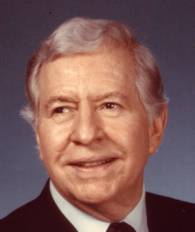
DOUGLAS EDWARDS
Another radio show I vividly remember was a unique series called “Wendy Warren and the News,” which was on CBS every day at noon, beginning in 1947.
Wendy Warren, who was played by Florence Freeman, was a radio and print journalist, who got involved in all kinds of mysterious and dangerous situations. The show was injected with an unusual element of realism by including an actual daily newscast — with the redoubtable Douglas Edwards as the anchor — and by telling its stories in 24-hour increments. The show, which was broadcast on weekdays, even took the weekends into account in its scripts.

FLORENCE FREEMAN
Time, the news magazine, reported on the show as follows in its edition of July 7, 1947:
Sudsy daytime serials are easy targets for radio’s detractors. But soap operas go on & on because sponsors find them profitable. Last week, an outlandish new jumble of fact & fancy called Wendy Warren and the News (CBS, Mon.-Fri., 12 noon, E.D.T.) tried desperately to vary the formula.
The new twist: CBS Reporter Douglas Edwards leads off with a three-minute summary of the day’s headlines. A girl reporter named “Wendy Warren” (Actress Florence Freeman) follows him, shrills out 45 seconds of “women’s news,” promptly plunges into her tortured fictional love life. By the end of the first broadcast, the new heroine was in an old, all-too-familiar lather. “She turns deathly pale,” the announcer confided, “and, but for Gil Kendal’s ready arm, would fall.”

VIRGINIA PAYNE
I can still hear the announcer’s voice saying, “And now …. Oxydol’s own Ma Perkins.”
This show was broadcast on NBC from 1933 to 1949 and on CBS From 1942 to 1960. In an unusual arrangement, “Ma Perkins” was heard simultaneously on both networks from 1942 to 1949.
Ma Perkins was played by Virginia Payne, who didn’t miss a broadcast in 27 years. Her character, if you can believe it, was a widow who ran a lumber yard in a small town called Rushville. The story line was hometown stuff, all about Ma Perkins’ three children and her relationships with the locals. Payne was only 23 when she took the part, so an older model was used for public appearances at first, and Payne herself dressed up in a wig and spectacles so as not to ruin the image of the kindly old woman. An interesting quirk in this show was that Payne was never identified on the air as the actress in the title role until the final episode in 1960, when she made some farewell remarks at the end of the broadcast.
One more show came to mind today: “Our Gal Sunday.” I heard this one often enough, too, that I can recite the daily introduction. This was “the story that asks the question: Can this girl from a little mining town in the West find happiness as the wife of a wealthy and titled Englishman?”
Sunday, played by Vivian Smolen when I was listening to it, was an orphan who had been raised by two prospectors in a mining camp. She wound up as Lady Brinthrope, married to a titled Brit who lived on the East Coast of the United States. The stories often had to do with the tsurris caused by high-brow women making a play for Sunday’s husband, Lord Henry.
The memories of a misspent youth.

ANN ELSTNER, left, played the iconic radio character Stella Dallas. She is shown with VIVIAN SMOLEN, who played Stella's daughter on that series.
One hell of a sunset
December 9, 2009
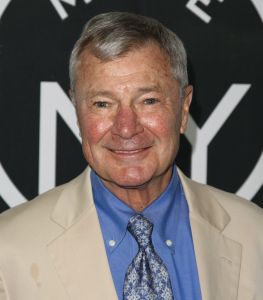
DON HASTINGS
I see by the papers, as Phil Cook used to say, that “As the World Turns” has been cancelled by CBS after 13,661 episodes spread over 54 years – most of the history of commercial television. TV blogger Ava Gacser wrote about a sort of personal tie to the show, and there’s a link to her blog on the right of this page.
Like Ava, I took the news personally, and for a similar reason. I was never a daytime drama fan, but I watched “As the World Turns” several times because I was prepping to interview performers who appeared on the show.
Chief among these was Don Hastings, who has been playing Dr. Robert Hughes for almost 50 years. Hastings has set some kind of record for hours on television. He started out when he was about 16, and in 1949 he started appearing as the second banana on “Captain Video and his Video Ranger,” a live sci-fi show for kids – when I was a kid. Among other gigs, he was on “The Edge of Night” for four years before signing on to “As the World Turns.” He has been one of the constants — maybe the most constant — on the TV screen for the past 60 years.
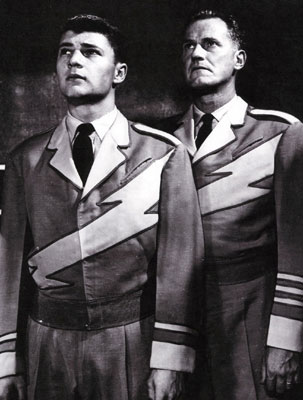
DON HASTINGS and AL HODGE (Captain Video)
I had lunch with Hastings many years ago. The occasion might have been his 25th annivesary on “As the World Turns.” He was a very pleasant man and had a lot of good stories to tell — including anecdotes about fans who had begun to confuse him with Dr. Hughes to the point that the would ask him for medical advice. As crazy as that sounds, that mentality was validated for me once by Joyce Randolph, who told me folks used to send curtains and table cloths to CBS because they thought the Kramdens actually lived in that drab apartment.
Hastings, who is 75, is the brother of Bob Hastings, who has also had a long acting career. His TV debut, by the way, was on “Captain Video.” Bob Hastings, who is about 11 years older than Don, has 144 credits listed on the International Movie Database site.
I also did a telephone interview with Eileen Fulton, when she was marking some benchmark in her “As the World Turns” resume, and I interviewed the gorgeous Lee Meredith, a New Jersey woman who had a short spin on the soap a long time ago. My interview with Lee didn’t have to do with that show, however, but with her role as the sketch nurse in a major production of “The Sunshine Boys.”

GREGG MARX
I also did a lunch interview with Gregg Marx, who in the 1980s had a recurring role on “As the World Turns” as a member of the Hughes family. He won a Daytime Emmy for that part. Gregg is the grandson of Milton “Gummo” Marx – the fourth of the five Marx Brothers. Like Don Hastings, Gregg is a sociable guy, and he was a pleasure to deal with.
For each of these interviews I had to tape the show for a week or so in order to talk intelligently about it to the actors. Fortunately I was working full-time back then. If I hadn’t been, I think I would have become addicted.
Maybe I’ll buy the boxed set.

PAUL WINCHELL and JERRY MAHONEY

PAUL WINCHELL and JERRY MAHONEY

PAUL WINCHELL with JERRY MAHONEY and MORTIMER SNERD
“I wish to be left alone. Since you ask me what I wish … that is my answer.” — Ebenezer Scrooge
November 7, 2009

JIM CARREY
I wasn’t surprised by the tone of Becky Sharkey’s review — in the Los Angeles Times — of Robert Zemeckis’ production of “A Christmas Carol,” yet another corruption of Charles Dickens’ morality story.
Sharkey gives the filmmaker some credit for the effects he creates:
“The film really does work the 3-D application in remarkable ways, possibly the best that we’ve seen from filmmakers, almost making the cost of those weird glasses worth it.
“But the most affecting multidimensional moments are not the blown-out action sequences with this or that tumbling toward you, which is what you might expect. Instead, it’s the way you seem to float through the snow and over the rooftops of London, the sensation of movement and depth making it feel as if you’re perched on the cameraman’s shoulder as he swings the lens around, capturing the city and its citizens from all sides.”

JIM CARREY
Overall, though, Sharkey found the film overbearing and in no way endearing.
I’m on record ad nauseam as disdaining movie makers who think they can tell the stories of a Dickens or a Lewis Carroll or a Victor Hugo better than the authors themselves. I’m too tired to beat that drum right now.
I was amused, however, by two passages in this review:
“We won’t linger on the story, since you’ve no doubt caught one of the countless adaptations since the Charles Dickens piece was first published in 1843.”
“The dialogue includes lines many of us could recite by rote from watching various tellings of the story over the years (an excellent version with George C. Scott is one of my favorites).”
It didn’t occur to Sharkey, apparently, that someone might have actually read the story.
You can read Sharkey’s review at this link:
http://www.latimes.com/entertainment/news/la-et-christmas-carol6-2009nov06,0,1734067.story

WARREN SPAHN
I know all about that, Mr. Damon. Baseball is all about chickens and hatching and not counting prematurely.
I was at the fourth game of the 1958 World Series with my father, my brother, and Mike Ferrante. The Yankees lost that day to Warren Spahn, one of the greatest pitchers of all time. The Milwaukee Braves, who had beaten the Yankees in the ’57 World Series, were ahead three games to one. When we got home, some of our friends were there, waiting for their chance to gloat over what looked like certain annihilation.
But it was not to be. The Yankees won the next three games and the title.
Of course history and the odds are not in the Phillies’ favor. Teams that have won three of the first four games have gone on to win the World Series 34 of 40 times. The last time a team bucked that trend was 1985, when the St. Louis lost the last three games to Kansas City.
If the Pirates’ manager, John Russell, wants to know how he can pull off such a miracle this year, I can only offer him Casey Stengel’s explanation after the Yankees sunk the Braves in ’58: “I couldn’t have done it without the players.”
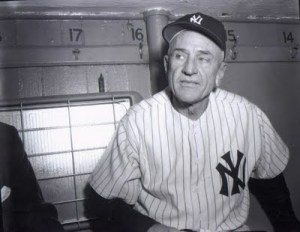
CASEY STENGEL
“It’s very simple: Keep your eye on the ball.” — Joe Sewell
October 31, 2009
 The coverage this week of Derek Jeter receiving the Roberto Clemente Award got me to wondering again about how he will be regarded a few decades from now. I’m not questioning Jeter’s qualifications; the performance and the stats are there. But baseball immortality, if that’s the right word, comes in more than one form. Many players of at least Jeter’s ability are enshrined in the Hall of Fame, and their statistics are indelibly spread upon the record book, but they are largely forgotten except by people like me who have nothing better to occupy their minds.
Jeter isn’t done, and his career base-hits total promises that his name will come up again and again when that category is open for discussion. But whether he will take on a more transcendent presence in the baseball conversation of the future — especially outside the New York area — is not at all certain.
 A player who comes to mind in this regard is Joe Sewell, who was a starting infielder in the American League from 1920 to 1933, the last three years with the Yankees and the rest with the Cleveland Indians. Sewell got into the Indians’ everyday lineup as a replacement for Ray Chapman, who was killed by a pitch thrown by the Yankees’ Carl Mays. A couple of Sewell’s batting statistics compare favorably to Jeter’s. His lifetime batting average was .312 compared to Jeter’s .317, and his on-base percentage was .391 compared to Jeter’s .388. But hidden in that on-base percentage was a factor that made Sewell one of the most remarkable players in history.
 Sewell was the hardest man to strike out in the history of the game. Not by a little bit, by a lot. No one else comes close. He came to bat 7,132 times, and he struck out 114 times. Nick Swisher, to pick a convenient example, strikes out more than that every year — 129 times in 2009, for instance. There were four seasons in which Sewell played every day and struck out only four times — only three times in 1932, which is the all-time record. He once went 115 consecutive at-bats without a strikeout — also the record. Over his career, he averaged one strikeout per 63 at-bats. The closest challenger is George Stone who, over seven years in the early 20th century, struck out once in every 50 at-bats.
It’s always risky to talk about sports records that will never be broken, but it’s safe to say that I’ll be shagging flies with Shoeless Joe and “Moonlight” Graham long before anyone makes contact better than Old Whatshisname.

SAMMY FAIN
We were having our evening tea with Gustav Mahler’s Symphony No. 3 playing in the background when Pat said to me, “What is this song?” I listened for a couple of seconds and said, “That’s ‘I’ll Be Seeing You,’ ” but as the music continued we realized that wasn’t correct. We had forgotten what we were listening to. Still, the theme was repeated a little later, and damned if that wasn’t “I’ll Be Seeing You.”
That happens to be one of my favorite songs. It was written in 1938 for a Broadway turkey called “Right This Way” – lyrics by Irving Kahal, music by Sammy Fain. The combination of the melody and the words is powerful, and the song had a particular resonance during World War II, when so many Americans were separated from loved ones fighting in Europe, Africa, or the Pacific.
 The song was resurrected as the main theme of a 1944 movie by the same name, starring Joseph Cotten and Ginger Rogers. Bing Crosby recorded it that same year, and the recording made it to the top of the charts.
But what of Gustav Mahler? It turns out that a British musicologist named Deryck Cooke, who was something of an authority on the Austrian composer, pointed out almost 40 years ago that the first four lines of Fain’s tune very closely resemble a repeated passage in Mahler’s Third.
We don’t miss much.
Mr. Fain — if you please — one more time:
I’ll be seeing you
In all the old familiar places
That this heart of mine embraces
All day through.
In that small cafe;
The park across the way;
The children’s carousel;
The chestnut trees;
The wishin’ well.
I’ll be seeing you
In every lovely summer’s day;
In every thing that’s light and gay.
I’ll always think of you that way.
I’ll find you
In the morning sun
And when the night is new.
I’ll be looking at the moon,
But I’ll be seeing you.
“It seems we’ve made a little faux pas” — Oliver Norville Hardy
September 29, 2009

GROUCHO MARX
Groucho Marx once attended an international film festival in Mexico City. One evening during the gathering, Groucho and a group of colleagues were informed by a government representative that they had been invited to meet the president of Mexico at 10 the following morning. Groucho raised his hand. “Yes, Mr. Marx?” “What assurance do we have that he will still be president at 10 o’clock tomorrow?”
This rude reflection on Mexico’s political history, coming from a professional wise-ass, did nothing to ingratiate the Marx Brothers to Mexico. It did not, however, prompt an orgy of self-hatred in which Americans wondered aloud if they had become a bit too boorish — “ugly” in the social sense of the word.
The Christian Science Monitor looked into a similar question regarding the recent peccadilloes on the part of Venus Williams, Kanye West, and Sen. Joe Williams. Can it be, the Monitor wonders, that in the age of social networking we have become social anarchists? Not to worry. The conclusion seems to be that there is nothing new about American bulls in the china shop of manners.

PRESTON BROOKS
The Monitor took the occasion to call attention to U.S. Rep. Preston Brooks who, as fate would have it, was from South Carolina. Brooks took umbrage at denigrating remarks about the institution of slavery, remarks that came from U.S. Sen. Charles Sumner of Massachusetts. Sumner was a leading advocate for abolition, and a progressive guy in general, as such things were measured before the Civil War. He was kind of a stiff. He once said that he would never assume a posture, even in the privacy of his own rooms, that he would not assume in the Senate of the United States. It makes one wonder how Sumner took care of certain, umm, personal necessities and intimate pleasures. Anyway, Brooks approached Sumner in the Senate and explained his objections by beating Sumner senseless with a cane. Joe Williams’ bad taste has earned him a million in political donations. Brooks’ fans sent him canes to replace the one he had shattered on Sumner’s head.

CHARLES SUMNER
With almost 300 million people in the country, it’s amusing to see how the news media try to find trends in incidents that involved one screwball, one red neck, and one short-tempered athlete. The Monitor found a couple of etiquette experts who agreed that the whole Shooting Match is going to the bow-wows, but there were also voices with a longer perspective. Public discourse in the 21st century is tame compared to the rough-and-tumble of the 17th and 18th. For one thing, we no longer answer insults with duels, as I was telling Mr. Hamilton just the other day.
The Monitor story is at the following link:
http://www.csmonitor.com/2009/0928/p23s01-ussc.html
“I want to die young at a ripe old age.” — Ashley Montagu
September 23, 2009

ARTHUR LAURENTS
I know what I want to be when I grow up — Arthur Laurents. I bumped into Arthur today at the George Street Playhouse where his latest play, “Come Back, Come Back, Wherever You Are,” will have its premiere next month. I was at the playhouse to interview Shirley Knight, who is rehearsing for this production.
I told Arthur I just finished reading his recent book “Mainly on Directing,” and he said, “I’m just starting to write a new book. It’s called ‘The Rest of the Story,’ and the first line is: ‘You have to know who is telling the story.’ ” The title is a reference to the book he published in 2001, “Original Story.” The first line, I’m sure, is a reference to the fact that Arthur Laurents regards himself as a work in progress, a person always evolving, always acquiring new insights, new ways to look at the theater, at life, and especially at love.

GEORGE STREET PLAYHOUSE
The thing is, Arthur is 92 years old. He just directed the Broadway Revival of “West Side Story” — for which he wrote the book — he has had a new play at George Street for at least the last three years in a row, he is writing a new book when the ink isn’t dry on the old one. And he’s 92 years old.
That’s what I want to be when I grow up.
When I’m 92. Still working, still learning, still thinking — as Pablo Casals said in his 90s — that “I’m making progress.”

ARTHUR LAURENTS and the cast of 'WEST SIDE STORY'
“It all depends.” — George Ade
August 19, 2009
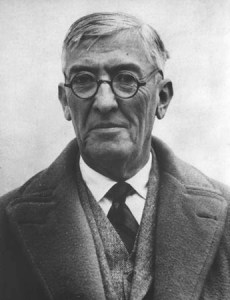
GEORGE ADE
I don’t know when it began. It seems to me that I have always been an obsessive reader. I had to have been fairly young when my mother started complaining that she couldn’t leave a milk container or a box of cereal on the table without my reading every bit of text.
I have considered that the tendency is inborn. My grandfather’s father and both of my parents were pretty much always reading something — mostly periodicals. So maybe I was always a reader, although I believe my romance with books in particular began with a mysterious incident that occurred on one summer Sunday. We came home from our lake house and found that someone had left on our front step a cardboard box loaded with old books. We never learned where it came from. I was the only person interested, so I rooted through the box and found several things of interest, including “Breaking Into Society” by George Ade. I had never heard of Ade, but I read some of the short stories — which Ade called “fables in slang” — and I became a fan. I became a fan not only of George Ade, but of books in general, and I became a regular client at the Paterson Public Library, which was no mean trick since it was nowhere near our house.
I also started buying cheap paperbacks at a local store, because that was easier than going to the library. I had odd taste for a kid, which helps to account for my stunted social life in those days. I bought and read a book about the Borgia popes, “The Nazarene” by Sholem Asch, “The Hunchback of Notre Dame” by Victor Hugo, and a collection of papal encyclicals edited by Anne Freemantle. I got stuck on “Mitt Brennender Sorge (With great anxiety)” by Pope Pius XI — in English, of course — and I read it over and over again.

FRANK NORRIS
I favored non-fiction until my senior year of college when I took a course in the American novel simply because I couldn’t fit anything else into my schedule. On the first day of class, the professor provided us with a syllabus that indicated that we would be reading 21 novels in 15 weeks. I thought about dropping the course, but that would have meant walking all the way over to the registrar’s office, so I read the novels instead — works including “McTeague” by Frank Norris, “The Crisis” by Winston Churchill (the American one), “Winesburg, Ohio” by Sherwood Anderson, and “Miss Ravenel’s Conversion from Secession to Loyalty” by John William DeForest. That course inspired me to read many more American novels that I might have otherwise neglected.
While I was still in college, I worked for a company that provided billing and shipping services to a number of book publishers, including Charles Scribners Sons. One of the managers was always slipping me books from the warehouse, and I spent about two years in the company of F. Scott Fitzerald and Ernest Hemingway.
Once I was out in the working world, a colleague mentioned Charles Dickens’ “Bleak House” to me. At the time, I had read only “A Tale of Two Cities,” which had been assigned to us in high school.

CHARLES DICKENS
I didn’t have to much confidence in this particular colleague, because she claimed to be a descendant of John Wilkes Booth, who had no descendants. But when I admitted to her that I had never read “Bleak House,” she brought me a paperback copy of it. I read it and then read it again. Then I read every one of Dickens’ novels — all of which I have read at least twice — and all the stories and articles of his that I could find.
My mind is wandering; why am I writing about this?
Oh, I remember.
David L. Ulin has a column in the Los Angeles Times in which he laments that he finds it increasingly difficult to read. Our culture has evolved, he says, into an environment that miltates against the state of silence that is necessary to read — to really read — a book.
“These days,” he writes, “… after spending hours reading e-mails and fielding phone calls in the office, tracking stories across countless websites, I find it difficult to quiet down. I pick up a book and read a paragraph; then my mind wanders and I check my e-mail, drift onto the Internet, pace the house before returning to the page. Or I want to do these things but don’t. I force myself to remain still, to follow whatever I’m reading until the inevitable moment I give myself over to the flow.”
So far, I haven’t had that problem. Time can be an impediment to reading, but not the lure of other media. I fact, I have read far more books since I was laid off in December than in any equivalent period since I left graduate school. Still, Ulin’s observations probably will resonate with many folks. You can read his column at this link:
http://www.latimes.com/features/books/la-ca-reading9-2009aug09,0,1920172.story?track=rss
What’s that? You’ve never read George Ade? And you call yourself an American? Check him out here:
 CharlesPaolino's Blog