Play “Misty” for me
March 27, 2025

Bruce Klauber, a journalist, producer, and musician, last year quoted Barbra Streisand as saying, ““There are a number of good singers, a smaller handful of truly great singers, and then there’s Johnny Mathis.” Johnny Carson put it another way after a performance on the “Tonight Show” in which Mathis held the final note of “Pieces of Dreams” for about 30 seconds. “I guess,” Carson said, “that takes care of that song,” meaning, of course, that no one else needs to sing it. One could say that of so many songs that are identified with Mathis, and vice-versa, although his repertoire is so much larger in style and genre than the titles that first come to mind.
My wife, Pat, and I were wondering aloud just the other day how much longer Mathis would continue to tour, and today he answered us, and everyone else, by announcing his retirement. I’m not much younger than Mathis and still working full time, but I’m also at the age when death is no longer an abstract idea. An event such as Johnny Mathis retiring is one more tick of the clock that will not tick forever.
Mathis came into prominence in the mid 1950s, just in time for Pat and me to become fans, an affection we wouldn’t share until we started dating about eight years later. We danced to “The Twelfth of Never” at our wedding; that’s “our song” 61 years later. We have gone to several Mathis concerts including one at which he sang five songs during his encore–a suitable reward, I thought, for the folks who beat it for the exits when he finished his regular set.
I spent many years in the newspaper business covering or supervising coverage of local affairs including municipal and county government. I took advantage of the access that job gave me by developing a sideline interviewing people in entertainment and sports. On one occasion, which happened to be Pat’s birthday, I arranged to attend a “press availability” Mathis was subjecting himself to in advance of a concert here in New Jersey. Without telling her where we were going, I took Pat with me. We were ushered into a room where there were only two other reporters who, it turned out, didn’t seem to know anything about Mathis nor care to find out. They were mute.
Johnny Mathis came into the room, wearing a sweat shirt and a pair of torn jeans, and sat on the edge of a wooden table, and Pat engaged him in conversation. He agreed when she told him that at the beginning of his career he seemed uncomfortable on stage but that he had gradually developed a graceful presence. She asked him if he had ever considered dramatic acting, and he said that he had expressed that ambition but that no one would take him seriously. They went on like that for almost an hour as though they had forgotten that anyone else was in the room until, at one point, Mathis looked at me and said with a laugh, “My God! He’s writing this down!”
We once found on YouTube a long interview with Mathis in which the interviewer asked, in effect, “After making so many recordings over so many years, which ones do you like to listen to most?” “I don’t listen to my records,” Mathis said. “After sixty years, I’m tired of the sound of my own voice!” Well, we haven’t heard his voice as much as he has, but the passage of nearly seventy years now has done nothing to make it any less thrilling and soothing and mesmerizing. Johnny Mathis is retiring, but we have stacks of CDs and vinyls to keep him with us till the ticking stops.
You’re lookin’ swell, Dolly!
December 30, 2024

September 17, 1932
I use this photo as wallpaper on my computers, because it is one of the best baseball action shots I have ever seen. The play took place on September 17, 1932 at the Baker Bowl in Philadelphia. The airborne player is Dick Bartell of the Phillies. The catcher, waiting to make the tag, is Gabby Hartnett of the Cubs. His teammates, visible in the first-base dugout, seem rather nonchalant about the play, but not so the fans—consisting largely of men in suits—who are on their feet. This was the first game of a double header. In the fourth inning, with the Phillies ahead 6 to 1, Bartell was trying for an inside-the-park home run. He was out on the play, but the Phillies would win the game, 7 to 1, and drop the second game, 5 to 1.
Although this episode is all about Bartell and Hartnett, I have always been drawn to the umpire, the trim figure crouching behind the plate, his mask off, his eyes glued to the anticipated point of impact. This is Albert “Dolly” Stark, an innovative, complicated, and ultimately tragic member of baseball’s dramatis personae. One of Stark’s distinctions was that he was the first Jewish umpire in baseball’s modern era and perhaps only the second Jewish umpire since baseball’s beginnings. I don’t know how we can be certain of this, but Jacob Pike, who umpired in the National Association in 1875 , is said to have been the only Jewish arbiter before Stark.

Stark was born in 1897 on the lower East Side of Manhattan. When Stark was a youngster, his dad died, and his mother lost her eyesight. After a police officer found the boy sleeping on a city street, Stark was consigned for a while to a facility for homeless children. Later, in an attempt to earn money for himself and for his family, he played second base for semi-pro and minor league teams. He tried out with the Yankees and Senators, but at 115 pounds, he could not compete at that level. It was during his playing days that he picked up the nickname “Dolly,” a reference to Monroe “Dolly” Stark, a shortstop with the Cleveland Naps and Brooklyn Superbas. Despite the surname, the Dollys were not related.
Albert Stark first umpired at the University of Vermont in 1921. By 1927, he was umpiring in the Eastern League where he did well enough to earn a promotion to the National League. At the time, Stark was also coaching basketball at Dartmouth College and continued until 1936. It might seem to us only common sense that an umpire does not remain stationary on the field but moves around in order to get the best view of a play. However, this was not a common practice until Stark introduced it, shifting positions behind the plate and running alongside fielders and runners to get the best view of plays.
The enmity between players and umpires, if is a staple of baseball lore, and at times it weighed heavily on Stark. And yet, when the Sporting News conducted a poll among players in 1934, they voted Stark the most competent umpire in the National League. If there were an award for the best-dressed umpire, Stark might have won that one too. He was very conscious of his appearance and always impeccably attired on the field in those days when umpires were decked out in suits, dress shirts, and ties, In 1935, Stark became the only umpire before or since to be honored at a day of his own. The event was held at the Polo Grounds in upper Manhattan where National League president Ford Frick presented Stark with a new car that had been purchased with small donations from Stark’s many fans.
In spite of this adulation, Stark’s relationship with baseball was sometimes tumultuous. In 1928, for instance, he wanted to quit in the middle of the season, because he didn’t think he was doing his job well. Bill Klem, one of the great umpires of that period, talked him out of it. Then, after the 1929 season, Stark again thought of quitting, this time because of the tense and lonely nature of umpiring, but he did continue in the 1930 season.
In 1936, Stark quit umpiring because, he said, he wasn’t being paid enough. His salary at the time was $9,000 per season which, according to some sources, was the equivalent of more than $200,000 today. Stark told Ford Frick—by then, the commissioner of baseball—that he would like to stay in the game in a different role, such as business manager or scout, but he never found such an assignment. He resumed umpiring in 1937 but had to retire in 1940 because of a knee injury.
Stark found other outlets for his talents. Among other things, he started a line of women’s apparel—the “Dolly Stark Dress; in 1936, he and Bill Dyer were the first radio team broadcasting Phillies games on WCAU; and he was co-host of an early television sports program, Your Sports Special, on the CBS network in 1948 and 1949.
Stark had a troubled private life. He financially supported his mother and sister, and his sister, who was chronically unwell, took her own life. He married in 1952 but was divorced after four years. Stark died in New York City in 1968.
Books: “Missing Her”
May 20, 2019
 Michio Kaku and the late Stephen Hawking, a couple of spoilsports in my estimation, both have maintained that time travel to the past is impossible. Their conclusions throw cold water on an idea that has stirred the imaginations of writers, film-makers, and ordinary people from, you should pardon the expression, time immemorial.
But J.L. Willow (it’s a nom de plume) isn’t deterred by theoretical physics, and so she has employed time travel to the past—her own original take on it—as the critical factor in her new novel, Missing Her.
This is the writer’s second novel, and she has just graduated from high school and is en route to the study of mechanical engineering. Her first novel was The Scavenger, a tale rooted in the New York City drug culture; I wrote about that book here last April, focusing on Willow’s talent as a story teller and her inventiveness in structuring the story she tells.

J.L. Willow
I’m impressed with the same things in Missing Her in which a teenaged girl, Eliza, vanishes after leaving a party alone, and her closest friend, Vanessa, is determined to find out what became of her. I don’t want to drop a spoiler here, so I’m going to rely on the description of the plot that appears in the promotional material:
“Months pass without a break in the case, until one day Vanessa wakes up . . . in Eliza’s mind. Even more disturbing, she discovers she’s woken up two days before Eliza goes missing. Vanessa has no choice but to relive her best friend’s memories leading up to the disappearance and discover the truth about what happened. . . . But is the past set in stone?”
That last question is a point on which Kaku and Hawking and others have based their conclusion that we can’t go back. If we visited the past, we might change the present, and, as Hawking pointed out in a PBS series, if you visited the past you would already be there!
The paradoxes involved in going back in time play a part in the story Willow weaves, a story in which the time traveler is not walking around in plain sight in her own persona, but rather is observing events from within the mind of another person, at times influencing the behavior of that person—acutely aware of the risks involved in altering events that have already occurred. If and when she does get to the point at which Eliza vanished, how will she be able to prevent it?
Willow creates a perplexing mystery, so much so that I was late for work one day, because I had to read one more chapter—and I still had to drive to my office wondering where this story was going.
Somewhere around here, I have two citations I received for stories I wrote in the first grade. I have no recollection of those stories, and, while I never mastered fiction writing, I have been a writer all my life.
In that respect, J.L Willow and I are two of a kind, and that’s why reading her first published works, and being captivated by them, is such an exciting experience for me.
You can view the book trailer by clicking HERE.
Doris Day: “The Thrill of It All”
May 13, 2019

DORIS DAY
If you ‘re looking for a way to do homage to Doris Day, who died today, I recommend The Thrill of It All, which she made in 1963. I’m not a fan of this genre, but this movie has been a favorite of ours since it appeared in theaters the year before we were married. The story is about Beverly Boyer, a perky wife and mother-of-two, who stumbles into a career as the spokesperson for a soap manufacturer.
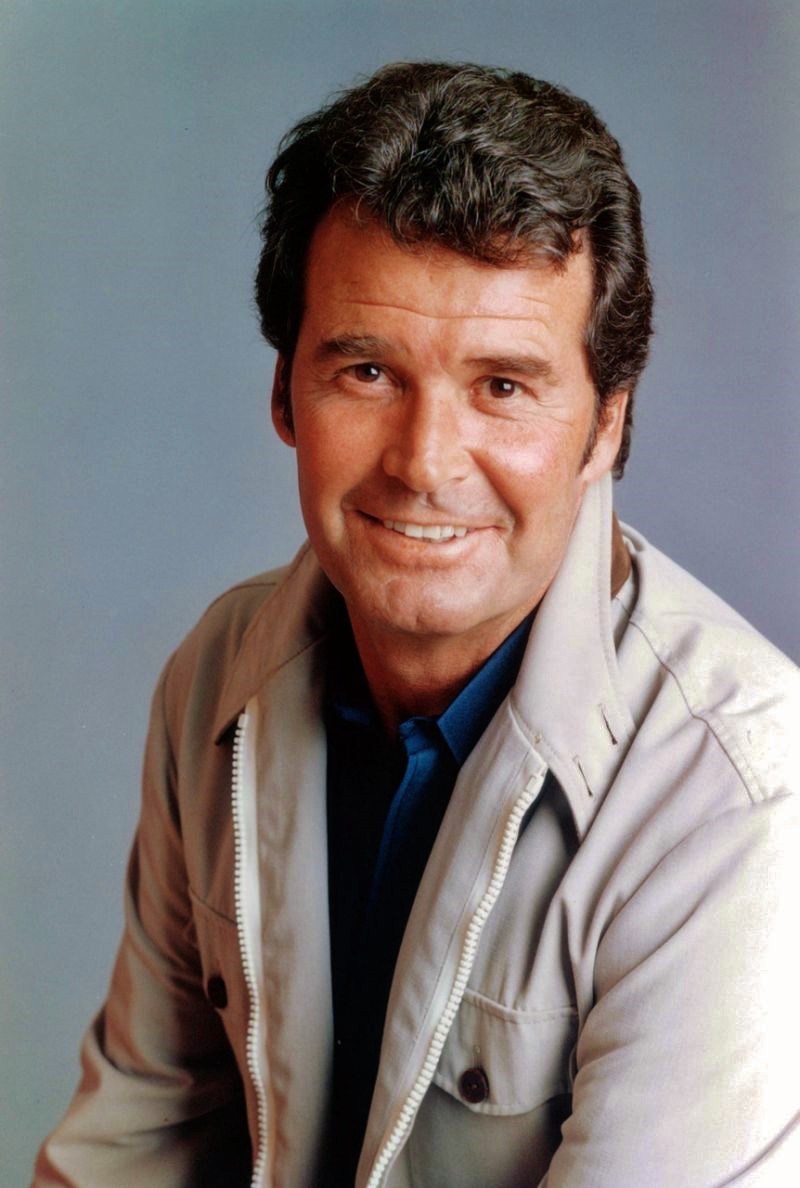
JAMES GARNER/NBC Universal
The fact that the principal product in this tale was called Happy Soap, will give you an idea of the tone of the movie. Beverly—played by Day, of course—makes a big salary from television commercials and becomes a celebrity, but the demands on her time play havoc with her marriage to Dr. Gerald Boyer, an obstetrician played by James Garner. And although I’m not crazy about slapstick, the scene in which Garner drives a Chevy convertible into a swimming pool tickles me every time I see it.

CARL REINER
I have read that Carl Reiner, the comedy genius who wrote this screenplay with another genius, Larry Gelbart, had wanted Judy Holliday in the female lead, but Holliday became ill with what proved to be terminal cancer. I have also read that Ross Hunter, one of the producers, wanted to invite Nelson Eddy and Jeanette McDonald to return to the screen in supporting roles, but they do not appear in the film.
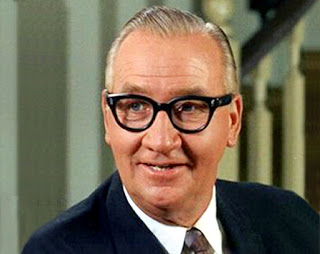
EDWARD ANDREWS
As it turns out, the cast that did appear in this film was golden. The players included Arlene Francis, who was 56 at the time, as a patient of Garner’s character—a woman who is delighted to find herself pregnant well past the standard age for such an enterprise. Her equally delighted but frantic husband is played by Edward Andrews. I presume these were the roles Hunter had envisioned for Eddy and McDonald, but, with all due respect to those classic actors, no one could have played the parts for more laughs than did Francis and Andrews. In a scene in which the expectant couple gets stuck in city traffic when the birth is imminent, gives Andrews a chance to give the comic performance of his life.
The company also includes Reginald Owen, ZaSu Pitts, and Elliot Reid, and Reiner himself in some cameos.
 I don’t know if most of the news reports of Doris Day’s death will adequately express the magnitude of her fame as a singer and movie actress. She was publicly recognized for that in many ways, including the Presidential Medial of Freedom. She was also a philanthropist with a particular interest in animal welfare.
A more jaded generation might dismiss The Thrill of It All for what it was, fluff, but it was designed as nothing more than entertainment, and it has entertained us again and again, and we have already planned to watch it again so that we can renew our appreciation for Doris Day. I know the feeling will quickly be dispelled, but we’ll give in to the fantasy once again and, when the Boyers have resolved their crisis, we’ll actually believe just briefly, that, no matter what we heard on that last newscast, everything will be all right.
“I’ll sing in the streets!”
April 2, 2019
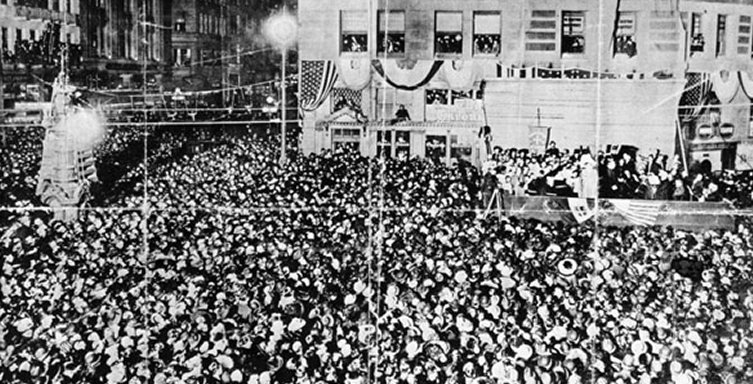
An estimated 250,000 people assemble for Tetrazzini’s Christmas Eve concert in San Francisco.
My recent post about Nellie Melba called to mind Luisa Tetrazzini, who had several things in common with Melba. Tetrazzini was also a soprano—a coloratura whose range extended to the F above high C—and a contemporary of Melba at the beginning of the 20th century. Also like Melba, Tetrazzini had an enormously successful career in opera and concert and was treated like royalty around the world. She was, by reputation, a warm and friendly woman, but one of the few people she didn’t get along was Melba.
 And Tetrazzini, like Melba, inspired a chef, although there is disagreement about whether the chef was Ernest Arbogast at the Palace Hotel in San Francisco or an unknown practitioner at the Knickerbocker Hotel in New York. The dish involved is “tetrazzini,” which consists of diced chicken or seafood and mushrooms in a sauce of butter, cream, and parmesan, laced with wine or sherry. This is usually served over pasta, although there is no fixed recipe or manner of presentation. Louis Paquet, a chef at the McAlpin Hotel in New York, seems to have had a hand in making this concoction popular. Paquet and Tetrazzini were friends, and he gave her cooking lessons.
 The popularity in their era of artists like Melba and Tetrazzini is hard to imagine now, because media and the nature of celebrity have changed so much. In 1910, Tetrazzini had a contract dispute with the impresario Oscar Hammerstein that was preventing her from singing in opera houses or concert halls in the United States. The soprano, who said San Francisco was her favorite city in the world, said, “When they told me I could not sing in America unless it was for Hammerstein, I said I would sing in the streets of San Francisco, for I knew the streets of San Francisco were free.” And she did that, on Christmas Eve, in front of the San Francisco Chronicle building. The mayor of San Francisco escorted her to a platform that had been built for an orchestra and chorus that were conducted by Paul Steindorf of the city’s Tivoli Opera. Hundreds of thousands of people turned out to hear a concert which Tetrazzini began with “The Last Rose of Summer” and concluded with the massive crowd joining her in “Auld Lang Syne.”
 Tetrazzini had several failed marriages, and the last one cost her most of her fortune. When she was through performing, she returned to her native Italy and taught singing in order to support herself. She never lost her joie d’vivre, by all accounts, and used to say, “I’m old. I’m fat. But I’m still Tetrazzini!”
Click HERE to see an unusual film clip in which the 61-year-old Tetrazzini listens to a recording of Enrico Caruso singing “M’appari” from Martha and breaks into a duet with her old friend. Even at this age and with this quality of reproduction, you can get a sense of the character of her voice.
Sic transit and so forth
March 31, 2019

When I saw this display at the supermarket today, it sent my mind reeling back to an eposide of Downton Abbey in which the Australian soprano Nellie Melba was engaged to gave a recital at the Granthams’ mansion. More precisely, this display reminded me that among the historical inaccuracies presented in that series, the visit by Nellie Melba was one of the most glaring—to anachronisms such as I am, at least.
One feature of the episode was that Charles Carson, the Granthams’ head butler, was scandalized that a mere entertainer would be invited into the house. According to the Downton Abbey storyline, Carson had been a song-and-dance man before he took on the pompous persona of a butler, but apparently he didn’t see the irony in that.

NELLIE MELBA/Lilydale Historical Society
Carson treated Melba—portrayed by past-her-prime soprano Dame Kiri Te Kanawa—as though she were a hired hand, leaving her in her room with nothing but a cup of tea. Others in the house made caustic remarks about having to sit through her performance.
Actually, by 1922, when this was supposed to have occurred, Nellie Melba was a dame commander of the Order of the British Empire for her charity work during World War I. More to it, she was one of the most celebrated singers in the world, eagerly received by royalty.
As Robert Christiansen, the opera critic for The Telegraph pointed out when the episode was first broadcast, Nellie Melba “would only have sung at a private party as a personal favour to her host. Melba was nobody’s hireling: she called all the shots, and the Granthams and their staff would have quaked at her approach.”
A story by Tom Huizenga of National Public Radio included this passage:
“Even today, Melba’s recorded voice rings clearly as a favorite of Tim Page, Pulitzer winner for criticism and professor of music and journalism at USC.
“‘There’s something sort of unreal about it,’ Page says. ‘It’s a voice of ethereal purity with perhaps the only perfect trill I’ve ever heard.’ Another celebrated Melba attribute is accuracy: ‘She hit things absolutely on pitch,’ he continues. ‘You never hear Melba sliding into a note. Her tone was as reliable as a keyed instrument. She’s just dead on.'”
Incidentally, while Melba—whose birth name was Helen Porter Mitchell—has been forgotten by all but opera buffs, her professional name lives on in the product you see above, which was named after her, as was peach melba and several other delicacies.
You can hear Nellie Melba with Enrico Caruso in the duet “O Soave Fanciulla” from Giacomo Puccini’s La Boheme by clicking HERE.
Books: “In Pieces” by Sally Field
November 8, 2018

SALLY FIELD/In Pieces/Simon & Schuster
“Why is it easier for me to write about the times in my life that felt humiliating or shameful? Is it because those are the things that still haunt me?”
Sally Field asks those questions in her remarkable memoir, In Pieces, and they imply that the distinguished actress is, in her interior life, a work in progress at 72.
“Do I hold on to those dark times as a badge of honor,” she asks, “or are they my identity? The moments of triumph stay with me but speak so softly that they’re hard to hear—and even harder to talk about.”

SALLY FIELD as Mary Todd Lincoln
We know all about the moments of triumph: Sally Field has won two Oscars, three Emmys, two Golden Globe Awards, and a Screen Actors Guild Award, and she has been nominated for a Tony Award. Not many can make that claim. She has starred in some of the finest properties available, including the television miniseries Sybil; the motion pictures Norma Rae, Places in the Heart, Absence of Malice, Steel Magnolias, Forrest Gump and Lincoln; the Broadway revival of The Glass Menagerie, and others.
But until Field published this memoir, we did not know about the punishing life she led away from the stage and the cameras—a lonely childhood; sexual and emotional abuse at the hands of her stepfather; sexual exploitation at the hands of others; a fraught but enduring relationship with her mother—who did nothing to prevent the abuse of her child; troubled alliances with men—including Burt Reynolds, and a long struggle to be taken seriously as an actor. Field has discussed many of the details in print and broadcast interviews concerning this book.
For Field, the result of these experiences was a fractured sense of identity—hence the title—and it took her decades to even begin to assemble the fragments into a recognizable whole.

MARGARET MORLAN FIELD
Field wrote this book herself—I think it took her three years; having spent the past fifty-three years as a writer, editor, and teacher of writing, I appreciate her literary skills, including her use of wry humor in a dark story and her offbeat imagery:
The most important figure in this book beside Field herself is her mother—a once stunning actress born Margaret Morlan. In one passage concerning their later life together, Field writes, “The combination of vodka and swallowed emotions had thickened her body and bloated her delicate face, making her look like a biscuit rising in the oven.”
Fields describes a complicated relationship with Reynolds, who, she writes, often tried to run her life. On one occasion, she was dressed to attend an awards ceremony, and he decided that she was too pale and insisted on slathering her with a Max Factor makeup known as Dark Egyptian.

SALLY FIELD/npr.org
“(W)hen I think of that moment,” she writes, “standing nervously before a wall of mirrors as Burt carefully painted my exposed body, I realize that I’d take his Earl Scheib job over the finest hair and makeup artist anytime. True, I ended up looking like Sacagawea with very curly hair, but it was what he had to give. And it made me smile.”
This book will attract some voyeurs, but it is a serious and important work, not a Hollywood tell-all. Recent events, including the sexual-abuse scandals in the Catholic Church and the wave of abuse accusations against high-profile men have brought to public attention the lifelong suffering of victims and the folly of assuming that the face a person shows the world is an accurate reflection of her inner being.
It took extraordinary courage for Field to undertake this enterprise, which required her to revisit painful, shaming, and confusing episodes—an exercise in introspection that many of us might hesitate to pursue. The result is not a broadside against everyone who has ever harmed her, but rather a nuanced examination of the often conflicting emotions that have colored her life so far. And by having the strength of character to tell her story to us, she reminds us that how we treat others has consequences that can reverberate for a lifetime.
“Beep Beep! Beep Beep!”
June 5, 2018

My friend from high school, Michael Peter Smith, wrote a song called “There’s a Panther in Michigan,” inspired by an actual incident, but it turns out the panther isn’t half the problem. The Detroit Free Press reports today that there have been several accounts in the metropolitan Detroit area of dogs being killed and coyotes fingered as the suspects.
Detroit. Coyotes. I grew up associating coyotes with Tex Ritter, the prairie, and tumbleweed, but it turns out the wolf relatives are an adaptable lot, easily moving into new habitats. They are now known from Panama to Alaska and most of Canada. That’s why they are not an endangered species—good on them—but it’s also why they are now a problem in my New Jersey neighborhood. A woman who lives about a mile from our condo reported last week that coyote were systematically exterminating her sheep.

© Warner Brothers
We’re accustomed to deer and squirrels and foxes and rabbits. There is even a herd of bison about four miles down the road—though, I’m glad to say, they are penned in. But the coyote is a relatively new blush on life in these parts.
The article in the Free Press cited a research report in ZooKeys magazine that reported that since 1900 coyotes have been expanding their territory across North America (by around 40 percent since the 1950s) while other species have been in decline. And they’re not afraid of traffic. The Free Press writes that the largest urban study of coyote is going on in the Chicago area where more than 1,000 of the buggers have been tagged,
Although there has never been a report in Michigan of a coyote attacking a human being, it has happened elsewhere, sometimes with fatal consequences. Despite the aggressive personality of the Warner Brothers character, a spokesperson for the Michigan Department of Wildlife Resources said coyotes are “docile” and “retiring” by nature, a notion that you might not want to test. Keep your dog on leash, and don’t carry no hamburger in your pocket neither.
You can hear Michael sing “There’s a Panther in Michigan” by clicking HERE.
Moonlight on the Wabash
June 2, 2018
David Lindquist, writing in the Indianapolis Star, recently took note of the end of the television series The Middle by recalling 20 fictional characters that, as Lindquist wrote, “put Indiana on the map.”
I’m pretty sure that Indiana, which I understand has been populated since around 8,000 years before the birth of Jesus, has been “on the map” at least since 1800 when Congress defined the Indiana Territory, which included what is now the sovereign state, so to speak.
Johnny Gruelle
Anyway, the characters that Lindquist cites for reminding us of Indiana in more recent times included James Whitcomb Riley’s “Little Orphant Annie” who was from Greenfield; M*A*S*H surgeon Frank Burns, who was from Fort Wayne; and Woody Boyd of Cheers, who was from Hanover.
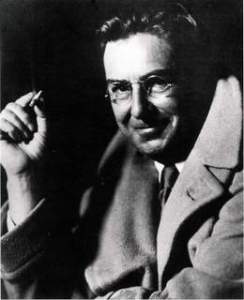
And Linquist’s Hall of Indiana Fame included Raggedy Ann and Andy, who were created by former Indianapolis Star cartoonist Johnny Gruelle who featured them in a series of children’s books that he wrote and illustrated. Gruelle made the first Raggedy Ann doll in 1915 and published the first book, Raggedy Ann Stories, in 1918, and the second, Raggedy Andy Stories, in 1920. Ann and Andy were siblings. I suppose they still are. For a time, the dolls and the books were sold together.

My personal Ann and Andy, circa 1968
Although there are alternative versions of the origin of Raggedy Ann, it appears that was planted in Gruelle’s mind when he found a homemade rag doll in the attack of his parents’ home in Indianapolis and mused that the doll could be the subject of a story. After his daughter, Marcella, was born, and Gruelle observed her playing with dolls, he was inspired to write what became the Raggedy Ann stories.
It is not true, as is often reported, that his daughter found the doll in the attic; nor is it true that Gruelle created Raggedy Ann as a tribute to Marcella after she died, at the age of 13, as a result of a contaminated injection. Anti-vaccination interests have adopted Raggedy Ann as a symbol, based on the latter myth, but Marcella’s death was attributable to the contamination, not to the vaccination itself.

Mug purchased by my parents circa 1941
As for the name of the doll, it is notable that Gruelle’s father, Richard, an artist, was a friend of James Whitcomb Riley, whose poems included “The Raggedy Man” and “Little Orphant Annie”—though why “orphant” rather than “orphan” I am not aware.
Gruelle’s inspiration after finding the forgotten doll has lived on in many forms besides the books, including animated films, a television series, a comic book, a stage play, and a Broadway musical.
Johnny Gruelle was an exceptional talent whose work appeared in the Star as well as the Toledo News-Bee, the Pittsburgh Press, the Tacoma times, and the Spokane Press. In 1911, he and about 1500 other aspirants entered a cartooning contest sponsored by the New York Herald, and Gruelle won with a creation he called Mr. Twee Deedle. The strip ran in the Herald for several years. Not too raggedy at that.
You can read a lot about the history of Raggedy Ann and Andy by clicking HERE.
Books: “The Scavenger”
April 7, 2018
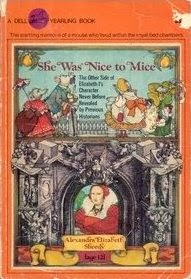 In 1977, I reviewed a book about Queen Elizabeth I, who was the British monarch from 1558 to 1603. It wasn’t the dense tome the topic might suggest, nor was it written by an historian.
This was a little book called She Was Nice to Mice, written two years earlier by Ally Sheedy, later a very successful actress, when she was 12 years old, and illustrated by her friend Jessica Ann Levy, who was 13.
The book, published first by McGraw-Hill and then in paperback by the Dell Publishing Company, was a fanciful look at the public and private life of the queen, told in the form of a memoir written by a mouse that lived in the palace. The discussion of Elizabeth’s relationship with the Earl of Essex, including a peek into the boudoir, has prompted a lot of lively discussion among readers.

J. L. Willow
This book came to mind recently as I was reading The Scavenger, a novel published last year by a high school junior who writes under the pen name J. L. Willow.
Willow, by her own account, has been a writer since she was six years old. I identify with that; I was the same way. I filled many notebooks with fiction, essays, and poetry while my mother good-naturedly encouraged me to “go outside.” I eventually went outside and took the notebook and pen with me. When I was 11, one of my elementary school teachers told me, “When it’s time for you to think about a career, you should seriously consider being a writer.” I’ve been a professional writer and editor for 53 years.
Because of my own experience, I am drawn to books written by young writers. When Willow told me in a chance meeting that she had written The Scavenger, I was eager to read it. I wasn’t disappointed.
 The novel is the story of four people whose lives intersect amid a crisis in a New York City community that has experience the drug-overdose deaths of several young people—a circumstance that has prompted an active police investigation focused on the school. The four principal characters in the book play various roles in this drama, which involves a drug dealer and a troubled boy whom he inveigles into drawing teenagers into addiction.
Willow uses a engaging device to tell this story, devoting each chapter to a first-person narrative by one of these characters. Her storytelling is enhanced by the fact that she has a keen ear for everyday speech and the ability to convey it in the written word.
I’d like to be in my teens again and finding my way as a writer. I’ll content myself with following the literary career of this young artist.
The Scavenger is available from Amazon and as a Kindle download.
 CharlesPaolino's Blog