“The wish for healing has always been the half of health.” — Hippolytus
September 25, 2009

MAURA TIERNEY
In catching up on the news today, I learned — a few days after everyone else, it seems — that Maura Tierney has withdrawn from NBC’s projected new series “Parenthood.” The speculation is that Helen Hunt, another wonderful actress, will replace her.
NBC had postponed the debut of the series when Tierney was diagnosed with cancer. She has already had surgery, but has put aside the series in order to accommodate her further treatment.
Like everyone else, I hope she fully recovers. I almost feel selfish in my disappointment that she won’t be on a series this season. I had reserved “Parenthood” for the only series I’d watch, and that was only because Maura Tierney was in it.
While I’m thinking of myself, I’m also looking forward to her resuming her career, because I hope she does a lot more on the stage. We got a chance to see her in her two off-Broadway projects, and found her to be a natural in the theater. That magnetism that works so well for her on television is even more potent in the intimacy of an off-Broadway house.
May God bless her and make her well.
Netflix Update No.19:”Sweet Bird of Youth”
September 25, 2009

PAUL NEWMAN
Prompted by Shirley Knight’s impending appearance at the George Street Playhouse, we watched “Sweet Bird of Youth,” the 1962 film adaptation of Tennessee Williams’ 1959 Broadway play. I have never seen the play on stage, and I have read that the tale lost some of its edge with the modifications that had to be made to satisfy the sensibilities of the early ’60s. By today’s standards it’s tame, but it dealt with some tough subject matter for the Eisenhower era.
This film has one of those casts that dazzles the mind: Paul Newman, Geraldine Page, Rip Torn, and the wonderful Canadian actress and even more wonderful human being, Madeleine Sherwood, recreated their Broadway roles, and they were joined by the redoubtable Ed Begley Sr. Geraldine Page and Rip Torn both were nominated for Tony awards for their work in the play. Begley won an Oscar and Page and Knight were nominated for the film.

GERALDINE PAGE
Newman plays Chance Wayne, who returns from Hollywood to his hometown in Florida, almost literally dragging along with him a legendary movie star, Alexandra Del Lago (Page), who has sunk into a drug-and-alcohol-induced stupor after what she perceives as the failure of her latest film. On the surface, Chance Wayne is her driver and spear carrier. In reality, he is exploiting her — in every possible way — in the hope that she will give him what has been an elusive “big break” in the movies.
Alexandra travels to Florida with Chance because she has gone underground to avoid the fallout from what she has adjudged a box-office flop. Chance has another goal — to reunite with Heavenly Finley, the love of his life whose father, Tom “Boss” Finley (Begley), is a moralizing, corrupt, and ruthless political kingpin who doesn’t want Chance near his daughter.
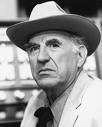
ED BEGLEY Sr.
Finley’s son, Tom Jr., who doesn’t have his father’s cunning but outdoes him in brutality, is played by Rip Torn.
This film, which in 1961 was off limits to audiences under 18, may have been sanded down from Williams’ original version, but it far outstrips the embarrassing 1989 television remake with Elizabeth Taylor and Mark Harmon as Alexandra and Chance and Rip Torn as “Boss” Finley. Even though its techniques are dated, the movie can play with your emotions as you try to sort out your feelings about the actress and her gigolo — both of whom are infuriating yet sympathetic — and frazzle your nerves as Chance keeps antagonizing the volatile and dangerous “Boss.” The players in this film aren’t stars first and foremost; they’re actors, doing their work as well as it can be done.
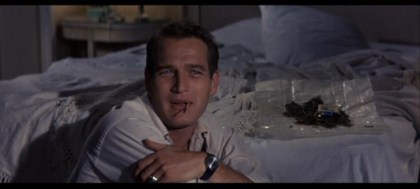
PAUL NEWMAN in a scene from "Sweet Bird of Youth."
“Trust me — like it says on the money” — line written by Larry Gelbart for George Burns in “Oh, God”
September 12, 2009

LARRY GELBART
While we were distracted by other matters, Larry Gelbart slipped away. I didn’t know Gelbart; I wish I had.
He had an ear for language, for how real people talk, and he combined that with a unique wit to produce some of the most memorable dialogue ever heard on the stage or screen. There is no better example than “M*A*S*H.” That show may have gotten bit too aware of itself but the writing when Gelbart was still working it was some of the best television has ever offered. Fortunately, that show is still being rerun, and when I watch it I marvel at how it never ages, never loses its edge.
Alan Alda and Larry Gelbart were a perfect match, and I think that’s because Alda has a classic sense of comedy – not the what-can-I-get-away-with drivel that passes too often for comedy today but the literate, witty kind of comedy one associates with S.J. Perelman and George S. Kaufman.

ALAN ALDA
Alda — particularly in the role of “Hawkeye” Pierce — has often been compared to Groucho Marx; in fact, he has been accused of aping Groucho Marx. But Marx was never the comic actor Alda is and, in that sense, any similarity in their delivery is more a compliment to Groucho than it is to Alda. I think that perception had to do with Gelbart, who brought that wise-ass attitude we saw in Groucho Marx to a much higher plain in Alan Alda.
The loss of someone as singularly talented as Gelbart is bad enough in itself, but it also is a reminder of how the quality of writing for television in particular has declined over the decades. Gelbart wrote for the “Duffy’s Tavern” radio series, for Bob Hope, and for Red Buttons, and he was a member of the legendary stable of writers on Sid Caesar’s television show. Most writers today don’t have that kind of background, but that’s what Gelbart brought to “M*A*S*H” and “Tootsie” and “Oh, God,” and “Sly Fox” and “A Funny Thing Happened on the Way to the Forum.”
GRETCHEN WYLER
Back when I was still considered employable, I wrote a column taking note of the death of Gretchen Wyler, whom I did know and admired very much both as an actress and as a human being. We had seen Gretchen in “Sly Fox” when the cast included Vincent Gardenia and Jack Gilford, and I mentioned that in the column. I don’t know how Larry Gelbart found out about it, but he sent me two e-mail messages thanking me for remembering Gretchen and expressing his own respect and affection for her. The fact that Gelbart, when there was nothing in it for him, took the trouble to respond to a relatively obscure writer spoke to his loyalty as a friend and colleague.
Larry Gelbart was 81. A detailed obituary is at this link:
http://www.latimes.com/news/obituaries/la-me-larry-gelbart12-2009sep12,0,2812430.story?page=1
“I thought drama was when the actors cried, but drama is when the audience cries.” — Frank Capra
July 20, 2009

MILTON BERLE
Saul Austerlitz filed an interesting story for the Los Angeles Times about the ambition of many comic actors and comedy directors to work in drama. I once attended a lecture by Milton Berle in which he talked about this subject. As do a lot of comic actors, Berle maintained that comedy was the more difficult genre inasmuch as no one is funny all the time, or even a lot of the time, whereas most of us are serious much of the time and some of us all of the time. At least, I think that’s what he said.
Berle had a few opportunities to prove that he was capable of playing straight roles. His autobiography revealed that he nursed his share of bitterness over certain events and personalities in his life, and those probably provided a well for him to draw on.
JACKIE GLEASON
Jackie Gleason who, like Berle, made his name with the broadest of comedy, had a flair for drama and demonstrated it in “The Hustler” and “Requiem for a Heavyweight.” He had already shown in a couple of his comedy characters — particularly “the poor soul” — that he could play a part for pathos, although when he tried to put that character virtually intact in a serious film — “Gigot” — the result was uninspired.
Anyway, those interested in film comics in particular might be interested in the Austerlitz piece — inspired by a new Adam Sandler project, at this link:
http://www.latimes.com/entertainment/news/la-ca-comedians19-2009jul19,0,4668140.story
The party of the second part
June 5, 2009

ELAINE STRITCH
I had a phone conversation last night with Elaine Stritch concerning her upcoming appearance at the Paper Mill Playhouse in “The Full Monty.” Something in her conversation put me to mind of a song written by Johnny Mercer sometime around the time I was born. I’m crazy about Mercer’s stuff – and there’s a lot to be crazy about since he wrote about a thousand songs. His lyrics were so hip; I never get tired of listening to them.
The song I was thinking about last night was “The Waiter, the Porter, and the Upstairs Maid.” This was part of the lyric:
The people in the ballroom were stuffy and arty / So I began to get just a little bit frayed / I sneaked into the kitchen, I dug me a party / The waiter and the porter / And the second storey maid. / I peeked into the parlor to see what was a-hatchin’ / In time to hear the hostess suggest a charade / But who was in the pantry a-laughin’ an’ scratchin’ / The waiter and the porter and the upstairs maid.
There’s a great recording of this song by Bing Crosby, Mary Martin, and the Jack Teagarden Orchestra. The smart-alec lyrics were perfect for Crosby.

JOHNNY MERCER
The reason I thought of that song last night was that Elaine Stritch was telling me about the sort of egalitarian social life she leads in which she is likely to talk to and even make friends with almost anybody. “I don’t know how I’d live,” she said, “if I couldn’t talk to the consierge when I get home after a performance or a rehearsal.”
I asked her what she meant by a remark attributed to her: “Being bored is the greatest sin.”
She said: “What is boring is spending your life with the same kind of people all the time. I avoid that. I reach out. I spent half of my life in kitchens. At parties, I would end up in the kitchen, having a ball. Or I’d be with the musicans; I l0ve to hang out with musicians.”
“But,” she said with a laugh, “I also had a lovelyevening with the Queen of England, so the hell with everybody.”
Mr. Mercer — on four:
If ever I’m invited to some fuddy-duddy’s / I ain’t-a gonna watch any harlequinade / You’ll find me in the kitchen applaudin’ my buddies / The waiter, the porter and the upstairs maid.
The final frontier … again.
May 7, 2009

WILLIAM SHATNER
Judging from the reviews, I might see the new “Star Trek” film after having forsaken the Enterprise when the first television series ended. I don’t know why that happened, because the first series was must-see in our house. We wouldn’t schedule any activities away from home on “Star Trek” night.
Back in those days, I was driving by a theater here in Jersey and saw that William Shatner was going to appear there in “Period of Adjustment.” It seemed like an odd idea to me at first, but I learned later that Shatner had played stage comedy early in his career. Also, I realized after I had thought about it, his character on “Star Trek” often had comic overtones. I took the opportunity to interview Shatner for a preview of “Period of Adjustment.” It wasn’t a very satisfying experience. He answered as many questions as possible with single syllables. He was very good in the play.

WILLIAM SHATNER
Shatner appeared at the same theater a year or so later, and I interviewed him again. That time, he talked almost compulsively – in fact, at one point he came up for air and asked, “How the hell are you going to write this?” Several years later, I interviewed him yet again – by phone – for an advance on an appearance he was making at a local college. I mentioned to him that I he and I had spoken twice before, and he asked, “Have you learned anything since then?”
Some people don’t like Shatner’s acting – several have told me they find his syncopated speech contrived and annoying. I don’t agree; I like his acting, including that peculiarity in his speech.

WILLIAM SHATNER
I find his appearance a little unsettling. He looks like he’s full of cortisone.
One of my favorite examples of Shatner’s work is “The Andersonville Trial,” a 1970 television movie directed by George C. Scott, based on Saul Levitt’s play of about a decade before. Shatner played Gen. N.P Chipman, who was judge advocate of the military court that tried Capt. Henry Wirz, who had been commandant of a prison camp for Confederate prisoners. Shatner was a perfect fit for the courtroom drama, whose cast included Richard Basehart, Buddy Ebsen, Jack Cassidy and Martin Sheen.
It’s available from Netflix and I wrote a review of it for this blog. The review is at THIS LINK.
“Yoo hoo! Mrs. Goldberg ….”
April 25, 2009

GERTRUDE BERG
We were happy last night to find that the web site http://www.archive.org has several episodes of the television series “The Goldbergs,” a program far superior to most half-hour shows today, with allowances for the technical advances that have taken place since the ’50s. This is a warm show, humorous without being silly, with a solid dramatic basis. The show starred Gertrude Berg, who also owned it and wrote it and insisted on such things as everday situations and no laugh track. The Goldberg family consisted of Molly Goldberg; her husband, Jake, who was in the wholesale garment business; her uncle, David Romaine; and her children, Rosalie and Sammy – to whom Molly always referred as “my Rosalie” and “Samalie.” The family first appeared in a long-lived radio series and also was portrayed in a Broadway play written by Berg and in a film. The episode we watched last night was the final season in what was not a continuous run. In this 1955 show, the family had just moved to the suburbs from The Bronx – mirroring what was actually going on with a lot of urban Jewish families at the time – and Molly was having a hard time adjusting to an unfamiliar neighborhood. The dialogue in this show is priceless; Berg had a good ear for how people talk. Molly and David, in particular, use a peculiar verbal shorthand one doesn’t hear often. For instance, when Molly wants to say, “Give me a minute to write that down,” she says, “Pardon me while I jot.” We’re grateful for whoever preserved these shows.

GERTRUDE BERG and PHILIP LOEB
There was a shadow over “The Goldbergs.” Philip Loeb, who was cast as Jake when the television series was on CBS, was fingered as a Communist by Lee J. Cobb and Elia Kazan in their testimony in 1950 before the House Un-American Activities Committee. Berg was pressured to fire Loeb, and she refused, so CBS dropped the show. Loeb resigned and accepted a monetary settlement, but he committed suicide in 1955. Eight months after CBS dropped it, NBC picked the show up with another actor in the role.
“Papa played the dobro this-a-way”
March 18, 2009

ADAM LAMBERT
This morning, I came across an account in the Los Angeles Times of last night’s “American Idol” broadcast. I missed it. How careless of me to have accepted an invitation to a dinner party on “Idol” night. Well, truth be told, I wouldn’t have watched it anyway. In fact, I have never seen more than a minute or two of an “Idol” broadcast, and that only two or three times when someone else was watching it. This has as much to do with my not watching television very much as it has to do with any objection to that show in particular. But what caught my attention in this article was the reference to the contestants’ “reverence for the most traditional of American genres – country music.” What did the writer mean by “country music”? How did country music – whatever the writer meant by it – become more “traditional” than folk music – whatever I mean by that? And, Miss Turner, what’s “reverence” got to do with it?
I presume the writer had a straight face when he or she wrote that several contestants delivered “solid but respectful versions of country standards by Garth Brooks, Dolly Parton, and Carrie Underwood.” That’s Carrie Underwood – the “American Idol” graduate who was salutatorian of her high school class in Oklahoma. And the writer soberly added that Adam Lambert’s “psychedelic, sitar-backed” rendition of “Ring of Fire” was – according to an audience member visiting from Missouri – “disrespectful to country music.”
If we owe some sort of “respect” to country music, is it to be found in the over-produced material that Dolly Parton has been disgorging for the past few decades? To me that’s as “country” as Jackie Wilson’s “Alone at Last” was classical. “Country” has the smell of stale beer about it. “Country” is what we used to find in the 1960s at the old Coral Bar in East Paterson when Elton Britt, a singer with gold hanging on his wall, would drive himself up from Maryland to perform for a few dozen patrons who would recognize his voice even if their vision was blurred. “Country” is what we found back then at open-ended shows at the old Mosque Theater in Newark, where headline acts sometimes had to be nudged off the stage to make room for Little Jimmy Dickens or Ray Price or Webb Pierce, who were waiting in the wings. If a singer appeared in a torquoise outfit covered with rhinestones, the clothes just emphasized the common nature of the man or woman inside. “Country” was real, and if there was anything to respect in it, it was the unfiltered, unapologizing reality. But then, “reality” has taken on a different meaning in our time.
“Hey, aren’t you ….?”
March 8, 2009
 The man mixing it up with Carl Malden in this photo is George Mathews, whose face was as familiar as the next door neighbor for almost three decades. Mathews appeared in nearly 60 properties – mostly television, including many of the major series. He made himself immortal, in a way, when he played Harvey, the tough guy Ralph Kramden – with a lot of help from Ed Norton – challenges to a fight after a poolroom argument in “The Honeymooners.” I don’t know how much stage experience he had, but in this photo he is appearing with Paul Newman, Malden, Patricia Peardon, and George Grizzard in a 1951 Broadway production of “The Desperate Hours.” We saw George Mathews last night when we watched “Pat and Mike,” one of the seven movies costarring Katherine Hepburn and Spencer Tracy. Mathews, as always, played a heavy – one of a trio of thugs trying to pressure Hepburn, through Tracy, to throw a golf tournament. George Cukor had the three thugs play it for laughs, and Mathews contributed at least his share. He appeared on “Death Valley Days,” “The Phil Silvers Show,” “Alfred Hitchcock Presents,” “Gunsmoke,” and “The Untouchables,” among many other programs, and his movies included “The Man with the Golden Arm.” Mathews, who died in 1984, was the quintessential actor that everyone recognizes but no one can name. On the Internet, at least, it seems impossible to find out anything about the man beyond the dates and places of his birth and death and the list of his television and movie appearances. In death as in life, he is The Unknown.
“Ain’t nobody’s business if I do”
March 8, 2009
 As we were leaving the George Street Playhouse in New Brunswick, Pat and I were discussing whether we would find any video of Bessie Smith on the Internet. A man who had come out before us overheard us and volunteered that there is a clip on YouTube of Bessie Smith singing “St. Louis Blues” in the 1925 film by the same name. Although it seems to have been a critical success, this film is all but lost. The YouTube clip runs a little more than nine minutes, and it gives a sense of the power of Bessie Smith’s performance. Of course, there is a lot of audio available from her recording career.
We were at the George Street Playhouse to see “The Devil’s Music,” a one-act musical show that recounts the life of a woman who was a major star in the 1920s and ’30s but is largely forgotten today. Miche Braden plays the singer and does justice the part. An interesting thing about Bessie Smith is that she led a life of drink and sex and violence that most of us would not condone in the abstract, but it was that very mode of life that fed the blues that she sang. She paid heavily for her recklessness, paid in ways that broke her heart, but somehow she tore out of her sad life a body of work that speaks for many souls who had the blues, too, but neither the voice nor the spirit to make their misery heard and make the rest of us think twice about dismissing them.
http://www.dailymotion.com/video/xrd9c_bessie-smith-st-louis-blues_music
 CharlesPaolino's Blog