“The pipes, the pipes are calling”
April 8, 2009

DANNY THOMAS
The Los Angeles Times is reporting today that of the 71 scripted pilots that are contending for spots on the broadcast schedules of five TV networks, 33 are half-hour comedies. The television industry evidently thinks we need a good laugh. How many good laughs we’ll actually get remains to be seen. The kind of writing that has characterized shows like “Taxi,” “Seinfeld,” “Frasier,” and “The Bob Newhart Show,” is hard to come by, and many television series are obvious at best and vacuous at worst. I wonder if folks more than 50 years from now will enjoy re-runs of “Surviving Suburbia” the way they do re-runs of “I Love Lucy” and “The Honeymooners.” In fact, I wonder if folks next week will watch an original episode of “Suburbia.” Chuck Barney, writing in the San Jose Mercury News, said it for me: It’s not that this is a horrible show or even the worse sit-com on ABC. “It’s just that it has no real reason for being. It’s a series that looks and feels like hundreds of other sit-coms, with the same kind of tone, the same forced one-liners and the same ridiculously annoying laugh track.”
Why has television comedy declined so much? It might have something to do with the form. A couple of playwrights have told me that they wouldn’t write sit-coms no matter how much it paid, because they refuse to force a story into a shape predetermined by the schedule of commercials. I wonder if it also has to do with the backgrounds of the producers, writers, and actors, many of whom have grown up in television. I was talking with Marlo Thomas last week about her upcoming appearance at the George Street Playhouse, and that naturally evoked some conversation and even more memories of her father. Danny Thomas had a genius for humor, but he also had a chance to refine his technique in nightclubs, on the radio, and in movies before he ever went before a television camera. He understood comedy – understood that it had to have structure, consistency, and an underlying sympathy – all of which were factors in the success of his own show, “Make Room for Daddy,” and in “The Dick Van Dyke Show” and “The Andy Griffith Show,” which he later produced.

MARLO THOMAS
Marlo Thomas – who has her own package of insights when it comes to entertaining people – opens at George Street next week in Arthur Laurents’ new play, “New Year’s Eve.” She told me her father used to say, “Do you know what I would have been if I hadn’t been a comedian? A pain in the ass.” “And I think he really meant that in the deepest sense,” she said. “He would have had no outlet. He would have been a butcher driving everybody crazy trying to make jokes about the lamb chops.” That compulsion to be a storyteller – as opposed to the compulsion to fill a half-hour time slot at the expense of some nearly bankrupt auto manufacturer – may have been more at work in those who created television programming during the medium’s first three decades than it is now.
Sic transit whatyacallit.
March 27, 2009

WILLIE AAMES
I got to wondering the other day about whatever happened to Dick Van Patten. The occasion for me to wonder was a TCM broadcast of the 1948 movie “I Remember Mama,” which was inspired by a novel and in turn inspired a Broadway play and a television series. Which brings us to Dick Van Patten, who played Nels Hansen in the TV show. The “Mama” properties have to do with a Norwegian family living in San Francisco in the early 20th century. It’s wholesome stuff. Van Patten became a more prominent figure when he starred as the patriarch in the later TV series “Eight is Enough,” another wholesome show.
I didn’t finish watching “I Remember Mama,” because it would have kept me up until 2 a.m., so I put it in my Netflix queue. Before I got around to checking up on Van Patten, I read today that Willie Aames, who played one of Van Patten’s kids on “Eight is Enough” was selling his personal belongings in Kansas this week in order to pay off his debts. Aames also appeared in the series “Charles in Charge,” but apparently couldn’t hang onto the money he made. His drug habit probably didn’t help.

WILLIE AAMES
Life didn’t imitate art for the Bradfords – Van Patten’s TV family. Adam Rich, who played the youngest kid, has a string of arrests to his credit, including multiple substance abuse charges and break-and-entry. And Lani O’Grady, who played the eldest daughter on “Eight” died of a drug overdose, according to the Los Angeles County coroner. At one point in his life, Aames was ordained to ministry, a fact that prompted readers of the Dallas Morning News web site to quarrel on line today about why God hadn’t stepped in to lift Aames out of insolvency. Apparently these readers are unacquainted with concepts such as free will and personal responsibility.

DICK VAN PATTEN
Oh, I did check on Dick Van Patten. He’s doing fine, thank you, and still has that wholesome aura. He’s 80 years old now and has been happily married to Josephine Acerno since 1954. They have three sons, all of them actors, none of whom have been busted for drugs. Most of the Van Pattens are very good tennis players. Not pool, tennis. Dick Van Patten completely recovered from a diabetic stroke he suffered in 2006, and, as though to reinforce his wholesome image, founded a company that makes “Natural Balance Pet Foods.’
As George Ade said, “It all depends.”
“Smoke, if ya’ got ’em.”
March 24, 2009


BARBARA EDEN
The Daily Star in Beirut is running an ad on its web site for hookahs and tobacco. If I’m not mistaken, that’s Barbara Eden in the ad. It certainly doesn’t look like any Lebanese women I know. I guess the agency figured that since “I Dream of Jeannie” is still in vogue in the United States – well, it’s one of the series that gets re-run ad nauseam while better ones stay on the shelf – then Barbara would be a good image for this campaign. I’ve been told that my grandmother, Selma Aoun, whom I never met, smoked a hookah, which the Lebanese and Syrians call something like arghille. (I have pictures of my grandmother; she looked more like Salma Hayek than like Barbara Eden.) Another common Arabic term for the water pipe is shisha, which evokes one of the materials a person might smoke in such a device. I have never smoked more than a few cigars, but I have always envied the image of the smoker. Not the crowd I recently saw huddled outside the back door of a restaurant in Morristown, but the thoughtful pose of the Edward R. Murrow. I have always wanted to place a Meerschaum between my teeth during a conversation and nod from behind the blue haze as though to say, “Hmmmmm. I’ll have to see what Spinoza had to say about that.” According to family lore, my grandmother’s arghille had several pipes, so that she could share it with her visitors. I fantasize about getting out that fez I bought at the Moroccan restaurant at Epcot, sitting cross-legged on the floor, and squinting through the smoke at two or three men in dark glasses as we plan the raid on Aqaba. Of course, even if I could sit cross-legged on the floor at my age, I couldn’t get up without assistance.
“You talkin’ to me?”
March 20, 2009

President Obama was on Jay Leno’s show last night, and showed again how comfortable he is in his clothes. He could have changed seats with Leno, and the show would have been none the worse for it. But Obama has an annoying speech mannerism that I first noticed during the campaign and that showed up three or four times last night. When he is asked a question, he frequently takes a breath and begins the answer with,”Look ….” The inflection suggests impatience if not condescension. Cokie Roberts has the same mannerism with the same inflection. Maybe some coach can help Obama get rid of it. Of course, the context for this observation is that Obama is president of the United States, Roberts is an NPR political analyst, and I’m an unemployed journalist and, oh, such a critic.
“Hello, I must be going.”
March 20, 2009

BARACK OBAMA
The television networks are getting impatient with President Obama’s requests for prime time. He’s holding a press conference on Tuesday, and that will mean – among other things – that “American Idol” will have to shift to a Wednesday-Thursday schedule. More than that, the networks will again lose top-dollar revenue that they can never recoup. Doesn’t the economic recovery program apply to them, they ask. I had a fleeting thought that the problem could be solved simply by moving Obama’s prime-time appearances off the major networks; that would separate the men from the boys, as it were, when Neilsen reported how the president did when he was up against Adam Lambert. I’d like to cast the networks as villains in this, but I can see their point even if I don’t think their revenues are more important than a public well informed on what the president is thinking in the present circumstances. I don’t have to balance their books. What concerns me more is that Obama is already overexposed, and the public may get weary of him and stop listening in the same way that it stopped paying attention to the color-coded terrorism alerts from the previous administration. As it is, expectations were unreasonably high when he took office, and the weeks since then have disabused most people from thinking they’ll see postive results overnight or in a week or a month or a year. His live TV appearances – especially following on an administration that avoided such exposure – may still be raising expectations, but that is likely to wear off. I read somewhere today that Obama is considering a series of much shorter appearances – something along the lines of Franklin Roosevelt’s radio addresses.
That reminds me of the movie “Room Service” and a scene in which Groucho Marx is trying to convince a playwright to go home to Oswego, appealing to the young man to picture his mother waiting by the fireside. “We don’t have a fireside,” the playwright says. “No fireside?” says Groucho. “How do you listen to the president’s speeches?”
“Roll ’em!”
March 16, 2009
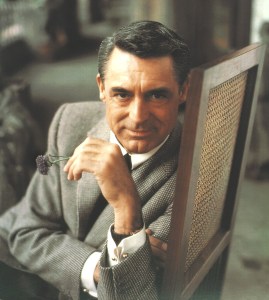
CARY GRANT
I don’t understand why a television channel that exists solely to present movies – and presents each movie with some kind of historical context – does not let the credits run at the end of the film. I am referring to Turner Classic Movies. It’s frustrating. Last night, for example, we watched “Talk of the Town,” a 1942 flick that starred Cary Grant, Ronald Coleman, and Jean Arthur. I was curious about the actor who played Coleman’s black valet, because the character was an elegant figure who exhibited a deep intellect and spoke with an almost Victorian propriety. No credits. I found out on IMDB that the actor was Rex Ingram, who was born on a riverboat in Mississippi and around 1916 became the first black man to earn a Phi Beta Kappa key at Northwestern University. Ingram – not to be confused with the white director of the same name – appeared in nearly 50 properties – most of them movies.

REX INGRAM
Anyone who goes to a movie with me knows enough not to get up before the screen goes dark for good, and I know I’m not the only one who likes to see the names of the best boy and the caterer and – especially important – the music credits. Frequently, too, there is a lot of care taken in choosing the music that plays over the credits. I would never turn off “Dominick and Eugene,” for instance, without watching the credits roll over “Goin’ Down to Rio.” But the least I expect is to read the names of the actors in case I want to find out more about them. But that’s me – never satisfied,
“Cash or charge?”
March 13, 2009
 It’s a good thing we don’t always have to explain our behavior. If we did, I’d have to invoke temporary insanity or on-set senility to account for myself last night. When I left home to drive to Passaic, I thought there was barely enough gas in the Beetle to make the round trip. I pass two gas stations within the first mile and a tenth from home, but I didn’t stop. Before I got to the college – actually, it was during that stop-and-go traffic jam at the junction of Routes 46 and 3 – I already knew there wasn’t enough gas left to make it back to Whitehouse Station. I don’t know how many gas stations I pass on Routes 3 and 46 on the return leg, but I passed by that number, whatever it is. Once I got on Interstate 80 in Wayne, I knew my options would be limited. But I got on. As I headed south on I-287, I passed by chances to buy gas on Route 10 and again in Morristown. Somewhere south of Morristown, the warning light went on on the gas gauge. The needle was nudging the “E” when I saw what I knew was the sign for the Last Resort, an all-night Exxon station that is three miles from the highway. I did a lot of coasting, and gratefully paid $1.99 a gallon – cheap under the circumstances. Did I enjoy myself? Sure – I love white knuckles. Still, I realize that I didn’t measure up to the standard set by Kramer and Rick, the car salesman. Unlike them, I’ll never know how far I could have gone if I hadn’t done the sensible thing, the boring, ordinary thing. Even when Cosmo and Rick had safely reached the dealership – and had not yet plunged on toward The Ultimate – Rick said, “I learned a lot. Things are gonna be different for me now.” For me, I guess, they’ll always be the same.
Goin’ home.
March 12, 2009

GEORGE CLOONEY
Charles Dickens said that when he finished writing “David Copperfield,” he felt if as someone had died. In a trivial way, I’m starting to feel that way about the approaching end of “ER.” I can’t explain my attachment to this show – especially in the past couple of years which I have spent straining to hear at least every third word uttered by Parmindra Nagra, who could win the Emmy for mumbling – to go along with her Guinness entry for sustained angst. I don’t even like the show enough to ever watch a re-run – on TV, never mind on line. Now that the end is in sight, the producers have been bringing back former characters, including Noah Wiley, who had a contractual obligation to do the encore. If he had known he was going to wind up on dialysis, he might have been more careful with his fountain pen. Julianna Margulies and Maura Tierney are among those expected at the reunion. Anthony Edwards, Abraham Benrubi, and William Macy have already picked up their name tags. Smart money says George Clooney will be nowhere in sight. Meanwhile, my regular television viewing will have been reduced to “Seinfeld” reruns. For the rest, baseball in season and occasional TCM movies and PBS productions – such as that wonderful “American Masters” profile of Jerome Robbins – will have to do. “Gray’s Anatomy” and “Scrubs” are just not up to – or down to – my standards for medical shows. It’s a been a long run from “Medic” through “St. Elsewhere” and “Chicago Hope,” but now, I’m afraid, I’m a permanent outpatient.
 CharlesPaolino's Blog