“I thought drama was when the actors cried, but drama is when the audience cries.” — Frank Capra
July 20, 2009

MILTON BERLE
Saul Austerlitz filed an interesting story for the Los Angeles Times about the ambition of many comic actors and comedy directors to work in drama. I once attended a lecture by Milton Berle in which he talked about this subject. As do a lot of comic actors, Berle maintained that comedy was the more difficult genre inasmuch as no one is funny all the time, or even a lot of the time, whereas most of us are serious much of the time and some of us all of the time. At least, I think that’s what he said.
Berle had a few opportunities to prove that he was capable of playing straight roles. His autobiography revealed that he nursed his share of bitterness over certain events and personalities in his life, and those probably provided a well for him to draw on.
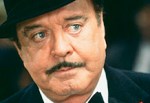
JACKIE GLEASON
Jackie Gleason who, like Berle, made his name with the broadest of comedy, had a flair for drama and demonstrated it in “The Hustler” and “Requiem for a Heavyweight.” He had already shown in a couple of his comedy characters — particularly “the poor soul” — that he could play a part for pathos, although when he tried to put that character virtually intact in a serious film — “Gigot” — the result was uninspired.
Anyway, those interested in film comics in particular might be interested in the Austerlitz piece — inspired by a new Adam Sandler project, at this link:
http://www.latimes.com/entertainment/news/la-ca-comedians19-2009jul19,0,4668140.story
“I hear you knockin’, but you can’t come in”
July 6, 2009

GALE STORM
It escaped my notice until this morning that Gale Storm died a few days ago at the age of 87.
She was a charming personality on early television; while her series “My Little Margie” was in its first run of 126 episodes, I was getting old enough to notice that she was very cute, too.
I bought a DVD with several episodes of that show. It’s not the kind of comedy that sells today, but it’s still entertaining — especially the conflicts between Margie Albright — Gale Storm’s character — and her father, Vern, played by Charles Farrell. In our household, this series had something for everybody — well, almost everybody. Charles Farrell had been a romantic film star, and he was right up there with Cesar Romero in my mother’s pantheon. I imagine Dad liked Gale Storm’s looks, but if he did, he didn’t say so.
I kind of lost interest in Gale Storm when she went into her second series, “Oh, Susanna,” but I was in high school by then and was spending significantly less time watching television. I rediscovered her when she recorded several hit songs, including “I Hear You Knockin’ ” and “Dark Moon.”
After a couple of setbacks, Gale Storm overcame alcholism, which is always an uplifting thing to hear. Like most people, I suppose, I know several people who struggle with substance addictions. In no case does it appear that they will rid themselves of that problem. I don’t pontificate about such things the way I do about other topics, because I deeply sympathize with the addicted person. I have trouble breaking much less lethal habits, habits that don’t involve substance dependency. I don’t say anything about the habits of others, except in prayer.

GALE STORM and CHARLES FARRELL
Joy, joy, joy
June 13, 2009

JOY BEHAR
I don’t know why this took so long, but I’m glad to see that Joy Behar is finally going to have her own TV talk show. It will be on at 9 p.m. weekdays on HLN, the network formerly known as Headline News.
I listened reguarly to Behar’s radio show on WABC in New York. I didn’t always agree with her – particularly on religious issues – but I was drawn in by the combination of wit, intelligence, and common sense and by her willingness to listen to other points of view. In fact, I called in to her show several times, and she always gave me enough time to say what was on my mind.

JOY BEHAR
While she was still doing that radio show, I wrote a long profile of her. I remember the lead: “Joy Behar is a chiacchierone” – that being the Italian term for “chatterbox.” I spent about an hour with her at WABC, and I later talked by phone to the station manager, who told me Behar’s show was doing well and that he had just signed her to a new contract. It wasn’t long after that that she was fired, not a surprising turn of events in radio. She seemed too liberal and too outspoken in general for the management of that station, but she wound up working for the same parent company when she got her position as a co-host of “The View.”

ANN COULTER
It isn’t possible to judge Behar’s potential as a TV host based on “The View,” because guests aren’t given enough time on that show and the hosts often talk simultaneously. There was a better example of her work recently when she substituted for Larry King and interviewed Ann Coulter. When Coulter appeared on “The View” the conversation deteriorated into babble as everyone tried to make her point at the same time in a contentious atmosphere. On the King show, however, Behar and Coulter were able to have a linear conversation in which – though they may be polar opposites in many ways – they showed each other mutual respect and the viewer got a chance to learn something from the dialogue.
At last, something to look forward to in the bleak landscape of television.
So, what have we learned here?
June 3, 2009

SUSAN BOYLE
Andy Burnham, the British culture secretary, wants the Office of Communications to investigate whether the television network and the producers of “Britain’s Got Talent” had acted responsibly toward Susan Boyle in the runup to the show’s finals. The implication is that the people behind the show that vaulted Boyle from the obscurity of a Scottish village to the limelight of YouTube should have done a better job of protecting her from the effects of sudden fame.
Burnham made reference to Britain’s broadcast code when he called for a determination that “duty of care” had been exercised with respect to Susan Boyle, who was briefly hospitalized for exhaustion after coming in second in the show’s finals. The Office of Communications doesn’t think the broadcast code covers what happened to Boyle, but Burnham said: “We are living in a world where it is not just about what happens on telly on a Saturday night. There is 360 degree scrutiny, 365 days a year. We need to look after people, not just around the camera. Broadcasters should always put people’s welfare first.”
This has prompted some bitter responses from readers of The Times of London, some sympathetic to Susan Boyle, some not. Some of the readers were outraged that the government would even think of becoming involved in a trivial, private matter. I liked the comment from Al of Manchester:
The UK is full of cruel people feasting on a diet of bile soaked Tabloid fodder and Reality TV trash. First they jeered and sneered at Susan for not looking like a singer and now they do the same because she not “tough enough to take it”. What a sad place and sad people we’ve become.
And Jessica of Eastbourne:
Can I just say that “they” did not treat Susan any differently than any of the other contestants. Susan was a victim of the throwaway celebrity culture that the UK and the US fawn over so much. If anyone “threw her away” it was the public, and the show’s producers are not as much to blame as we are.
What I loved about the reporting of this story is that after the universal handwringing and public penance over the snickering and eye-rolling when Susan Boyle first appeared on the show, the media couldn’t mention her without pointing out how “dowdy” she is, how unlikely a celebrity she is, or without calling attention again to the fact that she is a “virgin” who has “never been kissed.”
Idolness
May 22, 2009

ARTHUR GODFREY
I don’t understand the anti-American Idol sentiment that seems to be based on a premise of cultural superiority – or maybe it’s snobbery, a kind of knee-jerk reaction against anything that generates a lot of public excitement, a need to feel “above it all.”
I’ve never watched even a minute of “American Idol,” but I watch very little television at all. I do watch most of “Dancing with the Stars,” so the general concept of such shows is not foreign to me. To me, “American Idol” is just the over-produced and over-promoted 21st century version of “Arthur Godfrey’s Talent Scouts,” which was a huge success on radio and television – in fact, for a while it was on radio and television simultaneously.
What annoys me about “American Idol” is the endless hype – the way, for instance, the local Fox stations treat every snort and whimper that comes from an Idol contestant or judge as though it were not only news but the top story of the day. And it really irritates me when I turn to the channel with the TV Guide rolling program log, the top half of the screen is occupied by a cast of pinheads babbling on about the Idol contestants – OMG!
But the show itself seems to me to be an entertaining vehicle through which people who otherwise would get no public attention for their talents get a shot at starting a career. Godfrey’s show – a primitive thing by comparison – gave the public its first glimpses of many folks who later were successful and, in some cases, stars. The winner each week was determined by a gain meter that measured the applause of a live studio audience.

DON KNOTTS
Many of the contestants on Godfrey’s show were not really amateurs but small-time professionals trying to move up. Among the contestants were Pat Boone, Patsy Cline, the McGuire Sisters, Tony Bennett, Lenny Bruce, Roy Clark, Rosemary Clooney, violinist Florian ZaBach, Wally Cox, Vic Damone, The Diamonds of “Little Darlin’ ” fame, Eddie Fisher, Connie Francis, Don Knotts, Steve Lawrence, Barbara McNair, Leslie Uggams, and Johnny Nash.
Nobody’s perfect, by the way. Among those who didn’t survive the auditions for “Talent Scouts” were Elvis Presley and Buddy Holly.
Incidentally, Johnny Nash – it has always seemed to me – should have been a bigger star than he ever became. I think he’s still out there singing somewhere. He performs one of his biggest hits, “Hold Me Tight,” at this link: http://www.youtube.com/watch?v=HYhRpbqe1Zg

VLADIMIR LENIN
I’m not clear on this point: Was Rochelle of “Rochelle, Rochelle” a native of Milan who happened to have relatives in Minsk, or was she a native of Minsk who had emigrated to Milan? While we’re pondering that question, there is one native of Ulyanovsk – Simbirsk to you old timers – who may be making his own trek to the capital of Belarus that became a household word thanks to Larry David and Jerry Seinfeld.
Pravda is reporting that Vladimir Lenin’s mummified body may be removed from its tomb in Red Square and taken to Minsk, where it will be buried – perhaps no longer placed on public display in a crystal casket. As I mentioned here previously, Lenin – whom Pravda describes as the “leader of the world’s working class” – has already suffered the indignity of wearing the same suit for three years, and he’s not in line for a new one ITE – “in this economy.” Now, it appears from the Pravda report, the Russian government – which seems to only half-heartedly revere the old Bolshevik – may soon dispatch him to the republic from which he sprung – and the government of Belarus has said it would be glad to have him. In fact, a monument reminiscent of the tomb in Red Square is likely to be built to receive him.

ALEXANDER LUKASHENKO
The issue of actually burying the Hero of the Proletariat apparently is controversial: the Russian Orthodox Church, for instance, would like him out of sight and out of mind, but the president of Belarus, Alexander Lukashenko, says burying Lenin would be a crime. According to Pravda, there’s a strong nostalgia in Belarus for the glory days of the Soviet Union – no doubt among folks with medium-term memory disorder.
The final frontier … again.
May 7, 2009

WILLIAM SHATNER
Judging from the reviews, I might see the new “Star Trek” film after having forsaken the Enterprise when the first television series ended. I don’t know why that happened, because the first series was must-see in our house. We wouldn’t schedule any activities away from home on “Star Trek” night.
Back in those days, I was driving by a theater here in Jersey and saw that William Shatner was going to appear there in “Period of Adjustment.” It seemed like an odd idea to me at first, but I learned later that Shatner had played stage comedy early in his career. Also, I realized after I had thought about it, his character on “Star Trek” often had comic overtones. I took the opportunity to interview Shatner for a preview of “Period of Adjustment.” It wasn’t a very satisfying experience. He answered as many questions as possible with single syllables. He was very good in the play.

WILLIAM SHATNER
Shatner appeared at the same theater a year or so later, and I interviewed him again. That time, he talked almost compulsively – in fact, at one point he came up for air and asked, “How the hell are you going to write this?” Several years later, I interviewed him yet again – by phone – for an advance on an appearance he was making at a local college. I mentioned to him that I he and I had spoken twice before, and he asked, “Have you learned anything since then?”
Some people don’t like Shatner’s acting – several have told me they find his syncopated speech contrived and annoying. I don’t agree; I like his acting, including that peculiarity in his speech.

WILLIAM SHATNER
I find his appearance a little unsettling. He looks like he’s full of cortisone.
One of my favorite examples of Shatner’s work is “The Andersonville Trial,” a 1970 television movie directed by George C. Scott, based on Saul Levitt’s play of about a decade before. Shatner played Gen. N.P Chipman, who was judge advocate of the military court that tried Capt. Henry Wirz, who had been commandant of a prison camp for Confederate prisoners. Shatner was a perfect fit for the courtroom drama, whose cast included Richard Basehart, Buddy Ebsen, Jack Cassidy and Martin Sheen.
It’s available from Netflix and I wrote a review of it for this blog. The review is at THIS LINK.
“Your looks are laughable, unphotographable …”
April 17, 2009

MARIE DRESSLER
It’s interesting to listen to the vocabulary in media reports about the cruelty directed at Scottish villager Susan Boyle by the judges and audience on a British television show. Piers Morgan, one of the judges on the program, acknowledged after Boyle’s unexpected performance, that while “everyone was laughing at you” before the song, “nobody’s laughing now.” Morgan hadn’t laughed, but the camera caught his wince when Boyle first appeared on stage. Amanda Holden, another judge, was not shown overtly reacting to Boyle, but when Boyle had finished singing and the pandemonium in the studio had died down, Holden offered what seemed like a sincere communal apology for the “cynicism” that had greeted Boyle.
In the Los Angeles Times today, writers Josh Collins and Janice Stobart report on the Boyle phenomenon, which has set records for YouTube hits. It was a balanced story over all, but I wonder about their lead: “Less than a week ago, she was just another 47-year-old Scottish virgin.” The disingenuous Boyle had revealed that detail to producers, and the media has gleefully latched onto that term – “Scottish virgin” – as though to demonstrate that, despite her talent, it’s still okay to ridicule this woman, to constantly call attention with an oh-so-wry wit to what may be a painful part of her most private life. In the second paragraph of the story – the one-two punch being an effective offense – the writers describe Boyle as “a stocky, beetle-browed woman who would not ordinarily rate a second glance on the street.” (Emphasis mine.) Boyle is stocky and beetle-browed, but I would describe her appearance as unexceptional; I don’t know who licensed the Times writers to judge who does or does not “rate a second glance,” but I’m sure they enjoyed exercising the privilege. Presumably, they don’t understand the implication that if Boyle couldn’t sing, she wouldn’t “rate” anyone’s notice. If that’s the standard, I, for one, am in trouble.
The writers quoted Tanya Brown’s commentary in the Guardian: “Why are we so shocked when ‘ugly’ women can do things, rather than sitting at home weeping and wishing they were somebody else? Men are allowed to be ugly and talented.” The quotation marks, I suppose, were Brown’s way of softening the expression, but I wouldn’t have used the term, with or without the quotes, to describe Susan Boyle. Most people’s faces are interesting – nice, in some unique way. This is something I notice when I’m holding the Communion cup at Mass. I’ve been doing that for many years; I haven’t seen an ugly face yet.
The writers also referred to Marie Dressler, a film and vaudeville actress who, very late in life, became such a major movie star that she was the first woman to appear on the cover of Time. “I’m too homely for a prima donna,” she once said, “and too ugly for a soubrette” – “soubrette” being a coquettish sort of stock character in the theater and the opera. That was Dressler’s self-assessment, but be sure that once she re-emerged from obscurity and poverty in the 1930s, she was the only one calling Marie Dressler ugly. As for Susan Boyle, what’s wrong with that smile?


SUSAN BOYLE
The sensation caused by Susan Boyle’s appearance on a British talent show should be embarrassing to more than those judges and that audience who initially dismissed her based on her appearance alone. They didn’t dismiss her because her appearance was somehow exceptional; if they had met her at a backyard party in her village they might not have given her appearance a second thought. Rather, they either assumed from the outset that a person that ordinary, a person of that age, could have nothing to offer in the way of talent, or they assumed that no matter what she had to offer in the way of talent, it couldn’t be enough if she looked like that. The judges and the audience weren’t alone in making such assumptions. They live in a larger world in which uncounted people of enormous talent go unnoticed while mediocrities like Britney Spears make headlines regardless of their lack of artistic gifts.

KATE SMITH
The Susan Boyle phenomenon calls to mind the experience of Kate Smith, one of my favorite singers of standards. Early in her career, she had to put up with ridicule, especially “fat girl” jokes, but in the end the public couldn’t ignore her musical prowess. Based on the only thing I’ve heard Boyle sing, she reminds me of Kate Smith in that the power and clarity of her voice are enhanced by her ability to deliver the song. Kate Smith was a favorite among lyricists for that reason, which explains why she introduced more than 650 hit songs during her radio and recording career.
My guess is that we didn’t learn anything – at least, not permanently – from the Susan Boyle incident, but it will be justification enough for her if she flourishes in a mid-life career. I, for one, would love to hear more.
Netflix Update No. 5: “I Remember Mama”
April 11, 2009
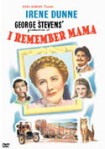 We watched the 1948 movie “I Remember Mama,” a masterpiece directed by George Stevens. I started to watch this on TMC a few weeks ago, but it would have ended at 2 a.m., so I gave up and put it in the Netflix queue. This film was based on Kathryn Forbes’ novel, a fictionalized memoir titled “Mama’s Bank Account.” The novel inspired a play that ran on Broadway for two years. The play led to this rather expensive movie, and the movie led to a successful television series – “Mama” – and an unsuccessful musical play, the last work of Richard Rodgers.
In all cases, the story concerns a Norwegian family living in San Francisco shortly after the turn of the 20th century. The central figure is Martha Hansen, the “Mama” of the title, played in this film by Irene Dunne and in the TV series by Peggy Wood. Irene Dunne was perfect in the role – as was Peggy Wood – and Dunne’s contributions were complemented by the fact that the rest of the casting was just as highly inspired. That included Barbara Bel Geddes as one of the Hansen daughters – Katherine – who narrates the film. Other choices that turned out to be strokes of genius were Rudy Vallee in the poker-faced role of a doctor who performs mastoid surgery on young Dagmar Hansen and Edgar Bergen in the comical role of a funeral director who courts one of Martha Hansen’s sisters.
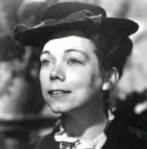
ELLEN CORBY
That sister, Trina, was played by Ellen Corby, who later played the grandmother on the TV series “The Waltons,” and appeared in nearly 230 movies and TV shows. In this film, she is charming in her earnestness and naievete. A pivotal member of the cast was the prolific Austrian actor Oskar Homolka as Chris Halverson, the blustering uncle of Martha Hansen and her three sisters – but, it turns out, the most complex figure in the film. Dunne, Homolka, Corby, and Bel Geddes were nominated for Oscars for this film, and Nicholas Musuraca won the award for black-and-white cinematography. He certainly deserved that for the evocative images of both turn-of-the-century San Francisco and the intimacy of a work-a-day home.
Everything about this film was carefully done. It deals with the most commonplace of issues, but does it with profound insight. The story is a reflection on the resources of the human spirit, presented in a manner that is both uplifting and convincing.
 CharlesPaolino's Blog