One hell of a sunset
December 9, 2009
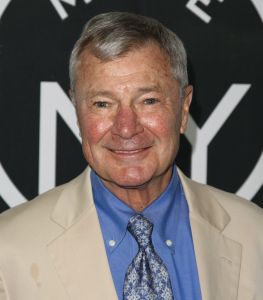
DON HASTINGS
I see by the papers, as Phil Cook used to say, that “As the World Turns” has been cancelled by CBS after 13,661 episodes spread over 54 years – most of the history of commercial television. TV blogger Ava Gacser wrote about a sort of personal tie to the show, and there’s a link to her blog on the right of this page.
Like Ava, I took the news personally, and for a similar reason. I was never a daytime drama fan, but I watched “As the World Turns” several times because I was prepping to interview performers who appeared on the show.
Chief among these was Don Hastings, who has been playing Dr. Robert Hughes for almost 50 years. Hastings has set some kind of record for hours on television. He started out when he was about 16, and in 1949 he started appearing as the second banana on “Captain Video and his Video Ranger,” a live sci-fi show for kids – when I was a kid. Among other gigs, he was on “The Edge of Night” for four years before signing on to “As the World Turns.” He has been one of the constants — maybe the most constant — on the TV screen for the past 60 years.
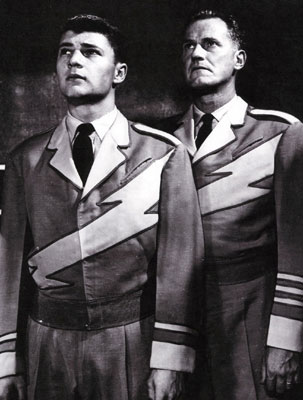
DON HASTINGS and AL HODGE (Captain Video)
I had lunch with Hastings many years ago. The occasion might have been his 25th annivesary on “As the World Turns.” He was a very pleasant man and had a lot of good stories to tell — including anecdotes about fans who had begun to confuse him with Dr. Hughes to the point that the would ask him for medical advice. As crazy as that sounds, that mentality was validated for me once by Joyce Randolph, who told me folks used to send curtains and table cloths to CBS because they thought the Kramdens actually lived in that drab apartment.
Hastings, who is 75, is the brother of Bob Hastings, who has also had a long acting career. His TV debut, by the way, was on “Captain Video.” Bob Hastings, who is about 11 years older than Don, has 144 credits listed on the International Movie Database site.
I also did a telephone interview with Eileen Fulton, when she was marking some benchmark in her “As the World Turns” resume, and I interviewed the gorgeous Lee Meredith, a New Jersey woman who had a short spin on the soap a long time ago. My interview with Lee didn’t have to do with that show, however, but with her role as the sketch nurse in a major production of “The Sunshine Boys.”
GREGG MARX
I also did a lunch interview with Gregg Marx, who in the 1980s had a recurring role on “As the World Turns” as a member of the Hughes family. He won a Daytime Emmy for that part. Gregg is the grandson of Milton “Gummo” Marx – the fourth of the five Marx Brothers. Like Don Hastings, Gregg is a sociable guy, and he was a pleasure to deal with.
For each of these interviews I had to tape the show for a week or so in order to talk intelligently about it to the actors. Fortunately I was working full-time back then. If I hadn’t been, I think I would have become addicted.
Maybe I’ll buy the boxed set.
“Una programma granda”
October 3, 2009

FLAVIO INSINNA

FLAVIO INSINNA AT WORK
“The wish for healing has always been the half of health.” — Hippolytus
September 25, 2009

MAURA TIERNEY
In catching up on the news today, I learned — a few days after everyone else, it seems — that Maura Tierney has withdrawn from NBC’s projected new series “Parenthood.” The speculation is that Helen Hunt, another wonderful actress, will replace her.
NBC had postponed the debut of the series when Tierney was diagnosed with cancer. She has already had surgery, but has put aside the series in order to accommodate her further treatment.
Like everyone else, I hope she fully recovers. I almost feel selfish in my disappointment that she won’t be on a series this season. I had reserved “Parenthood” for the only series I’d watch, and that was only because Maura Tierney was in it.
While I’m thinking of myself, I’m also looking forward to her resuming her career, because I hope she does a lot more on the stage. We got a chance to see her in her two off-Broadway projects, and found her to be a natural in the theater. That magnetism that works so well for her on television is even more potent in the intimacy of an off-Broadway house.
May God bless her and make her well.
Netflix Update No.19:”Sweet Bird of Youth”
September 25, 2009

PAUL NEWMAN
Prompted by Shirley Knight’s impending appearance at the George Street Playhouse, we watched “Sweet Bird of Youth,” the 1962 film adaptation of Tennessee Williams’ 1959 Broadway play. I have never seen the play on stage, and I have read that the tale lost some of its edge with the modifications that had to be made to satisfy the sensibilities of the early ’60s. By today’s standards it’s tame, but it dealt with some tough subject matter for the Eisenhower era.
This film has one of those casts that dazzles the mind: Paul Newman, Geraldine Page, Rip Torn, and the wonderful Canadian actress and even more wonderful human being, Madeleine Sherwood, recreated their Broadway roles, and they were joined by the redoubtable Ed Begley Sr. Geraldine Page and Rip Torn both were nominated for Tony awards for their work in the play. Begley won an Oscar and Page and Knight were nominated for the film.

GERALDINE PAGE
Newman plays Chance Wayne, who returns from Hollywood to his hometown in Florida, almost literally dragging along with him a legendary movie star, Alexandra Del Lago (Page), who has sunk into a drug-and-alcohol-induced stupor after what she perceives as the failure of her latest film. On the surface, Chance Wayne is her driver and spear carrier. In reality, he is exploiting her — in every possible way — in the hope that she will give him what has been an elusive “big break” in the movies.
Alexandra travels to Florida with Chance because she has gone underground to avoid the fallout from what she has adjudged a box-office flop. Chance has another goal — to reunite with Heavenly Finley, the love of his life whose father, Tom “Boss” Finley (Begley), is a moralizing, corrupt, and ruthless political kingpin who doesn’t want Chance near his daughter.
ED BEGLEY Sr.
Finley’s son, Tom Jr., who doesn’t have his father’s cunning but outdoes him in brutality, is played by Rip Torn.
This film, which in 1961 was off limits to audiences under 18, may have been sanded down from Williams’ original version, but it far outstrips the embarrassing 1989 television remake with Elizabeth Taylor and Mark Harmon as Alexandra and Chance and Rip Torn as “Boss” Finley. Even though its techniques are dated, the movie can play with your emotions as you try to sort out your feelings about the actress and her gigolo — both of whom are infuriating yet sympathetic — and frazzle your nerves as Chance keeps antagonizing the volatile and dangerous “Boss.” The players in this film aren’t stars first and foremost; they’re actors, doing their work as well as it can be done.
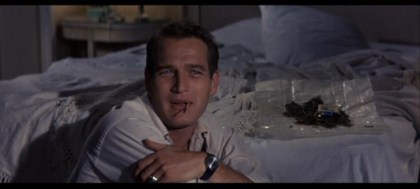
PAUL NEWMAN in a scene from "Sweet Bird of Youth."
“. . . better to burn than fade away …” — Neil Young
September 13, 2009

KURT COBAIN
Old Man Trouble can’t stay away from Kurt Cobain’s door. The huzzerai over the plaque honoring him in his hometown in Washington seems to have died down, but now there is a problem with how his image is used in the video game Guitar Hero 5.
Courtney Love, who was married to Cobain at the time of his death in 1994, gave Activision, the publisher of the game, permission to use Cobain’s image, but she says she did not know or agree that the avatar could be activated so as to sing other writers’ songs. Krist Novoselic and Dave Grohl, Cobain’s Nirvana-mates, are also annoyed. Love says there will be legal action against Activision if the game isn’t altered so as to restrict the use of Cobain’s image to songs associated with him.

SHIRLEY BOOTH
There have been similar blowups in the past, including one involving the great stage and screen actress Shirley Booth, who played the housemaid Hazel from 1961 to 1966 in a TV series based on Ted Key’s cartoon character by the same name. After the show left the air, in 1971, Key gave Colgate-Palmolive permission to use the Hazel image in a commercial for a detergent called Burst.
The sponsor or its ad agency hired an actress named Ruth Holden to provide the voice in the commercial, but the voice sounded exactly like Shirley Booth’s voice, as I recall myself. Anyone who was familiar with Booth and saw that commercial would have assumed the voice was hers.
Shirley Booth thought so, too. She sued the sponsor and its ad agency in federal court, but the court didn’t agree with her complaint.
For now, you can see the Kurt Cobain avatar and read a Christian Science Monitor blog about Courtney Love’s objections, both at this link:
“Trust me — like it says on the money” — line written by Larry Gelbart for George Burns in “Oh, God”
September 12, 2009

LARRY GELBART
While we were distracted by other matters, Larry Gelbart slipped away. I didn’t know Gelbart; I wish I had.
He had an ear for language, for how real people talk, and he combined that with a unique wit to produce some of the most memorable dialogue ever heard on the stage or screen. There is no better example than “M*A*S*H.” That show may have gotten bit too aware of itself but the writing when Gelbart was still working it was some of the best television has ever offered. Fortunately, that show is still being rerun, and when I watch it I marvel at how it never ages, never loses its edge.
Alan Alda and Larry Gelbart were a perfect match, and I think that’s because Alda has a classic sense of comedy – not the what-can-I-get-away-with drivel that passes too often for comedy today but the literate, witty kind of comedy one associates with S.J. Perelman and George S. Kaufman.

ALAN ALDA
Alda — particularly in the role of “Hawkeye” Pierce — has often been compared to Groucho Marx; in fact, he has been accused of aping Groucho Marx. But Marx was never the comic actor Alda is and, in that sense, any similarity in their delivery is more a compliment to Groucho than it is to Alda. I think that perception had to do with Gelbart, who brought that wise-ass attitude we saw in Groucho Marx to a much higher plain in Alan Alda.
The loss of someone as singularly talented as Gelbart is bad enough in itself, but it also is a reminder of how the quality of writing for television in particular has declined over the decades. Gelbart wrote for the “Duffy’s Tavern” radio series, for Bob Hope, and for Red Buttons, and he was a member of the legendary stable of writers on Sid Caesar’s television show. Most writers today don’t have that kind of background, but that’s what Gelbart brought to “M*A*S*H” and “Tootsie” and “Oh, God,” and “Sly Fox” and “A Funny Thing Happened on the Way to the Forum.”
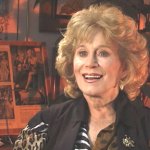
GRETCHEN WYLER
Back when I was still considered employable, I wrote a column taking note of the death of Gretchen Wyler, whom I did know and admired very much both as an actress and as a human being. We had seen Gretchen in “Sly Fox” when the cast included Vincent Gardenia and Jack Gilford, and I mentioned that in the column. I don’t know how Larry Gelbart found out about it, but he sent me two e-mail messages thanking me for remembering Gretchen and expressing his own respect and affection for her. The fact that Gelbart, when there was nothing in it for him, took the trouble to respond to a relatively obscure writer spoke to his loyalty as a friend and colleague.
Larry Gelbart was 81. A detailed obituary is at this link:
http://www.latimes.com/news/obituaries/la-me-larry-gelbart12-2009sep12,0,2812430.story?page=1
Netflix Update No. 16: “The Andersonville Trial”
August 14, 2009

WILLIAM SHATNER
We watched the 1970 television production of “The Andersonville Trial,” which was an adaptation of a 1959 play by Saul Levitt. The play is based on the trial in 1865 of Henry Wirz, commandant of the Confederate military prison at Andersonville, Georgia. Some 13,000 Union soldiers died while incarcerated there under inhumane conditions. Wirz was found culpable by a military court and was hanged, but the degree of his blame was the subject of controversy then as it is now.
Levitt’s play focuses, as the actual trial did not, on the moral question of whether Wirz had an obligation in conscience to disobey his superiors and provide relief for the inmates. That issue may sound familiar to 21st century audiences as may another issues raised in the play — the rights of prisoners held under military law and the propriety of trying Wirz by a military court when the war had ended.

CAMERON MITCHELL
The play, presented in three acts, stars Richard Basehart as Wirz; William Shatner as Lt. Col. Norton Chipman, who prosecuted Wirz; Cameron Mitchell as Gen. Lew Wallace, who presided at the trial; Jack Cassidy as Otis Baker, the civilian attorney who defended Wirz; and Buddy Ebsen as a physician who was assigned to the prison and testified at the trial.
Shatner, Basehart, Mitchell, and Cassidy should have paid to appear in this production — it was that much of a tour de force for each of them. All of them gave intense performances that together provide a glimpse of the brutal and corrosive character and consequences of a war that has since been wrapped up in too much glory and nostalgia.
Shatner has at times been rightfully criticized for chewing the scenery, but in this case he brought the appropriate passion to his role — an army officer who knew that the moral questions he was putting to Wirz also applied to him. One distraction, though, is what has to be the worst of the bad hairpieces Shatner has worn during his long career.

JACK CASSIDY
Cassidy was a master of cool, and he used his controlled reactions to make Baker a chilling opponent for the over-the-top prosecutor. Mitchell was equally effective as Wallace — a lawyer and military man who later wrote “Ben Hur” — who was impatient with the proceeding itself and with the constantly bickering attorneys and unruly defendant.
I last saw this presentation when it first appeared on PBS in 1970, but Basehart’s performance in particular remained vivid in my memory. Wirz — a native of Switzerland — was presented here as a man tortured by Chipman’s questions, by his own assessment of his behavior, and by his concern for the legacy he was leaving his family.
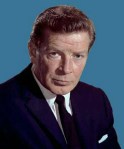
RICHARD BASEHART
Basehart was so thoroughly invested in these aspects of his character that it is almost as uncomfortable to watch and listen to him as it would have been to sit in that courtroom.
I had forgotten about the performance by Michael Burns, who did a skillful turn as a shell-shocked soldier called to testify about the atrocities at the prison. His disoriented posture and vacant look was disturbing even as a dramatization. Burns was an interesting figure who left acting early in life and became a respected history professor and author.
This production was directed by George C. Scott who played Chipman on Broadway. The only actor from the Broadway production who appeared in the television adaptation was Lou Frizzell who did not, however, play the same role.
Some of the dialogue in this play is taken from the trial, but the overall portrayal of the proceeding is Levitt’s interpretation. Even so, it is a valuable reflection on the role of conscience in the Civil War and war in general.
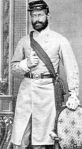
HENRY WIRZ
The lady and the dragon
August 11, 2009

KUKLA, OLLIE, and FRAN ALLISON
The stamps the Postal Service issued today under the title “Early TV Memories” omit broadcasting legend Gertrude Berg but do include the influential puppet show “Kukla, Fran and Ollie,” which first appeared 60 years ago. The show adopted the medieval format of hand puppets on a miniature stage, but added on-camera human being Fran Allison to interact with the characters. The major figures were Kukla — a bald creature inexplicably dressed as a clown, and Ollie – a dragon. They were joined as the situation dictated by about a dozen others, including Beulah Witch, Madame Oglepuss, Colonel Crackie, and Fletcher Rabbit, a letter carrier who was always singing “Buffalo Gal, Won’t You Come Out Tonight?”
The show, which was live when it first appeared, was done without a script. While Fran Allison was sort of an innocent, many of the puppet characters were wise-crackers. The impromptu gags often brought on audible laughter from the crew — with whom the characters frequently exchanged remarks. There is an instance of that kind of interaction — a gag about ad agencies — in the 1951 episode at the link below. That episode also has an example of a commercial — this one for a brand of shampoo — that is worked into the story line, a common device in early televison. There is also a more conventional commercial for Tide at the end of the program. The half-hour show included only those two commercials.

KUKLA and OLLIE
“Kukla, Fran and Ollie” was the brainchild of Burr Tillstrom, who appears briefly at the end of the episode I have linked to. Tillstrom worked all the puppets and provided their voices. What is most striking about his concept in this show is that it was not played for slapstick laughs and it was not condescending to children. It was conducted on such a thoughtful level, in fact, that its audience among adults was reputed to be at least as large as its audience among children. In the episode I have linked to, the characters make several references to “Tallulah” and “Tallulah’s place in New York.” Those were references to the stage and film actress Tallulah Bankhead, who was one of many public figures who were enthusiastic followers of the show.
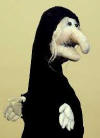
BEULAH WITCH
The leisurely pace of “Kukla, Fran and Ollie” was in sharp contrast to the frenetic programming that dominates television today. Tillstrom’s show relied heavily on character, and that was an important part of its attraction for adults. In this and other respects, the show foreshadowed — and, in fact, led to — the Muppets. The simple and silly figure of Oliver Dragon — who could be at turns romantic and manipulative — became as real and sympathetic to his audience as Burt and Ernie and Kermit became to theirs. Tillstrom and Allison recognized that; in fact, Ollie unblushingly discusses his charisms in the episode at this link:
http://video.google.com/videosearch?gbv=2&hl=en&q=kukla%20fran%20and%20ollie&ie=UTF-8&sa=N&tab=iv#
A Los Angeles Times story about the release of a DVD collection of later episodes of “Kukla, Fran, and Ollie” is at this link:
http://www.latimes.com/entertainment/news/la-et-kukla11-2009aug11,0,1322349.story
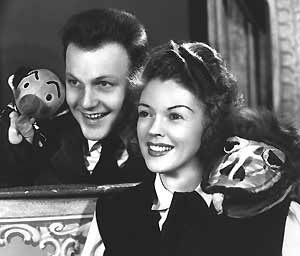
KUKLA, BURR TILSTROM, FRAN ALLISON, and OLLIE
Sui generis
August 5, 2009
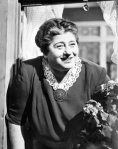
GERTRUDE BERG
A few months ago, I wrote in this journal that my wife and I had discovered and watched on line a few episodes of the television series “The Goldbergs.” Those episodes are at http://www.archives.com.
After I wrote that blog, I heard from a publicist who was handling a new documentary film about the owner, writer, and star of “The Goldbergs” — Gertrude Berg — who was one of the most remarkable women of the second half of the 20th century. As a result of that contact, I wrote the following story, part of which has appeared in the Courier-Post of Cherry Hill and has been picked up on other blogs:
When the U.S. Postal Service issues its “Early TV Memories” stamps this summer, don’t look for Gertrude Berg.
The New York City native, who 80 years ago created the domestic situation comedy, and became a media mogul, was not included with the likes of Lucille Ball and Harriet Nelson, who decades later followed her into American homes.
But Berg is being reintroduced to the American public in a documentary film – “Yoo Hoo, Mrs. Goldberg” – written and directed by Aviva Kempner.
The title evokes the phrase associated with Berg during the radio and television runs of the show she created and controlled, most widely known as “The Goldbergs.”
The principal character, Molly Goldberg, and her neighbors in a Bronx apartment building, interacted by leaning out their windows and calling: “Yoo Hoo, Mrs. Goldberg … Yoo Hoo, Mrs. Bloom.”
From her window, Molly – portrayed by Berg – invited listeners and viewers into the Goldberg household to share the lives of her husband, Jake; their children, Sammy and Rosalie; and Molly’s brother, David Romaine.
The show ran on radio from 1929 to 1946 – five days a week for much of that time – and on television from 1949 to 1956. Berg herself wrote every script in longhand.
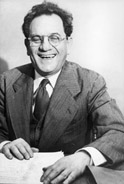
PHILLIP LOEB
There were also a stage play, a movie, a lucrative vaudeville tour, a comic strip, a jigsaw puzzle, a newspaper column, a line of women’s dresses, and a popular cookbook – although Berg couldn’t cook.
Berg’s rise to prominence, Kempner emphasized, occurred “at the time of the greatest domestic anti-Semitism in America, and during the rise of Adolf Hitler in Europe.’’
Berg presented the family as Jewish – adopting a mild Yiddish accent and a unique use of language that became a hallmark of the character:
As Molly shows off a hat, a neighbor asks: “With what dress are you going to wear it?’’
“With mine periwinkle,’’ Molly answers, striking a pose: “Visualize!”
And Berg didn’t shy away from difficult issues affecting Jews.
The documentary points out that in 1933, the year Hitler became dicator of Germany, she had a rabbi conduct a Seder service on the program. And after Kristallnacht in 1938, she wrote an episode in which a stone smashed an apartment window while the Goldbergs were celebrating Passover; Molly calmed the children and urged Jake to continue leading the Seder.
“And yet,’’ Kempner said, “Molly Goldberg was universal. You didn’t have to be Jewish to love her.’’
This urban mother first appeared on radio a month after the stock market crash, and the Goldbergs became so important to the national psyche during the Great Depression, as people maintaining the family circle in spite of want, that Franklin Roosevelt himself acknowledged it.
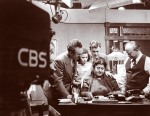
THE CAST OF "THE GOLDBERGS"
Kempner – based in Washington, D.C. – made the documentary through her Ciesla Foundation, whose goal is to “produce films about under-known Jewish heroes.” Kempner – whose work includes a 2000 film about baseball legend Hank Greenberg – said that although the Gertrude Berg film is complete, she is still raising money to pay for it.
The new film includes vintage photos and motion pictures and input from members of Berg’s family, actors, her biographer and others, including U.S. Supreme Court Justice Ruth Bader Ginsburg.
The story they tell has its dark sides.
Berg, born in 1898, did not grow up in the kind of setting she portrayed in her shows.
“She never had a nurturing mother like Molly Goldberg,’’ Kempner said. “She created what she didn’t have.’’
Berg’s own mother sunk into depression after the early death of her son and ended her life in a mental institution. Berg’s father badgered Gertrude into working at resorts he opened in the Catskills and in Florida but never supported her career as an actress and producer.
By contrast, her husband, Lewis Berg, a chemical engineer, typed many scripts from his wife’s handwritten originals.
Especially unsettling in Gertrude Berg’s life was the impact of “Red Channels,” the publication that purported to expose Communists working in radio and film.
One of those identified was Philip Loeb, an actors’ union leader, who played Jake Goldberg on the television series. Berg herself was listed as a “sympathizer.”
CBS and her sponsor pressured Gertrude Berg to fire Loeb. She refused, and her show was cancelled. NBC eventually picked up the show, but Loeb had accepted a cash settlement out of consideration for Berg and the other actors. Blacklisted from radio and film, he committed suicide in 1955.
Berg won an Emmy for her portrayal of Molly Goldberg, and a Tony for her 1959 Broadway performance in “A Majority of One,” and her autobiography was a best seller.
Still, only a small percentage of Americans today know who Gertrude Berg was, Kempner said, “and I want to restore her correct place in our cultural history.’’
The home web site for the film is at http://www.mollygoldbergfilm.org/home.php Information about theaters showing the film is available there.
The Ciesla Foundation web site is at http://www.cieslafoundation.org/

EDWARD ASNER
I always wonder what people in various professions think of how their field is portrayed in television dramas. I spent a lot of years in the newspaper business, and I cannot recall any show that presented an accurate picture of everyday life in that arena. The key, I suppose, is “everyday,” which might not be interesting enough to hold the interest of a television audience. I have heard folks suggest that the “Lou Grant” series was realistic, but I found it laughable — and Lou Grant himself an absurdity. Of course, I also think Ed Asner is a pompous windbag, so that might color my opinion.
There was a series in the early days of television, “The Big Story,” that dramatized the reporting of actual news stories — not all of them from large newspapers. I remember, in fact, that one episode in that series was based on an annual charity drive conducted by the Paterson Morning Call, which was a small paper in its best days. “The Big Story” was nominated for an Emmy in 1953.
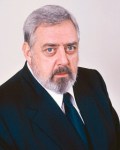
RAYMOND BURR
What calls this to mind is a report that a 12-member jury of the American Bar Association has named the best law series of all time, and it wasn’t Raymond Burr’s “Perry Mason,” nor yet his “Ironsides” — to both of which I was devoted before I became so jaded about television. The ABA choice was “LA Law,” a show I have never seen.
You can read about the ABA jury’s reasoning at this link:
 CharlesPaolino's Blog